UK government advisers tell ministers that renewables are a better bet than nuclear
New figures released by energy analytics firm EnAppSys show renewables have already overtaken nuclear for electricity generation. Wind, solar and biomass power stations supplied 28.1% of power across April, May and June, with nuclear at 22.5%, the third quarter in a row that renewables have outstripped nuclear.

 Cool down nuclear plan because renewables are better bet, ministers told, https://www.theguardian.com/uk-news/2018/jul/10/nuclear-renewables-are-better-bet-ministers-told Government advisers say UK should back just one more new nuclear power station in the next few years, Guardian, Adam Vaughan, 15 July 18
Government advisers have told ministers to back only a single new nuclear power station after Hinkley Point C in the next few years, because renewable energy sources could prove a safer investment.
The National Infrastructure Commission (NIC) said the government should cool down plans for a nuclear new build programme that envisage as many as six plants being built.
The commission, launched by George Osborne in 2015, said that a decade ago it would have been unthinkable that renewables could be affordable and play a major role in electricity generation. But the sector had undergone a “quiet revolution” as costs fell, it said.
Sir John Armitt, the NIC’s chairman, said: “They [the government] say full speed. We’re suggesting it’s not necessary to rush ahead with nuclear. Because during the next 10 years we should get a lot more certainty about just how far we can rely on renewables.”
He argued that wind and solar could deliver the same generating capacity as nuclear for the same price, and would be a better choice because there was less risk. “One thing we’ve all learnt is these big nuclear programmes can be pretty challenging, quite risky – they will be to some degree on the government’s balance sheet,” he said. Continue reading
Nuclear power advocates are running out of fuel
Nuclear power advocates are running out of fuel https://johnquiggin.com/2018/07/11/nuclear-power-advocates-are-running-out-of-fuel/
New research: Climate scientists underestimated speed of global warming and of sea level rise?
 Guardian 6th July 2018 Temperature rises as a result of global warming could eventually be double
what has been projected by climate models, according to an international
team of researchers from 17 countries. Sea levels could also rise by six
metres or more even if the world does meet the 2 degree target of the Paris
accord.
The findings, published last week in Nature Geoscience, were based
on observations of evidence from three warm periods in the past 3.5m years
in which global temperatures were 0.5-2 degrees above the pre-industrial
temperatures of the 19th century.
The researchers say they increase theurgency with which countries need to address their emissions. The
scientists used a range of measurements to piece together the impacts of past climatic changes to examine how a warmer earth would appear once the climate has stabilised.
https://www.theguardian.com/environment/2018/jul/06/global-temperature-rises-could-be-double-those-predicted-by-climate-modelling
U.S. Secretary of State visiting North Korea: it’s a lot more complicated than Trump made it out to be

 Mike Pompeo under pressure to secure nuclear progress in North Korea visit , Guardian , Justin McCurry in Tokyo and agencies, 5 Jul 2018 Secretary of state faces pressure to establish timeline for denuclearisation as well as duty to reassure regional allies
Weeks after Donald Trump declared the world a safer place following his historic summit with Kim Jong-un, Mike Pompeo is due to arrive in Pyongyang on Friday amid growing doubts over the regime’s willingness to abandon its nuclear weapons.
The secretary of state is expected to meet Kim in person in Pyongyang, according to the White House, though details of the agenda have not yet been released. Pompeo, on his third visit to the North Korean capital, is expected to press Kim on a recent report suggesting that far from beginning the process of denuclearisation, North Korea was making “rapid upgrades” to its Yongbyon nuclear complex.
Unnamed US intelligence officials also concluded that North Korea does not intend to completely give up its nuclear stockpile.
Pompeo will also use his visit to consult and reassure Washington’s allies in the region, with meetings planned with Japanese and South Korean officials in Tokyo on Sunday. Japan has voiced support for the leaders’ Singapore declaration, but reacted cautiously to Trump’s decision to cancel a joint US-South Korea military exercise scheduled for August.
Pompeo must establish how far North Korea’s nuclear and missile programmes have advanced before US officials can even attempt to draw up a potential timeline for America’s central demand – their complete, irreversible and verifiable dismantlement [CVID].
At present, the US has no reliable information on where all of North Korea’s production and testing facilities are located or the size of its ballistic inventory.
In a tweet this week, Trump said Washington and Pyongyang had been having “many good conversations” with North Korea over denuclearisation. “In the meantime, no Rocket Launches or Nuclear Testing in 8 months, he said. “All of Asia is thrilled. Only the Opposition Party, which includes the Fake News, is complaining. If not for me, we would now be at War with North Korea!”
Sceptics have pointed out that Kim no longer believes such tests are necessary now that the North has successful developed an intercontinental ballistic missile, and that dismantling North Korea’s missile and nuclear infrastructure represents a much tougher diplomatic challenge that could take years and cost billions of dollars, if it happens at all.
“Denuclearisation is no simple task,” Daryl Kimball, executive director of the Arms Control Association, wrote in a commentary. “There is no precedent for a country that has openly tested nuclear weapons and developed a nuclear arsenal and infrastructure as substantial as the one in North Korea to give up its nuclear weapons.”
Experts have played down Trump’s upbeat appraisal of his 12 June meeting with Kim in Singapore, where the leaders made a loose commitment to work towards the denuclearisation of the Korean peninsula and agreed goodwill measures such as the possible return of the remains of US soldiers from the 1950-53 Korean war.
There are signs Pompeo might abandon all-or-nothing demands for CVID and replace them with incremental steps that South Korea has reportedly suggested would be more likely to secure Kim’s cooperation…….https://www.theguardian.com/us-news/2018/jul/05/mike-pompeo-north-kroea-visit-pressure-nuclear-progress
The past week – all-time heat records set around the planet
 All-time heat records have been set all over the world during the past week, https://www.brisbanetimes.com.au/environment/climate-change/all-time-heat-records-have-been-set-all-over-the-world-during-the-past-week-20180705-p4zply.htmlBy Jason Samenow
Washington: From the normally mild summers of Ireland, Scotland and Canada to the scorching Middle East, numerous locations in the Northern Hemisphere have witnessed their hottest weather ever recorded over the past week.
Large areas of heat pressure or heat domes scattered around the hemisphere led to the sweltering temperatures. No single record, in isolation, can be attributed to global warming. But collectively, these heat records are consistent with the kind of extremes we expect to see increase in a warming world.
Let’s take a tour around the world of the recent hot-weather milestones. Continue reading
USA government proclaims that the nuclear weapons industry depends on the civilian nuclear power industry
 This loss of nuclear competence is being cited by nuclear and national security experts in both the U.S. and in Europe’s nuclear weapons states as a threat to their military nuclear programs. The White House cited this nuclear nexus in a May memo instructing Rick Perry, the Secretary of Energy, to force utilities to buy power from unprofitable nuclear and coal plants. The memo states that the “entire US nuclear enterprise” including nuclear weapons and naval propulsion, “depends on a robust civilian nuclear industry.”
All the while, nuclear is falling further behind renewable solar and wind power. As Schneider notes, the 3.3 GW of new nuclear capacity connected to the grid worldwide in 2017 (including three in China and a fourth in Pakistan built by Chinese firms) pales in comparison to the 53 GW of solar power installed in China alone.
A Double First in China for Advanced Nuclear Reactors, https://spectrum.ieee.org/energywise/energy/nuclear/a-double-first-in-china-for-advanced-nuclear-reactors By Continue reading
Nuclear power a very bad choice as part of action on climate change

Many argue that NPPs are necessary to mitigate climate change, but only one stage out of the 14-stage nuclear fuel cycle is carbon free. Unless equipped with desalination facilities, reactors consume vast amounts of water, an increasingly-scarce resource in countries like Pakistan, which is predicted to completely run out of water by 2025. Nuclear waste must be stored and secured for tens of thousands of years, not to mention the environmental disasters caused by reactor meltdowns. There are other strategies to limit global temperature rise below two degrees, and the idea that countries should deploy all low-carbon technologies no matter the costs should not be used to support such a volatile industry
Why the Civil Nuclear Trap Is Part and Parcel of the Belt and Road Strategy
Civil nuclear energy presents grave pitfalls in terms of cost, innovation and security that BRI countries cannot and should not afford. The Diplomat By Sam Reynolds July 05, 2018 The Larger Point
Although China will continue to promote the benevolent aspects of the BRI, countries along its corridors and elsewhere should not fall victim to the civil nuclear trap. Nuclear energy is too costly, too time-consuming and too risky, especially in light of better alternatives. Instead, developing countries should lead the way towards a secure, low-carbon, low-cost energy future without NPPs.
Nuclear advocates argue correctly that nuclear has comparable levelized costs to solar photovoltaics (PV). The irony is that projects regularly go over budget and costs can actually increase the more nuclear experience a country has, contradicting the learning curve phenomenon. Although the French nuclear program was incredibly successful, it demonstrated “negative learning,” wherein costs actually increased for additional projects. (Solar PV and wind costs decreased the fastest with every doubling of experience.)
Therefore, innovations and experience in nuclear technology might not lead to cost reductions. Continue reading
Light water nuclear reactors, new reactors, Amall Modular Nuclear Reactors (SMRs) none will combat climate change
 The vanishing nuclear industry, Science Daily, July 2, 2018
- Source:
- College of Engineering, Carnegie Mellon University
- Summary:
- Could nuclear power make a significant contribution to decarbonizing the US energy system over the next three or four decades? Probably not.
-
Could nuclear power make a significant contribution to decarbonizing the U.S. energy system over the next three or four decades? That is the question asked by four current and former researchers from Carnegie Mellon University’s Department of Engineering and Public Policy (EPP). Their answer: probably not.
In a paper, “U.S. nuclear power: The vanishing low-carbon wedge,” just published in the Proceedings of the National Academy of Science (PNAS), the team examined the current U.S. nuclear fleet, which is made up of large light water nuclear reactors (LWRs). While for three decades, approximately 20% of U.S. power generation has come from these LWRs, these plants are ageing, and the cost of maintaining and updating them along with competition from low cost natural gas, makes them less and less competitive in today’s power markets.
In place of these LWRs, the team asked whether advanced reactor designs might play a significant role in U.S. energy markets in the next few decades. They concluded that they probably would not. Then, the team examined the viability of developing and deploying a fleet of factory manufactured smaller light water reactors, known as small modular reactors (SMRs). The team examined several ways in which a large enough market might be developed to support such an SMR industry, including using them to back up wind and solar and desalinate water, produce heat for industrial processes, or serve military bases. Again, given the current market and policy environments, they concluded that the prospects for this occurrence do not look good. …https://www.sciencedaily.com/releases/2018/07/180702154736.htm
Following vague summit agreement with Donald Trump, North Korea is probably making more nuclear bomb fuel
North Korea agreed at the summit to “work toward denuclearization of the Korean Peninsula,” but the joint statement signed by Mr Kim and Mr Trump gave no details on how or when Pyongyang might surrender its nuclear weapons.
Ahead of the summit, North Korea rejected unilaterally abandoning an arsenal it has called an essential deterrent against US aggression.
North Korea likely making more nuclear bomb fuel despite Trump-Kim talks, report says http://www.abc.net.au/news/2018-06-30/believes-n-korea-making-more-nuclear-bomb-fuel-us-intelligence/9927908
US intelligence agencies believe North Korea has increased production of fuel for nuclear weapons at multiple secret sites in recent months and may try to hide these while seeking concessions in nuclear talks with the United States, NBC News has quoted US officials as saying.
Key points:
- Unidentified US officials told NBC North Korea had stepped up production of enriched uranium
- North Korea may have three or more secret nuclear sites
- Mr Trump said last week North Korea was blowing up four of its big test sites
Holtec’s storage plan isn’t worth the risk

 By John Buchser / Water Issues Chair, Rio Grande Chapter, Sierra Club, Sunday, July 1st, 2018 Holtec International has proposed placing used fuel rods from all U.S. nuclear reactors in a shallow burial site near WIPP. Two recent editorials by the Albuquerque Journal feature the point of view of Holtec executives, who painted too rosy a view of the safety issues this proposed facility could present. risk https://www.abqjournal.com/1191526/holtecs-storage-plan-isnt-worth-the-risk.html
Problems in Holtec’s casks for interim nuclear waste storage

Fatal flaws in Holtec’s plan http://www.santafenewmexican.com/opinion/my_view/fatal-flaws-in-holtec-s-plan/article_5cb7d5e5-e621-5e3f-b064-73b25ced1fb4.html, By John Buchser, 1 July 18
Corrosion risks in nuclear waste tanks
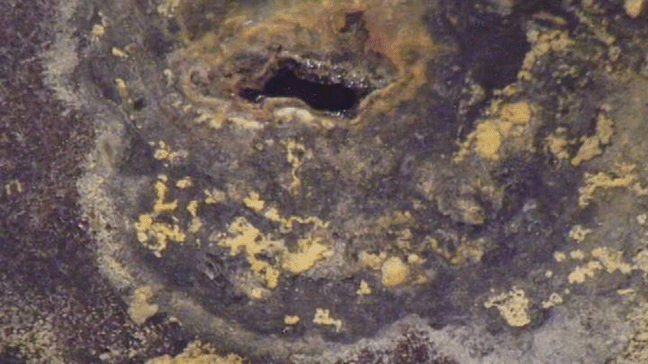
an inspection in 2017, after most of the waste was retrieved from the tank, found widespread pitting on the bottom of the inner shell, allowing waste to seep through. The finding pointed to a corrosion problem.
Experts don’t know enough about the issue yet to tell if the thinning is recent or definitely say what caused it.
More Hanford nuclear waste tanks at risk of leaking https://www.tri-cityherald.com/news/local/hanford/article214069424.html, BY ANNETTE CARY, 1 July 18 acary@tricityherald.com RICHLAND, WA
More of Hanford’s newest waste storage tanks could be at risk of developing leaks, according to a new evaluation.
Tank farm contractor Washington River Protection Solutions compared the chemistry of the waste in the nuclear reservation’s oldest double-shell tank, which was discovered to be leaking, to the waste in the nuclear reservation’s other double-shell tanks.
The evaluation’s conclusion and other findings about the condition of the Hanford Site’s double-shell tanks suggest a need to build more waste storage tanks for 56 million gallons of waste, according to the Washington Department of Ecology.
“We need to start doing something, the sooner the better,” said Steve Lowe, Ecology’s double-shell tank lead engineer. “Cleanup depends on it.”
He characterized three of the double-shell tanks that still hold waste as having “very high risk factors” for corrosion, based on information in the new study. Continue reading
Concern in Canberra over World War 1 explosive ordnance waste
Explosive WWI waste concerns but doesn’t need environmental assessment Canberra Times, By Steven Trask,
A major government housing development was exempted from environmental assessment requirements despite sewage contamination and concerns over explosive ordnance waste.
Last year ACT Environment Commissioner Kate Auty said she was uncomfortable with moves to exclude the same project from the environmental impact statement process.
In May, Planning Minister Mick Gentleman signed-off on an application to exempt the project from preparing an environmental impact statement.
Stage three of the ACT government’s Molonglo Valley urban development, located behind the National Arboretum, is expected to house about 27,000 people over 800 hectares………https://www.canberratimes.com.au/national/act/explosive-wwi-waste-concerns-but-doesn-t-need-environmental-assessment-20180628-p4zob6.html
The toll of AREVA’s uranium mining on a forgotten village in Niger
A forgotten community The little town in Niger keeping the lights on in France, Beyond Nuclear By Lucas Destrijcker & Mahadi Diouara, 1 July 18
Reprinted with kind permission from African Arguments
Welcome to Arlit, the impoverished uranium capital of Africa.
From Niamey, the capital of the landlocked West African nation of Niger, we call ahead to a desert town in the remote north of the country.
“Journalists? On their way here? It’s been a while”, we hear down the phone from our contact. “We welcome you with open arms, but only on the pretence that you’re visiting to interview migrants on their way to Algeria. If they find out you’re poking your nose in their business, it’s a lost cause.”
That same evening, the public bus jolts as it sets off. Destination: the gates of the Sahara.
The stuffy subtropical heat gradually fades into scorching drought and plains of seemingly endless ochre sands. About two days later, we pass through a gateway with “Arlit” written on it in rusty letters.
The town of about 120,000 inhabitants is located in one of the Sahel’s most remote regions, not far from the Algerian border. The surrounding area is known to be the operating territory of numerous bandits and armed groups, including Islamist militants. It is like an island in the middle of the desert, an artificial oasis with only one raison d’être: uranium……… Continue reading
The British campaigners who shed light on deadly nuclear fuel reprocessing
Children were dying. They took action
The British campaigners who shed light on deadly nuclear fuel reprocessing https://wordpress.com/read/feeds/72759838/posts/1909887908, By Linda Pentz Gunter , 1 July 18
The road winds steeply up through bucolic countryside, some of the most spectacular in Britain. There are sheep bleating in the distant meadows. Then suddenly, you are out on the fell, stripped almost barren, black, empty. But still there are sheep, their wool the same smoky color as the landscape, dotted like the rocks that are scattered across these bleak tops, the hallmark of the storied Lake District. Then down we go again, past a stone-walled pub, up another hill, and we are pulling up in front of a whitewashed cottage straight from a Beatrix Potter film.
And indeed, that is where we are — in Potter country — about as far removed in atmosphere and idyll as it is possible to be from the ugly, industrial, and deadly blight that sits just a few miles away on the Cumbria shore. That would be the Sellafield nuclear fuel reprocessing facility, which spews radioactive waste into the sea, pumps it into the air, and has accumulated 140 tonnes of plutonium to absolutely no purpose.
A sheepdog runs out to greet us. A pair of elderly cats languish contentedly on a warm stone wall, basking in some late afternoon sunshine. Later, we are introduced to a small flock of Herdwick sheep who are “pets,” and a flock of pigeons, of which more later.
The people who live in the house are Janine Allis-Smith and Martin Forwood, the heart of the aptly named small activist group CORE — Cumbrians Opposed to a Radioactive Environment. They have dedicated more than three decades to challenging the continued operation of Sellafield and calling out the harm it has caused.
Martin and Janine, partners in life as well as activism, embody the longstanding and tenacious anti-nuclear fight in Cumbria, the most nuclear county in the United Kingdom. Without their watchdog vigilance and their educational advocacy, far less would be known about the dangers posed by the British nuclear industry, and particularly by the Sellafield reprocessing and nuclear waste site.
Martin and Janine have been at the heart of the struggle against the Sellafield operations since the mid-1980s. They have exposed the facility’s clandestine activities, especially emissions of radioactive wastes into the environment. For Janine, formerly from the Netherlands, this hit home especially hard when her own son was diagnosed with leukemia in 1983. He survived, but as Janine began to look into the issue, she found far too many other instances of childhood leukemias among children living close to Sellafield, many fatal.
The pair began to suspect that radioactive discharges from Sellafield were contaminating local beaches and tide pools where children loved to play. And, as Allis-Smith, recounted, “it was not just leukemia, but other cancers. Some were stillborn, while other suffered unexplained deaths at a very young age.”
This launched Janine and Martin on a relentless campaign to expose the on-going violations at the Sellafield site where radioactive discharges have made the Irish Sea one of the most radioactively contaminated bodies of water in the world. In 2017, CORE released a damning report which showed how, “during the 1995-2013 period, the radioactive discharges to the marine environment from Sellafield’s reprocessing facilities B205 (magnox) and THORP (oxide) have dominated those from all other UK facilities and are recognized as being the major contributor to the levels of radioactive substances recorded in the Irish Sea and wider oceans.”
Both Martin and Janine were new to the issue when they began their work. But they quickly educated themselves, then others. They perfected an ideal and complementary presentation style — with Martin offering a simple, lay explanation of reprocessing itself, then Janine describing its impact, especially on the health of children. They quickly moved hearts and minds in equal measure. Politicians, the media, and the public at large were forced to take notice.
Over the years, the pair have collected numerous mud samples from local beaches and estuaries that have been analyzed for radioactive contamination, confirming their suspicions.
The pair uncovered scandals involving illegal activities at the Sellafield site. They fought the THORP reprocessing plant, due to close permanently in 2018; the rash decision to develop a MOX fuel manufacturing plant, which closed after just 10 years of operation; and the global transport of radioactive materials.
In 1990 Martin gave his first guided “Alternative Sellafield Tour”, highlighting the spots where the reprocessing plant endangers the environment.
More recently, the pair were part of a successful effort to prevent the Nuclear Waste Agency NIREX from building a subterranean depository for British and international nuclear waste at the edge of the Lake District National Park.
Currently, they are at the forefront of the fight to block new nuclear power plants planned for Moorside adjacent to Sellafield. Their landmark 2015 report, “Moorside Build & Job Projections – All Spin and No Substance,” has proven an essential tool for the broad opposition to this deadly scheme.
The couple are not without a sense of fun either. In 2005, Martin made and delivered a radioactive “Pizza Cumbriana” to the Italian Embassy in London — Italy was shipping radioactive waste to Sellafield for reprocessing at the time. The box was marked “Best before 26005”, a reference to plutonium 239, which has a half-life of 24,400 years. The pizza was immediately seized by the Environment Agency, stored, then buried eight years later at the Drigg nuclear waste dump in Cumbria, adjacent to the Sellafield site.
Also buried as radioactive waste was the garden of two elderly ladies living along the sea front in the drab town of Seascale adjacent to the Sellafield plant. The sisters had devotedly fed flocks of pigeons who visited their garden — birds that also roosted on the Sellafiled roofs. After the guesthouse next door complained about excessive bird poop and called for the birds’ removal, the entire garden had to be excavated down to several feet and hauled away as radioactive waste. Martin and Janine took in a few of those pigeons. Their descendants still live with them today and appear each morning and evening on the garage roof for feeding time.
Last year, Forwood and Allis-Smith received some long-overdue recognition for their commitment to a safer, cleaner, greener environment when they received the Nuclear-Free Future Award in the category of Education, a prize that carries a $10,000 cheque, a rare and much needed boon in a movement largely deprived of meaningful or consistent funding. (Disclaimer, I nominated them for the award.)
The couple were unable to attend the ceremony, but wrote in a press release: “We are honoured to have received NFFA’s Education Award for 2017 and humbled to be joining the list of diverse and distinguished winners of the past. Since the 1980s, when Sellafield was preparing to double its commercial reprocessing activities, we have focused not only on acting locally but also being the ‘eyes and ears’ for the many interested parties world-wide on Sellafield and its many detriments which include site accidents, environmental contamination, health risks, plutonium stockpiles and nuclear transports.
“With decades of uniquely difficult decommissioning yet to come, and with plans for new-build at Moorside, we still have much to do and will face the challenges with the same determination that has seen us through the many highs and lows experienced over the last thirty years in our campaign against an industry we believe still has much to answer for.” (You can view their full acceptance remarks in the video higher up in this article.)
This article was adapted from its original publication in The Ecologist.
1 This month
7 April – WEBINAR – Australia and the Doomsday Clock – Preventing nuclear war through NoFirstUse and other policies
Online | Tuesday April 7, 4:00-5:30pm, Australian Eastern Time / 8:00-9:30am Central Europe Time
– Access the registration link
15 April – Zoom –Nuclear Power is Not the Solution
Apr 15, 2026 01:00 AM in Canberra, Melbourne, Sydney

Join the International Physicians for the Prevention of Nuclear War (IPPNW) on Tuesday, April 14th for a timely webinar exploring the risks associated with nuclear power and challenging the myth that it offers a simple, safe, carbon-free solution to the climate crisis

of the week – Australians for War Powers Reform (AWPR)
To see nuclear-related stories in greater depth and intensity
 Antinuclear