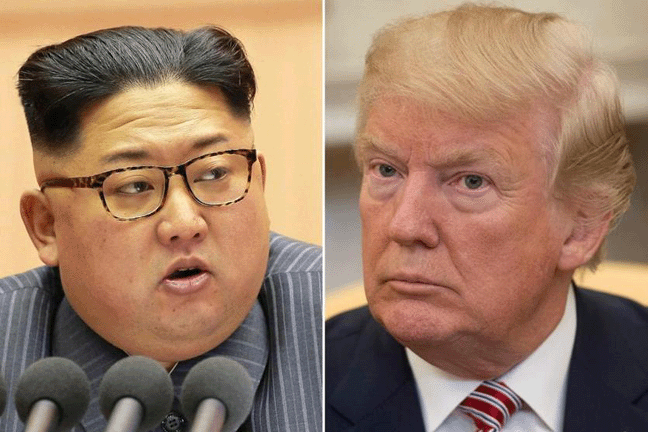
In the first summit meeting between the leaders of the United States and North Korea, Donald Trump met with Kim Jong-un, on June 12, 2018, in Singapore. The two leaders smiled warmly, posed for cameras as friends, shook hands, and Trump spoke in glowing terms of admiration about Kim at the news conference.
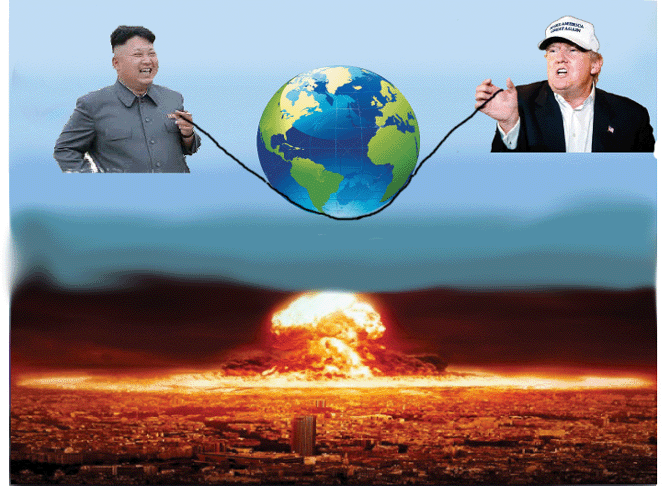
Kim and Trump can continue to hold the world hostage under threat of nuclear annihilation
 The scary truths about Trump’s nuclear summit https://www.engadget.com/2018/06/15/the-scary-truths-about-trump-s-nuclear-summit/ In which Donald Trump and Kim Jong-un compared the size of their nuclear buttons. Violet Blue
World is on track to exceed 1.5C of warming – leaked UN draft report
 Guardian 15th June 2018 The world is on track to exceed 1.5C of warming unless countries rapidly implement “far-reaching” actions to reduce carbon emissions, according to a draft UN report leaked to Reuters. The final draft report from the UN’s intergovernmental panel on climate change (IPCC) was due for publication in
October. It is the guiding scientific document for what countries must do to combat climate change.
Human-induced warming would exceed 1.5C by about 2040 if emissions continued at their present rate, the report found, but countries could keep warming below that level if they made “rapid and far reaching” changes.
Under the 2015 Paris climate agreement, almost 200 countries signed up to limit global temperature rises to well below 2C above pre-industrial levels and to pursue efforts to limit the temperature increase to 1.5C. Climate scientist and Climate Analytics director Bill Hare said the draft report showed with greater clarity how much faster countries needed to move towards decarbonisation under various temperature situations and that the impacts of climate change greatly increased between 1.5C and 2C of warming.
Necessary actions include making the transition to renewable energy, powering the transport sector with zero carbon electricity, improving agricultural management and stopping deforestation.
https://www.theguardian.com/environment/2018/jun/15/leaked-un-draft-report-warns-of-urgent-need-to-cut-global-warming
Bulletin of the Atomic Scientists not optimistic about the future of USA- North Korea nuclear negotiations
 Now, it’s time to deliver https://thebulletin.org/now-its-time-deliver11916?utm_source=Bulletin%20Newsletter&utm_medium=iContact%20email&utm_campaign=June15
USA Secretary of State Mike Pompeo says that USA- North Korea talks will take place next week
The Latest: Trump’s claim of no nuke threat seen as dubious WASHINGTON (AP) 14 June 18, — The Latest on the summit between President Donald Trump and North Korean leader Kim Jong Un
Secretary of State Mike Pompeo says he’s confident that U.S. talks with North Korea will resume “sometime in the next week.”
Pompeo says he doesn’t know the exact timing. Speaking in Seoul, he says he expects it to happen fairly quickly after he and the North Koreans return to their nations. Pompeo returns late Thursday to the U.S.
He says President Donald Trump is “in the lead” but that “I will be the person who takes the role of driving this process forward.”
He says much more work has been done by the U.S. and North Korean that couldn’t be encapsulated in the Trump-Kim Jong Un statement. So he says teams will now work to make more progress on those items……..https://apnews.com/79a6ec899f4c4fa08adbd05d4315ae24/The-Latest:-Pompeo-says-NKorea-talks-to-resume-next-week
Russia suspends nuclear waste transport due to safety fears with World Cup visitors
 World Cup puts break on nuclear transport A load of containers with spent nuclear fuel from Andreeva Bay on the Kola Peninsula will have to wait because of a general ban on transport of dangerous goods in Russia during the Football World Cup. https://thebarentsobserver.com/en/ecology/2018/06/world-cup-puts-break-nuclear-transport Thomas Nilsen, 14 June 18,
Russia puts priority to safety and doesn’t want any potential lethal substances moving around during the four weeks with World Cup when tens of thousands of football fans are commuting by railway to different cities.
In the north, the ban now delays a shipment of nuclear waste that otherwise would be on its way to Mayak north of Chelyabinsk in the South Urals.
Head of Rosatom State Nuclear Corporation’s international technical assistance project, Anatoly Grigoryev, says three railway sets already have departed to Mayak this year. «The fourth is ready, but we can’t send it because transport of dangerous goods during the World Cup is prohibited,» Grigoriyev says to Interfax in an interview reposted by Rosatom.
From Andreeva Bay near Russia’s border to Norway, the containers with old uranium fuel from Cold War submarines are shipped to Murmansk, where they are loaded over to a set of special rail-wagons. From Murmansk, the train follows Russia’s railway lines south through Karelia towards St. Petersburg and Yaroslav before heading east towards the Urals, a distance of more than 1,600 kilometers.
Mayak reprocessing plant is located between the cities of Chelyabinsk and Yekaterinburg. The last is one of the cities where football matches will be played.
Anatoly Grigoryev assures that the load of nuclear waste containers from the Murmansk region will be shipped to Mayak as soon as the World Cup is over by mid-July.
Last June, a top brass of Russian and Norwegian politicians, diplomates and nuclear safety experts cheered and waved as the first load of containers set out to sea from Andreeva Bay. Since the 1990s, Norway has spent tens of millions of euros to support preparing for the nuclear waste removal from the site to start.
In Murmansk, nuclear safety expert with the Bellona Foundation, Andrey Zolotkov, says this is the first time to his knowledge transport of nuclear waste has been put on break for such reason as a international tournament.
«I don’t recall any such thing. This is most likely due to keeping the railway routes free from such cargos because of all the [football] fans on the move,» Zolotkov says to the Barents Observer. Additional to Bellona, Zolotkov has for many years been working on board the Russian nuclear icebreaker fleet’s transport- and storage vessel «Imandra».
From Murmansk, the nuclear waste cargo-train follows the same tracks, and through the same big cities, as ordinary passenger trains.
«After all, we are just talking about a one month delay,» Andrey Zolotkov explains pointing to the many-years it will take to remove all spent nuclear fuel elements from Andreeva Bay.
A total of about 22,000 such uranium fuel elements where stored in three rundown concrete tanks. That is equal to about 100 submarine reactor cores.
Anatoly Grigoryev with Rosatom estimates it will take about 10 years to remove it all from the Kola Peninsula to the Mayak plant.
Why Are Nations Throwing Cash At Nuclear ‘White Elephants’?
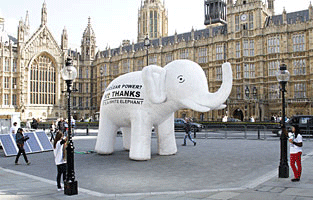
Jeremy Leggett: Why Are Nations Throwing Cash At Nuclear ‘White Elephants’? Impact4All.org, 14 June 18
In recent weeks we have seen evidence on the one hand of the fast advance of renewable energy, and on the other the incredible resilience of the energy-incumbency defence against that advance, including big oil and nuclear.
Celebrations of the fast growth of renewables I will leave to the inestimable REN21 report, published on 4 June. All clean-energy advocates should spend some time immersed in it, arming themselves with bullish ammunition. The point I want to make in this column is about the residual strength of the incumbency rearguard action.
In the last week of May and the first week of June the UK, US, and Canadian governments all tried to bail out uneconomic or stranded fossil fuel and nuclear projects with many billions in public funds. I have dubbed it “The Week of the White Elephants.”
First, the Canadian government bailed out a stranded Kinder Morgan oil pipeline system for US$3.5 bn. They hope to sell this, the Trans Mountain pipeline, in due course. Analysts doubt they can, so economically unattractive and risky is the proposition. In the interim, protestors have labelled Canadian PM Justin Trudeau – who says he aspires to be a climate hero – a climate criminal.
Second, US President Donald Trump ordered emergency federal action to stem coal and nuclear plant shutdowns. Proposals in a leaked memo included forcing utilities to buy electricity from coal and nuclear operators for two years, despite the fact that renewables and gas are both better value. The Economist describes Trump’s gambit as follows: “The plan would benefit a handful of firms the president favours at the expense of consumers: it entails up to $12bn worth of ‘cash for cronies’.”
Third, in a remarkable U-turn, the UK government agreed to a £5bn injection of taxpayer money into a Welsh nuclear power station, Wylfa. The total cost, to be shared with Hitachi and Japanese government, is £16 bn. The price of power will be £75-77 MWh (they say). That is more than solar and wind.
These are all very strange things to do when you consider not just the economics but the general direction of travel in all relevant areas
……..As for the UK nuclear decision, in France nuclear regulators now fear an “epidemic” safety-culture collapse at Flamanville, the supposed precursor of the British Hinkley Point C reactor. 150 weld failures mean the nuclear plant scheduled online in 2012 at €3.5bn is now probably delayed to 2020, at €10.5bn and counting. This is not the same type of reactor that Hitachi intends for Wylfa, but the horror show at Flamanville shows how badly, and quickly, things can go wrong in modern nuclear.As the formerly pro-nuclear The Economist put it in 2016, in a analysis entitled “Hinkley Pointless”, “Britain should cancel its nuclear white elephant and spend the billions on making renewables work.”…….https://impact4all.org/jeremy-leggett-new-coal-and-nuclear-deals-show-power-of-incumbent-energy-players/
Trump – Kim nuclear summit – great PR show, with meaningless blather result
U.S. President Donald Trump, and North Korean dictator Kim Jong Un seem to have both achieved their goals at the much hyped ‘nuclear summit’ in Singapore on June 12.
Kim achieved a kind of international recognition as an equal world leader, without having to give up anything, in the showy but fairly meaningless negotiation that went on .
Trump achieved his over-riding aim – having the eyes of the world on him, his endless craving for attention being satisfied, for the moment, anyway.
The body language is more interesting than the waffly document outcome. We saw Trump’s super-long super-strong handshake, and pats on Kim’s back – signs of dominance. We saw Kim’s eyes move sideways – a little nervous shiftiness?
It all could have been worse. Trump could have chosen, instead of his effusive praise for Kim, to say there is “a special place in hell” for Kim, (as Trump recently said of USA’s ally, Canada’s Prime Minister Trudeau). And with Trump’s new and dangerously bellicose security adviser John Bolton, hovering about, could have set off the “fire and fury” that he previously promised North Korea. I guess that Trump saved that for a later occasion, when he feels that he is not getting enough world attention.
The most interesting one, North Korea commits to work towards “complete denuclearisation of the Korean Peninsula.” Not a word about “complete, verifiable and irreversible”. As the Washington Post commented, that one is “empty blather” too.
The fourth point is a weak statement on North Korea returning the remains of U.S. prisoners of war, from the Korean war.
Why on earth would Kim Jong Un want to give up his biggest bargaining chip – the ability to send nuclear weapons to neighbouring States, and even to the USA? He saw what happened to Iraq and Libya. He can see how America is now backtracking from the nuclear agreement with Iran.
Full text of nuclear summit document from Donald Trump and Kim Jong-un
Singapore summit: Donald Trump and Kim Jong-un document released after historic meeting http://www.abc.net.au/news/2018-06-12/donald-trump-and-north-korea-leader-statement-after-meeting/9861688–June 12, 2018, Sentosa Island
The text from the document signed by Donald Trump and Kim Jong-un has been made available. Here it is in full:
President Donald J Trump of the United States of America and Chairman Kim Jong-un of the State Affairs Commission of the Democratic People’s Republic of Korea (DPRK) held a first, historic summit in Singapore on June 12, 2018.
President Trump and Chairman Kim Jong-un conducted a comprehensive, in-depth, and sincere exchange of opinions on the issues related to the establishment of new US-DPRK relations and the building of a lasting and robust peace regime on the Korean Peninsula.
President Trump committed to provide security guarantees to the DPRK, and Chairman Kim Jong-un reaffirmed his firm and unwavering commitment to complete denuclearisation of the Korean Peninsula.
Convinced that the establishment of new US-DPRK relations will contribute to the peace and prosperity of the Korean Peninsula and of the world, and recognising that mutual confidence-building can promote the denuclearisation of the Korean Peninsula, President Trump and Chairman Kim Jong-un state the following:
- The United States and the DPRK commit to establish new US-DPRK relations in accordance with the desire of the peoples of the two countries for peace and prosperity.
- The United States and the DPRK will join their efforts to build a lasting and stable peace regime on the Korean Peninsula.
- Reaffirming the April 27, 2018 Panmunjom Declaration, the DPRK commits to work towards complete denuclearisation of the Korean Peninsula.
- The United States and the DPRK commit to recovering POW/MIA remains, including the immediate repatriation of those already identified.
Having acknowledged that the US-DPRK summit — the first in history — was an epochal event of great significance and overcoming decades of tensions and hostilities between the two countries and for the opening of a new future, President Trump and Chairman Kim Jong-un commit to implement the stipulations in this joint statement fully and expeditiously.
The United States and the DPRK commit to hold follow-on negotiations led by the US Secretary of State, Mike Pompeo, and a relevant high-level DPRK official, at the earliest possible date, to implement the outcomes of the US-DPRK summit.
President Donald J Trump of the United States of America and Chairman Kim Jong-un of the State Affairs Commission of the Democratic People’s Republic of Korea have committed to cooperate for the development of new US-DPRK relations and for the promotion of peace, prosperity, and security of the Korean Peninsula and of the world.
Where will climate refugees go?
 Universal migration predicts human movements under climate change, Physics World, 12 Jun 2018
Antarctic Ocean Discovery Warns of Faster Global Warming
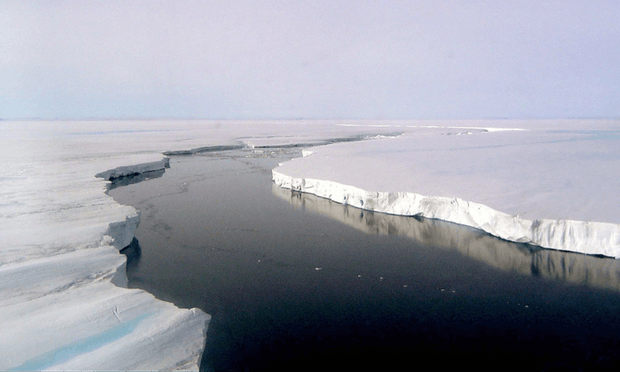 Climate Central By Mikayla Mace, Arizona Daily Star 10 June 18
A group of scientists, including one from the University of Arizona, has new findings suggesting Antarctica’s Southern Ocean — long known to play an integral role in climate change — may not be absorbing as much pollution as previously thought.
To reach their contradictory conclusion, the team used state-of-the-art sensors to collect more data on the Southern Ocean than ever before, including during the perilous winter months that previously made the research difficult if not impossible.The old belief was the ocean pulled about 13 percent of the world’s carbon dioxide — a greenhouse gas that contributes to climate change — out of the atmosphere, helping put the brakes on rising global temperatures.
Some oceanographers suspect that less CO2 is being absorbed because the westerlies — the winds that ring the southernmost continent — are tightening like a noose. As these powerful winds get more concentrated, they dig at the water, pushing it out and away.
Water from below rises to take its place, dragging up decaying muck made of carbon from deep in the ocean that can then either be released into the atmosphere in the form of CO2 or slow the rate that CO2 is absorbed by the water. Either way, it’s not good. Continue reading
Donald Trump approaches nuclear summit guided by his “instincts” – no scientific advice
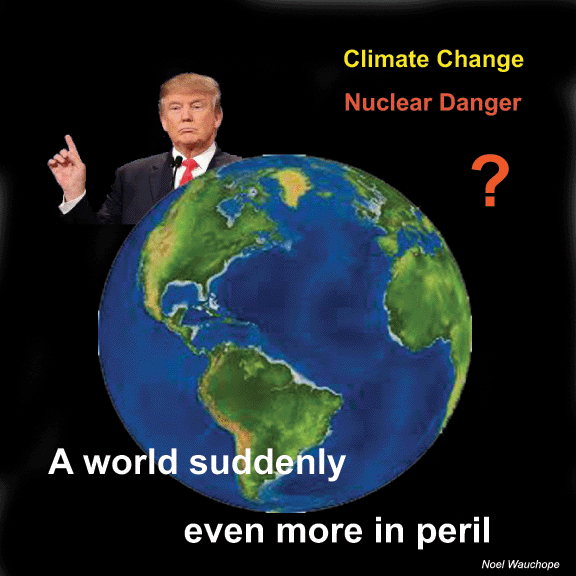 In the Trump Administration, Science Is Unwelcome. So Is Advice.
As the president prepares for nuclear talks, he lacks a close adviser with nuclear expertise. It’s one example of a marginalization of science in shaping federal policy. NYT By Coral Davenport 9 June 18
WASHINGTON — As President Trump prepares to meet Kim Jong-un of North Korea to negotiate denuclearization, a challenge that has bedeviled the world for years, he is doing so without the help of a White House science adviser or senior counselor trained in nuclear physics.
Mr. Trump is the first president since 1941 not to name a science adviser, a position created during World War II to guide the Oval Office on technical matters ranging from nuclear warfare to global pandemics. As a businessman and president, Mr. Trump has proudly been guided by his instincts. Nevertheless, people who have participated in past nuclear negotiations say the absence of such high-level expertise could put him at a tactical disadvantage in one of the weightiest diplomatic matters of his presidency.
“You need to have an empowered senior science adviser at the table,” said R. Nicholas Burns, who led negotiations with India over a civilian nuclear deal during the George W. Bush administration. “You can be sure the other side will have that.”
The lack of traditional scientific advisory leadership in the White House is one example of a significant change in the Trump administration: the marginalization of science in shaping United States policy.
There is no chief scientist at the State Department, where science is central to foreign policy matters such as cybersecurity and global warming. Nor is there a chief scientist at the Department of Agriculture: Mr. Trump last year nominated Sam Clovis, a former talk-show host with no scientific background, to the position, but he withdrew his name and no new nomination has been made.
These and other decisions have consequences for public health and safety and the economy. Both the Interior Department and the National Oceanic and Atmospheric Administration have disbanded climate science advisory committees. The Food and Drug Administration disbanded its Food Advisory Committee, which provided guidance on food safety.
Government-funded scientists said in interviews that they were seeing signs that their work was being suppressed, and that they were leaving their government jobs to work in the private sector, or for other countries.
After Mr. Trump last year withdrew from the Paris climate agreement, the international pact committing nations to tackle global warming, France started a program called “Make Our Planet Great Again” — named in reference to Mr. Trump’s slogan, “Make America Great Again” — to lure the best American scientists to France. The program has so far provided funding for 24 scientists from the United States and other countries to do their research in France…….https://www.nytimes.com/2018/06/09/climate/trump-administration-science.html
America dampening down expectations for nuclear summit
US plays down hopes from Trump-Kim nuclear summit Ft.com, 10 June 18 Both leaders land in Singapore as US seeks to manage expectations Bryan Harris and Stefania Palma in Singapore and Demetri Sevastopulo in Los Angeles
Kim Jong Un and Donald Trump landed in Singapore on Sunday in preparation for their historic summit, even as US officials sought to manage expectations for Tuesday’s much-heralded meeting. Once pitched as the final stage of a landmark denuclearisation deal, the meeting is increasingly being spun as just the beginning of a process of engagement between the two bitter adversaries. “I feel that Kim Jong Un wants to do something great for his people,” said Mr Trump as he departed Canada en route for the south-east Asian city state. “There’s a good chance it won’t work out. There’s probably an even better chance it will take a period of time.” The aim of the summit on Tuesday is to see if Mr Kim and Mr Trump could establish a level of chemistry and trust that would provide impetus for further negotiations between Washington and Pyongyang, according to one senior US official.
Joseph Yun, the state department’s former point-man on North Korea, echoed the sentiment, saying it was clear that high-level meetings between US and North Korean officials in recent days had reduced expectations on the American side. “Gone is the talk of all-in-one big bang and denuclearisation. The magic word seems to be process and progress,” said Mr Yun, adding that it would still be important to have a “substantive result” from the summit. Mr Trump said in advance of his arrival that he would know “within the first minute” of the meeting whether Mr Kim was “serious”. He added that he could make such a judgment based on “my touch, my feel — that’s what I do”……….
Washington is seeking CVID — the complete, verified and irreversible dismantlement of the North’s nuclear programme — a process that experts believe could take years, potentially even a decade. https://www.ft.com/content/99901e74-6c5b-11e8-92d3-6c13e5c92914
Donald Trump at G7 – a wrecking ball for climate change international action
“CANADA, FRANCE, GERMANY, ITALY, JAPAN THE UK AND THE EUROPEAN UNIONREAFFIRM THEIR STRONG COMMITMENT TO IMPLEMENT THE PARIS AGREEMENT, THROUGH AMBITIOUS CLIMATE ACTION”
“PRESIDENT TRUMP’S WRECKING BALL APPROACH TO INTERNATIONAL DIPLOMACY LEFT HIM UTTERLY ISOLATED AT THE G7 SUMMIT,”
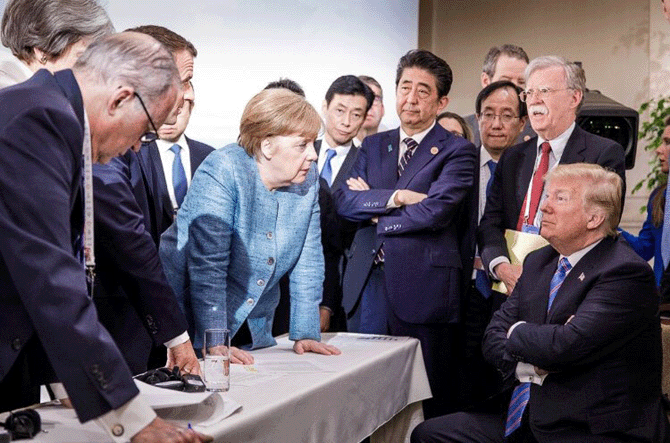
Six of the G7 Commit to Climate Action. Trump Wouldn’t Even Join Conversation. https://insideclimatenews.org/news/10062018/g7-summit-climate-change-communique-trump-allies-estranged-germany-france-canada
Trump skipped the formal climate discussions, had the U.S. negotiators promote fossil fuels instead, and then renounced the group’s official communique. BY STAFF, INSIDECLIMATE NEWS JUN 10, 2018
Trump’s nuclear bailout could cost consumers up to $17 billion each year
https://inhabitat.com/trumps-nuclear-bailout-could-cost-consumers-up-to-17-billion-each-year/ The Trump Administration is taking unprecedented steps to bail out failing nuclear and coal power plants, effectively nationalizing the American energy market with potentially drastic consequences for the renewable energy industry and the American consumer. According to an updated report from the Nuclear Information and Resource Service (NIRS), the Trump Administration’s plan could result in artificially high electricity prices. The planned subsidies for nuclear power plants alone could increase the overall cost of electricity in the U.S. by up to $17 billion each year; the subsidies for coal plants would add even more. This skewing of the American energy market, which has recently seen significant progress made by wind and solar energy, could also result in the decline of renewable energy in the U.S. Continue reading
1 This month


Help Aunty Sue Protect Her Land and Sacred Sites From Destructive Rocket Testing.
.

Australians deserve the truth
about
AUKUS – https://aukuspublicinquiry.com/

PETITION – To: Prime Minister Anthony Albanese and the Australian Labor Government

of the week – Australians for War Powers Reform (AWPR)
To see nuclear-related stories in greater depth and intensity

