Uranium company Cameco’s gloomy outlook
 Motley Fool 28th May 2018 , It has been a tough few years for one-time high-flying uranium miner Cameco Corp.. Over the last five years, its value has plummeted by 38% after nuclear power fell into disfavour after the 2011 Fukushima disaster in Japan, which caused the price of uranium to collapse.
Since then, uranium has remained caught in a protracted slump, despite claims by industry insiders and analysts that it is poised to rebound because of a combination of growing demand and emerging supply constraints. Nonetheless, despite these claims, there has been no sign of a sustained rally, and an upturn in the fortunes of the radioactive metal may never occur.
This is because the outlook for uranium is not as bright as claimed, and there is every indication that nuclear power will remain in disfavour. That will continue to weight on Cameco’s market value.
https://www.fool.ca/2018/05/28/despite-an-improved-1st-quarter-2018-the-outlook-for-cameco-corp-remains-poor/
The EPR nuclear reactor – France’s costly nuclear crisis
 Liberation 30th May 2018 [Machine Translation] “The impasse”, how the EPR sank French nuclear.
France 5 broadcasts this Wednesday night “Nuclear, the French impasse”, a documentary against the declining reign of the atom. This film investigates EDF’s crazy gamble: risking its survival on the EPR, a reactor that accumulates trouble.
Will the EPR be the Titanic of French nuclear power? This is the shocking question posed by a film investigated by director Patrick Benquet broadcast tonight on France 5 which points to the “impasse”
in which the “most nuclearized country in the world” has locked up by equipping itself with 58 reactors. the 70s-80s. A fleet of 19 aging plants, which still produces 75% of French electricity, and which EDF wants to keep at all costs by launching a new generation of pressurized water reactor:
the EPR, “the most powerful never built, able to supply electricity to a metropolis like Paris. It must have been the deadly weapon of the nuclear lobby to defend the reign of the atom undermined by the Fukushima disaster and the rise of green energies.
EDF dreamed of exporting it all over the world by selling this “new nuclear” as the best lever against global warming. But things did not go at all as planned. And today EDF is going through a crisis that threatens the very existence of the “public service preferred by the French,” says the documentary.
There are these hidden costs of the atom, put under the carpet for decades, which rise to the surface: the enormous costs of reprocessing radioactive waste, is added the bill of the “great refit”: these works of Hercules designed to extend the lifespan of aging plants from 40 to 50 years. ”
EDF promised cheap electricity, but the real cost of nuclear energy today is in the tens and tens of billions. And ultimately it is the taxpayer who will pay, announces the implacable voice off. Yet, EDF, the nuclear state in the state, will launch the EPR at all costs. By assigning a strategic mission: take over
the old reactors that will gradually retire by 2035.
http://www.liberation.fr/france/2018/05/30/l-impasse-comment-l-epr-a-coule-le-nucleaire-francais_1655363
International Renewable Energy Agency reports on companies across 75 nations sourcing renewable energy
 Edie 29th May 2018,A new report from the International Renewable Energy Agency (IRENA) found
that corporates have actively sourced renewable energy equivalent to the overall demand of France, but renewables demand could soar if companies turned voluntary agreements into active goals.
The new IRENA report, published at last week’s Clean Energy Ministerial meeting in Copenhagen,
found that more than 2,400 companies across 75 nations sourced 465TWh of renewable energy in 2017. The report found that more than half of the companies studied are voluntarily procuring and investing in onsite generation or purchasing agreements to power their operations with renewable electricity.
Of the companies listed in the study, more than 200 are sourcing 50% or more of their energy from renewables. According to IRENA, 100% of active corporate sourcing of renewable electricity is “already feasible”, but the report found that just 17% of the companies listed had a renewable electricity target in place and three-quarters of these targets are set to expire before 2020.
Margaret Atwood: women will bear brunt of dystopian climate future
Booker prize-winning author predicts climate reality will not be far from scenarios imagined in her post-apocalyptic fiction, Guardian, Fiona Harvey Environment correspondent, 31 May 2018
New analysis finds that costs of new nuclear reactors even higher than expected
 Construction delays make new nuclear power plants costlier than ever http://www.imperial.ac.uk/news/186487/construction-delays-make-nuclear-power-plants/by Hayley Dunning
The cost of building new nuclear power plants is nearly 20 per cent higher than expected due to delays, a new analysis has found.
A new analysis of the history of nuclear power plant projects shows since 2010 delays have contributed 18 per cent the costs.
These delays – which can run into years or even decades – increase the cost compared with older projects and are often overlooked when new projects are planned. The authors say that these extra costs need to be properly assessed when considering new nuclear projects.
They say nuclear projects are more like ‘mega-projects’, such as large dams, which require more rigorous financial assessments due to their high uncertainty and risk.
In the study, published today in the journal Energy Policy, the authors also suggest that because these delay costs make nuclear projects high risk, decision-makers might instead focus on more low-risk low-carbon technologies such as wind or solar power.
When assessing the cost of new nuclear projects, decision makers often use ‘overnight construction costs’, which assume the project is built on time, usually within five years. However, the ‘lead-time’ – the time between initiation of the project and completion – can cause significant extra costs.
The research team, from Imperial College London, the Universidade Federal do Rio de Janeiro and the University of Minho, looked at total costs of nuclear projects between 1955-2016, including delay costs.
Usually, as technologies mature and experience is gained in construction, costs come down. However, the team found that for nuclear, there has been a blip in the learning curve, with costs currently increasing, especially for projects since 2010.
Lead author Dr Joana Portugal Pereira, from the Centre for Environmental Policy at Imperial, said: “Nuclear projects are actually becoming more complex to carry out, inducing delays and higher costs. Safety and regulatory considerations play heavily into this, particularly in the wake of the 2011 Fukushima Dai-ichi nuclear accident in Japan.”
The analysis is one of the first to assess full financial costs of building nuclear projects throughout time, and not just the ‘overnight’ costs. It also looked at projects around the world, including newer nuclear builders like China, India, and the UAE, rather than just the traditional builders in Europe, the USA and Japan.
They say that while nuclear projects can help bridge the gap between fossil fuels and renewable energy, they could hinder progress if projects stall.
Dr Portugal Pereira said: “If we want to decarbonise our energy system, nuclear may not be the best choice for a primary strategy. Nuclear power is better late than never, but to really address climate change, it would be best if they were not late at all, as technologies like wind and solar rarely are.”
‘Better late than never, but never late is better: Risk assessment of nuclear power construction projects’ by J. Portugal-Pereira, P. Ferreira, J. Cunha, A. Szklo, R. Schaeffer and M Araujo is published in Energy Policy.
American State fights back – resentful of being treated as the nation’s nuclear waste dumping ground
Federal Nuclear Dumping in Nevada Stirs Statewide Resentment, 
For decades, the federal government has treated Nevada as a radioactive waste dumping ground, now the state is fighting back U.S. News by Michael Green May 29, 2018
NEVADANS CAN BE FORGIVEN FOR THINKING THEY ARE IN AN ENDLESS LOOP OF “THE WALKING DEAD” TV SERIES. Their least-favorite zombie federal project refuses to die.
In 2010, Congress had abandoned plans to turn Yucca Mountain, about 100 miles northwest of Las Vegas, into the nation’s only federal dump for nuclear waste so radioactive it requires permanent isolation. And the House recently voted by a wide margin to resume these efforts.
Nevada’s U.S. Sens. Dean Heller, a Republican, and Catherine Cortez Masto, a Democrat, have made their determination to block the latest Yucca proposal clear since the Trump administration first proposed resurrecting the project in early 2017.
While teaching and writing about the state’s history for more than 30 years, I have followed the Yucca Mountain fight from the beginning — as well as how Nevadans’ views have evolved on all things nuclear. The project could well go forward, but I believe that it probably won’t as long as there are political benefits to stopping it.
The roots of statewide resentment
TWO-THIRDS OF NEVADANS OPPOSE THIS PLAN, according to a 2017 poll. The state’s experience with federal actions, including nuclear weapons and waste, may help explain the proposed repository’s long-standing unpopularity……. https://www.usnews.com/news/best-states/articles/2018-05-29/commentary-federal-nuclear-dumping-in-nevada-stirs-statewide-resentment
USA city council opposes transport of radioactive trash past the city
Council opposed to shipping radioactive waste through city Albuquerque  Journal By Steve Knight / Journal Staff Writer May 28th, 2018 Albuquerque city councilors voted 4-3 – with one abstention – to approve a memorial opposing transportation of high-level radioactive waste by railway through the city for temporary consolidated storage in southeastern New Mexico……..
Hiroshima hibakusha attends Massachusetts memorial ceremony for U.S. POWs killed in A-bombing
https://www.japantimes.co.jp/news/2018/05/29/national/hiroshima-hibakusha-attends-massachusetts-memorial-ceremony-u-s-pows-killed-bombing/#.Ww39OzSFPGg KYODO 29 May 18 LOWELL, MASSACHUSETTS – An atomic bomb survivor attended a memorial ceremony Monday to honor the 12 American servicemen who died in the U.S. nuclear attack in the closing days of World War II.
Hibakusha Shigeaki Mori, an 81-year-old historian, spent years researching and identifying the 12 American soldiers who were killed during the bombing of Hiroshima. He was reunited at the ceremony with a relative of one of the fallen POWs, Normand Brissette of Lowell, Massachusetts.
In a speech, Mori said Brissette was a true patriot who risked his life to fight for his country. Brissette was a naval officer who was taken prisoner and died from radiation poisoning in the days following the bombing.
Susan Archinski, a niece of Brissette, said her reunion with Mori is “emotional because he is a wonderful, wonderful man and his wife is a wonderful woman. Mori-san is (the) best. Very pleased.” The two had met once before, in Hiroshima in 2015.
Mori was 8 years old at the time of the world’s first atomic bombing. He was blown off a bridge near his school at 8:15 a.m. on Aug. 6, 1945, 1½ miles (about 2.5 km) from ground zero in Hiroshima.
After 42 years of research, Mori found each soldier’s name and tracked down their next of kin to obtain permission to memorialize the 12 POWs on the cenotaph for A-bomb victims in Hiroshima among the more than 300,000 Japanese, Korean and Chinese victims.
Mori is visiting the United States for the first time. He attended screenings of the film “Paper Lanterns,” a documentary about his research into the U.S. POWs, in California and will attend more screenings of the film in Boston and at the United Nations in New York.
The 2016 documentary, which the filmmakers hope to release digitally this summer, caught the attention of former U.S. President Barack Obama shortly after its limited release.
Obama, who in May 2016 became the first sitting U.S. president to visit Hiroshima, mentioned Mori in his speech at the Peace Memorial Park as “the man who sought out families of Americans killed here because he believed their loss was equal to his own.” Afterward, Obama and Mori shared an embrace that garnered international attention.
Even a Japan State-owned bank balks at funding Hitachi’s UK nuclear boondoggle
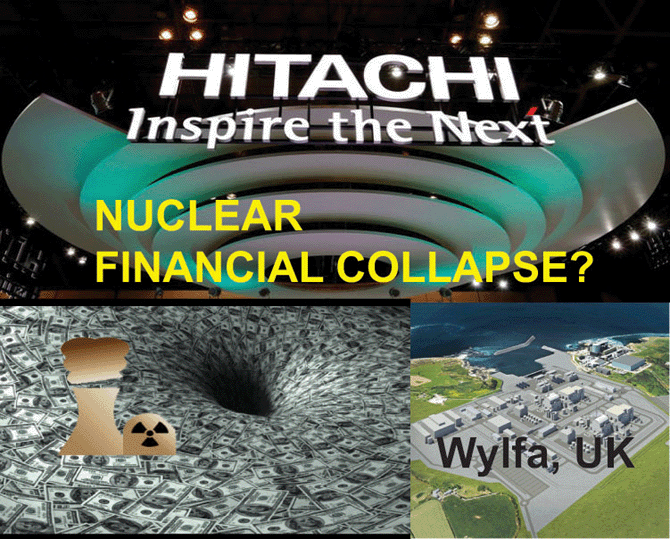
State-affiliated bank resists call to fund Hitachi nuclear project http://www.asahi.com/ajw/articles/AJ201805290047.html, THE ASAHI SHIMBUN, May 29, 2018 A government-affiliated financial institution balked at an agency’s request to pump 75 billion yen ($688 million) into Hitachi Ltd.’s nuclear power project in Britain, while the entire plan came under fire from citizen groups. Continue reading
The stranded nuclear-waste time bomb will keep ticking.

interim stores in places such as Fort St. Vrain could be in business not just for decades but for centuries. The nuclear-waste time bomb will keep ticking.
The 60-Year Downfall of Nuclear Power in the U.S. Has Left a Huge Mess The demand for atomic energy is in decline. But before the country can abandon its plants, there’s six decades of waste to deal with. The Atlantic , FRED PEARCE
Sprawling across 600 square miles of sagebrush semidesert, Hanford is a $100 billion cleanup burden, full of accidents waiting to happen. It is the biggest headache, but very far from being the only one, emerging in what increasingly look like the final years of America’s nuclear age.
It is 60 years since America’s first commercial nuclear power station was opened by President Dwight D. Eisenhower at Shippingport, near Pittsburgh, Pennsylvania, on May 26, 1958. But the hopes of a nuclear future with power “too cheap to meter” are now all but over. All that is left is the trillion-dollar cleanup.
Public fear and suspicion about all things nuclear grew sharply after March 1979, when the cooling system at Three Mile Island Nuclear Generating Station failed and triggered a meltdown. In the end, actual releases of radiation were minimal, but the incident left behind a reputational mess in addition to the radiological one. On the day of the accident, the United States had 140 operating nuclear reactors, with 92 under construction and 28 more awaiting official approval. In the next five years, more than 50 orders for new nuclear reactors in America were canceled. New contracts entirely dried up.
Hanford has not produced plutonium for three decades. Nobody is making new material for bombs anymore. President Trump’s plans for more weapons can be met by recycling existing plutonium stocks. And even the civil nuclear industry, which still generates a fifth of America’s electricity, is in what looks like terminal decline. With cheap natural gas and renewable solar and wind energy increasingly available, the numbers no longer add up. Nuclear power plants across the nation are being closed with years of licensed operation unused.
No new nuclear power stations have come on line in the past two decades. The only new build underway, two additional reactors at Georgia Power’s Alvin W. Vogtle plant near Waynesboro, is five years behind schedule and has seen its costs double. Its planned completion in 2022 remains uncertain.
America’s 99 remaining operational nuclear power reactors, which still deliver power to the grid, are too important to be closed overnight. But nearly half are over 40 years old. The only question is how long the regulators and accountants will allow them to keep going.
Oyster Creek in New Jersey disconnects from the grid in October with 11 years left on its license. Indian Point in New York State is to shut by 2021 due to falling revenues and rising costs. In California, Diablo Canyon is being closed by state regulators in 2025. The reactor at Three Mile Island in Pennsylvania that survived the 1979 accident will finally shut in 2019.
Shutdown is only the beginning of the end. Final closure and clearance of the sites can take decades, and the waste crisis created by decommissioning cannot be dodged. Lethal radioactive material is accumulating at dozens of power plants, military facilities, and interim stores across the country.
Some, like the train cars buried at Hanford, is evidently in a precarious situation. Much more needs urgent attention. Cleaning up and safely disposing of the residues of the nuclear adventure—much of it waste with a half-life measured in tens of thousands of years—is turning into a trillion-dollar nightmare for the nation. ………..
In the 1990s, a five-mile tunnel was dug into the remote mountain. Then work stopped, in part because of vehement state opposition and in part because of concerns raised by geologists that a future volcanic eruption could propel buried waste back to the surface. One of President Obama’s first acts on taking office in 2009 was to formally abandon the $100 billion project. Things headed for the courts, which began awarding damages to power companies unable to make use of the nonexistent federal facility. The payouts amount to around half a billion dollars a year, and by 2022 will likely reach $29 billion.
Now President Trump wants to revive Yucca. His 2019 budget request included $120 million for the task. But the state opposition remains as strong as ever, and only $50 million was included in the final budget for Yucca-related items. Maybe Yucca Mountain will make a comeback. If not, then with no alternatives on the horizon, utilities will carry on being paid to keep spent fuel in pools next to abandoned nuclear power plants, and the interim stores in places such as Fort St. Vrain could be in business not just for decades but for centuries. The nuclear-waste time bomb will keep ticking. This piece is adapted from Pearce’s new book, Fallout: Disasters, Lies, and the Legacy of the Nuclear Age. https://www.theatlantic.com/science/archive/2018/05/the-60-year-downfall-of-nuclear-power-in-the-us-has-left-a-huge-mess/560945/
USA nuclear lobby’s latest promotional tactic – “Nuclear is N.I.C.E.”
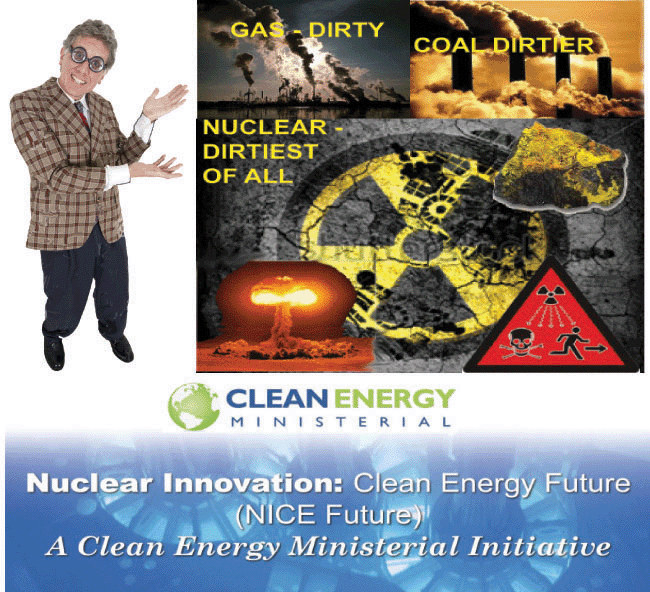
America Joins With Canada And Japan To Promote Nuclear Power, Forbes, , 29 May 18, “…… at a summit in Copenhagen, Denmark last week, it was clear the US is now trying a different tact.
A ‘Clean Energy Summit’ was organized bringing together energy ministers from across the world. At the event, the US launched new partnerships to promote nuclear power and coal with carbon capture and storage technology as alternatives to traditional fossil fuels……
The new nuclear partnership with Japan and Canada, was launched on Thursday. At the summit, the US was able to convince two new partners who are member states of the European Union – Poland and Romania – to join the alliance.
The partnership is called Nuclear Innovation: Clean Energy Future (NICE Future).
“Countries will need to use nuclear energy alongside other forms of clean energy to deliver a sustainable energy mix that is affordable to all and that supports economic development,” Agneta Rising, director general of the World Nuclear Association, said at the launch.
The aim of the initiative is to promote nuclear as a solution to climate change….
Separately, the US also promoted a new platform on Carbon Capture and Storage (CCS) called the Carbon Capture, Utilization and Storage Initiative that will focus on obtaining more financing for CCS demonstration projects. Such financing has been hard to come by in Europe, because investors are still sceptical about whether the technology, which stores the carbon underground rather than releasing it into the air, is viable.
The efforts may represent a new phase in America’s climate diplomacy……
Environmental campaigners, however, are having none of it. Hundreds of activists disrupted an event organized by the US government in November to promote nuclear and clean coal. They say the recent US moves are greenwashing a pro-coal agenda that is not actually interested in stopping climate change.
Whether these new US initiatives attract more members remains to be seen. https://www.forbes.com/sites/davekeating/2018/05/28/america-joins-with-canada-and-japan-to-promote-nuclear-power/#4c8293d4da53
Worrying trend for USA, as Trump administration tends to isolate from America’s international allies
 Think Progress 25th May 2018 , The events of the past few days signal a worrying trend for the administration of President Donald Trump: The world will not hold its breath for the United States on issues of international politics and
security.
In trying to isolate his targets — Iran and North Korea — what Trump has so far done is push his allies away from the United States and closer to states he views as hostile. First, North Korea: That the talks in the lead up to the now-cancelled June summit to negotiate Pyongyang’s nuclear and ballistic missiles weren’t going well for the past week was obvious. North Korea balked at comments made by National
Security Adviser John Bolton (who called for the “Libya model” of denuclearization) and Vice President Mike Pence (who flat out said North Korea might end up like Libya).
https://thinkprogress.org/iran-north-korea-nuclear-issues-world-moves-on-without-us-4a380e4047d9/
International talks recognising the coming wave of climate refugees

The Coming Wave of Climate Displacement https://www.project-syndicate.org/commentary/climate-change-global-compacts-migration-refugees-by-kumi-naidoo-2018-05,
Not since 1951 has the international community produced a treaty to protect the legal status of the world’s refugees. Now, two agreements are currently under discussion at the United Nations, and each offers a rare opportunity to protect global migrants from the biggest source of displacement today.
Workers evacuated at USA nuclear waste dump site, due to problem with a container
 Container problem spurs evacuation at nuclear waste site http://www.kristv.com/story/38282972/container-problem-spurs-evacuation-at-nuclear-waste-site
May 26, 2018 ALBUQUERQUE, N.M. (AP) – Workers had to evacuate the U.S. government’s only underground nuclear waste repository after finding a container of waste misaligned inside its packaging, but officials confirmed Friday that no radiation was released.
It marked another problem for the New Mexico facility where a drum of radioactive waste leaked in 2014 and shut down operations for nearly three years. The leak highlighted safety concerns and resulted in a costly recovery and sweeping changes in the way low-level nuclear waste destined for the dump is treated and handled.
In the latest incident, the contractor that runs the Waste Isolation Pilot Plant activated its emergency operations center after discovering the misaligned container Thursday night. Officials later determined conditions were stable and deactivated emergency operations.
Donavan Mager, a spokesman with Nuclear Waste Partnership LLC, said Friday that officials are investigating how the problem occurred.
In disposing the waste, seven 55-gallon drums are wrapped together in a tight formation to go deep inside the ancient salt formation where the repository is located. The idea is that the shifting salt will eventually entomb the waste.
Workers found one drum wasn’t aligned with the six others that made up the waste package. Work was immediately halted.
Procedures call for officials to develop a plan to re-enter the underground portion of the repository to deal with the pack of drums. It was not immediately known how long that would take.
“The plan is developed with extreme conservatism to ensure workers are protected,” Mager said.
Shipments to the repository resumed in 2017 following the lengthy closure stemming from the container of waste that was improperly treated at Los Alamos National Laboratory, also in New Mexico.
The repository has been receiving several shipments a week of waste that includes gloves, clothing, tools and other debris contaminated by plutonium and other radioactive elements. The Cold War-era waste was generated over years of bomb-making and nuclear weapons research.
The shipments are coming from Los Alamos lab and installations in Idaho, Tennessee, South Carolina and Texas.
The danger of nuclear diplomacy being treated like Reality-TV
White House–watchers feared a move toward the “preventive war” National Security Adviser John Bolton is on the record favoring. And war on the peninsula, with a predicted 300,000 Korean casualties in the opening days alone, even if nuclear weapons were not used — plus the deaths of American soldiers, plus the prospect of a nuclear launch — is decidedly real life, not a movie.
 What Happens When You Treat Nuclear Diplomacy Like a Reality-TV Show http://nymag.com/daily/intelligencer/2018/05/trump-nuclear-diplomacy-is-like-a-reality-tv-show.html Recently, a reader asked why my columns often compare Trump administration moves to TV shows. The reason is simple — Trump’s actions often seem inexplicable or counterproductive if viewed through a traditional national security lens. Seeing them as moves to promote a media narrative often makes them easier to understand — and offers a way to predict what comes next. Trump’s reality-TV approach to foreign and domestic policy has served him well — getting him elected and keeping his base closely enough bound to him that members of his own party do little to challenge him. Continue reading
1 This month
7 April – WEBINAR – Australia and the Doomsday Clock – Preventing nuclear war through NoFirstUse and other policies
Online | Tuesday April 7, 4:00-5:30pm, Australian Eastern Time / 8:00-9:30am Central Europe Time
– Access the registration link
15 April – Zoom –Nuclear Power is Not the Solution
Apr 15, 2026 01:00 AM in Canberra, Melbourne, Sydney

Join the International Physicians for the Prevention of Nuclear War (IPPNW) on Tuesday, April 14th for a timely webinar exploring the risks associated with nuclear power and challenging the myth that it offers a simple, safe, carbon-free solution to the climate crisis

21 April Webinar: No Nuclear Weapons in Australia
Start: 2026-04-21 18:00:00 UTC Canberra, Melbourne, Sydney (GMT+10:00)
End: 2026-04-21 19:30:00 UTC Canberra, Melbourne, Sydney (GMT+10:00)
Event Type: Virtual
A virtual link will be communicated before the event.
Host Contact Info: australia@icanw.org

of the week – Australians for War Powers Reform (AWPR)
To see nuclear-related stories in greater depth and intensity
 Antinuclear
JOHANNESBURG – Governments around the world are engaged in a series of talks that could fundamentally alter how the movement of people across borders is managed. One dialogue is focused on the protection of refugees; the other on migration.
These discussions, which are being led by the United Nations, will not re sult in legally binding agreements. But the talks themselves are a rare chance to forge consensus on contemporary migration challenges. And, most importantly, they will offer the international community an opportunity to plan for the impact of climate change, which will soon become a key driver of global displacement and migration
At last count, there were some 258 million migrants worldwide, with 22.5 million people registered as refugees by the UN Refugee Agency. These numbers will be dwarfed if even the most modest climate-related predictions are borne out. According to the International Organization for Migration, climate change could displace as many as one billion people by 2050. And yet no international treaty covers climate-induced migration – a gap that must be addressed now.
Not since 1951 have international standards for refugee protection received so much attention. That year, with more than 80 million people displaced after World War II, UN member countries ratified a comprehensive framework to standardize their treatment of refugees. The Global Compact on Refugees that is currently under discussion builds on this framework with strategies to empower refugees and assist host governments. Most significantly, it would commit signatories to protecting “those displaced by natural disasters and climate change.”
The second agreement is even more consequential for the management of climate-induced displacement. There has never been a global treaty governing migration, and past bilateral efforts have focused almost exclusively on violence and conflict as root causes of displacement. The proposed Global Compact for Migration goes beyond these factors, and notes that climate change is among the “adverse drivers and structural factors that compel people to leave their country of origin.”
This type of regulatory language reaffirms what at-risk populations around the world already know: droughts, natural disasters, desertification, crop failure, and many other environmental changes are upending livelihoods and rendering entire communities uninhabitable. In my country, South Africa, a record drought is forcing major cities to consider water rationing. If water shortages persist, migration is certain to follow.
Resource scarcity is particularly dangerous in politically unstable states, where climate change has already been linked to violent conflict and communal upheaval. For example, disputes over fertile land and fresh water fueled the war in Darfur, and even the current crisis in Syria – one of the greatest sources of human displacement today – began after successive droughtspushed Syrians from rural areas into cities. It is not a stretch to predict that climate change will produce more bloodshed in the coming years.
The two UN frameworks could serve as a basis for planning how to manage the coming climate-induced migrations. With scientific modeling to guide decision-making, states could draft orderly, dignified, and equitable relocation strategies. This is certainly a smarter approach than the ad hoc responses to date.
But history tells us that governments are reluctant to seek out collective solutions to forced migration. This failure is visible today in the haunting and inexcusable plight of refugees around the world.
As we enter the final months of the Compact talks, what should we expect of those negotiating the global plan for managing unprecedented movements of people? The causes and consequences of climate change demand close attention. Displaced people must be able to get on with their lives in dignity. The test of world leaders will be whether the global compacts on refugees and migrants can achieve this.