Climate change on track to cause major insect wipeout, scientists warn
Insects are vital to ecosystems but will lose almost half their habitat under current climate projections , Guardian, Damian CarringtonEnvironment editor@dpcarrington Fri 18 May 2018
Global warming is on track to cause a major wipeout of insects, compounding already severe losses, according to a new analysis.
Insects are vital to most ecosystems and a widespread collapse would cause extremely far-reaching disruption to life on Earth, the scientists warn. Their research shows that, even with all the carbon cuts already pledged by nations so far, climate change would make almost half of insect habitat unsuitable by the end of the century, with pollinators like bees particularly affected.
However, if climate change could be limited to a temperature rise of 1.5C – the very ambitious goal included in the global Paris agreement – the losses of insects are far lower.
The new research is the most comprehensive to date, analysing the impact of different levels of climate change on the ranges of 115,000 species. It found plants are also heavily affected but that mammals and birds, which can more easily migrate as climate changes, suffered less.
“We showed insects are the most sensitive group,” said Prof Rachel Warren, at the University of East Anglia, who led the new work. “They are important because ecosystems cannot function without insects. They play an absolutely critical role in the food chain.”
“The disruption to our ecosystems if we were to lose that high proportion of our insects would be extremely far-reaching and widespread,” she said. “People should be concerned – humans depend on ecosystems functioning.” Pollination, fertile soils, clean water and more all depend on healthy ecosystems, Warren said.
This fact was one of the primary reasons for the Climate Leaders’ Summit: Women Kicking it on Climate, which was hosted on 16 and 17 May by Catherine McKenna, Canada’s Minister of Environment and Climate Change.
“I am privileged to work with so many fearless women who are climate leaders,” said McKenna on why she organized the summit. “We know women and girls are particularly at risk when it comes to climate change, and yet women are also at the forefront of bold climate leadership around the world. Together, women are turning ideas into solutions.”
The event brought together female climate leaders from around the world, with representatives from the public, private, academic and civil society sectors. The group focused on topics such as improving collaboration to find solutions to climate change, female empowerment and ensuring that women are represented in global conversations surrounding the environment.
As scientists have begun to understand the effects of climate change, it has become apparent that women are at greater risk, especially in the developing world. In many countries women are responsible for securing food, water and energy for cooking, heating and sustaining their families. This means that they depend on natural resources for their livelihoods, which are threatened by drought, uncertain rainfall and deforestation – all things that are exacerbated by climate change.
For this reason, one of the primary topics of the summit was the importance of sustainable development and clean growth. Especially important is giving women the tools they need to earn a better living and live themselves, and their families out of poverty.
While many issues were discussed, the main theme of the summit was the importance of women’s leadership, especially in combating climate change. Women in leadership roles were essential in creating the Paris Agreement, which includes a soon-to-be implemented Gender Action Plan that will ensure greater female participation in climate negotiations. But the greatest takeaway from the discussions was the importance of advocating for equal gender representation in leadership roles, whether it be in politics, business, or at the local level.
At the end of the summit the general feeling among the women involved was one of inspiration and empowerment. Tina Birmpili, the head of the United Nations Ozone Secretariat, was one of the women who participated. At the end of the experience she felt especially motivated to continue pushing for change.
“We need more women, not only in policymaking and environmental science but also in engineering and technological innovation,” said Birmpili. “Let the disproportionate effect climate change has on women, and the deeper understanding they consequently acquire day by day, be the driving force to catapult them to all positions they deserve to have in the fight against climate change.”
‘Melbourne, Australia:
SNAICC is delighted to announce the theme for
National Aboriginal and Torres Strait Islander Children’s Day for 2018 is SNAICC – Celebrating Our Children for 30 Years.
‘Our children are the youngest people from the longest living culture in the world,
with rich traditions, lore and customs that have been passed down from generation to generation.
Our children are growing up strong with connection to family, community and country.
Our children are the centre of our families and the heart of our communities.
They are our future and the carriers of our story.
‘This year, we invite communities to take a walk down memory lane,
as we revisit some of the highlights of the last 30 years. We look back
on the empowering protest movements instigated by community that had led
to the establishment of the first Children’s Day on 4 August 1988.
‘We look back at all of the amazing moments we’ve shared with our children over the years,
and how we’re watching them grow into leaders.
‘We look back to see what we’ve achieved, and decide where we want to go
from here to create a better future for our children.
‘If you have celebrated Children’s Day at any time during the past 30 years,
we would love to hear from you. … ‘
Nuclear industry urged to address business case, 16TH MAY 2018 ,BY:REBECCA CAMPBELLCREAMER MEDIA SENIOR DEPUTY EDITOR Decisions on the future energy mix for South Africa need to be forward looking, not backward looking. So affirmed EE Publishers MD Chris Yelland in his keynote address to the National Nuclear Regulator’s second Nuclear Regulatory Information Conference on Wednesday.
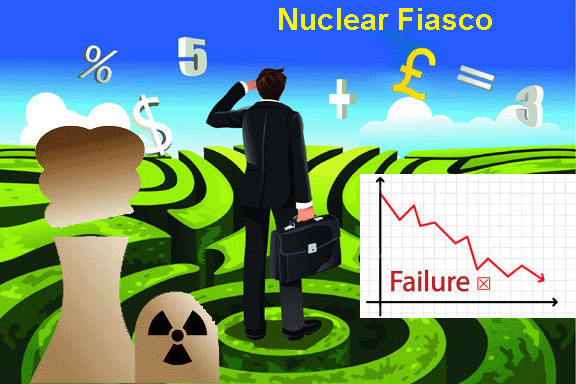
…………”Thenuclear sector needs to address the real elephants in the room,” he asserted. “In my view the biggest elephant in the room is not the technology, but the business case.” There is great uncertainty about the future demand for grid electricity. Megaprojects have high costs and risks. Nuclearpower plants also have long construction periods and high up-front costs. There are serious financing issues, both with the public and private sectors in South Africa (local institutions were unwilling to invest in nuclearprojects). Nuclearpower plants had to be run constantly at a high output level for maximum efficiency.
The risk associated with nuclearpower was not low. While the risk of technological failure was low, when such failures did happen, the consequences were very serious. The crisis at the Fukushima nuclearpower station in Japan had very severe financial consequences. Consequently, the private sector was reluctant to insure nuclearpower plants, leaving that to governments.
Quartz, Heather Timmons, 16 May 18We have been here before. North Korea, a weaponized family-run dictatorship, seems close to an agreement with Western powers to disarm—only for things to fall apart before that happens.
North Korea is reconsidering holding a summit with Donald Trump, a senior diplomat said May 14. Past deals with the West—in 1985, 1995, and 2005—have also fallen apart.
But if Trump and Kim Jong-un fail to get a deal, or even meet, this time around, the Trump administration’s incoherent and rapidly shifting messaging will be as much to blame as the fickleness of North Korean leaders, a Korean peninsula expert says.
…….. The problem is, it’s impossible to tell whether Trump and his administration have any strategic plan on North Korea, or if they’re just “winging it,” he said. Bolton has said he wants a preemptive strike(paywall), while Pompeo, Guase says, is twisting in the wind: “One day he’s offering a compromise, the next day he’s taking the hardline.” Trump, meanwhile, is likely to listen to whoever he spoke to last.
The National Security Council, the White House, and State Department didn’t immediately respond to requests for comment. The White House said Wednesday morning that the turnaround was “fully expected,” despite the fact that Trump last week announced a date for his meeting with Kim, calling it a “special moment for World Peace.”
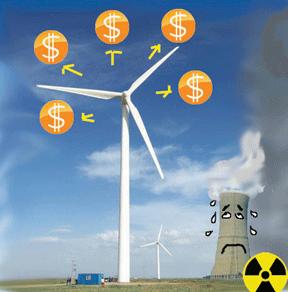
Britain’s windfarms provided more electricity than its eight nuclear power stations in the first three months of 2018, marking the first time wind has overtaken nuclear across a quarter.
The renewable energy industry hailed the milestone as a sign the UK was well on its way to an electricity system powered by cheap, domestic green energy. Continue reading →
INTERNATIONAL INSTITUTE FOR APPLIED SYSTEMS ANALYSIS EUREKALERT, 16 MAY 18
New research identifying climate vulnerability hotspots has found that the number of people affected by multiple climate change risks could double if the global temperature rises by 2°C, compared to a rise of 1.5°C.
The team, led by IIASA Energy Program researcher Edward Byers, investigated the overlap between multiple climate change risks and socioeconomic development to identify the vulnerability hotspots if the global mean temperature should rise by 1.5°C, 2°C and 3°C by 2050, compared to the pre-industrial baseline. Since those in poverty are much more vulnerable to climate change impacts, knowing where and how many vulnerable people are at high risk is therefore important for creating policies to mitigate the situation.
The researchers from IIASA, Global Environment Facility (GEF), the United Nations Industrial Development Organization (UNIDO), the University of Oxford, and the University of Washington, developed 14 impact indicators in three main sectors – water, energy, and food & environment – using a variety of computer models. The indicators include a water stress index, water supply seasonality, clean cooking access, heat stress events, habitat degradation, and crop yield changes. They compared the potential risks at the three global temperatures and in a range of socioeconomic pathways, to compare more equitable, sustainable development with pathways characterized by development failures and high inequality……..https://www.eurekalert.org/pub_releases/2018-05/iifa-g2r051518.php
Paul Waldon Fight To Stop Nuclear Waste Dump In Flinders Ranges SA, 16 May 18
The Australian Atomic Energy Commission was born to the ignorance of locals who were prepared to accept a reactor in their backyard when it was planed before 1952. “A reactor.”
Yes, one reactor, is what they live with, but how many reactors worth of forever radioactive fuel rods, raffinates, old reactor components, and any other toxic industrial products does the Department of Industry, Innovation and Science expect Hawker or Kimba to live with. ANSTO and DIIS don’t give a damn as long as its not in their backyard, they can keep promoting and produce more. https://www.facebook.com/groups/344452605899556/
A decade ago, the last time North Korea took talks with the U.S. so far, then-leader Kim Jong Il blew up a cooling tower at the Yongbyon nuclear plant as part of a deal to limit its weapons program. Within months, he was reassembling the reactor — a key source of weapons-grade plutonium. That’s one reason why arms-control experts are watching with caution as his son, Kim Jong Un, now moves to publicly dismantle the remote subterranean testing site used by the regime to detonate six nuclear bombs.
…….Does North Korea need more tests?
Possibly not. Both India and Pakistan established themselves as nuclear powers after a similar number of tests — and neither has detonated a bomb since 1998. In his April 20 statement announcing the Punggye-ri closing, Kim said the country’s efforts to build a warhead small enough to fit on a ballistic missile had progressed to the point where tests were no longer necessary. Still, it’s unclear whether North Korea has figured out how to prevent a warhead from burning up during re-entry from space.
Would the site’s closing be permanent?
No. A 38 North analysis of satellite images taken May 7 showed that several support buildings outside the northern, western and southern portals had been razed while some mining cart rails had been removed. Such facilities can be replaced as easily as the Yongbyon cooling tower. Lewis, of the Middlebury Institute, argues that the tunnel’s horizontal layout would also make it relatively easy to “pop” open the sealed entrances and regain access after their closing.
What about building a new tunnel?
A new test site could be constructed in three to six months, depending on how much labor was thrown at the job, according to Suh Kune Y., a nuclear engineering professor at Seoul National University. Future detonations — most likely to test warhead miniaturization — might only require a simple straight tunnel with one right angle at the end, he said.
What about other sites?
North Korea, which is believed to manage a vast subterranean network in part to frustrate U.S. and South Korean spies and military planners, probably has other locations that could house tests. Suh pointed out that North Korea refers to the Punggye-ri facility as its “northern test site,” possibly implying there are others. And, of course, tests don’t need to be underground. In September, North Korea Foreign Minister Ri Yong Ho suggested that his country could detonate a hydrogen bomb over the Pacific Ocean. https://www.bloomberg.com/news/articles/2018-05-15/closing-kim-s-test-site-won-t-hinder-his-nuke-plans-quicktake
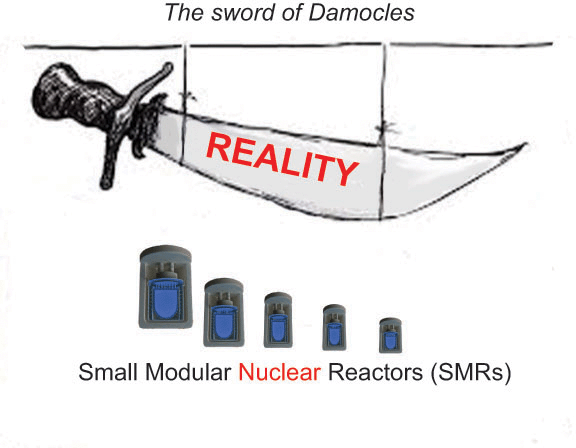
Small Modular Nuclear Reactors Will Soon Face a Moment of Reckoning
NuScale is bringing small nuclear alive. But will the concept survive? GreenTech Media Jason Deign, MAY 14, 2018 Last month’s first-ever small modular reactor design approval could usher in a new era for nuclear power, provided the technology can live up to the hype.
The U.S. Nuclear Regulatory Commission (NRC) phase 1 review approval of a small nuclear reactor (SMR) design from Portland, Oregon-based NuScale Power means the technology now has a realistic chance of being up and running within a decade.
In a press release, NuScale said its first operational products, for Utah Associated Municipal Power Systems (UAMPS), could be hooked up to the grid “by the mid-2020s,” while Bloomberg reported that the company was aiming for commercial operations in 2026.
The reactor developer next has to get NRC design certification application approval and customer UAMPS needs a combined construction and operating license, NuScale’s director of communications, Mariam Nabizad, told GTM. …….
When it goes live, the UAMPS plant could be the definitive test of whether nuclear has a future in many Western economies. In Europe and the U.S. the industry is on the wane, mounting a rearguard PR campaign to claw back fans and betting heavily on SMRs to regain credibility.
That means the UAMPS project, which is set to have a dozen 50-megawatt NuScale SMR modules, will have to buck recent nuclear new-build trends by coming in on time and on budget.
And, critically, it will have to be competitive with other generation sources being built eight years from now. Nabizad said that the estimated overnight cost for the UAMPS project was $2.9 billion, and its target levelized cost of energy was $65 per megawatt-hour.
For comparison, the International Renewable Energy Agency predicts that by 2020, more than half a decade ahead of the UAMPS project going live, onshore wind will be hitting an LCOE of $50 per megawatt-hour and solar will be at $60 per megawatt-hour.
……… with wind- or solar-tied storage plummeting in cost, it is unclear to what extent intermittency will be an issue for intermittent renewables eight years from now. All these factors could fuel concernsthat SMRs may never be a viable technology. ……. even if NuScale and its brethren can reignite interest in nuclear across the U.S. and Europe, it may still face a threat from within its own industry.
Mongabay, by Mayank Aggarwal on 14 May 2018
In the past couple of weeks, severe dust storms, thunderstorms and lightning have hit several parts of India, resulting in the deaths of more than 150 people and injuries to at least 300 others.
With the rise in global temperatures, the intensity of dust and thunderstorms is expected to increase in the future, experts say.
But even though dust storms and thunderstorms are a common feature in India, there has been no focused work on studying the trends related to it.
India could witness an increase in the severity and frequency of dust storms and thunderstorms due to rising global temperatures, experts say.
“[The] intensity of sandstorms is increasing across the world,” said Chandra Bhushan, deputy director general at the Centre for Science and Environment (CSE), a Delhi-based think tank. He cited studies from the U.S. Midwest, the Middle East and the Sahara, all of them linking the phenomenon to sudden increases in surface temperature.
“All of them are saying that as the climate gets warmer the temperature gradient is going to become very steep. This steep increase in temperature gradient will lead to two things — heat waves and sand storms,” Bhushan said.
“There is enough research happening [to predict] that the intensity of sandstorms is going to become more intense as the temperature increases further. It is indeed linked to climate change.”
On May 2, severe dust storms, thunderstorms and lightning hit several parts of India, resulting in the deaths of at least 124 people and injuries to 300 others. More than 10,000 utility poles and hundreds of power transformers were damaged, while farmers suffered losses to their cattle and poultry stocks. Similarly, on May 13, fierce dust and thunderstorms led to the deaths of some 40 people, while several others were injured.
Bhushan said the enormity of losses from dust storms was shocking, but that they would only become more intense in the future. With higher global temperatures, he said, the soil would become drier. That will result in an increase in the amount of dust carried by the wind, and consequently the intensity of dust storms.
Dallas, Midland and San Antonio city councils have already made resolutions prohibiting railcars from coming through their towns and exposing the citizens of their towns to this deadly radioactive waste.
The site can be seen from the air and is a beautiful target for terrorists during transit and after arrival at the site.
I believe our livelihood is in great danger of becoming destroyed by a company named Holtec International. They have applied to the Nuclear Regulatory Commission (NRC) for a 40-year license for an interim High-Level Radioactive Nuclear Waste Facility to be built between Carlsbad and Hobbs, New Mexico.
This is not the facility in Andrews. Although, now that Holtec has applied for their license, Waste Management Specialists (WCS) had placed their license request for the High-Level Radioactive Nuclear Waste on hold due to issues regarding the pending sale of their facility to Orano. However, now that the sale is complete and things have settled down, and they are watching what is going on with Holtec. Then, we fear, Orano is going to revise and reapply for a license requesting for the same as Holtec – high-level radioactive nuclear waste to be disposed of in the Andrews site, claiming it to be interim as well.
Why are we concerned and people in Midland and Odessa should be, too?
1. This is the first time anything of this gravity has ever been attempted in this country!
a. Radioactive waste has been moved around, but nothing remotely on this level of danger, nothing on this scope of magnitude and nothing on this level or for this interim duration.
b. Our deep concern is that no permanent site has even been discussed yet!!
c. By the time a “permanent” repository is found (which will probably be never) the canisters/casks will be too fragile to be moved due to deterioration from sun exposure/weathering or just time in general and the site will become a de facto permanent disposal site and another Super Fund site that New Mexico will have to try to maintain forever.
2. The Holtec site is on top of our Permian Basin oil reserves sitting directly on top of the Delaware Basin and our Olgalla Aquifer and don’t let any tell you they’re not as the old maps tell you they are.
3. This deadly waste is responsible for cancers, genetic birth defects and deaths as witnessed in the Tulrosa Basin Downwinders Claims after the atomic bomb experiments at the Los Alamos experimental site prior to the dropping of the bombs in Hiroshima and Nagasaki that ended WWII. The town of Trinity was never advised of these trials and the fallout affected the towns’ people with all kinds of different cancers that no one had ever had before.
4. This radioactive waste (even though they tell you it is in solid form and is more easily handled), is to be sent here by rail coming through Odessa. If that train wrecks on Faudree and Hwy 80 would have contained nuclear waste, it would have taken out the Odessa Country Club Golf Course and some of the richest real estate in Odessa as the land will become unusable for 25,000 years or more.
5. What’s going to happen if an accident leaves the land unable to be used for drilling for oil? The Fasken Oil Company came to Roswell to testify in front of the NRC to say that this is a bad idea and vowed to do everything they can to round up all the people in the Permian Basin Oil Industry to fight this licensing. Continue reading →
MPs from both major parties have attacked the government’s latest incentive to entice communities into volunteering to host Britain’s first deep underground store for nuclear waste as “completely inadequate”.
Ministers have offered up to £1m per community for areas that constructively engage in offering to take part in the scheme, and a further sum of up to £2.5m where deep borehole investigations take place.
The aim is to find a permanent underground geological disposal facility (GDF) that could store for thousands of years the waste from Britain’s nuclear energy and bomb-making programmes. The scheme could involve building stores under the seabed to house highly radioactive material. It is predicted that the UK is likely to have produced 4.9m tonnes of nuclear waste by 2125.
But critics say the inducements offered by the government – part of the consultations it launched this year – to ensure local cooperation are “simply not good enough”, and point to the example of France, which has a similar amount of nuclear waste. It offers around €30m (£26.5m) a year as local support for districts neighbouring the site at Bure, in north-east France, and has also offered €60m in community projects.
“The government’s offer in its consultation is simply not good enough. These communities are being asked to perform an important public service and should be properly recompensed,” said Rebecca Long-Bailey, the shadow business secretary.
In 2012 the government’s attempt to encourage local areas to host nuclear waste facilities ended in failure when councils in Cumbria and Kent rejected proposals for underground stores to be built within their boundaries. These were the only communities to show significant interest at the time and remain the main candidates for sites now that the government has relaunched its nuclear store programme.
However, local campaigners fear that a waste site could affect tourism, on which Cumbria is heavily reliant. “For the sake of a few hundred jobs and a few million pounds, we risk thousands of jobs in the tourism sector, which contributes £2.7bn a year to Cumbria’s economy,” said Geoff Betsworth, chairman of the Cumbria Trust. “Even a 10% dent in tourism would cost £270m a year. The offer of £1m in community benefits, rising to £2.5m when boreholes begin, is absurdly low.”
The government is seeking to dispose of the UK’s nuclear waste underground because current storage facilities are both ineffective and expensive to maintain. A GDF would involve sealing the waste in rock for as long as it remains a hazard.
The plan was also criticised by the Conservative MP Zac Goldsmith, who said the UK should stop making nuclear waste and stop building new reactors.
“We are still pouring untold billions of taxpayer money into propping up an industry that the free market would have killed off years ago,” he said. “In return, we will be compounding the catastrophe of a nuclear waste build-up, which we are no closer to solving than we were when the industry was born.”
Nina Schrank, energy campaigner at Greenpeace UK, added: “The lack of seriousness with which the UK government treats nuclear legacy issues makes it predictable that their quest for a suitable site has been so unsuccessful that they are looking again at the Irish Sea, which Sellafield turned into one of the most radioactively contaminated seas in the world.”
A government spokesperson said: “The GDF will be a multibillion-pound project that can provide substantial benefits to host communities. This includes skilled employment for hundreds of people for decades to come, spin-off benefits such as infrastructure investment, as well as positive impacts on local service industries that support the facility and its workforce.”
Iran to negotiate with world powers to keep nuclear deal in place
Aljazeera, 14 May 18 FM says Tehran is ‘ready for all options’ as he embarks on tour with pact’s other signatories in wake of US withdrawal.
Iran’s foreign minister has held talks in China as he began a diplomatic tour with the remaining signatories of a multinational nuclear deal following the recent US withdrawal from the landmark 2015 pact.
Speaking on Sunday in Beijing, Mohammad Javad Zarif underlined Tehran’s readiness “for all options” but expressed optimism that this round of negotiations could save the 2015 deal.
“We hope that with this visit to China and other countries we will be able to construct a clear future design for the comprehensive agreement,” Zarif said, speaking alongside his Chinese counterpart, Wang Yi.
“[But] if the nuclear deal is to continue, the interests of the people of Iran must be assured.”
Earlier on Sunday, Iranian President Hassan Rouhani said Iran would remain committed to the deal “if the remaining five countries abide by the agreement”.
Diplomatic tour
After the Chinese capital, Zarif will attend talks in Moscow and Brussels with representatives of the pact’s other signatories.
Under the deal signed in Vienna with six world powers – China, France, Russia, the UK, the US, Germany, and the European Union – Iran scaled back its uranium enrichment programme and promised not to pursue nuclear weapons in exchange for the lifting of economic sanctions.
Mayor of London 11th May 2018 ,The Mayor of London, Sadiq Khan, has today set out his ambitious vision for London’s environment in 2050, presenting his Environment Strategy to the
London Assembly for consideration before final publication in the coming
weeks.
The strategy outlines Sadiq’s plans for making the city a greener,
cleaner and healthier place by targeting London’s toxic air, increasing
its green cover and making London a zero-carbon city by 2050 with energy
efficient buildings, clean transport and energy and increasing recycling.
All this will boost London’s green spaces, clean up its air, and help
safeguard the health and wellbeing of all Londoners. For the first time,
this strategy brings together approaches to every aspect of London’s
environment in one integrated document. The publication follows one of City
Hall’s largest ever strategy consultations with almost 3,000 Londoners
and 370 stakeholders responding to the draft Strategy launched last August. https://www.london.gov.uk/press-releases/mayoral/london-environment-strategy-sets-out-vision
Apr 15, 2026 01:00 AM in Canberra, Melbourne, Sydney
Join the International Physicians for the Prevention of Nuclear War (IPPNW) on Tuesday, April 14th for a timely webinar exploring the risks associated with nuclear power and challenging the myth that it offers a simple, safe, carbon-free solution to the climate crisis
21 April Webinar: No Nuclear Weapons in Australia
Start: 2026-04-21 18:00:00 UTC Canberra, Melbourne, Sydney (GMT+10:00)
End: 2026-04-21 19:30:00 UTC Canberra, Melbourne, Sydney (GMT+10:00)
Event Type: Virtual A virtual link will be communicated before the event.









 Antinuclear