Antinuclear

Australian news, and some related international items

Fukushima: Total atmospheric releases of ionising radiation has exceeded that of Chernobyl disaster.

Counterpunch 27th April 2018 The radiation dispersed into the environment by the three reactor meltdowns at Fukushima-Daiichi in Japan has exceeded that of the April 26, 1986
Chernobyl catastrophe, so we may stop calling it the “second worst”
nuclear power disaster in history. Total atmospheric releases from
Fukushima are estimated to be between 5.6 and 8.1 times that of Chernobyl,
according to the 2013 World Nuclear Industry Status Report. Professor Komei
Hosokawa, who wrote the report’s Fukushima section, told London’s
Channel 4 News then, “Almost every day new things happen, and there is no
sign that they will control the situation in the next few months or
years.”
https://www.counterpunch.org/2018/04/27/move-over-chernobyl-fukushima-is-now-officially-the-worst-nuclear-power-disaster-in-history/

April 29, 2018 Posted by | General News | Leave a comment

Cumbria County Council (CCC) finds flaws in the selection process for a nuclear waste dump site

Cumbria County Council (CCC) have recognised the fundamental flaws within the latest process to find a location to bury the nation’s nuclear waste. The CCC response to the government consultation echos many of the points which Cumbria Trust has made.  In particular the failure to address the need for secure interim storage, despite the most dangerous elements within waste being too hot to bury for well over a century.  They also highlight the lack of clarity over the community’s right of withdrawal, something of particular concern to Cumbria Trust.  As we have previously stated this is a process which has been designed to be very simple to enter and very difficult to leave.

Five years ago it was CCC which called a halt to the search process, and their concerns have not gone away.

The News & Star has reported this week:

A NEW search to find a community willing to host an underground nuclear waste storage bunker is based on ‘fundamentally flawed’ government policy, council officials in Cumbria have said.

The nationwide scheme to identify a location for a £12 billion geological disposal facility buried at least 200 metres below the surface was relaunched by the government in January and is expected to take 20 years to secure.

It promises incentives including £1m per year for five years for the five communities that volunteer to be on the shortlist – with £2.5m a year for the two that go forward to the testing stage, which would see deep boreholes dug underground.

But experts within Cumbria County Council have instead called for more clarity on how the high level waste – the majority of which is currently kept in storage vessels in west Cumbria – will be kept safe if a suitable location is not identified within the time frame.

They also state the right of willing communities to withdraw from the process is not clear enough within the proposal, while there is no detail about how the waste could be retrieved at a later date if new technology to dispose of it more efficiently is developed.

Read the full report here

April 29, 2018 Posted by | General News | Leave a comment

Climate change global impacts now, with rapidly melting Arctic ice

Melting Arctic sends a message: Climate change is here in a big way, The Conversation,  Mark Serreze, Research Professor of Geography and director, National Snow and Ice Data Center, University of Colorado, 

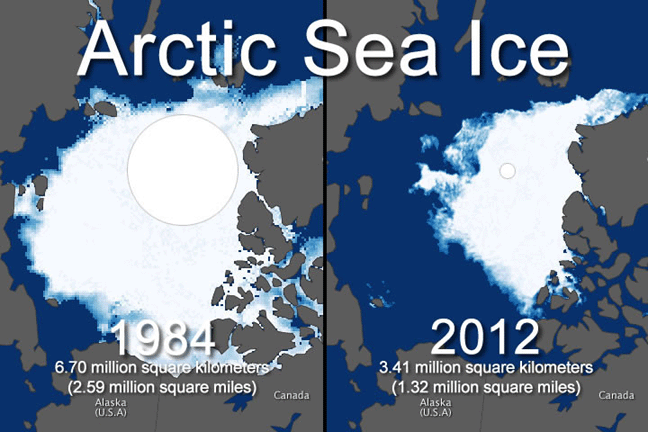
Scientists have known for a long time that as climate change started to heat up the Earth, its effects would be most pronounced in the Arctic. This has many reasons, but climate feedbacks are key. As the Arctic warms, snow and ice melt, and the surface absorbs more of the sun’s energy instead of reflecting it back into space. This makes it even warmer, which causes more melting, and so on.

This expectation has become a reality that I describe in my new book “Brave New Arctic.” It’s a visually compelling story: The effects of warming are evident in shrinking ice caps and glaciers and in Alaskan roads buckling as permafrost beneath them thaws.

But for many people the Arctic seems like a faraway place, and stories of what is happening there seem irrelevant to their lives. It can also be hard to accept that the globe is warming up while you are shoveling out from the latest snowstorm.

Since I have spent more than 35 years studying snow, ice and cold places, people often are surprised when I tell them I once was skeptical that human activities were playing a role in climate change. My book traces my own career as a climate scientist and the evolving views of many scientists I have worked with.  When I first started working in the Arctic, scientists understood it as a region defined by its snow and ice, with a varying but generally constant climate. In the 1990s, we realized that it was changing, but it took us years to figure out why. Now scientists are trying to understand what the Arctic’s ongoing transformation means for the rest of the planet, and whether the Arctic of old will ever be seen again.

Evidence piles up

Evidence that the Arctic is warming rapidly extends far beyond shrinking ice caps and buckling roads. It also includes a melting Greenland ice sheet; a rapid decline in the extent of the Arctic’s floating sea ice cover in summer; warming and thawing of permafrost; shrubs taking over areas of tundra that formerly were dominated by sedges, grasses, mosses and lichens; and a rise in temperature twice as large as that for the globe as a whole. This outsized warming even has a name: Arctic amplification.

……….  Indeed, the question is no longer whether the Arctic is warming, but how drastically it will change – and what those changes mean for the planet. https://theconversation.com/melting-arctic-sends-a-message-climate-change-is-here-in-a-big-way-95573


April 27, 2018 Posted by | General News | Leave a comment

North Korea’s Most Recent Nuclear Bomb Test Collapsed a Mountain

That’s One Reason To Suspend Nuclear Tests: North Korea’s Most Recent Blast Collapsed a Mountain http://fortune.com/2018/04/25/north-korea-nuclear-test-mountain-mount-mantap/, By DAVID MEYER , April 25, 2018

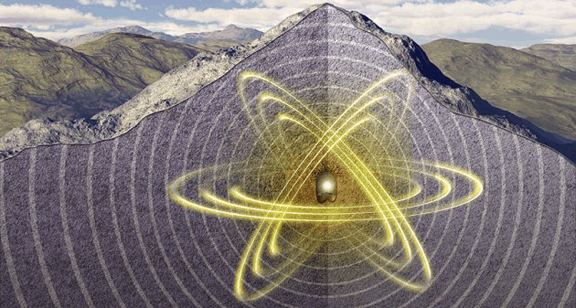
Last weekend, North Korea suspended its nuclear tests and shut down the site where the last six detonations took place: underneath Mount Mantap, in the country’s northeast.

The reasons are ostensibly diplomatic, pointing to a thaw in relations between Kim Jong-un’s regime and South Korea and the West, but some noted that Pyongyang might have also been worried that the mountain was at risk of collapsing, as it visibly shifted during the last nuclear test. However, two separate groups of Chinese scientists now say Mount Mantap did in fact collapse after that detonation.

That means there’s a risk of radioactive contamination spreading not only within North Korea, but to other countries in the region. The site is not far from North Korea’s borders with China and Russia.

According to geologists from the University of Science and Technology of China, the collapse took place minutes after Kim Jong-un’s regime conducted its last nuclear test in September of last year.

The test of the 100-kiloton bomb, which led Chinese seismologists to register a 6.3 magnitude earthquake, apparently opened up a hole of up to 656 feet in diameter. Part of the mountain then fell into the hole.

The findings of the team, led by renowned seismologist Wen Lianxing, are set to be published next month in the journal Geophysical Research Letters.

According to the Hong Kong-based South China Morning Post, another team from the China Earthquake Administration reckons the collapse created a “chimney” that could allow the escape of fallout. The publication quoted researcher Zhao Lianfeng from the Chinese Academy of Sciences as saying the site was “wrecked” beyond repair.

So Pyongyang’s renouncement of land-based nuclear tests, for now, appears to be motivated by more than mere diplomatic concerns.

April 26, 2018 Posted by | General News | Leave a comment

SAN ONOFRE’S NUCLEAR WASTE STORAGE TANKS ALREADY BREAKING

 https://www.surfer.com/features/san-onofres-nuclear-waste-storage-tanks-already-breaking/  BUSTED BOLT FOUND IN NEW TANK MEANT TO HOLD SPENT FUEL,  BY JUSTIN HOUSMAN  Just a few months into Southern California Edison’s very controversial plan to relocate spent nuclear fuel to holding tanks on the beach at San Onofre, crews are finding the holding tanks aren’t working properly.

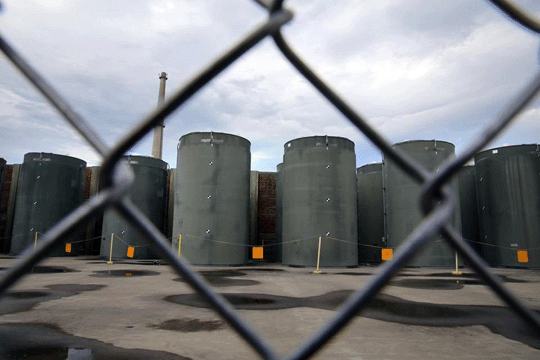
The LA Times reported last month that when workers tried to move spent fuel from a cooling tank to dry storage tanks–that are kept a mere 100-feet from the shoreline–broken bolts were found in the long-term storage tanks. Those tanks are meant to hold and stabilize the spent fuel rods indefinitely.

Work stopped for ten days after the bolts were found, but has since resumed, angering nearby residents and people opposed to the plan to store waste at San Onofre, who were already worried about the safety of keeping nuclear waste so near the ocean and major population centers.

Now that broken bolts have been found, those fears are heightening.

The broken bolts are part of a system that helps keep the rods balanced in the storage tanks. They’re apparently a new design, and four of them have already been filled with radioactive waste. Unfortunately, there’s no way for Southern California Edison to test the already-filled containers for the same issue.

Edison is trying to assuage fears and insists there’s no threat to the public. And they’ve resumed filling more storage tanks, but not the newly-designed tanks with bolt issues.

But for watchdog groups who were already warning that unforeseen problems made storing this waste highly dangerous, malfunctioning tanks so early in the relocation process isn’t sitting very well.

“We warned them that this was going to happen, and nobody listened to us,” Donna Gilmore of SanOnofreSafety.org told the LA Times. “Now they are trying to tell us: ‘Everything is OK. Don’t worry.’ This is insane. Edison has proven they can’t keep us safe.”

As part of a lawsuit settlement, Edison has agreed to look into options to store the spent fuel permanently in New Mexico or Arizona, far from millions of Orange County and San Diego County residents.

For now though, the waste is still headed to San Onofre, busted bolts and all. All 3.6 million pounds of it.

April 26, 2018 Posted by | General News | Leave a comment

Canada’s First Nations were not properly consulted about nuclear waste dump site

Toronto Star 23rd April 2018 ,Canada mishandling nuclear waste plans, Indigenous, environmental groups warn. First Nations leaders say they have not been properly consulted about
the prospect of a nuclear waste disposal site being established northwest
of Ottawa near a prominent nuclear research centre.

Environmental groups also say the controversy over the site near Chalk River, Ont., illustrates
the fact that the federal government lacks suitable policies to regulate
the handling of nuclear waste. Glen Hare, deputy grand chief of the
Anishinabek Nation, says his people were not consulted about the proposed
dump site, which is located less than a kilometre away from the Ottawa
River.
https://www.thestar.com/news/canada/2018/04/23/canada-mishandling-nuclear-waste-plans-indigenous-environmental-groups-warn.html

April 26, 2018 Posted by | General News | Leave a comment

Cumbria struggles with stranded nuclear wastes and flawed community consultation

Whitehaven News 26th April 2018 , Search to find nuclear waste storage site is ‘flawed’, Cumbria council chiefs claim. Cash incentives are being offered to communities that step forward to host an underground waste bunker.

A NEW search to find a community willing to host an underground nuclear waste storage bunker is based on ‘fundamentally flawed’ government policy, council officials in Cumbria have said.

The nationwide scheme to identify a location for a £12 billion geological disposal facility buried at least 200 metres below the surface was relaunched by the government in January and is expected to take
20 years to secure. It promises incentives including £1m per year for five
years for the five communities that volunteer to be on the shortlist – with
£2.5m a year for the two that go forward to the testing stage, which would
see deep boreholes dug underground.

But experts within Cumbria County Council have instead called for more clarity on how the high level waste -the majority of which is currently kept in storage vessels in west Cumbria
– will be kept safe if a suitable location is not identified within the time frame.

They also state the right of willing communities to withdraw from the process is not clear enough within the proposal.

The authority’s official response, expected to be adopted by members of its cabinet
committee in Carlisle today, states: “The county council believes the
policy on which this consultation is based is fundamentally flawed.

Having a plan B for the safe storage of this waste during the 15 to 20 year period
the government estimate this process, to identify and select a site, will
take is vital. “The waste is still in situ and needs safe surface or near
surface storage facilities in the intervening time, which cannot be of a
sub-standard quality.”
http://www.whitehavennews.co.uk/news/Search-to-find-nuclear-waste-storage-site-is-flawed-Cumbria-council-chiefs-claim-c7de9658-2bf6-42f2-8785-d1b67d5ef835-ds

April 26, 2018 Posted by | General News | Leave a comment

Climate refugees will be forced by sea level rise, from low-lying islands

Guardian 25th April 2018 ,Hundreds of thousands of people will be forced from their homes on
low-lying islands in the next few decades by sea-level rises and the contamination of fresh drinking water sources, scientists have warned.

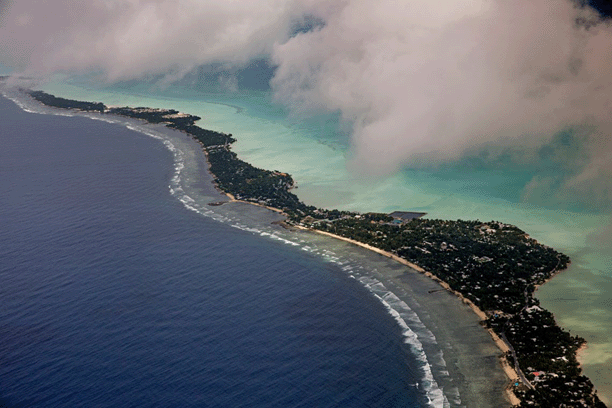
A study by researchers at the US Geological Survey (USGS), the Deltares Institute in the Netherlands and Hawaii University has found that many small islands in the Pacific and Indian Oceans will be uninhabitable for humans by the middle of this century. That is much earlier than previously thought.

Experts say the findings underline the looming climate change driven migration crisis that is predicted to see hundreds of millions of people forced from their homes in the coming years. More than half a
million people around the world live on atoll islands, often extraordinary and beautiful structures based on coral reefs. Their closeness to sea level makes them particularly vulnerable to climate change.
https://www.theguardian.com/environment/2018/apr/25/climate-change-to-drive-migration-from-island-homes-sooner-than-thought

April 26, 2018 Posted by | General News | Leave a comment

New Zealand’s Prime Minister Just Stood Up to One of The Most Powerful Industries in The World

No more drilling. Af, CARLY CASSELLA, 13 APR 2018

Prime Minister Jacinda Ardern is doing everything in her power to wean New Zealand off fossil fuels.

This week, the New Zealand government announced it will no longer grant any new offshore oil exploration permits. The 22 permits that have already been issued are set to expire in 2030.

The new Prime Minister, who took office last year, says this is all part of her aggressive, long-term plan to move towards a carbon-neutral future.

“When it comes to climate change, our plan is clear,” said Ardern, according to The New York Times.

“We are committed to the goal of becoming a net zero emissions economy by 2050.”

Ardern added that her ultimate goal is to switch the country’s electricity system to 100 percent renewable energy by 2035.

….. Ardern’s government has promised that “no current” jobs will be lost as a result of the change, which still honors “all agreements with current permit holders.” https://www.scienceaf.com/new-zealand-prime-minister-jacinda-ardern-offshore-drilling#.WuFOjDvAQh0.twitter

April 26, 2018 Posted by | General News | Leave a comment

UK government struggles to get community consent for nuclear waste dumping

GDF Watch 20th April 2018  Ministers have been told to drop their Local Authority ‘veto’ idea, and to focus on doing more to build community confidence and trust. That is the headline conclusion from a review of responses to the Working With Communities (WWC) consultation that have already been published. Although not a statistically representative sample of the responses submitted, the opinions come from all corners of society.

All the expert and public evidence received during the policy development phase said that giving any tier of local government a ‘veto’ over the process would undermine the policy and any concept of ‘community consent’.

Despite that near unanimous opinion, Ministers still decided to include proposals that would give local authorities the power to block the will of the community. There has been a consistent and broad-based push back to those proposals in the published consultation responses. GDFWatch believes a veto power would make a mockery of the Government’s own consent-based policy and mean the siting process would be DOA [dead on arrival]. Community and place-based organisations, while fully recognising the integral role of local authorities, were equally
critical of the proposal
http://www.gdfwatch.org.uk/2018/04/20/consultations-closed-what-now-summary-of-responses/

April 25, 2018 Posted by | General News | Leave a comment

We are getting perilously close, warn First Nations

Mother Earth and the “too late” time https://beyondnuclearinternational.org/2018/04/24/radioactive-waste-first_nations/ 

April 25, 2018 Posted by | General News | Leave a comment

American community concerned about long term dangers of giant casks of nuclear waste.

Special vehicles are required to move the casks, as are specially built roads that can handle the immense weight.

“We don’t know if this highly dangerous material will be there for another 100 years or a thousand years.

if the casks are not moved in the coming decades, or even centuries, they worry about who would ultimately be responsible for protecting the nuclear waste. It’s unlikely, for example, that Entergy will still own the property, they say.

Pilgrim officials consider moving nuclear waste to higher ground more https://www.bostonglobe.com/metro/2018/04/20/seas-rise-pilgrim-mulls-moving-its-nuclear-waste-higher-ground/rcrkilSqo4cGpfledFyrJJ/story.html? 

April 22, 2018 Posted by | General News | Leave a comment

Earth Day 22 April – time to speak out boldly on climate change

Earth Day and the Hockey Stick: A Singular Message https://blogs.scientificamerican.com/observations/earth-day-and-the-hockey-stick-a-singular-message/

On the 20th anniversary of the graph that galvanized climate action, it is time to speak out boldly

By Michael E. Mann on April 20, 2018 Two decades ago this week a pair of colleagues and I published the original “hockey stick” graph in Nature, which happened to coincide with the Earth Day 1998 observances. The graph showed Earth’s temperature, relatively stable for 500 years, had spiked upward during the 20th century. A year later we would extend the graph back in time to A.D. 1000, demonstrating this rise was unprecedented over at least the past millennium—as far back as we could go with the data we had.

Although I didn’t realize it at the time, publishing the hockey stick would change my life in a fundamental way. I was thrust suddenly into the spotlight. Nearly every major newspaper and television news networkcovered our study. The widespread attention was exhilarating, if not intimidating for a science nerd with little or no experience—or frankly, inclination at the time—in communicating with the public.

Nothing in my training as a scientist could have prepared me for the very public battles I would soon face. The hockey stick told a simple story: There is something unprecedented about the warming we are experiencing today and, by implication, it has something to do with us and our profligate burning of fossil fuels. The story was a threat to companies that profited from fossil fuels, and government officials doing their bidding, all of whom opposed efforts to reduce greenhouse gas emissions. As the vulnerable junior first author of the article (I was a postdoctoral researcher), I found myself in the crosshairs of industry-funded attack dogs looking to discredit the iconic symbol of the human impact on our climate…by discrediting me personally.

In my 2013 book, The Hockey Stick and the Climate Wars: Dispatches from the Front Lines, I gave a name to this modus operandi of science critics: the Serengeti strategy. The term describes how industry special interests and their facilitators single out individual researchers to attack, in much the same way lions of the Serengeti single out an individual zebra from the herd. In numbers there is strength; individuals are far more vulnerable.

The purpose of this strategy, still in force today, is twofold: to undermine the credibility of the science community, thus impairing scientists as messengers and communicators; and to discourage other researchers from raising their heads above the parapet and engaging in public discourse over policy-relevant science. If the aggressors are successful, as I have argued before, we all lose out—in the form of policies that favor special interests over our interests.

As the Serengeti strategy has been deployed against me, I have beenvilified on the editorial pages of The Wall Street Journal and other conservative media outlets, and subject to inquisitions by fossil fuel industry–funded senators, congressmen and attorneys general. My e-mails have been stolen, cherry-picked, taken out of context and broadcast widely in an effort to embarrass and discredit me. I have been subject to vexatious, open-records law requests by fossil fuel industry–funded front groups for my personal e-mails and numerous other documents. I have experienced multiple death threats and have endured threats against my family members. All because of the inconvenience my scientific findings posed to powerful and influential special interests.

Yet, in the 20 years since the original hockey stick publication, independent studies again and again have overwhelmingly reaffirmed our findings, including the key conclusion: recent warming is unprecedented over at least the past millennium. The highest scientific body in the U.S., the National Academy of Sciences, affirmed our findings in an exhaustive independent review published in June 2006. Dozens of groups of scientists have independently reproduced, confirmed and extended our findings, including a team of nearly 80 scientists from around the world who in 2013 published their finding in the premier journal Nature Geoscience that recent warmth is unprecedented in at least the past 1,400 years.

The latest report of the Intergovernmental Panel on Climate Change, the most authoritative and exhaustive assessment of climate science on the planet, concluded recent warmth is likely unprecedented over an even longer time frame than we had concluded. There is tentative evidence, in fact, that the current warming spike is unprecedented in tens of thousands of years.

Of course, the hockey stick is only one of numerous lines of evidence that have led the world’s scientists to conclude climate change is (a) real, (b) caused by burning fossil fuels, along with other human activities and (c) a grave threat if we do nothing about it. There is no legitimate scientific debate on those points, despite the ongoing effort by some people and groups to convince the public otherwise.

Their preferred tactic is to exaggerate the uncertainty in models that project where climate change is heading and argue such uncertainty is a cause for inaction, when precisely the opposite is the case. Arctic sea ice is disappearing faster than the climate models have predicted. The Greenland and Antarctic ice sheets appear prone to collapse sooner than we previously thought—and with that, estimates of the sea level rise we could see by the end of this century have doubled from previous estimates of about three feet to more than six feet. If anything, climate model projections have proved overly conservative; they are certainly not an exaggeration.

Scientists are finding other examples as well. In part as a result of our own work three years ago, there is an emerging consensus—as publicized in recent news accounts—that the “conveyor belt” of ocean circulation may be weakening sooner than we expected. The conveyor delivers warm waters from the tropics to the higher latitudes of the North Atlantic, supporting vibrant fish communities there and moderating climates in western Europe and eastern North America. The earlier melt of Greenland ice, it appears, is freshening the surface waters of the subpolar North Atlantic, inhibiting the sinking of cold, salty water that helps drive the conveyor.

When the hockey stick was first attacked in the late 1990s I was initially reluctant to speak out, but I realized I had to defend myself against a cynical assault on my science and on me. I have come to embrace that role. What more noble cause is there than to fight to preserve our planet for our children and grandchildren?

There is great urgency to act now if we are to avert a dangerous 2- degree Celsius (3.6-degree Fahrenheit) planetary warming. My own recent work suggests the challenge is greater than previously thought. Yet I remain cautiously optimistic we will act in time. Along with many other Americans, I have been inspired by the renewed enthusiasm of our youth, who are demanding action now when it comes to the societal and environmental threats they face. Indeed, I have committed myself to helping insure a future in which we avoid catastrophic climate change. So let me conclude with this exhortation from the epilogue of The Hockey Stick and the Climate Wars:

“While slowly slipping away, that future is still within the realm of possibility. It is a matter of what path we choose to follow. I hope that my fellow scientists—and concerned individuals everywhere—will join me in the effort to make sure we follow the right one.”

April 20, 2018 Posted by | General News | Leave a comment

Unlike the Kimba/Hawker area, the 82 residents of quiet French village Bure are up in arms against nuclear waste dumping

Quiet no more, French village becomes centre of anti-nuclear protest, Reuters  Gilbert ReilhacLucien Libert, 19 Apr 18.

The 82 residents of the French village of Bure lived a quiet life until the government began testing the feasibility of storing nuclear waste there. Now Bure is rocked by protests as a final decision on the project looms.

For the past 20 years, French nuclear waste agency Andra has tested the stability of the clay of the northeastern village to see if it could hold radioactive waste for hundreds of thousands of years. Andra is preparing a formal request for next year to build the 25 billion euro ($31 billion) facility to hold waste from the reactors of state-owned utility EDF.

“Life will become unbearable here with the nuclear waste and all the demonstrators,” said Bure mayor Gerard Antoine, who breeds beef cattle.

Antoine approved the installation of Andra research facilities two decades ago but said he now regrets that decision and would say no if he were asked today.

Hundreds of demonstrators who built a camp nearby were kicked out by police in February but say they are there for the long run and will fight the project until the government changes its plans.

“We are heading straight for … a nuclear disaster, that’s why we’re against it,” said Jean-Marc Fleury, a local elected official with an environmentalist party.

Police are maintaining a heavy presence while protesters have regrouped in and around a house in the Bure village centre…..

For now, spent fuel from French nuclear reactors is stored in pools next to the reactors before it is shipped to state-owned nuclear fuel group Orano’s recycling plant in La Hague, western France.

But La Hague is not designed for long-term storage and France does not have a solution 40 years after investing heavily in nuclear energy. Other countries that use nuclear power face the same problem……..https://uk.reuters.com/article/uk-france-nuclearpower-waste/quiet-no-more-french-village-becomes-centre-of-anti-nuclear-protest-idUKKBN1HP1S7

April 20, 2018 Posted by | General News | Leave a comment

Donald Trump says he’s ready to pull the plug on the summit meeting with Kim Jong Un

Trump leaves open possibility of bailing on meeting with North Korea leader, Military Times, Matthew Pennington, The Associated Press , 19 Apr 18, WASHINGTON — President Donald Trump said that although he’s looking ahead optimistically to a historic summit meeting with North Korean leader Kim Jong Un he could still pull out if he feels it’s “not going to be fruitful.”

April 20, 2018 Posted by | General News | Leave a comment