RADIOACTIVE PIGS Japan ‘covering up’ Fukushima nuclear danger-zone radiation levels and blackmailing evacuees to return to radiated areas swarming with radioactive pigs and monkeysThree reactors went into meltdown after the 2011 Japanese tsunami in the worst accident since Chernobyl, leaving an apocalyptic vision of ghost towns and overgrown wildernesses and scared residents refuse to return Sun UK, By Patrick Knox 19th April 2018
JAPAN is lying to the world about nuclear-ravaged Fukushima’s recovery while forcing terrified evacuees to return to their radioactive homes, it is claimed.
More than seven years after the nuclear catastrophe rocked the world, many of the 154,000 people who fled their homes have not returned and towns remain deserted.
Thousands of irradiated wild boars and monkeys roam around while poorly paid and protected decontamination workers scrub homes, schools and shops down ready for people to come home.
Chilling footage of taken inside the evacuated areas of Fukushima City and Köryama lay bare the disaster that unfolded after an earthquake, measuring 9.01 on the Moment Magnitude scale, struck off the coast of Japan on March 11, 2011.
……….Now there is a big campaign is under way to make people return but residents, campaigners and experts believe it not safe.They accuse the Japanese authorities of wanting to allay public fears over the nuclear power by downplaying the dire consequences of the leak.
Propaganda videos showing the remarkable recovery of Fukushima have been spread by the government on its social media accounts.
But senior nuclear specialist Shaun Burnie, from Greenpeace Japan, said the nuclear nightmare continues.
He said: “They are not telling the whole truth either to the 127 million people of Japan or to the rest of the world – about the radiation risks in the most contaminated areas of Fukushima.
“The nuclear crisis is not over – we are only in year seven of an accident that will continue to threaten public health, and the environment, for decades and well into the next century.
“Attempts by the government and the nuclear industry communicate that it is safe and it’s over are a deliberate deception.”
……….Mr Burnie said: “If they can create the illusion of the region that that has recovered from the nuclear accident they think it will reduce public opposition. [to development of nuclear power]”But meanwhile the crisis continues at the Fukushima plant.
He said: “The massive Ice Wall built at the nuclear plant to stop contamination of groundwater is a symbol of this failure and deception – this is no Game of Thrones fantasy but the reality of a nuclear disaster that knows no end.”
Today he says there were areas of Fukushima where radiation levels could give a person’s maximum annual recommended dose within a week.
He said: “This is of particular concern with regards to poorly paid decontamination workers, thousands of whom have been involved in attempts to decontaminate radiation around people’s homes, along roads and in narrow strips of forest.”
Mr Burnie said the government claims decontamination has been completed in 100 percent of affected areas after a £8bn clean up operation.
But he added: “What they don’t explain is that 70-80 percent of areas such as Namie and Iitate – two of the most contaminated districts – are forested mountain which it is impossible to decontaminate.
“In areas opened in March 2017 for people to return – radiation levels will pose a risk until the middle of the century.
“These areas are still to high in radiation for people to return safely – and is one reason so few people are returning.”
Meanwhile heavy-handed tactics are being used with some fearful residents reporting that they have been warned they won’t receive lifeline compensation cash if they don’t comply.
Dr Keith Baverstock, a radiation health expert who was at the World Health Organization at the time disaster, told Sun Online: “For the past two years the Japanese government has encouraged the evacuees to return to their homes, but relatively few people have taken up this offer, even though there is a threat – it may even now be a fact – that their compensation will cease.”
Dr Baverstok says the plant and the areas remain a danger zone for humans.
He said: “It seems there is no end in sight for the release of radioactive water from the site and these releases will inevitably put more radioactivity into the food chain if the local waters are fished.
The Latest on the United States and North Korea , WASHINGTON (AP) Chron — 19 Apr 18 The anti-nuclear weapons group that won last year’s Nobel Peace Prize says it’s “very supportive” of a summit between President Donald Trump and North Korean leader Kim Jong Un, after months of risky tensions between them.
Executive director Beatrice Fihn of ICAN says that mutual threats between the two leaders have made the risk of nuclear confrontation “really dangerously high.”
Speaking to reporters, Fihn said that if the summit in late May or early June makes progress on disarmament, “we’ll definitely applaud it … every step forward is positive.” Overall, she reiterated ICAN’s support for a nuclear weapons ban treaty, saying, “It’s hard to see the world being able to solve one nuclear-armed state at this point in isolation from the other states.”…..https://www.chron.com/news/politics/article/The-Latest-US-says-it-s-maintaining-pressure-on-12847167.php
Two main types of radiation in space are extremely harmful to humans: protons spewed out by the sun and cosmic rays. These high-energy particles and the secondary radiation they create penetrate deep into cells, promoting chronic and sometimes deadly diseases such as cancer.
Cancer is a major risk of radiation exposure, but there are more immediate and surprising symptoms. Deep-space radiation might promote cataracts and impair eyesight
Animal-based experiments also suggest radiation could damage the nervous system, including the brain, which might impair astronauts’ focus and memory.
But the cosmos teems with invisible, high-energy radiation – particles travelling near light-speed that can pummel human travellers and the surfaces of worlds like tiny bullets.
NASA recently signed on to test a new polymer-based radiation-blocking vest for astronauts, called AstroRad, on its next mission around the moon.
Musk, meanwhile, has said his new Big Falcon Rocket will use water to block radiation, though only during emergencies.
“Ambient radiation damage is not significant for our transit times,” Musk said during an Oct. 2017 chat on Reddit. “Just need a solar storm shelter, which is a small part of the ship.”
But just how bad is the problem of radiation in space? Continue reading →
Nasa is to make a major announcement about its project to put nuclear power in space.
The agency has been working on “Kilopower” – a project to use a nuclear reactor to generate clean energy on the Moon, Mars and beyond – for some time. And now it will hold a press conference to reveal the latest results from its plans to unveil a new space exploration power system, it has said.
The conference will see the agency discuss the results of its latest experiments, it said in a release. It has been conducted from November 2017 through until March 2018, at the Nevada National Security Site or NNSS.
That site, deep in the Nevada desert, has long served as a testing ground for nuclear experiments. In the 1950s, for instance, it was used to detonate nuclear bombs that could be felt across the state and into Las Vegas.
Nasa hopes that Kilopower can use some of that same nuclear technology to provide energy for space explorers as they make their way through the solar system. They will need energy for a wide variety of tasks, from generating the light, water and oxygen they need to conducting experiments and sending information back to Earth.
“That’s why NASA is conducting experiments on Kilopower, a new power source that could provide safe, efficient and plentiful energy for future robotic and human space exploration missions,” Nasa wrote in a statement in January.
“This pioneering space fission power system could provide up to 10 kilowatts of electrical power — enough to run two average households — continuously for at least ten years. Four Kilopower units would provide enough power to establish an outpost.”
Using nuclear fission will allow astronauts to be able to generate energy wherever they are. If people on Mars, for instance, the amount of energy coming from the sun varies wildly; on Moon, the night lasts for 14 days.
“We want a power source that can handle extreme environments,” says Lee Mason, NASA’s principal technologist for power and energy storage. “Kilopower opens up the full surface of Mars, including the northern latitudes where water may reside. On the Moon, Kilopower could be deployed to help search for resources in permanently shadowed craters
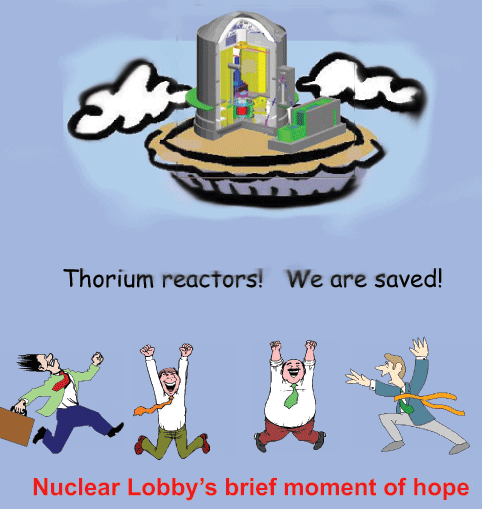
https://www.ucsusa.org/sites/default/files/legacy/assets/documents/nuclear_power/thorium-reactors-statement.pdf Some people advocate the use of thorium to fuel nuclear power plants. Thorium could be used in a variety of different types of reactors, including conventional light-water reactors, which are the type used in the United States. However, thorium cannot be used by itself to sustain a nuclear chain reaction: it must be used together with a fissile material such as enriched uranium, uranium-233, or plutonium.
Nuclear reactors fueled with thorium and uranium do not provide any clear overall advantages over reactors fueled with uranium alone. All types of nuclear fuels, whether uranium- or thorium-based, generate large amounts of heat during reactor operation, and failing to effectively remove that heat will lead to serious safety problems, as was seen at Fukushima. The U.S. Department of Energy has concluded after a review that “the choice between uranium-based fuel and thorium-based fuel is seen basically as one of preference, with no fundamental difference in addressing the nuclear power issues [of waste management, proliferation risk, safety, security, economics, and sustainability].”1 However, the report also notes that “Since no infrastructure currently exists in the U.S. for thorium-based fuels, and the processing of thorium-based fuels is at a lower level of technical maturity when compared to processing of uranium-based fuels, costs and RD&D [research, development and deployment] requirements for using thorium are anticipated to be higher.”
Some people believe that liquid fluoride thorium reactors, which would use a high-temperature liquid fuel made of molten salt, would be significantly safer than current-generation reactors. However, such reactors have major flaws. There are serious safety issues associated with the retention of fission products in the fuel, and it is not clear these problems can be effectively resolved. Such reactors also present proliferation and nuclear terrorism risks because they involve the continuous separation, or “reprocessing,” of the fuel to remove fission products and to efficiently produce U-233, which is a nuclear weapon-usable material. Moreover, disposal of the used fuel has turned out to be a major challenge. Stabilization and disposal of the remains of the very small “Molten Salt Reactor Experiment” that operated at Oak Ridge National Laboratory in the 1960s has turned into the most technically challenging cleanup problem that Oak Ridge has faced, and the site has still not been cleaned up.
Hundreds of lawmakers from Germany, France, and Britain have called on their counterparts in the U.S. Congress to support the 2015 nuclear deal between Iran and six world powers, calling it a “major diplomatic breakthrough.”
The initiative came as U.S. President Donald Trump has set a May 12 deadline to either improve or scrap the deal providing Iran with relief from sanctions in return for curbs on its atomic program.
“We were able to impose unprecedented scrutiny on the Iranian nuclear program, dismantle most of their nuclear enrichment facilities, and drastically diminish the danger of a nuclear arms race,” reads a statement signed by some 500 MPs from the German, British, and French national parliaments and posted online on April 19.
Britain, Germany, and France are signatories to the nuclear accord, along with the United States, China, and Russia.
Trump accuses Tehran of violating the spirit of the agreement and has called on European powers to “fix” what he says are the “terrible flaws” of the agreement. He wants new restrictions to be imposed on Tehran’s nuclear and missile programs.
“It is the U.S.’s and Europe’s interest to prevent nuclear proliferation in a volatile region and to maintain the transatlantic partnership as a reliable and credible driving force of world politics,” the European lawmakers said.
They wrote that abandoning the accord would result “in another source of devastating conflict in the Middle East and beyond,” would “diminish the value of any promises or threats made by our countries,” and would damage “our credibility as international partners in negotiation, and more generally, to diplomacy as a tool to achieve peace and ensure security.”
“We therefore urge you to stand by the coalition we have formed to keep Iran‘s nuclear threat at bay,” they added.
French President Emmanuel Macron and German Chancellor Angela Merkel will both travel to Washington next week on separate official visits, in part to convince Trump not to pull the United States out of the nuclear deal with Iran.
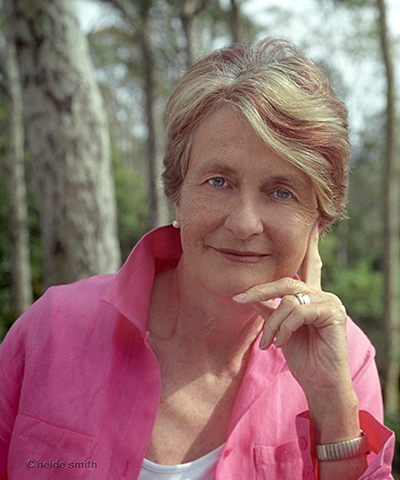
Interview A conversation with Helen CaldicottFrom the forthcoming issue (May 2018)Taylor and Francis online, 17 Apr 18
Dan Drollette Jr For decades, anti-nuclear weapons campaigner Helen Caldicott (helencaldicott.com) has been educating people about the effects of nuclear weaponry and issuing rousing calls to action. A practicing pediatrician from Australia, Caldicott was the subject of an Oscar-winning short film, If You Love This Planet, and is the author of 12 books.In this Skype interview from her home in Sydney, Australia, the 79-year-old Caldicott doesn’t pull punches. For nearly six decades, she has been taking on the powers that be, in joyously feisty terms: She has said that the US Defense Department should be re-named the Killing Department and characterized Barack Obama as an “intelligent, lovely man, who failed the world” when it came to eliminating nuclear weapons. She considers the movie Dr Strangelove more of a documentary than a satire, labeled arms manufacturers “wicked,” and called American politicians “corporate prostitutes.”
And of the current president, Caldicott said: “We’ve got a man in charge who I think has never read a book, and who knows nothing about global politics, or his own country’s politics. Who operates with his own kind of sordid intuition. And he’s putting people in every department committed to destroying that department. He’s absolutely destroying the infrastructure of America.”
Noting that it was International Women’s Month, Caldicott had one thing to say to young women: “We need to take over, because we’re on the short course to annihilation, and we need to say to men ‘Look, stand aside, you need your bottom smacked.’ ”
Yet for someone who has spent a lifetime fighting vigorously against the specter of nuclear annihilation, Caldicott reveals that she is remarkably pessimistic about humanity’s chances. Caldicott said that she wants her tombstone to read: “She tried.”
Editor’s note: This interview has been condensed and edited for clarity.
……..I noticed there seem to be a lot of people in the anti-nuclear weapons movement with medical backgrounds.
Helen Caldicott:
It’s a medical problem. And explaining the medical dangers of nuclear war was a very good way to teach people what the danger is, and to bring it home to their city. That approach was – and is – very powerful. During the 1980s, when I was one of the leaders of the nuclear weapons freeze movement and one of the founding presidents of PSR, we at PSR held symposia on the medical effects of nuclear war at various universities, all around the country. It started at Harvard, where we had George Kistiakowsky, a physicist who had been in the Manhattan Project as an explosives expert (https://www.manhattanprojectvoices.org/oral-histories/george-kistiakowskys-interview). It was quite wonderful.
Although afterwards, some journalists did say: “What are doctors talking about this for, this is a political issue.” And we said no, it’s a medical issue, because it will create the final medical epidemic of the human race……….
…… I think we’re actually in a much more dangerous situation than we were during the height of the Cold War, though no one’s really taking any notice. I mean, Dan Ellsberg went to 14 different publishers before Bloomsbury published his book. And my latest book, Sleepwalking to Armageddon, (https://thenewpress.com/books/sleepwalking-armageddon) is not selling very well at all. It seems like society is practicing psychic numbing and manic denial. We’re into clothes and food, and all sorts of things like that, while life on the planet just hangs in the balance………
Of course. America’s economy is built on killing. It’s the Killing Department, not the Defense Department. There’s no defense from nuclear weapons. It’s all run by voracious, wicked corporations, such as Lockheed-Martin, General Electric, General Dynamics, and the like. And many American politicians are corporate prostitutes. ……
Exelon Official: No New Nuclear Plants To Be Built in the U.S. Because of the plants’ size and security needs, the costs become prohibitive.U.S. News By Alexa Lardieri, Staff WriterApril 16, 2018,
A SENIOR OFFICIAL WITH America’s largest nuclear plant operating company is predicting a dim future for nuclear power in the U.S.
William Von Hoene, senior vice president and chief strategy officer at Exelon, said last week that he doesn’t foresee any new nuclear plants being built in the United States due to their high operating costs.
“The fact is – and I don’t want my message to be misconstrued in this part – I don’t think we’re building any more nuclear plants in the United States. I don’t think it’s ever going to happen,” S&P Global quoted Van Hoene as saying at the annual U.S. Energy Association’s meeting in Washington, D.C. “I’m not arguing for the construction of new nuclear plants. They are too expensive to construct, relative to the world in which we now live.”………
“I think it’s very unlikely that absent some extraordinary change in environment or technology, that any nuclear plants beyond the Vogtle plant will be built in my lifetime, by any company,” S&P Global quoted Van Hoene as saying, referring to a plant currently under construction in Georgia.
The federal government’s Indigenous ranger program
employs more than 700 workers across the country,
but the scheme is under threat.
By Rhiannon Elston
‘Sophia Walter from the Country Needs People campaign,
an alliance of 36 Aboriginal and Torres Strait Islander organisations
and the Pew Charitable Trust,
has called on the minister to urgently deliver the promised funding extension.
‘“We know ranger groups around the country are getting nervous
with contracts ending in just two months,” she says. … ‘
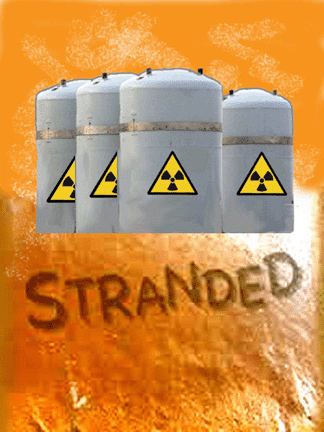
The township will be stuck with 753 metric tons of nuclear waste because the U.S. has no plan for its disposal. Oyster Creek’s used nuclear fuel now goes to the plant’s spent fuel pool, a specially designed area where the fuel cools for five years. After that, it’s moved to dry cask storage in metal canisters safely contained within a massive concrete structure.
Gary Quinn, Lacey’s former mayor and a current committeeman, said the town never anticipated having to deal with the spent fuel, which stays radioactive for hundreds of thousands of years.
With nuke plant shutting down, N.J. community inherits 1.7M pounds of waste WHYY By Catalina Jaramillo April 16, 2018
As nuclear power plants around the country continue to shut down — 20 reactors are already on their way out, and several more are expected to follow — questions remain about what to do with the nuclear waste they leave behind.
The U.S. Department of Energy made the commitment to remove and dispose spent nuclear fuel from reactors starting in 1998, but a federal plan to store that waste at Yucca Mountain in Nevada never came to fruition. And there are no plans in place for a permanent spent fuel repository.
Meanwhile, communities hosting nuclear plants — including Lacey Township, New Jersey — face an uncertain future. Exelon’s Oyster Creek nuclear generating station, the oldest operating in the country, will retire in October. The plant, which sits alongside Barnegat Bay, in Ocean County, has served as the town’s main economic driver for 50 years. Residents are anxious about what will happen next.
“Is it going to bring the town down? As far as empty houses, … lost business and things like that,” asked Richard Rom, community president of Pheasant Run, a senior complex with more than 400 residents. “I’m concerned.” ……..
Lacey is not only losing the economic benefits of hosting the nuclear plant. The township will be stuck with 753 metric tons of nuclear waste because the U.S. has no plan for its disposal. Oyster Creek’s used nuclear fuel now goes to the plant’s spent fuel pool, a specially designed area where the fuel cools for five years. After that, it’s moved to dry cask storage in metal canisters safely contained within a massive concrete structure.
Gary Quinn, Lacey’s former mayor and a current committeeman, said the town never anticipated having to deal with the spent fuel, which stays radioactive for hundreds of thousands of years.
“When it was first built, it was never agreed upon that it would become a spent fuel storage facility — which … at this point in time appears to be what we’re facing,” Quinn said.
………Last year, bills authorizing federal funds to compensate Lacey and other communities for storing the nuclear waste were introduced in the U.S. House and Senate. The Stranded Act of 2017 establishes that — because the federal government failed to keep the waste — the communities hosting nuclear plants are “interim nuclear waste storage sites” and should be paid what the Nuclear Waste Policy Act of 1982 set as a rate for states operating waste sites: $15 per kilogram of spent nuclear fuel.In the case of Oyster Creek, which by the end of 2018 will have approximately 1.66 million pounds of nuclear waste, that would work out to $11.2 million a year for Lacey Township. That’s exactly what the town could be losing in energy tax receipts.
But the bills, which have been referred to committees, have gained no traction……..
Russian President Vladimir Putin warns of global ‘chaos’ if West strikes Syria again, ABC News 16 Apr 18, Russian President Vladimir Putin has warned that further Western attacks on Syria would bring chaos to world affairs, as Washington prepared to increase pressure on Russia with new economic sanctions.
Key points:
Vladimir Putin said further attacks on Syria will bring “chaos” in world affairs
America accused Russia of blocking attempts to investigate Syria’s chemical weapons capabilities
New sanctions against Russia will target companies linked to Syria
In a telephone conversation with his Iranian counterpart Hassan Rouhani, Mr Putin and Mr Rouhani agreed the Western strikes had damaged the chances of achieving a political resolution in the seven-year Syria conflict, according to a Kremlin statement.
“Vladimir Putin, in particular, stressed that if such actions committed in violation of the UN Charter continue, then it will inevitably lead to chaos in international relations,” the Kremlin statement said.
New Mexico Political Report 11th April 2018 , Groups opposed to construction of a storage facility for spent nuclear fuel
from the nation’s commercial reactors are on a tour this week to make sure people know what’s being proposed for southern New Mexico.
The Nuclear Regulatory Commission is considering a proposal from Holtec International to build and transport the waste, now stored in casks at various nuclear power plants around the country, to southern New Mexico.
The Dept. for Business, Energy & Industrial Strategy (BEIS), the government department dealing with the GDF programme, has sent Cumbria Trust and other organisations a list of responses to questionswhich went unanswered at recent workshop events which we attended. Unfortunately and perhaps unsurprisingly they have been very selective in which questions they have chosen to answer, and which to ignore. They failed to give adequate responses to a number of Cumbria Trust’s key questions. Here are just a few of them:
How could it possibly be appropriate for the first and only test of public support to take place 20 years after the process starts, during which time the community will have been subject to a large scale borehole drilling programme lasting for a decade or more?
Why does BEIS suggest (in 4.57) that a local authority member of a Community Partnership may have the power to overrule other partnership members? What kind of partnership would that be if one member could ignore the others?
Why is the process very simple to enter – even a member of the public can formally express an interest, and yet be extremely difficult to leave?
Why has BEIS gone against the advice of their own advisory committee, CoRWM, and many others, by watering down the geological screening report to such an extent that it no longer screens any areas out at all?
This gives the clear impression that the consultations are not being taken seriously, and they are there to give the appearance of listening, while continuing along a predetermined path.
India Slashes Plans for New Nuclear Reactors by Two-Thirds, April 11, 2018 The Energy Collective, The Financial Express, one of India’s major newspapers, reports that the Narendra Modi government, which had set the ambitious 63,000 MW nuclear power capacity addition target by the year 2031-32, has cut it to 22,480 MW, or by roughly two thirds.
…….. The drastic reduction in planned construction of new reactors will diminish India’s plans to rely on nuclear energy from 25% of electrical generation to about 8-10%.
…. It appears that India’s long list of nuclear reactors, which at one time it aspired to build, is now in the dust bin. Instead, a much shorter list of 19 units composed of indigenous 700 MW PHWRs and Russian VVERs will be completed for an additional 17 GWE……..
The list of 57 cancelled reactors also includes 700 MW PHWRs and Russian VVERs. In addition it includes future plans for Areva EPRs and Westinghouse AP1000s. Four fast breeder reactors are part of this list which raises questions about India’s policy commitment to its three phase plan for nuclear energy. …….
While the Department of Atomic Energy did not specify the reasons for the change, it is likely that India has come face-to-face with the same reality that other developing nations seeking rapid construction of nuclear power plants. The challenges are the lack of funding, a reliable supply chain that can handle a huge increase in orders, and a trained workforce to build and operate the plants at the planned level of activity.
Apr 15, 2026 01:00 AM in Canberra, Melbourne, Sydney
Join the International Physicians for the Prevention of Nuclear War (IPPNW) on Tuesday, April 14th for a timely webinar exploring the risks associated with nuclear power and challenging the myth that it offers a simple, safe, carbon-free solution to the climate crisis
21 April Webinar: No Nuclear Weapons in Australia
Start: 2026-04-21 18:00:00 UTC Canberra, Melbourne, Sydney (GMT+10:00)
End: 2026-04-21 19:30:00 UTC Canberra, Melbourne, Sydney (GMT+10:00)
Event Type: Virtual A virtual link will be communicated before the event.










 Antinuclear