In the fallout, Facebook faces its toughest test on privacy safeguards, and its founder and CEO, Mark Zuckerberg, has been summoned by MPs in the U.K.He faces similar calls from the U.S. Congress and from India, with revelations that Cambridge Analytica worked to influence the 2016 Brexit referendum and elections in India, Nigeria and other countries as well. Continue reading
4 firms on ICAN list ban nuclear arms investment
 https://www3.nhk.or.jp/nhkworld/en/news/20180324_11/ NHK has learned that at least 4 Japanese financial institutions listed by a nuclear-weapons watchdog as investing in firms involved in the production of nuclear weapons have internal policies forbidding such ties.
The International Campaign to Abolish Nuclear Weapons, or ICAN, says 329 banks and asset management firms in 24 countries and regions invested in companies involved in nuclear weapons production over a 3-year period starting in 2014.
NHK contacted 7 Japan-based banks and other institutions listed by the Nobel Peace Prize-winning group. Asked about ICAN’s findings, 3 of the firms said they do not currently deal with such companies. Four institutions did not reply.
At least 4 said their internal regulations restrict them from investing or providing loans to businesses related to nuclear weapons production.
ICAN says 30 non-Japanese companies have suspended such investments following the adoption last year of the UN Treaty on the Prohibition of Nuclear Weapons.
Yuki Tanabe, an official at the Japan Center for a Sustainable Environment and Society, says banks and other institutions could be accused of lacking social responsibility by doing business with such companies — even when they have no direct deals with them, or have policies against such investments.
Research indicates links between cellphone (electromagnetic) radiation to heart and-brain tumors
 Italian study links cellphone radiation to heart and-brain tumors https://www.ewg.org/release/italian-study-links-cellphone-radiation-heart-and-brain-tumors#.WrVYStRubGg Alex Formuzis (202) 667-6982 alex@ewg.org, MARCH 22, 2018 WASHINGTON – Laboratory animals exposed to cellphone radiation developed heart and brain tumors similar to the types seen in some studies of human cellphone users, according to an Italian study published today. EWG said the findings reinforce the need for people, especially children, to exercise caution when using cellphones and other radiation-emitting devices.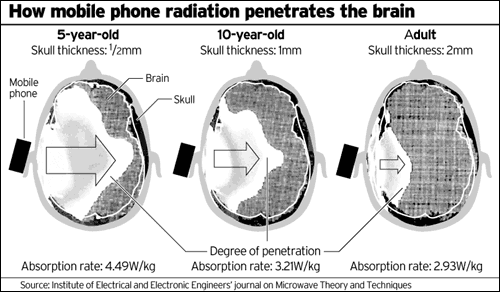
The study by the Ramazzini Institute, published in the journal Environmental Research, supports the findings of the federal National Toxicology Program. Last month, the NTP reported that male rats exposed to radio-frequency radiation at levels including those emitted by cellphones had a greater chance of developing malignant brain cancer, and tumors in the heart and other organs.
The Ramazzini Institute’s research found that male rats exposed to the radio-frequency radiation emitted by cellphones using GSM networks had a greater chance of developing heart tumors and hyperplasias affecting Schwann cells, which support the peripheral nervous system. Schwann cell tumors were also observed in human epidemiological studies of tumor incidence in cellphone users, and in the NTP studies of lab animals.
“The Italian study reinforces the need for a precautionary approach when it comes to radiation from phones and other devices, especially for young kids,” said Olga Naidenko, Ph.D., senior science advisor at EWG. “Children’s bodies develop through the teenage years and may be more affected by cellphone use. As new telecom networks are built around the country, in-depth assessment of children’s health risks from cellphone radiation is essential.”
In 2011, the World Health Organization’s International Agency for Research on Cancer declared the kind of radiation emitted by cellphones a “possible carcinogen” based on human epidemiological studies that found increased gliomas and acoustic neuromas in long-term cellphone users. The data on health effects of cellphone radiation in laboratory animals collected by the NTP and the Ramazzini Institute studies support the earlier evidence from human studies that cellphone radiation increases the risk of cancer.
EWG has been at the forefront of public interest organizations raising concerns about connections between cellphone use and cancer. EWG’s 2009 Science Review on Cancer Risks and Children’s Health summarized comprehensive studies showing a variety of health harms linked to long-term cellphone use. This included increased risk of brain tumors; lower sperm counts, motility and vitality among men; neurological effects; and changes in brain metabolism.
While the public debate on cellphone radiation risks has focused on cancer, which progresses slowly in response to lifelong exposures, a growing body of research suggests that even shorter exposures could cause harm. In a study published last year, Kaiser Permanente researchers reported that pregnant women exposed to radio-frequency radiation from sources such as wireless devices and cell towers had nearly a threefold greater frequency of miscarriage.
In December 2017, the state of California issued official guidelines advising cellphone users to keep phones away from their bodies. The state Department of Public Health also recommended that parents consider reducing the amount of time their children use cellphones, and encourage kids to turn the devices off at night.
To help concerned consumers, EWG has created tools and tips for reducing exposure to cellphone radiation. This includes EWG’s Guide to Safer Cellphone Use and Six Questions About Cellphone Radiation and Your Health.
For more information about how studies on laboratory animals can help answer the questions about human health risks from radio-frequency radiation, read EWG’s Comments to the National Toxicology Program on the NTP cellphone radiation study.
A turning point for social media – the Cambridge Analytica Scandal
Aral described Cambridge Analytica as “a nefarious actor with a very skewed understanding of what’s morally right and wrong.” He pointed out that there’s an important line to be drawn between the appropriate uses of technology “to produce social welfare” through platforms like Facebook, and the work that Cambridge Analytica did. “It would be a real shame if the outcome was to, in essence, throw the baby out with the bathwater and say that the only solution to this problem is to pull the plug on Facebook and all of these social technologies because you know there’s no way to tell the difference between a bad actor and a good actor.”
All said, sophisticated data analytics “may also be used for generating a lot of good,” said Nave. “Personalized communication may help people to keep up with their long-term goals [such as] exercise or eating healthier, and get products that better match one’s needs. The technology by itself is not evil.”http://knowledge.wharton.upenn.edu/article/fallout-cambridge-analytica/
 Why the Cambridge Analytica Scandal Is a Watershed Moment for Social Media, Wharton University of Pennsylvania, 24 March 18 ( LISTEN TO THE PODCAST – on original) Jennifer Golbeck from the Univeristy of Maryland and MIT’s Sinan Aral discuss the fallout from the Cambridge Analytica scandal.
Serious concerns have arisen in the past week over how social media firms guard the privacy of their users’ personal data, and how the analytics of such data can influence voter preferences and turnout. Those worries follow a whistleblower’s account to The Observer newspaper in the U.K. about how Cambridge Analytica, a data analytics firm with offices in London and New York City, had unauthorized access to more than 50 million Facebook profiles as it micro-targeted voters to benefit Donald Trump in the 2016 U.S. presidential election.
Earth Hour 24 March
 Scotsman 21st March 2018, WWF’s Earth Hour is the biggest global campaign for the
environment. Its unique display of darkness has become a phenomenon over
the past decade, with last year proving to be the biggest and best yet.
https://www.scotsman.com/news/opinion/dr-sam-gardner-world-embraces-the-dark-side-for-earth-hour-1-4708872
Reckless nuclear weapons testing cost many many civilian lives
US nuclear tests killed far more civilians than we knew https://qz.com/1163140/us-nuclear-tests-killed-american-civilians-on-a-scale-comparable-to-hiroshima-and-nagasaki/ Tim Fernholz@timfernholz December 21, 2017
When the US entered the nuclear age, it did so recklessly. New research suggests that the hidden cost of developing nuclear weapons were far larger than previous estimates, with radioactive fallout responsible for 340,000 to 690,000 American deaths from 1951 to 1973.
The study, performed by University of Arizona economist Keith Meyers, uses a novel method (pdf) to trace the deadly effects of this radiation, which was often consumed by Americans drinking milk far from the site of atomic tests.
From 1951 to 1963, the US tested nuclear weapons above ground in Nevada. Weapons researchers, not understanding the risks—or simply ignoring them—exposed thousands of workers to radioactive fallout. The emissions from nuclear reactions are deadly to humans in high doses, and can cause cancer even in low doses. At one point, researchers had volunteers stand underneath an airburst nuclear weapon to prove how safe it was:
The emissions, however, did not just stay at the test site, and drifted in the atmosphere. Cancer rates spiked in nearby communities, and the US government could no longer pretend that fallout was anything but a silent killer.
The cost in dollars and lives Continue reading
Katharine Hayhoe on how to talk about climate change
Katharine Hayhoe Reveals Surprising Ways to Talk About Climate Change These climate-skeptic-whispering tactics have nothing to do with science Sierra BY KATIE O’REILLY | MAR 20 2018
Katharine Hayhoe on how to talk about climate change (highlights video)
Katharine Hayhoe isn’t your typical atmospheric scientist. Throughout her career, the evangelical Christian and daughter of missionaries has had to convince many (including her pastor husband) that science and religion need not be at odds when it comes to climate change. Hayhoe, who directs Texas Tech’s University’s Climate Science Center, is CEO of ATMOS Research, a scientific consulting company, and produces the PBS Kids’ web series “Global Weirding,” rose to national prominence in early 2012 after then-presidential candidate Newt Gingrich dropped her chapter from a book he was editing about the environment. The reason? Hayhoe’s arguments affirmed that climate change was no liberal hoax. The Toronto native attracted the fury of Rush Limbaugh, who encouraged his listeners to harass her.
After the ensuing deluge of hate mail, Hayhoe made a habit of reaching out to climate foes. Along with her husband Andrew Farley, she wrote A Climate for Change: Global Warming Facts for Faith-Based Decisions. She also authored 2014’s third National Climate Change Assessment for the National Academy of Sciences. Last year, Fortune magazine named Hayhoe one of the world’s 50 greatest leaders. While she frequently gives talks on climate science and faith, she often makes a point of keeping science out of her talks………..
Sierra: From a global perspective, the United States stands out for our considerable contingent of vocal climate change deniers. Why do you think this attitude is so uniquely American?
Katharine Hayhoe: There’s some of that sentiment in Australia as well, and in Alberta, the province known as the “Texas of Canada.” Interestingly, if you look across all countries’ fossil fuel resources and political positions on climate, you’ll find that economics doesn’t account for all of it. Fossil fuel influences certainly have an influence, but look at Norway—oil made them rich! One recent study concluded that the U.S. Republican Party is an anomaly. Social scientists study the characteristics of different cultures—some, for instance, are very hierarchical, some are very communal, and some are very independent. I can do it myself. If you correlate the predominance of rejection of climate science with the independence of the culture, I’d bet you anything you’d find a significant correlation. The U.S. is the most culturally independent country in the world, followed by Australia, and then Alberta is much more independent-minded than other Canadian provinces.
Where does this independence stem from?
It comes from the ruggedness of the terrain and the challenges that people had to overcome and endure—and the recency of those struggles.
……. Of course, fighting climate change requires people to work together for the benefit of the entire community—to not just go it alone. When you try to talk climate action to resilient pioneer types, they’re often hearing that the government is gonna be their nanny and pick their car, set their thermostat, limit their water, and tell them what they can and can’t do. And rugged individualists do not need a nanny. They believe the government wants to take away their freedom, and what’s more American than freedom?…….
So how can you make tough, self-reliant, freedom-loving types care about climate change?
That’s the real problem because no one thinks it really matters. Even the people who think it’s really important don’t tend to think it affects them. Particularly if you’re not already a dyed-in-the-wool environmentalist, climate action has be be framed as something that’s a natural expression of something you already are—something that makes you feel like a better version of yourself. ……. So when we have these conversations, we need to start from a place of genuine appreciation of values we share with that person or that group…… https://www.sierraclub.org/sierra/katharine-hayhoe-reveals-surprising-ways-talk-about-climate-change
Warning on radioactive waste transport, and the danger to aquifers
 Don’t let Idaho become the transportation hub for radioactive
  material http://magicvalley.com/opinion/letters/letter-don-t-let-idaho-become-the-transportation-hub-for/article_69ca6d43-c8bd-52d5-a7c4-1bb00edf7174.html Donna Pence 20 Mar 18 What is it that Governors Andrus and Batt knew that current state officials seem to not understand concerning highly radioactive material entering Idaho? Could it be these gentlemen were more concerned about the people of Idaho than the money entering the state through the Department of Energy? I was disturbed, but not surprised, when I read that the DOE now wants our state to become the transportation hub for highly radioactive nuclear waste from all around the country. This will include nearly 50 million gallons from the Hanford site in the state of Washington. This hazardous material will need to be transported by rail or truck through southern Idaho to its destination at the Idaho Nuclear Laboratory (INL) in eastern Idaho. I still remember when Governor Andrus placed a blockade at the Idaho border to stop such shipments because of the risk to the public should an accident occur.
The existence of the Magic Valley depends on the viability of its water resources both from the Snake River and the Eastern Snake Plain Aquifer (ESPA). An “accidental” spill from waste entering or being stored for processing at the INL could place our way of life at extreme risk. Many people don’t understand the interaction between the river and the aquifer. If one water source is contaminated so is the other. The INL is situated directly above the ESPA, our most valuable resource. Without it, life could not exist in a large part of our region. Once contamination hits the many springs flowing into the Snake River from above and below American Falls Reservoir, much of the irrigation on the north and south sides of the Snake would be unusable, not to mention those waters downstream from Magic Valley. Remember the adage “Trust me, I’m from the government and I’m here to help.”
Darwin headed for climate doomsday, scientists warn
 Darwin is going to get hotter and people will die as a result, a group of Australia’s leading climate scientists have warned… [subscribers only]
http://www.ntnews.com.au/news/northern-territory/darwin-will-get-hotter-and-people-will-die-thanks-to-climate-change-scientists-warn/news-story/57190166f9abfbcfa838ec6dac489757
The danger of foreign policy run by macho males
American Foreign Policy Has A Masculinity Problem, Huffington Post, Lauren Sandler, Columnist 15 Mar 18
 Foreign policy has always had a masculinity issue: gender shapes war, gender shapes intervention and gender shapes peacekeeping. In regard to military foreign policy, women and men are divided “always and everywhere,” according to a 2013 Pew Research Center study. Not only are women rarely part of diplomatic negotiations, but a statistical chasm exists where global security is concerned. From drone strikes to nuclear armament, women tend to disagree with men’s support of offensive strategies.
With few exceptions, foreign policy, especially in its highest echelons, is a man’s territory. But even in a realm governed by a formal rotation of masculine superegos, American foreign policy has never been in the hands of such a male id. Last week’s surprise announcement of a meeting by May between President Trump and North Korean leader Kim Jong Un highlights, yet again, the perils of letting fragile male egos run the world. The prospect of the summit would be comic ― a Trey Parker and Matt Stone musical number ― were millions of lives, and perhaps ultimately the planet itself, not on the line………..
Diplomacy’s masculinity problem is nothing new, though every new Republican leader seems to inject it with fresh testosterone. Consider the Bush Doctrine, which arrived under cover of so much World Trade Center smoke. It sold two wars packaged in unequivocally masculine rhetoric, using the language of strength and dominance to distract from ― in the case of the Iraq War ― a lack of evidence of weapons of mass destruction or of Iraqi involvement in the 9/11 attacks. As analysts at the Brookings Institution described Bush’s aggressive “revolution” in foreign policy, “other countries will either follow or get out of the way.” But such rhetoric, and indeed a defense of American manhood itself, led us as surely into the Spanish American War more than a century earlier, according to historian Kristin Hoganson. Stunningly little has changed since that war began, in 1898. ……..
Of course, what makes our situation even more dangerous is that it’s not just Trump who is operating from a place of defensive masculinity. “From the outside, it is easy to underestimate how much of North Korea’s threats and bizarre expressions of aggression reflect its sense of vulnerability and wounded pride,” Evan Osnos wrote in The New Yorker this week. It’s essentially a therapist’s diagnosis of the pain underlying toxic manhood.
We now find ourselves at the mercy of two insecure grown-up boys pretending to be men, who might deploy defensive machismo by any nuclear means necessary. Each is led baldly by fear of failing to be the alpha male. And it’s a zero sum game: There’s only one alpha allowed. Who is going to rule the locker room? And who, when hazed, will punish the world for it? https://www.huffingtonpost.com/entry/opinion-sandler-foreign-policy-trump-masculinity_us_5aa941fee4b0f7a689ce9915?ncid=engmodushpmg00000004
Fukushima likely to be Japan’s permanent nuclear wasteland.
The expanse of Fukushima in and around the exclusion zone represents an already contaminated area with, since 2011, far fewer residents to protest against such plans. Such a rare opportunity for relatively unopposed intervention in a desolate area will surely prove irresistible to the nuclear lobby.
 Is Fukushima doomed to become a dumping ground for toxic waste? https://www.theguardian.com/environment/2018/mar/16/is-fukushima-doomed-to-become-a-dumping-ground-for-toxic-waste
Despite promises of revitalisation from Japan’s government, seven years on from the nuclear disaster the area is still desolate
This month, seven years after the 2011 Fukushima Daiichi reactor meltdowns and explosions that blanketed hundreds of square kilometres of northeastern Japan with radioactive debris, government officials and politicians spoke in hopeful terms about Fukushima’s prosperous future. Nevertheless, perhaps the single most important element of Fukushima’s future remains unspoken: the exclusion zone seems destined to host a repository for Japan’s most hazardous nuclear waste.
No Japanese government official will admit this, at least not publicly. A secure repository for nuclear waste has remained a long-elusive goal on the archipelago. But, given that Japan possesses approximately 17,000 tonnes of spent fuel from nuclear power operations, such a development is vital. Most spent fuel rods are still stored precariously above ground, in pools, in a highly earthquake-prone nation.
Japanese officialdom relentlessly emphasises positive messages regarding Fukushima’s short- and medium-term future, prioritising economic development and the gradual return of sceptical evacuees to their newly “remediated” communities. Yet the return rate for the least hard-hit communities is only about 15%. Government proclamations regarding revitalisation of the area in and around the exclusion zone intone about jobs but seem geared ominously toward a future with relatively few humans.
The Fukushima prefecture government is currently promoting a plan, dubbed The Innovation Coast, that would transform the unwelcoming region into a thriving sweep of high-tech innovation. Continue reading
AUSTRALIA’S HISTORY OF MISMANAGING RADIOACTIVE WASTE
Jim Green shared a link. 18 Mar 18 “The disposal of radioactive waste in Australia is ill-considered and irresponsible. Whether it is short-lived waste from Commonwealth facilities, long-lived plutonium waste from an atomic bomb test site on Aboriginal land, or reactor waste from Lucas Heights. The government applies double standards to suit its own agenda; there is no consistency, and little evidence of logic.” ‒ Nuclear engineer Alan Parkinson nuclear.foe.org.au
The myth of baseload power refuted by the experience of Germany
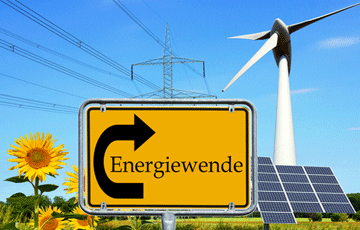 Energy Post 12th March 2018, The experience of the German Energiewende shows that increasing amounts ofrenewable energy on the power system, while at the same time reducing
inflexible baseload generation, does not harm reliability write Michael
Hogan, Camille Kadoch, Carl Linvill and Megan O’Reilly of the Regulatory Assistance Project (RAP).
American policymakers who are still skeptical can look across the Atlantic, to Germany, for a concrete example of a successful transition away from traditional baseload, the authors note.
Numerous studies sponsored by utilities, system operators, the national
labs, and others show that a large share of variable renewable energy
production can be integrated while keeping the lights on, without any
valuable role for traditional baseload.
No study, not even by the US Department of Energy, which examined this issue in an August 2017 Staff Report on Electricity Markets and Reliability, has found evidence that baseload generation is required for reliability. Most studies have found that reliability and least cost are best served by reducing the share of inflexible baseload generation.
Germany is meeting nearly a fifth of its electricity requirements with VREs while retiring inflexible thermal generation, the nation has not experienced reliability problems on either the distribution or bulk electric system. If anything, government data show that the reliability of the German system has increased. http://energypost.eu/how-german-energiewendes-renewables-integration-points-the-way/
In Japan, the Mainichi newspaper succumbed to pressure, sanitising photo of nuclear wastes
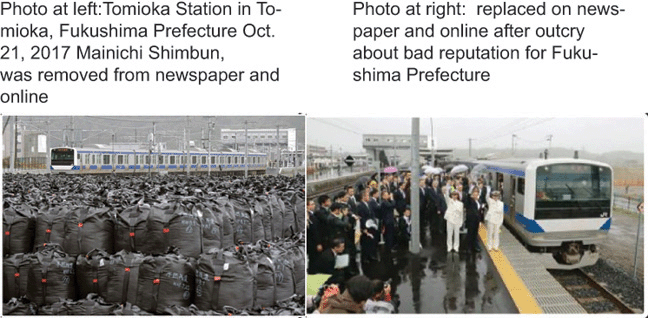
The Great Train Photo Robbery https://beyondnuclearinternational.org/2018/03/13/the-great-train-photo-robbery/
Japanese government is ordereed by court to pay new Fukushima damages

 Court orders Japan government to pay new Fukushima damages http://www.straitstimes.com/asia/east-asia/court-orders-japan-government-to-pay-new-fukushima-damages, 16 Mar 18,
TOKYO (AFP) – A Japanese court on Thursday (March 15) ordered the government to pay one million dollars in new damages over the 2011 Fukushima nuclear disaster, ruling it should have predicted and avoided the meltdown.
The Kyoto district court ordered the government and power plant operator Tokyo Electric Power Co (TEPCO) to pay 110 million yen (S$1.3 million) in damages to 110 local residents who had to leave the Fukushima region, a court official and local media said.
Thursday’s verdict was the third time the government has been ruled liable for the meltdown in eastern Japan, the world’s most serious nuclear accident since Chernobyl in 1986.
In October, a court in Fukushima city ruled that both the government and TEPCO were responsible, following a similar ruling in March in the eastern city of Maebashi.
However, another court, in Chiba near Tokyo, ruled in September that only the operator was liable.
On Thursday, presiding judge Nobuyoshi Asami ordered that 110 plaintiffs who saw their lives ruined and their property destroyed by the disaster be awarded compensation, Jiji Press and other media reported.
Contacted by AFP, a court spokesman confirmed the reports, adding that the ruling denied damages to several dozen additional plaintiffs.
“That damages for 64 people were not recognised was unexpected and regrettable,” a lawyer for the plaintiffs said, adding that they would appeal, according to public broadcaster NHK.
Around 12,000 people who fled after the disaster due to radiation fears have filed various lawsuits against the government and TEPCO.
Cases have revolved around whether the government and TEPCO, both of whom are responsible for disaster prevention measures, could have foreseen the scale of the tsunami and subsequent meltdown.
Dozens of class-action lawsuits have been filed seeking compensation from the government.
In June, former TEPCO executives went on trial in the only criminal case in connection with the disaster.
The hearing is continuing.
Triggered by a 9.1-magnitude earthquake, the tsunami overwhelmed reactor cooling systems, sending three into meltdown and sending radiation over a large area.
Space travel just got even more complicated. Radiation turns out to be even more dangerous
 There’s more harmful radiation in space than previously thought, UNH study says https://www.bostonglobe.com/news/science/2018/03/15/radiation-could-cause-serious-long-term-health-effects-for-astronauts-study-says/XW1W77m
Space travel just got even more complicated.
University of New Hampshire researchers recently concluded there’s at least 30 percent more dangerous radiation in our solar system than previously thought, which could pose a significant risk to both humans and satellites who venture there.
In their study, published Feb. 22 in the journal Space Weather, the researchers found that astronauts could experience radiation sickness or possibly more serious long-term health effects, including cancer and damage to the heart, brain, and central nervous system, said Nathan Schwadron, a space plasma physics professor at UNH and lead author of the study.
“Both concerns are very serious, but what we’re seeing in deep space is that over time, radiation seems to be getting worse,” Schwadron said.
Why is it getting worse? The sun’s activity has been low, the lowest it’s ever been during the Space Age, which began in 1957 with the launching of Sputnik, the world’s first satellite.
That’s bad because an active sun intensifies the sun’s magnetic field, which shields our solar system from cosmic rays, the university said in a statement.
“When we started sending human beings to the moon in the late 50s, the solar activity cycles were fairly strong, so the number of cosmic rays were lower,” Schwadron said. “But now the cosmic rays number is going up.”
Scientists expect the solar activity levels to vary, but they don’t know why the current activity is so weak, he said.
1 This month
7 April – WEBINAR – Australia and the Doomsday Clock – Preventing nuclear war through NoFirstUse and other policies
Online | Tuesday April 7, 4:00-5:30pm, Australian Eastern Time / 8:00-9:30am Central Europe Time
– Access the registration link
15 April – Zoom –Nuclear Power is Not the Solution
Apr 15, 2026 01:00 AM in Canberra, Melbourne, Sydney

Join the International Physicians for the Prevention of Nuclear War (IPPNW) on Tuesday, April 14th for a timely webinar exploring the risks associated with nuclear power and challenging the myth that it offers a simple, safe, carbon-free solution to the climate crisis

21 April Webinar: No Nuclear Weapons in Australia
Start: 2026-04-21 18:00:00 UTC Canberra, Melbourne, Sydney (GMT+10:00)
End: 2026-04-21 19:30:00 UTC Canberra, Melbourne, Sydney (GMT+10:00)
Event Type: Virtual
A virtual link will be communicated before the event.
Host Contact Info: australia@icanw.org

of the week – Australians for War Powers Reform (AWPR)
To see nuclear-related stories in greater depth and intensity
 Antinuclear