ICAN founder Tilman Ruff calls US’s new nuclear policy ‘a blueprint for war’
 On Monday, Ruff was speaking aboard the Peace Boat, which
 was docked in Sydney Harbour.
US’s new nuclear policy ‘a blueprint for war’, Nobel peace laureate says https://www.theguardian.com/world/2018/feb/06/uss-new-nuclear-policy-a-blueprint-for-war-nobel-peace-laureate-says
International Campaign to Abolish Nuclear Weapons founder describes weapons review as ‘a chilling document’ that echoes cold war era, Guardian, Ben Doherty, 6 Feb 18,
Australia’s Nobel peace laureate says America’s aggressive new nuclear policy is “a blueprint for nuclear war” that returns the world to a cold war mentality.
Tilman Ruff, the founding chair of the Melbourne-founded International Campaign to Abolish Nuclear Weapons (Ican) said the newly released US nuclear posture review was “a chilling document”.
“This increases the danger of nuclear war … it clearly flags that great power confrontation with Russia is back on again. It essentially says, ‘we’re back in the cold war’.” Continue reading
The cold war is on again, with Trump’s nuclear policy
 Ironically, an Obama-era nuclear agreement with Russia went into full effect Monday. It was aimed, like previous agreements forged by the Reagan and George W. Bush administrations, to defuse the possibility of just such a cataclysmic “Great Power” conflict. Under the terms of the New START treaty, as it’s known, both Russia and the United States are committed to deploying no more than 1,550 nuclear warheads. There’s a strict verification regime on both sides, and proponents of the pact say those inspections have built confidence in the otherwise severely strained U.S.-Russia relationship.
Trump’s nuclear policy is taking us back to the Cold War, WP The Trump administration has touted its new nuclear policy, released at the end of last week by the Pentagon, as a tough, realistic assessment of foreign threats and U.S. capabilities. The Nuclear Posture Review, the first to be conducted since 2010, purportedly describes “the world as it is, not as we wish it to be” — and calls for an expansion of America’s nuclear arsenal to confront the evolving capabilities of other nuclear powers.
If that is the administration’s view of the world, it is far from a consensus. A legion of critics blasted a potential nuclear buildup as dangerous, fiscally ruinous and redolent of outdated Cold War thinking. Some pointed out that a coterie of nuclear hawks helped draft the NPR, including one academic who argued in 1980 that the United States could defeat the Soviet Union in a nuclear war, while stomaching “approximately 20 million” casualties, “a level compatible with national survival and recovery.” Continue reading
Australians demand lawmakers #StopAdani from building the country’s largest coal mine
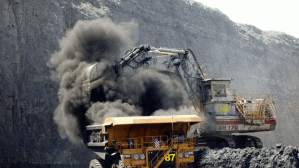 ~ Brandon Jordan ‘Maggie McKeown, a community organizer for the Mackay Conservation Group
and a speaker at Monday’s demonstration, highlighted the
#StopAdani alliance as an example of resistance to the mine.
‘In March 2017, several groups, including McKeown’s, formed the coalition to stop the project.
‘“In the last 10 months, the #StopAdani alliance has grown
from a few groups to hundreds of groups and
to thousands and millions of supporters around Australia and the world,” McKeown said. …
‘With Monday’s demonstration as the official start to
further actions and demonstrations this year,
activists anticipate even more victories against the company and,
perhaps, an end to a near-decade conversation over the facility.
‘“We built a movement that nags politicians,” McKeown said.
“We want politicians to know that we’re not a movement that will go away.
We’re a movement that will keep lobbying until its stopped together.”’
Read more of Brandon Jordan‘s comprehensive, interesting & well-researched article:
wagingnonviolence.org/2018/02/australia-stop-adani-coal-mine/
USA’s ‘temporary’ nuclear waste storage nightmare
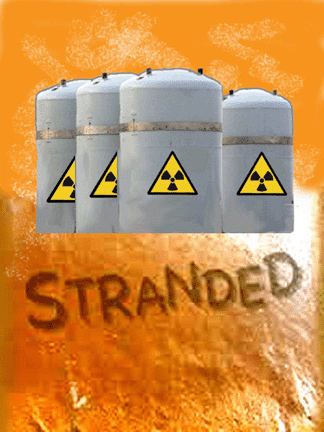
 The Nuclear Regulatory Commission has given its permission to use the thin-wall canisters and to install more than 100 of them near the San Onofre State Beach. They are required to have a 40-year lifespan, which critics say is inadequate given that the spent fuel will remain there “indefinitely.”
the fact remains that the political will to transport such material is always out-of-reach. The radioactive used fuel thus remains on site
 Spent Fuel Storage Still A Hot Topic in California’s Coastal Communities, Forbes, Ken Silverstein, 6 Feb 18 Radioactive material from the San Onofre Nuclear Generating Station (SONGS) will be making a short trek from the now closed units to a spot next to the beach — a move that has outraged community activists, who fear it will remain buried there for decades to come.
France going for wind energy in a big way, (turning away from nuclear)
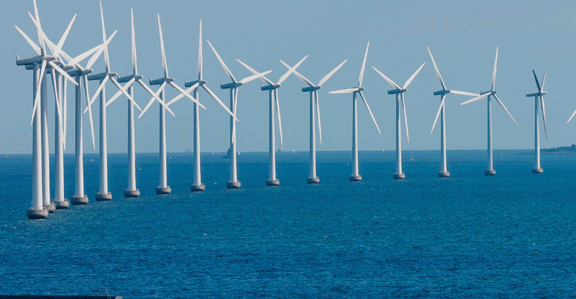 France Set to Become a European Offshore Wind Powerhouse by 2022 Bloomberg By Jeremy Hodges and Jess Shankleman,
-
WindEurope sees French turbine orders passing U.K., Germany
-
Offshore wind investments to recover after contracting in 2017
Europe’s wind-power industry expects new French offshore turbine installations to overtake the U.K. and Germany by 2022, boosting President Emmanuel Macron’s pledge to increase renewable energy.
The abandoned, radioactive, dogs of Chernobyl
Meet the dogs of Chernobyl – the abandoned pets that formed their own canine community, Hundreds of stray dogs have learned to survive in the woods around the exclusion zone – mainly descendants of those left behind after the nuclear disaster, when residents were banned from taking their beloved pets to safety, Guardian, by Julie McDowall, 6 Feb 18, “….. After the Chernobyl disaster in 1986, Pripyat and the surrounding villages were abandoned, and residents were not allowed to take their pets to safety. Chernobyl Prayer, a devastating oral history of the period, tells of “dogs howling, trying to get on the buses. Mongrels, alsatians. The soldiers were pushing them out again, kicking them. They ran after the buses for ages.” Heartbroken families pinned notes to their doors: “Don’t kill our Zhulka. She’s a good dog.” There was no mercy. Squads were sent in to shoot the animals. But some survived and it is mainly their descendants that populate the zone.
Life is not easy for the Chernobyl strays. Not only must they endure harsh Ukrainian winters with no proper shelter, but they often carry increased levels of radiation in their fur and have a shortened life expectancy. Few live beyond the age of six.
Nadezhda Starodub, a guide with the Chernobyl tour specialist Solo East, says the visitors (there are no “tourists” in the zone) love the dogs. “Most of the time people find them cute, but some think they might be contaminated and so avoid touching the dogs.”….
their health needs are met by Clean Futures Fund, a US non-profit organisation that helps communities affected by industrial accidents, which has set up three veterinary clinics in the area, including one inside the Chernobyl plant. The clinics treat emergencies and issue vaccinations against rabies, parvovirus, distemper and hepatitis. They are also neutering the dogs. Lucas Hixson, the fund’s co-founder, says: “I don’t think we’ll ever get zero dogs in the exclusion zone but we want to get the population down to a manageable size so we can feed and provide long-term care for them.” This makes Chernobyl safer for the dogs, but also for the workers and visitors.
The Chernobyl plant has recently been sealed under a new “sarcophagus” designed and built by a multinational group of experts, and similar cooperation can be seen with the dogs. In the woods behind Chernobyl I look again at yellow-eyed Tarzan and see, not a wild animal, but a playful example of global kindness and cooperation.https://www.theguardian.com/lifeandstyle/2018/feb/05/dogs-chernobyl-abandoned-pets-stray-exclusion-zone
Once again – they talk about a WINNABLE NUCLEAR WAR !

They’re Talking About “Winnable” Nuclear War Again, February 03, 2018, By William Rivers Pitt, Truthout | “……… The missiles are still there. Thousands and thousands of them, marking time in their holes like funnel-web spiders. The astonishingly toxic byproduct left by their creation is still there, entombed in places like Yucca Mountain, and will be there for thousands of years unless it leaks or is stolen. The ability of a sitting president to use them is still there.
Some 25 years ago, we mostly broke the habit of building and testing more of these engines of annihilation, an absolute good in every sense. Not entirely, to be sure: The nuclear weapons program had its own gravity long before Trump came along, and it was President Obama who first put the trillion dollar weapons modernization program on the table. Still, it feels as if we’ve forgotten the things still exist and are existentially lethal…….
Not even Trump’s ongoing middle school shoving match with North Korea’s Kim Jong-un and his growing nuclear toybox appears to have ruffled a great many feathers around here. Perhaps it’s the surreal nature of this president and his administration that explains our national shrug at this incredibly dangerous, feckless faceoff. It’s a strange plot twist in a weird animation starring two cartoon characters ordering bombs from the Acme catalog. Who could take these guys seriously?
Enter Robert R. Monroe, Vice Admiral, US Navy (Ret.) and his recent article in The Hill titled, “Only Trump Can Restore America’s Ability to Win a Nuclear War.” Vice Admiral Monroe, former director of the Defense Nuclear Agency, is the kind of man Curtis LeMay would have recognized as a brother on sight. “When the Cold War ended in 1991,” laments Monroe in his opening line, “America made an unwise decision.”
It goes downhill from there. “Ongoing nuclear programs were stopped,” seethes Monroe. “Budgets were cut. New nuclear capabilities were prohibited by law. A presidential moratorium denied underground nuclear testing. No research into advanced nuclear technology was allowed. Essentially, America went into an unannounced a nuclear freeze, and we have progressively increased its restrictions and denials for a quarter-century.”
These are all good things, unless you are one of those interesting individuals who still believe a nuclear war can be won………
Donald Trump has already announced his desire to increase the massive US nuclear arsenal tenfold. The draft of his soon-to-be-released Nuclear Posture Review seeks significant production of so-called “low-yield” nuclear weapons, because our current weapons are theoretically too big to use with any degree of tactical success. It should be noted that, according to modern metrics, the bombs dropped on Hiroshima and Nagasaki were also “low-yield.” An arsenal of smaller bombs is key to Admiral Monroe’s fever dream of a winnable nuclear war. It is a dream Trump appears to share.
The world is dangerous enough as it is, one would think. It is so dangerous, in fact, that a great many people are frozen to near-immobility by it, by the sheer immensity of the perils we face. Where to even begin?
If you seek a place to lay your chisel, I have two words: “No Nukes.”
Should you choose this path, your first task is to remind everyone that the threat not only still exists, but is growing again. White House officials were concerned about Richard Nixon’s mindset during the 1973 crisis, mired as he was in the Watergate scandal. Donald Trump makes Richard Nixon look like Marcus Aurelius. We are all in a great deal of trouble, and no one seems to care.
Make them care, please and thank you. Let’s go find that peace dividend they were talking about on my birthday. I think we’ve earned it. http://www.truth-out.org/opinion/item/43446-they-re-talking-about-winnable-nuclear-war-again
Radiation leaks at Fukushima pose a global threat
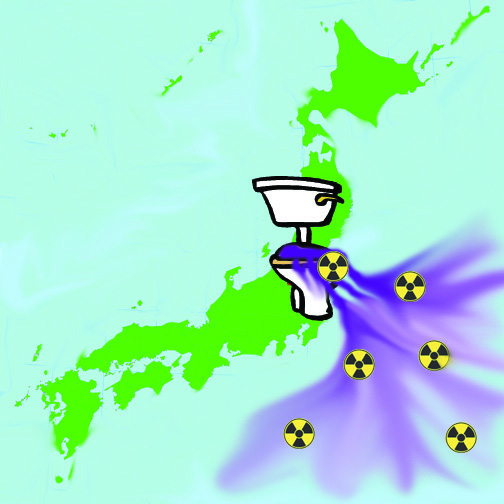 Sunshine Coast Daily, by Jeff Farrell, The Independent 4th Feb 2018 LETHAL levels of radiation have been detected at Japan’s Fukushima nuclear power plant, seven years after its destruction by an earthquake and tsunami.
Like Australia? – “nobody in Sweden wants this nuclear fuel repository”

 GDF Watch 2nd Feb 2018, A week on from the Environmental Court’s ruling, and it would seem nobody in Sweden is any the wiser about what happens next. The general view seems to be that this is a hiccup, and everything will eventually continue as planned.
But don’t expect that to happen anytime soon, and at least not until after this autumn’s national elections in Sweden. Anders Lillienau, who chaired the Court’s Hearings, is reported as saying that while they had significant concerns about the safety of the copper canisters, the Court did not otherwise see any barriers to the safety of the repository.
The Court has asked SKB, the organisation responsible for the repository, to provide further information on copper canisters to address their concerns. It is understood that SKB are preparing such information, and reportedly told a community meeting in Östhammar earlier this week that they intend to provide that information later this year.
Anders Lillenau has also made clear the ball is now in the Government’s court: “In the
end, it is still the case that the Government may make the overall assessment whether or not this will be allowed.” A Swedish Government spokesman, Magnus Blücher, explained that this was a complex issue and it was too soon to say what the Government might do, or when.
Back in Östhammar, the local referendum planned for 4 March has been postponed. The referendum was advisory, and any final decision on agreeing to host the repository has to be taken by the local council. A spokesman for Östhammar Municipality says that it is too soon to know when the referendum and council vote will now take place.
Local resident Åsa Lindstrand chairs a resident’s group opposed to the repository. She told the local newspaper that she was pleased but surprised by the Court’s decision, but feels little will change:
“Actually, nobody else in Sweden wants this nuclear fuel repository, so the rest of Sweden would probably be lucky if someone takes it. The municipality is so marinated by SKB that it is not easy to
say ‘no’. For us who live here, it’s more about noise and traffic than about the copper capsules, it’s happening before they get there at all.” Her sense of pyrhhic victory is shared by environmentalist Johan
Swahn, who added, “but only if the government stays passive and the copper canister issues raised by the Court become a matter solely for SKB.” His organisation, MKG, has raised concerns about the long-term
safety of copper canisters over many years.
While delighted that the Court accepted the case presented by leading corrosion scientists, he now wants
the Swedish Government to guarantee an open scientific re-evaluation of the issues relating to copper canister corrosion. http://www.gdfwatch.org.uk/2018/02/02/sweden-update/
Slovakia Supreme Court upholds decision of Environment Minister against uranium mining
Slovak Spectator 1st Feb 2018, Uranium ore will not be mined in the Čermeľ-Jahodná locality in the Košice Region. This stems from the final ruling issued by the Supreme
Court, which decided not to extend a permit for a geological survey of
uranium ore at the site close to Košice, the TASR newswire reported. The
court has thus ended the legal proceedings and upheld a decision by the
Environment Ministry.
https://spectator.sme.sk/c/20751213/uranium-mining-near-kosice-definitely-rejected.html
The un-safety of France’s nuclear power plants

 JDD 3rd Feb 2018, Nuclear: the book that undermines the safety of French power plants. The JDD publishes preview extracts of Nuclear, immediate danger , a survey book that challenges the dogma of the safety and profitability of French power stations.
At the forefront of concerns: the alarming state of severaltanks, which contain the heart of the reactors. “That’s it, we are there atthe age of 40. By 2028, 48 reactors [out of 58 in service in France] – those of the level of 900 MW and a part of the reactors of 1,300 MW – will reach this canonical age.
Since the mid-2000s, because of its financial difficulties that prevent it from investing in new means of production, EDF is asking for, calling for, even imposing, that all of its nuclear power stations be allowed to operate at the same time. beyond the age of forty, and prolonged by twenty years. […]
[Among the elements that will] determine the extension or the stop of the vats: do they have defects, of
origin or appeared with the time, which compromise the safety?
This is one of the biggest secrets of the nuclear industry in France. […] According to EDF, 10 tanks in operation have cracks that date from their manufacture. […] Tricastin, with its reactor 1, is the worst central of the country.
This reactor combines all the problems: defects under coating, no margin at break, and exceeding the fragility forecast at forty years! Not to mention the risk of catastrophic flooding in the event of an earthquake, as noted in September 2017 by the Nuclear Safety Authority (ASN), which has automatically stopped the operation of the four reactors of the plant while waiting for EDF finally, work to reinforce the dike of the Donzère-Mondragon canal. The plant is below the canal, 6 m below the water.
Pierre-Franck Chevet, the president of the ASN, told us’ that in the event of a strong earthquake we could go to a situation, with four simultaneous reactors merging, which potentially looks like a Fukushima type accident. EDF has found the immediate stoppage of the plant to carry out this unjustified work, I find it justified. ” http://www.lejdd.fr/societe/nucleaire-le-livre-qui-met-a-mal-la-surete-des-centrales-francaises-3564173
Premier Jay Weatherill’s opposition to Federal nuclear waste dump in Kimba and Hawker is welcomed
 Eyre Peninsula Tribune, 31 Jan 18 Conservation SA and the South Australian Greens party have welcomed Premier Jay Weatherill’s opposition to the National Radioactive Waste Management Facility proposed for Kimba and Hawker.
The comments from Conservation SA and the Greens were in response to an article published in The Australian, which suggested the state government would look at legal action if the facility was approved in South Australia.
“The state government is not considering High Court action.”
However he said the federal government’s process was “wrong”.
“The state government’s position on this matter hasn’t changed,” Mr Weatherill said.
“The federal government should follow the state government’s lead and consult with the community first.”……..
Conservation SA chief executive Craig Wilkins said the organisation strongly welcomed the news that the state Labor party would oppose any attempt by the federal government to impose nuclear waste from Lucas Heights on South Australia..
“SA Labor have a long and proud tradition of opposing similar moves in the past, most notably Mike Rann, who famously won a High Court challenge against the Howard government over a decade ago,” Mr Wilkins said.
“This statement by Premier Weatherill will help reassure a community that was disturbed and disappointed by his government’s previous push to explore opportunities in the nuclear fuel cycle.
“We commend Premier Weatherill for standing up for our state and the communities of Kimba and Flinders Ranges.”
Greens SA parliamentary leader Mark Parnell invited Mr Weatherill and the state government to join the party in opposing the nuclear facility.
“The Greens have steadfastly opposed the Commonwealth government’s process of nuclear waste dump site selection and we have supported communities in both Kimba and the Flinders Ranges who are opposed to the dump,” Mr Parnell said.
“We invite Labor to join us in this campaign.”
Kimba has two sites in phase two of consultation for a potential National Radioactive Waste Management Facility.https://www.eyretribune.com.au/story/5200966/state-not-considering-nuclear-legal-action-weatherill/
Trump’s Nuclear Posture Review makes the world an even more dangerous place
The review neglects to make a compelling case for the necessity of its proposed systems.
Overall, the NPR reflects an outdated and simplistic view of deterrence.
the most significant problem with Trump’s Nuclear Posture Review is the slanted view it holds of the world and the obsolete theory of deterrence and war fighting that it promotes, which is so poorly suited to today’s threats. Rather than working to reduce nuclear dangers, the nation’s nuclear policy now reflects the reasoning of U.S. adversaries and readily follows them into a more dangerous world.
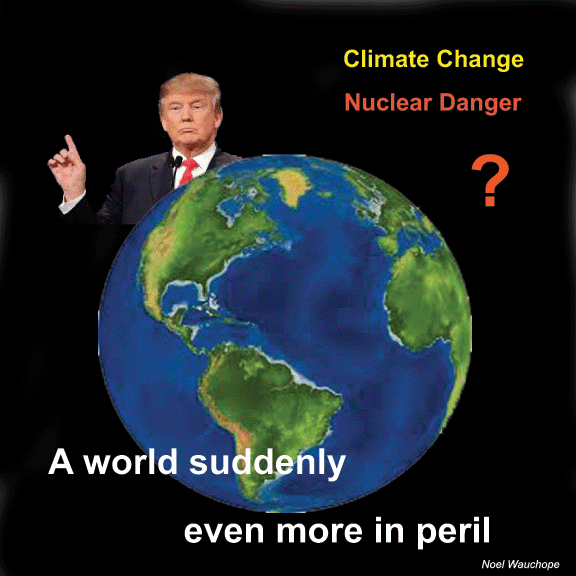 Trump’s Troubling Nuclear Plan, How It Hastens
  the Rise of a More Dangerous World https://www.foreignaffairs.com/articles/2018-02-02/trumps-troubling-nuclear-plan,
Malysia’s nasty history of radioactive trash from rare earths processing
A factory processing radioactive materials in Perak gave the people living nearby leukemia.
Bukit Merah’s rare earth metal processing site cleanup had been the largest radiation cleanup so far in the world’s rare earth industry. Dr. Yoshihiko Wada’s report revealed that Mitsubishi Chemical came up with ARE in Bukit Merah after being one of the main companies that caused severe asthma in Nagoya, Japan. Also, 100% of the rare earth products processed in Bukit Merah were exported back to Japan, so it’s not like we gained anything but money from the venture, which puts forth the question of whether it’s worth endangering the lives of local residents for rare earth metals.
30 YEARS AGO, A HUGE RADIOACTIVE INCIDENT HAPPENED IN PERAK. AND THEY’RE STILL CLEANING IT UP https://cilisos.my/30-years-ago-a-huge-radioactive-incident-happened-in-perak-heres-the-story-behind-it/ 21 Jan 2018,
Earlier this year, Lynas Corporation had been popping up in the news again. For those of who have no idea who or what Lynas is, a few years back there had been a hullabaloo when Lynas set up a rare-earth processing plant in Gebeng, Kuantan, called the Lynas Advanced Materials Plant (LAMP). But what’s the big deal with that?
Well, in very simple words, concerns about radioactive waste.
Basically, rare earth metals are a group of chemical elements that are quite useful in manufacturing electronics and stuff. They’re not ‘rare’, but in nature they come clumped together with a buttload of other elements and minerals that make extraction difficult. Continue reading
More and more American nuclear reactors are biting the dust
 More Premature Nuclear Unit Retirements Loom, Power Magazine, 02/01/2018 | Sonal Patel Two more U.S. nuclear power plants are facing early retirement, joining a string of generators whose fate was determined by market conditions, political pressure, or financial stresses assailing the sector. Several others may be poised to join them.
The 647-MW Duane Arnold nuclear plant in Palo, Iowa, will likely close in 2025 after a current contract with the facility’s primary customer expires, said NextEra Energy Resources’ chief financial officer, John Ketchum, in a fourth-quarter earnings call on January 26.
“Without a contract extension, we will likely close the facility at the end of 2025 despite being licensed to operate until 2034,” Ketchum said. “As a result, during the fourth quarter, Duane Arnold’s book value and asset retirement obligation were reviewed, and an after-tax impairment of $258 million was recorded that reflects our belief it is unlikely the project will operate after 2025.” Ketchum added, however, that NextEra will continue to pursue a contract extension.
On the same day, the Toledo Blade reported that FirstEnergy Corp.’s Davis-Besse nuclear plant in Oak Harbor, Ohio, is headed for premature closure, citing James Pearson, the company’s chief financial officer. Pearson told the newspaper that no date has been set for the closure of Davis-Besse. He also reportedly said that the outlook for the company’s Perry plant in Ohio and twin-reactor Beaver Valley nuclear plant in Pennsylvania is “bleak.” FirstEnergy is intent on exiting its competitive business, but though the company may want to sell the plants, they are “probably impossible to sell in today’s market,” he reportedly said.
A Critical Condition The plants join a series of generators recently stricken by financial pressure primarily by competition from cheap natural gas, expanding renewable capacity, and lethargic power demand growth.
Throughout the short history of the U.S. nuclear power sector, 31 reactors licensed to operate have been permanently shut down—11 between 1960 and 1980; four in the 1980s; and nine in the 1990s. The recent streak began in 2010—12 years after the nation’s last reactor, Millstone 1 in Waterford, Connecticut, had been shut down in 1998—as Exelon announced it would shutter its Oyster Creek plant in New Jersey by 2019 owing to economic conditions and changing environmental regulations. In February 2013, Duke Energy (then Progress Energy) retired its Crystal River reactor in Florida, unable to repair damage to the containment structure. A string of casualties then ensued, as Kewaunee in Wisconsin was closed in May 2013; two units at San Onofre in California were formally shuttered in June 2013; Vermont Yankee in Vermont was shut down in December 2014; and Fort Calhoun in Nebraska closed its doors in October 2016. Other units slated for near-term shutdown include Pilgrim in Massachusetts and Palisades in Michigan. (For more, see, “THE BIG PICTURE: Nuclear Retirements.”)
Early retirement has also been proposed for Clinton and Quad Cities in Illinois and for Nine Mile Point, Fitzpatrick, and Ginna in New York—but their fate appears dependent on the outcome of legal challenges to “bailout” programs to keep those plants operating for economic reasons. The states’ measures are being legally challenged by several independent power producers—including Dynegy, Eastern Generation, NRG Energy, and Calpine Corp.—and, prominently, competitive power producer trade group the Electric Power Supply Association. The consortium has long argued that the state rules interfere with Federal Energy Regulatory Commission (FERC) jurisdiction over wholesale electric rates and unlawfully interfere with interstate commerce………..
Earlier in January, California regulators approved Pacific Gas & Electric’s application to retire the Diablo Canyon plant by 2025, following a protracted battle over the generating station that pitted local economic interests against environmentalists and other opponents of nuclear power. In New York, political pressure combined with economic misgivings, also prompted plans to shut down Indian Point by 2021.
A Swath of Other Reactors May Be Troubled According to a September 2017 report from the Idaho National Laboratory (INL), several more nuclear plants are likely to retire early, stymied by an “ongoing industry wide, systemic economic and financial challenge to operating nuclear plants particularly in the deregulated markets.”
A revenue gap analysis conducted by the national laboratory for 79 of 99 operational reactors that are in a region where public wholesale electricity market prices are available suggests that 63 units would have lost money in 2016. Of those 63, 36 are merchant generators, 19 are regulated, and eight are public power generators.
INL suggests that among plants at high risk of early retirement are Davis-Besse, Three Mile Island in Pennsylvania, and Xcel Energy’s Prairie Island in Minnesota.
A number of studies separately suggest similar findings. ……..http://www.powermag.com/more-premature-nuclear-unit-retirements-loom/
1 This month
7 April – WEBINAR – Australia and the Doomsday Clock – Preventing nuclear war through NoFirstUse and other policies
Online | Tuesday April 7, 4:00-5:30pm, Australian Eastern Time / 8:00-9:30am Central Europe Time
– Access the registration link
15 April – Zoom –Nuclear Power is Not the Solution
Apr 15, 2026 01:00 AM in Canberra, Melbourne, Sydney

Join the International Physicians for the Prevention of Nuclear War (IPPNW) on Tuesday, April 14th for a timely webinar exploring the risks associated with nuclear power and challenging the myth that it offers a simple, safe, carbon-free solution to the climate crisis

21 April Webinar: No Nuclear Weapons in Australia
Start: 2026-04-21 18:00:00 UTC Canberra, Melbourne, Sydney (GMT+10:00)
End: 2026-04-21 19:30:00 UTC Canberra, Melbourne, Sydney (GMT+10:00)
Event Type: Virtual
A virtual link will be communicated before the event.
Host Contact Info: australia@icanw.org

of the week – Australians for War Powers Reform (AWPR)
To see nuclear-related stories in greater depth and intensity
 Antinuclear