
 Communities offered £1m a year to host nuclear waste dump https://www.theguardian.com/environment/2018/jan/25/communities-offered-1m-a-year-to-host-nuclear-waste-dump
New search for communities willing to host underground site for thousands of years, Guardian, Adam Vaughan, 25 Jan 18, Local communities around England, Wales and Northern Ireland will be offered £1m a year to volunteer to host an underground nuclear waste disposal facility for thousands of years, as part of a rebooted government programme.
The financial incentive is one way the government hopes to encourage communities to host the £12bn facility, after previous efforts failed in 2013 when Cumbria county council rejected the project.
Under new plans published on Thursday, a test of public support will be required for the scheme to go ahead, which could include a local referendum.
The only areas to explore the idea last time round were Copeland and Allerdale borough councils in Cumbria, and Shepway District Council in Kent.
This time, interested communities that explore hosting the facility will also receive £1m a year, which officials say could be spent on developing skills locally or apprenticeships. The payments, which could rise to £2.5m annually as a community considers whether to proceed, are expected to last for around five years.
The geological disposal facility (GDF) is seen by experts as the best long-term solution to storing the estimated 750,000 cubic metres of waste generated by half a century of nuclear power and defence, which would fill three quarters of Wembley Stadium.
It also includes the radioactive material created by potentially five new plants that the government expects to be built, including Hinkley Point C, which EDF Energy is constructing in Somerset.
The Institute of Directors said storing waste deep underground would be cheaper than storing it above ground, as it is at present at around 30 sites.Business, unions and local authority groups welcomed the renewed bid to site a GDF.
“Running costs for a geological disposal facility storing the waste 1,000 metres below the surface would be significantly lower,” the business group said.
Richard Harrington, energy minister, said: “We owe it to future generations to take action now to find a suitable permanent site for the safe disposal of our radioactive waste. And it is right that local communities have a say.”
But Greenpeace criticised the payments, calling them bribes, and said new nuclear power plants should not go ahead without a long-term solution in place for their waste.
Doug Parr, the group’s chief scientist, said: “Having failed to find a council willing to have nuclear waste stored under their land, ministers are resorting to the tactics from the fracking playbook – bribing communities and bypassing local authorities.
“With six new nuclear plants being planned, the waste problem is just going to get much worse. Since there is no permanent solution for the disposal of spent nuclear fuel, the responsible thing to do would be to stop producing more of it instead of just passing the radioactive buck to future generations.”
Nuclear waste is currently stored at about 30 sites, but predominantly at ground level at Sellafield in Cumbria. The GDF project is expected to cost £12bn, spread over a century.
January 26, 2018
Posted by Christina Macpherson |
General News |
Leave a comment
Safety risks stall nuclear role in Australia’s energy mix, SMH, 25 January 2018, Cole Latimer
http://www.smh.com.au/business/the-economy/safety-risks-stall-nuclear-role-in-australia-s-energy-mix-20180125-p4yyvj.htmlIf Australia is to hit its Paris climate change targets and lower carbon emissions it needs to think seriously about nuclear energy, lobbyists say, but the safety risks coupled with its economic viability have former supporters doubting its future in Australia.
Australia’s commitment to the 2015 Paris climate agreement – which aims to reduce emissions by 5 per cent below 2000 levels – has increased the pressure to reduce the electricity industry’s emissions levels, and nuclear energy has been put forward as a way to reach decarbonisation of the network.
Robert Parker, who is a current committee member and former president of the Australian Nuclear Association, said nuclear energy could play a major role in Australia’s decarbonisation if it is used along with renewable generation such as wind, solar and pumped hydro storage. Mr Parker said there was the potential to replace Victoria’s brown coal-fired power stations with nuclear reactors once they had reached the end of their operating life. He said the infrastructure was already in place to rapidly build and operate a nuclear power plant…..
Friends of the Earth national nuclear campaigner Dr Jim Green said the cost of nuclear power had made it unviable.
“With the possible exception of carbon capture and storage, nuclear power would be the most expensive and least effective way of reducing emissions in Australia,” Dr Green told Fairfax Media.
“The estimated cost of reactors under construction in the UK is $20 billion each. The estimated cost of reactors under construction in France and Finland has risen to $16 billion each. Energy efficiency and conservation programs, coupled with renewable energy expansion, can sharply reduce emissions in Australia – far more quickly and cheaply than nuclear power.
“Ten years ago, there might have been a debate to be had over the economic merits of nuclear power, when the Switkowski inquiry estimated that a reactor could be built for $4 billion to $6 billion. The Switkowski panel was out by a factor of three and even Ziggy Switkowski himself now acknowledges that renewables are a more economically viable choice.”
Nuclear physicist and NBN chairman Ziggy Switkowski, who once said Australia needs 50 nuclear reactors across the nation, believes “the window for gigawatt-scale nuclear has closed”.
Mr Switkowski said nuclear energy as a power option was now less economically viable than renewables and batteries alone.
“Government won’t move until a real business case is presented and none has been, to my knowledge, and there aren’t votes in trying to lead the debate,” he told Fairfax Media.
He said nuclear was no longer lower cost than renewables and the levelised cost of electricity of the two was rapidly diverging.
While nuclear could provide zero emissions energy, Mr Switkowski said this was more than offset by community concerns about waste and safety.
“Support for nuclear is everywhere except from the generators and financiers who would have real skin in the game.” …………. http://www.smh.com.au/business/the-economy/safety-risks-stall-nuclear-role-in-australia-s-energy-mix-20180125-p4yyvj.html
January 26, 2018
Posted by Christina Macpherson |
General News |
Leave a comment
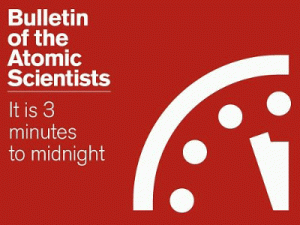 CLOSER TO MIDNIGHT: THE DOOMSDAY CLOCK AND THE THREAT OF NUCLEAR WAR, Wired, 25 Jan 18, THE ACCIDENTAL MISSILE
 alert
in Hawaii earlier this month made real for 38 terrifying minutes the vague, low-level dread that permeates American life today: Nuclear war seems closer and more real than it has in a generation. Even the pope—not exactly a fear-monger—said last week that the world now stood at “the very limit.”That existential fear was affirmed today by the organization of nuclear scientists who have spent seven decades trying to turn humanity away from nuclear weapons: The Bulletin of Atomic Scientists moved its “Doomsday Clock” 30 seconds closer to “midnight,” an unofficial barometer of how close the world stands to a man-made catastrophe. It now stands two minutes away.
“To call the situation dire is to understate the danger,” said Rachel Bronson, the head of the Bulletin, at the National Press Club in Washington, DC, Thursday, announcing the clock’s new setting.
The clock dates back to 1947, when the scientists who participated in the Manhattan Project wanted to create a mechanism to warn of escalating global tensions and the danger of global Armageddon. The iconic stylized timepiece has since become the global arbiter of dread—or hope. It aims to answer two questions: Is the future of civilization safer or at greater risk than it was last year? And how does today’s risk compare to the risks we’ve experienced over the last 71 years?
The graphical clock started at seven minutes to midnight, its two-dozen changes since marking the shifting tensions of the Cold War. Its “peacetime” rating peaked in 1991 at 17 minutes to midnight, as the Soviet Union broke apart. It has gradually ticked darker ever since, first as nuclear weapons proliferated to countries like India and Pakistan, and then as it began to factor in other global threats, like climate change.
Last year, for the first time, it ticked forward a half-minute, reflecting the rise of nationalism and the threat to the post-war international order, as well as President Donald Trump’s troubling supportive comments about the appeal of nuclear weapons, and his climate change skepticism.
At the time, he’d been president only a few days; there was little track record to measure his actions versus his campaign rhetoric. But as Bronson told me last month, “Many of our fears played themselves out in 2017… A lot of our concerns were really borne out.”
Today’s movement of the Doomsday Clock—announced live in a webcast—was yet another sign that the world stands on a precipice perhaps unparalleled in the modern era. It hasn’t sat this close to midnight since 1953, a few months after the United States and Russia tested their first thermonuclear bombs……..
The current system makes nuclear war easier to start than to avoid; there’s precious little room for reflection. The first ICBMs will leave their silos just four minutes after a presidential order; once they launch, there’s no mechanism to stop them. No country on the planet possesses the capability to shoot down an incoming strike………
The Threat of War
January 26, 2018
Posted by Christina Macpherson |
General News |
Leave a comment
 US stealth bombers in Guam appear to be readying for a tactical nuclear strike on North Korea, Business Insider, ALEX LOCKIE, JAN 25, 2018,
- The US recently sent nuclear bombers to Guam that can carry tactical nukes that would be perfect for taking out Kim Jong Un.
- Some have suggested that a quick tactical nuclear strike on North Korea could cripple the country’s nuclear infrastructure with few casualties.
- Recent reports have suggested President Donald Trump considering a strike on North Korea, but some experts and politicians think the idea of a tactical nuclear strike is a recipe for disaster.
The US has been quietly amassing firepower in the Pacific during a lull in tensions with North Korea, but recent developments on an under-the-radar nuclear weapon suggest preparation for a potential tactical nuclear strike.
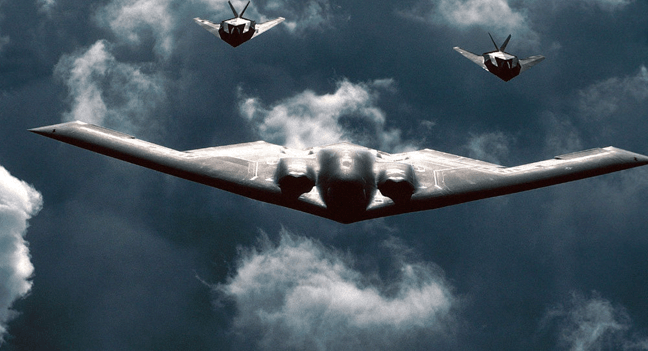
The US recently sent B-2 stealth bombers to Guam, where they joined B-1 and B-52s, the other bombers in the US’s fleet.
While the B-2 and B-52 are known as the air leg of the US’s nuclear triad, as they carry nuclear-capable air-launched cruise missiles, a smaller nuclear weapon that has undergone some upgrades may lend itself to a strike on North Korea………..
Despite evidence that tactical nuclear weapons won’t solve the North Korean military quagmire, President Donald Trump’s administration has looked favourably on smaller nuclear weapons.
Trump’s recent nuclear posture review recommended building more small nuclear weapons, as their size would make them easier to use in a conflict – something the International Security paper supports.
The B-61 bombs live in military bases spread across Europe and are much less visible than big bombers, whose movements are often publicized……..https://www.businessinsider.com.au/us-stealth-bombers-guam-tactical-nuclear-strike-north-korea-2018-1?r=US&IR=T
January 26, 2018
Posted by Christina Macpherson |
General News |
Leave a comment
Australia Day poll: While many believe date shouldn’t offend, many ignore significance of Jan 26
By Nakari Thorpe : NITV News 18 Jan 2018
‘While more Australians say that Australia Day should not be celebrated on a day that is offensive to Indigenous Australians, many do not know the significance of January 26, according to a new poll.’
‘The poll was conducted by Canberra based think-tank, the Australia Institute,
which surveyed 1417 Australians regarding their knowledge about and attitudes to Australia Day.
‘“The polling shows that most Australians don’t know what historical event Australia Day commemorates
and most people are not aware it wasn’t always celebrated on this date.
Perhaps that’s why more than half of Australians say they don’t really mind
when we hold Australia Day, as long as we do,”
Ebony Bennett, Deputy Director of The Australia Institute said.’
Read more of Nakari‘s informative, interesting & well-researched article here:
www.sbs.com.au/nitv/nitv-news/article/2018/01/18/australia-day-poll-while-many-believe-date-shouldnt-offend-many-ignore
January 26, 2018
Posted by Christina Macpherson |
General News |
Leave a comment
Off-the-Shelf Nuclear Plants Could Soon Help Power Electric Cars, Bloomberg, By
Rachel Morison, January 25, 2018,
Demand for low-carbon electricity to power a future wave of electric vehicles could be provided by small, factory-built nuclear reactors……….
January 26, 2018
Posted by Christina Macpherson |
General News |
Leave a comment
 In D.C., Goodman highlights dangers of transporting nuclear
  waste, https://lasvegassun.com/news/2018/jan/25/in-dc-goodman-highlights-dangers-of-transporting-n/ By Yvonne Gonzalez (contact)Thursday, Jan. 25, 2018
Nuclear waste coming to Nevada from all corners of the country would be dangerous, Las Vegas’ mayor told bipartisan city leaders in Washington, D.C. Mayor Carolyn Goodman was in the capital for the U.S. Conference of Mayors winter meetings. She spoke to fellow members about the nation’s aging infrastructure and other risks associated with bringing nuclear waste to Nevada, where a proposed repository at Yucca Mountain has been a political football for years. The American Society of Civil Engineers gives the nation’s infrastructure an average D+ rating.
“Anywhere it’s transported is at risk because of the tunnels, the bridges, the railroads, the roads,” she said. “An accident … puts millions and millions of people around the country at risk for loss of life, cancer and everything else.”
The conference of mayors has expressed concern about the transportation of nuclear waste since as early as 2002, although the group has not explicitly come out against the dumpsite. Goodman said she is talking to mayors at this winter’s meetings and working to get a resolution passed.
“You have to tell them that this stuff is being transported through their city or 50 miles away and the spill-out from an accident” will impact them, she said.
The mothballed Yucca Mountain project could see movement under President Donald Trump, who has called for funding to prepare for the licensing process. The proposed project stalled years ago under President Barack Obama and then-Sen. Harry Reid, a Nevada Democrat.
Henderson Mayor Debra March and Bob Halstead, executive director of the Nevada Agency for Nuclear Projects, were among the Nevada contingent to hold the reception. Halstead and Sen. Dean Heller, R-Nev., spoke to the audience about concerns associated with the project. Rep. Mark Amodei, R-Nev., is the only member of Nevada’s delegation who has not signed onto legislation calling for consent-based siting for nuclear waste storage.
“The issues are very very concerning,” Goodman said. “It’s not so much about Nevada as it is about the people throughout the country who are placing their residents and their visitors at risk.”
January 26, 2018
Posted by Christina Macpherson |
General News |
Leave a comment
 Watershed year ahead for US nuclear industry 22 January 2018 This may be a “watershed” year for the US nuclear industry, which must maintain a strong domestic sector by keeping its reactors operating but must also demonstrate it can build new plants, while paving the way for advanced reactors, the Nuclear Energy Institute’s (NEI) John Kotek told the US Energy Association’s State of the Energy Forum on 18 January………
January 24, 2018
Posted by Christina Macpherson |
General News |
Leave a comment
 The US appears to be quietly preparing for nuclear war with North Korea. https://www.businessinsider.com.au/us-appears-quietly-preparing-nuclear-war-north-korea-2018-1?r=US&IR=T, ALEX LOCKIE– JAN 20, 2018,
- Despite the appearance of thawing tensions with North Korea, both Washington and Pyongyang have made several steps that suggest things could escalate soon.
- The US has quietly moved heavy firepower, like nuclear bombers and aircraft carriers, to the region.
- On the sidelines of important diplomatic meetings, talk of military action has been ever present, if not front and center.
While much of the world has celebrated the progress in talks between North Korea and South Korea before the Winter Olympics in Pyeongchang next month, as well as an apparent thaw in tensions with North Korea, the US has taken steps to move heavy firepower to the region.
Though the US will delay its military exercises with South Korea until the end of the Paralympics in March, it has elsewhere trained for scenarios that seem tailor-made for fighting North Korea. Continue reading →
January 20, 2018
Posted by Christina Macpherson |
General News |
Leave a comment
From the beginning of the Atomic Age, says Ellsberg, the true purpose of our nuclear arsenal, the whole terrifying array of warheads and delivery systems in all their vast numbers and varieties, has not been the “defense” of our country. It has not been, as trumpeted by politicians and generals (and as believed by citizens and schoolchildren), to “deter” an adversary from launching a nuclear attack against the U.S. It is the maintenance of a first-strike nuclear force —not so much for the purpose of launching a deliberate surprise attack on anyone else, but to be ready to respond instantly
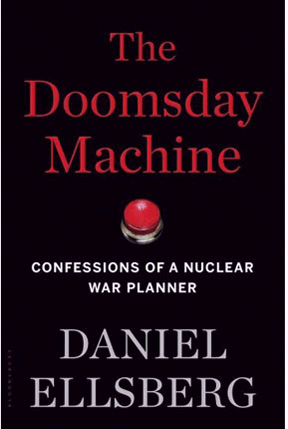 Dismantling Doomsday: Daniel Ellsberg on the Risk of Nuclear Apocalypse https://undark.org/article/book-review-ellsberg-doomsday-machine/ The whistleblower who gave us the Pentagon Papers unveils another secret history — this one ‘dizzyingly insane and immoral.’01.19.2018 Mark Wolverton
DANIEL ELLSBERG is perhaps the premier whistleblower of all time, the man who in 1971 dragged the Pentagon Papers out of top-secret darkness into the light. Yet even as excerpts from the papers’ 7,000 pages were being published by The New York Times, The Washington Post, and other newspapers, Ellsberg was sitting on an entire second set of secrets, having nothing to do with Vietnam: all his material on nuclear policy, such as the operational plans for general nuclear war that he had drafted for the Joint Chiefs of Staff in his job as a RAND Corporation defense analyst.
With the Vietnam War raging, Ellsberg made what he calls a “tactical judgment” to release those papers first, holding off on the nuclear material until the fallout (so to speak) from the Vietnam revelations had settled. As he faced trial, he entrusted the nuclear papers to his brother Harry, who hid the cache in a compost heap and later moved it to the local dump to evade FBI searches. But the papers were irrevocably lost when the dump was later ravaged by a tropical storm.
Ellsberg’s new book, “The Doomsday Machine: Confessions of a Nuclear War Planner,” is his revelation of what was in those lost papers, made possible not only by his prodigious memory and note-keeping but also the declassification and release of much of the material through official channels and Freedom of Information Act requests (many filed by Ellsberg himself). Speaking with the authority of an insider who was intimately involved with nuclear strategy and policymaking at the highest levels, he reveals that practically everything the American public believes about nuclear war and nuclear weapons is, quite simply, a “deliberate deception.” Continue reading →
January 20, 2018
Posted by Christina Macpherson |
General News |
Leave a comment
The Kovvada Nuclear Reactor was to be built by US nuclear reactor maker, Westinghouse. But, in March 2017, Westinghouse filed for bankruptcy. The company was bled to death because of cost-escalations in two of the four nuclear power plants it designed and is constructing in the United States. “Kovvada will benefit only Westinghouse, and no one else. Not the people. Not India’s energy security,” said EAS Sarma, former Union Energy Secretary.
“India is being bamboozled by the multinationals into signing these agreements with foreign companies”
 “It is not just the US, even Europe is not gung-ho about nuclear. So, Westinghouse and GE have very little business,” said Dr Sarma. “They are looking for a market and India is fertile ground of them”
If nuclear energy is not as safe or inexpensive then why invest in it? “Because nuclear energy is a possible front for weaponisation
In Kovvada, villagers displaced forcibly even as the prospects of Westinghouse’s nuclear project remain uncertain, DiaNuke.org, JANUARY 19, 2018 Raksha Kumar | The News Minute
The coast curves through northern Andhra Pradesh and forms a giant U. Deep in the womb of this horseshoe lies Ranastalam mandal of Srikakulam district. During the light winter showers in November, this region takes on a darker shade of green. Small fishing villages are sprinkled across the uneven coast.
People here consider the vast sea their sole asset. “We have been fishermen for generations,” said Juggle Mailapally, ex-sarpanch of Chinna Kovvada village. “I was taught how to stitch a fishing net when I was 9,” he added.
Since 2008, when the Indo-US Nuclear Deal was signed, there have been rumours in the air about a giant nuclear plant taking over their idyllic existence. However only in 2015 did those rumours get confirmed. Continue reading →
January 20, 2018
Posted by Christina Macpherson |
General News |
Leave a comment
Lorna Arnold, an official historian of the British Ministry of Defense, justified her governments treatment of Aborigines by arguing that, all the time, the latter had “NO” legal rights – a problem general to the 1950’s Australian and British society and thus not specific to the atomic tests.
Arnold asserted that the greatest damage suffered by the Aborigines from the tests was to their “way of life rather than directly to their health.” The fact that the Aborigines interests in the land were neither registered or respected, Arnold wrote, was because of “their general situation and was neither new nor peculiar to the weapons trials.
The British military carried out nuclear tests in Australia for almost a decade, with a vast majority of experiments (as claimed) taking place on Aboriginal lands.
January 20, 2018
Posted by Christina Macpherson |
General News |
Leave a comment
Paul Waldon, 19 Jan 18 Edward Teller, “Father of the H-Bomb,” relentlessly promoted a plan to use 300 nukes to build a second Panama Canal, that’s 233 more bombs than what was exploded on the Marshall Islands, with residents unable to return. While here in Australia we have the Department of Industry, Innovation and Science relentlessly promoting their risky agenda of abandoning deadly radioactive waste within a community of unwilling people.
January 20, 2018
Posted by Christina Macpherson |
General News |
Leave a comment
 Shareholder lawsuits against SCANA over nuclear debacle debut in federal court. http://www.thestate.com/news/politics-government/article195428354.html COLUMBIA, SC
A federal judge in Columbia on Thursday designated lead lawyers and plaintiffs in two types of shareholder lawsuits against SCANA over its bungled V.C. Summer expansion.
The lawsuits charge SCANA and its top officers with misconduct and breaches of fiduciary duty in their handling of the failed $9 billion construction project. Continue reading →
January 20, 2018
Posted by Christina Macpherson |
General News |
Leave a comment
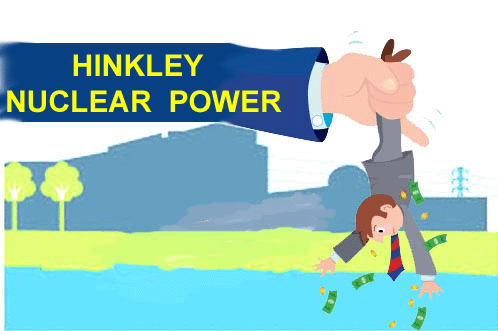
 Abandoning Hinkley Point C now could save consumers almost £1.5bn per year for 35 years from 2027 http://www.no2nuclearpower.org.uk/news/ 19 Jan 18 Stop Hinkley Campaign submits response to the Helm ‘cost of energy’ review.
The Stop Hinkley Campaign has submitted a joint response, with the Nuclear Free Local Authorities (NFLA), to the UK Government’s call for evidence on Professor Dieter Helm’s review of the UK energy market and the financial costs of energy to consumers and businesses. (1)
The joint submission argues the best way for the Government to keep electricity costs to consumers as low as possible over the coming decades, while reducing carbon emissions, and providing secure electricity supplies, is to cancel Hinkley Point C, scrap the new nuclear programme, launch a much more comprehensive energy efficiency programme and expand renewable energy ambitions.
The response also notes:
• Cancelling Hinkley Point C now might incur a cancellation cost of around £2bn, but consumers could save around £50bn over its lifetime. (2)
• Offshore wind is already approaching half the cost of nuclear power and Bloomberg New Energy Finance (BNEF) predicts costs will drop a further 71% by 2040.
• Removing the current block on onshore wind could save consumers around £1bn.
• Solar power is expected to be the cheapest source of energy (not just electricity) anywhere in the world by 2030 or 2040.
• Cost-effective investments in domestic energy efficiency between now and 2035 could save around 140 terawatt hours (TWh) of energy and save an average of £270 per household per year at current energy prices. The investments would deliver net benefits worth £7.5bn to the UK.
• Renewables could soon be producing enough electricity to power the grid from April to October. If the Government continues with the nuclear programme then Ministers will have to explain to consumers why they are having to pay for expensive nuclear electricity when cheap renewables are being turned off.
• The UK has the technology to match green power supply and demand at affordable cost without fossil fuels – by deploying the ‘smart grid’, using ‘green gas’ made from surplus power, and raising energy efficiency.
• Baseload is not helpful in balancing a variable energy supply – it simply leads to further overproduction of energy at times when renewables can meet demand on their own.
Just before the Christmas holidays the two organisations also submitted a joint response to the UK Government’s Clean Growth Strategy. (3)
Instead of funding R&D on new nuclear technology and Small Modular Reactors to the tune of around £460m, this called for more funding for low carbon heat and energy efficiency. In particular the Government should be investigating power-to-gas (P2G) technology which can produce renewable hydrogen, using surplus renewable electricity, which could then be fed into the gas grid for storage or used for producing renewable heat.
Stop Hinkley Spokesperson Roy Pumfrey said:
“The cost of renewables is declining rapidly, and it is becoming increasingly clear that there are lots of ways of dealing with intermittency issues. It now looks as though Hinkley Point C won’t be online before 2027. Several financial institutions have predicted that large centralised power stations are likely to be obsolete within 10 to 20 years, because they are too big and inflexible, and are “not relevant” for future electricity. (4) So Hinkley Point C and the rest of the UK’s ill-conceived new nuclear programme will be too late, too expensive and too problematic. Wind and solar are cheaper more flexible and much quicker to build. It is time to cancel Hinkley Point C now before consumers are saddled with a needless bill for £50bn not to mention the nuclear waste which we still don’t know what to do with.”
Notes
(1) The Stop Hinkley and NFLA joint submission on the Government’s call for evidence on the Helm Review is available here.
(2) See Time to Cancel Hinkley Point C by Emeritus Professor Steve Thomas available here.
(3) The Stop Hinkley and NFLA joint submission on the Government’s Clean Growth Strategy is available here.
(4) See Stop Hinkley Press Release 28th August 2014
January 20, 2018
Posted by Christina Macpherson |
General News |
Leave a comment









 Antinuclear