UN Treaty on the Prohibition of Nuclear Weapons reaches the required 50 ratifications to become law

Historic milestone: UN Treaty on the Prohibition of Nuclear Weapons reaches 50 ratifications needed for entry into force https://www.icanw.org/historic_milestone_un_treaty_on_the_prohibition_of_nuclear_weapons_reaches_50_ratifications_needed_for_entry_into_force 25 Oct 20,
On October 24, 2020, the UN Treaty on the Prohibition of Nuclear Weapons reached the required 50 states parties for its entry into force, after Honduras ratified just one day after Jamaica and Nauru submitted their ratifications. In 90 days, the treaty will enter into force, cementing a categorical ban on nuclear weapons, 75 years after their first use.
This is a historic milestone for this landmark treaty. Prior to the TPNW’s adoption, nuclear weapons were the only weapons of mass destruction not banned under international law, despite their catastrophic humanitarian consequences. Now, with the treaty’s entry into force, we can call nuclear weapons what they are: prohibited weapons of mass destruction, just like chemical weapons and biological weapons.
ICAN’s Executive Director Beatrice Fihn welcomed the historic moment. “This is a new chapter for nuclear disarmament. Decades of activism have achieved what many said was impossible: nuclear weapons are banned,” she said.
Setsuko Thurlow, survivor of the atomic bombing of Hiroshima, said “I have committed my life to the abolition of nuclear weapons. I have nothing but gratitude for all who have worked for the success of our treaty.” As a long-time and iconic ICAN activist who has spent decades sharing the story of the horrors she faced to raise awareness on the humanitarian consequences of nuclear weapons this moment held particular significance: “This is the first time in international law that we have been so recognized. We share this recognition with other hibakusha across the world, those who have suffered radioactive harm from nuclear testing, from uranium mining, from secret experimentation.” Survivors of atomic use and testing all over the world have joined Setsuko in celebrating this milestone.
The three latest states to ratify were proud to be part of such a historic moment. All 50 states have shown true leadership to achieve a world without nuclear weapons, all while facing unprecedented levels of pressure from the nuclear armed states not to do so. A recent letter, obtained by AP only days before the ceremony, demonstrates that the Trump administration has been directly pressuring states that have ratified the treaty to withdraw from it and abstain from encouraging others to join it, in direct contradiction to their obligations under the treaty. Beatrice Fihn said: “Real leadership has been shown by the countries that have joined this historical instrument to bring it to full legal effect. Desperate attempts to weaken these leaders’ commitment to nuclear disarmament demonstrate only the fear of nuclear armed states of the change this treaty will bring.”
This is just the beginning. Once the treaty is in force, all states parties will need to implement all of their positive obligations under the treaty and abide by its prohibitions. States that haven’t joined the treaty will feel its power too – we can expect companies to stop producing nuclear weapons and financial institutions to stop investing in nuclear weapon producing companies.
How do we know? Because we have nearly 600 partner organisations in over 100 countries committed to advancing this treaty and the norm against nuclear weapons. People, companies, universities and governments everywhere will know this weapon has been prohibited and that now is the moment for them to stand on the right side of history
Small nuclear reactors – just a convenient ‘cover’ for the nuclear weapons industry

so-called “small nuclear reactors”
Downing Street told the Financial Times, which it faithfully reported, that it was “considering” £2 billion of taxpayers’ money to support “small nuclear reactors”
They are not small
The first thing to know about these beasts is that they are not small. 440MW? The plant at Wylfa (Anglesey, north Wales) was 460MW (it’s closed now). 440MW is bigger than all the Magnox type reactors except Wylfa and comparable to an Advanced Gas-cooled Reactor.
Only if military needs are driving this decision is it explicable.
”Clearly, the military need to maintain both reactor construction and operation skills and access to fissile materials will remain. I can well see the temptation for Defence Ministers to try to transfer this cost to civilian budgets,”
Any nation’s defence budget in this day and age cannot afford a new generation of nuclear weapons. So it needs to pass the costs onto the energy sector.
How the UK’s secret defence policy is driving energy policy – with the public kept in the dark. https://www.thefifthestate.com.au/energy-lead/how-the-uks-secret-defence-policy-is-driving-energy-policy-with-the-public-kept-in-the-dark/ BY DAVID THORPE / 13 OCTOBER 2020
The UK government has for 15 years persistently backed the need for new nuclear power. Given its many problems, most informed observers can’t understand why. The answer lies in its commitment to being a nuclear military force. Continue reading
Freakishly warm weather delays development of Arctic sea ice

|
Alarm as Arctic sea ice not yet freezing at latest date on record
Delayed freeze in Laptev Sea could have knock-on effects across polar region, scientists say, Guardian, jonathan Watts Global environment editor @jonathanwatts, Thu 22 Oct 2020 For the first time since records began, the main nursery of Arctic sea ice in Siberia has yet to start freezing in late October. The delayed annual freeze in the Laptev Sea has been caused by freakishly protracted warmth in northern Russia and the intrusion of Atlantic waters, say climate scientists who warn of possible knock-on effects across the polar region. Ocean temperatures in the area recently climbed to more than 5C above average, following a record breaking heatwave and the unusually early decline of last winter’s sea ice. The trapped heat takes a long time to dissipate into the atmosphere, even at this time of the year when the sun creeps above the horizon for little more than an hour or two each day. Graphs of sea-ice extent in the Laptev Sea, which usually show a healthy seasonal pulse, appear to have flat-lined. As a result, there is a record amount of open sea in the Arctic. “The lack of freeze-up so far this fall is unprecedented in the Siberian Arctic region,” said Zachary Labe, a postdoctoral researcher at Colorado State University. He says this is in line with the expected impact of human-driven climate change. 2020 is another year that is consistent with a rapidly changing Arctic. Without a systematic reduction in greenhouse gases, the likelihood of our first ‘ice-free’ summer will continue to increase by the mid-21st century,’ he wrote in an email to the Guardian. This year’s Siberian heatwave was made at least 600 times more likely by industrial and agricultural emissions, according to an earlier study. The warmer air temperature is not the only factor slowing the formation of ice. Climate change is also pushing more balmy Atlantic currents into the Arctic and breaking up the usual stratification between warm deep waters and the cool surface. This also makes it difficult for ice to form……… https://www.theguardian.com/world/2020/oct/22/alarm-as-arctic-sea-ice-not-yet-freezing-at-latest-date-on-record?CMP=twt_a-environment_b-gdneco&fbclid=IwAR1qZzerjnAanadMi942h7N8XdCf6Drz_-UIO5mECgAzvXqgiIYjuh6BETc |
|
Global heating is bringing huge water stress to nuclear and coal-fired power stations
 Climate change poses big water risks for nuclear, fossil-fueled plants, S and P Global, Esther Whieldon Taylor Kuykendall, 23 Oct 20,
Climate change-exacerbated water shortage issues pose a near-term and longer-term performance risk to power plants, such as hydropower and nuclear, around the world. And in the Lower 48, more than half of the fossil-fueled and nuclear fleet is located in areas forecast to face climate-related water stress by the end of this decade under a business-as-usual scenario, according to an analysis by S&P Global Market Intelligence.
But electric utilities’ overall exposure to power plant water stress risks could diminish as they pursue decarbonization strategies and replace water-dependent plants with wind and solar generation that require little to no water. Some companies are also implementing water management and related investment strategies to reduce their exposure. ……..
According to projections from the World Resources Institute’s Aqueduct Water Risk Atlas, water stress — when humanity’s competition for water exceeds the rate at which nature can replenish its stocks — could grow materially by 2030 in the drought-prone Western U.S., as well as the upper Midwest and portions of the Northeast and Florida, due to climate change.
About 61.8% of existing fossil-fueled and nuclear power plants in the Lower 48, or a combined 535 GW of operating capacity, is in areas that could face medium-high to extremely high water stress in 2030, based on an analysis of Market Intelligence’s power plant data paired with the Aqueduct water stress projections.
Moreover, 68.6% of the Lower 48’s natural gas-fired fleet, 73.3% of its oil-fueled fleet, 61.0% of its nuclear fleet, and 44.6% of its coal-fired fleet are in areas expected to face medium-high to extremely-high water stress that year.
“As we’re seeing snowpack decline — a natural mountainous reservoir of water — and as we’re getting lower amounts of total precipitation and available water in the U.S. West, this is going to be a really serious issue for the power sector,” said Betsy Otto, director of the Global Water Program at the World Resource Institute, or WRI. Moreover, scientists have said the West is entering a megadrought that could last more than 20 years.
Otto also noted that several other U.S. regions not normally thought of as facing water supply issues are already experiencing chronic water challenges that, if left unchecked, could become a problem if extended droughts, heatwaves, and other major extreme weather events should occur.
A number of utilities use WRI’s Aqueduct tool to assess their water risks in their annual reports to the CDP, formerly known as the Carbon Disclosure Project, and other organizations. But those reports typically focus on the WRI’s current water stress models and not the tool’s future climate projections.
WRI’s current water stress models show a number of regions that are facing water stress will be in the same situation, or worse, at the end of the decade.
Along those lines, Moody’s Investors Service in August reported that about 48 GW of nuclear capacity across the U.S. face elevated exposure to combined heat and water stress, including plants owned by Exelon Corp., Vistra Corp., Entergy Corp., and the Arizona Public Service Co.
In hot water
A plant’s location is not the only factor that will determine its vulnerability to water stress. A plant’s water source, cooling technology and the temperature of the water when it is withdrawn are also key factors, according to scientific reports. The Market Intelligence analysis using the WRI tool does not account for those three factors.
In addition, rising ambient air and water temperatures can also create operational and legal issues for plants. Because plants primarily use water to cool their systems, “if that water is hot or warmer to start with, that’s not so good. That makes the power plant less efficient” and it also means the plant risks violating federal restrictions on how hot water can be when it is discharged, said Auroop Ganguly, director of the Northeastern University College of Engineering Sustainability and Data Sciences Laboratory.
Ganguly co-authored a study that found that by the 2030s, climate-induced water stress in the form of increased water temperatures and limited freshwater supplies will hurt the power production of thermoelectric plants in the South, Southwest, West and West North Central regions of the U.S. According to the 2017 study, U.S. nuclear and fossil-fueled plants at that time used about 161 billion gallons per day, or 45% of the nation’s daily freshwater usage, 90% of which was for cooling.
The technologies used by a power plant can also make a big difference in how much water it needs. Dry-cooling technology uses very little water but is costlier and less efficient than alternatives. And while once-through cooling systems withdraw more water than recirculating systems, once-through cooling returns nearly all of the water to the source while recirculating systems consume more water due to evaporation………. https://www.spglobal.com/marketintelligence/en/news-insights/blog/street-talk-episode-69-banks-left-with-pockets-full-of-cash-and-few-places-to-go
Fossil fuels are ”very clean” – in Donald Trump’s world
 Guardian 23rd Oct 2020, In Donald Trump’s world – laid bare during Thursday night’s final
presidential debate with his Democratic rival Joe Biden in Nashville – fossil fuels are “very clean”, the US has the best air and water despite his administration’s extensive regulatory rollbacks, and thecountry can fix climate change by planting trees.
not exist. Humanity has just eight years to figure out how to get climate change under control before the future starts to look drastically worse – multiple-degree temperature increases, global sea-level rise, and increasingly disastrous wildfires, hurricanes, floods and droughts. Doing so will mean that unless there is a technological miracle, humans will at some point have to stop burning oil, gas and coal.
https://www.theguardian.com/us-news/2020/oct/23/joe-biden-transition-from-oil-industry-rowing-back
More on the presidential debate – about climate change
 Independent 23rd Oct 2020 It has been around 20 years since a lengthy discussion on climate change featured in a presidential debate during which time a monumental shift has happened in how America views the crisis.
Two-thirds of Americans think that the US government should do more on climate change and moderator Kristen Welker asked both Donald Trump and Joe Biden how they would step up
on the issue during the final presidential debate on Thursday, with millions of Americans already taking to the polls ahead of election day on 3 November.
Calling it an “existential crisis”, Mr Biden sounded the alarm for the world to address global warming, as Mr Trump took credit for pulling the US out of the 2015 Paris Climate Accord, the international agreement aimed at doing precisely that. Mr Trump said his focus was saving
American jobs, while taking credit for some of the “cleanest air and water the nation has seen in generations” — partly down to regulations passed in the Obama era.
Independent 23rd Oct 2020, President Trump, who has repeatedly called climate change a “hoax”, said he planned for a “trillion trees” before touting America’s “clean air”, “clean water” and lower carbon emissions (all of which are, at best, misleading, as The Independent has reported).
The president then pivoted to an attack on clean energy, taking particular issue with windmills. “He thinks wind causes cancer. Windmills,” Mr Biden noted. “I know more about wind than you do,” Mr Trump replied, before going on to say windmills are extremely expensive, “kill all the birds” and “the fumes coming up, if you’re a believer in carbon emission … for these massive windmills is more than anything we’re talking about with natural gas which is very clean”.
Nations divided over nuclear ban treaty: the ethical case grows stronger
THE NUCLEAR TREATY dividing the World, Byline Times, Stephen Colegrave, 21 October 2020 As the latest United Nations nuclear treaty is on the eve of coming into force, Stephen Colegrave looks at how it might finally end the ethical and moral case for nuclear weapons.
The Treaty on the Prohibition of Nuclear Weapons has been a long time in the making. It is the first legally binding agreement to comprehensively prohibit nuclear weapons and was originally agreed at the United Nations on 7 July 2017.
To enter into force it requires ratification by at least 50 countries. At last, this is in sight. Any day, the fiftieth nation will ratify despite the determined efforts by all NATO countries and others with nuclear weapons.
UK representatives have remained outside of all meetings in Geneva about the treaty, to try to persuade countries not to sign. What are the predominantly Western powers so afraid of? And why is there such a fissure opening up between countries with access to or guaranteed by nuclear weapons and those which want them to be completely banned?
A Different Type Of Treaty
Up until now, most nuclear treaties have either been between nuclear powers or to limit proliferation internationally. This treaty is different.
The Treaty on the Prohibition of Nuclear Weapons seeks to ban all nuclear weapons and wipe out the hegemony of nuclear powers that has lasted since 1945.
It questions the moral basis of the Western powers’ nuclear ‘deterrent’ policy, which claims to have maintained peace, specifically banning the “use of force and the threat of the use of force”. This is why the treaty is vehemently opposed by NATO members and other nations with nuclear weapons. For the first time, the deterrent stance is now being questioned by politicians in nations around the world, not just by activists.
Northern Hemisphere nations such as Austria, Mexico and Ireland have actively campaigned against nuclear weapons and, in the Southern Hemisphere, many nations have already signed treaties and conventions setting up Nuclear Weapon Free Zones. In fact, the six main zones include 60% of the 195 nation states, 59% of the world’s geography and 39% of the world’s population. These nations will not allow the transportation of nuclear weapons, their supply chain in their territories, or even let ships use their harbours. Attitudes in these areas and other non-nuclear states is very different than those found in the UK and America.
Until recently, nations with nuclear weapons have been setting the agenda and the conversation about limiting nuclear proliferation, in countries such as North Korea and Iran, has focused on limiting their ‘special club’.
With this treaty, the countries that have banned nuclear weapons in their own regions have taken global leadership over the issue for the first time. They have been responsible for setting a new legal standard and building the moral case that nuclear weapons must be eliminated. This is because they realise that their Nuclear Weapon Free Zones are worthless if nuclear powers accidently or deliberately set off a nuclear winter.
Very dubious claims made by proponents of NuScam’s small nuclear reactor plans
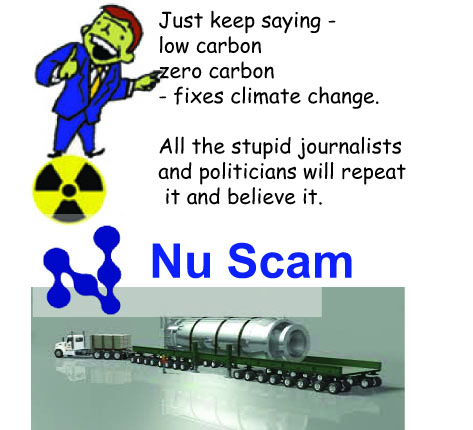 Small Nuclear Reactors Would Provide [a dubious claim] Carbon-Free Energy, but Would They Be Safe? Inside Climate News, Jonathan Moens, -21 Oct 20 Regulators have approved designs for 12 small reactors to be built in Idaho, but opponents say the project is dangerous and too late to fight climate change. “……… Last month, U.S. officials approved NuScale Power’s designs for 12 small nuclear reactors to be built in Boise, Idaho. The reactors could make use of the water, transmission lines and general infrastructure of former coal-powered plants in the West to produce clean energy, said Jose Reyes, co-founder of the company.
NuScale said the energy produced by its reactors would generate enough electricity to power about 50,000 homes across six Western states. The Utah Associated Municipal Power Systems, an energy cooperative, would be the first to build the reactors on a federal site at the Idaho National Laboratory.
The NuScale Power initiative has met with opposition from local environmental groups, who say that nuclear power is a dangerous and unsustainable energy source.
In addition, the highly radioactive waste from nuclear reactors must be securely stored indefinitely to prevent accidents, and contains plutonium and uranium that can be reprocessed into nuclear weapons. “We see this project as a way to create a whole new generation of high level radioactive waste,” said Scott Williams, executive director of Healthy Environment Alliance of Utah, a nuclear watchdog. ……
The designs underwent a public health and safety review by the Nuclear Regulatory Commission. But some scientists think they still aren’t safe enough. In a public statement, Edwin Lyman, director of nuclear power safety with the Union of Concerned Scientists, cited a report by a senior engineer at the Nuclear Regulatory Commission expressing concern that the cooling process might inadvertently cause “catastrophic” core damage to the reactors.
Other scientists worry that NuScale may be getting ahead of itself by not having a planning protocol for a radioactive emergency that affects areas around the site.
“In the event of an accident, the people around there will not have rehearsed how to do an evacuation,” said M.V. Ramana, a professor in the School of Public Policy and Global Affairs at the University of British Columbia. …….
Too Late in a Climate Crisis?
The municipal power systems cooperative still needs to obtain a license to build and begin operating the reactors. To do so, the project will undergo an additional site-specific review to consider the potential ecological, geographic and residential impact the technology may have on the area, said George Griffith, lead technician at the Idaho National Laboratory.
The delay means that while NuScale will be ready to manufacture modular reactors by around 2024, it will take an additional five to six years for them to be operational at the Idaho site, said Reyes.
Some experts, however, question whether 2029 is too late for the technology to be relevant in a time of climate crisis…….
Ramana, of the University of British Columbia, said, “While the overall capital cost [for small modular reactors] might be smaller, they also generate smaller amounts of electricity.” He outlined his concerns in a report released in September urging the Utah energy cooperative to “end their pursuit of small modular reactors.”
Ramana made clear that while devastating incidents associated with nuclear power plants might seem unlikely, we need to remain cautious.
“The lesson we should learn from all the many nuclear and other accidents that have happened with hazardous technologies, is a little bit of humility,” he said. https://insideclimatenews.org/news/20102020/small-nuclear-reactors-carbon-free-energy
Vital need to protect Antarctic seas: groups aim for new protected areas
|
‘No other choice’: Groups push to protect vast swaths of Antarctic seas, Mongabay
BY ELIZABETH CLAIRE ALBERTS ON 19 OCT, 2020
‘……………… While Antarctica’s land mass is currently protected through the Antarctic Treaty (although this expires in 2048), vast swaths of its marine region are open to industrial fishing for species such as Antarctic krill (Euphausia superba) and Patagonian toothfish (Dissostichus eleginoides). Conservationists say these fishing activities are endangering the Southern Ocean’s delicate marine ecosystem that hosts more than 15,000 species, and a region that plays a vital role in regulating the world’s climate.
A coalition of conservation groups, including Pew, ASOC, SeaLegacy, Antarctica2020, Ocean Unite, and Only One, are working together to advocate for the formation of three marine protected areas (MPAs) in East Antarctica, the Antarctic Peninsula, and the Weddell Sea. Together, these areas would protect about 4 million square kilometers (1.5 million square miles), encompassing 1% of the world’s ocean. That’s two and a half times the size of Alaska, and nearly three times the size of Papahānaumokuākea Marine National Monument in Hawaiʻi, which is currently one of the world’s largest marine sanctuaries. “If these three marine protected areas … [are] created at the same time, it would form the largest marine protection in the history of humanity,” Cristina Mittermeier, National Geographic wildlife photographer and co-founder of SeaLegacy, told Mongabay. “[It would be] a piece of good news that the planet needs.” This is a matter of political will’The body responsible for making decisions surrounding Antarctica’s marine region is the Commission for the Conservation of Antarctic Marine Living Resources (CCAMLR), an international commission with 25 member states and the European Union, as well as 10 acceding states. Originally established to manage krill fisheries in the Southern Ocean, the commission meets each year in Hobart, Australia, to negotiate total allowable catches for fisheries, and to discuss other matters related to Antarctica’s marine region, including the designation of MPAs. Any decision requires a consensus among all members, and proposals can take a long time to be approved. For instance, it took more than five years for the commission to approve a proposal to turn a region of the Ross Sea into an MPA, according to Werner. But it finally went ahead in 2016: now 1.55 million km2 (nearly 600,000 mi2)of the Ross Sea is classified as an MPA, with 1.12 million km2 (432,000 mi2) of the region fully protected from commercial fishing. “In CCAMLR, everything is possible,” said Werner, who acts as an official observer and scientific representative at the commission. “You can have a proposal blocked for years like the Ross Sea, and then one day [it happens].”………… The way that Antarctica goes, so does the world’One of the most important species living in the Southern Ocean is krill. These tiny, shrimp-like crustaceans are the foodstuff for many species, such as whales, seals, penguins, squids, fish and seabirds. Without krill, the pelagic food web would entirely collapse. Krill is also heavily harvested for human consumption, mainly for fish meal and omega-3 dietary supplements. The establishment of the three proposed MPAs — which would include no-take zones, but also areas that would allow regulated fishing — would help protect krill populations from overharvesting and enable fishing activities to continue in other areas, Cousteau said. According to one study, MPAs help increase fish mass……… But it’s not just fishing that’s a threat to krill — climate change is wreaking havoc on the species as high temperatures melt the ice it vitally depends upon. …….. https://news.mongabay.com/2020/10/no-other-choice-groups-push-to-protect-vast-swaths-of-antarctic-seas/ |
|
Bees are harmed by quite low levels of ionising radiation
|
Current Chernobyl-level radiation harmful to bees: study https://www.thehindu.com/sci-tech/energy-and-environment/current-chernobyl-level-radiation-harmful-to-bees-study/article32908484.eceAFP
PARIS, FRANCE, OCTOBER 21, 2020 Researchers exposed bee colonies in a laboratory setting to a range of radiation levels found in areas of the exclusion zone around the ruined Chernobyl site Bumblebees exposed to levels of radiation found within the Chernobyl exclusion zone suffered a “significant” drop in reproduction, in new research published Wednesday that scientists say should prompt a rethink of international calculations of nuclear environmental risk. The study, published in the journal Proceedings of the Royal Society B, set out to discover how ionising radiation affects insects, which are often thought to be more resilient than other species. “We found that at radiation levels detectable in Chernobyl, the number of new queen bees produced from the colony was significantly reduced and colony growth was delayed — meaning colonies reached their peak weight at a week later,” said the paper’s lead author Katherine Raines. The lecturer in environmental pollution at the University of Stirling told AFP by email that researchers “anticipate that this may have an effect on pollination/ecosystem services in contaminated areas”. The authors said they chose bumblebees both because of a lack of lab-based research into bees and because of their crucial role in pollination. Ionising radiation can occur either from nuclear sites or medical procedures, although the levels tested were higher than those that would likely be found in the environment from normal releases, Raines said. But she added that the researchers were “very surprised that we could detect effects as low as we did”. “Our research suggests insects living in the most contaminated areas at Chernobyl may suffer adverse effects, with subsequent consequences for ecosystem services such as pollination,” she added. The authors said if their findings could be generalised “they suggest insects suffer significant negative consequences at dose rates previously thought safe” and called revisions to the international framework for radiological protection of the environment. People are not allowed to live near the Chernobyl power station and the abandoned settlements within the exclusion zone are surrounded by forests hosting birds, wolves, elks and lynxes. A giant protective dome was put in place over the destroyed fourth reactor in 2016. |
|
Why Nuclear Power Is Unsustainable

https://dragontrailz.tumblr.com/post/632215852166610944/why-nuclear-power-is-unsustainable/amp
China’s nuclear oppression of the Uighur people
A third of the PRCs uranium for nuclear energy comes from extortion in the Yili basin of Xinjiang. This is also home to a great population of Uighurs.
Today, China has one of the world’s largest nuclear energy development programmes. During the Cold War era, there did not exist a political or economic motivator for commercialising nuclear energy as coal-fired power stations and hydroelectric energy dominated the system. However, after 2005, China has been able to reinvent this narrative. Notably, what this resurrected was a reassertion of spaces of injustice for their minorities. Their lands were first grounds for nuclear weapons’ testing and now used for energy rather than warfare purposes, thus continuing a historical subjugation to nuclear imperialism. This nuclear imperialism situates itself within an already prevalent cyclic violence against China’s far western frontier region of Xinjiang’s ethnic minorities, the predominantly Muslim Uighurs, ever since the establishment of the People’s Republic of China (PRC) in 1949. Continue reading
Solar power really can provide cheap electricity
 Nuclear power never delivered on its promise, but will solar? John Quiggin, Canberra Times, 19 Oct 20,

The International Energy Agency attracted attention recently when executive director Fatih Birol declared that solar would be “the new king of electricity markets.” Long known for its conservative view of renewables, the IEA’s latest Global Energy Review marked a radical change. Instead of growing slowly over time, solar (along with wind and other renewables) is now seen as meeting all new electricity demand, with coal set for a sharp decline. …….
The prospect of electricity this cheap might seem counter-intuitive to anyone whose model of investment analysis is based on concepts like “present value” and payback periods. But in the world of zero real interest rates that now appears to be upon us, such concepts are no longer relevant. Governments can, and should, invest in projects whenever the total benefits exceed the costs, regardless of how those benefits are spread over time.
- John Quiggin is a Professor of Economics at the University of Queensland and a columnist with Inside Story, where this article also appears. https://www.canberratimes.com.au/story/6974708/energy-that-is-too-cheap-to-meter/
Dismal future for nuclear power: small nuclear reactors a false hope
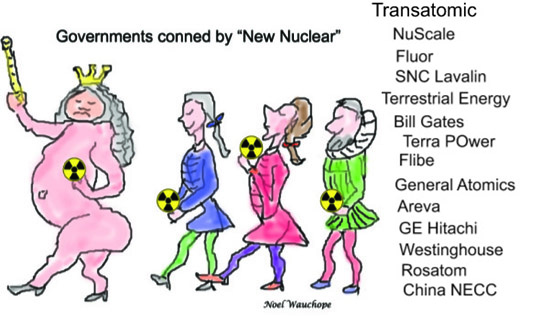
“Overall, in terms of the cost of power, new nuclear is clearly losing to wind and photovoltaics,”
More recently, the nuclear industry has been promising a technological renaissance through small modular reactors (SMRs). But “the industry is actually selling PowerPoint reactors, not detailed engineering,”
“if you look at nuclear power, it’s not only the most expensive, but it’s by far the slowest.” With even French nuclear giant EDF bidding against its own legacy technology to supply lower-cost solar projects, “do we really have to discuss what the future is or where this goes?”
|
WORLD NUCLEAR INDUSTRY LOSES GROUND TO CHEAP RENEWABLES AS CANADA CONSIDERS SMALL MODULAR REACTORS, The Energy Mix SEPTEMBER 27, 2020
MITCHELL BEER @MITCHELLBEER
The world nuclear industry “continues to be in stasis,” with power plants shutting down at a faster rate in western Europe and the United States, the number of operating reactor units at a 30-year low, and the few new construction projects running into “catastrophic cost overruns and schedule slippages,” according to the latest edition of the annual World Nuclear Industry Status Report (WNISR), released last week. Continue reading
|
In America, anti-science attacks Dr Fauci, about the pandemic, and Michael Mann, on climate change
America re-discovers anti-science in its midst, Environmental Health News,16 Oct 20
Fauci, Birx, Redfield & Co. are in the middle of a political food fight. They could learn a lot from environmental scientists.
Let’s start with the story of a scientist who beat back a powerful global denial movement without any help from social media or modern, sophisticated organizing campaigns.
It took Galileo 359 years to wrangle an apology out of the Vatican for his heretical belief that the Earth revolved around the sun.
I’m glad he didn’t take it personally. Science denial is neither new nor purely American—but we sure are finding ways to make it lethal and lasting.
Climate scientists have been dealing with anti-science, largely unnoticed by the general public, for 20 years. Doctors face a growing wave of anti-vaccination zealots. Now a pandemic with a seven-figure global death toll and a stranglehold on the world’s economy has opened the doors wide for some multi-front anti-science blowback.
Americans, many refusing to wear masks and ignoring social distancing guidelines, appear to be gathering at frat parties, raves, political rallies, nightclubs and more in defiance of what credentialed experts say are the most vital ways to restrict the spread of COVID-19.
Major sporting events, notably college football, are backing down from previously self-imposed restrictions.
And, lo and behold, positive test rates are going back up in a big way.
Past is deadly prologue
Here are a couple recent, high profile examples of anti-science fervor in the U.S.:………
But nothing in science can quite match the decades-long assault on climate science and climate scientists. On the high end, there are PR campaigns backed by fossil fuel money, well-heeled litigation, and unhinged attacks from national pols and pundits. Then, there are the confounding, face-palming antics of the Coal Rollers—pickup truck owners who modify their rides with “Prius Repellent”—thick sooty black smoke intended to make a bizarre anti-science, pro-climate denial statement. Yes, people do this.
Penn State’s Michael Mann is arguably the highest-profile climate scientist in the U.S. Let’s make a minor leap of faith and say Mann’s climate stature is the closest equivalent to Dr. Anthony Fauci’s standing on coronavirus.
Right now, Dr. Fauci’s main public tormentor is President Trump. Their conflicts are tame compared to the deniers’ gang-up on Mann, which has lasted more than a decade and may offer Fauci a few tips on being a scientist in the middle of a political peeing match…….
Make no mistake, Fauci’s a heroic public servant in an awful bind who, as far as I know, may not even be interested in the killer tell-all book that now resides in his head.
But after COVID-19 is finally conquered, Mike Mann and a thousand others will still be getting bashed, and the worst impacts of climate change will still be ahead of us.
Peter Dykstra is our weekend editor and columnist and can be reached at pdykstra@ehn.org or @pdykstra.
1 This month

of the week – Australians for War Powers Reform (AWPR)
To see nuclear-related stories in greater depth and intensity
 Antinuclear