‘A couple of months ago, Adani looked set to defy
economic logic, popular opposition and
the urgent reality of climate change. …
‘All of a sudden there was a plausible – albeit absurd on many levels
– pathway that Adani might find to secure the billions of dollars
it needed for the Carmichael mine to proceed.
‘And then it all fell to pieces. …
‘After all, here we are at the start of 2018 still talking
about the prospect of allowing the largest thermal coal mine in Australia to proceed,
heavily subsidised by the taxpayer,
opposed by over 70 per cent of people who know about the project,
in a context of the thermal coal trade in structural decline
and in the middle of a climate crisis. …
‘Julien Vincent is the executive director of Market Forces’
These days, the political-information network publishes every MP’s reiteration of the song as it happens, and people see it for the insincere, boring confection that it is.
New info networks v old political hierarchy, by CRISPIN HULL on DECEMBER 30, 2017, MUCH is made of how the 24-hour media cycle is having a disturbing influence on politics in Australia and elsewhere, but perhaps it is not so much the change to the timing of publication, but the change to the nature of the sources that is causing the disruption. In the pre-internet model, news and opinion was presented to the public by organisations which were highly hierarchical. Media corporations had a CEO, an editor, news directors, various section heads, sub-editors, a chief of reporting staff down to the lowly reporters.
They were, and to some extent still are, like military organisations, though the average reporter might be allowed a little more initiative than the average foot soldier. Nonetheless, media outfits were highly directed. The political system was also a hierarchy – party leader, front-bencher, back-bencher, on the federal or state executive, chair of electorate machine, executive of electorate machine, party member.
Together they worked well. The political hierarchy produced the daily song sheet and it was repeated once in the newspaper and once on the TV news. It was received wisdom. The discussion agenda was defined.
Then came the internet, which is the opposite of hierarchical. Rather than the top-down hierarchies of traditional media it is a network, with links in all directions.
Using it, people have a far wider selection of sources of news, opinion and information. In response to the ease of publication people created new news and information sites where experts could speak directly to the public.
Sites such as The Conversation, Online Opinion, Pearls and Irritations, Crikey and dozens of others sprung up around the world. (So, of course, did sites run by ignorant, opinionated, non-experts.)
The result is that a greater political literacy and more nuanced discussion among people interested in politics replaced the pre-internet received wisdom. We now are seeing a trickle sideways. It is now far easier for many voters to become better informed than most MPs about a lot of issues.
It has perplexed politicians. By and large they have remained stone-deaf and trapped in their hierarchy. Continue reading →
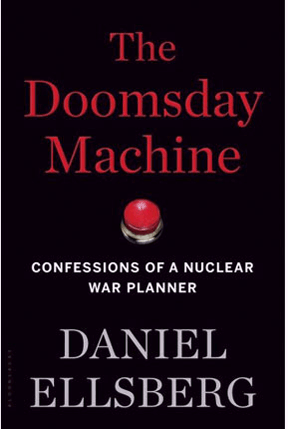
Doomsday Machine: US top-secret nuclear war plans exposed, NZ Herald, 7 Jan, 2018 , news.com.au, By: James Law, A legendary whistleblower has exposed the US’s top-secret nuclear war plans that could bring humankind to extinction in an explosive new book.
In The Doomsday Machine, former White House nuclear war adviser Daniel Ellsberg argues that the world’s nuclear powers have had the ability to wipe all human beings off the planet since the 1960s — and current policies mean the risk of global annihilation are higher than ever today, reports news.com.au.
Mr Ellsberg became a whistleblowing legend in the ’70s when he leaked the Pentagon Papers to The New York Times and other newspapers. The trove of photocopied classified documents exposed that the US government had lied to the public and the Congress about its involvement in the Vietnam War. Mr Ellsberg’s leaking of the documents has been dramatised in the upcoming Steven Spielberg movie The Post, out on January 11.
But Mr Ellsberg’s photocopying of top-secret government files didn’t stop with the Pentagon Papers.
In his new book, he reveals for the first time that he copied an additional 8000 pages of top-secret material from his work for the White House and the RAND Corporation, a military research and development business that advises the US armed forces.
Much of his work at the RAND Corporation involved drawing up a secret plan, under president Dwight Eisenhower, for a nuclear war.
Mr Ellsberg asserts that much of what he learnt of the dire threats US nuclear strategy posed in the late ’50s and early ’60s is still true today.
Mr Ellsberg became a whistleblowing legend in the ’70s when he leaked the Pentagon Papers to The New York Times and other newspapers. The trove of photocopied classified documents exposed that the US government had lied to the public and the Congress about its involvement in the Vietnam War. Mr Ellsberg’s leaking of the documents has been dramatised in the upcoming Steven Spielberg movie The Post, out on January 11.
But Mr Ellsberg’s photocopying of top-secret government files didn’t stop with the Pentagon Papers.
In his new book, he reveals for the first time that he copied an additional 8000 pages of top-secret material from his work for the White House and the RAND Corporation, a military research and development business that advises the US armed forces.
Much of his work at the RAND Corporation involved drawing up a secret plan, under president Dwight Eisenhower, for a nuclear war.
Mr Ellsberg asserts that much of what he learnt of the dire threats US nuclear strategy posed in the late ’50s and early ’60s is still true today.
Mr Ellsberg writes that US nuclear plans have always been drawn up with the aim of striking first under all circumstances.
Successive presidents, Donald Trump included, have declined to change US military policy to “no first use”, which is a pledge not to use nuclear weapons unless first attacked by an enemy using its own nukes.
Mr Ellsberg argues that this creates an implied threat of nuclear attack on every state that might come into conflict with the US, such as North Korea, and only serves to encourage nuclear weapons proliferation.
“Indeed, it has encouraged proliferation in states hoping either to counter these American threats or to imitate them,” he writes.
“Of course, our insistence on maintaining an arsenal of thousands of weapons, many on alert, a quarter century into the post-Cold War era, nullifies our advice to most other states in the world that they ‘have no need’ or justification for producing a single nuclear weapon.”
One of the more alarming parts of the book is the revelation of what Mr Ellsberg calls “one of our highest national secrets” — that a number of people in the US have the delegated authority to pull the trigger on nuclear weapons.
“With respect to deliberate, authorised US strategic attacks, the system has always been designed to be triggered by a far wider range of events than the public has ever imagined,” Mr Ellsberg writes.
“Moreover, the hand authorised to pull the trigger on US nuclear forces has never been exclusively that of the president, nor even his highest military officials.”…….
Mr Ellsberg sums up by saying the world’s nuclear build-up is a “chronicle of human madness”.
“Most aspects of the US nuclear planning system and force readiness that became known to me half a century ago still exist today, as prone to catastrophe as ever but on a scale, as now known to environmental scientists, looming vastly larger than was understood then,” he writes.
“The present risks of the current nuclear era go far beyond the dangers of proliferation and non-state terrorism that have been the almost exclusive focus of public concern for the past generation and the past decade in particular.
The dry-storage plan OK’ed by the Coastal Commission is the Holtec system: cheaper canisters with 1/2 to 5/8-inch thick stainless steel walls, wildly short of the 10 to 20-inch thick-walled ones used in other countries.
At the controversy’s core is the susceptibility of Holtec canisters to cracking, which could leak radiation into the environment.
Holtec canisters have no seismic rating, are not proven safe for transport, and there is no means to even inspect them for cracks or for existing cracks to be repaired in a safe manner. A crack can’t even be detected until after a radiation leak has occurred.
A highly disturbing report from Sandia National Laboratories states that a crack in a hot canister can penetrate the wall in under 5 years.
Mosko: Ticking Time Bomb at San Onofre Nuclear Plant,https://voiceofoc.org/2018/01/mosko-ticking-time-bomb-at-san-onofre-nuclear-plant/By SARAH “STEVE” MOSKOThe seaside nuclear reactors at the San Onofre Nuclear Generating Station in San Clemente were permanently shut down in 2013 following steam generator malfunction. What to do with the 3.6 million pounds of highly radioactive waste remains an epic problem, however, pitting concerned citizens against Southern California Edison, the California Coastal Commission and the Nuclear Regulatory Commission (NRC). Edison operates San Onofre, the Coastal Commission is charged with protecting the coastline, and the NRC is responsible for long-term storage of spent nuclear fuel and protecting the public.The Problem
A reactor’s spent nuclear fuel must be stored safely for 250,000 years to allow the radioactivity to dissipate. San Onofre’s nuclear waste has been stored in containers 20 feet under water in cooling pools for at least five years, the standard procedure for on-site temporary storage. Long-term storage necessitates transfer to fortified dry-storage canisters for eventual transportation to a permanent national storage site which, under the Nuclear Waste Policy Act of 1982, the federal government is under obligation to construct.
However, the plan to build an underground repository at Yucca Mountain in the Nevadan desert was ditched in 2011 out of concern that deep groundwater could destabilize the canisters, leaving the United States with literally no plan on the horizon for permanent storage of nuclear waste from San Onofre or any other of the country’s nuclear power plants. In fact, under the NRC’s newest plan – the so-called Generic Environmental Impact Statement – nuclear power plant waste might be stored on-site forever.
Given this, informed southern Californians are up in arms about the 2015 permit by the Coastal Commission allowing Edison to build a dry-storage bunker right at San Onofre – near major metropolitan areas and within a few hundred feet of both the I-5 Freeway and the shoreline in a known earthquake zone – using thin-wall canisters never proven safe for storage or transport (Coastal Development Permit No. 9-15-0228). Most other countries, including Germany, France, Japan, Russia and Australia, utilize thick-wall canisters with time proven safety technology. Continue reading →
He says through its social media manipulation operations, spy agency Government Communications Headquarters (GCHQ) tried to influence online activists during the 2009 Iranian presidential election protests, and the 2011 uprisings widely known as the Arab Spring.
Al-Bassam told the Chaos Communication Congress in Germany last week that the Joint Threat Research Intelligence Group (JTRIG) – a unit in GCHQ – uses “dirty tricks” to target activists. Continue reading →
with the whole world receding from setting up nuclear plants, by the time this “major powerhouse” is established in 4-6 years, where are the foreign orders for nuclear plant components going to come from? Or, are we planning to use tax-payers’ money to continually prop up the ailing big manufacturing industries in India by giving them nuclear power orders, whether we want nuclear power or not?
India Should Halt Further Expansion of its Nuclear Power ProgramThe Citizen, –-A. GOPALAKRISHNAN[Dr A.Gopalakrishnan is former Chairman, Atomic Energy Regulatory Board,Governmentof India. He welcomes discussions and comments from readers. They can contact him at his e-mail:agk37@hotmail.com]13 NOVEMBER, 2017
Nuclear safety is in jeopardy An overall evaluation of the status of the Indian civilian nuclear power sector, and the government’s uncertain future plans, do cause a great deal of concern for the welfare of the country and the safety of our people. Therefore, it is best to freeze all plans for the further expansion of this sector until Parliament and the public are provided full details of the government’s intentions and rationale and a national consensus is reached.
Background: The Indian civilian nuclear power program is ultimately administered by the Department of Atomic Energy (DAE) which reports to the Prime Minister.
The detailed policies, programs, and projects of both the civilian and military aspects of atomic energy are overseen and approved by a supra-powerful body called the Atomic Energy Commission (AEC).
…… Once this group approves a program or gives a decision, no other entity like the Comptroller & Auditor General (CAG), who should be overseeing financial propriety in the Central Government expenditure or the Atomic Energy Regulatory Board (AERB) which is responsible for project & public safety, will usually dare to question the AEC decision. This top-heavy administration of the nuclear program and the fear that it exudes is at the heart of most of the ailments of the nuclear sector.
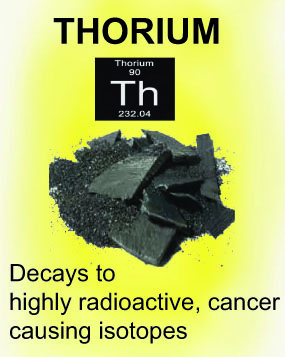
The militants had hoped to transform low-grade radioactive Thorium 232 (Th-232) into deadly Uranium 233 (U-233). When combined with powerful home-made explosive triacetone triperoxide (TATP), the concoction can create a “nuclear bomb”, according to an instruction manual used by the militants and reviewed by Reuters.
IS supporters in Malaysia may build bombs with radioactive materials, Today online 02 JANUARY, 2018, KUALA LUMPUR— Fears are growing that fighters from the Islamic State (IS) group, including their sympathisers in Malaysia, may attempt to build bombs using radioactive materials.
This concern is especially real as the Malaysian police have recorded no less than 20 cases involving radioactive and nuclear materials which have “gone missing” over recent years.While some may have been retrieved, the whereabouts of many others remain unknown.
Perturbed by the combination of “missing radioactive goods and IS”, sources in security agencies said it was crucial for the counter-terrorism division to aggressively trace the missing radioactive materials.Normally, these cases will be investigated by the police’s Criminal Investigation Department. However, it should not be treated as a usual case of theft,” the sources said.
“There is a need to trace who the perpetrators are, their background, contacts and find out their motives. These are all vital information that must be cross-checked to ensure that these dangerous materials do not fall into the wrong hands.”
The sources also warned that terrorists might make use of radioactive and nuclear materials which had not been categorised as “controlled items”.
“There are two groups of radioactive and nuclear materials: those which are controlled and monitored by the authorities, and the others that we cannot control as they are stolen or improperly disposed off.”
Concerns about security threats in South-east Asia intensified when Indonesian security forces recently foiled an attempt by militants to detonate a dirty bomb.A dirty bomb is a conventional bomb that contains radioactive material.
The plot was foiled when police raided homes and arrested five suspects in Bandung, West Java in August last year. After the raids, police spoke of a plan to explode a “chemical” bomb but provided no other details.
The militants had hoped to transform low-grade radioactive Thorium 232 (Th-232) into deadly Uranium 233 (U-233). When combined with powerful home-made explosive triacetone triperoxide (TATP), the concoction can create a “nuclear bomb”, according to an instruction manual used by the militants and reviewed by Reuters.
Malaysia has been on high alert since gunmen linked to the IS launched multiple attacks in Jakarta in January 2016 and has arrested hundreds of people over the past few years for suspected links to militant groups, and has arrested hundreds of people over the past few years for suspected links to militant groups.
Malaysia’s Atomic Energy Licensing Board (AELB) director-general Hamrah Mohd Ali cautioned the authorities against underestimating terrorists’ knowledge and capabilities in utilising radioactive and nuclear materials to produce dirty bombs.
The delay is another setback for China’s ambitious development programme, which aims to raise its installed nuclear power capacity to 58 gigawatts by the end of 2020 from 34.73GW last year, and the world’s hopes for a successful launch of third-generation nuclear reactors.
They are touted by their designers to be safer and more efficient than second-generation ones, a key selling point after the global nuclear industry was dealt a blow by Japan’s Fukushima disaster in 2011.
“The delays reflect our concerns over the high execution risk for CGN in rolling out its aggressive expansion target and its adoption of a new generation of nuclear technology,” Ada Li, senior analyst at Moody’s, wrote in a note on Tuesday.
“The delays also imply the deferral of cash flows from the two nuclear units and potential additional capital expenditure, which would further pressure CGN’s financial metrics.”
She estimated the two reactors to initially make 5 billion yuan in annual revenues, amounting to 7 per cent of the firm’s 2016 revenues, adding its repeated delays are “credit negative”.
CGN said on Friday the first two generating reactors of the plant in Taishan – 136 kilometres west of Hong Kong – has been delayed to 2018 and 2019, from the second half of 2017 and the first half of 2018 respectively.
“As no nuclear power generating unit with the EPR [Evolutionary Power Reactor] technology has been put into commercial operation across the world … Taishan Nuclear has to conduct more experimental verifications in respect of design and equipment,” it added.
The firm in early 2015 cited a “comprehensive evaluation” of the construction plan and risks for its first delay. In the second delay early last year, it said it the needed to conduct “more experimental verifications in respect of its design and equipment”.
The project was originally expected to come on line in 2015.
Moody’s said the latest postponement will not affect its A3 issuer credit rating on CGN, which has already incorporated a six to 12-month delay.
Dennis Ip, head of Hong Kong and China utilities equities research at Daiwa Capital Markets, believes CGN will have difficulty meeting the revised target, saying in a note that he expects the first unit to start up in the first half of 2019.
Ip a year ago projected the Taishan plant’s investment cost to rise to between 22 and 23 yuan per watt from his previous forecast of 21 yuan. The company, meanwhile, had budgeted it at 14 yuan. Each unit has 1.75 billion watt of capacity.
Sally Attrill, The Mercury–29 Jan. 2018 This is the 96th voyage of the Peace Boat, since its first trip in 1983. During that time it has visited over 120 ports in more than 80 countries.
FACEBOOK NOW SEEMS to be explicitly admitting that it also intends to follow the censorship orders of the U.S. government.
the Trump administration — has the unilateral and unchecked power to force the removal of anyone it wants from Facebook and Instagram by simply including them on a sanctions list.
Facebook Says It Is Deleting Accounts at the Direction of the U.S. and Israeli Governments, The Intercept, Glenn Greenwald, December 31 2017, IN SEPTEMBER OF last year, we noted that Facebook representatives were meeting with the Israeli government to determine which Facebook accounts of Palestinians should be deleted on the ground that they constituted “incitement.” The meetings — called for and presided over by one of the most extremist and authoritarian Israeli officials, pro-settlement Justice Minister Ayelet Shaked — came after Israel threatened Facebook that its failure to voluntarily comply with Israeli deletion orders would result in the enactment of laws requiring Facebook to do so, upon pain of being severely fined or even blocked in the country.
The predictable results of those meetings are now clear and well-documented. Ever since, Facebook has been on a censorship rampage against Palestinian activists who protest the decades-long, illegal Israeli occupation, all directed and determined by Israeli officials. Indeed, Israeli officials have been publicly boasting about how obedient Facebook is when it comes to Israeli censorship orders:
Shortly after news broke earlier this month of the agreement between the Israeli government and Facebook, Israeli Justice Minister Ayelet Shaked said Tel Aviv had submitted 158 requests to the social media giant over the previous four months asking it to remove content it deemed “incitement.” She said Facebook had granted 95 percent of the requests. Continue reading →
Let’s start with the “ugly”. We are assured that nuclear weapons keep us safe, but with almost 15,000 in existence and more than 4000 deployed, the reverse is true. To say they will never be used is magical thinking, the stuff of fairy stories. It is only a matter of time. There have been many near misses, due to human or technical error, where only luck has stopped a nuclear launch. This luck cannot hold indefinitely.
The extent of destruction is so vast it’s difficult to contemplate. The fears of the 1950s and ’60s have given way to a sort of collective denial. But the horrors of the past are just a pale shadow of what lies ahead, with current weapons 30 to 50 times more powerful than those used on Hiroshima and Nagasaki.
No response will be possible. All hospitals and health workers will be destroyed. The thermonuclear blast will be followed by a massive firestorm, reaching temperatures of 800 degrees. All oxygen within a radius of 25 kilometres will be consumed, killing anyone who survives the fire.
After the blast, the soot in the atmosphere will create a decade-long nuclear winter, damaging crop yields and resulting in global famine. Careful modelling has found up to 2 billion lives will be put at risk from starvation.
Jong-un and Trump are unequivocally “bad”, way beyond the Twitter use of the word. They have horrified millions with their immature brinkmanship, name-calling and threats. Not since the Cuban missile crisis has there been such public concern.
The United States blames North Korea for acquiring these weapons yet, given the fate of Iraq and Libya, it’s unsurprising that the North feels it needs them. Clearly, as long as these weapons are regarded as legitimate, nations will try to acquire them. Indeed, the US is spending $US1.2 trillion($A1.5 trillion) to update its nuclear arsenal.
It’s appalling that North Korea has them yet, in many ways, inevitable given the nuclear-armed states’ abject failure to honour their undertakings to disarm under the non-proliferation treaty.
So where is the “good” in all this? The new UN treaty finally places nuclear weapons on the same footing as biological and chemical weapons. Stigmatising these weapons and holding governments to account is a critical next step in restarting the disarmament process. One-hundred-and-twenty-two countries voted in favour of this treaty and, once 50 countries sign and ratify it, it will become international law. Fifty-six countries have signed so far.
Once it is international law, using these weapons will constitute a war crime. Major divestment and a shift in how the public and the military view these weapons will follow. There needs to be serious negotiations, with an agreed, verifiable, balanced, stepwise reduction in stockpiles, with a specific timetable. No one is saying the new treaty is a magic wand. All this will take time and extensive diplomacy.
In Australia, the government continues to cling to the belief that nuclear weapons make us safer. By legitimising these weapons, it ultimately encourages proliferation. Japan, South Korea, Saudi Arabia and the United Arab Emirates are all considering becoming nuclear-armed.
We are at a turning point. New Zealand, Thailand and the Philippines were among the first to sign the treaty, and all remain US allies.
People say nuclear disarmament is unrealistic, but what is truly unrealistic is to pretend our luck will continue to hold, and that these appalling weapons will never be used. The humanitarian impacts are too great, and the risks too high. The treaty offers a new impetus and renewed hope for a safer world. It’s high time for our government to acknowledge this, and sign it.
Dr Margaret Beavis, a GP, is a board member of ICAN (Australia) and the Medical Association for Prevention of War.
“The Japanese government wants to show the fake side of Fukushima,”
Large swaths of Fukushima remain uninhabitable, with cleanup at the plant estimated to take up to 40 years and cost almost $200 billion
Would You Play Ball at Fukushima?, NYT, By SETH BERKMANFUKUSHIMA, Japan — A sea of brightly colored banners and advertisements decorated Fukushima train station in early November to celebrate coming road races and Fukushima United, the local soccer club.
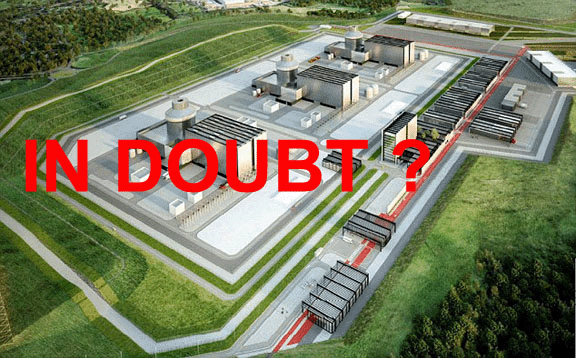
Blunders, catastrophic, delays, even bankruptcy… ANOTHER nuclear power plant is going into financial meltdownhttp://www.thisismoney.co.uk/money/article-5223475/ANOTHER-nuclear-power-plant-enerting-financial-meltdown.html Neil Craven for The Mail on Sunday, 1 January 2018The company behind one of Britain’s biggest nuclear power projects has plunged to a £266 million loss citing ‘uncertainties’ over its future and the viability of crucial technology.
Japanese firm Toshiba said the huge loss incurred by one of its UK subsidiaries was due to writing off hundreds of millions of pounds of investment in the proposed Moorside plant, in west Cumbria.
It is the latest sign of financial strain at the Tokyo-based firm amid wider concerns over the spiralling costs and catastrophic delays that have beset the UK’s nuclear industry. Continue reading →
The devastating effects of climate change are becoming apparent — and the world has begun taking action. But the frequency of extreme weather events has shown we are starting to run out of time.
“Crazy” weather has been a hot topic for elevator conversations this year — and yes, extremes are starting to become the new normal.
No continent was spared in 2017 when it came to extreme weather. From droughts to hurricanes, from smog to forest fires, these events killed thousands of people — and have been directly linked to climate change.
Southern Europe, Canada and the United States were among the areas worst hit by devastating wildfires. Both in California and Portugal, 2017 has been the deadliest year on record for wildfires. Even icy Greenland wasn’t spared. Climate change, along with the dangerous combination of a lack of sustainable forest management and careless — or malicious — human activity, has been to blame.
Major storms were also responsible for the year’s most catastrophic events. Hurricane Harvey in the US, Irma and Maria in the Caribbean and Katia in the Gulf of Mexico left destruction in their wake. While hurricanes aren’t unusual in tropical regions, the frequency and intensity of these most recent storms — fueled by warming oceans — were out of the ordinary. But they may be a sign of things to come, if the world doesn’t take action to limit climate change.
At the same time, global sea levels reached a new high in 2017, with the polar ice caps melting at an accelerating pace. Warmer ocean temperatures contributed to the breakaway of a 1 trillion ton iceberg from the Larsen C ice shelf in Antarctica in July, at 5,800 square kilometers (2,200 square miles) one of the largest icebergs ever recorded.
Flooding caused the death of hundreds of people in the Philippines, Greece, Germany and Vietnam, to name just a few countries. Meanwhile, drought is increasing the pressure on regions of Africa and Asia, such as Somalia, South Sudan and Pakistan, where armed conflicts are already making daily life a struggle for survival.
Often forgotten, the struggles of the world’s oceans also increased this year. Despite several initiatives protecting the Great Barrier Reef, coral bleaching has continued at an alarming rate. Ocean acidification, meanwhile, is on track to make the seas uninhabitable for many aquatic creatures, endangering entire ocean ecosystems.
Governments across the globe are taking action to address current and upcoming climate threats, and leaders like French President Emmanuel Macron, who took office in May and pledged to fund climate research, have been a source of hope for many.
But 2017 will also, unfortunately, be remembered for the US withdrawal from the 2015 Paris climate accord, along with President Donald Trump’s other moves away from the fight against climate change.
As despairing as all of this may sound, it’s actually another call to take action. Weather has always been out of our control — and will remain so. But we can still work to avoid making extremes the new normal.
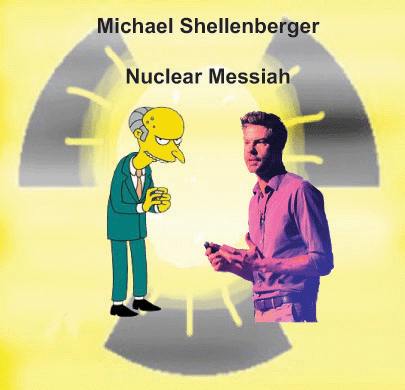
Exposing the misinformation of Michael Shellenberger and ‘Environmental Progress’ Jim Green,Nuclear Monitor Issue: #853 4689 30/10/2017
“………….Fake scientists and radiation quackery
EP’s UK director John Lindberg is described as an “expert on radiation” on the EP website.38 In fact, he has no scientific qualifications whatsoever let alone specialist qualifications regarding the health effects of ionizing radiation. Likewise, a South Korean article39 reposted on the EP website (without correction) falsely claims that Shellenberger is a scientist; in fact, he has a degree in cultural anthropology.
Lindberg is an ‘Associate Member’ of Scientists for Accurate Radiation Information (SARI)40, a group comprised mostly of quacks, cranks, non-scientists and conspiracy theorists whose views are directly at odds with those of scientific associations such as UNSCEAR.
SARI is at war with the linear, no-threshold (LNT) model ‒ the group’s short ‘Charter & Mission’ insists three times that LNT is “misinformation”.41 Yet LNT enjoys heavy-hitting scientific support. For example the 2006 report of the US National Academy of Sciences’ Committee on the Biological Effects of Ionizing Radiation states that “the risk of cancer proceeds in a linear fashion at lower doses without a threshold and … the smallest dose has the potential to cause a small increase in risk to humans.”34 Likewise, a report in the Proceedings of the National Academy of Sciences states: “Given that it is supported by experimentally grounded, quantifiable, biophysical arguments, a linear extrapolation of cancer risks from intermediate to very low doses currently appears to be the most appropriate methodology.”42
A 2010 UNSCEAR report isn’t sold on the linear part of LNT but it is at odds with SARI (and EP) on the question of a threshold. The UNSCEAR report states that “the current balance of available evidence tends to favour a non-threshold response for the mutational component of radiation-associated cancer induction at low doses and low dose rates.”43By contrast, SARI promotes hormesis ‒ the discredited view that low-dose radiation exposure is beneficial to human health.44 https://wiseinternational.org/nuclear-monitor/853/exposing-misinformation-michael-shellenberger-and-environmental-progress
Apr 15, 2026 01:00 AM in Canberra, Melbourne, Sydney
Join the International Physicians for the Prevention of Nuclear War (IPPNW) on Tuesday, April 14th for a timely webinar exploring the risks associated with nuclear power and challenging the myth that it offers a simple, safe, carbon-free solution to the climate crisis
21 April Webinar: No Nuclear Weapons in Australia
Start: 2026-04-21 18:00:00 UTC Canberra, Melbourne, Sydney (GMT+10:00)
End: 2026-04-21 19:30:00 UTC Canberra, Melbourne, Sydney (GMT+10:00)
Event Type: Virtual A virtual link will be communicated before the event.














 Antinuclear