Another blow for our First Australians , Echo.net. Lynette Dickinson, Pottsville. 27 Dec 17
‘I was shocked to hear that the Queensland Government was ready to extinguish Native Title rights
of the Wangan and Jagalingou traditional owners of the land on which the Adani Carmichael coal mine is set to be built, even though on four occasions since 2012 the W&J traditional owners had voted unanimously at an authorisation meeting to reject an Indigenous Land Use Agreement with Adani,
underlining their sustained opposition to the mine.
‘However, the government had refused to wait until their Federal Court case to challenge extinguishment of their Native Title rights is heard next March.
‘Subsequent to thousands of emails and phone calls of objection being sent.., this week the W&J traditional owners have been granted an interim injunction against the Queensland Government and Adani. This gives them respite… ‘
Exposing the misinformation of Michael Shellenberger and ‘Environmental Progress’ Jim Green, Nuclear Monitor Issue: #853 4689 30/10/2017
“………..Attacking environment groups
Shellenberger reduces the complexities of environmental opposition to nuclear power to the claim that in the 1960s, an “influential group of conservationists within Sierra Club feared that cheap, abundant electricity from nuclear would result in overpopulation and resource depletion” and therefore decided to campaign against nuclear power.4
If such views had any currency in the 1960s, they certainly don’t now. Yet EP asserts that Greenpeace and FOE “oppose cheap and abundant energy”3 and Shellenberger asserts that “the FOE-Greenpeace agenda has never been to protect humankind but rather to punish us for our supposed transgressions.”4 And Shellenberger suggests that such views are still current by asserting that the anti-nuclear movement has a “long history of Malthusian anti-humanism aimed at preventing “overpopulation” and “overconsumption” by keeping poor countries poor.”8 Again we see Shellenberger’s M.O. of relentless repetition of falsehoods in the hope that mud will stick.
In an ‘investigative piece’ ‒ titled ‘Enemies of the Earth: Unmasking the Dirty War Against Clean Energy in South Korea by Friends of the Earth (FOE) and Greenpeace’ ‒ Shellenberger lists three groups which he claims have accepted donations “from fossil fuel and renewable energy investors, as well as others who stand to benefit from killing nuclear plants”.4 FOE and Greenpeace don’t feature among the three groups even though the ‘investigative piece’ is aimed squarely at them.
Undeterred by his failure to present any evidence of FOE and Greenpeace accepting fossil fuel funding (they don’t), Shellenberger asserts that the donors and board members of FOE and Greenpeace “are the ones who win the government contracts to build solar and wind farms, burn dirty “renewable” biomass, and import natural gas from the United States and Russia.”4 Really? Where’s the evidence? There’s none in Shellenberger’s ‘investigative piece’.
In an article for a South Korean newspaper, Shellenberger states: “Should we be surprised that natural gas companies fund many of the anti-nuclear groups that spread misinformation about nuclear? The anti-nuclear group Friends of the Earth ‒ which has representatives in South Korea ‒ received its initial funding from a wealthy oil man …”45He fails to note that the donation was in 1969! And he fails to substantiate his false insinuation that FOE accepts funding from natural gas companies, or his false claim that natural gas companies fund “many of the anti-nuclear groups”.
Shellenberger’s ‘investigative piece’ falsely claims4 that FOE keeps its donors secret, and in support of that falsehood he cites an article8 (written by Shellenberger) that doesn’t even mention FOE. EP falsely claims that FOE has hundreds of millions of dollars in its bank and stock accounts.3
EP has an annual budget of US$1.5 million, Shellenberger claims, and he asks how EP “can possibly succeed against the anti-nuclear Goliath with 500 times the resources.”8
An anti-nuclear Goliath with 500 times EP’s budget of US$1.5 million, or US$750 million in annual expenditure on anti-nuclear campaigns? Shellenberger claims that Greenpeace has annual income of US$400 million to finance its work in 55 nations8 ‒ but he doesn’t note that only a small fraction of that funding is directed to anti-nuclear campaigns. FOE’s worldwide budget is US$12 million according to EP3 ‒ but only a small fraction is directed to anti-nuclear campaigns.
Ed. note. Incidentally, this is the period when Professor Ernest Titterton managed to cancel testing of of radioactive fallout to the East coast of Australia
France to study nuclear test veterans, https://www.radionz.co.nz/international/pacific-news/347025/france-to-study-nuclear-test-veteransReports from French Polynesia say the French government will launch an epidemiological study of 21,000 nuclear test veterans. According to Radio1 in Tahiti, the defence ministry will test all those whose exposure to radiation was measured between 1966 and 1996 – the period during which France tested 193 atomic bombs.
The study is to update the findings of two previous studies into mortality and morbidity.
The first found that by the end of 2008 more than 5,500 had died.
The study of the remaining 21,000 veterans is to help improve assessing their health care risks.
Climate Change Is Happening Faster Than Expected, and It’s More Extreme
New research suggests human-caused emissions will lead to bigger impacts on heat and extreme weather, and sooner than the IPCC warned just three years ago.BY BOB BERWYN, INSIDE CLIMATE NEWS DEC 26, 2017 IN THE PAST YEAR, THE SCIENTIFIC CONSENSUS SHIFTED TOWARD A GRIMMER AND LESS UNCERTAIN PICTURE OF THE RISKS POSED BY CLIMATE CHANGE.
When the UN’s Intergovernmental Panel on Climate Change issued its 5th Climate Assessment in 2014, it formally declared that observed warming was “extremely likely” to be mostly caused by human activity.
Other scientific authorities have issued similar assessments:
The Royal Society published a compendium of how the science has advanced, warning that it seems likelier that we’ve been underestimating the risks of warming than overestimating them.
The American Meteorological Society issued its annual study of extreme weather events and said that many of those it studied this year would not have been possible without the influence of human-caused greenhouse gas emissions.
While 2017 may not have hit a global temperature record, it is running in second or third place, and on the heels of records set in 2015 and 2016. Talk of some kind of “hiatus” seems as old as disco music.
‘A Deadly Tragedy in the Making’
Some of the strongest warnings in the Royal Society update came from health researchers, who said there hasn’t been nearly enough done to protect millions of vulnerable people worldwide from the expected increase in heat waves……..
One of the starkest conclusions of the Royal Society update is that up to 350 million people in places like Karachi, Kolkota, Lagos and Shanghai are likely to face deadly heat waves every year by 2050—even if nations are able to rein in greenhouse gas emissions enough to keep the average global temperature increase to 1.5 degrees Celsius, as per the Paris climate agreement.
There’s also an increasing chance global warming will affect a key North Atlantic current that carries ocean heat from the tropics toward western Europe, according to a 2016 study. It shows the Atlantic Meridional Overturning Current weakening by 37 percent by 2100, which could have big effects on European climate and food production.
Melting Ice and Risks to Oceans and Ecosystems
The Royal Society report also notes:
An increasing risk that ocean acidification will rapidly and significantly alter many ecosystems and food webs;
A concern that crops grown in high-CO2 conditions could be less nutritious, leading to mineral deficiencies;
That the commonly accepted wet-areas-wetter and dry-areas-drier scenario has regional nuances with important implications for local water management and food production planning; and,
That scientists are finding more links between melting Arctic sea ice and weather extremes like heat waves, droughts and blizzards.
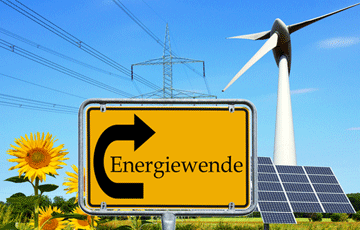
French people support energy transition, survey reveals, Energy Transition by Energiewende Team19 Dec 2017 “……… It is often said that the French people strongly support nuclear energy as a jewel of the French industry. However, a survey commissioned by the French office of the Heinrich Boell Foundation and the French Think tank La Fabrique écologique, carried out by the research institute Harris Interactive, shows that the French people would rather like to pull up the anchor and set sail for a new model based on renewable energy.
Indeed, 91 % of interviewees consider the energy transition as “priority issue” (47%) or a “major issue” (44%). 63% see the energy transition as an opportunity rather than as a threat (11 %). But what should energy transition look like, according to them?
A clear preference for the development of renewable energy
The trend is very clear: 83 % of French people think France should prioritize investments in renewable energy. Only 12% of the interviewees prefer that investments go towards the modernization and life extension of nuclear power plants. 66 % of respondents come out against the construction of new nuclear power plants. It shows that the advertising and constantly repeated arguments that nuclear energy – often described as “clean energy” – is the only adequate solution when it comes to fighting climate change is not having the intended effect on French public opinion.
Also surprising is the fact that the actor in which the French people have the most confidence to lead the energy transition is neither the state (trusted by 49% of the interviewees) nor the energy producers and providers like the state owned EDF (trusted by only 46%). Rather, people trust citizen energy cooperatives (trusted by 78%), as well as NGOs and associations (trusted by 66 %).
A positive view of the Energiewende
Another salient point of the survey is the opinion of the French people about the German energy transition. Respondents perceived the German Energiewende much more positively than their economic and political elites……..
Over half of them see the Energiewende as “a good example for the energy transition.” Last but not least, the French people think France should work more closely with Europe (54%) and with Germany (51%) on energy issues……
Study suggests higher temperatures in the Rocky Mountains are preventing trees from growing back following wildfires Josh Gabbatiss Science Correspondent 21 Dec 17 A new study suggests hotter climates resulting from global warming may prevent forests from regenerating after wildfires.
In hot, dry climates like those found in the western US, wildfires are often a natural part of the environment, contributing to the cycling of nutrients and growth of new plants.
However, a new study published in the journal Ecology Letterssuggests increasing global temperatures may be preventing this natural cycling from taking place.The result could be long-term damage to areas of forest destroyed by wildfires.
Led by Dr Camille Stevens‐Rumann, an ecologist at Colorado State University, the study involved testing fire-struck areas of forest for signs of regeneration.
The scientists examined 1485 sites in the Rocky Mountains, all of which had been affected by fires between 1985 and 2015.
They looked for seedlings growing in the examined sites, comparing growth with nearby unburned forests to determine how well forests in each area were able to regenerate.
The team found the proportion of sites in which no post-fire tree regrowth had taken place increased from 19 to 32 per cent when comparing earlier years of the analysis to the more recent years.“Significantly less tree regeneration is occurring after wildfires in the start of the 21st century compared to the end of the 20th century,” the scientists wrote in their paper.
Comparing these findings with information on the region’s changing climate suggested increases in global temperatures were influencing forest regeneration, particularly in the driest regions.
“Dry forests that already occur at the edge of their climatic tolerance are most prone to conversion to non-forests after wildfires,” the scientists wrote. Natural disasters are increasingly being linked to climate change, and according to Todd Gartner, a senior associate at environmental think tank World Resources Institute, climate change is a “contributing factor” to the recent events in California.
Scientists have linked changes in temperature, levels of rain and soil moisture – all of which are influenced by global warming – to increased risk of wildfires.
This new study suggests the impact of climate change on wildfires may have longer term consequences as well.
“As scientists, managers and the public aim to understand and plan for increasing fire activity, our results suggest a high likelihood that future wildfires will facilitate shifts to lower density forest or non-forested states under a warming climate,” the scientists concluded.
WILDFIRES MARK THE NEW REALITY OF CLIMATE CHANGE IN 2017
As fire conditions intensify around the globe, scientists are helping countries prepare for a fiery new normal. Pacific Standard, BOB BERWYN, DEC 20, 2017
Sometimes the effects of climate change seem to creep up, as when sea levels rise an inch every few years, or when temperatures break records by a tenth of a degree. But when your backyard is on fire, you feel global warming breathing down your neck.
In the last three years, as global temperatures spiked to new records, it sometimes felt like the whole world was ablaze, as a series of “worst-ever” fires damaged and destroyed ecosystems and human communities on nearly every continent, under new climate conditions that will be the norm by 2050.
Even if we stopped emitting greenhouse gases today, fire conditions will become even more persistent in areas already at risk, and will spread to new regions as warming drives vegetation patterns and land-use changes. Without rethinking our relationship with nature, landscapes, and wildfire, we are doomed to repeat the mistakes of the past, with the same catastrophic results.
The past few years have shown how bad things can get, fire experts say. In the super-heated El Niño years of 2015 and 2016, there were late-summer tundra fires in Greenland, peat fires in Indonesia, and hardwood forests in the southeast United States that burned on an unprecedented scale.
By early 2017, El Niño had faded, but parts of the Southern Hemisphere were scorched by record heat and fires, including Australia, where fire experts made statements similar to the bulletins coming out of Southern California right now: “This is the worst day we have seen in the history of New South Wales when it comes to fire danger ratings and fire conditions,” Shane Fitzsimmons, the state’s rural fire chief, told the BBC in February, with almost 100 bushfires burning………..
Scientists have been warning for 20 years that climate change would increase the risk of damaging fires, and that many of these fires can’t be stopped. Communities in less developed countries are most at risk right now. They need more resources to manage landscapes to prevent fires, and they need better weather and climate forecasting services—and the ability to put people and tools on the ground.
At times, the growing risk already seems to be outpacing society’s capacity to adapt. In 2016, the GFMC sent a team of experts to South America to warn of fire risks and help communities prepare. Six months later, before any measures were taken, deadly fires burned across parts of Chile and Argentina following a record heat wave.
Alexander Held, a resilience expert at the European Forest Institute, says that hubris is the biggest problem in the face of a growing fire threat. “It’s all coming down to failed land management and that our societies have forgotten how to live with fire,” Held tells Pacific Standard via email.
Held advocates shifting resources from fire suppression to fire prevention, including managed fires, which are scientifically proven to be the best way to minimize catastrophic effects on communities and natural resources.
“Look at Western Australia. They had a large-scale prescribed burning program, and for decades there was nothing like a disaster fire. Only when they reduced the area that was supposed to be burned by prescription did disaster fires start to happen,” he says. “The biggest challenge is how to influence policymakers and political decision making,” Held says. https://psmag.com/environment/2017-the-year-in-wildfires
it’s hard to access reliable information about Rosatom’s plans because many of its nuclear facilities are in so-called closed cities, like Zheleznogorsk. There are around 40 of these towns across Russia, the majority of which are sealed off from the outside world by barbed wire, fences and armed guards. Access is forbidden to foreigners, and even Russians who don’t live there have to receive special permission from the authorities to visit.
Those restrictions mean it’s easier for the authorities to ramp up the pressure against critics.
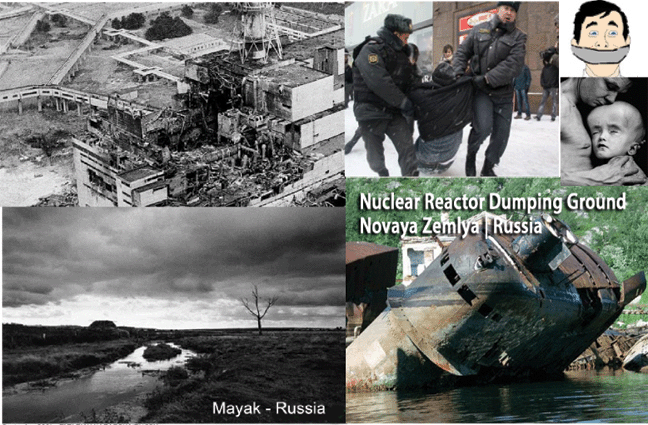
CRACKDOWN IN RUSSIA: CRITICS ACCUSE NUCLEAR AUTHORITIES OF SOVIET-STYLE COVER-UPS AND HEAVY-HANDED TACTICS, .http://www.newsweek.com/crackdown-russia-critics-accuse-nuclear-authorities-soviet-style-cover-ups-and-755389 Newsweek, BY MARC BENNETTSWhen Russia’s FSB security service raided Fyodor Maryasov’s apartment in Siberia last year, the authorities seized his computer and a scathing report he had compiled about Rosatom, the Kremlin-owned nuclear corporation. Among other things, the authorities accused him of inciting hatred against nuclear industry employees, an unusual charge that carries a maximum sentence of five years behind bars. “They accused me of revealing state secrets in my report,” the 49-year-old environmental activist says. “But every single thing in it was taken from open sources.”
The raid came as activists are increasingly criticizing Rosatom over a range of issues, including the way it handles nuclear waste. This fall, for instance, critics alleged that one of its facilities was the source of a mysterious cloud of radioactive pollution that drifted across Europe.
Russian authorities have responded to these critics with tough tactics—including raids and smear campaigns—and in recent years, they’ve employed similar measures against other environmental groups. Rosatom says it was in no way trying to stifle dissent. “We strongly believe that every voice should be heard,” a spokesman for the nuclear agency tells Newsweek, “and we welcome open dialogue with civil society, including with those who are opposed to nuclear power.”
Maryasov says the crackdown is a continuation of the routine cover-ups of nuclear accidents and atomic pollution during the Soviet era and beyond—from the 1957 Kyshtym disaster to the meltdown at Chernobyl in 1986. “Trust in Rosatom and the authorities,” he says, “is at an absolute minimum.” Continue reading →
And so, the billions of tons of silt that has accumulated in Lake Mead and Lake Powell serve as archives of sorts. They hold the sedimental records of an era during which people, health, land, and water were all sacrificed in order to obtain the raw material for weapons that are capable of destroying all of humanity.
The West’s uranium boom brought dozens of mills to the banks of the Colorado River — where toxic waste was dumped irresponsibly.
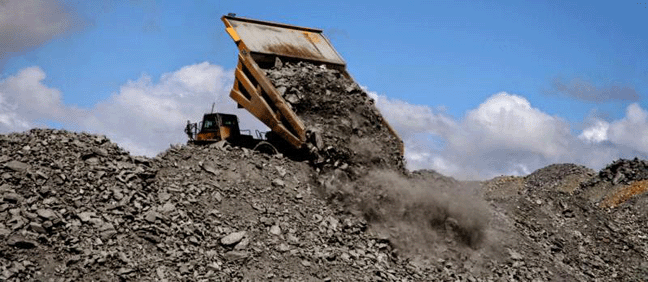
Jonathan ThompsonPERSPECTIVE Dec. 18, 2017 This article was originally published on The River of Lost SoulsBeneath the murky green waters on the north end of Lake Powell, entombed within the tons of silt that have been carried down the Colorado River over the years, lies a 26,000-ton pile of unremediated uranium-mill tailings. It’s just one radium-tainted reminder of the way the uranium industry, enabled by the federal government, ravaged the West and its people for decades.
Replacing coal plants with renewables will help save Rs 54000 crore in power costs’
Greenpeace campaigner Ashish Fernandes said that it is now widely accepted that new coal power plants are not financially competitive with new renewables in India.
By: PTI | New Delhi | Published: December 21, 2017 9:35 pm
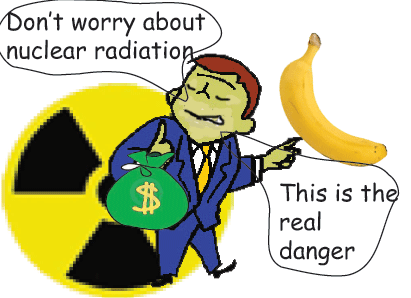
“The more the nuclear industry claims eating plutonium, strontium, cesium, iodine and other fuel and fission products is OK because bananas exist and because the potassium is a needed nutrient, the more I consider them to be blatant liars.”
The ‘Nuclear for Climate’ lobby group recently attended the United Nations’ COP23 climate conference armed with bananas, in order to make specious comparisons between radiation exposures from eating bananas and routine emissions from nuclear power plants. Continue reading →
governments and organizations such as the United Nations should consider modifying international law to provide legal status to environmental refugees and establish protections and rights for them.
The scale of this challenge is unlike anything humanity has ever faced
Climate change will displace millions in coming decades. Nations should prepare now to help them, https://theconversation.com/climate-change-will-displace-millions-in-coming-decades-nations-should-prepare-now-to-help-them-89274The Conversation, Gulrez Shah Azhar Ph.D. Candidate, Pardee RAND Graduate School, 20 Dec 17,Wildfires tearing across Southern California have forced thousands of residents to evacuate from their homes. Even more people fled ahead of the hurricanes that slammed into Texas and Florida earlier this year, jamming highways and filling hotels. A viral social media post showed a flight-radar picture of people trying to escape Florida and posed a provocative question: What if the adjoining states were countries and didn’t grant escaping migrants refuge?
By the middle of this century, experts estimate that climate change is likely to displace between 150 and 300 million people. If this group formed a country, it would be the fourth-largest in the world, with a population nearly as large as that of the United States. Continue reading →
DIIS, and ANSTO are nothing short of a crutch, supporting a dying industry and its radioactive waste producing machines. The DIIS agenda to change the boundaries for the eligibility to legally and morally vote on the program to abandon radioactive waste in a community of unwilling people not only show “NO” regard for such people but the hypocrisy when they accept a nomination for a site from a former politician who doesn’t reside in such area. This agenda to rescind voting rights from people who are impacted is reminiscing of a dictatorship, and should be the subject of a coup.
Updating and cleaning up Dutch nuclear industry could cost state €400m http://www.dutchnews.nl/news/archives/2017/12/updating-and-cleaning-up-dutch-nuclear-industry-could-cost-state-e400m/Updating the Netherlands nuclear industry could cost the state up to €400m, according to a review by four senior civil servants and quoted in Tuesday’s Volkskrant. Officials from the economic affairs, health, environment and finance ministries were asked to assess the cost of the clean-up and update by previous health minister Edith Schippers.
They say the biggest financial hit will come from demolishing the Dodewaard nuclear power station which was shut down in 1997. The government has insisted until now that the bill is paid by the power station’s shareholders, which include Vattenfall, the Volkskrant points out. However, the report indicates civil servants now assume the shareholders will default and put the cost of that project to the state at up to €200m.
A further €100m will be needed to deal with nuclear waste created at the Petten reactor – which makes medical isotopes. That waste is currently stored above ground near the Borselle nuclear power station and the state has paid €200m towards disposing of Petten’s waste over the past 20 years, the report says. In addition, the officials say that a ‘rough estimate’ of €60m to €100m will be needed to build a new reactor at Petten – another issue which the state has always assumed will be privately funded.
Confidential The Volkskrant says the report is notable because it is virtually identical to one sent to parliament in July, although that report did not contain the financial details. At the time, a finance ministry spokesman told the paper the figures were confidential. However, the paper has now been published on the website containing all the documents used during the formation of the current government and was spotted by anti-nuclear power group Laka. Laka spokesman Dirk Bannink said the report shows that the nuclear industry cannot exist without state support. ‘The government has to step in every time,’ he said.
Apr 15, 2026 01:00 AM in Canberra, Melbourne, Sydney
Join the International Physicians for the Prevention of Nuclear War (IPPNW) on Tuesday, April 14th for a timely webinar exploring the risks associated with nuclear power and challenging the myth that it offers a simple, safe, carbon-free solution to the climate crisis
21 April Webinar: No Nuclear Weapons in Australia
Start: 2026-04-21 18:00:00 UTC Canberra, Melbourne, Sydney (GMT+10:00)
End: 2026-04-21 19:30:00 UTC Canberra, Melbourne, Sydney (GMT+10:00)
Event Type: Virtual A virtual link will be communicated before the event.













 Antinuclear