The long haul towards getting rid of nuclear weapons

 A long road to abolishment of nuclear weapons, http://www.timescolonist.com/opinion/op-ed/comment-a-long-road-to-abolishment-of-nuclear-weapons-1.23115603 JONATHAN DOWN / Times Colonist DECEMBER 7, 2017 With the Doomsday Clock now set at 2.5 minutes to midnight, the key role of the International Campaign to Abolish Nuclear Weapons in building the historic UN Treaty on the Prohibition of Nuclear Weapons is more remarkable than ever.
On July 7, 122 United Nations member countries adopted the treaty, and 50 nations have signed it since Sept. 20. It is anticipated that by the end of 2018, the treaty will become international law.
Recognizing that the risk of nuclear war is even higher today than during the Cold War, the Nobel Committee is honouring ICAN’s work with the 2017 Nobel Peace Prize to be awarded in Oslo on Sunday. Canadian peace campaigner and Hiroshima bomb survivor Setsuko Thurlow, together with ICAN’s executive director Beatrice Fihn, will accept the prize.
However, although a Canadian activist will receive the Nobel in Oslo, Canada has turned its back on the treaty and refused to sign. Pressure from the United States is considered the main reason for this decision, which directly contradicts Canada’s international reputation as a supporter of nuclear disarmament. It also flouts the treaty’s vision of a world where nuclear weapons are stigmatized, prohibited and eventually eliminated.
Run almost entirely by enthusiastic, highly motivated young people from different parts of the world, ICAN clearly understands that 21st-century threats such as terrorism, cyber-security, failed states and climate change can’t be solved with nuclear weapons. Inflammatory rhetoric threatening “fire and fury” moves the world ever closer to the catastrophe of a nuclear war. Rather than acting as a deterrent, the threat of nuclear weapons encourages nations such as North Korea to accelerate their efforts to acquire their own nuclear arsenal.
ICAN-affiliated organizations are found in more than a hundred countries, including Canada, and the Nobel prize is a tribute to the millions of activists such as Thurlow who have worked to abolish the worst weapons of mass destruction. Victoria-based Vancouver Island Peace and Disarmament Network is affiliated with ICAN through member organizations, and several members participated in the negotiations leading up to the landmark treaty.
Canadians should be extremely proud of ICAN and the huge amount of work that has been done to advance the cause of global peace. We have a long way to go before nuclear weapons are finally abolished — but this year’s Nobel Peace Prize shows that the civil world is on the right track.
Jonathan Down is a pediatrician in Victoria and president-elect of Physicians for Global Survival, the Canadian affiliate of IPPNW. He is a member of the Vancouver Island Peace and Disarmament Network.
USA increasingly isolated internationally, with Donald Trump’s menacing talk on North Korea
 Donald Trump’s menacing talk on North Korea is leaving the US isolated https://www.theguardian.com/us-news/2017/nov/30/donald-trump-menacing-talk-north-korea-us-isolated
The US president seems oblivious to the consequences of war, and international support for his belligerence is weakening, Guardian, Simon Tisdall, 1 Dec 17, Donald Trump’s latest threat to destroy North Korea’s regime by force produced an angry response from Russia on Thursday. Yet elsewhere, the menacing talk from Washington was mostly met with uncomfortable silence.
While there is no shortage of international concern about Kim Jong-un’s latest, “breakthrough” missile test on Wednesday, Trump’s bellicose talk of war is rendering the US increasingly isolated.
Sergei Lavrov, Russia’s foreign minister, appeared to voice doubts shared by other countries when he claimed on Thursday that Trump was deliberately pushing Pyongyang towards military confrontation. “It seems they have done everything on purpose to make Kim lose control and make another desperate move,” he said. Continue reading
AGL resists govt pressure, goes for gas, wind, solar – not coal
AGL resists PM to ditch coal for cheaper gas, wind, solar power
AGL Energy has rejected Turnbull government pressure to extend the life of the coal-fired Liddell power station and instead revealed a $1.36 billion plan to replace it with electricity generated from gas, wind and solar…. (subscribers only)
http://www.afr.com/business/energy/electricity/agl-energy-unveils-14b-liddell-replacement-scheme-20171206-h0022p
Southern California is burning
 California’s Climate Emergency, Rolling Stone, By Eric Holthaus, 8 Dec 17 Fires continue to burn Southern California, and climate scientists have warned us for years that the region was entering a year-round fire regime In the hills above the Pacific Ocean, the world crossed a terrifying tipping point this week.

As holiday music plays on the radio, temperatures in Southern California have soared into the 80s, and bone-dry winds have fanned a summer-like wildfire outbreak. Southern California is under siege.
That one of California’s largest and most destructive wildfires is now burning largely out of control during what should be the peak of the state’s rainy season should shock us into lucidity. It’s December. This shouldn’t be happening.
The Thomas fire is the first wintertime megafire in California history. In a state known for its large fires, this one stands out. At 115,000 acres, it’s already bigger than the city of Atlanta. Hundreds of homes have already been destroyed, and the fire is still just 5 percent contained.
In its first several hours, the Thomas fire grew at a rate of one football field per second, expanding 30-fold, and engulfing entire neighborhoods in the dead of night. Hurricane force winds have produced harrowing conditions for firefighters. Faced with such impossible conditions, in some cases, all they could do is move people to safety, and stand and watch.
“We can’t control it,” firefighter and photographer Stuart Palley told me from a beach in Ventura. “In these situations, you can throw everything you’ve got at it, tanker planes dropping tens of thousands of gallons of flame retardant, thousands of firefighters, hundreds of engines, you can do everything man has in their mechanical toolbox to fight these fires and they’re just going to burn and do whatever the hell they want. We have to learn that.” As we spoke, another wall of flames crested a nearby ridge, reflecting its orange glow off the sea.
The Thomas fire isn’t the only one burning right now. At least six major fires threaten tens of thousands of homes and have forced hundreds of thousands of people to flee in recent days. “California fires enter the heart of Los Angeles” read one New York Timesheadline, a statement so dire it could double as a plot synopsis in a nearby Hollywood movie studio. Million-dollar mansions in Bel Air were evacuated, and the 405 freeway, one of L.A.’s busiest, was transformed into a dystopian hellscape during the morning commute. Ralph Terrazas, the Los Angeles fire chief, called the conditions the worst he’s seen in his entire 31-year career. “There will be no ability to fight fires in these kinds of winds,” said Ken Pimlott, the state fire chief. Shortly after these statements, state officials sent an unprecedented push notification to nearly everyone in Southern California, ominously warning millions of people to “stay alert.”
For years, climate scientists have warned us that California was entering a year-round fire regime. For years, climate campaigners have been wondering what it would take to get people to wake up to the urgency of cutting fossil fuel emissions. For years, we’ve been tip-toeing as a civilization towards a point of no return.
That time is now.
The advent of uncontrollable wintertime megafires in California is a turning point in America’s struggle to contain the impacts of a rapidly changing climate. …….http://www.rollingstone.com/culture/features/southern-california-wildfires-climate-change-emergency-w513659
Will wildfires finally change Rupert Murdoch’s climate stance?
 The media-mogul’s Santa Monica vineyard was saved from wildfire destruction, but the world may yet burn thanks to his climate views, says Richard Schiffman New Scientist, By
A wildfire has ripped through one of the wealthiest neighbourhoods in the US, damaging Rupert Murdoch’s $28.8 million vineyard estate in the Santa Monica mountains at the edge of Los Angeles.
The media-mogul’s palatial house was saved, thanks to firefighters who spent the afternoon and night battling the conflagration. Others weren’t so lucky. Hundreds of homes and scores of lives have been lost in both northern and southern California in a spate of recent wildfires that were fiercer and moved faster than any in recent memory.
Such fires are made more likely as the world warms. California has just had its hottest summer on record, and the recent wildfires came much later in the year than normal. We also know that seven of California’s 10 largest recorded wildfires have occurred in the last 14 years.
California isn’t alone. Wildfires are occurring with greater… subscribers only https://www.newscientist.com/article/will-wildfires-finally-change-rupert-murdochs-climate-stance/
Small Modular Nuclear Reactors would produce much more expensive electricity than large reactors
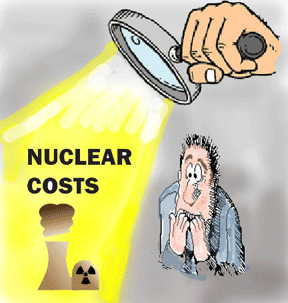 Power from mini nuclear plants ‘would cost more than from large ones’
UK government study finds electricity would be nearly one-third pricier than it would from plants such as Hinkley Point C, Guardian, Adam Vaughan, 7 Dec 17, Electricity from the first mini nuclear power stations in Britain would be likely to be more expensive than from large atomic plants such as Hinkley Point C, according to a government study.
Power from small modular reactors (SMRs) would cost nearly one-third more than conventional large ones in 2031, the report found, because of reduced economies of scale and the costs of deploying first-of-a-kind technology.
The analysis by the consultancy Atkins for the Department for Business, Energyand Industrial Strategy said there was “a great deal of uncertainty with regards to the economics” of the smaller reactors.
However, the authors said such reactors should be able to cut costs more quickly than large ones because they could be built and put into service in less time.
Advocates have argued that the reactors could be built in factories and achieve savings through their modular nature.
While the report covers the technology being used by several of the international companies seeking government support, it does not apply to the design being pushed by businesses including Rolls-Royce.
A government source said nuclear companies had told officials that the cost of the technology had come down since the report, which was finished in July last year but only published on Thursday.
As revealed by the Guardian earlier this week, ministers confirmed that SMR developers would receive £56m of public funding for research and development over three years. A further £86m was announced for work on nuclear fusion.
Greg Clark, the business secretary, said the backing would help the nuclear sector compete globally………
The government also defended Britain’s need for new nuclear power in the face of falling renewable costs.
Richard Harrington, the energy minister, said the record low subsidies recently awarded to offshore windfarms emphasised the challenge for the French, Korean, Chinese and Japanese companies building the UK’s new generation of nuclear plants to be competitive on price………
green groups and politicians accused the government of talking down renewables.
Doug Parr, the policy director at Greenpeace UK, said: “Instead of downplaying the rapid advancement of UK renewables, the government should concentrate on the export opportunities for this UK success story.”
Caroline Lucas, the Green party co-leader, called the UK’s energy policy a mess. “Ministers are ploughing huge sums of money into supporting overpriced nuclear, while retaining a de facto ban on onshore wind and failing to give solar the support the sector needs,” she said……. https://www.theguardian.com/environment/2017/dec/07/power-mini-nuclear-plants-cost-more-hinkley-point-c
More revelations about Trump’s former National Security Adviser Michael Flynn and his secretive nuclear deals
 Michael Flynn’s involvement in a plan to build nuclear reactors in the Middle East is looking even shadier https://www.vox.com/2017/12/6/16743476/michael-flynn-russia-sanctions According to a whistleblower, a Flynn business associate bragged that Flynn would end sanctions on Russia to clear the way for this project. By On President Donald Trump’s Inauguration Day, a former business parter of incoming National Security Adviser Michael Flynn allegedly bragged that Flynn told him Trump would quickly lift US sanctions on Russia — a move that would pave the way for a controversial plan to build nuclear plants across the Middle East, with Russian help.
That’s the explosive, but unverified, allegation of a whistleblower cooperating with House Democrats probing the myriad scandals surrounding Flynn, who pleaded guilty earlier this month to lying to the FBI about his contacts with a senior Russian diplomat.
The allegation has been made public by Rep. Elijah Cummings (D-MD), the top Democrat on the House Oversight Committee — who is demanding that his Republican counterpart on the committee investigate Flynn and others involved in the matter more aggressively.
The project in question — promoted by a group of former senior US military officers, and often described as a “Marshall Plan” of sorts — would involve US companies working with Russian companies to build and operate nuclear plants in the Middle East, and export spent fuel from those plants.
In June 2015, Flynn flew to Egypt and Israel to “gauge attitudes” on the proposal, Newsweek’s Jeff Stein has reported. And one of the companies involved in the project covered his travel expenses and wrote him a check for $25,000 for the trip, though it’s not clear if Flynn cashed the check.
But reports over the last few months have suggested that Flynn continued to promote the project after the election, and even after he had been sworn in as national security adviser.
One businessman involved in the project — Alex Copson of ACU Strategic Partners — even dubbed it the “Trump/Putin M.E. [Middle East] Marshall Plan,” according to an email obtained by Reuters.
Now, new allegations are coming from a whistleblower who says he met Copson at a Washington, DC, event on Inauguration Day — and that Copson had some very interesting things to say about the project.
Michael Flynn’s business partner allegedly said this project was a pretext for expanding the US military presence in the Middle East
According to the whistleblower, Copson flat-out said the following things:
- That he “just got” a text message from Flynn saying the nuclear plant project was “good to go,” and that his business colleagues should “put things in place”
- That Flynn was making sure sanctions on Russia would be “ripped up,” which would let the project go forward
- That this was the “best day” of his life, and that the project would “make a lot of very wealthy people”
- That the project would also provide a pretext for expanding a US military presence in the Middle East (the pretext of defending the nuclear plants)
- That citizens of Middle Eastern countries would be better off “when we recolonize the Middle East”
The whistleblower said that Copson quickly displayed what he claimed to be a text message from Flynn that appeared to have been sent during Trump’s inauguration speech. But the whistleblower says he or she could not read the actual message. Still, he or she claims to have been disturbed enough by the interaction to have documented it at the time.
Perhaps most intriguingly of all, Cummings writes that he told Special Counsel Robert Mueller’s team about all this some time ago — and that they asked him to delay publicly revealing this information “until they completed certain investigation steps.”
Cummings added: “They have now informed us that they have done so.”
The most accurate climate predictions appear to show worst case scenarios
 The Worst-Case Climate Predictions Seem To Be the Most Accurate Ones http://www.popularmechanics.com/science/environment/a14380947/worst-case-scenario-climate-predictions/
The climate models that predict the most warming over the next century were the best at predicting climate change over the past decade. Avery Thompson, Dec 8, 2017
It’s hard to predict the exact effects of climate change over the course of a few decades. Even while broad trends appear, the litany complex interactions between the air, the water, polar ice, land masses, and so on, make exact predictions elusive. To deal with this problem, scientists develop models that simulate a few of these elements at one time and see which models are the most accurate.
This variety of climate models is the reason long-term predictions tend to be all over the place, with some models predicting only a few degrees of warming while other models predict a lot more. While some people have been pointing to the more milder predictions as evidence that climate change might not be that bad, there is some bad news. A team of researchers from the Carnegie Institution for Science has found that the most accurate models so far also tend to be the most severe ones.
The new study, published in Nature, compared more than a decade’s worth of data from climate satellites to a wide range of different climate models. This data included the amount of sunlight reflected back into space, how much heat is leaving the Earth, and how much total energy is entering and leaving the atmosphere. Scientists then analyzed various climate models for that period to see which ones came closest to predicting reality.
The researchers found that the most accurate models were the ones that predicted the most warming over the next century. This means that rather than see only a few degrees of warming—as predicted by some of the milder models—we’re much more likely to see almost twice that.
According to the paper, there’s a good chance we could see 5 degrees C of warming by 2100, and a 95 percent chance of more than 4 degrees of warming, assuming we do nothing to stop it. The goal set by the Paris agreement in 2015—to keep warming below 2 degrees C by the end of the century—is looking increasingly impossible. Source: MIT Technology Review
Greens MP to campaign against Adani coal plan. NAIF considering funding. Bob Carr lobbying against coal investment
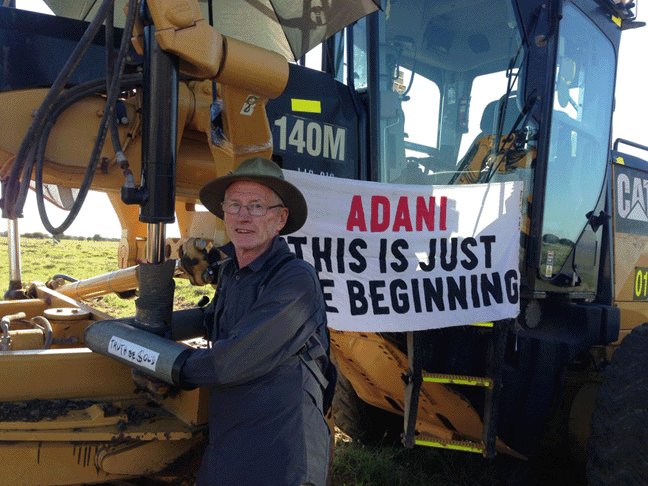 Interesting headlines – the content is available to “subscribers only”
Queensland Election 2017: Greens MP plans anti-Adani regional tour after Maiwar win
http://www.couriermail.com.au/news/queensland/state-election-2017/queensland-election-2017-greens-mp-plans-antiadani-regional-tour-after-maiwar-win/news-story/8d4c2983cdc24e62cfc31c02518bb61b
NAIF still assessing Adani loan
The Northern Australia Infrastructure Facility will keep assessing a potential $1 billion loan to Adani until it is officially killed off by the Queensland government.
http://www.afr.com/news/politics/naif-will-continue-to-assess-adani-loan-until-killed-off-by-qld-government-20171207-h00gut
Bob Carr a one-man lobbying effort to stop investment in Adani’s Carmichael mine
Courier Mail editorial:
http://www.couriermail.com.au/news/opinion/editorial-bob-carr-a-oneman-lobbying-effort-to-stop-investment-in-adanis-carmichael-mine/news-story/0cf2a660b087b6c75e762921907c1f59
US government report finds steady and persistent global warming
Skeptical Science 6 December 2017 by John Abraham The US Global Change Research Program recently released a Climate Science Special Report. It is clearly written – an authoritative summary of the science, and easy to understand.
The first main chapter deals with changes to the climate and focuses much attention on global temperatures. When most people think of climate change, they think of the global temperature – specifically the temperature of the air a few meters above the Earth surface. There are other (better) ways to measure climate change such as heat absorbed by the oceans, melting ice, sea level rise, or others. But the iconic measurement most people think of are these air temperatures, shown in the top frame of the figure below. [on original] ……..https://www.skepticalscience.com/report-steady-persistent-gw.html
Dramatic and continuing rise in energy storage in USA
U.S. Energy Storage Surges 46% Led by Big Project in Windy Texas https://www.bloomberg.com/news/articles/2017-12-07/u-s-energy-storage-surges-46-led-by-big-project-in-windy-texas By Brian Eckhouse
Driven by regulatory demands and sharp price declines, energy-storage is becoming more common. Prices for lithium-ion battery packs have fallen 24 percent from 2016 levels, according to Bloomberg New Energy Finance. Utilities including Exelon Corp., Duke Energy Corp. and American Electric Power Co., meanwhile, are increasingly receptive to storage projects, which potentially will facilitate wider adoption of wind and solar power.
Downward trajectory of solar energy costs make coal power economically unviable
Renew Economy 6th Dec 2017, Burning coal to generate electricity in today’s era of cheap power from the sun makes as about as much economic sense as “burning dollar
notes”, one of Australia’s leading solar researchers has said.
Speaking at the APVI Asia Pacific Solar Research Conference in Melbourne this week,
UNSW Professor Martin Green said the world had entered a “new area”
where solar was well and truly the cheapest way of generating bulk
electricity.
Green, who recently predicted that the cost of solar would
fall to around $US10/MWh, or 1c/kWh by 2020, repeated that bullish
projection on Wednesday, based on the new lows in prices being bid at
international auctions for the long-term supply of electricity.
Green said this downward trajectory had taken the cost of solar from still “a
relatively expensive option” just two years ago, to a point two months
ago where a price of $US17.86/MWh was bid at an auction in Saudi Arabia. It
has since fallen even lower, to $US17.70/MWh, or $A23.40/MWh, in Mexico’s
latest tender, for 3 terawatt-hours of solar electricity.
http://reneweconomy.com.au/burning-coal-for-power-like-burning-dollar-notes-in-era-of-cheap-solar-47928/
How Russia denies and deceives the world, following a nuclear accident

Nuclear Russia Scares The World (Again), Lobe Log, DECEMBER 5, 2017, by Tatyana Ivanova An international scandal involving ruthenium-106 (Ru-106) contamination of the atmosphere in most European countries has revealed fundamental problems with the Russian nuclear industry. The Russian State Corporation (Rosatom) has denied the massive leak at its Ural reprocessing facility. Instead, it has withheld data and spread propaganda in the best Soviet tradition……
In this region of the Southern Urals, about 30 kilometers from these two polluted sites, there is only one potential large-scale polluter: the “Mayak” nuclear waste reprocessing plant. Accordingly, suspicion has fallen on it. Mayak is part of the Russian Rosatom State Corporation and is located at the closed secret town of Ozersk, in the Chelyabinsk district…….
If such a large scale release had happened in France, IRSN reports, inhabitants within a radius of several kilometers would have been evacuated and local food produced within tens of kilometers would have been declared unsafe for human consumption……….
Denial, Pressure, and Propaganda
As soon as information about the likely Russian origin of the ruthenium cloud over Europe appeared in the mass media, the Russian nuclear state corporation sprang into action to prevent any Russian investigation. Rosatom and then Mayak stated that their facilities couldn’t be a source of Ru-106 release and that the background radiation around them is normal. At the same time, they didn’t provide any specific data on Ru-106 concentrations in the air. Rosatom only made reference to its website, which is monitoring the gamma background.
A Russian regulatory agency “inspected” Mayak, and after only one day came to the hasty conclusion that there had been no accidents or events at the plant. Its public report contained only one number: the Ru-106 concentration in Bucharest that the IAEA had already published.
Some days later Russian pro-government mass media published a flurry of propaganda, denying that the contamination was of Russian origin and making fun of the journalists and citizens who wrote of a cover-up. Some of the Russian mass media disseminated false information that the release could have been caused by a downed American spy satellite or even an alien spaceship.
The most radical websites started a second wave of defamation against Nadezhda Kutepova, blaming her for espionage and intentional misinformation about Mayak. Some Russian officials blamed IRSN for issuing “false information” about the Russian trace, saying that the French regulator is competing with Rosatom.
Rosatom went further by publishing a poster on behalf of Ru-106 with the headline “Everyone accuses the little one” in the style of a propaganda cartoon for children. The poster states that Ru-106 is “small and good” and does not appear at nuclear waste reprocessing plants. Then the official Rosatom Facebook page invited journalists and bloggers to visit Mayak to “touch and smell” Ruthenium-106. They selected 16 people from 200 who expressed interest, stating that experts were not invited because they “already understand all the fictitiousness of the hype.”
At the same time, the Russian regulatory agency altered its published report, removing the words “extremely high concentrations of Ru-106” in reference to the villages around Mayak and reported instead that the levels did not exceed the limits. Last week a special commission including representatives of all the aforementioned Russian state organizations began another inspection of Mayak. The results have not yet been announced.
The situation is reminiscent of the Chernobyl catastrophe of 1986, during the Soviet era. Indeed, the Mayak facility, which specializes in nuclear fuel reprocessing and the production of nuclear weapons materials, never really left the Soviet era. The enterprise avoids publishing any detailed figures on emissions In its environmental impact assessments. An iron veil of secrecy, as well as Rosatom’s influence over decision-makers at the highest level, protect it from the scrutiny of Russians and everybody else.
Tatyana Ivanova is a Belarusian journalist residing in the United States https://lobelog.com/nuclear-russia-scares-the-world-again/
Rise in thyroid cancer near New York’s nuclear reactor
 Is This Nuclear Plant to Blame for Soaring Thyroid Cancer Rates in New York? https://www.ecowatch.com/indian-point-thyroid-cancer-2515063468.html, By Joseph Mangano, 5 Dec 17,
“Plutopia: Nuclear Families, Atomic Cities, and the Great Soviet and American Plutonium Disasters,”
 Kate Brown’s award-winning book, “Plutopia: Nuclear Families, Atomic Cities, and the Great Soviet and American Plutonium Disasters,” is a history of the Hanford plant and its Soviet doppelgänger, a plant in the Ural Mountains called Maiak. Brown points out that over the course of a few decades, the two nuclear sites spewed two times the radiation emitted in the Chernobyl explosion. Yet few Americans at the time, even those involved in plutonium production, realized this was going on or how dangerous it was.
A few months ago, a 110-meter-long tunnel collapsed at the site, exposing an old rail line and eight rail cars filled with contaminated radioactive equipment. This open wound in the landscape, which was quickly covered over again, is a tiny part of an environmental and human health catastrophe that steadily unfolded there over four decades of plutonium production. Big Cold War fears justified big risks. Big, secretive, nuclear-sized risks.
Hanford and other toxic reminders of the Cold War should serve as a cautionary tale to those who have a say in mitigating geopolitical tensions today, as well as to those who promote nuclear energy as an environmentally sustainable source of electricity. The energy debate must balance the downside – not just the risk of a nuclear meltdown but also the lack of a permanent repository for the still-dangerous spent fuel rods – with the environmental benefits of a source of electricity that produces no greenhouse gases. People on both sides of the issue have a vested interest in how the current geopolitical tussling over nuclear weapons plays out……
Even if, as we all hope, the “new Cold War” never gets hot, escalating tensions can have seriously harmful effects at home. The radioactive cave-in at the Hanford site earlier this year should serve as a reminder of that. Continue reading
1 This month
Chernobyl: The Lost Tapes – A good documentary on Chernobyl on SBS available On Demand for the next 3 weeks– https://www.sbs.com.au/ondemand/tv-program/chernobyl-the-lost-tapes/2352741955560
15 April – Zoom –Nuclear Power is Not the Solution
Apr 15, 2026 01:00 AM in Canberra, Melbourne, Sydney

Join the International Physicians for the Prevention of Nuclear War (IPPNW) on Tuesday, April 14th for a timely webinar exploring the risks associated with nuclear power and challenging the myth that it offers a simple, safe, carbon-free solution to the climate crisis

21 April Webinar: No Nuclear Weapons in Australia
Start: 2026-04-21 18:00:00 UTC Canberra, Melbourne, Sydney (GMT+10:00)
End: 2026-04-21 19:30:00 UTC Canberra, Melbourne, Sydney (GMT+10:00)
Event Type: Virtual
A virtual link will be communicated before the event.
Host Contact Info: australia@icanw.org

of the week – Australians for War Powers Reform (AWPR)
To see nuclear-related stories in greater depth and intensity
 Antinuclear