It was supposed to be a trip to paradise, instead it sealed their fatehttp://www.abc.net.au/news/2017-11-28/the-toxic-legacy-of-a-deadly-paradise/9168422 These soldiers were ordered to clean up the toxic legacy of America’s nuclear program, now they’re dying, and their Government has abandoned them.Foreign Correspondent, By Mark Willacy When Jim Androl landed on a remote central Pacific atoll to take part in the biggest nuclear clean-up in United States history, the only extra items his military superiors gave him were some flea powder and a pamphlet on how to avoid heat stroke.
The army did have special radiation suits and respirators for handling the left-over atomic waste on the atoll, but the young soldiers were only allowed to wear them on special occasions.
“The [protective suits] were for photo ops,” the former communications specialist with the US Army’s 84th Engineer Battalion recalls.
“I know once when I believe 60 Minutes was there, they did [let us wear them]. We were just issued our normal warm weather gear … shorts, tee-shirts, hats and jungle boots and that’s it.”
Androl was one of about 4,000 US troops sent to Enewetak Atoll in the Marshall Islands between 1977 and 1979 to scrape up the contaminated remnants of the United States’ atomic testing program.
The US government decided to use soldiers for the clean-up, because employing specialist nuclear workers would have doubled the cost.
“I’d never even heard of Enewetak. I never knew that there were 43 nuclear tests out there,” Androl, who was 22-years old when he was deployed to the atoll, says.
Some of those bombs were the among the most powerful ever detonated, and they left behind a toxic legacy that will live on for thousands of years. Continue reading →
by Jan Haverkamp, Andrey Allakhverdov – 27 November, 2017
A week ago, the Russian meteorological service, Roshydromet, reacted to a month-long standing request for information from Greenpeace. It triggered extraordinary interest among journalists world-wide in a rather unknown bit of nuclear physics: the radioactive substance ruthenium-106.
For weeks, two Russian state-run bodies, Rosatom and Roshydromet, made statements negating or misinterpreting each other’s information and the data coming from French and German sources. The International Atomic Energy Agency – the UN body in which all nuclear states are supposed to cooperate – did not give any clarity, and only a Russian energy propaganda site leaked what looks like the IAEA’s measurement data. The Russian disinformation services were working overtime over social and even official media, making denial statements and sometimes pointing the finger to France and the Ukraine. In other words, there is no reliable information on where the cloud of this rare man-made radioactive substance came from.
The only thing that is clear, is that at its source there must have been a lot of it – sufficient,according to the French nuclear research institute IRSN, to activate precautionary measures for some kilometres around. The scary thing is that we still don’t know what caused it. Speculation abounds: medical waste burned in an incinerator? Or an incident in the recently started new vitrification plant in the nuclear reprocessing facility, Mayak, or like in 2001 in a similar installation in France? We know it was no satellite and no nuclear power plant.
The Russian nuclear giant Rosatom has a legacy of denying accidents at nuclear facilities and radiation pollution: The explosion at Mayak (also known as the Kyshtym disaster) in 1957 andcontinuous contamination of the area in the South Urals; the Chernobyl catastrophe that was denied in the first days, and the effects of which last until today; the 1993 explosion at the Siberian Chemical Combine where, among other isotopes, the same ruthenium-106 was released into the atmosphere and about 2000 people were contaminated. The emergency situation in 2007 at Mayak resulted in the radioactive contamination of water; and many other incidents. In these cases, the event was immediately denied, then later reluctantly admitted after denial had become impossible.
Rosatom is building, or is planning to build, nuclear power plants in Europe, Asia, Africa and Latin America. It boasts a portfolio worth some $133 billion. We need a high level of safety culture: full transparency, immediate cooperation with regulatory authorities, the IAEA, international partners and competitors, whistleblower protection, and attention and care for the potential victims.
Rosatom has done nothing to demonstrate it is a responsible actor. No early and constructive publication of measurement data, no constructive analysis of what the source could be. Only denial, diversion of attention, and shooting at the messenger. In order to get more clarity, Greenpeace saw no other possibility than to request an investigation from the public prosecutor. The fact that the source of this ruthenium-106 emission remains a mystery is a reason for concern in itself. But the fact that Rosatom, one of the largest nuclear operators in the world, reacts as it did makes it really scary.
Jan Haverkamp is nuclear expert consultant at Greenpeace Central and Eastern Europe.
Andrey Allakhverdov is press secretary of the Greenpeace CEE nuclear project.
Russia Taking Action to Address Nuclear Waste Hazards in Far North http://www.eurasianet.org/node/86196,November 27, 2017 – Emma Claire FoleyConfronting one of the most hazardous environmental legacies of the Soviet era, Russian authorities are taking steps to clean up a decades-old problem posed by nuclear waste in Arctic areas.
On October 31, officials sent a second shipment of spent fuel rodsfrom Andreeva Bay near the Norwegian border to the Mayak reprocessing plant in Ozersk, the closed city in Chelyabinsk Oblast that served as the cradle of the Soviet nuclear weapons program. The first delivery of nuclear waste occurred in June.
The cleanup has been partially funded by European countries and Japan, with Norway alone contributing $230 million since the mid-1990s.
The problem is vast: there are still 26,000 containers of waste in northern Russian locations waiting to be reprocessed, along with thousands of containers of nuclear waste, reactors, and decommissioned nuclear submarines offshore. Many storage facilities in the north have been in use long past their intended lifespans, and leaks of radioactive material into the surrounding soil are well-documented.
Two of the most dangerous hazards are two nuclear submarines – a K-27 and a K-159 – languishing in Arctic waters. Combined, the two subs contain nearly 900 kilograms of highly enriched uranium fuel.
In addition to waste produced at home, the state-owned nuclear entity Rosatom has agreed to reprocess and store nuclear waste produced by plants they have constructed abroad. Rosatom has agreements with Egypt, Turkey, Belarus, Hungary and Finland and several other countries to manage nuclear waste repatriation.
Russia reprocesses nuclear waste to extract usable plutonium and uranium so it can be reused as fuel. But this presents additional risks from transporting and storing this fuel, which activists say has often been handled without sufficient care for the local population’s well-being.
For officials, addressing Russia’s nuclear waste issue has become an increasing priority in recent years – at least when it comes to their rhetoric. In 2014, for example, at the 58th General Conference of the International Atomic Energy Agency, the then-director of Rosatom, Sergei Kiriyenko, stated that Russia planned to clean up its nuclear waste within 20 to 25 years. This fall, Rosatom and the Nuclear Safety Institute of the Russian Academy of Sciences announced the creation of a journal devoted to nuclear waste management.
Concrete action has been stymied by a lack of funding and ongoing disputes over who exactly is responsible for creating the problem. Under a plan approved in 2007, the Andreeva Bay area was supposed to have been cleaned up by 2017, yet the process began in earnest only this year, and funding for removing submerged nuclear materials from Arctic waters will not be available until at least 2020.
With the cleanup process now gaining momentum, questions are starting to be asked about whether Russia’s existing reprocessing and storage facilities in the Urals and Siberia can handle the growing volume of nuclear waste coming from the North. The Ozersk storage facilities can accommodate 200,000 cubic meters; besides that, a facility in Novouralsk that opened in late September can contain 53,000 cubic meters of waste, and one in Seversk in Tomsk Oblast can hold 150,000 cubic meters. Three more facilities that would roughly double this projected storage capacity are in the early planning stages.
Environmental activists have called for facilities in the North to be upgraded to deal with reprocessing nuclear waste in order to reduce transportation risks. Nadezhda Kutepova, an activist who opposes the shipping of nuclear waste to Mayak, also contended in a recent interview with the Barents Observer that conditions at the Mayak plant pose a significant hazard to area residents. The facility was the scene of one of the worst nuclear accidents in history, when a storage facility exploded in 1957, spreading radioactive contamination over a wide area.
The Mayak facility also has been in the news recently, as European monitors believe it could be the potential source of a mysterious cloud of ruthenium-106, a radioactive isotope, detected in elevated concentrations over Europe. After weeks of denials, Russian authorities have acknowledged that elevated levels of ruthenium-106 had been detected in and around Ozersk. Mayak officials have denied that the plant is the source of the problem. Ruthenium-106 is found in spent nuclear fuel.
Rosatom officials and Norwegian authorities supporting their work say that the safety situation at Mayak has improved significantly since the mid-20th century, and that Norway has overseen an overhaul of safety procedures at Mayak.
Presently Olympic Dam makes a 1 per cent return on capital and it will take a whole lot of hard core tweaking of men and machinery between now and 2022 to lift that return to a comparatively more acceptable 6 per cent. Continue reading →
Debate over nuclear waste site not ‘simply about money or beads and trinkets,’ community says
The Canadian Press: Nov 26, 2017 Indigenous people in the shadow of one of the world’s largest nuclear reactors are adamant their values will underpin their decision on whether to approve a proposed multibillion-dollar storage bunker for radioactive waste — a process that could take at least another year to play out.
Armed with commitments from both the Canadian government and proponents of the Deep Geologic Repository to await their buy-in, the Saugeen Ojibway Nation say they will take their time to reach an informed opinion on a project already more than a decade in the planning.
“Our values and who we are as a people and our connection to the lands and the waters are in many ways more important than the technical aspects of this,” Randall Kahgee, a former chief and now lead adviser to the First Nations on nuclear issues, said in an interview.
“This is not just a simple project. This is a forever project. It requires our people to think beyond seven generations, which is typically how we plan and think about these things.” Continue reading →
Counterpunch 24th Nov 2017, Linda Pentz Gunter: September 29 marked the 60th anniversary of the world’s third most deadly— and least known — nuclear accident. It
took place at the Mayak plutonium production facility, in a closed Soviet
city in the Urals.
The huge explosion was kept secret for decades. It
spread hot particles over an area of more than 20,000 square miles,
exposing a population of at least 270,000 and indefinitely contaminating
land and rivers. Entire villages had to be bulldozed. Residents there have
lived for decades with high rates of radiologically induced illnesses and
birth defects.
Now, evidence is emerging of a potentially new nuclear
accident and indications point once again to Mayak as one of the likely
culprits. Ironically, if there was indeed an accident there, it happened on
or around the precise anniversary of the 1957 disaster. The Research
Institute of Atomic Reactors in Dimitrovgrad in the region is another
possible suspect. https://www.counterpunch.org/2017/11/24/a-radioactive-plume-thats-clouded-in-secrecy/
After an announcement from the Donald Trump administration that it is terminating temporary protections for about 59,000 Haitians who fled to the United States after a devastating 2010 earthquake, journalist Naomi Klein warns decisions by the United States and Canadian governments indicate how wealthy nations may handle climate refugees in the years to come. Continue reading →
Bloomberg 24th Nov 2017, Power generated this year by onshore and offshore wind in Germany exceeded the amount of electricity coming from hard coal and nuclear plants for the
first time, the Fraunhofer ISE institute said on its website. German coal
plant operators choked generation from hard coal plants in favor of
cheaper-to-run lignite units this year and nuclear power operators kept
plants like Grundremmingen B, which were offline for extended periods,
Bruno Burger, a professor at Freiburg-based Fraunhofer ISE, said by phone on Friday. https://www.bloomberg.com/news/articles/2017-11-24/german-wind-power-beats-hard-coal-nuclear-power-for-first-time
Accelerating glacial melt in the Andes caused by climate change has set off a gold rush downstream, letting the desert bloom. But as the ice vanishes, the vast farms below may do the same. [great photography]
NYT, NICHOLAS CASEY 27 Nov 17 Photographs by TOMAS MUNITA VIRU, Peru— The desert blooms now. Blueberries grow to the size of Ping-Pong balls in nothing but sand. Asparagus fields cross dunes, disappearing over the horizon.
The desert produce is packed and shipped to places like Denmark and Delaware. Electricity and water have come to villages that long had neither. Farmers have moved here from the mountains, seeking new futures on all the irrigated land.
It might sound like a perfect development plan, except for one catch: The reason so much water flows through this desert is that an icecap high up in the mountains is melting away.
And the bonanza may not last much longer.
“If the water disappears, we’d have to go back to how it was before,” said Miguel Beltrán, a 62-year-old farmer who worries what will happen when water levels fall. “The land was empty and people went hungry.”
In this part of Peru, climate change has been a blessing — but it may become a curse. In recent decades, accelerating glacial melt in the Andes has enabled a gold rush downstream, contributing to the irrigation and cultivation of more than 100,000 acres of land since the 1980s.
Yet the boon is temporary. The flow of water is already declining as the glacier vanishes, and scientists estimate that by 2050 much of the icecap will be gone.
Throughout the 20th century, enormous government development projects, from Australia to Africa, have diverted water to arid land. Much of Southern California was dry scrubland until canals brought water, inciting a storm of land speculation and growth — a time known as the “Water Wars” depicted in the 1974 film “Chinatown.”
Yet climate change now threatens some of these ambitious undertakings, reducing lakes, diminishing aquifers and shrinking glaciers that feed crops. Here in Peru, the government irrigated the desert and turned it into farmland through an $825 million project that, in a few decades, could be under serious threat.
Authorities finally admit that Argayash was at the centre of a radiation cloud. Henry Foy in Argayash , 24 Nov 17
Argayash is a cynical, mistrustful town. Decades of being lied to by the government about being down the road from a leaking nuclear plant does that to a place. So too does watching generations of people dying of radiation-related ailments while officials assure them nothing is amiss.
A small, two-road settlement where homes roofed with corrugated iron and Soviet-era Lada cars nod to its poverty, Argayash is one of a handful of towns surrounding the Mayak Production Facility in southern Russia, one of the world’s biggest radiation emitters where a litany of tragic accidents has made it a byword for the dangers of the atomic industry.
This week, 76 years after radiation first began seeping from Mayak into the surrounding rivers, lakes and atmosphere, Russian authorities admitted that Argayash was at the centre of a radiation cloud containing “exceptionally high” levels of radioactive isotope ruthenium-106, which spread so far west that it reached France. The radiation was detected by Russia’s meteoological agency in late September, but only revealed on Monday, after local politicians had spent weeks denying rumours of a leak and rubbishing reports from EU agencies that had tracked the cloud’s movement.
The levels of the isotope in Argayash were almost 1,000 times the normal level. Officials say it is not harmful to public health. “Nobody tells us anything. They keep it secret,” says Lilia Galimzhanova, a cook at a café in the town. “We are afraid. We are afraid for our children and grandchildren.” “But we know that the air, the environment is very bad here,” she says. Her 80-year-old mother suffers from radiation poisoning from Mayak. “We are not protected by anyone here . . . We are survivors.”
The source of the leaked isotope, which does not occur naturally and is produced during the processing of nuclear fuel, has not been confirmed. Rosatom, which operates the Mayak facility, has repeatedly denied it is to blame. “[Mayak] is not a source of increased content of ruthenium-106 in the atmosphere,” Rosatom said in a statement. On Thursday, the company published a message poking fun at journalists on its Facebook page, inviting them to tour the plant, which it sarcastically dubbed “the cradle of ruthenium”. The local region’s chief oncology specialist has told concerned residents to stop worrying, advising them to instead “watch football and drink beer”.
But local residents see little to laugh about. Many scoff at official denials, having heard similar for decades, even as they watched family and friends die from radiation-related ailments. “We are not told anything about Mayak,” says Nadia, an 18-year-old medical student living in the town, 1,700km east of Moscow. “The government should not keep things secret when people suffer.” “People in the west know more about this than we do here,” she adds.
Ms Galimzhanova only heard of the radiation that had enveloped her town when a friend in Germany read about it in a western newspaper. Before the authorities admitted its existence, text messages had been sent to residents saying that high levels of pollution from nearby industrial factories meant people should stay indoors. Regardless of the potential health risks, many here say the government’s initial silence, denial and obfuscation has dredged up painful memories of a past that refuses to stay buried. Secretly constructed in the 1940s, Mayak was at the forefront of the USSR’s scramble to catch up with the US nuclear programme. As it raced to produce weapons-grade plutonium, a vast amount of nuclear waste was discharged into nearby lakes and the Techa river. Then, in 1957, nuclear waste storage tanks at the site exploded, raining fallout over hundreds of towns — and releasing more radiation than any other nuclear accident except Chernobyl and Fukushima. Ten years later, an adjacent reservoir used for waste disposal dried out, and powdered radioactive dust was blown over the area.
Not that local people were evacuated, or even warned: Mayak’s very existence was only acknowledged in the late 1980s, as information began to circulate about the long-term contamination. An estimated 450,000 were exposed to radiation from the accidents and the discharging of waste into the water supply, Russian authorities said in 1993, making Mayak one of the world’s biggest sources of harmful radiation. But anti-nuclear campaigners say safety breaches continued: a 2005 court case revealed nuclear waste was still being dumped into rivers as late as 2004, while Rosatom only sealed off the radioactive lake that caused the 1967 disaster in 2015.
An estimated 450,000 were exposed to radiation from the accidents and the discharging of waste into the water supply, Russian authorities said in 1993, making Mayak one of the world’s biggest sources of harmful radiation. But anti-nuclear campaigners say safety breaches continued: a 2005 court case revealed nuclear waste was still being dumped into rivers as late as 2004, while Rosatom only sealed off the radioactive lake that caused the 1967 disaster in 2015.
“Previous experience has taught us that they lie and suppress information,” said Andrey Talevlin, co-chairman of the Russian Social-Ecological Union NGO. “We can’t trust what they say, whether they mislead the population on purpose or not.”
Mr Talevlin, an academic and environmental activist who this week was branded a “foreign agent” by Russian state TV after he called for an investigation into the ruthenium leak, says that suppression of anti-nuclear groups in Russia has rapidly increased over the past two decades. A fellow activist, Nadezhda Kutepova, fled to France in 2015 seeking political asylum after a similar media campaign accused her of “industrial espionage”. President Vladimir Putin’s spokesman said this week that the Kremlin has “no information” regarding any possible causes of the radiation. And some in Argayash say it is little more than an occupational hazard of living in one of Russia’s most industrialised regions.
The authorities say they do not know anything about it. And we must trust them,” says Jamshed, who runs a greengrocer on the town’s main Lenin Street. “Nobody has proven anything. And even if something is proved, I am sure our government will immediately take measures,” he says, looking over his locally-grown vegetables.
Now scientists are trying to work out just what the long term effects are of changes in the brain during extended missions in space before NASA’s planned mission to Mars.
More people today are poised to explore space than ever before; and those who do will experience the effects of microgravity on the human body.
Roberts, of The Medical University of South Carolina, said: “Exposure to the space environment has permanent effects on humans that we simply do not understand.
“What astronauts experience in space must be mitigated to produce safer space travel for the public.”
NASA astronauts have experienced altered vision and increased pressure inside their heads during spaceflight aboard the International Space Station (ISS).
The conditions can be serious problems for astronauts.
To describe the symptoms, NASA coined the term visual impairment intracranial pressure syndrome, or VIIP Syndrome.
The cause of VIIP Syndrome is thought to be related to the redistribution of body fluid toward the head during long-term microgravity exposure, but the exact cause is unknown.
NASA has made determining the cause of VIIP Syndrome and how to resolve its effects a top priority.
Roberts proposed to NASA that MRI scans be used to investigate the anatomy of the brain following spaceflight.
She suspected subtle anatomical changes in the brains of astronauts during spaceflight might be contributing to the development of VIIP Syndrome.
She examined the brains and muscular responses of participants who stayed in bed for 90 days, during which time, they were required to keep their heads continuously tilted in a downward position to simulate the effects of microgravity.
Using MRI scans, Roberts evaluated brain neuroplasticity, studying the brain’s motor cortex before, during and after long-term bed rest.
Results confirmed neuroplasticity in the brain occurred during bed rest.
As Roberts evaluated the brain scans, she noted a “crowding” occurrence at the vertex, or top of the brain, with narrowing of the gyri and sulci, the bumps and depressions in the brain that give it its folded appearance.
The crowding was worse for participants who were on longer bed rest.
Roberts also saw evidence of brain shifting and a narrowing of the space between the top of the brain and the inner table of the skull.
She questioned if the same thing might be happening to the astronauts during spaceflight.
She also acquired brain MRI scans and related data from NASA’s Lifetime Surveillance of Astronaut Health program for two groups of astronauts: 18 who had been in space for short periods of time aboard the U.S. Space Shuttle and 16 who had been in space for longer periods of time, typically three months, aboard the ISS.
The researchers compared the brain images of the two groups of astronauts.
The results confirmed a narrowing of the brain’s central sulcus, a groove in the cortex near the top of the brain that separates the parietal and frontal lobes, in 94 percent of the astronauts who participated in long-duration flights and 18.8 percent of the astronauts on short-duration flights.
Cine clips also showed an upward shift of the brain and narrowing of the CSF spaces at the top of the brain among the long-duration flight astronauts but not in the short-duration flight astronauts.
Her findings concluded that “significant changes” in brain structure occur during long-duration space flight.
And, more importantly, the parts of the brain that are most affected — the frontal and parietal lobes — control movement of the body and higher executive function.
The longer an astronaut stayed in space, the worse the symptoms of VIIP syndrome would be.
To further understand the results of the study, Roberts plans to compare repeated post-flight imaging of the brains of astronauts to determine if the changes are permanent or if they will return to normal after some time back on Earth.
With NASA’s Mars expedition mission set to launch in 2033, there’s an urgency for researchers to collect more data about astronauts and understand the basics of human space physiology. A journey to Mars can take three to six months, at best.
During the two-year time period, crew members would remain on Mars, conducting exploration activities. The gravity on Mars is around one-third that of Earth.
Considering travel to and from Mars, along with the time on the surface, Roberts said the Martian expedition crew would be exposed to reduced gravity for at least three years.
To date, the longest continuous time in space was 438 days, a record held by Russian cosmonaut Valery Polyakov.
Roberts said: “We know these long-duration flights take a big toll on the astronauts and cosmonauts; however, we don’t know if the adverse effects on the body continue to progress or if they stabilize after some time in space.
“These are the questions that we are interested in addressing, especially what happens to the human brain and brain function?”
Study co-author Dr. Michael Antonucci added: “This study is exciting in many ways, particularly as it lies at the intersection of two fascinating frontiers of human exploration — space and the brain.
“We have known for years that microgravity affects the body in numerous ways.
“However, this study represents the most comprehensive assessment of the impact of prolonged space travel on the brain.
“The changes we have seen may explain unusual symptoms experienced by returning space station astronauts and help identify key issues in the planning of longer-duration space exploration, including missions to Mars.”
That terrifying question, often asked worriedly, privately or rhetorically over the last months, is echoing ever more loudly this week after President Trump insulted another inexperienced authoritarian nuclear commander, North Korea’s Kim Jong-un.
Trump described Kim as “short and fat,” and the 33-year-old dictator responded by sentencing Trump to death. The nightmare of nuclear-armed boys in the playground of geopolitics has come to life.
William Perry, Secretary of Defense in the Clinton administration, who said he was “terrified” by trends in nuclear proliferation before Trump took office, says the American people cannot count on Trump’s advisers from restraining him in a crisis. Continue reading →
More Australians fear nuclear attacks and health epidemics than average: Ipsos, Matt Wade, SMH, [good graphs] 24 Nov 17
A new 24-nation survey shows Australians are more fearful about security threats including terrorism, nuclear attacks, computer hacks and health epidemics than most other countries.
The Ipsos poll found 82 per cent of Australians feel the “real threat” of a terrorist attack in the next 12 months – 10 percentage points above the international average. That proportion was the same as Turkey, which has recently suffered a series of major terrorism attacks, and was only eight percentage points lower than France and the United States which have experienced multiple terrorist incidents during the past two years.
The proportion of Australians who feel a real threat of “nuclear biological or chemical attack somewhere in the world” during the next year rose eight percentage points to 79 per cent – that was the fifth highest share among the 24 nations, and well above the international average.
By comparison, the proportion of South Koreans fearing a nuclear attack was 15 percentage points lower than Australia, despite heightened tensions with its nuclear-armed neighbour, North Korea.
Australians also had an above average share of respondents who fear being hacked for fraudulent or espionage purposes.
Social researcher, Hugh Mackay, blamed deliberate political tactics for stoking public fears in Australia.
“We’ve had a series of governments who have deliberately played on our fears and exaggerated threats,” he said.
“Why do governments do that? Well, because in Australia, and elsewhere, we’ve seen governments benefiting from fear in the populous.”
Mackay suspects a more general “epidemic of anxiety” in the community also contributed to pessimism revealed by the poll…….
The Ipsos poll, taken almost a year after the election of Donald Trump as US President, found 83 per cent of Australians believe the world has become more dangerous over the past year, up by two percentage points compared with a year earlier and three percentage points above the international average.
A separate poll on Australian attitudes to the world published by the Lowy Institute earlier this year found “feelings of safety” were at the lowest point in the 13-year history of the survey.
The Ipsos polling comes days after the federal government’s foreign policy white paper drew attention to a number of entrenched security threats, including North Korea’s long-range missile and nuclear programs, Islamist terrorism and the effects of climate change.
Ipsos researcher, David Elliott, said blanket media coverage of worrying events – such as terrorist attacks – had a significant influence on public perceptions.
“We know from previous studies that we over-estimate issues we worry about,” he said……….
Australians are also more worried than average about the threat of war. The poll found nearly two thirds of respondents fear an armed conflict with another nation within 12 months – 11 percentage points above the international mean.
Professor Wesley said that high share may be linked to our close military ties to America.
“Most Australians probably realise that if the United States gets involved in a barney somewhere there’s a high likelihood that we’ll be involved as well,” he said.
Most Australians also expect another world war – 76 per cent anticipate another conflict involving super powers “similar to World Wars 1 and 2” in the next 25 years. That was the fourth biggest proportion out of the 24 nations surveyed – behind the US, Canada and India.
But there is a silver lining to the glum risk assessment – Australians were more optimistic than the international average about our government’s level of preparedness to deal with security threats.
The poll found 72 per cent of Australians are confident authorities can provide “appropriate levels of security and protection” in the event of a natural disaster during the next 12 months – the second highest share among nations surveyed.
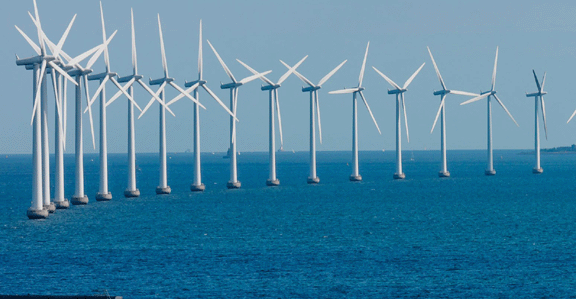
New nuclear power cannot rival windfarms on price, energy boss says
Innogy Renewables chief claims future reactors will not be competitive as offshore windfarms become even cheaper, Guardian, Adam Vaughan, 23 Nov 17, New nuclear power stations in the UK can no longer compete with windfarms on price, according to the boss of a German energy company’s green power arm.
Hans Bunting, the chief operating officer of renewables at Innogy SE, part of the company that owns the UK energy supplier npower, said offshore windfarms had become mainstream and were destined to become even cheaper because of new, bigger turbines.
Asked whether nuclear groups that want to build new reactors in the UK could compete with windfarms on cost, even when their intermittency was taken into account, Bunting replied: “Obviously they can’t.”
“What we see now [with prices] is with today’s technology. It’s not about tomorrow’s technology, which is about [to come in] 2025, 2027, when Hinkley will most likely come to the grid … and then it [windfarms] will be even cheaper.”
Apr 15, 2026 01:00 AM in Canberra, Melbourne, Sydney
Join the International Physicians for the Prevention of Nuclear War (IPPNW) on Tuesday, April 14th for a timely webinar exploring the risks associated with nuclear power and challenging the myth that it offers a simple, safe, carbon-free solution to the climate crisis
21 April Webinar: No Nuclear Weapons in Australia
Start: 2026-04-21 18:00:00 UTC Canberra, Melbourne, Sydney (GMT+10:00)
End: 2026-04-21 19:30:00 UTC Canberra, Melbourne, Sydney (GMT+10:00)
Event Type: Virtual A virtual link will be communicated before the event.











 Antinuclear