Student nuclear disarmament speech canceled due to Chinese pressure: gov’t sourcesKYODO NEWS – Nov 16, 2017 – A speech by a Japanese student peace ambassador at an international disarmament conference in Geneva in August was canceled due to pressure from the Chinese government, Japanese government sources said on Thursday.
The speech by a representative of high school student ambassadors calling for the abolition of nuclear weapons had been delivered at every annual Conference on Disarmament since 2014.
But at the 2017 gathering, China objected, citing rules that allow only government officials to speak, according to the sources.
With Beijing having voiced concerns in the past that Tokyo highlighted the 1945 U.S. atomic bombings of Hiroshima and Nagasaki to present itself as a victim of World War II, it is believed that China pressured for the speech to be quashed for the same reason.
At the past three editions of the conference, a student ambassador representative dispatched by a Japanese civic group gave a speech by registering as a member of the Japanese government delegation for one day.
‘Planet at a crossroads’: climate summit makes progress but leaves much to do
The UN negotiations in Bonn lay the groundwork for implementing the landmark Paris deal, but tough decisions lay ahead, Guardian, Damian Carrington , 18 Nov 17 The world’s nations were confident they were making important progress in turning continued political commitment into real world action, as the global climate change summit in Bonn was drawing to a close on Friday.
The UN talks were tasked with the vital, if unglamorous, task of converting the unprecedented global agreement sealed in Paris in 2015 from a symbolic moment into a set of rules by which nations can combine to defeat global warming. Currently, the world is on track for at least 3C of global warming – a catastrophic outcome that would lead to severe impacts around the world.
The importance of the task was emphasised by Frank Bainimarama, Fiji’s prime minister and president of the summit: “We are not simply negotiating words on a page, but we are representing all our people and the places they call home.”
The Paris rulebook, which must be finalised by the end of 2018, now has a skeleton: a set of headings relating to how action on emissions is reported and monitored. Nations have also fleshed this out with suggested detailed texts, but these are often contradictory and will need to be resolved next year. “The worst outcome would have been to end up with empty pages, but that is not going to happen,” said a German negotiator.
One issue that did flare up during talks was the action being taken by rich nations before the Paris deal kicks in in 2020. Developing nations argued not enough is being done and, with the UN climate negotiations running largely on trust, the issue became unexpectedly serious before being defused by commitments to a “stocktake” of action in 2018 and 2019.
The final hours of the negotiations were held up by a technical row over climate funding from rich nations, always a sensitive topic. Poorer and vulnerable nations want donor countries to set out in advance how much they will provide and when, so recipient nations can plan their climate action. Rich nations claim they are not unwilling, but that making promises on behalf of future governments is legally complex.
Progress in raising the importance of gender, indigenous peoples and agriculture in tackling climate change was made. But NGOs criticised slow progress in delivering previous funding promises. Raijeli Nicole, from Oxfam, said: “For the most part, rich countries showed up to Bonn empty-handed.”
Coal – the dirtiest fossil fuel – has had a high profile at the summit, with the US administration’s only official side-event controversially promoting “clean coal”. But the overwhelming momentum has been against the fuel, with a new coalition of countries pledging a complete phaseout. This happened outside the negotiations, a significant move, according to Camilla Born at thinktank E3G: “We have had the Paris agreement living in the real world.”
Poland, which is heavily dependent on coal, is hosting the next UN climate summit in a year’s time and has frequently held up climate action in the EU. But on Friday, apparently under heavy EU pressure, it ended its hold-out against passing a climate commitment called the Doha amendment which sets in law pre-2020 climate action.
Germany, however, has been unable to commit to phasing out its huge coal industry, because Angela Merkel’s talks to form a new coalition have run over time. Nonetheless, Barbara Hendricks, the out-going German environment minister, said on Friday: “The phasing out of coal makes sense environmentally and economically.” She was certain the new government would act, she said….. https://www.theguardian.com/environment/2017/nov/17/planet-at-a-crossroads-climate-summit-makes-progress-but-leaves-much-to-do
Special Report: Revolt at Trump’s Pro-Coal, Pro-Nuclear & Pro-Gas Panel Rocks U.N. Climate Summit NOVEMBER 14, 2017, Democracy Now! was there when activists and Democratic lawmakers at the U.N. climate summit in Bonn, Germany, staged a full-fledged revolt Monday when the Trump administration made its official debut at this year’s conference with a forum pushing coal, gas and nuclear power. The presentation was entitled “The Role of Cleaner and More Efficient Fossil Fuels and Nuclear Power in Climate Mitigation.” The panel was the only official appearance by the U.S. delegation during this year’s U.N. climate summit. Of the four corporate representatives pushing nuclear, gas and coal, Lenka Kollar of NuScale Power and Amos Hochstein of Tellurian told Amy Goodman that they disagreed with Trump’s decision to pull the U.S. out of the climate agreement.
Transcript This is a rush transcript. Copy may not be in its final form.
AMYGOODMAN: This is Democracy Now!, democracynow.org, The War and Peace Report. We’re broadcasting live from the U.N. climate summit here in Bonn, Germany. Close to 200 countries are gathered. The U.S. says that it is pulling out of the climate accord. Well, on Monday night, activists and Democratic lawmakers staged a full-fledged revolt as the Trump administration made its official debut at this year’s COP at a forum pushing coal, gas and nuclear power. The presentation was entitled “The Role of Cleaner and More Efficient Fossil Fuels and Nuclear Power in Climate Mitigation.” It included speakers from coal company Peabody Energy, the nuclear engineering firm NuScale Power and a gas exporter. The panel was the only official appearance by the U.S. delegation during this year’s U.N. climate summit.
Well, Democracy Now! was there Monday night as the U.S. delegation made its official debut. It didn’t go too well. At least, it didn’t begin well, with a White House consultant telling Democracy Now! we could not film him……..https://www.democracynow.org/2017/11/14/special_report_revolt_at_trumps_pro
Who’s Really Driving Nuclear-Weapons Production? Follow the money.The Nation By William D. Hartung [This piece has been updated and adapted from William D. Hartung’s “Nuclear Politics” inSleepwalking to Armageddon: The Threat of Nuclear Annihilation, edited by Helen Caldicott and just published by the New Press.] 14 Nov 17
“………..The techniques that the arms lobby and its allies in government used more than half a century ago to promote sky-high nuclear weapons spending continue to be wielded to this day. The twenty-first-century arms complex employs tools of influence that Kennedy and his compatriots would have found familiar indeed—including millions of dollars in campaign contributions that flow to members of Congress and the continual employmentof 700 to 1,000 lobbyists to influence them. At certain moments, in other words, there have been nearly two arms lobbyists for every member of Congress. Much of this sort of activity remains focused on ensuring that nuclear weapons of all types are amply financed and that the funding for the new generations of the bombers, submarines, and missiles that will deliver them stays on track.
When traditional lobbying methods don’t get the job done, the industry’s argument of last resort is jobs—in particular, jobs in the states and districts of key members of Congress. This process is aided by the fact that nuclear weapons facilities are spread remarkably widely across the country. There are nuclear weapons labs in California and New Mexico; a nuclear weapons testing and research site in Nevada; a nuclear warhead assembly and disassembly plant in Texas; a factory in Kansas City, Missouri, that builds nonnuclear parts for such weapons; and a plant in Oak Ridge, Tennessee, that enriches uranium for those same weapons. There are factories or bases for ICBMs, bombers, and ballistic missile submarines in Connecticut, Georgia, Washington State, California, Ohio, Massachusetts, Louisiana, North Dakota, and Wyoming. Such a nuclear geography ensures that a striking number of congressional representatives will automatically favor more spending on nuclear weapons.
In reality, the jobs argument is deeply flawed. As the experts know, virtually any other activity into which such funding flowed would create significantly more jobs than Pentagon spending. A study by economists at the University of Massachusetts, for example, found infrastructure investment would create one and one-half times as many jobs as Pentagon funding and education spending twice as many.
In most cases it hasn’t seemed to matter that the jobs claims for weapons spending are grotesquely exaggerated and better alternatives litter the landscape. The argument remains remarkably potent in states and communities that are particularly dependent on the Pentagon. Perhaps unsurprisingly, members of Congress from such areas are disproportionately represented on the committees that decide how much will be spent on nuclear and conventional weaponry……… https://www.thenation.com/article/whos-really-driving-nuclear-weapons-production/
A group of concerned St. Louis residents confront representatives from the Army Corps and EPA over the safety of their neighborhood, in light of nuclear waste being dumped in a nearby landfill, in an exclusive clip from the HBO documentary Atomic Homefront.
The film, which is set to premiere at the Doc NYC festival on Wednesday (Nov. 15) before opening in New York on Friday (Nov. 17) and airing on HBO early next year, follows a group of moms-turned-activists in the St. Louis area as they take on the government and corporations over the illegal dumping of nuclear waste in their community in a desperate bid to protect their families from the toxic effects of radioactive waste.
In the clip, the residents of Bridgeton, Missouri, gather at a meeting with representatives from the Army Corps of Engineers and EPA and the residents, many of whom are moms, grow frustrated at the officials’ inability to explain the risk facing their community and suggestion that their neighborhood is a safe living area. The residents are afraid that radioactive particles could become airborne once an uncontrolled, subsurface fire reaches the nuclear waste.
Press-conference of the coalition Don’t nuke the climate: “Is nuclear a solution to climate change?”
Speaking: Speaking:Kerstin Rudek, BI Luchow-Dannenberg and Don’t Nuke The Climate campaign, Germany
Markus Atkinson, Anti-Nuclear Alliance of Western Australia
Vladimir Slivyak, Ecodefense, Russia
Nuclear industry and its supporters became very active inside the UN talks promoting outdated, expensive and dangerous nuclear energy as a climate friendly technology. Russia, USA and several other countries are organizing pro-nuclear side-events at COP-23 and trying to get developing world to believe in nuclear solution. The reality is that nuclear is not carbon free and far too expensive to be any kind of solution. Nuclear waste is another hot problem that doesn’t have a solution. Activists from various countries talk on why nuclear is part of problem and not part of solution. Also announcing the demonstration against false solutions for climate change on November 11 in Bonn.
you can’t advocate for nuclear reactors without indirectly advocating for nuclear weapons and radioactive waste. That’s because nuclear reactors are producers of both weapons material and radioactive waste. Ike was a nuclear conman. ‘Atoms for Peace’ have always been Atoms for War.
The Real Nuclear Triad: Energy, Weapons and Waste byJAMES HEDDLE , COUNTERPUNCH, NOVEMBER 7, 2017 “……..Nukes on the Dole – Radioactive Welfare Queens
…………. some strange recent developments.
Nuclear utilities are in trouble, fighting for life against – as Amory Lovins once predicted – ‘a massive overdose of market forces’ and the surging economics of renewables.
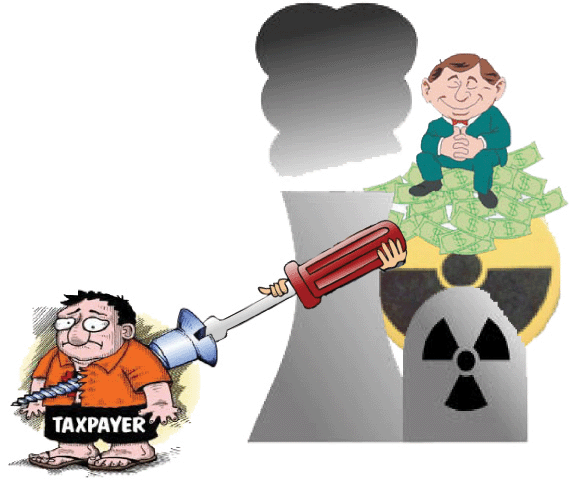
But wait. Whatever happened to ‘”the wisdom of the ‘free market’?” Around the country, as aging reactors reach the end of their operational and economic lives, some states like Wisconsin, Vermont, Massachusetts, and Nebraska are letting them die a dignified natural death. But other states, like New York and Illinois are putting their moribund reactors on life support at public expense. Projections suggest that state-sponsored electric ratepayer handouts in the two states could total as much as $10 billion over 12 years.
Tim Judson, Director of Nuclear Information and Resource Service (NIRS), warns that if other states follow New York and Illinois, “The price would be outrageous. If reactor subsidies go nationwide, it could cost $130-$280 billion by 2030.”
Bailout legislation for dilapidated reactors is now pending: in Connecticut, for Millstone 2 & 3; in New Jersey, for Salem 1 & 2 and Hope Creek; in Texas, for South Texas 1 & 2 and Comanche Peak 1 & 2; in Maryland, for Calvert Cliffs 1 & 2; and for nine reactors in Pennsylvania including Beaver Valley 1 & 2, Three Mile Island 1, Susquehanna 1 & 2, Limerick 1 & 2, and Peach Bottom 2 & 3.
Meanwhile America’s Trillion dollar nuclear arsenal upgrade goes forward, even as an overwhelming majority of United Nations states sign on to a treaty declaring the possession, use or threatened use of nuclear weapons illegal under international law.
In the face of the spreading renewed nuclear crackpotism noted above, the International Campaign to Abolish Nuclear Weapons (ICAN), has been the driving force behind the UN Treaty to Prohibit Nuclear Weapons. ICAN will receive the Nobel Peace Prize Dec 10.
Atoms for Peace War
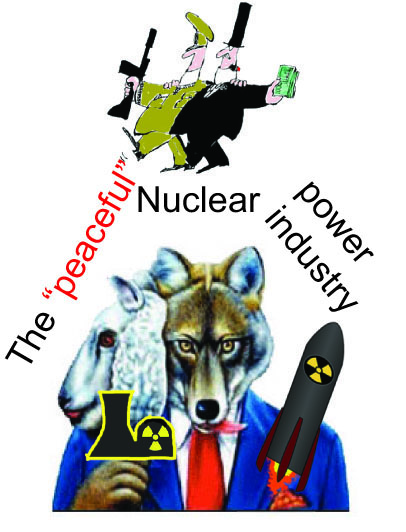
All of which suggests, you can’t advocate for nuclear reactors without indirectly advocating for nuclear weapons and radioactive waste. That’s because nuclear reactors are producers of both weapons material and radioactive waste. Ike was a nuclear conman. ‘Atoms for Peace’ have always been Atoms for War.
And, as Bennett Ramberg showed conclusively in his prescient, but tragically ignored, 1984 book Nuclear Power Plants as Weapons for the Enemy: An Unrecognized Military Peril, its also because every nuclear reactor and radioactive waste storage site in the world are themselves nuclear-weapons-in-place for any enterprising terrorist.
Nuclear Power’s Existential Crisis, New Matilda, By Jim Green on November 12, 2017
Nuclear power is dying a slow, painful and wildly expensive death, writes Jim Green. This year has been catastrophic for nuclear power, and just when it seemed the situation couldn’t get any worse for the industry, it did. There are clear signs of a nuclear slow-down in China, the only country with a large nuclear new-build program.
China’s nuclear slow-down is addressed in the latest World Nuclear Industry Status Report and also in an August 2017 article by former World Nuclear Association executive Steve Kidd.
China’s nuclear program “has continued to slow sharply”, Kidd writes, with the most striking feature being the paucity of approvals for new reactors over the past 18 months. China Nuclear Engineering Corp, the country’s leading nuclear construction firm, noted earlier this year that the “Chinese nuclear industry has stepped into a declining cycle” because the “State Council approved very few new-build projects in the past years”.
Kidd continues: “Other signs of trouble are the uncertainties about the type of reactor to be utilised in the future, the position of the power market in China, the structure of the industry with its large state-owned enterprises (SOEs), the degree of support from top state planners and public opposition to nuclear plans.”
Over-supply has worsened in some regions and there are questions about how many reactors are needed to satisfy power demand. Kidd writes: “[T]he slowing Chinese economy, the switch to less energy-intensive activities, and over-investment in power generation means that generation capacity outweighs grid capacity in some provinces and companies are fighting to export power from their plants.”
Kidd estimates that China’s nuclear capacity will be around 100 GW by 2030, well below previous expectations. Forecasts of 200 GW by 2030, “not unusual only a few years ago, now seem very wide of the mark.” And even the 100 GW estimate is stretching credulity ‒ nuclear capacity will be around 50 GW in 2020 and a doubling of that capacity by 2030 is highly unlikely in the context of the slow-down.
Kidd states that nuclear power in China may become “a last resort, rather as it is throughout most of the world”. The growth of wind and solar “dwarfs” new nuclear, he writes, and the hydro power program “is still enormous”.
Chinese government agencies note that in the first half of 2017, renewables accounted for 70 per cent of new capacity added (a sharp increase from the figure of 52 per cent in 2016), thermal sources (mainly coal) 28 per cent and nuclear just 2 per cent. And just in the past week, Beijing announced plans to stop or delay work on 95 GW of planned and under-construction coal-fired power plants.
Crisis in the US and malaise elsewhere
The plan to build two AP1000 reactors in South Carolina ‒ abandoned in July after A$11.5‒13.3 billion was spent on the partially-built reactors ‒ is now the subject of multiple lawsuits and investigations including criminal probes.
Pro-nuclear commentator Dan Yurman discussed the implications of the decision to abandon the VC Summer project in South Carolina in a September 11 post:
“It is the failure of one of the largest capital construction projects in the U.S. Every time another newspaper headline appears about what went wrong at the VC Summer project, the dark implications of what it all means for the future of the nuclear energy industry get all the more foreboding…. Now instead of looking forward to a triumph for completion of two massive nuclear reactors generating 2300 MW of CO2 emission free electricity, the nation will get endless political fallout, and lawsuits, which will dominate the complex contractual debris, left behind like storm damage from a hurricane, for years to come.”
The only other nuclear new-build project in the US ‒ two partially-built AP1000 reactors in Georgia ‒ is hanging on by a thread. Georgia’s Public Service Commission is reviewing a proposal to proceed with the reactors despite the bankruptcy filing of the lead contractor (Westinghouse), lengthy delays (5.5 years behind schedule) and a doubling of the cost estimate (the original estimate was A$17.9 billion and the latest estimates range from A$32.5‒38.4 billion for the two reactors).
Indicative of their desperation, some nuclear advocates in the US (and to a lesser extent the UK) are openly acknowledging the contribution of nuclear power (and the civil nuclear fuel cycle) to the production of nuclear weapons and using that as an argument to sharply increase the massive subsidiesthe nuclear power industry already receives.
The French nuclear industry is in its “worst situation ever“ according to former EDF director Gérard Magnin. The only reactor under construction in France is six years behind schedule, the estimated cost has escalated from A$5 billion to A$16 billion, and the regulator recently announced that the pressure vessel head of the reactor will need to be replaced by 2024 following a long-running quality-control scandal. The two French nuclear utilities face crippling debts (A$56.5 billion in the case of EDF) and astronomical costs (up to A$151 billion to upgrade ageing reactors, for example), and survive only because of repeated government bailouts.
In South Africa, a High Court judgement on April 26 ruled that much of the country’s nuclear new-build program is without legal foundation. There is little likelihood that the program will be revived given that it is shrouded in corruption scandals and President Jacob Zuma will leave office in 2019 (if he isn’t ousted earlier).
Public support for South Korea’s nuclear power program has been in free-fall in recent years, in part due to a corruption scandal. Incoming President Moon Jae-in said on June 19 that his government will halt plans to build new nuclear power plants and will not extend the lifespan of existing plants beyond 40 years.
In June, Taiwan’s Cabinet reiterated the government’s resolve to phase out nuclear power by 2025.
In the UK, nuclear industry lobbyist Tim Yeo says the compounding problems facing the industry “add up to something of a crisis for the UK’s nuclear new-build programme”. The estimated cost of the only two reactors under construction was recently increased to A$46.2 billion (A$23.1 billion each) and they are eight years behind schedule.
India’s nuclear industry keeps promising the world and delivering very little ‒ nuclear capacity is 6.2 GWand nuclear power accounted for 3.4 per cent of the country’s electricity generation last year.
In Japan, Fukushima clean-up and compensation cost estimates have doubled and doubled again and now stand at A$245 billion. Only five reactors are operating in Japan, compared to 54 before the March 2011 Fukushima disaster.
In Russia, Rosatom’s deputy general director Vyacheslav Pershukov said in June that the world market for new nuclear power plants is shrinking, and the possibilities for building new large reactors abroad are almost exhausted. He said Rosatom expects to be able to find customers for new reactors until 2020‒2025 but “it will be hard to continue”.
In Switzerland, voters supported a May 21 referendum on a package of energy policy measures including a ban on new nuclear power reactors. Thus Switzerland has opted for a gradual nuclear phase-out and all reactors will probably be closed by the early 2030s, if not earlier (while all of Germany’s reactors will be closed by the end of 2022 and all of Belgium’s will be closed by the end of 2025)……. https://newmatilda.com/2017/11/12/nuclear-powers-existential-crisis/
The Real Nuclear Triad: Energy, Weapons and Waste byJAMES HEDDLE , COUNTERPUNCH, NOVEMBER 7, 2017 “……….Chasing Nuclear Market ShareIn a recent piece in Foreign Affairs, entitled Will the West Let Russia Dominate the Nuclear Market? – What the Westinghouse Bankruptcy Means for the Future, born-again ‘new environmentalists’ and new nukes enthusiasts Nick Gallucci and Michael Shellenberger argue that US taxpayers should bail out the once-powerful, now bankrupt and Japanese-owned nuclear giant Westinghouse, or risk losing both global commercial and military nuclear primacy.
In the face of documented world-wide nuclear industry collapse, these guys want to revive what they call Eisenhower’s ‘humanitarian dream’ of Atoms for Peace (which spread deadly US nuclear technology around the world in the first place ) in order to, as Ike promised, “provide abundant electrical energy in the power-starved areas of the world.”
Now, according to nuclear true-believers Nick and Mike, with the added benefit of saving civilization from climate change with new, ‘clean’ nuclear energy will be run on what they call ‘accident tolerant fuels’ – still a completely untested ‘nukes-for-ever’ concept.
The core element in their misguided pitch is that the decline of the civilian nuclear industry in the USA “would significantly undermine U.S. and Western national security interests.”
This, despite statistics showing that global investments in non-hydro renewables are now greater than the global investments in nuclear, hydro and fossil fuels combined.
Nuclear Policy Group-Think Adrift in a Sea of Delusion
Elsewhere in the news, a report by the pro-nuclear Energy Innovation Reform Project on the future costs of new nuclear in the USA notes that: “A sustained decline in the commercial industry could also have a negative impact on the U.S. nuclear naval program.”
The existence of nuclear weapons creates a false sense of security that holds international relations hostage and stifles peaceful coexistence, Pope Francis said.
“The threat of their use as well as their very possession is to be firmly condemned,” the pope told participants at a conference on nuclear disarmament hosted by the Vatican.
For years, popes and Catholic leaders had said the policy of nuclear deterrence could be morally acceptable as long as real work was underway on a complete ban of the weapons. In condemning possession of the weapons, Pope Francis seemed to indicate that deterrence is no longer acceptable.
Nuclear weapons “exist in the service of a mentality of fear that affects not only the parties in conflict but the entire human race,” he said.
The conference, sponsored by the Vatican Dicastery for Promoting Integral Human Development, brought together 11 Nobel laureates, top officials from the United Nations and NATO, diplomats from around the world and experts in nuclear weapons and the disarmament process. They were joined by scholars, activists and representatives of bishops’ conferences, including Stephen Colecchi, director of the U.S. bishops’ Office of International Justice and Peace.
Several speakers, including Masako Wada, one of the last survivors of the U.S. atomic bombing of Hiroshima in 1945, were to discuss the suffering wrought by nuclear arms.
Pope Francis told the group that the “essential” witness of survivors of the bombings in Japan as well as those suffering the effects of nuclear weapons testing are prophetic voices that serve “as a warning, above all for coming generations.”
In his speech, the pope said that when it comes to the ideal of a nuclear-free world, a “certain pessimism” exists and brings with it “considerable expense” as nations modernize their nuclear arsenals.
“As a result, the real priorities facing our human family, such as the fight against poverty, the promotion of peace, the undertaking of educational, ecological and health care projects, and the development of human rights, are relegated to second place,” he said.
Pope Francis said the existence of weapons whose use would result in the destruction of humanity “are senseless even from a tactical standpoint.”
What is more, he said, there is the growing danger that the weapons or weapon technology could fall into the wrong hands.
“The resulting scenarios are deeply disturbing if we consider the challenges of contemporary geopolitics, like terrorism or asymmetric warfare,” he said.
With the ongoing tensions surrounding North Korea’s nuclear ambitions, the Vatican conference came at a time Pope Francis described as one of “instability and conflict.”
But despite the troubling global scenario, he continued, initiatives such as the U.N. Treaty on the Prohibition of Nuclear Weapons, provide a dose of “healthy realism” that “continues to shine a light of hope in our unruly world.”
The treaty, which would enter into force 90 days after at least 50 countries both sign and ratify it, bans efforts to develop, produce, test, manufacture, acquire, possess or stockpile nuclear weapons or other nuclear explosive devices.
Although as of Sept. 20 the treaty had been signed by more than 40 countries, including the Holy See, the United States and other countries possessing nuclear weapons did not take part in the negotiations and do not plan to sign it.
Nevertheless, Pope Francis urged the international community “to reject the culture of waste” and place care for people suffering “painful disparities “over “selfish and contingent interests.”
Progress, he said, “that is both effective and inclusive can achieve the utopia of a world free of deadly instruments of aggression, contrary to the criticism of those who consider idealistic any process of dismantling arsenals.”
At a pre-conference event in Rome Nov. 9, Jesuit Father Drew Christiansen, professor of ethics and global human development at Georgetown University, and Carole Sargent, director of the university’s Office of Scholarly Publications, outlined what they saw as major progress in 2017 toward a ban on nuclear weapons.
The work of grass-roots movements and organizations, including the International Campaign to Abolish Nuclear Weapons, which won the Nobel Peace Prize, has been particularly important, Father Christiansen said. And not to be ignored are hundreds of Catholic women religious who have engaged in major protests, but also dedicated lobbying efforts. Sargent has been researching the grassroots involvement of women religious, especially in Japan, the United States and Great Britain.
The Vatican conference, Father Christiansen said, could be a major push in getting the new U.N. Treaty on the Prohibition of Nuclear Weapons “supported around the world.”
Speaking to journalists before the start of the conference, Mohamed ElBaradei, Nobel laureate and former director general of the International Atomic Energy Agency, commented on tensions between U.S. President Donald Trump and North Korea’s leader, Kim Jong Un, and the threat of nuclear war.
In August, Trump threatened to unleash “fire and fury like the world has never seen” in response to North Korea’s announcement that it had created a nuclear warhead small enough to fit on an intercontinental ballistic missile. Kim responded to Trump’s “fire and fury” talk by saying his country was preparing to fire missiles into the waters around Guam, a U.S. territory in the western Pacific Ocean with two military bases.
When asked for his response on the possibility of a U.S.-North Korea nuclear conflict, ElBaradei had few words.
The symposium, organized by the Dicastery for Promoting Integral Human Development got underway as tensions escalated between the US and North Korea.
It saw the participation of eleven Nobel peace laureates, top United Nations and NATO officials, leading experts, heads of major foundations and of civil society organizations, as well representatives of bishops conferences, Christian denominations and other faiths. Pope Francisaddressed the gathering on Friday.
Wrapping up the symposium on Saturday, Cardinal Peter Turkson, President of the Dicastery for Promoting Integral Human Development, read out the following preliminary conclusions:
The Dicastery brought together religious leaders and representatives of civil society, officials of States and international organizations, noted academics and Nobel Laureates and students, to illuminate the connections between integral disarmament and integral development, and to explore the links among development, disarmament and peace. As our Holy Father, Pope Francis, repeatedly reminds us, “everything is connected.”
Emerging nations have told rich countries to do more to cut emissions quicker. A group of campaigners have called for the US to be kicked out of the talks. But the main story seem to be around rich countries reluctance to commit to past promises around climate finance. NGOs may even sue.
With lighter news of how kale is climate-friendly and some art from Venice, here are the biggest COP23 stories from the second half of this week.
1. Emerging nations urge rich to kick-start climatepact before 2020
Emerging nations pressed developed countries on Wednesday to step up cuts in greenhouse gas emissions by 2020 to kick-start the Paris climate agreement, saying the rich were wrongly focused on 2030 goals.
“We came here needing to hit the accelerator, not the brakes,” Brazil’s chief negotiator Antonio Marcondes told Reuters Read more on Thomson Reuters Foundation
2. African campaigners call for the US to be kicked out of major UN climate talks because of Donald Trump
The Pan African Climate Justice Alliance (PACJA) has organised a petition in favour of the US delegation being barred from the UN negotiations in response to Mr Trump’s decision to pull his country out of the Paris Agreement on Climate Change. The group claims the US has no right to be involved in discussions on how the agreement should be implemented given that it has chosen to opt-out of the deal.Read more on The Independent
3. Climate-hit nations ask: Who will pay the rising costs of disasters?
The question of who might pay the mounting costs of disasters is a controversial one at the talks. Developed countries — as the biggest emitters of greenhouse gas emissions — have been reluctant to discuss the costs, fearing they could be held liable. Read more on Thomson Reuters Foundation
4. Carbon price among policy wishlist issued by businesses at COP23
Members of the World Business Council for Sustainable Development (WBCSD), including the chief executives of more than 200 international businesses, have called for governments to collaborate with the private sector to set meaningful carbon prices and improve climate resilience.Read more on Edie
5. Kale on the agenda at COP23
Ten years ago, Nordic chefs drafted a manifesto to shape a new food culture, grounded in gastronomy, but their overall ambition was to create a new, sustainable food identity. What came out of was a boost in Nordic gastronomy based on locally sourced vegetables, creating thousands of new jobs and inspiring others across the food sector to follow suit.Read more on Huff Post
6. Climate change art illustrates sea level rise in Venice during COP 23
Andreco Studio has unveiled its latest art installation, Climate 04-Sea Level Rise in Venice, to raise awareness of the climate change conference COP 23 currently underway in Bonn, Germany. Introduced as a project promoting dialogue between the arts and sciences, the climate change-inspired installation calls attention to the effects of potential sea level rise in Venice.Read more on Inhabitat
7. COP23: NGOs may take nations to court over climate loss and damage
Developed countries have not lived up to their promises around climate financing. NGOs at the UN climate talks in Bonn are now pushing for action through legal means.Read more on Eco Business
7. COP23: NGOs may take nations to court over climate loss and damage
Developed countries have not lived up to their promises around climate financing. NGOs at the UN climate talks in Bonn are now pushing for action through legal means.Read more on Eco Business
9. Climate summit deadlocked over immediate action
A closed-door meeting over the inclusion of immediate climate action in the agenda at this year’s conference in Bonn, Germany, has failed to break the deadlock between developing and developed countries.
From the start of the UN summit on Monday, developing countries led by India, China and Iran have been asking for the inclusion of immediate climate action in the agenda.
Developed countries have been opposing this because it puts their actions under the spotlight. The Paris Agreement comes into force in 2020 so prior efforts to limit climate change are largely the responsibility of industrialised countries under the second phase of the Kyoto Protocol. But many industrialised countries have not even ratified the second phase in their legislatures.Read more on China Dialogue
10. One nation, two tribes: opposing visions of US climate role on show in Bonn
Donald Trump has pulled the US out of the Paris accord – but other Americans are standing with the world to help fight the ‘existential crisis’ of global warming. Deep schisms in the US over climate change are on show at the UN climate talks in Bonn – where two sharply different visions of America’s role in addressing dangerous global warming have been put forward to the world.Read more on Guardian
11. Rich countries not talking climate finance seriously, say African officials
Developed countries promised to deliver $100bn a year by 2020 in public and private fund to help struggling countries cope with climate change. Current flows are estimated at between $17bn and $61bn. However, at UN climate talks in Bonn, Seyni Nafo, who leads the group of African states, said the rich were refusing to advance even on procedural discussions around finance.Read more on Climate Home
Apr 15, 2026 01:00 AM in Canberra, Melbourne, Sydney
Join the International Physicians for the Prevention of Nuclear War (IPPNW) on Tuesday, April 14th for a timely webinar exploring the risks associated with nuclear power and challenging the myth that it offers a simple, safe, carbon-free solution to the climate crisis
21 April Webinar: No Nuclear Weapons in Australia
Start: 2026-04-21 18:00:00 UTC Canberra, Melbourne, Sydney (GMT+10:00)
End: 2026-04-21 19:30:00 UTC Canberra, Melbourne, Sydney (GMT+10:00)
Event Type: Virtual A virtual link will be communicated before the event.










 Antinuclear