Stanford professor sues critics of his 100% renewables article, Washington Post, By Chris Mooney November 1 2017Mark Z. Jacobson, a Stanford University professor who has prominently contended that the United States can fully power itself with wind, water and solar energy, is suing the National Academy of Sciences and the lead author [Clack] of a study published in its flagship journal that criticized Jacobson’s views — pushing an already bitter academic dispute into a courtroom setting……
The dispute turns on Jacobson’s idea, itself published in the PNAS and other journals, that it is feasible to construct a grid for the entire country that would be powered entirely by wind, solar and water energy (hydropower), with additional help from forms of energy storage. “No natural gas, biofuels, nuclear power, or stationary batteries are needed,” Jacobson and his colleagues wrote in 2015.
This idea of “100 percent clean energy” has been embraced by many environmental and climate change advocates, including actor Mark Ruffalo and Sen. Bernie Sanders (I-Vt.). And no wonder, for it presents a highly ambitious and optimistic outlook on how the current transition toward clean energy — which would be central to stopping climate change — could continue to develop……
Jacobson charges that after seeing that [Clack] study prior to publication, he sent a list of its purported errors to the NAS. These were not corrected in the final published version, his lawsuit says. …..
One of his greatest objections is over the claim that his work contained “modeling errors,” which turns on a technical dispute over how much U.S. electricity could be provided by hydropower and how much the current system of dams can be altered to increase their electricity-generating capacity.
This claim is “particularly harmful and damaging to Dr. Jacobson’s reputation because his primary expertise is in computer modeling,” the suit asserts……
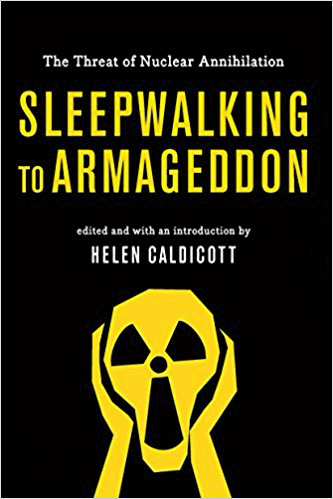
To understand what drives America’s frighteningly militaristic stance and warmongering, follow the money. After the Cold War ended, US negotiators promised Mikhail Gorbachev that America would not enlarge NATO, and the world enjoyed a period of relative peace. But the United States reneged on its promise a few short years later: “No war” was bad for business! In 1997 Norman Augustine, the head of Lockheed Martin, traveled to Romania, Hungary, Poland, Czechoslovakia, and the other newly liberated Eastern European countries and asked: Do you want to join NATO and be a democracy? (Joining NATO doesn’t make you a democracy.) But in order to join NATO, these small countries had to spend billions of dollars to buy weapons.
That’s the dynamic that instigated NATO’s expansion from the end of the Cold War to the present time — right up to the border of Russia
Despite Donald Trump’s vows to seal the US border and eradicate ISIS, the real terrorists of the world today are the United States and Russia. They possess 94 percent of the nuclear weapons on the planet, and they hold the rest of the world hostage to their provocative and self-serving foreign policies and misadventures. As a result, we are closer to nuclear war now, at the start of the twenty-first century, than we’ve ever been before, even during the height of the Cold War.
While we must be concerned about global warming — the other existential threat to the planet — it is imperative that we do not take our eyes off the nuclear threat. To do so is to risk sleepwalking to Armageddon. Continue reading →
South Australia, with its nest of nuclear industry enthusiasts, should consider the history of South Carolina, stuck with numerous dead nuclear projects.
The South’s legacy of abandoned nuclear reactors, The Slate, BY CAROLINE PEYTON AND SPECIAL TO THE STATE’S EDITORIAL BOARDNOVEMBER 02, 17COLUMBIA, SC “……..The cancellation of the V.C. Summer expansion project testifies to innumerable missteps, but our collective amnesia has missed the bigger story: The South’s long, messy nuclear history is a catalog of modest successes and epic failures.
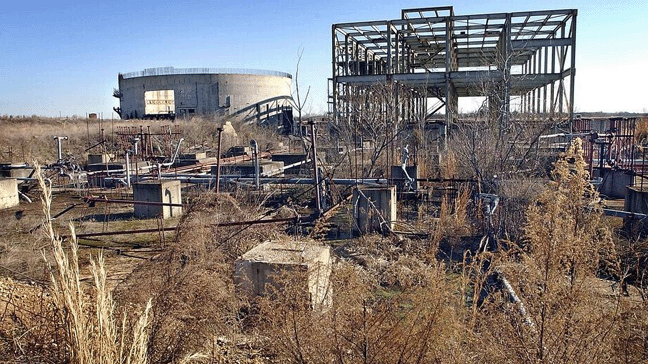
Sadly, the V.C. Summer project shutdown is nothing new for the South. It has happened at least 22 times since the 1970s. Some plants existed merely as blueprints, while others were canceled mid-construction. Across the region, half-finished projects stand as emblems of bungled industry efforts. At its core, this history has been defined by secrecy, miscalculations and decisions made by the few at the expense of ordinary people. Continue reading →
Australians have contorted ourselves to look like we’re responding to climate change without really doing so.
Enter the Turnbull government’s National Energy Guarantee…..That this is the best we can do — indeed that this is a relative triumph for Mr. Turnbull — illustrates just how tangled Australia’s climate politics have become. The country has taken a long, hard look at every warning about the costs of delayed climate action and ignored them all. And, subsequently, it has paid for those costs through high energy prices and curtailed investment.
Australia Has a Climate Change Lesson for the World https://www.nytimes.com/2017/11/01/opinion/australia-climate-change.html?_r=0, By WALEED ALY, MELBOURNE, Australia— No issue has been such a political graveyard in Australia as climate change. At least three prime ministers from the last decade have had their tenure buried there: John Howard, Kevin Rudd and Julia Gillard all lost their jobs, at least in part, for trying and failing to deliver polices to combat climate change.
To this list, you could add Malcolm Turnbull’s stint as opposition leader, which ended when Tony Abbott challenged him as party leader over his acceptance of the emissions cap-and-trade plan of the prime minister at the time, Mr. Rudd.
Today, of course, Mr. Turnbull is prime minister (a role he seized, in turn, from Mr. Abbott). And he is the latest to run this gantlet, having just announced a new energy policy that he describes as a “game changer” in Australia’s never-ending climate wars.
He might even be right. But it’s hard to tell because what he has offered is not so much a policy as a framework for what might become a policy. Continue reading →
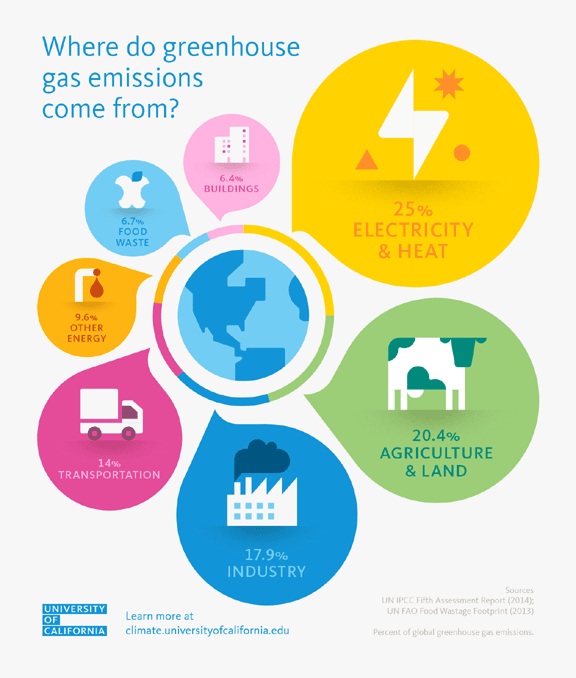
The climate report, obtained by NPR, notes that the past 115 years are “the warmest in the history of modern civilization.” The global average temperature has increased by about 1.8 degrees Fahrenheit over that period. Greenhouse gases from industry and agriculture are by far the biggest contributor to warming.
The findings contradict statements by PresidentTrump and many of his Cabinet members, who have openly questioned the role humans play in changing the climate.
“I believe that measuring with precision human activity on the climate is something very challenging to do,” EPA Administrator Scott Pruitt said in an interview earlier this year. “There’s tremendous disagreement about the degree of impact.”
That is not consistent with the conclusions of the 600-plus-page Climate Science Special Report, which is part of an even larger scientific review known as the fourth National Climate Assessment. The NCA4, as it’s known, is the nation’s most authoritative assessment of climate science. The report’s authors include experts from leading scientific agencies, including the National Oceanic and Atmospheric Administration, NASA and the Department of Energy, as well as academic scientists.The report states that the global climate will continue to warm. How much, it says, “will depend primarily on the amount of greenhouse gases (especially carbon dioxide) emitted globally.” Without major reductions in emissions, it says, the increase in annual average global temperature could reach 9 degrees Fahrenheit relative to pre-industrial times. Efforts to reduce emissions, it says, would slow the rate of warming.
“This is good, solid climate science,” says Richard Alley, a geoscientist at Penn State University, who says he made minor contributions to the report’s conclusions on sea level rise. “This has been reviewed so many times in so many ways, and it’s taking what we know from … a couple of centuries of climate science and applying it to the U.S.”
The assessments are required by an act of Congress; the last one was published in 2014. Alley says this year’s goes further in attributing changes in weather to the warming climate, especially weather extremes. “More heat waves and fewer cold snaps, this is very clear,” he says. The report also notes that warmer temperatures have contributed to the rise in forest fires in the West and that the incidence of those fires is expected to keep rising.
Some of the clearest effects involve sea level rise. “Coastal flooding, you raise the mean level of the ocean, everything else equal you get more coastal flooding,” Alley says. The report notes that sea level has risen 7 to 8 inches since 1900, and 3 inches of that occurred since 1993. The report says that rate is faster than during any century over the past 2,800 years.
The report also points out that heavy rainfall is increasing in intensity and frequency across the U.S., especially in the Northeast, and that is expected to keep increasing.
Other connections are harder to nail down, Alley says, such as whether a particular hurricane can be attributed to climate change.
“The Climate Science Special Report is like going to a doctor and being given a report on your vital signs,” says environmental scientist Rachel Licker of the Union of Concerned Scientists. She notes that the authors assessed more than 1,500 scientific studies and reports in making their conclusions.
Alley adds that the new report “does a better job of seeing the human fingerprint in what’s happening.” He says that while he hasn’t read all of it yet, he sees no evidence that it has been soft-pedaled or understates the certainty of the science.
Alley notes that “there’s a little rumbling” among climate scientists who are concerned that the Trump administration will ignore this effort. “I think the authors really are interested in seeing [the report] used wisely by policymakers to help the economy as well as the environment.”
The report has been submitted to the Office of Science and Technology Policy at the White House. Trump has yet to choose anyone to run that office; it remains one of the last unfilled senior positions in the White House staff.
Independent 1st Nov 2017, Germany generated enough wind power at the weekend for consumers to get
free energy. So much was generated by wind turbines in weekend storms that
costs fell to below zero. Bloomberg reported that power prices turned
negative as wind output reached 39,409 megawatts on Saturday. To balance
supply and demand in this situation, energy producers close power stations
or pay consumers to take extra electricity from the network.
The collapse happened at the Punggye-ri nuclear test site in the northeast of the country on October 10, according to Japan’s TV Asahi. The disaster has prompted fears of a massive radioactive leak which could spark a Chernobyl- or Fukushima-style disaster, The Sun reported.
A North Korean official said the collapse happened during the construction of an underground tunnel, South Korea’s Yonhap news agency reports.
Some 100 people are said to have been trapped by the initial tunnel collapse, with a further 100 lost in a second collapse during a rescue operation, Asahi reported.
Lee Eugene, a spokeswoman at South Korea’s unification ministry, said: “We are aware of the report but do not know anything about it.”
The accident is believed to have been caused by Kim Joing-un’s sixth nuclear test which weakened the mountain, according to the report. It was reported earlier this year that the mountain under which the base is believed to be hidden was at risk of collapsing and leaking radiation into the region.
Experts said if the peak crumbles, clouds of radioactive dust and gas would blanket the region, the South China Morning Post reported.
The Punggye-ri test site is carved deep into the side of Mount Mantap. Geophysicist Wen Lianxing and his team at the University of Science and Technology of China in Hefei, Anhui province, said they were “confident” underground detonations were occurring underneath the mountain. Continue reading →
Imagine if the US flew what North Korea thought were nuclear-capable bombers up near its border, sporadically at first, then once per month. Then twice per month. In parallel, the US starts sending nuclear-capable submarines to port in South Korea. Then it issues warning orders to US Navy surface ships armed with Tomahawk land-attack cruise missiles (the kind used against Syria in April) to program North Korean targets while patrolling in waters off North Korea’s eastern coast. Then it deploys fifth-generation stealth fighters to Japan in conjunction with the arrival of three aircraft carriers to the Pacific.
What do these military preparations look like?
Now imagine that the political rhetoric coinciding with all these military moves aims for nothing short of convincing a nuclear North Korea to unilaterally disarm itself. Continue reading →
Christiana Figueres is chair of the Lancet Countdown advisory board. When the doctor tells you that your cholesterol is too high, you tend to listen and change your diet. When the world’s climate scientists tell us that temperatures are rising to dangerous levels, we should heed their advice. It’s time to give up climate change, it’s bad for our health.
I’m not talking about the health of our planet or the health of species such as the polar bear, so often associated with climate change – though they are suffering. I’m talking about human health. The health of you, your family, your neighbours – each and every one of us.
A report just published in the Lancet from the specially created Lancet Countdown initiative, reveals just how bad climate change is for public health. The diagnosis reveals that hundreds of millions of people are already suffering the health impacts of climate change. Its insidious creep is being felt in multiple ways: rising temperatures are hastening the spread of infectious diseases; crop yields are becoming uneven and unpredictable, worsening the hunger and malnourishment for some of the most vulnerable people on the planet; allergy seasons are getting longer; and at times it is simply too hot for farmers to work in the fields.
Typhoons and hurricanes, such as Harvey, feed off unnaturally warm waters to deliver more forceful threats to human health, including to life itself. The attribution of climate change as a contributing factor in such events is of course complex. The Lancet report’s analysis – that there has been a 46% increase in extreme weather disasters since 2000 – helps to cut through any confusion.
Then there is the heat, which might be the most widespread and dangerous of all. Continue reading →
Global atmospheric CO2 levels hit record high, UN warns that drastic action is needed to meet climate targets set in the Paris agreement, Guardian, Jonathan Watts, 31 Oct 17, The concentration of carbon dioxide in the atmosphere increased at record speed last year to hit a level not seen for more than three million years, the UN has warned.
The new report has raised alarm among scientists and prompted calls for nations to consider more drastic emissions reductions at the upcoming climate negotiations in Bonn.
“Globally averaged concentrations of CO2 reached 403.3 parts per million (ppm) in 2016, up from 400.00 ppm in 2015 because of a combination of human activities and a strong El Niño event,” according to The Greenhouse Gas Bulletin, the UN weather agency’s annual flagship report.
This acceleration occurred despite a slowdown – and perhaps even a plateauing – of emissions because El Niño intensified droughts and weakened the ability of vegetation to absorb carbon dioxide. As the planet warms, El Niños are expected to become more frequent.
US nuclear arsenal to cost $1.2tn over next 30 years, independent CBO report findshttps://www.theguardian.com/world/2017/oct/31/us-nuclear-arsenal-cost-cbo-report CBO finds total price tag marks 25% increase from previous estimate
Nuclear Posture Review under way and expected by end of the year, Guardian, Julian Borger 1 Nov 17, The cost of the US nuclear arsenal over the next 30 years will be over $1.2tn, even before any new weapons ordered by the Trump administration, and is unlikely to be affordable without cuts elsewhere in the defence budget, according to a independent congressional report.
The total price tag marks nearly a 25% increase from previous estimate, taking in the modernisation programme established under the Obama administration, which account for $400bn, the Congressional Budget Office (CBO) found. The costs would peak in the 2020s and the 2030s.
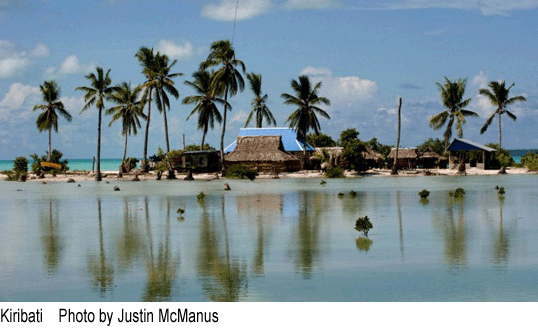
The new category would make official the Green party’s pre-election policy which promised 100 visas for those affected by climate change.
As part of the new Labour-led coalition government, the Green party leader James Shaw was given the role of climate change minister.
He told Radio New Zealand on Tuesday that “an experimental humanitarian visa category” could be implemented for people from the Pacific who are displaced by rising seas resulting from climate change.
“It is a piece of work that we intend to do in partnership with the Pacific islands,” Shaw said. Continue reading →
Emissions Gap Report, http://www.unenvironment.org/resources/emissions-gap-report [good graphs] , Authors: UN Environment, November 17 The goal of the Paris Agreement on climate change, as agreed at the Conference of the Parties in 2015, is to keep global temperature rise this century to well below 2 degrees Celsius above pre-industrial levels. It also calls for efforts to limit the temperature increase even further to 1.5 degrees Celsius.
The UN Environment Emissions Gap Report 2017 presents an assessment of current national mitigation efforts and the ambitions countries have presented in their Nationally Determined Contributions, which form the foundation of the Paris Agreement.
The report has been prepared by an international team of leading scientists, assessing all available information. The governments of countries mentioned specifically in the report have been invited to comment on the specific assessment findings; independent experts have also been invited to review the different chapters.
What’s new in this year’s report?
Update on global greenhouse gas emissions
This year, the Emissions Gap Report includes an assessment of the emissions associated with the Nationally Determined Contributions and current policies of each of the G20 members, including the European Union. This is in addition to presenting an update on global greenhouse gas emissions and national actions to meet the earlier Cancun pledges.
Exploring “negative emission technologies”
This year’s report explores removing carbon dioxide from the atmosphere as an additional way to mitigate climate change, over and above conventional abatement strategies.
An analysis of global carbon dioxide emissions from energy and industry
The Report includes a new systematic assessment of how various economic sectors can reduce their climate-warming emissions, focusing on the potential eductions from the wide application of already-known and cost-effective technologies.
The role of short-lived climate pollutants
The report describes the opportunities offered by limiting emissions of the so-called short-lived climate pollutants. Reductions of these pollutants will limit the rate of short-term warming, and when sustained and combined with reductions in carbon dioxide emissions, they help to limit long-term warming, which is the ultimate aim of closing the emissions gap.
Phasing out coal
This year’s report includes a detailed assessment of global developments in the coal sector. This also examines the options and barriers for a gradual coal phase-out.
Swamp Tales: Puerto Rico Cancels $300 Million Trump Crony Electrical Grid Rebuild Contract, The Progressive, by Harvey Wasserman October 30, 2017, The swampish saga would be hard to invent. In early October, Puerto Rico’s Energy Power Authority awarded a $300 million tax-funded contract to reconstruct the island’s hurricane devastated power grid to a two-person, two-year-old firm based in the small Montana hometown of Trump Interior Secretary Ryan Zinke. The company is financially backed by a major donor to Donald Trump’s 2016 presidential campaign.
About eighty percent of Puerto Rico is still without power. Many hospitals are still dark. Local citizens needing medical treatments such as surgeries or dialysis have been forced to flee to places where electric power is available.
Puerto Rico’s power grid centers on antiquated oil, gas, and coal generators, the median age of which is forty-four years. Just two percent Puerto Rico’s juice came from wind and solar. One wind farm, on the south side of the island, survived Hurricane Maria largely intact, as did at least one small commercial solar array.
For Puerto Rico’s 3.4 million residents, restoring power is a matter of life and death. But the $300 million dollar contract was handed, with no public hearings, legislative discussion or long-term planning, to Whitefish, an obscure company from rural Montana.
At least one Zinke relative—his son—has worked on part-time contract for Whitefish. Zinke claims he had nothing to do with the deal.
Anti-Trump sentiment is rampant throughout the island, fed by a lack of concern expressed by the President for Puerto Ricans’ dire situation, and capped by a recent visit in which he pitched paper towels to a crowd of bewildered local residents. When San Juan mayor Carmen Yulin Cruz questioned the contract with Whitefish, the company threatened to stop work, then apologized.
The Puerto Rican power company’s contract astoundingly exempted Whitefish from official audits, stating, “In no event shall [governmental bodies] have the right to audit or review the cost and profit elements.” It also waived “any claim against Contractor related to delayed completion of the work,” meaning Whitefish was empowered to pretty much take as long as it wanted to complete the job……..
the uproar should also focus on the growing demand that the electric power systems in Puerto Rico and the rest of the Caribbean be reconstructed around renewables and microgrids, rather than fossil-fired central distribution networks.
Most likely those systems will not be built by Trump cronies flown in at huge expense, who then must dodge rocks and bottles being thrown by angry locals.
California governor heads to Europe for climate talks http://m.startribune.com/california-governor-heads-to-europe-for-climate-talks/454332843/?section=nationBy KATHLEEN RONAYNE , ASSOCIATED PRESS October 31, 2017 SACRAMENTO, Calif. — California Gov. Jerry Brown is continuing his international fight against climate change with an 11-day trip to Europe starting Saturday including stops at the Vatican and a United Nations conference in Germany.
Brown is a chief adversary to Republican President Donald Trump in the battle over U.S. climate policy, promising to help the country reach its emissions reductions targets even as Trump withdraws from an international climate accord. He’s been named the special adviser for states and regions at the U.N. Climate Change Conference in Bonn, Germany.
“While the White House declares war on climate science and retreats from the Paris Agreement, California is doing the opposite and taking action,” Brown said in a statement announcing the trip. “We are joining with our partners from every part of the world to do what needs to be done to prevent irreversible climate change.”
The non-profit California State Protocol Foundation, which accepts donations from private businesses, pays for Brown’s international travel. Travel for Brown’s staff members will be partially covered by money from the non-profit Climate Registry and the Climate Action Reserve, a program that deals with carbon offset projects, spokesman Evan Westrup said.
Brown’s November trip follows visits to China and Russia earlier this year to promote international collaboration on climate change. Next year, he plans to host a summit in San Francisco.
He will give a speech Saturday to the Vatican Pontifical Academy of Sciences symposium. During the week, Brown will address European Parliament leaders, the state parliament in Baden-Wurttemberg Germany, meet with representatives from national scientific academies and serve on several panels at the U.N. conference.
Govs. Kate Brown of Oregon, Jay Inslee of Washington and Terry McAuliffe of Virginia — all Democrats — will join him on a panel about states’ roles in fighting climate change. California Senate leader Kevin de Leon, also a Democrat, is scheduled to speak Friday at a Vatican workshop on climate.
Apr 15, 2026 01:00 AM in Canberra, Melbourne, Sydney
Join the International Physicians for the Prevention of Nuclear War (IPPNW) on Tuesday, April 14th for a timely webinar exploring the risks associated with nuclear power and challenging the myth that it offers a simple, safe, carbon-free solution to the climate crisis
21 April Webinar: No Nuclear Weapons in Australia
Start: 2026-04-21 18:00:00 UTC Canberra, Melbourne, Sydney (GMT+10:00)
End: 2026-04-21 19:30:00 UTC Canberra, Melbourne, Sydney (GMT+10:00)
Event Type: Virtual A virtual link will be communicated before the event.












 Antinuclear