The UN Charter Requires Peaceful Dispute Resolution.
The UN Charter Prohibits Threats and Preemptive Use of Force.
The Crime of Genocide
Crimes Against Humanity
The War Crime of Collective Punishment
Destroying North Korea Would Violate Distinction and Proportionality.
First-Strike Use of Nuclear Weapons Violates International Law.
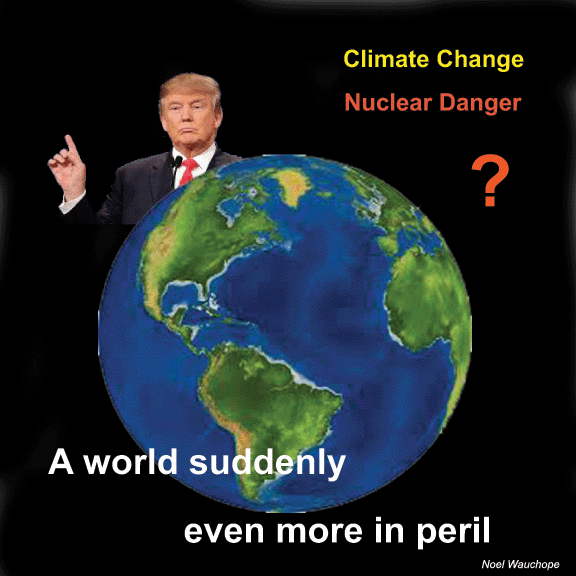
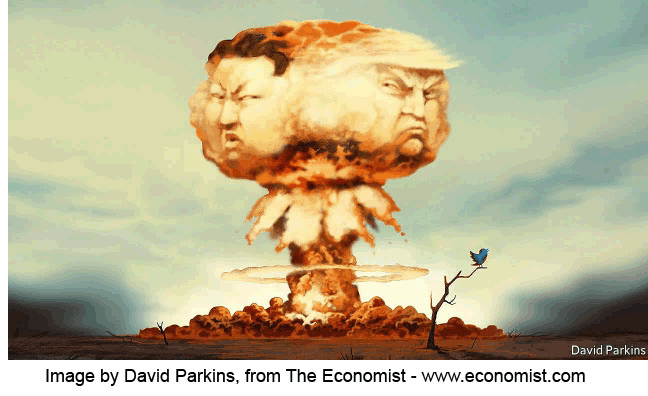
Trump Threatens Genocide, Crimes Against Humanity in North Korea, http://www.truth-out.org/news/item/42101-trump-threatens-genocide-crimes-against-humanity-in-north-korea September 29, 2017By Marjorie Cohn, Truthout | News Analysis Donald Trump threatened to “totally destroy North Korea” in his address to the United Nations General Assembly on September 19. That threat violates the UN Charter, and indicates an intent to commit genocide, crimes against humanity, the war crime of collective punishment and international humanitarian law. Moreover, a first-strike use of nuclear weapons would violate international law.
By threatening to attack North Korea, Trump is endangering the lives of countless people. In the past, he has indicated his willingness to use nuclear weapons and Kim Jong-un has threatened to retaliate. The rapidly escalating rhetoric and provocative maneuvers on both sides has taken us to the brink of war. Continue reading →
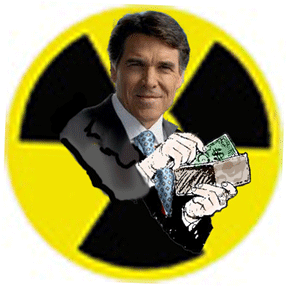
Perry is trying “to essentially end competition in U.S. power markets in order to force customers to pay billions of dollars for uneconomic coal and nuclear plants they don’t want or need,” Mark Kresowick, an expert on FERC rules, told ThinkProgress. Kersowick called the move “unprecedented.”
Perry wants to stop cheaper, cleaner renewables like solar and wind from shutting down more dirtier and more expensive plants like coal (and nuclear).
Significantly, Germany has one of the most reliable electric grids in the world, with 10 times fewer minutes of grid outages a year than the United States. In the morning of May 8, 2016, a whopping 95 percent of Germany’s electricity was provided by renewables.
JOE ROMM, In a brazen move, Energy Secretary Rick Perry has ignored the findings of his own grid study and proposed a new federal rule that would effectively force Americans to buy dirtier, more expensive power. Continue reading →
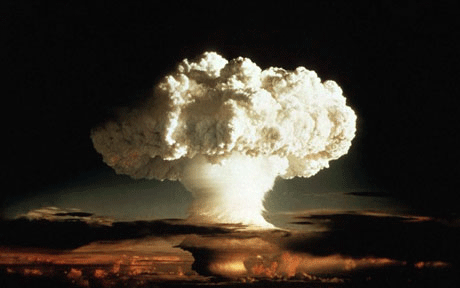
Author challenges British denial over Pacific nuclear legacy http://www.radionz.co.nz/international/pacific-news/340397/author-challenges-british-denial-over-pacific-nuclear-legacyThe author of a new book on Pacific nuclear weapons testing says he hopes it will shed more light on Britain’s tests in the region. US and French nuclear tests at Bikini atoll in the Marshall Islands and Murorua and Fangataufa atolls in Tahiti feature regularly in discussions about the environmental and social legacy of Pacific nuclear testing.
But the author Nic McLellan says the fallout of Britain’s hydrogen bomb tests at Kiritimati island in Kiribati isn’t as well documented.
Mr McLellan says unlike the US and France, Britain refuses to accept any responsibility for the negative impacts of its tests on the health of local men, women and children as well as its own soldiers and those from Fiji and New Zealand who observed the tests.
“The British of course tested in my own country Australia with atomic weapons and yet the hydrogen bomb tests in Kiribati are not very well known. And so the book is compiling a lot of information gathered and presents portraits of people who are opposed to the tests. It is really important to recognise that in the 1950s there was widespread opposition to these tests going ahead.”
‘Left To Die As Guinea Pigs’: Tatar Village Struggles On, 60 Years After Nuclear Catastrophehttps://www.rferl.org/a/russia-nuclear-mayak/28755780.html, September 28, 2017 An explosion at a Soviet nuclear plant 1,400 kilometers east of Moscow remains the world’s third-largest nuclear disaster, after Chernobyl and Fukushima. At the time, in 1957, it was the worst ever. Sixty years on, nearby Tatar villagers are still struggling for official recognition of their plight. (RFE/RL’s Tatar-Bashkir Service) TEXTS BELOW DESCRIBE EACH OF THE EXCELLENT PICTURES ON THE ORIGINAL
The sign says “Danger Zone.” An explosion on September 29, 1957, contaminated an area of 23,000 square kilometers and exposed more than 270,000 people to significant levels of radiation.
The village of Karabolka is 30 kilometers from the Mayak nuclear plant, where the explosion occurred. For decades afterwards, it did not appear on maps, only reappearing 20 years ago. But life there continued.
Gulshara Ismagilova has lived in Karabolka all her life. She is campaigning for official recognition for the suffering of the villagers. Rates of cancer and genetic abnormalities here are significantly higher than the national average. “We are all handicapped here,” she says.
These are Ismagilova’s relatives who have died over the last 60 years. It includes an aunt, her mother, and her brother, who all died of cancer. Ismagilova herself has liver cancer.
In 1957, the village had about 4,000 residents; in 2010, just 423. The village had two distinct parts: a mostly Tatar part, which was not evacuated, and a mostly Russian part, which was. Some locals say they were used in an experiment on the effects of radiation.
The village has eight cemeteries. Seven of them are a resting place for residents who died of cancer. Children here are often born with cancer and die before reaching adulthood.
Only Muslims are buried here. Following their beliefs, some relatives prevent autopsies being performed. This can prevent some deaths being classified as cancer-related.
A pile of coffins at the ready. Families usually bury their dead by noon of the day following their death. “People don’t know what to eat and how to survive,” Ismagilova says. “They have been left here to die as guinea pigs.”
This house has a pile of firewood outside. In the 1990s, local people were warned that wood stored radiation and should not be used for burning. But the village was not connected to a gas supply until 2016.
A water pump outside a house. “The authorities prohibited drinking water from local wells but couldn’t arrange supplies of clean water. A couple of months later, they took samples and said the local water was good enough to drink,” says Ismagilova.
A Greenpeace report 10 years ago said the Mayak site was “one of the most radioactive places on Earth.” It added that thousands of people in surrounding towns and villages still lived on contaminated land
Global carbon emissions stood still in 2016, offering climate hope
The new data is a welcome sign of progress in the battle against global warming but many challenges remain, including methane from cattle, Guardian, Damian Carrington, 28 Sept 17, Global emissions of climate-warming carbon dioxide remained static in 2016, a welcome sign that the world is making at least some progress in the battle against global warming by halting the long-term rising trend.
Stalled global emissions still means huge amounts of CO2 are being added to the atmosphere every year – more than 35bn tonnes in 2016 – driving up global temperatures and increasing the risk of damaging, extreme weather. Furthermore, other heat-trapping greenhouse gases, mainly methane from cattle and leaks from oil and gas exploration, are still rising and went up by 1% in 2016.
“These results are a welcome indication that we are nearing the peak in global annual emissions of greenhouse gases,” said climate economist Prof Lord Nicholas Stern at the London School of Economics and president of the British Academy.
“To realise the goals of the Paris agreement and hold the increase in global average temperature to well below 2C, we must reach peak emissions as soon as possible and then achieve a rapid decline soon afterwards,” Stern said. “These results from the Dutch government show that there is a real opportunity to get on track.”………
Stern said many of the big emitting nations had achieved significant reductions in 2016: “However, all countries have to accelerate their emissions reductions if the Paris goals are to be met.” He said this could also drive development in poorer nations: “We can now see clearly that the transition to a low-carbon economy is at the heart of the story of poverty reduction and of the achievement of the UN Sustainable Development Goals.”
The new Dutch report shows CO2 emissions from China, the world’s biggest emitter, fell 0.3% in 2016. US CO2 emissions fell 2.0% and Russia’s by 2.1%, with the EU flat, although UK emissions tumbled by 6.4%, as coal burning plunged.
BY HELENA WRIGHTSince President Donald Trump announced the U.S. withdrawal from the Paris Climate Agreement, the world has been looking towards other countries to pick up global leadership on climate change action. France recently announced that it plans to become the first country to phase out all oil and gas exploration and production by 2040, according to a draft bill. What does this signal for markets and other governments? Is France stepping forward into a new era of global leadership on climate change?
Under the Paris Agreement on climate change, countries agreed to keep the global temperature rise to well below 2 degrees of warming and strive for 1.5 degrees. Impacts are still expected at 2 degrees of warming, but at least some of the world’s coral reefs could survive. Beyond this level, coral reefs, which a quarter of the world’s marine life and half a billion people depend on, are expected to be completely wiped out.
At the United Nations this week, French President Emmanuel Macron described the Paris climate deal as a “pact between generations” and has told Donald Trump that the climate deal will not be renegotiated. Macron also stated that the “door will always remain open” for America to re-join, and suggested he hopes to convince Trump to do so.
The terrifying math of climate change shows us that in order to stay within the 2-degree safety limit, the majority of the world’s existing fossil fuel reserves need to stay in the ground and not be burned. Macron’s plans to rule out fossil fuel exploration are essential, as exploration for new fossil fuels risks pushing the world over dangerous thresholds. Climate change is an existential threat. At six degrees of warming, which we could get if all remaining fossil fuels were burned, falling oxygen levels could be a threat to the survival of life on earth. France’s new policy to phase out oil and gas exploration is absolutely in line with the science, and if anything, the year of 2040 is too late – exploration needs to be ruled out earlier.
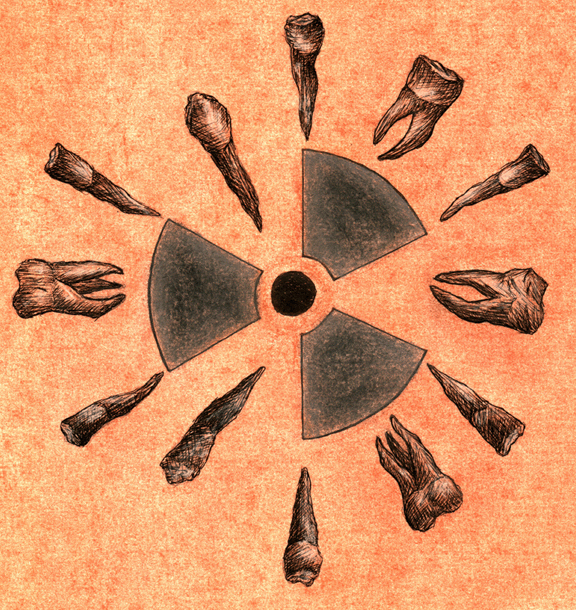
The analysis revealed a spike in strontium-90 levels in children born between 1954 and 1955. This coincided with a period of extensive nuclear testing that started in 1953. Among these children, strontium-90 levels were also found to be higher in those who were bottle-fed compared to those who were breastfed.
This observation further emphasized that the children were absorbing the radioactive element from the environment — picture acres of dairy farms showered with rain that has just passed through kilometers of atmosphere containing radioactive dust.
Experiments explained: Baby Tooth Survey In June 1963, shortly after publishing the first phase of the study, Dr. Eric Reiss, one of the main participating scientists, presented the findings in testimony before the American Senate committee. Two months later, the Partial Test Ban Treaty (PTBT) between the United States, the Soviet Union, and Britain was signed. This agreement prevented countries from performing test detonations of nuclear weapons, except for those conducted underground.
During a second phase of the study, a 50 per cent decline in strontium-90 was seen in children born in 1968, thanks in part to the PTBT that Franklin and her team helped bring about.
ZAHRA DANAEI/THE VARSITY, Humanity has been fundamentally transformed by the discovery of nuclear radiation and radioactive chemical elements. Marie and Pierre Curie discovered radium in the late 1890s, following Henri Becquerel’s discovery of radioactivity. Since then, World War I has led to the advent of the first X-ray machine, which treated injured soldiers, and World War II has brought upon the development of weapons of mass destruction.
Not long after, scientists began collecting radioactive baby teeth on American land: the unexpected aftermath of harnessing the unprecedented power of nuclear radiation. Continue reading →
查看繁體中文版 By RICK GLADSTONE and DAVID E. SANGER,North Korea threatened on Monday to shoot down American warplanes even if they were not in the country’s airspace, stating that President Trump’s comments suggesting he would eradicate North Korea and its leaders were “a declaration of war.”
France to invest 20 billion euros in energy transition, Reuters Staff, PARIS (Reuters) 26 Sept 17 – The French government plans to invest 20 billion euros in an energy transition plan, including 9 billion euros towards improved energy efficiency, 7 billion for renewables and 4 billion to precipitate the switch to cleaner vehicles.
The environment-related investments, drafted by economist Jean Pisani-Ferry and presented by Prime Minister Edouard Philippe on Monday, are part of a 57 billion-euro investment plan to run from 2018 to 2022.
Buildings are responsible for 20 percent of greenhouse gas emissions, so the government plans a 9 billion-euro thermal insulation programme that will focus on low-income housing and government buildings, the government said in a statement.
“The number of badly insulated low-income housing and social housing will be divided by two, and a quarter of government buildings will be renovated in line with environmental norms,” it said.
The programme aims at financing the renovation of 75,000 dwellings per year, or 375,000 over the government’s five-year term.
The government will also invest 7 billion euros ($8.31 billion) to boost the growth of French renewable energies by 70 percent over the next five years.
(CNN)Tensions on the Korean Peninsula have led to a lot of military terms being thrown about by politicians and the media.
To help you cut through the verbiage and hyperbole, here’s a list of common terms and what they really mean.
NUCLEAR POWERED AIRCRAFT CARRIER All active US Navy aircraft carriers are powered by nuclear reactors. They would not, however, typically carry nuclear weapons. US aircraft carriers have a displacement of about 97,000 tons. Japan and the US have smaller ships, with a displacement of 24,000 to 43,000 tons, which look like aircraft carriers but are considered helicopter destroyers and amphibious assault ships, respectively. Continue reading →
The nuclear threat can be contained by diplomacy, These issues are manageable if they are given the right degree of priority, John Sawers Ft.com 25 Sep 17 “……… North Korea is the issue of the day. The objective of a denuclearised Korean peninsula, pursued by the previous US administrations, is no longer an achievable goal.
The best that can be hoped for is the suspension of nuclear and missile testing in return for security assurances and practical aid. Sanctions are designed to draw Kim Jong Un into a negotiation with that aim, and to pressure China to take a more active part. But it is very hard to see President Kim pulling back now. And China is more concerned about a new US-led war in Korea or the north collapsing and sending millions of refugees into China, than it is about living with a nuclear armed Pyongyang.
The US only really has two strategic options: contain and deter the threat; or destroy it, which would require regime change. There are always military options. But all who have studied the secret Pentagon plans are sobered by the scale of loss of life in South Korea these would entail. There is also a risk of China reluctantly coming to the aid of the north as it did in the 1950s.
Realistically, it seems the only practical option is containment. That requires missile defence systems to create uncertainty that nuclear-tipped missiles would ever get through to their target, and to deter any use of such weapons by being clear that North Korea would be destroyed if it ever tried to use them.
Mr Kim may be hard for us to comprehend, but he is a rational actor and he is certainly not suicidal. US concern about this isn’t exaggerated by the Trump administration: it has a serious problem on its hands.
However much we may view containment as the only sensible answer, there are still dangers of miscalculation. Mr Kim may be tempted to use his nuclear arsenal to hold others to ransom. There is also a proliferation threat. We have seen how Pyongyang has used its nuclear technology as an export earner. In 2007, the Israelis destroyed a secret nuclear reactor in the Syrian desert that had been designed and built by the North Koreans. Is it conceivable that a future terrorist organisation might be able to obtain such a device? Unlikely. But if they had the means, then Pyongyang would be the first place to go to get it. Pakistan’s ambivalent relationship with terrorist organisations adds to the dangers.
One country where our nuclear weapons concerns had eased is Iran. The nuclear agreement has its weaknesses, especially that it only applies for 10 years. But it is worth having, and Tehran is complying by its technical requirements. If Donald Trump walks from the nuclear deal — as he threatened at the UN last week — then before long he could find he has another North Korea to deal with, this one in the Gulf.
The outlook on nuclear weapons might look grim. But as we showed in the cold war, these issues are manageable with skilful diplomacy and the right investments in defence. We just have to give it the right degree of priority. When I was at MI6, and before that our negotiator with Iran on its nuclear programme, I was always mindful of the nuclear threat. The only issue that can seriously threaten our way of life must be among our top international security priorities. The writer is chairman of Macro Advisory Partners and a former chief of MI6, the British Secret Intelligence Service https://www.ft.com/content/02c58f70-9c80-11e7-8b50-0b9f565a23e1
The US President warned Pyongyang’s foreign minister that if he if ‘he echoes thoughts’ of the country’s leader Kim Jong Un they both ‘won’t be around much longer’.
He was responding after Ri Yong Ho told the United Nations General Assembly on Saturday that targeting the US mainland with its rockets was inevitable after ‘Mr Evil President’ made an ‘irreversible mistake’ by calling Mr Kim ‘rocket man’.
Describing Mr Trump as a ‘mentally deranged person full of megalomania,’ Mr Ri went on to tell the annual gathering of world leaders that the country was now ‘only a few steps away from the final gate of completion of the state’s nuclear force’. Continue reading →
North Korea’s latest threat to test a Hydrogen bomb in the pacific is probably making reasonable nuclear reactor supporters have a re-think. Take Barnaby Joyce’s words when he was surprised with the news – “…because what they’re doing is they’re testing a mechanism to incinerate human beings, to kill men, women and children, to give people disease from radiation, to partially burn human bodies. Why would you say well that’s a good thing? Why would you say that must be a good person? No. ” His words “to give people disease from radiation” gives me hope that he is beginning to understand the risks of nuclear in general.
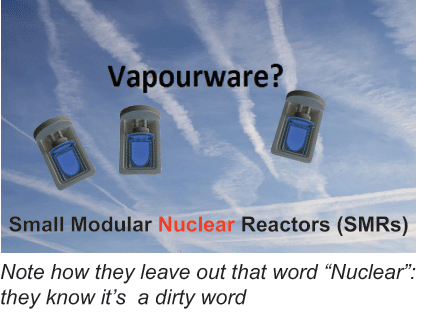
Is The UK Really Planning To Approve “Mini Nuclear Reactor” Rollout? https://cleantechnica.com/2017/09/22/uk-really-planning-approve-mini-nuclear-reactor-rollout/ by James AyreIt was reported last week in The Telegraph that ministers in the UK were “ready” to approve the rapid development and testing of a fleet of “mini nuclear reactors” — to be used as baseload capacity and meant to make up for older soon-to-be-decommissioned nuclear facilities.
Is there any truth to this assertion? What about the assertion that such mini nuclear facilities will provide electricity that’s one-third cheaper than that provide by the nuclear facilities currently in use in the UK?
That sounds a bit “too good to be true” (which means that it probably is), but that is the sales pitch that’s being used.
I haven’t been able to find out too much about what’s going on, as many news outlets haven’t been covering the matter apparently, but it seems that “Rolls-Royce, NuScale, Hitachi, and Westinghouse have held meetings in past weeks with civil servants about Britain’s nuclear strategy and development of ‘small modular reactors’ (SMRs)” in recent days — if The Telegraph is to be believed.
Here’s more from that coverage: “Whitehall sources confirmed that officials from the Department for Business were whittling down proposals from consortia keen to work with government to develop SMRs, with an announcement on the final contenders for funding expected soon.
“The report to be published by Rolls-Royce, entitled ‘UK SMR: A National Endeavour’, which has been seen by The Telegraph, claims SMRs will be able to generate electricity significantly cheaper than conventional nuclear plants.
“The mini reactors are each expected to be able to generate between 200 megawatts and 450 megawatts of power, compared with the 3.2 gigawatts due from Hinkley, meaning more of them will be required to meet the UK’s energy needs.”
The Rolls Royce report claims that its projects would be able to generate electricity at a strike price of £60 per megawatt-hour — a fair bit higher than a number of other electricity generation modalities can offer. Though, I guess that the sales pitch is based on the idea of its use as baseload capacity?
Tony Abbott’s gut v Elon Musk’s brain and billions: which would you follow? Brisbane Times, 23 Sept 17 By Richard Denniss South Australia has one of the highest concentrations of renewable energy in the world. And its government was recently the first to announce a state-based bank tax. But while Australians have been told these “reckless” policies will destroy jobs and discourage investment, some of the world’s most-successful entrepreneurs recently chose to invest big in the state. How could this be?
Tech entrepreneur Elon Musk, who gave the world PayPal, Tesla and SpaceX, recently secured the bid to build the world’s largest battery-storage plant in South Australia. English billionaire Sanjeev Gupta, whose family fortune was made in good old-fashioned steel, recently bought the Whyalla steelworks. Either these businessmen didn’t do their due diligence or what conservative politicians tell us about South Australia is utter nonsense. I know which way I’d lean.
Before Tony Abbott began his 23 years as a public servant, he dabbled with being a priest and a journalist. And while he clearly knows how to tell a simple story based on blind faith, there is nothing in his education or experience to suggest he knows anything about how to run a power station or a steel mill. But in Australia the ability to “cut through” trumps the ability to talk sense. And Abbott excels at simplifying complex issues into three-word slogans.
Abbott isn’t an engineer or an economist, but he claims you can’t have a modern economy without coal-fired steam engines. Musk, who is an engineer, is betting a lot of his own money that the future of energy is renewable sources linked to battery storage and smart grids. Gupta, who has a masters in economics and owns the only steel mill in the world powered by waste fish oil, just spent his own money buying a steel mill in the state with the most renewable sources. Someone is completely wrong………
Chaos may be Abbott’s best chance to return to the top job but it won’t lead to business certainty or lower electricity prices. Abbott has variously supported, and opposed, carbon taxes, emissions-trading schemes and renewable-energy targets. He once described himself as “a bit of a weathervane” on climate change. He’s more like a field of landmines that periodically explodes as Turnbull tries to tiptoe through it. It’s a waste of time to try to placate Abbott and the coal industry – you can’t negotiate with a landmine.
Australia’s Parliament is settling in for another long fight about what not to do about climate change while the rest of the world continues its march away from the age of coal towards energy systems based on renewables and storage.
Leaving aside that Australia is the world’s largest exporter of coal and that we will soon be the world’s largest exporter of gas, the risks to Australia are not just that we will exacerbate dangerous climate change, but that we will be left behind domestically and left surrounded by big piles of coal that the rest of the world doesn’t want.
Last year, China’s economy grew by 6.7 per cent and its coal consumption fell by 4.7 per cent. That’s the third year in a row that China’s coal consumption fell. …….
India is on a similar trajectory. Despite claims made by those who are desperate to bail out the Adani coal mine in North Queensland, Indian coal consumption and imports are declining……..
But as new entrepreneurs, technologies and ideas bust up the complacency of much of our political debate, there is no doubt the old guard will fight till the end. Abbott told us the carbon price would wipe out Whyalla. It didn’t. He told us that scrapping the carbon price would give us cheap energy. It didn’t. And while Abbott tells us that you can’t run an industrial economy on renewable energy, Gupta is betting you can.
Just as facts don’t get in the way of Malcolm Roberts’ beliefs about his citizenship (or anything else), facts won’t slow down Abbott and the coal industry’s political war against renewable energy. The problem is that, even if Abbott wins, the Australian economy loses. Again.
Apr 15, 2026 01:00 AM in Canberra, Melbourne, Sydney
Join the International Physicians for the Prevention of Nuclear War (IPPNW) on Tuesday, April 14th for a timely webinar exploring the risks associated with nuclear power and challenging the myth that it offers a simple, safe, carbon-free solution to the climate crisis
21 April Webinar: No Nuclear Weapons in Australia
Start: 2026-04-21 18:00:00 UTC Canberra, Melbourne, Sydney (GMT+10:00)
End: 2026-04-21 19:30:00 UTC Canberra, Melbourne, Sydney (GMT+10:00)
Event Type: Virtual A virtual link will be communicated before the event.








 Antinuclear