Antinuclear

Australian news, and some related international items

Trump not a huge success on the international stage at United Nations

Trump makes little headway in his first turn on U.N. world stage LA Times, 22 Sept 17 Tracy Wilkinson Contact Reporter

The presidents of Japan and South Korea welcomed Trump’s announcement of new sanctions against North Korea but privately questioned whether his threat to “totally destroy” the country would lead to the diplomacy they prefer.

Arab and Iranian leaders sat stone-faced during Trump’s bellicose address on Tuesday — while several other world leaders reacted with bemusement, chagrin and confusion to his often-contradictory comments.

Netanyahu could be observed laughing and grinning as Trump described the hard-fought international nuclear accord with Iran as the “worst deal ever” and an “embarrassment” to the United States.

Far from taming his enemies, Trump seems to have inflamed tensions further as the world faces a nuclear-armed North Korea and worries about a deal designed to prevent Iran from building a bomb.

South Korea’s Yonhap News Agency reported Thursday night that North Korea’s foreign minister, Ri Yong Ho, said in New York that his country may test a hydrogen bomb in the Pacific Ocean to fulfill leader Kim Jong Un’s vow to take the “highest level” action.

The Partial Nuclear Test Ban Treaty, which the United States and the Soviet Union signed in 1963, forbade atmospheric and underwater testing of nuclear weapons. No confirmed ocean tests have occurred since then, but North Korea is not a signatory.

North Korea conducted an underground test of what it called a hydrogen bomb on Sept. 3. An ocean test could severely damage the environment as well as expand the security crisis…….

During the weeklong General Assembly, Trump, invoking his reality-TV flair for drama, said he had made a decision on whether to walk away from the Iranian deal, but he would not yet reveal it.

His administration recently continued lifting sanctions against Iran, which was part of the agreement. But next month, Trump must issue a separate certification to Congress on whether Iran is complying with the deal, an every-90-day requirement under U.S. law.

Several administration officials have suggested Trump will not certify compliance even though the U.N.’s nuclear watchdog, the International Atomic Energy Agency, has found Iran in compliance eight times since the deal was signed in 2015. http://www.latimes.com/nation/la-fg-trump-un-assess-20170922-story.html

September 22, 2017 Posted by | General News | Leave a comment

Leonardo DiCaprio blasts Trump over climate change

 http://pagesix.com/2017/09/22/leonardo-dicaprio-blasts-trump-over-climate-change/By Jessica Sager

The Oscar winner, 42, met with then-president-elect Trump, 71, in December, only to have the POTUS disregard their conversation once he took office.

“We presented him with a comprehensive plan to tackle climate change, while also simultaneously harnessing the economic potential of green jobs,” DiCaprio recalled at the Yale Climate Conference on Tuesday (via The Hartford Courant). “We talked about how the United States has the potential to lead the world in clean-energy manufacturing and research and development.”

Once in office, Trump pledged to withdraw from the Paris climate accord, which regulates greenhouse emissions, and appointed climate change skeptic Scott Pruitt to head the Environmental Protection Agency.

The moves left staunch environmentalist DiCaprio nonplussed.

“We should not have people in office who do not believe in facts and truths and modern science that are able to manipulate and risk the entire future of this entire generation,” he fumed. “We are at that turning point right now, and we are going to look back at this point in history, and frankly this administration, and certain people are going to be vilified for not taking action. They really are. And it’s up to this generation, it’s up to all of you to get involved and make a difference.”

September 22, 2017 Posted by | General News | Leave a comment

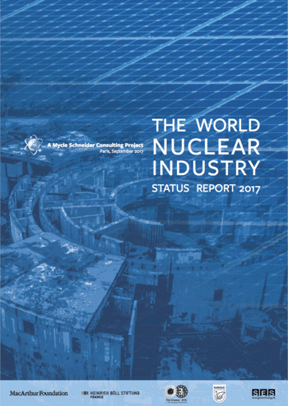
2017 World Nuclear Status Report released

A status report on a troubled nuclear industry http://thebulletin.org/status-report-troubled-nuclear-industry11130, By John Mecklin, 22 Sept 17

This year’s version of the World Nuclear Industry Status Report (WNISR) is out, and its message is not a happy one for nuclear power proponents. As former Tennessee Valley Authority chairman S. David Freeman notes in a foreword, “The report makes clear, in telling detail, that the debate is over. Nuclear power has been eclipsed by the sun and the wind. These renewable, free-fuel sources are no longer a dream or a projection—they are a reality [and] are replacing nuclear as the preferred choice for new power plants worldwide.”

As in previous years, the report—coordinated by Paris-based independent nuclear consultant Mycle Schneider—provides an almost-daunting array of data on almost every aspect of nuclear power plant construction and operation. This year’s report also includes an assessment of what it calls “the financial crisis of the nuclear sector,” a status update on the Fukushima nuclear situation, and a chapter that compares investments in, capacity of, and generation from nuclear, solar, and wind energy installations on a worldwide basis.

Doubtless, nuclear power supporters will argue against some (and perhaps many) of the conclusions that Schneider and co-author Antony Froggatt express in the report. But the data the report presents—data underlying the Global Nuclear Power Database, an interactive visualization that the WNISR developed for the Bulletin—are truly comprehensive. Anyone interested in nuclear power will likely find the report worth at least a first look, and probably a second and third.

September 22, 2017 Posted by | General News | Leave a comment

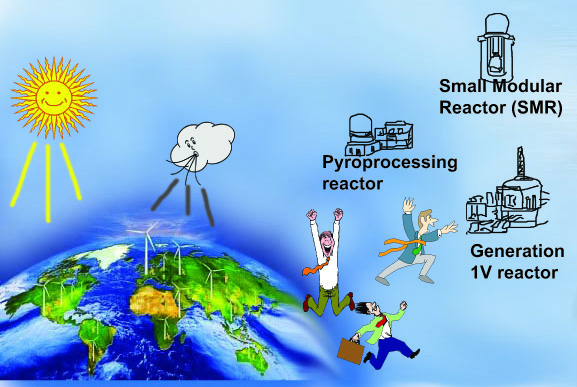
Nuclear lobby depending on China to develop Generation IV nuclear reactors

the theories behind many of the proposed systems aren’t new and often date back to the 1950s and ’60s. Some experimental plants have been built, such as the fast breeder reactors in the U.K. and U.S. Most suffered from crippling cost or design problems or were abandoned after nuclear accidents.

“Most if not all of these so-called advanced reactor designs have been around for decades,”

Different designs have different problems. I don’t think anyone can be or should be confident that these problems can be resolved merely by throwing money and hiring engineers and scientists.”

Nuclear Experts Head to China to Test Experimental Reactors, Bloomberg By 

Stephen Stapczynski China is becoming the testing ground for a new breed of nuclear power stations designed to be safer and cheaper, as scientists from the U.S. and other Western nations find it difficult to raise enough money to build experimental plants at home.

Continue reading

September 22, 2017 Posted by | General News | Leave a comment

At United Nations, dozens of countries signing up to the nuclear weapons ban treaty

50 signatories ink U.N. nuclear ban treaty opposed by major powers https://www.japantimes.co.jp/news/2017/09/21/world/50-nations-ink-u-n-nuclear-ban-treaty-opposed-major-powers/#.WcQszPMjHGg AP, KYODO, JIJI, 21 SEPT 17, AP, KYODO, JIJI  Dozens of countries on Wednesday signed a treaty to ban nuclear weapons, a pact that the world’s nuclear powers spurned but supporters hailed as a historic agreement nonetheless.

“You are the states that are showing moral leadership in a world that desperately needs such moral leadership today,” Beatrice Fihn, executive director of the International Campaign to Abolish Nuclear Weapons, said as a signing ceremony began.

 Before the day was out, 50 signatories as different as Indonesia and Ireland had put their names to the treaty; others can sign later if they like. Guyana, Thailand and the Vatican also have already ratified the treaty, which needs 50 ratifications to take effect among the nations that back it.

They would be barred from developing, testing, producing, manufacturing, otherwise acquiring, possessing or stockpiling nuclear weapons “under any circumstances.”

Seven decades after the United States dropped two atomic bombs on Japan during World War II — the only use of nuclear weapons — there are believed to be about 15,000 of them in the world today. Amid rising tensions over North Korea’s nuclear and missile tests, U.N. Secretary-General Antonio Guterres said Tuesday that the threat of a nuclear attack is at its highest level since the end of the Cold War.

“This treaty is an important step towards the universally held goal of a world free of nuclear weapons,” he said Wednesday.

Supporters of the pact say it is time to push harder toward eliminating atomic weapons than nations have done through the nearly 50-year-old Nuclear Non-Proliferation Treaty.

Under its terms, non-nuclear nations agreed not to pursue nukes in exchange for a commitment by the five original nuclear powers — the U.S., Russia, Britain, France and China — to move toward nuclear disarmament and to guarantee other states’ access to peaceful nuclear technology for producing energy.

More than 120 countries approved the new nuclear weapons ban treaty in July over opposition from nuclear-armed countries and their allies, who boycotted negotiations.

The U.S., Britain and France said the prohibition wouldn’t work and would end up disarming their nations while emboldening “bad actors,” in U.S. Ambassador Nikki Haley’s words. French Foreign Minister Jean-Yves Le Drian has called the treaty “wishful thinking” that is “close to irresponsible.” The nuclear powers have suggested instead strengthening the nonproliferation treaty, which they say has made a significant dent in atomic arsenals.

Absent from the signing ceremony were the five permanent U.N. Security Council seat holders — Britain, China, France, Russia and the United States — which all possess the destructive devices.

Nuclear umbrella nations, such as Japan and South Korea, and North Atlantic Treaty Organization members like Germany and The Netherlands did not endorse it either

“Although we share the same feelings about nuclear abolition, (the treaty) differs from Japan’s approach, so we will not be signing it,” Foreign Minister Taro Kono told reporters in New York.

“Unfortunately, the reality is that there are divisions between countries with nuclear weapons and those without, as well as between the countries without them, when it comes to recognizing (both) the inhumanity of nuclear weapons and the severity of the security environment,” he said, adding that Japan will try to bridge those gaps through existing frameworks.

Brazil was the first country to sign onto the ban Wednesday, followed by nations from Algeria to Venezuela.

“Those who still hold nuclear arsenals, we call upon them to join this date with history,” Costa Rican President Luis Guillermo Solis said as he prepared to sign.

In attendance at the signing ceremony were Japanese atomic bomb survivors and the mayor of Nagasaki.

The adoption of the treaty on July 7, when 122 countries voted in favor of banning atomic weapons for the first time after decades of prodding by atomic bomb victims — known as hibakusha in Japanese — and civil society.

The treaty’s backers believe that their path is the best option to prevent future nuclear catastrophes of the kind experienced by Japan in 1945 during the closing days of World War II. The bombings of Hiroshima on Aug. 6 of that year and Nagasaki three days later ushered in the nuclear era.

“The heroic survivors of Hiroshima and Nagasaki — the hibakusha — continue to remind us of the devastating humanitarian consequences of nuclear weapons,” Guterres said.

Also speaking was Peter Maurer, president of the International Committee of the Red Cross, who said the organization received a cable from Hiroshima on Aug. 30, 1945 describing a “city wiped out,” a great number of dead and over 100,000 wounded.

“The world today needs the promise of this treaty: the hope for a future without nuclear weapons,” he said. “Humanity simply cannot live under the dark shadow of nuclear warfare, and the immense suffering which we all know would result.”

In Hiroshima ahead of the signing, hibakusha and other citizens urged that all countries — including Japan — sign and ratify the treaty.

Close to 90 people gathered in front of the Atomic Bomb Dome. After observing a moment of silence, participants held up origami cranes and papers with messages demanding that countries sign the treaty.

The assembly was part of the Peace Wave 2017 campaign, in which citizens start a chain of movements from Japan in hopes of realizing a peaceful world free of nuclear weapons.

The event was planned by an organization of atomic bomb survivors in Hiroshima Prefecture and the Hiroshima Congress against A- and H-Bombs, or Hiroshima Gensuikin.

“If people believe that getting rid of nuclear weapons will lead to peace, a democratic government (sharing the belief) will be born, followed by the signing of the treaty,” said Kunihiko Sakuma, 72, head of the hibakusha organization.

“The governments of the nuclear nations will also change,” Sakuma added, emphasizing the importance of starting a civil movement.

As part of the campaign, more events will be held over the period through Tuesday, which has been set by the U.N. as International Day for the Total Elimination of Nuclear Weapons.

 

September 21, 2017 Posted by | General News | Leave a comment

South Korea and Japan alarmed at Donald Trump’s bellicose speech at UN

Jitters and surprise in South Korea and Japan over Trump’s speech to the U.N  WP 20 September 17  The United States’ closest allies in Asia seemed blindsided by President Trump’s latest outburst against North Korea, in which he threatened not just to act against Kim Jong Un’s regime, but also to destroy an entire country of 25 million people.

In his maiden speech to the United Nations General Assembly on Tuesday, Trump derided Kim as “Rocket Man” and said the United States would “totally destroy North Korea” if needed to protect its allies.Those allies, Japan and South Korea, were silent on Trump’s threat to bring war to their neighborhood, while China and Russia both warned that Trump risked fueling tensions.

China’s nationalist Global Times newspaper ran a cartoon captioned “Bully pulpit” showing Trump holding a megaphone, shouting “America First,” while the state-owned China Daily newspaper said Trump’s speech was “full of sound and fury.

“Today’s dangerous deadlock has been the result of Pyongyang’s and Washington’s persistent pursuit of their own interests in disregard of other countries’ efforts to persuade the two antagonists to talk,” the China Daily wrote in an editorial Wednesday morning. “His threat to ‘totally destroy’ [North Korea] if need be will, therefore, likely worsen the already volatile situation.”……..https://www.washingtonpost.com/world/russia-calls-trumps-korea-remarks-a-dangerous-step-toward-instability/2017/09/19/1a6d9b56-9d69-11e7-b2a7-bc70b6f98089_story.html?utm_term=.62cf8

September 21, 2017 Posted by | General News | Leave a comment

Abbot Point spill further proof Adani can’t be trusted on coal, green groups say

Pollution of wetlands adjacent to Adani’s main coal export port in Queensland is proof the Indian-owned company can’t be trusted to operate a much larger operation should the Galilee Basin ever be opened up to mines, environmental groups said.
http://www.smh.com.au/environment/abbot-point-spill-further-proof-adani-cant-be-trusted-on-coal-green-groups-say-20170920-gyl2dp.html

September 21, 2017 Posted by | General News | Leave a comment

Trump’s first United Nations appearance was not well received

Trump’s First U.N. Appearance Was a Clunker, Slate, 19 Sept 17  But why is the United Nations so worried about bureaucracy at a time like this? By Fred Kaplan  President Trump got off to an underwhelming start at the U.N. General Assembly on Monday morning. He sat on a panel flanked by various diplomats, including Ambassador Nikki Haley, who introduced him before he delivered some brief remarks, and it would be charitable to describe the welcoming applause as “light.”

Then came the clunker. Haley had told the assembled that the new American president sees “tremendous potential” in the U.N.—a cold enough slap at an organization that’s been around for 72 years and, for all its flaws, has accomplished quite a bit. But Trump followed that dig with a face-splash of ice water, saying that the real “potential” he saw was “right across the street”—a reference to one of his East Side real-estate projects—and noted that the U.N.’s presence was what gave it such potential.

t’s so typical of Trump to view the rest of the world, even the official assembly of the world’s leaders, as a footnote to the saga of his own wealth.

Trump’s remarks, which he read from notes, were brief and inconsequential. U.N. reform was the topic on the agenda, and Trump spoke of the need to “focus more on people and less on bureaucracy” and to ensure that no one member-state “shoulders a disproportionate share of the burden … militarily or financially.”

In that last line, he may have flashed a glimpse of his “America First” theme, which is expected to shine front and center in his longer address to the General Assembly—his first as president—on Tuesday……http://www.slate.com/articles/news_and_politics/war_stories/2017/09/trump_s_first_united_nations_appearance_was_a_clunker.html

September 20, 2017 Posted by | General News | Leave a comment

Most Britons would not be happy living near mini nuclear power stations

Guardian 18th Sept 2017 Most Britons would not be happy living near the mini nuclear power stations that Rolls-Royce and several other international companies want to build in the UK, a survey has found.

The government has promised the developers of small modular reactors a slice of a £250m funding pot in a race to position the UK as the place where the first generation of the power stations should be built.

Polling by YouGov, however, believed to be the first survey of public attitudes towards the plants, found that 62% of people would be unhappy living within five miles of one.

The poll, commissioned by the climate change charity 10:10, found that only 24% would be unhappy living near an onshore windfarm, which the Conservative party has stymied with tougher planning rules. The figure fell to 17% for community-owned windfarms.

Ellie Roberts, a campaigner at 10:10, said:
“These results show just how wildly out of step with public opinion UK energy policy has become.” Most small modular reactors (SMRs) would generate less than a tenth of the power the projected Hinkley Point C will provide, but are backed by industry as a cheaper option to big nuclear plants and an opportunity for British firms to be first in a new technology. Harry Holt, the president of nuclear at Rolls-Royce, said: “With demand for energy set to rise in the near future, in part due to
the growing popularity of electric cars, we believe that a UK SMR programme is a vital addition to our national infrastructure.” https://www.theguardian.com/business/2017/sep/18/most-britons-dislike-prospect-living-mini-nuclear-station

September 20, 2017 Posted by | General News | Leave a comment

Donald Trump at the UN threatens to ‘totally destroy’ North Korea

Donald Trump threatens to ‘totally destroy’ North Korea in UN speech
President castigates ‘a small group of rogue regimes’
Iran nuclear deal ‘an embarrassment to the United States’, Guardian, 
Julian Borger 20 Sept 17, Donald Trump has threatened to “totally destroy” North Korea, in a bellicose first address to the United Nations general assembly in which he lashed out at a litany of US adversaries and called on “righteous” countries to confront them.

The speech was greeted in the UN chamber mostly with silence and occasional outbreaks of disapproving murmurs, as Trump castigated a succession of hostile regimes.

In an address heavy with echoes of George W Bush’s “Axis of Evil” State of the Union address more than 15 years earlier, Trump said: “The scourge of our planet today are a small group of rogue regimes.

“If the righteous many do not confront the wicked few, then evil will triumph,” the president said.

He first singled out North Korea, recounting its history of kidnapping, oppression, and missile and nuclear tests.

 “The US has great strength and patience,” Trump said. But he added: “If it is forced to defend ourselves or our allies, we will have no choice but to totally destroy North Korea.”

As alarmed murmurs spread around the hall, Trump had another barb. Using his newly adopted epithet for Kim Jong-un, Trump said: “Rocket Man is on a suicide mission for himself and for his regime.”……….

Trump said the Iran nuclear deal, signed by the US under the Obama administration with five other countries two years ago, was “one of the worst and most one-sided transactions the United States has ever entered into”.

“Frankly, that deal is an embarrassment to the United States,” he said. “I don’t think you’ve heard the last of it – believe me.”

Trump must decide by 15 October on whether to certify Iranian compliance or not. His threatened withdrawal of presidential endorsement could lead to Congress reimposing nuclear-related sanctions and the collapse of the agreement.

Like much of the 41-minute speech, Trump’s reference to the Iran deal was met by stony silence. The deal is overwhelmingly supported by UN member states, including most of Washington’s closest allies……..

Trump is also almost entirely isolated on climate change. Unlike the other opening speakers, including the UN secretary general, António Guterres, Trump made no mention in his speech of an issue that most other leaders in the chamber consider to be the greatest threat to the world.

When his turn to speak came, Macron insisted that though the Paris climate accord, which Trump said he would leave, could be improved, “it will not be renegotiated”. He said he “profoundly respected” the US decision but said “the door will always be open to them”.

The US president had clearly not come to the UN in the mood to placate foreign leaders, but rather to speak over their heads to his own supporters…… https://www.theguardian.com/us-news/2017/sep/19/donald-trump-threatens-totally-destroy-north-korea-un-speech

September 20, 2017 Posted by | General News | Leave a comment

International Treaty on the ozone layer is also working against climate change

The 30-year-old ozone layer treaty has a new role: fighting climate change  https://theconversation.com/the-30-year-old-ozone-layer-treaty-has-a-new-role-fighting-climate-change-84025 Martyn Chipperfield
The 1987 treaty that stopped the pollution causing a hole in the ozone layer is rightly seen as a major success story. It’s arguably the most successful international environmental agreement ever. It’s true that, 30 years on from the signing of the Montreal Protocol, the Antarctic ozone hole still reappears every year. Yet the protocol really is working and its continued development means that it is doing more good than ever, including helping the fight against climate change.

Continue reading

September 20, 2017 Posted by | General News | Leave a comment

Success of an international Treaty – the ozone hole is healing

After 30 years of the Montreal Protocol, the ozone layer is gradually healing The Conversation Andrew Klekociuk, Adjunct Senior Lecturer, University of Tasmania, Paul Krummel, Research Group Leader, CSIRO This weekend marks the 30th birthday of the Montreal Protocol, often dubbed the world’s most successful environmental agreement. The treaty, signed on September 16, 1987, is slowly but surely reversing the damage caused to the ozone layer by industrial gases such as chlorofluorocarbons (CFCs).

Each year, during the southern spring, a hole appears in the ozone layer above Antarctica. This is due to the extremely cold temperatures in the winter stratosphere (above 10km altitude) that allow byproducts of CFCsand related gases to be converted into forms that destroy ozone when the sunlight returns in spring.

As ozone-destroying gases are phased out, the annual ozone hole is generally getting smaller – a rare success story for international environmentalism.

Back in 2012, our Saving the Ozone series marked the Montreal Protocol’s silver jubilee and reflected on its success. But how has the ozone hole fared in the five years since?

The Antarctic ozone hole has continued to appear each spring, as it has since the late 1970s. This is expected, as levels of the ozone-destroying halocarbon gases controlled by the Montreal Protocol are still relatively high. The figure below shows that concentrations of these human-made substances over Antarctica have fallen by 14% since their peak in about 2000.

It typically takes a few decades for these gases to cycle between the lower atmosphere and the stratosphere, and then ultimately to disappear. The most recent official assessment, released in 2014, predicted that it will take 30-40 years for the Antarctic ozone hole to shrink to the size it was in 1980………

Reassuringly, a recent study showed that the size of the ozone hole each September has shrunk overall since the turn of the century, and that more than half of this shrinking trend is consistent with reductions in ozone-depleting substances. However, another study warns that careful analysis is needed to account for a variety of natural factors that could confound our detection of ozone recovery……..

While annual monitoring continues, which includes measurements under the Australian Antarctic Program, a more comprehensive assessment of the ozone layer’s prospects is set to arrive late next year. Scientists across the globe, coordinated by the UN Environment Program and the World Meteorological Organisation, are busy preparing the next report required under the Montreal Protocol, called the Scientific Assessment of Ozone Depletion: 2018.

This peer-reviewed report will examine the recent state of the ozone layer and the atmospheric concentration of ozone-depleting chemicals, how the ozone layer is projected to change, and links between ozone change and climate.

In the meantime we’ll watch the 2017 hole as it peaks then shrinks over the remainder of the year, as well as the ozone holes of future years, which will tend to grow less and less large as the ozone layer heals. https://theconversation.com/after-30-years-of-the-montreal-protocol-the-ozone-layer-is-gradually-healing-84051

September 18, 2017 Posted by | General News | Leave a comment

Time for a new approach on the North Korean nuclear crisis?

Some Analysts Say Time May Be Right For A Rethink On North Korean Nuclear Crisis, NPR, September 17, 2017, ANTHONY KUHN

North Korea test-launched another missile Friday that arced over northern Japan and into the Pacific, showing its progress toward being able to strike the U.S. and signaling its defiance of U.N. sanctions imposed after its sixth, and most recent, nuclear testearlier this month.

“The world will never accept a nuclear-armed North Korea,” U.S. Ambassador Nikki Haley told the U.N., after the sanctions passed the Security Council on Monday. She added: “If the North Korean regime does not halt its nuclear program, we will act to stop it ourselves.”

But some analysts believe that this approach to the North Korean nuclear crises is dangerously deluded.

A decade or so ago, it still may have been possible to use sanctions or the threat of military force to compel North Korea to give up its nuclear programs, argues Zhao Chu, an independent, Shanghai-based analyst, former soldier and former editor of World Outlook, a foreign affairs magazine.

But Zhao warns that the situation has now fundamentally changed, and that trying to fly through a window of opportunity that has already closed is a very bad idea. Pyongyang can hardly be expected to give up the nuclear ace in the hole that it worked so long to acquire. Continue reading

September 18, 2017 Posted by | General News | Leave a comment

Time that the world revived the stigma previously attached to the idea of nuclear war

In the shadow of Fat Man and Little Boy: how the stigma of nuclear war was unravelled, https://www.theguardian.com/science/brain-flapping/2017/sep/15/in-the-shadow-of-fat-man-and-little-boy-how-the-stigma-of-nuclear-war-was-unravelled

Dr Becky Alexis-Martin is a senior Research Fellow in Nuclear Geography, University of Southampton, UK.

Dr Stephanie Malin is an assistant Professor of Environmental Sociology, Colorado State University, USA.

Dr Kristen Iversen is a professor of English, University of Cincinnati, USA.

Dr Kathleen Sullivan is Director of Hibakusha Stories, New York, USA.

Dr Mwenza Blell is a lecturer in Sociology, University of Cambridge, UK. 15 Sept 17 

Atomic bombs ‘Fat Man’ and ‘Little Boy’ exploded over Nagasaki and Hiroshima 72 years ago creating a lasting nuclear taboo – until now. What has changed?”……..Thanks to President Donald Trump and Supreme Leader Kim Jong-Un, our generation’s own volatile Fat Man and Little Boy, the sensible norms of restraint and careful diplomacy that have previously surrounded nuclear deterrence proliferation and use are now under stress. President Donald Trump seems indifferent to social norms, and behaves without rationality. He made several public statements, via Twitter and traditional media, that glamorise the use and increased production of nuclear weapons. All while his administration slashes budgets and slashes programs designed to protect communities from the well-documented risks that come from producing nuclear weapons. Trump has ostracized himself from international leadership nearly every turn, including NATO and G-20 summits, isolating himself from democratic world leaders, and aligning himself more with leaders of totalitarian and authoritarian regimes. He has divided America, twisting the knife into historical wounds of racism and civil rights abuses, as well as upending environmental protection, denying climate change and proposing a tax regime that will create persistent poverty – to name a few examples.

North Korea is currently basking in its own nuclear disruption, finally gaining the place that it feels it deserves in the geopolitical arena – for all the wrong reasons. Like a child who learns to gain attention for bad behaviour, Kim relishes this moment. However, there is a tragic legacy behind his trumped-up attempts at power. Poverty and human rights violations are experienced by many North Koreans, and there is a dark legacy of Eisenhower’s Atoms for Peace programme that originally took nuclear technology to South East Asia in the hopeful 1960s. We mustn’t forget the human beings who live in North Korea, and the way that UN sanctions are already affecting their lives.

The bickering across Twitter has escalated, and the sheer ubiquity of Trump and Kim’s threats have to some extent re-legitimised the use of nuclear weapons to ‘solve’ conflict rather than deter such “fire and fury” that might bring to an end life as we know it. Indeed, recent research suggests that a limited use of nuclear weapons could disrupt the climate in such a way that would radically alter food production, and in turn lead to global famine.

Trump needs to cut the sass, to scale back his inflammatory and impulsive rants, and to start engaging in the nuclear debate with much greater sensitivity. We want the most peaceful resolution that is now possible, to prevent further escalation of conflict. We do not want stumble into nuclear war, a risk that exists beyond bellicose displays of power. The current hot-threat engagement is not just a security issue, but a massive humanitarian one too. Kim starves his own people in the pursuit of nuclear defence technology. Trump and Kim’s verbally violent exchange is as serious as North Korea’s possession of nuclear weapons. It could have devastating future implications if the stigma of nuclear weapons is not restored. The people of the supposed democracy of the USA and the totalitarian state of North Korea both seem powerless to change the behaviour of their leaders.

However, international attitudes are more progressive. The stigma of nuclear deterrence has not been lost on the majority of nations, 122 of whom endorsed a nuclear weapon ban treaty that seeks to prohibit the development, production, possession, testing, use and threat of use of nuclear weapons. The BAN treaty is likely to enter into force on 20 September 2017, when it opens for signatures at the United Nations in New York. Although no nuclear possessor nation supports this treaty, they understand that the BAN will re-stigmatize nuclear weapons and re-invigorate public debate and action for nuclear abolition.

Our taboos are a greater reflection of our global society and ethics.. What does it say about us at this point in history, if we let the taboo of the unspeakable horror of nuclear warfare disappear? We cannot uninvent the bomb, so we need to rethink and redesign the rules of de-escalation and disarmament, if we are to avoid the fallout of nuclear conflict.

September 16, 2017 Posted by | General News | Leave a comment

Nuclear power on its way out, as renewables rise –  World Nuclear Industry Report,

Renewable Energy Industry Hotting Up as World Goes Cold on Nuclear Power https://sputniknews.com/environment/201709151057423093-nuclear-energy-industry-decline/Nuclear power is on its way out the world over, with its global share of energy generation declining and construction of just one new nuclear reactor being undertaken in 2017. Renewable energy seems poised to take its place as the energy source of the future.

Nuclear power is in a state of terminal decline, with construction of just one new nuclear reactor being undertaken in 2017, according to the World Nuclear Industry Report, an annual study of the sector that analyzes data on capacity, production and construction of nuclear reactors around the world.

Once vaunted as the future of energy production, nuclear power has suffered an unceremonious fall from grace since the 1960s — to the point the report suggests it will be phased out entirely in due course.

The number of nuclear reactors under construction has diminished for the fourth consecutive year, falling from 68 in 2013 to 53 in 2017 — and the report’s authors suspect projects are often ongoing purely because of uncertainty and inertia in the industry.

Russia and the US shut down reactorsin 2016, while Sweden and South Korea both closed their oldest units in the first half of 2017. There are 37 reactor constructions behind schedule, of which 19 reported further delays over the past year — eight projects have been under construction for a decade or more, of which three for over 30 years. In January, there were 17 reactors scheduled for startup before the end of the years, although as of mid-2017, but two of these units had started up and 11 were delayed until at least 2018.

The industry’s financial crisis may play a role in the failure of projects to get off the ground on schedule — after the discovery of massive losses over its nuclear construction projects, Toshiba filed for bankruptcy of its US subsidiary Westinghouse, the largest nuclear power builder in history, and industry giant AREVA has accumulated US$12.3 billion in losses since 2011.

Nonetheless, nuclear power’s global share of electricity generation has only declined meagerly (-0.2 percent), to 10.5 percent in 2017, with five countries producing 70 percent of total nuclear energy in the world — although in 1996, this figure stood at 18 percent. The two largest producers, the US and France, account for half total production.

By contrast, wind power output grew by 16 percent and solar by 30 percent in 2016. Wind power increased generation by 132 TWh, solar by 77 TWh, respectively 3.8 times and 2.2 times more than nuclear’s 35 TWh. Renewables represented 62 percent of global power generating capacity additions, and rnewable energy auctions achieved record low prices at and below US$30/ MWh in Chile, Mexico, Morocco, United Arab Emirates, and the US. Average generating costs of amortized nuclear power plants in the US were US$35.5 in 2015.

The fall in costs for renewable energies has attracted significant investment, with over US$240 billion  invested in renewable energies compared to only about US$10 billion in the nuclear sector.

Look East

Nonetheless, the report highlights that China is a notable exception to the overall anti-nuclear trend — in 2016, the world’s nuclear production increased by 1.4 percent due to a 23 percent increase in Beijing’s production, and China is “the only country” to persist in building a “significant number” of nuclear reactors. Of the world’s remaining nuclear reactors under construction, 20 are sited in China, although 11 are behind schedule.

Still, the Chinese exception could also be nearing its end, given in 2017 no nuclear reactor was built in the country, although the report acknowledges it’s “too early” to draw concrete conclusions.

The two biggest issues with nuclear energy are set-up costs for production, and dealing with resultant waste. Every few years, a portion of a nuclear power station’s spent fuel — composed of uranium that failed to fission, the products of fission, and plutonium — is removed from the reactor to be stored in water, which both cools it and blocks its radiation. This decay can take up to hundreds of thousands of years, however.

September 16, 2017 Posted by | General News | Leave a comment