Yami Lester is mourned: his daughters carry on the anti nuclear fight
 We mourn the passing of Yankunytjatjara elder Yami Lester OAM, who was blinded by the ‘Totem 1’ nuclear test of 1953 but never gave up fighting for his country and people. Yami played a vital role in exposing the terrible impacts of the British nuclear testing program, suffered largely by Aboriginal people whose lands were contaminated.
Yami’s daughters Rosemary and Karina are carrying on the fight. Rosemary recently spoke at the Women’s March to Ban the Bomb in Sydney, and Karina addressed the ban treaty negotiating conference at the UN on behalf of 35 Indigenous groups worldwide. The Treaty acknowledges the ‘disproportionate impact of nuclear-weapon activities on indigenous peoples’.
We are glad that the international community banned nuclear weapons within Yami’s lifetime.
You can leave a tribute message for the Lester family via the No Dump Alliance website.
America’s polluting methods of disposing of military wastes

Wonder if this is the sort of thing that’s going on at Woomera?
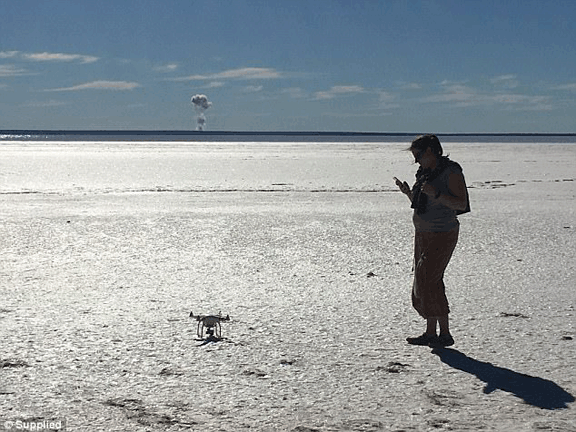
The U.S. military burns millions of pounds of munitions in a tiny, African-American  corner of Louisiana. The town’s residents say they’re forgotten in the plume., by Abrahm Lustgarten, ProPublica, Photography by Ashley Gilbertson/VII Photo, special to ProPublica July 21, 2017 COLFAX, LOUISIANA— Two years ago, the U.S. military had an embarrassment on its hands: A stockpile of aging explosives blew up at a former Army ammunition plant in Minden, Louisiana, sending a cloud of debris 7,000 feet into the sky
U.S. judge upholds nuclear power plant subsidies
U.S. District Judge Valerie Caproni in Manhattan rejected claims that federal law preempted New York and its Public Service Commission from offering credits to promote clean energy and reduce reliance on fossil-fueled or gas plants.
The plaintiffs said the credits could boost electric bills for New York’s “captive ratepayers” by $7.6 billion over 12 years, and violate the “dormant” Commerce Clause by impeding Congress’ power to regulate commerce among states.
But the judge said New York’s “zero-emissions credits” program was “plainly related to a matter of legitimate state concern”: the production of clean energy, and reduction of emissions from other energy that could add to global warming……..
Audrey Zibelman, in her role as PSC chair, was the lead defendant. Nuclear generators receiving the credits and their owners, including Exelon Corp, also sided with the governor.
Cuomo endorsed the subsidies in connection with his “Clean Energy Standard” announced last August, which required that half of New York’s electricity come from renewable energy sources such as wind and solar by 2030.
The case is Coalition for Competitive Electricity et al v. Zibelman et al, U.S. District Court, Southern District of New York, No. 16-08164.
Reporting by Jonathan Stempel in New York; editing by Grant McCool https://www.reuters.com/article/us-new-york-nuclearpower-idUSKBN1AA2VF

One Clean Energy Target solution – ENERGY EFFICIENCY
Energy efficiency: The unsexy solution for a Clean Energy Target, REneweconomy,By Richard McIndoe on 25 July 2017 The COAG Energy Council is supporting 49 of the Finkel Review’s 50 recommendations, including new demand response measures, which are crucial to driving down electricity prices.
It’s a big step in the right direction, but why have we stalled on a Clean Energy Target?
Unfortunately, the CET has become another political stick to beat the government with. To be more accurate, it’s a stick with which the Coalition beats itself. Labor sits by quietly, biding Napoleon’s sage advice not to interrupt your enemy when he’s making a mistake.
Reducing costs to all consumers is critical; ensuring quality power supply is non-negotiable; and there can’t be many people who really think coal fired power stations are good for the environment.
It’s known as the “energy trilemma,” and a CET which includes real, hard energy efficiency targets will help us solve it quickly, at the least cost.
Let’s move the debate away from solely whether to invest billions in new coal or new solar, and let’s start investing a fraction of that amount in energy efficiency.
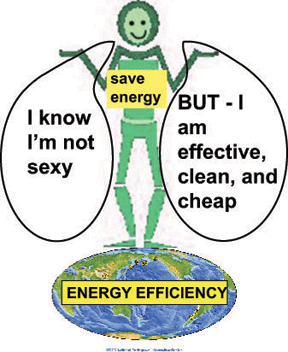
We can start by re-badging it as energy productivity, which sounds way sexier for politicians on both sides. Fact of the matter is that, along with solar and storage, energy efficient technology is moving so quickly that today’s CET may soon be out of date. Energy efficiency technologies which reduce business and residential customers’ usage by well over 10% are available today.
Improved energy productivity also benefits everyone, which will certainly be of interest if you live in an apartment, don’t own your own home or simply can’t afford a sparkling set of solar panels on your roof.
The difficulty is getting your energy company to provide energy efficient technology to you.
They’d much prefer to keep selling you more energy from newly built solar and wind projects than reduce their overall sales revenue.
No surprises there, it’s just business protecting its own market.
The convergence of new, low cost technology and continuing short-sighted price gouging by incumbent gentailers is driving more business and commercial customers to seek relief from high electricity costs through energy efficiency, solar and storage.
With just a modest effort by customers and a modicum of government support, we can easily achieve the proposed CET…….
The Government has a golden opportunity to include energy efficiency measures in the CET that will make it more acceptable to all sides and move forward from this embarrassing impasse.
They should do this now.
A clear CET with firm energy efficiency targets is a vital tool in solving the energy trilemma, and a lifeline that customers desperately need in the battle against electricity prices. http://reneweconomy.com.au/energy-efficiency-unsexy-solution-clean-energy-target-76298/
Dramatic shrinkage of sea ice over the past few decades
 Here’s how much Arctic sea ice has melted since the ‘80s, REneweconomy, By Andrea Thompson on 24 July 2017 Climate Central
Arctic sea ice has been melting at a steady clip this summer as it heads toward its annual low point. But a new chart shows that with nearly two months still left in the melt season, sea ice area is already below what would have been a yearly low in the 1980s.
The comparison shows the clear long-term decline of Arctic sea ice fueled by the global rise in heat-trapping greenhouse gases.
The dramatic shrinkage of sea ice over the past few decades is driving major changes, from the loss of crucial Arctic habitat to the potential influence of weather patterns around the world……http://reneweconomy.com.au/heres-much-arctic-sea-ice-melted-since-80s-55828/
Bell is tolling for coal, as wind and solar now “base-cost renewables.”
 Base-cost renewables: When wind and solar finally kill coal,http://reneweconomy.com.au/base-cost-renewables-when-wind-and-solar-finally-kill-coal-72324/ [good graphs] By Giles Parkinson on 19 July 2017 Coal generation may have a future in Australia’s energy grid, as prime minister Malcolm Turnbull would have us believe, but it may not be a long one.
It is now clearly recognised, away from the imaginary world of the fossil fuel lobby, that the cheapest form of new generation in Australia – and most other places in the world – is wind and solar, and certainly not coal and gas (or nuclear).
Recently, Bloomberg New Energy Finance predicted that the cost of new wind and solar would soon beat the cost of refurbished coal plants.
Now BNEF predicts that solar will beat the cost of existing, fully depreciated and unrefurbished coal plants by 2032. And wind will follow soon after.
“At that point it will be cheaper to build solar than it is to shovel coal into fully depreciated coal-fired power station.
“That is going to be a critical changing point in energy economics. It is one that was previously unthinkable, it was on no one’s horizon.”
And this is a prediction that will affect not just Australia. It will occur in just about every country in the world, including in China, also in the 2030s, with a stunning impact in energy markets across the globe.
The result of this, Bhavnagri says, will be a shift from the concept of “baseload” to a new concept that BNEF describes as “base-cost renewables.” Continue reading
IN its quest for Arctic oil, Russia admits its undersea nuclear dump
17,000 containers of radioactive waste, 19 ships containing radioactive waste, 14 nuclear reactors, including five that still contain spent nuclear fuel; 735 other pieces of radiactively contaminated heavy machinery, and the K-27 nuclear submarine with its two reactors loaded with nuclear fuel.
 one of the most critical pieces of information missing from the report released to the Norwegian Radiation Protection Authority was the presence of the K-27 nuclear submarine, which was scuttled in 50 kilometers of water with its two reactors filled with spent nuclear fuel in in Stepovogo Bay in the Kara Sea in 1981.
Information that the reactors abord the K-27 could reachieve criticality and explode was released at the Bellona-Rosatom seminar in February.
 Russia Dumped 17 Nuclear Reactors and Tons of Waste in the Arctic by Charles Digges / Bellona.org, Earth First! Newswire, 30 Aug 12, Enormous quantities of decommissioned Russian nuclear reactors and radioactive waste were dumped into the Kara Sea in the Arctic Ocean north of Siberia over a course of decades, according to documents given to Norwegian officials by Russian authorities and published in Norwegian media.
Bellona had received in 2011 a draft of a similar report prepared for Russia’s Gossoviet, the State Council, for presentation at a meeting presided over by then-president Dmitry Medvedev on Russian environmental security.
The Russian state nuclear corporation Rosatom confirmed the figures in February of this year during a seminar it jointly held with Bellona in Moscow. Bellona is alarmed by the extent of the dumped Soviet waste, which is far greater than was previously known – not only to Bellona, but also to the Russian authorities themselves.
The catalogue of waste dumped at sea by the Soviets, according to documents seen by Bellona, and which were today released by the Norwegian daily Aftenposten, includes some 17,000 containers of radioactive waste, 19 ships containing radioactive waste, 14 nuclear reactors, including five that still contain spent nuclear fuel; 735 other pieces of radiactively contaminated heavy machinery, and the K-27 nuclear submarine with its two reactors loaded with nuclear fuel. Continue reading
Asia’s coal-fired power boom ‘bankrolled by foreign governments and banks’
The vast majority of newly built stations in Indonesia relied on export credits agencies or development banks, says study by Market Forces, Guardian, Michael Slezak, 20 July 17, The much-discussed boom in coal-fired power in south-east Asia is being bankrolled by foreign governments and banks, with the vast majority of projects apparently too risky for the private sector.
Environmental analysts at activist group Market Forces examined 22 deals involving 13.1 gigawatts of coal-fired power in Indonesia and found that 91% of the projects had the backing of foreign governments through export credit agencies or development banks.
Export credit agencies, which provide subsidised loans to overseas projects to assist export industries in their home countries, were involved in 64% of the deals and provided 45% of the total lending.
The majority of the money was coming from Japan and China, with the Japan Bank for International Cooperation (JBIC) involved in five deals and the Export-Import Bank of China (Cexim) involved in seven deals. All the deals closed between January 2010 and March 2017.
The China Development Bank was the biggest development bank lending to the projects, imparting $3bn, with a further $240m in development funds coming from Korea’s Korea Development Bank.
“Right now, several key countries supporting the Paris climate change agreement are actively undermining it by trying to expand the polluting coal-power sector in other countries,” said Julien Vincent, executive director of Market Forces.
According to the International Energy Agency, the world needs to phase out coal-power by 2050 in order to keep warming under 2C……..
The push of financing comes as Japan, China and Korea move to cut plans for coal-power in their own countries. Vincent said the moves were related, since Indonesia was now seen as a testing ground for new coal-fired power station technology. https://www.theguardian.com/environment/2017/jul/20/asias-coal-fired-power-boom-bankrolled-by-foreign-governments-and-banks
Tasmania Energy probe report stalled: Labor
THE State Government has been accused of sitting on a crucial report meant to give Tasmanians insight into the energy crisis and the state a way forward on energy security.
http://www.themercury.com.au/news/politics/state-government-in-no-hurry-to-release-final-report-of-the-energy-security-taskforce/news-story/651ed9bbe43f3d3b88428d16039a4eec
More locals join push to stop oil drilling in Great Australian Bight.
Holdfast Bay council wants moratorium on oil and gas exploration in bight over fears of ‘devastating impacts’ of oil spill.
https://www.theguardian.com/australia-news/2017/jul/20/more-locals-join-push-to-stop-oil-drilling-in-great-australian-bight
Former head of BP calls for an end to the cynical and dishonest denial of climate change
The cynical and dishonest denial of climate change has to end: it’s time for leadership, Guardian, Gerry Hueston, 14 July 17 Absence of climate and energy policy has left Australia lagging dangerously behind, missing out on investment and facing major electricity disruptions. Gerry Hueston is chairperson of the Climate Council and former BP president
Australia has enough renewable energy to power the country 500 times over. With South Australia a step closer to unveiling the largest lithium ion battery storage facility in the world, it is clear just how fast we can make the transition to large-scale renewables when the right policy settings are in place and investors have certainty.
More than a decade ago, as the head of BP Australasia I pushed for action on climate change.
At the time many Australian business leaders, global companies, governments and the world’s major scientific institutions accepted the science of climate change. As a sector, we wanted certainty. Ten years later and business is still calling for certainty. That is, long-term policies that allow businesses to commit to do the heavy lifting in response to an identified, significant and growing business risk – climate change.
A carrot-and-stick approach will be required to nurture the transition to a clean energy future and move potential investments from discretionary to mandatory categories. Often there is no competitive advantage in being a first mover.
Businesses will not drive investment without the right policies. Our preference a decade ago was for a price on carbon established by an emissions trading scheme as a core part of policy settings.
The transition to a low carbon future will now be more expensive and more disruptive than it ever needed to be. An absence of climate and energy policy has left Australia lagging dangerously behind, missing out on significant investment and facing major disruptions in local electricity markets.
Governments have also, for the most part, elected to overlook the social disruptions that our inevitable energy transition will cause……..
The effects of climate change are happening now. This looks like sea-level rise and coastal flooding. It looks like record-breaking temperatures and worsening extreme weather events. There is widespread business and public support for action as well as widespread acknowledgment that inaction will leave us increasingly exposed to social and economic disruption.
Strong leadership is vital. Whether we get carrots and sticks or both, industry needs a political consensus that policy arising from the Finkel Review process will stand the test of time and changes of government.
Procrastination is not a good option. It’s time to take responsibility for our past decade of avoidant politicking. Each day that goes by without policy settings that invite investment in large-scale renewables only makes the inevitable transition harder. https://www.theguardian.com/commentisfree/2017/jul/14/the-cynical-and-dishonest-denial-of-climate-change-has-to-end-its-time-for-leadership
Rather than mindlessly toeing militaristic USA line, Australia could urge negotiations on North Korea crisis
Nuclear weapons – the only man made threat that could virtually destroy our planet in an afternoon – have hit the news again, in two ways that represent polar opposites of the struggle to banish them forever.
In New York at the United Nations we have just witnessed historic progress towards realising the goal of a nuclear weapons free world. Late last week, the UN adopted the new ‘Treaty on the Prohibition of Nuclear Weapons’, to prohibit states from developing, testing, producing, manufacturing, acquiring, possessing, stockpiling, transferring, deploying, stationing, using or threatening to use nuclear weapons, under any circumstances.
That’s a fairly comprehensive thumbs down to the weapons, the strongest collective statement yet from governments that they are totally illegitimate in every respect.
Meanwhile, in Washington DC and Pyongyang, two people – chronologically adults but in other respects displaying no signs of maturity – are squaring off at each other, each with a finger on a button that can incinerate cities.

Donald Trump and Kim Jong-un display the very reason that the new UN treaty is so critically important, because it categorically rejects any role for any nuclear weapons in anyone’s hands. As Ban Ki-Moon, former UN Secretary-General said, “There are no right hands for the wrong weapons”.
The treaty leaves no doubt that its prohibitions apply not only to actually using nuclear weapons but also to their possession. Continue reading
Crazy for Australia to subsidise coal – says Al Gore
 Al Gore: Australian government subsidising coal power would be ‘crazy’
Former US vice president and climate change campaigner says providing funding for infrastructure to support Adani coal mine is ‘just nuts’, Guardian, Calla Wahlquist, 12 July 17, Any move by the Australian government to subsidise coal-fired power would be “crazy” and providing funding for infrastructure to support the Adani coal mine is “just nuts,” former US vice president and climate change campaigner Al Gore has said.
“Globally, the world is moving rapidly away from subsidies to fossil fuels,” he said. “It would be odd if Australia went in the opposite direction and subsidised coal. It’s impolitic of me to say it, but it would be crazy.”
The Adani Group’s proposed $16bn Carmichael coal mine in Queensland’s Galilee Basin, which is yet to get finance but has been promised $1bn from the Australian government to build a rail line to port, was particularly unwise, Gore said.
“The Adani mine doesn’t have its financing, I hope it never gets its financing,” he said. “It’s not my place to meddle with your politics, but truly, this is nuts.”
Gore made the comments at the end of a presentation to the Investor Group on Climate Change, in a Q&A with Guardian Australia editor Lenore Taylor………
Without policy levers in favour of coal, Gore said the declining cost of both renewable energy and battery storage made it “now the dominant reality in energy markets”.
“Most people assume that the coal industry is in a terminal decline,” he said. “The market capitalisation of the global coal industry has declined … I think the figure is almost 90% in the last seven our eight years. It’s quite dramatic. The world is turning away from coal.”
Federal policy leadership was helpful and would provide additional certainty for investors, but it was not necessary, he said. Earlier, Gore said the United States was working towards its Paris Agreement targets through actions taken at a state and local level, despite US President Donald Trump opting out.
“And if there’s another president elected, please God … the new president within 30 days can come back in,” he said…….. https://www.theguardian.com/us-news/2017/jul/12/al-gore-australian-government-subsidising-coal-power-would-be-crazy
Al Gore at Melbourne’s energy summit
Former US vice president Al Gore speaks at Melbourne summit, ANDREW JEFFERSON, CASSIE ZERVOS, Herald Sun July 13, 2017 “.. Victoria’s energy minister Lily D’Ambrosio announced the state will grow renewable energy by 40 per cent by 2025.
South Australia’s big battery will show up the lies of Australia’s politicians and big business
 Elon Musk’s big battery brings reality crashing into a post-truth world, Guardian, 8 Jul 17, Tim Hollo For months, politicians and fossil fuel industry have lied about the viability of renewables. Now Tesla’s big battery in South Australia will prove them wrong
• Tesla to build world’s biggest lithium ion battery in South Australia
For months now, Malcolm Turnbull, Josh Frydenberg, various fossil fuel energy executives and media commentators like Paul Kelly have been rabbiting on about the “energy trilemma”. It’s their contention that energy policy must deal with cost, reliability and emissions, and that it is impossible to achieve all three at the same time. Conveniently, they choose to put emissions at the bottom of this list and bury it under a pile of coal, which they claim is cheap and reliable.
This is not true. Not even close to it. It doesn’t stand up to basic scrutiny.
Renewable energy, which obviously wins on emissions, is now beating coal on cost. What’s more, with an energy grid managed effectively by people who want renewables to succeed, it is no less reliable than fossil fuels. The fact that arch-conservative, Cory Bernardi, was recently revealed to have installed rooftop solar panels demonstrates that these people do not even believe their own rhetoric. They have just chosen to throw truth onto the fire of climate change for political reasons.
nterestingly, the great bulk of Australians already don’t believe this story. The Climate Institute’s latest (and sadly final) Climate of the Nation report, featuring comprehensive polling data on a range of climate-related issues, showed once again that the vast majority of Australians want to see more renewable energy, do not believe that renewable energy is driving price rises (correctly identifying mis-regulation, privatisation and other corporate price-gouging as more to blame), and don’t think renewables need fossil fuels to back them up in the long term.
The politicians, business people and commentators, however, continue to lie. It suits their agenda, and it clearly activates something in people’s minds – enough to make it worth their while. People know that they are wrong. But they sound like they might sort of be right.
Musk’s gambit closes this book. He has brought reality crashing in.
Within 100 days, there will be a huge battery system making South Australia’s energy grid clean, affordable and reliable, and benefitting the eastern states along with it.
All the talk of building new coal-fired power stations, or a Snowy Hydro 2.0, no longer sounds vaguely “truthy”. It sounds ridiculous. It sounds silly. It sounds like old men yelling at clouds……https://www.theguardian.com/commentisfree/2017/jul/07/elon-musks-big-battery-brings-reality-crashing-into-a-post-truth-world
1 This month


Help Aunty Sue Protect Her Land and Sacred Sites From Destructive Rocket Testing.
.

Australians deserve the truth
about
AUKUS – https://aukuspublicinquiry.com/

PETITION – To: Prime Minister Anthony Albanese and the Australian Labor Government

of the week – Australians for War Powers Reform (AWPR)
To see nuclear-related stories in greater depth and intensity

