The Small Modular Nuclear Reactor lobby targets Canada’s indigenous people
The nuclear lobby’s tactics world wide are uncannily similar. South Australians in the Kimba area will recognise the tactics of bribery, disinformation, etc used in Norther Canada, where another disadvantaged community is pushed into hosting nuclear facilities, that nobody down South wants.
First Nations Targeted for Untested Small Modular Nuclear Reactors: Libbe Halevy interviews Candyce Paul , Nuclear Hot Seat Saskatchewan by Libbe HaLevy | Sep 3, 2020
Notes – (not a completely accurate transcript), by NoelWauchope
Candyce Paul: Uranium mining in Saskatchewan. Uranium was mined in the 50s for the cold war, essentially for nuclear weapons. Primarily on the land of indigenous people.
Little information was supplied to the people, but they did understand that it was for weapons, and they knew traditionally, the indigenous people knew – that the black rock should stay in the ground……….there were legends that once it comes out of the ground it would bring death and destruction.
The miners wwere not predominantly indigenous. There are over 40 legacy mines. Very poorly cleaned up – piles of uranium talings left for 60 years – blowing around, contaminating lake, entering streams. Once these tailings are ingested – many years later comes poor health, soaring cancer rates, children with cognitive and physical disabilities. More mines were opened in late 70s, early eighties. Since then, miners have been flyng in flying out, for 2 week sessions. This has been having its impact on the social structure. Jobs in the mines are the only jobs, the only economy being offered in Northern Saskatchewan. Only one mine is operating now. This is Cigar Lake, it just re-opened. The fly-in miners were initially settlers, later the mines were hiring indigenous people – 49% were indigenous, – the indigenous people got the dirty and more dangerous work. Young indigenous worked in the mills, non indigenous in the offices. Because it is the only economy around, – they paid for it later with illnesses. There were many complaints, but people were blacklisted if they complained.
Mining slowed down since Fukushima. Gradually all mines shut down, except Cigar Lake. In 2011 Northern Saskatchewan was targeted for nuclear waste . Most people did not want the wastes, millions of times more radioactive than the uranium.
In the community where I live, Northern Saskatchewan , we raised 20, 000 signatures in a petition against it, and delivered it to the legidlature 80% of residents opposed it. The nuclear waste authority pulled out in 2014. We based our opinions on facts, had talked to scientists, physicists from all over the world.
Question from Liby Halevy about current state of affairs – What do you think about the creation of an inter-provincial corporate partnership to support the launch of a research centre to support the development of small nuclear reactors?
Candyce Paul: Canada, and the nuclear industry have been looking for a way to keep the nuclear industry alive. The only way they can come up with this is to promote Small Modular Nuclear Reactors (SMNRs) for use in Northern Canada. Most Canadians live in the Southern parts, the lower third of Canada. In the North the people are mainly indigenous. There are big resources there. Diesel fuel is in use. The Canadian Mining Association is pushing Small Modular Nuclear Reactors – promoting this to northern communities, (who get most electricity from diesel), as far North as beyond the Arctic circle. The University of Saskatchewan has been used to promote this idea, getting research done on it.. The Canadian Nuclear Laboratories is a conglomerate of companies, mostly pretty shady, for example, SNC Lavalin, which is up on charges and exposed as interfering at the highest levels of government to prevent charges against it. SNC Lavalin is not allowed to borrow money, or bid on construction projects funded by the World Bank, because of bribery charges in the past. It has bribery charges in Canada, too. The Government of Canada has dozens of contracts with SNC Lavalin.
A decade ago the government, who owned Atomic Energy Canada, broke it up, sold it to this conglomerate for $12 million.- a pittance. The top laboratory is in Northern Ottawa, was making medical isotopes, and was closed down, still classified, and there’s a ton. of wastes there. Then there’s Pinewa labs in Manatoba, which had some sort of accident that is still classified. At that time a moratorium was placed on storing wastes in Manatoba. They were researching deep underground storage of nuclear wastes. Since Atomic Energy Of Canada Limited (AECL) was sold they are now going to bury onsite the waste that is there. At Chalk River Laboratories they are going to build a mound around the wastes. within 100 metres of the Ottawa River, upstream of Ottawa.
Canadian Nuclear Laboratories is to develop Small Modular Nuclear Reactors, promoting at Chalk River, and at Pinewa and at Point Lepreau Nuclear Generating Station New Brunswick. In 2019 the Provinces of Ontario, Saskatchewan and New Brunswick signed a memorandum of understanding to try and develop SMNRs – Ontario and New Brunswick have nuclear power stations. Saskatchewan has the uranium mines. In 2008-9 the Saskatchewan government had been promoting the full nuclear chain, reprocessing etc. Saskatchewan people didn’t want it. After that we had the nuclear waste issue, which squashed that plan.
They opened the Centre for Nuclear Innovation at University of Sasatchewan to promote nuclear development of all kinds. Just prior to that they announced a new office , a Nuclear Secretariat to promote SMNRs in Saskatchewan. I’m pretty sure that there’s public money going into this. That is the concern Northern communities could not afford a nuclear power station, small or large. Northern communities could not use that amount of energy. In Northern Saskatchewan 80% of electricity used is used by the mining industry- in Saskatchewan it’s primarily the uranium industry. So who does it benefit? It benefits themselves.
A place on Baffin Island, when they were being pitched these SMNRs, put out a review, thoroughly researched- pointing out the safety problems – the inability of emergency help to reach there.in time, in the event of a nuclear accident. Proponents of nuclear power talk about a smaller exclusion zone, a few km radius. – But this is all wilderness -in huge ecosystems These Northern areas are primarily water. If an accident happens, pollution would be flowing in water, the exclusion zone would not apply. The radiotoxicity in the case of accident would be massive.
They are promoting themselves as green – but they are putting out pollutants in processing, milling, and if they started reprocessing the radiotoxicity pollution would be massive. There are leaks in the mills, that have gone through the floor of the milling stations. The molybdenum extraction plant has a leak getting into groundwater, and that hasn’t been addressed. So how do we trust them?
Libby Halevy: With the push for these cute little modular, sounds like Lego reactors, being so heavily promoted – what are you and your communities doing?
Candyce Paul: We are pushing to educate the community about these SMNRs. Working along with an education co-op, about SMNRs and the fact that no nuclear will get in here unsubsidised. The community, the energy providers can’t afford it. It needs public money . There’s an election coming up. The two main parties are pretty much on the same wavelength promoting it.
They’re promoting it as the answer to greenhouse gases. It will take about 30 years before there’s a SMNR- during which time they’re doing nothing about greenhouse gases. They want it to get at the tar sands in Saskatchewan, to help develop the tar sands. – Alberta is now pushing nuclear to provide the power for tar sands extraction.
We don’t have much population The population is down South. The decisions are made down South. The voting power is down South. It’s the only work that people up here can get The education system here is influenced by the uranium companies, from kindergarten to the curriculum upwards. The mining companies don’t want our people knowledgeable. We need help from professionals, technicians, but we have a difficult time in getting this help. If they help us they may not get work again. That’s a huge factor.
We’re working on some videos, short messages. We need people to help us with reviews, reviews of environmental impact statements, during the very short public comment period.. It has to be done on science. They want only scientific facts. It doesn’t necessarily have to be logical, but it has to be science. The nuclear lobby thinks they’re indisputable, that their technology knowledge puts them above you.
We’re supposed to have ”consultation” as indigenous communities – ”free prior informed consent ”. They come in and tell us what they’re going to do. It’s already pre approved.
They do a fishing expedition to find what the community wants and needs, (what bribes) can we provide to get you on side.They have kept our communities intentionally needy, under-resourced. Shortage of health and education services, not a lot of jobs. People want jobs – they offer jobs. They put through their environmental impact statements, but the community does not get properly informed, – the statement does not get a properly informed consent . They play people against each other – those who need jobs today versus those who care about the land and the future generations.
We’ve been in a bust economy for 2 years, because of the low uranium price, but there are still aspirational uranium companies coming in.applying for licences to mine.They put though their EIS during Covid-19 without the community consultations being completed. We then get 30 days to put together something. – it’s a farcical process. No time to review it in depth.We hope to get some help.
To help people with the technology background for reviewing EISs contact me at Committee for Future Generations. on Facebook – or contact Inter-Church Uranium Committee Educational Co-operative (ICUCEC) in Saskatoon, who are working on this SMNR Before this election- we are working on pamphlets in language clear and concise that people not highly technical can understand. No pamphlets are available in hospitals here on radiation and health People here need to know that these jobs being promoted to their children have radiation hazards -not good for health nor for future generations.
They really do not want to stop climate change. They’re using this long long way to so-called green small modular nuclear reactors People need to understand the process of lying that is going on about climate change. SMNR not needed. There’s a process happening here to develop northern Saskat resources that will include a Northern corridor 3000km long several km wide to get at all the resources in Northern Canada, also for for haul routes for all hazardous materials including nuclear wastes.
They are looking forward to Northwest Passage being opened, so that they use it can sell more of the resources that they are going to mine from our areas . The climate will have a huge impact on whether or not they can even run a nuclear reactor, with the increasing temperatures here.
Radiation -free medical imaging for some aneurysm patients
 Scottsdale hospital implements radiation-free imaging for some aneurysm patients https://www.azfamily.com/news/health/scottsdale-hospital-implements-radiation-free-imaging-for-some-aneurysm-patients/article_0f1e6346-ee03-11ea-b1f9-37334de91744.html, By Maddy Pumilia, Arizona’s Family producer Sep 3, 2020
-
- HonorHealth Scottsdale Osborn Medical Center is using new imaging technology that protects doctors and patients from dangerous radiation.
The old technology left doctors and patients exposed to radiation for hours. This new technology doesn’t use radiation, which means it could protect doctors from serious health issues like cancer in the long run. “Radiation exposure with its consequences can be disastrous to doctors and staff,” HonorHealth surgeon Venkatesh Ramaiah Ramaiah said.
HonorHealth Scottsdale Osborn Medical Center is the only hospital in Arizona, and one of the few in the country that has implemented the new imaging technology. The technology provides a 3D image instead of a 2D image.
Climate change is spreading radiation from Chernobyl over 2,000 miles away
 Climate change is spreading radiation from Chernobyl over 2,000 miles away, Boing Boing, 3 Sep 20, One of the more difficult parts of trying to convince people about the seriousness of climate change is explaining how so many disparate elements and factors can collude and compound* and make everything worse. And it’s even harder to predict how long those complications will take to manifest, whenever they do what they do…….
. As The Atlantic reports:
Monitors in Norway, 2,000 miles away, detected increased levels of cesium in the atmosphere. Kyiv was smothered in smoke [from forest fires]. Press reports estimated that the level of radiation near the fires was 16 times higher than normal, but we may never know how much was actually released: Yoschenko, Zibtsev, and others impatient to take on-the-ground measurements were confined to their homes by the coronavirus pandemic. August is typically the worst month of the Chernobyl fire season, and this year, public anxiety is mounting. The devastation left by the world’s worst nuclear disaster is colliding with the disaster of climate change, and the consequences reach far and deep.
The unexpected result is an immense, long-term ecological laboratory. Within the exclusion zone, scientists are analyzing everything, including the health of the wolves and moose that have wandered back and the effects of radiation on barn swallows, voles, and the microorganisms that decompose forest litter. Now, as wildfires worsen, scientists are trying to determine how these hard-hit ecosystems will respond to yet another unparalleled disruption. ……
when something nuclear does go wrong — which is still likely, because nothing’s perfect — more nuclear power production will result in more radiation damage. And, if this situation with Chernobyl’s forest fires is any indication, then the ultimate fallout of that combined with our existing climate change problems could be even more insurmountably devastating……. https://boingboing.net/2020/09/04/climate-change-is-spreading-ra.html
Uranium mining’s health toll, on Indian regions
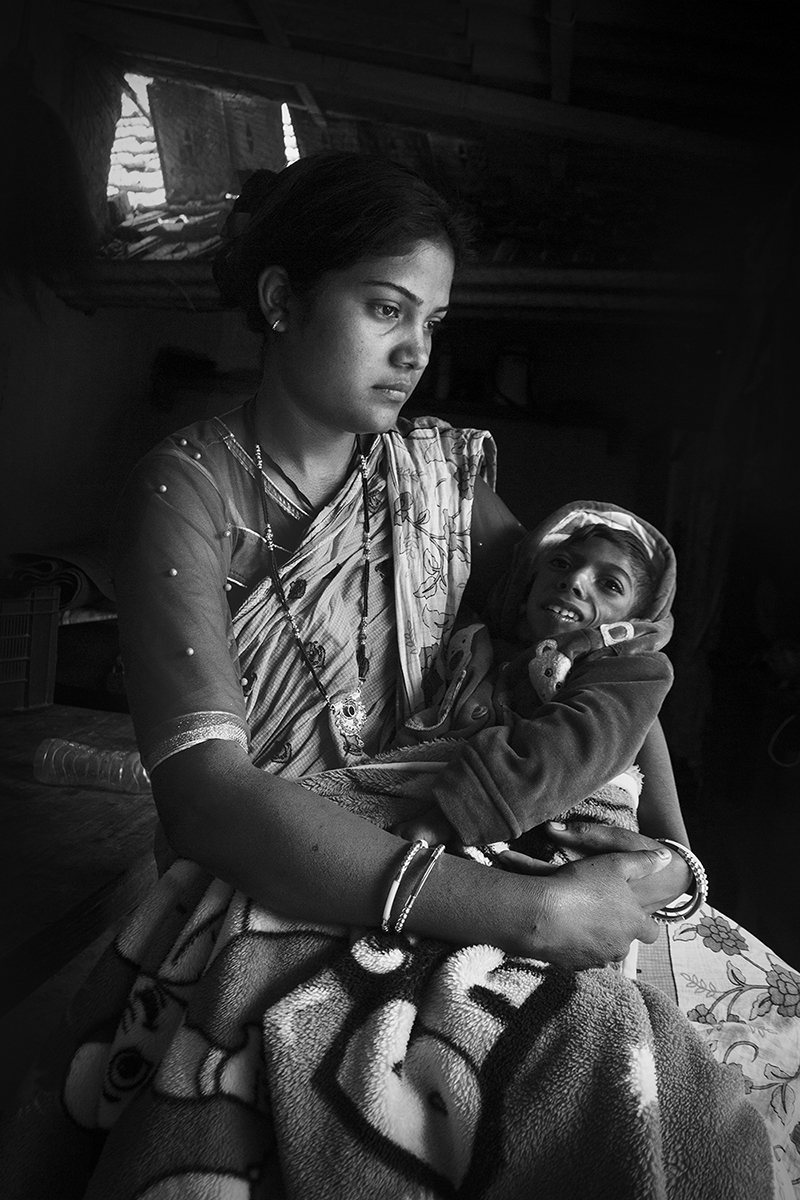 Child with cerebral palsy, in uraniummining region Dungridih village. Jaduguda, photo by Subhrajit Sen.
[Photos] Suffering in the town powering India’s nuclear dreams. Mongabay, BY SUBHRAJIT SEN ON 4 SEPTEMBER 2020
- Uranium is a vital mineral for India’s ambitious nuclear power programme. Out of the seven states with uranium reserves, Jharkhand and Andhra Pradesh have currently operating mines.
- In Jharkhand’s Jaduguda region, which has India’s oldest uranium mines, local communities narrate stories of suffering due to degrading health and the environment. The government, however, denies any ill-impact of uranium mining on people.
- The Indian government is aiming to increase uranium exploration and mining.
- This photo essay features images taken between 2016-2019 of residents of villages around uranium mines in Jharkhand. Some of these photos contain sensitive content.
Anamika Oraom, 16, of village Dungridih, around a kilometre away from Narwa Pahar uranium mine in Jharkhand, wants to study. But she cannot, owing to severe headaches that come up periodically, triggered by a malignant tumour on her face. Sanjay Gope, 18, cannot walk and is confined to his wheelchair. Haradhan Gope, 20, can study, walk, talk, but owing to a physical deformity, his head is much smaller in proportion to his body.
There are many more, young and old, in the village Bango, adjacent to Jaduguda uranium mine in Jharkhand, whose lives and death highlight the ill-effects of uranium mining, say the villagers.
Uranium is a naturally occurring radioactive mineral and is vital to India’s nuclear power programme. At present (till August 31, 2020), India’s installed nuclear power capacity is 6780 megawatts (MW). The country aims to produce 40,000 MW of nuclear power by 2030.
The Uranium Corporation of India Limited (UCIL) is involved in the mining and processing uranium ore in the country. According to the UCIL, mining operations at Jaduguda began in 1967, and it is India’s first uranium mine.
In the 25-kilometre radius of Jaduguda, there are other uranium deposits at Bhatin, Narwa Pahar, Turamdih, Banduhurang, Mohuldih, and Bagjata. While UCIL claims that Jaduguda mine has created a large skill base for uranium mining and the mining industry, local communities point out that their lives and land have changed irreversibly.
The villagers complain that the hills surrounding Jaduguda, dug up to create ‘tailing ponds,’ have proven to be a severe health hazard. A tailing pond is an area where leftover material is stored after the excavated ore is treated to extract uranium. Communities argue that these ponds have led to groundwater and river contamination.
Namita Soren of village Dungridih said, “This radioactive element has become a part of our daily life.”
“Children are born with physical disabilities or people with cancer. But our sorrow doesn’t end there,” said Soren who had three miscarriages before giving birth to a child born with physical deformities.
Ghanshyam Birulee, the co-founder of the Jharkhandi Organisation Against Radiation (JOAR), said that villagers earlier marked certain forest areas as ‘cursed’ – a woman passing through the area was believed be affected by an evil gaze and suffer a miscarriage or people would feel dizzy. These areas coincided with the forest spaces around tailing ponds. In cultural translation, the regions surrounding tailing ponds became infested with ‘evil spirits.’ But as the people became more aware, they connected their misery to the mining operations.
A 2003 study by Tata Institute of Social Sciences emphasised that 18 percent of women in the region suffered miscarriages/stillbirth between 1998 and 2003, 30 percent reported some sort of problem in conception, and most women complained of fatigue and weakness.
When asked the reason for opposing the UCIL’s mining project, Birulee said, “Before mining started, people never used to have diseases like these – children were not handicapped, women were not suffering from miscarriages, people didn’t have tuberculosis or cancer. People had ordinary illnesses, cold and cough, that got cured by traditional medicines. But today, even the doctors are not able to diagnose diseases. It all emerged after uranium mining started.”
India has uranium reserves in Rajasthan, Jharkhand, Chhattisgarh, Meghalaya, Telangana, Andhra Pradesh, and Karnataka. It is currently operating mines in Jharkhand and Andhra Pradesh. The country has a detailed plan to become self-sufficient in uranium production by achieving a nearly ten-fold rise by 2031-32, including expansion from existing mines and opening new mines. However, to augment supply until then, it has signed a long-term contract with Uzbekistan (in 2019) to supply 1,100 metric tons of natural uranium ore concentrates during 2022 -2026. Similar agreements have been signed with overseas suppliers from various other countries like Canada, Kazakhstan, and France to supply uranium ore.
No help from the government or politicians
Birulee feels that the political class is aware of the problem but that has not translated into safeguarding villagers’ lives. “Whoever is elected from here – legislator or parliamentarian – has never raised our issue about radiation either in the state legislature or parliament. If they raise our issue, I am sure the government will take some action to resolve people’s issues,” said Birulee.
In March 2020, Bharatiya Janata Party leader Rajiv Pratap Rudy asked Prime Minister Narendra Modi in Lok Sabha about public health hazards due to India’s uranium mines.
Rudy asked whether the central government has reports of hazardous activities like radioactive slurry being stored in the open, causing health hazards to people residing in adjacent areas of uranium mines in the country, and, if so, the action taken on it.
While replying to the question, Minister of State for Personnel, Public Grievances and Pensions and Prime Minister’s Office, Jitendra Singh, refuted any such impact. ………..
Birulee reflects on the opposing conditions that he has witnessed. For him, it is impossible to leave behind his land, livelihood, and traditions. But for people close to the mines and tailing ponds, “the only solution is that from this region – from this radiation zone – people should be rehabilitated to a safer place. Else they’ll be surrounded by the same problems.”
Local livelihood options impacted
The people note that displacement and then deforestation for uranium mining robbed them of their land and livelihood, and later cursed them with health impacts.
Though the company and those in power deny any ill-impact on local ecology and livelihood, locals alleged that small-scale production of bidis is also hampered due to the low quality of tendu leaves. They suspect that the trees have been exposed to contaminated groundwater.
Villagers said that with expansion of mining large tracts of sal, sarjom, and teak trees are being wiped out. The trees are essential for the communities’ sacred rituals and traditional activities.
Ashish Birulee, photojournalist and member of JOAR, said that the route for transporting uranium ore is the same used by the public. He says the resulting pollution from the dust has a long-term impact on health and ecology.
Ashish adds that the mining company cannot ignore the most significant factor – the experience of people living in this area. “The experience of people is nothing less than any study or research. It can’t be denied. UCIL is not ready to admit that there are problems. It is because if it admits it would have to compensate people. Peoples’ experience shows that before 1967 there were no such issues, but it started after mining took off. If you look at the population of Jaduguda, there are a lot of people with disabilities. But if you go about 15 kilometres away, there are no such problems.”
“As far as a solution is concerned, once you start mining at any place, there is no solution. The company will mine here till the uranium ore exists. It has a lease for 45-50 years and after mining is over here, it will move to a new mine and extract resources. But the mining waste will be left here,” said Ashish. …… https://india.mongabay.com/2020/09/photos-suffering-in-the-town-powering-indias-nuclear-dreams/
Climate risks growing for nuclear reactors
 Analysis: Nuclear operators face growing climate risks, https://www.michiganradio.org/post/analysis-nuclear-operators-face-growing-climate-risks
In the report, analysts found the Cook, Fermi, and Palisades nuclear power plants in Michigan and the nearby Davis-Besse plant in Ohio fall into the High Risk category (although Palisades is scheduled to close in 2022).
The analysis says that means the nuclear power plants will face relatively high changes in temperature extremes compared to the global average, according to the report.
“If the temperature goes up a little bit too high, the plan would either have to lower its output for a given period or maybe shut down if things are extreme,” said David Kamran one of Moody’s analysts.
The trickiest part for the nuclear power plant operators is reacting to how quickly changes in the climate happen. Recently, some models show the planet is getting warmer faster than previously thought.
“As these entities, the plants, want to have their licenses extended over many years, they may need to make additional investments to keep up with new information regarding climate and temperature and water, that sort of thing,” Kamran said.
The nuclear power plants use massive amounts of water. While the supply is not an issue, the temperature of the water could be an issue in the future depending on how fast the climate changes.
Nuclear nations have handled COVID-19 the worst
The most useless of arsenals – Nuclear nations have handled COVID-19 the worst https://beyondnuclearinternational.org/2020/08/30/the-most-useless-of-arsenals/, By Tilman Ruff, August 30, 2020 by beyondnuclearinternational
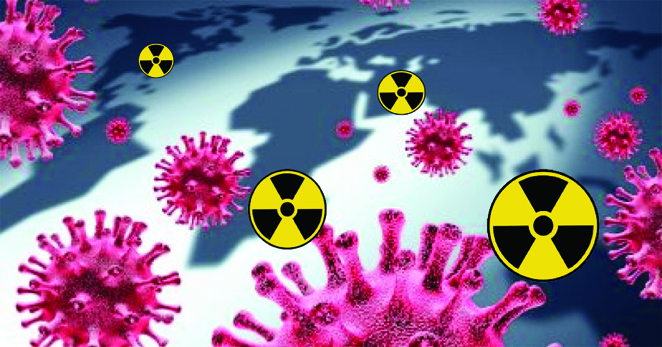
The Covid-19 pandemic has demonstrated that massive arsenals are useless in a pandemic. The countries that have spent obscene sums on nuclear weapons have failed to provide the most basic of protective equipment against the coronavirus, putting their citizens in danger every day.
New pathogens will continue to evolve, spread and disrupt our world. Indeed as we deplete habitats for other species, wreak climate havoc, and grow food industrially, we can expect new infectious diseases more often.
COVID-19 is just the latest; it will certainly not be the last. Bad enough it is, but far from the worst we could expect.
Exposing vulnerability
COVID-19 has caught even the wealthiest nations unprepared; their massive armaments useless against a small, mindless aggregation of single stranded RNA, a few proteins and a thin lipid envelope about 120 nm across.
Nations investing obscene sums in nuclear weapons that must never be used have been unable to provide the most basic of protective equipment – gowns, gloves, and facemasks for their frontline health professionals putting themselves in danger every day.
The best funded public health organization in the world, the Centers for Disease Control and Prevention of the United States, went from recommending N95 respirators for doctors and nurses at risk to recommending improvised bandanas in the face of severe shortages of the most basic protection costing a fraction of a dollar.
The US government rejected international assistance with test kits and was then left with woefully inadequate numbers of its own faulty kits.
Learning from the pandemic
This coronavirus can teach us a lot if we are willing to learn.
It shows where the real threats to our security lie, for which massive military arsenals and the most powerful WMD are not only useless, but get in the way.
It shows our interconnected vulnerabilities and capacities, that globalized problems respect no borders, are shared and demand cooperative solutions.
It has shown how quickly the exceptional hubris of arrogant leaders serving their own and narrow vested interests can enable great harm to occur; evil measured in monumental failures of leadership, causing tens of thousands of deaths that could readily have been prevented.
It has shown the uselessness of ideological baggage in confronting big challenges.
It has laid bare that respect for truth, evidence and science; and listening to the expert custodians of that evidence, are crucial.
It has demonstrated that changes once deemed unthinkable can be made, and made fast.
It has shown that female leaders are often more sensible and reliable in a crisis, and that we need more of them.
It has shown the great ingenuity, resourcefulness and kindness that people everywhere are capable of.
It has shown that what the science and experts tell us – that new pandemics will occur and that we are woefully prepared to deal with them – will occur if warnings are not heeded.
Choosing to listen
We can prevent some new pandemics from occurring. We can always respond better if we listen to the evidence and prepare well for what can be expected.
If we do not listen to or choose to see the overwhelming evidence of accelerating climate disruption, and quickly and drastically reduce greenhouse gas emissions, catastrophe will bear down on us in our lifetimes and the world our children and grandchildren live in will be much more violent, difficult and impoverished.
If we ignore the reality of what nuclear weapons do, and the growing dangers of their use, then what may be a small risk on any given day, over time will become inevitable.
A final epidemic
This COVID pandemic will abate. However after a nuclear war there will be no re-building, no coming back. It would be the final epidemic. There will not be a health care system in overloaded crisis; there will be no health system and no one able to staff it. We can prepare for a pandemic; for nuclear war there is only prevention.
That is why we have to act now to protect our Earth from rampant heating and the abrupt ice age that would follow the radioactive incineration of nuclear war; as if our lives depended on it, because they do.
We can’t stop all new epidemics. And we don’t yet know if we can eradicate the COVID-19 virus.
But we can and must end nuclear weapons before they end us. The Treaty on the Prohibition of Nuclear Weapons provides the best available path forward. We should heed the lessons of COVID and take that path while we still can.
Tilman Ruff is Associate professor at the Nossal Institute for Global Health, School of Population and Global Health, University of Melbourne, Co-President, International Physicians for the Prevention of Nuclear War (Nobel Peace Prize 1985) and Co-founder of the International Campaign to Abolish Nuclear Weapons (ICAN, Nobel Peace Prize 2017)
This article first appeared on Croakey and is republished with kind permission of the author.
Global coronavirus infections reach reach 25 million
 Coronavirus update: India records world’s biggest single-day jump in infections, global cases reach 25 million, ABC News , 31 Aug 20, India has broken a global record for the highest number of coronavirus infections recorded in a day, as the country continues to further ease pandemic restrictions nationwide.The number of confirmed coronavirus cases globally has topped 25 million, according to figures by Johns Hopkins University. Coronavirus update: India records world’s biggest single-day jump in infections, global cases reach 25 million, ABC News , 31 Aug 20, India has broken a global record for the highest number of coronavirus infections recorded in a day, as the country continues to further ease pandemic restrictions nationwide.The number of confirmed coronavirus cases globally has topped 25 million, according to figures by Johns Hopkins University.
Meanwhile, far-right protesters and others have stormed the German parliament building following a protest against the country’s pandemic restrictions. This story will be regularly updated throughout Monday. India records world’s biggest single-day jump in virus casesThe Health Ministry on Sunday local time also reported 948 deaths in the past 24 hours, taking total fatalities to 63,498. India has now reported more than 75,000 infections for four straight days. The surge has raised the country’s total virus tally to over 3.5 million and comes at a time when India is reopening its subway networks and allowing sports and religious events in a limited manner from next month as part of efforts to revive the economy. Even as eight Indian states remain among the worst-hit regions and contribute nearly 73 per cent of the total infections, the virus is now spreading fast in the vast hinterlands, with experts warning that the month of September could be the most challenging. Global cases reach 25 millionThe number of confirmed coronavirus cases globally has topped 25 million, according to a tally kept by Johns Hopkins University. The United States leads the count with 5.9 million cases, followed by Brazil with 3.8 million and India with 3.5 million. The real number of people infected by the virus around the world is believed to be much higher — perhaps 10 times higher in the US, according to the Centres for Disease Control and Prevention — given testing limitations and the many mild cases that have gone unreported or unrecognised. Global deaths from COVID-19 stand at over 842,000, with the US having the highest number with 182,779, followed by Brazil with 120,262 and Mexico with 63,819. Far-right pandemic restriction protesters attempt to storm German parliament Senior German officials have condemned attempts by far-right protesters and others to storm the parliament building following a protest against the country’s pandemic restrictions. Hundreds of people, some waving the flag of the German Reich of 1871-1918 and other far-right banners, breached a security barrier outside the Reichstag late on Saturday local time but were intercepted by police and forcibly removed……… https://www.abc.net.au/news/2020-08-31/coronavirus-update-covid19/12610940 |
|
|
Climate change and its impacts are not just the future: they are now
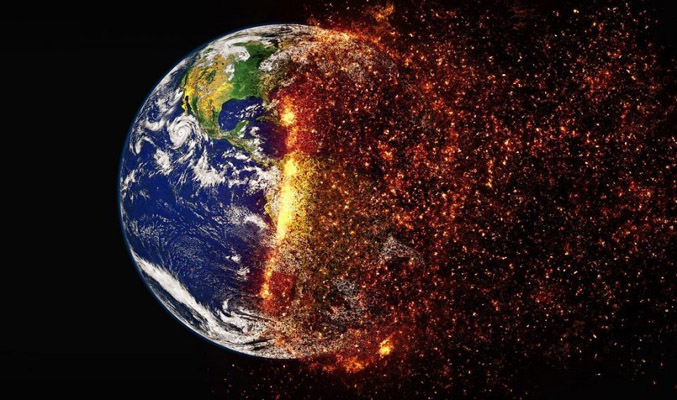
Everything Is Unprecedented. Welcome To Your Hotter Earth, NPR, REBECCA HERSHER, NATHAN ROTT, LAUREN SOMMER-30 Aug 20,
|
The upshot of climate change is that everyone alive is destined to experience unprecedented disasters. The most powerful hurricanes, the most intense wildfires, the most prolonged heat waves and the most frequent outbreaks of new diseases are all in our future. Records will be broken, again and again. But the predicted destruction is still shocking when it unfolds at the same time. This week, Americans are living through concurrent disasters. In California, more than 200,000 people were under evacuation orders because of wildfires, and millions are breathing smoky air. On the Gulf Coast, people weathered a tropical storm at the beginning of the week. Two days later, about half a million were ordered to evacuate ahead of Hurricane Laura. We’re six months into a global pandemic, and the Earth is on track to have one of its hottest years on record. Climate scientist Camilo Mora of the University of Hawaii says if our collective future were a movie, this week would be the trailer. “There is not a single ending that is good,” he says. “There’s not going to be a happy ending to this movie.” Mora was an author of a study examining all the effects of climate change. The researchers concluded that concurrent disasters will get more and more common as the Earth gets hotter. That means we will live through more weeks like this one — when fires, floods, heat waves and disease outbreaks layer on top of one another. “Keep in mind that all these things are related,” Mora explains. “CO2 is increasing the temperature. As a result, the temperature is accelerating the evaporation of water. The evaporation of water leads to drought that in turn leads to heat waves and wildfires. In places that are humid, that evaporation — the same evaporation — leads to massive precipitation that is then commonly followed by floods.” Disease outbreaks are also more likely. The most recent U.S. National Climate Assessment warns that changing weather patterns make it more likely that insect-borne illnesses will affect the U.S. Climate change is also causing people and animals to move and come in contact with one another in new and dangerous ways. If humans dramatically reduce greenhouse gas emissions immediately, scientists say it will help avoid the most catastrophic global warming scenarios. Worldwide emissions are still rising, and the United States is the planet’s second-largest emitter. Mora says helping people connect the dots between the current disasters and greenhouse gas emissions should be every scientist’s priority. “That’s the million-dollar question,” he says. “How do we speak to people in a way that we get them to appreciate the significance of these problems?” Hurricanes and climate change Climate change is making the air and water hotter, and that means more power for hurricanes. “Whenever you get ocean temperatures that are much above average, you’re asking for trouble,” meteorologist Jeff Masters explains. “And we’ve seen some of the warmest ocean temperatures on record for the Atlantic basin this year.” Hot water is like a battery charger for hurricanes. As a storm moves over hot water, like Hurricane Laura did this week, it captures moisture and energy very quickly. In recent years, scientists have seen evidence that global warming is already making storms more likely to grow large and powerful and more likely to intensify quickly. …….. Scientists have also found that hurricanes are dropping more rain, which means more flooding. Flooding is consistently the most deadly and damaging effect of a hurricane. Studies show many people underestimate the flood risks from hurricanes. Just a few inches of moving water can make it impossible to stay on your feet or control your car. Add all that to the current pandemic, and you get a dangerous situation, especially for people living in the path of the storm. As NPR has reported, safe options for people who evacuate this year could be limited because group shelters might accept fewer people in order to maintain social distancing. ………. “People are becoming more vulnerable as this COVID crisis goes on,” Morris says, as more people get laid off or run out of savings. “We have frankly been failing to serve the most vulnerable, and the people who have been made vulnerable by these cascading catastrophes.” Wildfires and Climate Change The fingerprints of climate change are all over the Western wildfires, too. ………. Fires are burning more frequently and intensely in places where they’ve always occurred, and they’re creeping into places where they were previously rare. …………….. How bad it eventually gets depends on how quickly the world can reduce carbon emissions. But the past weeks should make clear: “Climate change and its impacts are not the future,” says Crystal Kolden, a fire scientist at the University of California, Merced. “They are now.” https://www.npr.org/2020/08/28/905622947/everything-is-unprecedented-welcome-to-your-hotter-earth?utm_campaign=storyshare&utm_source=twitter.com&utm_medium=social |
|
Minigrids – the clean energy revolution across Africa and Asia
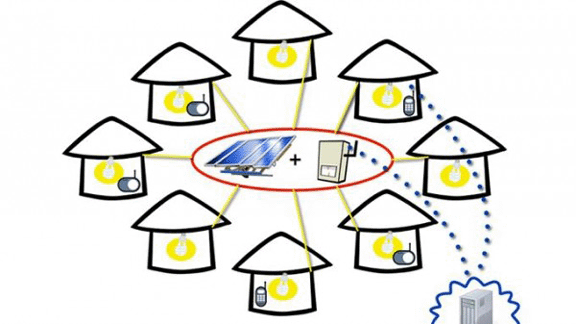 The little-known clean energy revolution https://energy.economictimes.indiatimes.com/news/renewable/the-little-known-clean-energy-revolution/77742430
There are about 5,500 mini-grids in operation across 12 countries in Africa and Asia, according to The State of the Global Mini-grids Market Report 2020 published by the international non-governmental organization Sustainable Energy for All and BloombergNEF, Bloomberg, August 26, 2020,
Over the last decade, the number of people in the world without access to electricity has fallen drastically — from 1.4 billion in 2010 to about 900 million in 2018, according to the United Nations. And yet, if current trends persist, the world won’t be able to meet the UN’s sustainable development goal of universal access to electricity by 2030, with as many as 600 million still lacking basic 21st century services.
It doesn’t have to be so. A new technology has matured and become affordable that could help achieve the laudable goal, and it’s called mini-grids.
There are about 5,500 mini-grids in operation across 12 countries in Africa and Asia, according to The State of the Global Mini-grids Market Report 2020, published by the international non-governmental organization Sustainable Energy for All and BloombergNEF earlier this year. The report’s authors found that mini-grids could meet the needs of half the people who still need access to electricity in those regions.
As the name suggests, mini-grids are small, isolated versions of larger power grids. They increasingly use solar power as an energy source, with support from batteries or diesel generators. Because the cost of solar power has fallen drastically , mini-grids have become much cheaper than installing long-distance transmission lines from a central electricity grid.
Universal power access will require $128 billion of spending, the report found, but the world is on track to spend only about $63 billion on mini-grids over the next decade. Plugging the gap would cost less than $600 per target household reached.
The need goes beyond money. “Today the mini-grid market is nascent, despite being the least-cost option for electricity access in many areas,” the report concludes. The international Mini-Grids Partnership, which includes the World Bank and other development agencies from rich countries, has approved $2 billion in awards since 2012 but only disbursed 13% of the money, with many projects stuck because of policy uncertainties.
In 2017, the country passed a law to help mini-grid development, which streamlines the online application process, offers $350 in government subsidies per user once grids with more than 30 users are up and running, and provides for compensation if the main power grid eventually arrives in an area served by a mini-grid. Developers in Nigeria now have simpler processes and clearer guidelines to follow.
The upshot is that mini-grids have become a much more attractive investment. “Now you see a lot of companies flocking to Nigeria,” says Ruchi Soni, program manager at Sustainable Energy for All. “We hear from partners that they would like to replicate Nigeria’s success in their country.”
This offshoot of the clean energy revolution has three benefits: mini-grids can help provide access to electricity to those who lack it and do so in a cleaner and cheaper way. Few things in life are win-win-win.
Welcome to the ‘Pyrocene,’ an Epoch of Runaway Fire
Fire scholar Stephen J. Pyne proposes a pyrocentric view of the last 10,000 years — and warns that California’s wildfires herald a very combustible future. Bloomberg City Lab By Laura Bliss, August 27, 2020 It isn’t just California that’s burning. This summer, smoke from massive wildfires in Siberia choked skies as far as Alaska and set new pollution records, in a second consecutive year of unprecedented blazes in the Arctic Circle. Rising temperatures, a loss of precipitation, and parched vegetation are hallmarks of climate change, scientists say, as are the increasingly extreme wildfires that result, from the arid Western U.S. to some of coldest places on Earth. Continue reading
You can have four more years of Trump, or you can have a habitable planet. But you can’t have both.
 Climate Apocalypse Now, Maybe it’s just a failure of human imagination to understand what is coming, Rolling Stone, By JEFF GOODELL 28 Aug 20
And, of course, we are fucking it up. We are heating up the planet so fast that large parts of it will be uninhabitable by the end of the century. We are amping up storms like Hurricane Laura — it is the strongest storm to hit the Louisiana coast since 1856 — and turning the Gulf Coast into a shooting gallery — which city is going to get hit next? New Orleans? Houston? Tampa? Miami? They are all living on borrowed time. And it’s not just the hurricanes: As Greenland melts and Antarctica falls into the Southern Ocean, they will be swamped by rising seas, as will virtually every other low-lying city in the world. The rich will huddle behind sea walls; the poor will flee or drown.
We are mowing down rainforests, destroying the lungs of the planet, and pushing animals — and the viruses they carry — into new places, increasing the risks of spillover into humans. You think Covid-19, with a fatality rate of about one percent (depending on risk group), is bad? Wait until a Nipah virus, with a fatality rate of 50 percent or higher, morphs in a way that allows asymptomatic transmission. ………..
Maybe it’s a failure of human imagination to understand what is coming. Maybe it’s a failure of democracy and the media (including writers like myself). After all, at this vital turning point in the climate crisis, at a moment when most scientists agree is the last chance to save a stable climate, America elected a president who sees science as a church for losers, and who believes the climate crisis is a hoax perpetuated by the Chinese. ……
Maybe the real message that Mother Nature is sending with these storms and fires in the midst of the Republican National Convention is not to Trump, but to us. And it says this: You can have four more years of Trump, or you can have a habitable planet. But you can’t have both. https://www.rollingstone.com/politics/political-commentary/hurricane-laura-california-wildfire-climate-crisis-jeff-goodell-1050746/
A second Trump term would mean severe and irreversible changes in the climate
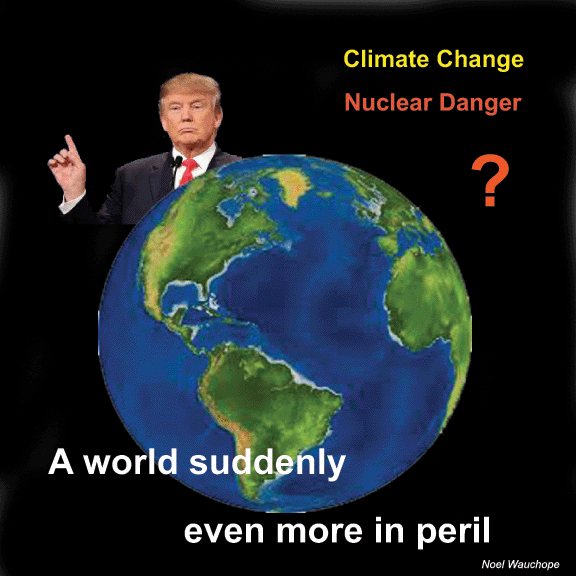 A second Trump term would mean severe and irreversible changes in the climate No joke: It would be disastrous on the scale of millennia. VOX, By David Roberts@drvoxdavid@vox.com Aug 27, 2020, I f Donald Trump is reelected president, the likely result will be irreversible changes to the climate that will degrade the quality of life of every subsequent generation of human beings, with millions of lives harmed or foreshortened. That’s in addition to the hundreds of thousands of lives at present that will be hurt or prematurely end.
This sounds like exaggeration, some of the “alarmism” green types are always accused of. But it is not particularly controversial among those who have followed Trump’s record on energy and climate change……..
………..a Trump victory would make any reasonable definition of “success” on climate change impossible….
More Trump will ensure the continued escalation of global temperatures
We know from the latest IPCC report that the climate target agreed to by nations — no more than a 2° Celsius rise in global average temperatures — is not a “safe” threshold at all. Going from 1.5° to 2° means many more heat waves, wildfires, crop failures, migrations, and premature deaths. We know that every fraction of a degree beyond 2° means more still, along with the increasing risk of tipping points that make further warming unstoppable. Continue reading
Two U.S.cities cut their losses, pullout of dodgy NuScam “small” nuclear reactor project
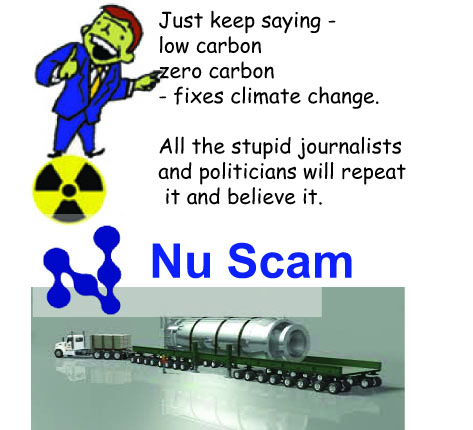 Lehi, Logan Back Out Of First-Of-Its-Kind Nuclear Power Plant Project Citing Financial Risk InKuer, By KATE GROETZINGER • 27 Aug 20, Two Utah cities have pulled out of a nuclear power plant investment — saying the financial risks are just too high. But 28 other towns and service districts in the state are still involved in the project, which is organized by a utility cooperative called Utah Associated Municipal Power Systems, or UAMPS. Lehi, Logan Back Out Of First-Of-Its-Kind Nuclear Power Plant Project Citing Financial Risk InKuer, By KATE GROETZINGER • 27 Aug 20, Two Utah cities have pulled out of a nuclear power plant investment — saying the financial risks are just too high. But 28 other towns and service districts in the state are still involved in the project, which is organized by a utility cooperative called Utah Associated Municipal Power Systems, or UAMPS.The Carbon Free Power Project involves a first-of-its-kind technology called “small modular nuclear reactors”, which would produce around 720 megawatts of nuclear energy. UAMPS and the U.S. Department of Energy have invested $3 million in the project since it began in 2017. But the reactors are still in development, and it’s unclear how much the project — and the power — will ultimately cost. That’s one reason the city of Logan cited in its decision to leave the project ahead of a Sept. 30 deadline to invest in its next phase, which is expected to cost $130 million. Logan was planning to use seven megawatts of power from the plant and has put around $250,000 into the project based on that amount so far. The city would have had to put in another $654,000 over the next three years to remain invested in the project. The cost could continue to grow, according to Mark Montgomery, director of light and power for Logan. He told the city council that Logan could end up having to pay millions into the project during the second phase of its licensing period, from 2023 to 2025……. Montgomery also cited concerns that it’s still up in the air whether the Department of Energy will invest in the project. The department pledged to fully fund the first reactor in 2018, but it went back on that deal. Now, it plans to invest $1.4 billion in the project — about a quarter of its total $6 billion price tag. That agreement is not yet final and the appropriation would need to be approved by Congress. The city of Lehi also voted to leave the project during a city council meeting this week. So far, Lehi has invested $455,000 in the project for a 21 megawatt subscription. Power Director Joel Eves said the project has struggled to find new investors, while its budget almost doubled to $6 billion from $3.4 billion since 2017. “A big piece of this is project subscription, and that does make us nervous,” Eves said. “It seems like we’re going at this alone as UAMPS members.” ……. https://www.kuer.org/post/lehi-logan-back-out-first-its-kind-nuclear-power-plant-project-citing-financial-risk#stream/0 |
|
Not all scientists are objective, especially nuclear scientists
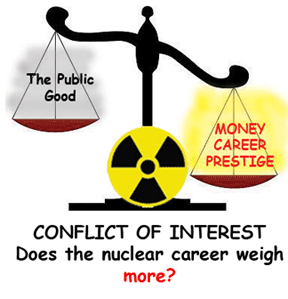
With a denier of science in The White House—whether it has to do with the climate crisis or Covid-19 and so on—there is a major push, including by Democratic officials, for making science the basis for governmental decision-making.
That’s completely understandable.
But what about the push by some scientists to politically further areas of science and technology which they favor? Science might be objective—but that doesn’t mean all scientists are.
Take Congressman Bill Foster.
Major holes in ozone hole treaty must be addressed to avert stronger climate change
 Experts reveal major holes in international ozone treaty https://www.eurekalert.org/pub_releases/2020-08/uos-erm082520.php
– 26-AUG-2020
Major holes in ozone hole treaty must be addressed to avert stronger climate change and serious risks to human health, experts warn
A new paper, co-authored by a University of Sussex scientist, has revealed major holes in an international treaty designed to help repair the ozone layer, putting human health at risk and increasing the speed of climate change.
Evidence amassed by scientists in the 1970s and 1980s showed that the depletion of the ozone layer in the stratosphere was one of the first truly global threats to humanity.
Chemicals produced through economic activity were slowly drifting to the upper atmosphere where they were destroying the ozone layer, which plays an indispensable role in protecting humanity and ecosystems by absorbing harmful ultraviolet radiation from the sun.
In 1987, countries signed up to a treaty to take reparative action, known as the ‘Montreal Protocol on Substances that Deplete the Ozone Layer, which was eventually ratified by all 197 UN member states.’
But in a paper published today in Nature Communications, experts have flagged major gaps in the treaty which must be addressed if the ozone layer is to be repaired and avert the risks posed to human health and the climate.
Professor Joseph Alcamo, Director of the Sussex Sustainability Research Programme and former Chief Scientist at UNEP, said: “The Montreal Protocol and its amendments have no doubt been an effective worldwide effort to control the toughest substances depleting the ozone. But our paper shows that the treaty has developed too many gaps to fully repair the ozone layer. It’s time to plug the holes in the ozone hole treaty.”
Professor Alcamo, along with lead author Professor Susan Solomon of Massachusetts Institute of Technology (MIT) and co-author Professor A. R. Ravishankara of Colorado State University, have identified several ‘gaps’ which consist of ozone depleting substances not covered in the treaty.
These include:
- Unaccounted for new sources of CFC and HFC emissions recently detected in the atmosphere.
- Leakages of ozone depleting substances from old air conditioners, refrigerators and insulating foams.
- Inadvertent releases of ozone-depleting gases from some manufacturing processes.
- Emissions of the ozone-depleting gas, nitrous oxide, stemming mostly from agricultural activities.
The authors have called for a range of solutions to plug the gaps including:
- A toughening of compliance with the treaty by using provisions that are already part of the Montreal Protocol.
- Boosting the effectiveness of the treaty by adding in regular environmental monitoring of ozone-depleting substances.
- Controlling the emissions of substances that have slipped through the treaty up to now, including nitrous oxide emissions from agriculture, and ozone-depleting substances leaking from old refrigerators and other equipment.
- In addition, because ozone-depleting substances and their substitutes contribute significantly to global warming, the authors urge a faster phasing out of all of these substances as a way of combatting climate change.
The ozone layer absorbs harmful ultraviolet radiation from the sun but this protective layer is slowly destroyed by industrial gases that slowly drift up from the earth’s surface including CFCs (chlorofluorocarbons) contained in refrigerants, foaming agents and, earlier, propellants in aerosol sprays.
Discovery of the ‘ozone hole’ above high latitudes in the 1980s provided final evidence of the importance of ozone depletion.
By 1985, countries had signed the Vienna Convention, which pledged to reduce CFCs and other ozone-depleting substances. Two years later, they signed the Montreal Protocol that laid out a plan of action.
During his time as the first Chief Scientist of UNEP, which hosts the Secretariat of the Montreal Protocol, Professor Alcamo coordinated groups of scientists in producing policy-oriented reports that addressed emerging ozone depletion issues.
UNEP reports that 98% of the chemicals targeted for removal in the Montreal Protocol had been phased out by 2009, avoiding hundreds of millions of cases of skin cancer and tens of millions of cases of cataracts. However, this new paper shows that some important sources were not targeted by the Protocol – and urgently need to be now.
Professor Alcamo said: “Since most ozone-depleting gases and their current substitutes are also potent greenhouse gases, it’s time to use the Montreal Protocol to draw down these gases even faster to help avoid dangerous global warming.
“We won’t be able to reach the global Sustainable Development Goals by 2030 without closing the gaps in the ozone treaty. It’s hard to imagine, for example, how the global health and climate goals could be reached without drastically drawing down all ozone-depleting gases and their substitutes. If we fail, humanity will have to face a higher risk of skin cancers and more rapid climate change.”
1 This month
7 April – WEBINAR – Australia and the Doomsday Clock – Preventing nuclear war through NoFirstUse and other policies
Online | Tuesday April 7, 4:00-5:30pm, Australian Eastern Time / 8:00-9:30am Central Europe Time
– Access the registration link
15 April – Zoom –Nuclear Power is Not the Solution
Apr 15, 2026 01:00 AM in Canberra, Melbourne, Sydney

Join the International Physicians for the Prevention of Nuclear War (IPPNW) on Tuesday, April 14th for a timely webinar exploring the risks associated with nuclear power and challenging the myth that it offers a simple, safe, carbon-free solution to the climate crisis

of the week – Australians for War Powers Reform (AWPR)
To see nuclear-related stories in greater depth and intensity
 Antinuclear
