Australians would be ill-advised to accept Turnbull’s “green” credentials
Flying the nuclear kite, The Guardian, 4 Nov 15 Malcolm Turnbull’s disagreements with former Prime Minister Tony Abbott over climate change were widely reported. Abbott is, at heart, a climate change denier who sought to do nothing about the looming disaster under cover of his “direct action plan”. Turnbull, still very much the merchant banker, wanted to tackle soaring emission levels with a market based “solution” of doubtful value that favours big corporations and dominant, capitalist economies. The new PM is still trying to promote a new, more sophisticated, post-Abbott image. Australia has a science minister again, for example, with Christopher Pyne adding the portfolio to a brace of others.
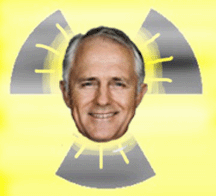 An indication of his approach and undeserved reputation on environmental issues was the recent appointment of Australia’s new Chief Scientist, Alan Finkel. The appointee projects a good image. His home is powered entirely by renewables. He looks forward to a fossil-fuel-free future and as speedy an exit for coal as possible. But Dr Finkel is also an advocate of nuclear power as part of the future energy mix in Australia.
The nuclear industry has never been popular in Australia. The ALP’s anti-uranium mining stance was broken by industry pressure, not popular demand. The Liberal Party has tip-toed around its pro-nuclear platform, which includes nuclear power generation. The Howard government got a fright in 2006 when it appointed former Telstra chief Ziggy Switkowski to review the nuclear power option. Zwitkowski’s recommendation for up to 25 nuclear power stations near major coastal cities had Howard & Co running for cover.
No doubt Dr Finkel will continue efforts in his new job for the rehabilitation of nuclear energy in the eyes of a public keen to embrace renewable sources such as wind and solar. The chief scientist’s last post was as Chancellor of Monash University. Academia has been a stomping ground for pro-nuclear advocates in recent times. Their voices have been added to those of obvious stakeholders, such as uranium mining companies. The industry has fallen on hard times following the Fukushima disaster. Naturally, people the world over don’t want to embrace that sort of risk…….
With the Paris Climate Change Conference due to start at the end of the month, it is looking very unlikely that the Turnbull government will bring anything to it that anyone would describe as “innovative”. It’s inevitable that the government, along with its senior allies, will trot out the same pro-corporate agenda that got the planet into the current predicament. It is up to the progressive people of the world to press hard for a future based on renewable energy sources and other changes that get to the core question of a new social system. Needless to say, this won’t be handed down from above. http://www.cpa.org.au/guardian/2015/1709/02-editorial.html
Nuclear energy – the Dream That Failed – Senator Scott Ludlam
Whether or not a commercial fusion / thorium / plutonium power industry ever emerges in the next 20 or 30 years would be irrelevant to the climate debate if not for the huge commitment of resources, expertise and time that are going into these new reactor types, and that is cash that’s not being spent on scalable, decentralised clean energy networks. Despite this, these are the technologies that are presently carving the epitaph on the headstone on the nuclear industry, the Dream that Failed.
 NUCLEAR NO ANSWER http://greens.org.au/magazine/national/nuclear-no-answer
Oct 29th, 2015
Nuclear power is the solution to a question no-one asked. Here’s why it is now known as “the dream that failed”. By Senator Scott Ludlam
The nuclear industry has been getting a fair bit of air time of late with the South Australian Royal Commission into the Nuclear Fuel Cycle and a well-credentialed new Chief Scientist throwing nuclear into the mix as part of the solution to climate change.
The anti-nuclear movement is something of a victim of its own success when these arguments roll around every few years. The last serious attempt to get a commercial plant built in Australia dates back to the Jervis Bay proposal in 1969. The proposal provoked fierce opposition, and the case fell apart in 1971 when Treasury finally got around to looking at the costs of the 500MW plant.
For subsequent generations, arguments against nuclear power probably still have a tinge of the 1970s about them. Particularly in the age of climate change, a new generation are querying whether opposition to the technology might be an ideological hangover that we can no longer afford.
It would be comforting if this were true, but it isn’t. The evidence shows the commercial nuclear sector is in terminal trouble, and its offers to deliver bulk, reliable ‘baseload’ energy are precisely the opposite of where global energy markets are heading. Continue reading
Australia’s chance for a new “mining” boom – mining the sun
Think outside the nuclear square: expert, 9 News 3 Nov 15
Would it be crazy for Australia to mine the sun for energy instead of going nuclear? A leading energy researcher says things that sound crazy now might be better investments in the nation’s energy future.
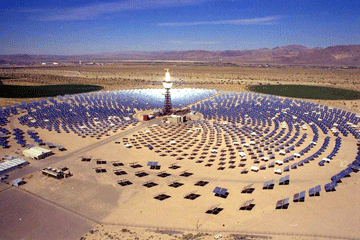
Professor Vassilios Agelidis, director of the Australian Energy Research Institute at the University of New South Wales, says Australia lacks the expertise to support a nuclear industry, meaning it would have to import everything except the uranium.
Australia could, for example, create a new solar-to-hydrogen export industry, Prof Agelidis said, if it had a strategic, visionary approach.
Building large-scale solar in the middle of the country and using the electricity generated and piped-in water to create hydrogen for fuel cells is one example of the potential for energy innovation.
“It’s like mining but like mining the sun,” Prof Agelidis said……..http://www.9news.com.au/national/2015/11/03/11/13/think-outside-the-nuclear-square-expert#lAlcLQ5rSwf804pk.99
Climate change goal posts have changed everywhere, except Australia
 Now, Australia is nearly the only industrial nation that for Paris has pledged emissions reductions that wouldn’t even bring down its emissions significantly below the 1990 level by 2030. And it does not have the policies in place that would deliver even those modest reductions. Australia thus has much scope to improve – and it has fantastic renewable energy resources that make every German envious.
Australia must step up on emission cuts to rejoin world’s enlightened countries, SMH, November 3, 201 Stefan Rahmstorf
The climate change goal posts have long been changing everywhere, except Australia..……Worldwide, 19 per cent of our energy now comes from renewable sources and growth in these industries is exponential, not linear. Last year half of all global energy investments were in renewables, led by China. This momentum suggests that investments in fossil fuels will collapse worldwide in the coming years as investors realise they’d risk massive stranded assets.
The numbers are also in on the true costs of transitioning to renewable energy worldwide. We can afford it. About US$500 billion a year is spent looking for new fossil fuel deposits. That’s about the same amount of money we need to invest in renewable energy to keep global warming below 2 degrees. On top of that there’s some US$500 billion in various government subsidies to fossil fuels. Continue reading
Greg Hunt’s renewable energy backflip
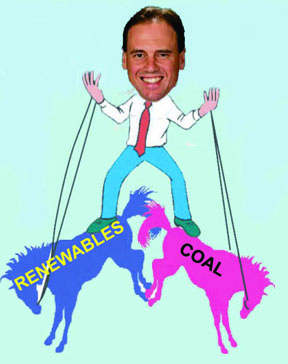 Greg Hunt does backflip on future of renewables in Australia http://www.news-mail.com.au/news/a-turnaround-in-the-hunt-for-renewables/2828865/3rd Nov 2015 ENVIRONMENT Minister Greg Hunt has rejected the long-standing duel between the economy and the planet in a speech in China.
The speech by Mr Hunt comes as the Turnbull government looks to reset Australia’s fall from grace in diplomatic and scientific circles over climate change.
He told a clean energy meeting on Tuesday he recently created a new Office of Climate Change and Renewables Innovation, as part of a “positive agenda”.
Mr Hunt said we are “transforming the way we produce electricity”, as “older coal plants retire, a process which has started”.
Despite previously attempting to abolish the national renewable energy agency and the Clean Energy Finance Corporation when Tony Abbott was prime minister, Mr Hunt promoted the bodies as where Australia “excels” on climate change.
Politicians’ ‘blinkered thinking’ in favouring nuclear industry – Bob Brown
 Keep nuclear out of our backyard by Bob Brown, 1 Nov 15 http://www.afr.com/opinion/letters-to-the-editor/keep-nuclear-out-of-our-backyard-20151031-gknvq7 Proposals for a nuclear reprocessing hub in South Australia, apparently gaining in both Coalition and Labor support, will be sorely tested in the coming and inevitable public debate.
This is a thinly disguised plan for the first nuclear power stations and a reprocessing plant on Australian soil. Such reactors and plant will require public subsidies unless, as in the latest British project, a foreign entity like China helps foot the bill. China and Japan are at the heart of the South Australian proposals. When Prime Minister John Howard tested the waters of public opinion on nuclear power stations – without the China or Japan factor – his retreat was swift and total.
The idea is to store nuclear waste above and below ground somewhere in the Outback – that is, on Aboriginal land. Besides raising questions of transporting the waste, what of the morality of dumping such toxic material in someone else’s yard? If so safe, why not put the nuclear hub in Adelaide or Canberra, let alone the Chinese, Japanese, Taiwanese, Indian, British or French countrysides?
We are in an age of handbag-sized nuclear weapons. International terror organisations see these as the Holy Grail. In the coming century of unprecedented human dilemmas, a nuclear Australia will inevitably become a more attractive focus and target for such organisations, as well as for hostile foreign governments.
With rapid innovation and cost reduction for both energy efficiency and renewable energy, the South Australian proposal is not just unnecessary, it is a case of blinkered thinking, foreign pressure and big dollars getting in the way of a clear-eyed national strategy for Australia’s future independence, security and lifestyle.
At least one woman had the guts to confront Turnbull over his pro #nuclear stance
 Malcolm Turnbull comes up against criticism over nuclear waste management stance, ABC News, 30 Oct 15 By political reporters Jane Norman and Anna Henderson Prime Minister Malcolm Turnbull has been confronted by a woman questioning his stance on nuclear waste management, as the debate over nuclear energy in Australia heats up again.
Low and intermediate level waste from nuclear medicine and research is being held at more than 100 facilities around the country, and the Federal Government is set to release a shortlist of potential sites for a national radioactive waste dump by the end of the year.
During a trip to Tasmania, Mr Turnbull was asked why there were plans to have “spent uranium buried in our backyard”.
His questioner said Australia should not develop nuclear power, and should put more money into wind and solar energy instead……
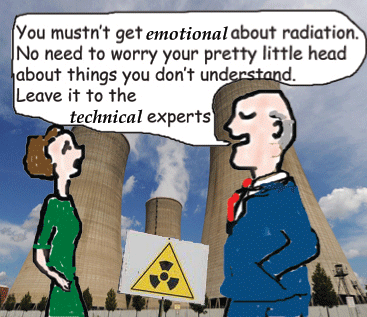
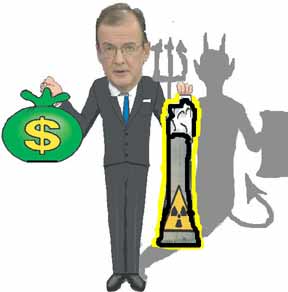 Meanwhile, high profile nuclear energy advocate Ziggy Switkowski has lamented the time Australia is taking to establish a national radioactive waste dump, saying it “reflects poorly” on the nation………http://www.abc.net.au/news/2015-10-30/malcolm-turnbull-questioned-over-nuclear-waste-management-stance/6900128
Prince Charles to Australia to speak on climate change
Prince Charles pushes for a carbon price before his visit to Australia, SMH, October 30, 2015 Nick Miller London: Prince Charles has said putting a price on carbon is a vital part of addressing climate change, setting him on a potential collision course with his hosts during his November visit to Australia.
Last year Australia became the first developed nation to repeal a carbon price scheme.
The Prince of Wales, for decades a campaigner for conservation and ecological causes, has emerged as a keen mediator on climate change in the lead-up to December’s COP21 in Paris – the United Nations summit intended to draw up a new global climate change action plan.
On Thursday in London he convened a high-level meeting on deforestation and climate change at Lancaster House, next door to the prince’s home and office, Clarence House……
The prince is due to speak on climate change on November 12 in Sydney, at a roundtable discussion hosted by CISL.
The day before he will meet with new Prime Minister Malcolm Turnbull in Canberra……. http://www.smh.com.au/environment/climate-change/prince-charles-pushes-for-a-carbon-price-before-his-visit-to-australia-20151029-gkmf9x.html#ixzz3pzt7BZdd
PM Turnbull’s deceptive answers on coal and climate change – Senator Larissa Waters
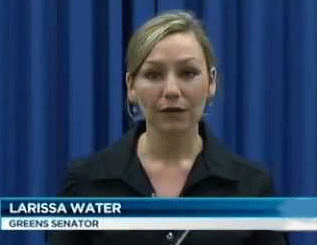 Senator Larissa Waters, Greens Deputy Leader & climate change spokesperson:
PM dodges coal moratorium question and says coal will relieve energy poverty
http://larissa-waters.greensmps.org.au/content/media-releases/pm-dodges-coal-moratorium-question-and-says-coal-will-relieve-energy-poverty 27 Oct 15:
“The Prime Minister has failed to properly respond to today’s admirable call by 61 eminent Australians for an international moratorium on new coal mines to be negotiated at the Paris climate talks. Senator Larissa Waters, Australian Greens Deputy Leader and climate change spokesperson, said:
“The group of eminent Australians are calling for an international moratorium on new coal mines and for this to be put on the agenda in Paris. “But when asked about the call, the Prime Minister
mischaracterised it as one for ending existing coal mining in Australia, and avoided answering the real call for no additional, new coal mines.
“Australians deserve more than a Prime Minister who sidesteps questions about our future and that of our children and our Pacific neighbours. Coal must not be treated as the elephant in the room at the climate talks.
“Standing next to our new chief scientist, who had just outlined his vision for a zero emissions future, the Prime Minister repeated the coal lobby’s mantra that coal will relieve energy poverty, which is factually incorrect given the lack of electricity grid and the expense of coal.
“In contradiction, the Prime Minister then correctly said in developing countries where people are not connected to the grid, solar was a cheaper option than coal. … “
Turnbull tangled in knots over climate change and coal policy
Malcolm Turnbull is a good debater, and in a democracy words and arguments matter. But sophistry cannot conceal the simple mathematics of climate change. We need to burn less fossil fuels, and no rhetoric can conceal the simple economics that you don’t need more mines to make less coal.
 Turnbull fails debate, economics and science with dumb coal defence, Crikey
DR RICHARD DENNISS | OCT 28, 2015
Malcolm Turnbull doesn’t seem to understand the basic laws of the market — or the science of climate change, writes Dr Richard Denniss, chief economist at The Australia Institute.
Malcolm Turnbull either doesn’t understand how global commodity markets work or he is betting that most Australians don’t. Either way, the PM’s#coalisamazing moment yesterday was not a great way to start a new conversation about the reality of the Australian economy and the choices we face.
The Prime Minister dismissed calls for a global moratorium on new coal mines from the likes of Sir Nicholas Stern and former Reserve Bank boss Bernie Fraser by saying a moratorium was “not sensible from an economic point of view”. Let’s be clear, Nicholas Stern and Bernie Fraser are economists; the Prime Minister is not…….
Echoing the lines of the Minerals Council of Australia and his Resources Minister Josh Frydenberg, Mr Turnbull also went on to argue that exporting coal was ‘an absolutely critical ingredient’ in alleviating hunger and world poverty.
The Prime Minister’s debating skills are widely renowned, but while clever arguments might win court cases they don’t solve real world problems like climate change. Sadly for those hoping that our public debate might have turned a corner under our new PM, if we break his arguments down we see that not only are they flawed, they aren’t even that clever. Continue reading
Malcolm Turnbull not keen on nuclear power, but keen on nuclear waste import
Malcolm Turnbull sceptical about need for nuclear power plants in Australia, consults with ‘Brett the chef’, ABC News 27 Oct 15 By political reporter Anna Henderson Prime Minister Malcolm Turnbull has expressed reservations about whether Australia will need a French-style nuclear power industry, despite acknowledging there is support for further investigation into the technology in South Australia.
South Australian Premier Jay Weatherill set up a royal commission in March to undertake an independent investigation into the state’s participation in the nuclear fuel cycle.
In Adelaide for a day of media events, Mr Turnbull was asked for his view in an interview with local radio station 5AA……..
a lot of South Australians feel like this, and it’s a perfectly reasonable view, is we’ve got the uranium, we mine it, why don’t we process it, turn it into the fuel rods, lease them to people overseas?
“When they’re done, bring them back and we’ve got very stable geology in remote locations and a stable political environment and store them.
“That is a business that you could well imagine here.”
Mr Turnbull went on to lay out his view of the future of widespread nuclear power in Australia.
“Would we ever have a nuclear power station in Australia? Or like the French do, dozens of nuclear power stations?” he said.
“I would be a bit sceptical about that and I’m not talking about the politics.”
Mr Turnbull said Australia was already using more affordable sources of energy, including coal, gas, wind and solar……..http://www.abc.net.au/news/2015-10-28/turnbull-sceptical-about-need-for-nuclear-power-plants/6891580
Malcolm Turnbull on a tricky tightrope
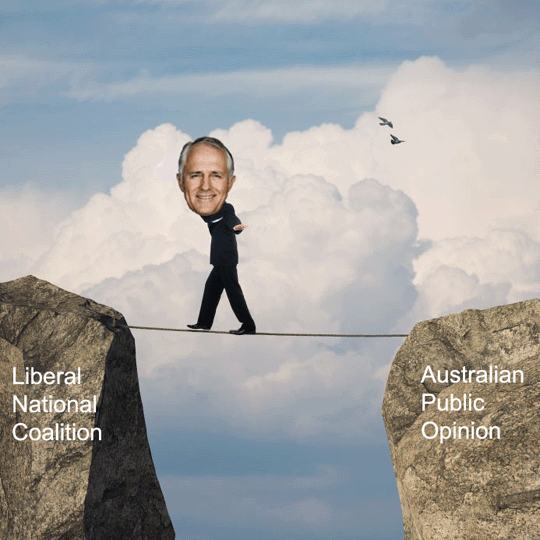
61 eminent Australians — including a science Nobel Laureate, Peter Doherty, and Australian of the Year for her service to medicine, Fiona Stanley — had issued an open letter urging world leaders to place a moratorium on new coal mines and expansions.
Meanwhile The Australian newspaper reveals that the Prime Minister is facing an internal push from some of his Liberal National colleagues, led by Nationals senator Matt Canavan, to push through with legislative amendments removing the right of environmental groups to mount legal challenges to environmental approvals such as what occurred in relation to Adani’s huge Carmichael coal mine. Continue reading
AUSTRALIA UNDER HEAVY CRITICISM FOR NUCLEAR AGREEMENT WITH INDIA
 By Neena Bhandari | IDN-InDepthNews Analysis SYDNEY (IDN) 27 Oct 15 – Though the Australian Parliament has not yet ratified the Australia-India Nuclear Cooperation Agreement signed in 2014, civil society, environment and disarmament advocates caution that sale of uranium to India would fuel a nuclear arms race in the region and undermine Australia’s strong credentials as an exponent of nuclear safeguards policies.
The International Campaign to Abolish Nuclear Weapons (ICAN) Australia has expressed grave concerns regarding the weak safeguards in the Agreement, the poor safety record at Indian nuclear facilities, and the implications of the Agreement for the nuclear non-proliferation regime. This is the first time the Australian Government would be selling uranium to a country that is not a signatory to the nuclear Non-Proliferation Treaty (NPT). Continue reading
The Next Boom A Surprise New Hope for Australia’s Economy?
http://www.futurebusinesscouncil.com/thenextboom/
Across Australia and around the world, demand for sustainable goods and services is booming. The Future Business Council has tracked the performance of leading sustainable goods and services since the turn of the century. We found compelling evidence that sustainability should not be seen as a cost, but a business opportunity. From solar panels to green buildings and sustainable agriculture, the results are striking and represent a significant new economic growth story.
The Next Boom represents a major opportunity for businesses to become sector leaders in Australian and international markets. At the national level, there is a once in a lifetime chance for Australia to position itself among the world’s leading suppliers of sustainable goods and services, capturing a share of the trillions of dollars that will be invested to meet the explosion in demand.
The rest of the world is not sitting idly by. Australia must do much more to develop new industries and support companies making the transition to more sustainable business models if it is to compete for a share of these fast-growing markets.
Turnbull’s biggest economic challenge is Climate Change
Climate policy looms as Turnbull’s greatest economic challenge, ABC News 26 Oct 15 By Ian Verrender The climate of fear may slowly be lifting after Tony Abbott’s relegation to the political bleachers but the fear of climate persists within the Government.
With little more than a month to go before the 2015 United Nations Climate Change Conference in Paris, we find ourselves in the awkward position of being one of the few developed nations swimming against the tide.
Earlier this month, International Monetary Fund chief Christine Lagarde suggested nations give serious consideration to implementing a carbon tax, rather than cap and trade market-based emission programs.
“It is just the right moment to introduce carbon taxes,” she told delegates at the annual meetings of the IMF and World Bank in Lima, Peru…….
Faced with a structural budget deficit, the Abbott government, in its infinite wisdom, decided to rid itself of a roughly $6 billion a year source of income from the carbon tax and replace with a $2.88 billion spending program over four years.
It was a decision that recoils from everything for which a Coalition government purports to stand.
Apart from the fiscal recklessness, which blows out the deficit and adds to national debt, it has shifted away from a pricing policy to one of heavy handed government intervention.
The Direct Action policy is nothing more than a subsidy for polluters with the tab being picked up by taxpayers.
Abbott politicised climate change, instilling fear into the electorate about the cost of a carbon price to business and consumers without ever being brought to task over the cost to taxpayers of his subsidy program.
His former comrades in arms are still at it. Last month Barnaby Joyce launched into a familiar rant on the ABC’s Q&A, claiming Direct Action was “vastly cheaper and vastly more effective”…..But where is the evidence that it is cheaper? Or more effective? In fact, the studies say the opposite. More on that later…….
Academic studies overwhelmingly reject Direct Action as an efficient or effective way to reduce carbon emissions in the long term.
A study by the Australian National University’s Crawford School found that the Gillard government’s carbon tax cut emissions from the electricity sector alone by between five and nine million tonnes a year while it was in operation. Once it was lifted, emissions began rising again.
And that’s the point. A pricing mechanism works permanently across the economy. A subsidy, on the other hand, may simply produce a one-off effect in one industry while other industries lift emissions….
Then there’s the Government’s very own Productivity Commission study back in 2011, which examined a range of emissions reduction programs around the world.
In its study of eight other countries’ carbon reduction policies, it concluded that a price on carbon was the cheapest way to go……Will Turnbull be able to bring a rational economic approach to climate policy? It is likely to be his greatest challenge as Prime Minister.http://www.abc.net.au/news/2015-10-26/verrender-the-economics-of-climate-change/6883938
1 This month


Help Aunty Sue Protect Her Land and Sacred Sites From Destructive Rocket Testing.
.

Australians deserve the truth
about
AUKUS – https://aukuspublicinquiry.com/

PETITION – To: Prime Minister Anthony Albanese and the Australian Labor Government

of the week – Australians for War Powers Reform (AWPR)
To see nuclear-related stories in greater depth and intensity

