Abbott govt effectively stall renewable energy as talks drag on
Hot air can be even more expensive than renewable energy, Financial Review, y Jennifer Hewett, 17 Mar 15 “……….CERTAINTY, PREDICTABILITY REQUIRED
Joaquin Mollinedo, chief institutional relations officer of Acciona, says that the company simply requires certainty and predictability before it can proceed with any investment decisions.
That doesn’t seem too much to ask. Apparently, it is in Australia. This is even more perplexing for European companies participating in the global trend towards greater use of renewable energy.
Australian industry is still hoping for an imminent breakthrough after months of negotiation between Labor and the government to try and reach a compromise on a lower number of gigawatt hours. This would include exemptions for heavily emitting industries such as aluminium, cement making and steel – which would otherwise face high penalties.
But any deal is still elusive…….http://www.afr.com/opinion/columnists/hot-air-can-be-even-more-expensive-than-renewable-energy-20150316-1m0f8s
Tortuous progress between Labor and Coalition on deal about Renewable Energy Target
 Labor and Coalition inch towards deal on renewable energy target Guardian, Lenore Taylor, 15 Mar 15 Opposition leader Bill Shorten talks up the urgency of a deal as cabinet meets to consider report on the lack of progress on reaching an agreement The Labor leader, Bill Shorten, has convened a meeting of the renewable energy industry on Monday in an apparent attempt to gather support to put a compromise position to the Abbott government over the renewable energy target.
Also on Monday, cabinet will discuss a joint letter from the environment minister,Greg Hunt, and the industry minister, Ian Macfarlane – effectively an update on the lack of progress in the RET negotiations…….
Renewable industry sources expect Shorten will use the meeting to try to reach an agreed position on a compromise to put to the government – higher than its current 31,000-gigawatt- hour stance but lower than Labor’s previous position. A compromise could possibly be around 34,000 gigawatt hours.
The chief executive of the clean energy council, Kane Thornton, said the government’s current position was “clearly unacceptable to industry”.
Shorten has invited industry, union and renewable energy representatives to his Monday summit.
As well as the overall target, industry has been urging the government to deal with a glut of renewable energy certificates in the market, perhaps by extending the end date of the scheme. http://www.theguardian.com/environment/2015/mar/15/labor-and-coalition-inch-towards-deal-on-renewable-energy-target
Bill Shorten to host summit on Renewable Energy Target
Shorten to host RET summit BILL Shorten will today meet unions, business groups and the clean energy industry on the renewable energy target. (subscribers only)
http://www.theaustralian.com.au/national-affairs/bill-shorten-to-host-a-summit-on-finding-a-compromise-on-ret/story-fn59niix-1227263839307
Toro Uranium CEO Vanessa Guthrie hanging out for that distant day when uranium prices might rise
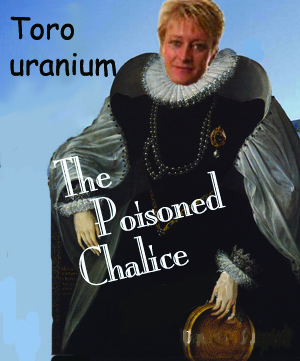 Toro Energy Managing Director Dr. Vanessa Guthrie Says Be Patient and Persistent in Tough Times, Uranium Investing News,March 13, 2015, Toro Energy Ltd. (ASX:TOE) Managing Director Dr. Vanessa Guthrie says what makes Toro Energy stand out from any other uranium company in its class is that, “we are the only project approved, ready to go, and the most advanced in terms of engineering and resource studies in Australia. [And]
all we are now waiting for is the time to come back… the market to come back, with the uranium price, which will actually put Wiluna into production.” In the last 12 months, major funds have invested in Toro Energy: $5 million from RealFin Capital Partners, and a $20 million investment from The Sentient Group.http://uraniuminvestingnews.com/
South Australia warned on the risks of the nuclear industry
‘Don’t underestimate risks’: Fukushima investigator’s words of advice for South Australia’s nuclear industry, SMH 13 Mar 15, A Fukushima nuclear disaster investigator has warned South Australians to consider risks carefully before getting involved in an expanded nuclear industry.
A royal commission will look into the potential to expand South Australia’s role in the nuclear industryfrom next week and will include the consideration of power generation.
Professor Nobumasa Akiyama was a member of the independent investigation panel into the triple nuclear meltdown at Fukushima, Japan, four years ago this week, which started following damage caused by a tsunami.
Some 120,000 people are still unable to return to their homes because of high radiation levels.
Professor Akiyama had a word of warning for South Australians. “Think about the unthinkable,” he said.
“I think that’s the important principle, to think about the risk of the nuclear power plants.”
He said Japanese people had underestimated the risk…… “In the case of Japan, people experienced the Chernobyl and Three Mile Island accidents, but saw it as the accidents of others.
“A nuclear accident anywhere is a nuclear accident everywhere.”
New South Wales election candidates called upon to declare their policy on wind farms

 Wind farm industry weighs into New South Wales election campaign http://www.abc.net.au/news/2015-03-13/wind-farm-industry-weigh-into-nsw-election/6314658 ABC Rural By Michael Condon The wind farm industry has called on all New South Wales election candidates to declare whether or not they support wind farms being built.
Andrew Bray, national co-ordinator of the Wind Alliance, said wind farms were a perfect fit on many farms and could really boost jobs and economic activity in rural areas.
“Voters have the right to know how the candidates stand on wind farms and whether they will support wind turbines being built,” he said. “New wind projects are really drivers for regional economies.
“There is a real strong natural wind resource around New South Wales and that wind resource can be developed and harnessed to create jobs and also to provide energy that is clean and not damage 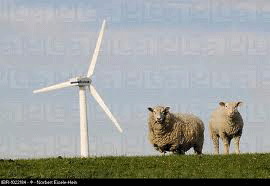 farmland.
“Wind farms coexist really well with grazing, in particular, and it doesn’t use water and it is no threat to the water table, compared with coal seam gas or mining operations.
“It is the kind of energy-producing technology that can work well with farming land.”
Mr Bray said wind farms were supported by candidates of all political persuasion, not just the Greens or Labor. Federally Queensland Coalition MP Warren Enstch had been very supportive as had Rob Stokes, a NSW state Liberal.
South Australian government to publish submissions on Terms of Reference for Royal Commission on Nuclear Power

13 Mar 15 From the Attorney Generals’ Department, South Australia
the Government proposes to publish submissions received through the AGD:Submissions mailbox which have not been marked ‘confidential’, in the very near future.
South Australia’s Nuclear Royal Commission – an undemocratic device for a fake nuclear approval
 Dennis Matthews, 13 Mar 15 David Penberthy is correct when he says “the debate in South Australia right now clearly isn’t about the production of nuclear weapons” (The Advertiser, 13/3/15). This is because, thanks to the Premier and his mates in the nuclear industry, debate about such distasteful facts as nuclear weapons and the nuclear industry’s disastrous past is being gagged by the terms of reference of the Royal Commission.
As the name implies, the farcical Royal Commission has all the hallmarks of an undemocratic device to put a fake seal of approval on a done-deal within the reigning Labor-Liberal duopoly.
Just look at the pitiful parade of nuclear junkies appearing before various government committees and being thrust on the public through the commercial media. Some of these even have the gall to claim to not be pro-nuclear despite a history to the contrary.
This travesty of a debate doesn’t alter the facts which, as has happened in the last two Queensland elections, are likely to bite devious politicians where it hurts most.
Greens could do well in New South Wales election – Abbott and Baird beware!
 Tony Abbott, Mike Baird at risk of being washed away by Greens
THE Greens tsunami that has seen the minor party seize state and federal seats in Melbourne could be repeated in NSW. – (subscribers only)
http://www.theaustralian.com.au/national-affairs/tony-abbott-mike-baird-at-risk-of-being-washed-away-by-greens/story-fn59niix-1227257520728
Former New South Wales Governor condemns loss of farmland for mining
NSW state election 2015: Marie Bashir lashes out at loss of farmland for mining SMH, March 10, 2015 Former NSW governor Marie Bashir says the destruction of fertile Australian farmland for mining is a “crisis” that must stop, adding: “I have never been so emphatic or political in my life”.
It is the first time Dame Marie has spoken out against mining after 13 years in the traditionally apolitical role of NSW governor. The beloved dame, who retired late last year, also said her fears about foreign ownership of Australian land bring out her “nasty side”.
The conflict between faming and mining, including coal seam gas, has become a defining election issue in regional NSW, and may heavily sway results in seats on the north coast and in western NSW.
Speaking at an International Women’s Day event in Sydney on Sunday, Dame Marie said Australia was in the incredible position of being able to “help to feed the world”.
“And of course, what is the counter to that? Digging up precious farm land for coal …
Dame Marie said the situation was “a clarion call” to women, adding “I couldn’t be more passionate about a cause than this one. We must do something to protect our food-producing land”……
NSW Labor wants a permanent ban on coal seam gas in the Northern Rivers region. Labor leader Luke Foley said last week the region’s farm industries “depend on the purity of the fertile land and the purity of clean water. Both of those are at risk from coal seam gas.”
Australia’s role in fuelling nuclear trade, and in contributing to Fukushima’s catastrophe
At this fourth anniversary it is time for Australia to stop making excuses and promises and start taking real steps to identify the costs and consequences of our role in fuelling the global nuclear trade.
Fukushima four years on – what lessons has Australia learnt? Fukushima remains a profound human, economic and environmental tragedy – and Australian uranium exports must shoulder some of that blame. SBS News By David Sweeney 11 MAR 2015 Four years ago this week the world held its breath as the nuclear emergency at the stricken Fukushima nuclear complex dominated our screens and headlines. The vision of smoke billowing from reactor 4 as it teetered on the edge of meltdown remains frighteningly vivid today.
On March 11, 2011 the earthquake and tsunami that ripped through much of Japan’s eastern seaboard also ripped through the Tokyo Electric Power Corporation’s (TEPCO) Fukushima-Daichi nuclear complex.
Later that year came confirmation from Canberra that the nuclear meltdown in Fukushima had its beginning in the back of a large yellow truck in Australia.
Giving evidence to a Parliamentary Committee in October Dr Robert Floyd, the head of Australia’s nuclear safeguards office stated: we can confirm that Australian obligated nuclear material [uranium] was at the Fukushima Daiichi site and in each of the reactors.
So radioactive rocks dug up in northern South Australia and Kakadu are the source of the Fukushima fallout threatening Japan and far beyond.
Fast forward to 2015 and at the end of this week – aptly enough on Friday the 13th – public comment closes on the South Australian state governments new Royal Commission into all things nuclear.
In the shadow of Fukushima – a continuing crisis directly fuelled by Australian uranium – it is important that the experiences lived and the lessons learned are not forgotten or ignored.
But it seems that not many in decision making positions in either Australian governments or uranium corporations are in a mood for listening. Following Fukushima the United Nations Secretary General initiated a system wide study into what happened and what is needed to avoid any future Fukushima’s.
One aspect of this review with particular relevance to Australia was the Secretary General’s call for ‘an in-depth assessment of the net cost impact of the impacts of mining fissionable material [uranium] on local communities and ecosystems’.
Hardly too onerous or unreasonable: Australian uranium had just fuelled a category seven nuclear disaster, the highest international crisis level – and all the promises of best practise and highest standards were looking as shabby as the Fukushima containment vessel – surely a review of practises and processes was warranted.
Not according to the Australian Uranium Association, or the two major uranium producers BHP Billiton and Rio Tinto, or any state, territory or federal government.
No review or in-depth assessment has ever taken place. There have been numerous politicians prepared to rally in support of the under-performing uranium sector or to talk up future prospects for nuclear power – but not one politician or uranium industry leader has had the courage, capacity or courtesy to fulfil Ban Ki Moons modest request……. Continue reading
Driving Aboriginals off their land is genocide
Of ‘lifestyle choices’ and genocide, John Passant, 11 Mar 15
“……..Our beloved PM thinks that Aboriginal people living on their land and that of their ancestors is a ‘lifestyle choice’. Racist shit that he is.
Let’s not pussy foot around. Driving Aboriginal people off their land is genocide. It has been going on since 1788 and this closure of up to 150 settlements in WA is the latest instalment.
I know of some lifestyle choices we do endlessly and needlessly support. The top ten percent of income earners get almost 1/3 rd of the superannuation tax concessions, all up about $15 bn revenue forgone a year. That would fund better services for remote communities.
And speaking of remote communities, the Abbott government and Shorten Labor Opposition are the two communities totally removed from the reality of every day life for most workers and the poor. Why do we endlessly subsidise politicians in their lifestyle choices?
Australia’s Prime Minister is an ignorant racist pig heading up a genocidal government and system.” http://enpassant.com.au/
In South Australia, don’t mention Maralinga, Rum Jungle, Radium Hill, Chernobyl, Fukushima …..
 Dennis Matthews. 7 March 15 Isn’t it fascinating how the nuclear industry and it’s fellow travellers are so sensitive about the industry’s past and present performance and want us to concentrate on some idyllic, non-existent, waste-free, nuclear weapons-free, mirage.
Whatever you do don’t mention Maralinga, or Rum Jungle, or Radium Hill, or radioactive emissions and leaks at Roxby Downs, or underground acidic leach mining of uranium in SA, or Three Mile Island, or the on-going tragedies at Chernobyl and Fukushima, or a host of lesser publicised “incidents”, let’s all forget that nasty, distasteful stuff (ugh!), let’s be positive, let’s waffle on about what might be possible in some far-distant future.
Talk about fairies at the bottom of the garden!
As a history professor is reputed to have told his students “those of you who fail to learn from history will, at the very least, have to repeat this course.”
On this basis alone the nuclear lobby would score a big fat F.
BHP supports a price on carbon (I bet they want to exclude uranium mining)
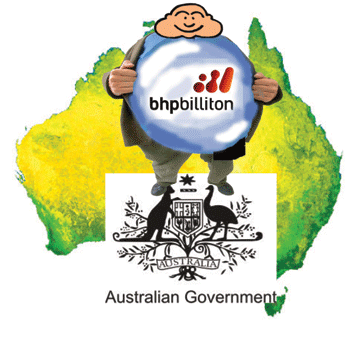 BHP demands ‘rules’ of the carbon game
BHP Billiton is looking to increase its investment in low-emissions technologies and has called for clarity from governments on climate change policy, saying “we want to know what the rules of the game are and get on and play”. …
BHP is a long-time supporter of political action on climate change, but only on specific terms.
The miner backed the Abbott Government’s decision to repeal the Gillard government’s carbon tax. However, BHP supports a price on carbon.
Financial institutions behind the push for nuclear expansion in South Australia?
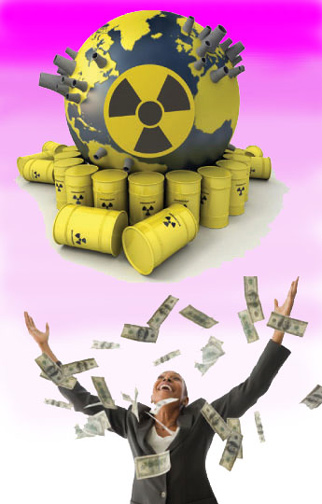 NoNukes 5 Mar 15 It is important to realise that World Finance is totally for promotion of Uranium mining and Nuclear energy in South Australia and everywhere beyond.
This is probably one of the factors behind the scenes of the SA State Bank disaster a few decades ago :
World Finance wanted to make the People of South Australia feel and think more “beholden” (in debt) to World Finance and the “way” to make up the debt and have the better credit rating was to
INCREASE URANIUM MINING
however
When Diggers Dig Uranium it causes Nuclear Disasters
and Diggers Nuclear Disasters can become a Nuclear War
and a Diggers Nuclear War can become a World Race War
and a Diggers World Race War can become NO MORE WHITE PEOPLE
so NO thanks to Diggers Digging Uranium…
1 This month


Help Aunty Sue Protect Her Land and Sacred Sites From Destructive Rocket Testing.
.

Australians deserve the truth
about
AUKUS – https://aukuspublicinquiry.com/

PETITION – To: Prime Minister Anthony Albanese and the Australian Labor Government

of the week – Australians for War Powers Reform (AWPR)
To see nuclear-related stories in greater depth and intensity

