We’ve been electing governments that damage our children’s future
The Age, Ross Gittins, 18 Aug 20,“……….the plain truth is that one way governments have got themselves elected and re-elected in recent decades has been to pursue policies that favour the old and don’t worry about the young.
Politicians have been tempting us to put our immediate interests ahead of our offspring’s future – and it’s worked a treat.
This week the Actuaries Institute of Australia published a new index of intergenerational equity, which compares the “wealth and wellbeing” of people aged 65 to 74 with that of people aged 25 to 34 between 2000 and 2018.
Note that this is before any effect of the coronacession……..
This week the Actuaries Institute of Australia published a new index of intergenerational equity, which compares the “wealth and wellbeing” of people aged 65 to 74 with that of people aged 25 to 34 between 2000 and 2018.
Note that this is before any effect of the coronacession.
…….their greatest loss (sure to grow in coming years) is from the deterioration in the natural environment: rising carbon emissions and temperatures, the drying Murray-Darling Basin and declining biodiversity.
And all these trends before the likely weak and prolonged recovery from the coronacession scars the careers and lives of another generation of education-leavers, without governments or voters being too worried about it. https://www.smh.com.au/business/the-economy/we-ve-been-electing-governments-that-damage-our-children-s-future-20200818-p55mrj.html
Small Nuclear Reactors – NuScam an expensive pipe dream

Look Over There! Jason Kenney’s Phoney Nuclear Power Distraction Why the Alberta premier’s small nukes pipe dream  makes no economic sense., David Climenhaga 14 Aug 20, | TheTyee.ca
When Alberta Premier Jason Kenney says small nuclear reactors “could be a game changer in providing safe, zero-emitting, baseload power in many areas of the province,” as he did this week in a tweet, he’s pulling your leg…….
No electrical utility is ever going to buy one unless they are forced to by government policy or regulation — the kind of thing Alberta’s United Conservative Party purports to oppose……..
Small nuclear reactors are not as cheap to build as the premier’s fairy tale suggests.
Bringing an acceptable small nuclear reactor design all the way from the drawing board to approval by a national nuclear regulatory authority will cost hundreds of millions of dollars.
While dozens of speculative companies are printing colourful brochures with pretty pictures of little nukes being trucked to their destinations, very few are serious ventures with any possibility of building an actual reactor. The United Nations International Atomic Energy Agency says diplomatically there are about 50 concepts “at different stages of development.” Those that are serious, like NuScale Power in the United States, have huge amounts of government money behind them.
The only small nuclear reactor plant known to be operating in the world now is the Akademik Lomonosov, Russia’s floating power barge with two 35-megawatt reactors aboard. From an original estimate of US$140 million in 2006, its cost had ballooned to US$740 million when the vessel was launched last year.
The kind of small reactors Kenney is talking about won’t be cheap by any yardstick.
Small reactors are less economical to run than big reactors…….
This is why nobody wanted to buy the scaled-down CANDU-3 reactor, development of which was paid for by Canadian taxpayers in the 1980s. At 300 megawatts, they were just too small for commercial viability. A working CANDU-3 has never been built.
The cost of small reactors would have to come down significantly to change this. And remember, the research and development requirements of small reactors are just as high as for big ones. With nobody manufacturing modules, there are no existing economies of scale. In other words, dreamy brochures about the future of small reactors are just that — dreams.
By the way, in 2011 the Harper government privatized the best commercial assets of Crown-owned Atomic Energy of Canada Ltd. to… wait for it… SNC-Lavalin Group Inc. Think about that every time you hear Conservatives in Ottawa screeching about the goings on at SNC-Lavalin!
Small reactor designs mostly require enriched uranium, and Canada doesn’t produce any……
Small reactors might be safer than big ones, but we don’t really know.
Kenney and Savage talk about small reactors as if it were a fact they’re safer than big reactors. Maybe they are. But we don’t really know that because nobody but the Russians actually seems to have built one, and in most cases they haven’t even been designed.
Remember, the Russians’ small reactors are both on a barge. For what it’s worth, critics have called it “Floating Chernobyl.”
Small reactors won’t be safe without public regulation……..
Then there’s the matter of waste disposal.
Nuclear plants don’t produce a lot of waste by volume, but what there is sure has the potential to cause problems for a very long time. Thousands of years and more. So safe storage is an issue with small nukes, just like it is with big ones.
Where are we going to store the waste from all these wonderful small nuclear reactors Kenney is talking about?
How many jobs is it likely to create here in Western Canada? Well, Saskatchewan’s Ministry of Environment recently posted a job for a director of small modular reactors. That person will supervise four people. That’s probably about it for jobs for the foreseeable future.
If Alberta ever ends up with the same number of people working on this, we’ll be lucky https://thetyee.ca/Analysis/2020/08/13/Kenney-Nuclear-Power-Plant-Distraction/
Even with $1.4 billion government subsidy, NuScam’s nuclear station is still a dodgy prospect
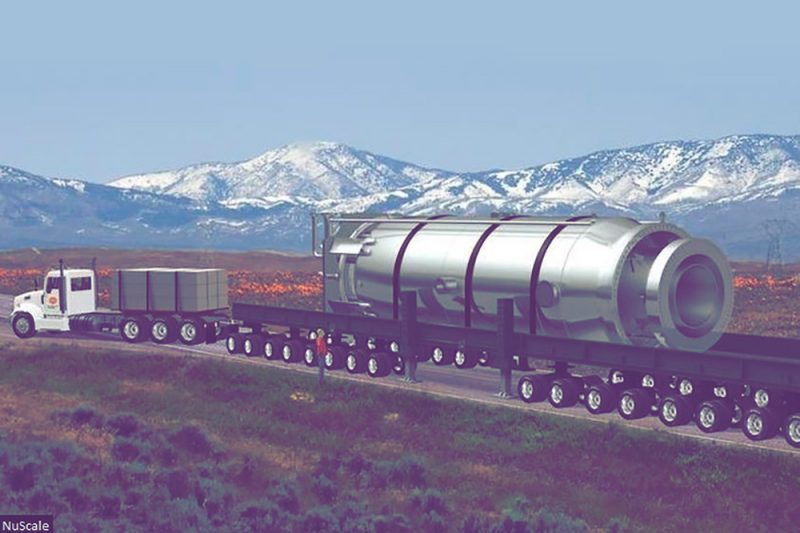
The NuScale SMR plant is designed to be built with up to a dozen 60-MW reactor modules.
UAMPS is seeking other utilities throughout the West to purchase hundreds of megawatts of the $6 billion project’s output, but no utility has agreed to such a purchase.
Utah Taxpayer Association Vice President Rusty Cannon said UAMPS members currently committed to the project should withdraw from it because of the risks.
“The development of untried new designs is no place for small utilities with no nuclear construction experience to risk their customers’ money,” former NRC Commissioner Peter Bradford said during the briefing.
the first module is now expected to be operational in June 2029. Previously NuScale had targeted commercial operation of at least one reactor module in 2027.
|
HIGHLIGHTS Utah Associated Municipal Power Systems (UAMPS) members face September decision on project Startup of first unit delayed to 2029 from 2027 Odds of members agreeing to go forward 50/50: muni Washington — A Utah municipal power association is expecting an influx of $1.4 billion in federal funds for the small modular reactor plant it is looking to build in Idaho, but association members are still deciding whether to go forward with the 720-MW project and the completion date has recently slipped, officials said. Continue reading |
South Australia’s electricity prices fall as renewables ramp up and coal declines
SA power prices in steep fall [ Adelaide Now , 14 Aug 20,
Prices of electricity charged by generators are falling sharply in SA and across the market as more renewables power up and coal output falls. ... (Subscribers only)
The nuclear weapons race lives on anew – 75 years after Hiroshima and Nagasaki
|
75 years after Hiroshima and Nagasaki, the arms race isn’t over, Independent Australia By Binoy Kampmark | 12 August 2020, The twin bombings of Hiroshima and Nagasaki on August 6 and 9, 1945 are always moments that warrant a tick on the commemorative calendar.This has become fairly functional fare: those were the only occasions where atomic weapons were used on humans, mostly civilians. In the United States, the occasion has had to be regaled with a degree of necessary patriotic gush. No other country has ever used them in war.
Much ink and paper have been expended on the justifications, the salvations and the guiding considerations behind using these killers to conclude the Second World War. U.S. President Harry S. Truman either comes out a torn, anguished statesman who did what the thought best in a terrible situation, or a devilish huckster determined to score a success that would not merely knock out Japan but prevent the rise of Soviet (USSR) influence in East Asia. The USSR was far from intimidated. For one, Soviet officials knew well in advance of the race for the weaponised atom between the Allies and Nazi Germany, and kept abreast of advances made by the U.S.-led Manhattan Project, the name given to the development of the world’s first atomic weapon. Despite the acclaimed secrecy of the project, regular gobbets of information were conveyed back to Moscow via a network of well-planted Soviet agents. ……….. The arms race that followed between the United States and USSR was horrendously costly, needless and indicative how the human species can have those shuddering moments when extinction might just be around the corner. Both sides attempted various methods of restraint through arms-control agreements but these made only modest efforts to empty their respective arsenals. What international instruments from the Strategic Arms Limitation Talks I (SALT) to New START did was create employment for an industry that has never been threatened by termination: that of nuclear disarmament. The nuclear club also expanded, though membership numbers were restricted, at times poorly, to an elite. The international document doing so was the Treaty on the Non-Proliferation of Nuclear Weapons (NPT). The United Nations Office for Disarmament Affairs is not being ironic in describing the NPT ‘as the cornerstone of the global nuclear non-proliferation regime and an essential foundation for the pursuit of nuclear disarmament’. Roguish claims to master the nuclear option presented themselves in due course. South Africa, India, Pakistan, Israel, North Korea have all sought membership via back channels and duplicity. Now, the 75th anniversary of the bombings has caused discomfort amongst the pundits and policy wonks. Is there a new arms race before us? Ishaan Tharoor, writing in The Washington Post, fears that might be the case. The Trump Administration’s withdrawal from the Intermediate-Range Nuclear Forces Treaty and mutterings about not renewing the New START Treaty in 2021 are cited as possible incentives to avoid limiting arsenals. Ruadhán Mac Cormaic, assistant editor of the Irish Times, is even more pessimistic….. Cormaic rattles off the list of Trump’s destabilising treaty withdrawals, all doing their bit to foster the spirit of international insecurity. To the INF treaty already noted by Tharoor, he also adds Washington’s repudiation of the Iran nuclear deal (the Joint Comprehensive Plan of Action) and exiting from the Open Skies Treaty permitting state parties to conduct, according to the Arms Control Association, unarmed reconnaissance flights over each other’s territory on military forces and activities. Not renewing New START or finding some successor could fire “the starting gun” on ‘a new arms race between the cold war’s protagonists’. From the Russian perspective, encouragement for a splurge of spending, particularly in the field of tactical nuclear weaponry, abounds. …….. https://independentaustralia.net/article-display/75-years-after-hiroshima-and-nagasaki-the-arms-race-isnt-over,14192 |
|
As the tundra burns, we cannot afford climate silence’: a letter from the Arctic
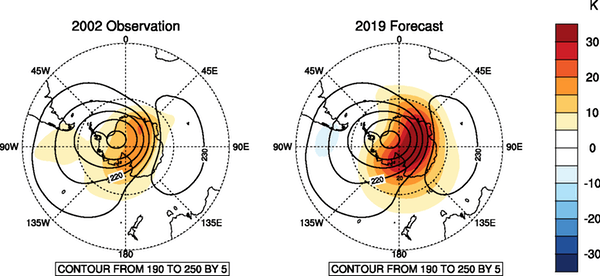 In June, the Russian Arctic reached 100.4F, the highest temperature in the Arctic since record-keeping began in 1885. The heat shocked scientists, but was not a unique or unusual event in a climate-changed world. The Arctic is warming at nearly three times the rate of the global average, and June’s single-day high was part of a month-long heatwave. This relentless heat has melted sea ice and made traditional subsistence dangerous for skilled Indigenous hunters. It’s fueled costly wildfires, some of which are so strong they now last from one summer to the next. And it’s sped up permafrost thaw, buckling roads and displacing entire communities.
I study the Arctic. The decision to withdraw from the Paris climate accord is reprehensible – but we can’t give up hope
When you stand facing an exposed edge of permafrost, you can feel it from a distance.
It emanates a cold that tugs on every one of your senses. Permanently bound by ice year after year, the frozen soil is packed with carcasses of woolly mammoths and ancient ferns. They’re unable to decompose at such low temperatures, so they stay preserved in perpetuity – until warmer air thaws their remains and releases the cold that they’ve kept cradled for centuries. Continue reading
High level nuclear waste a big danger. Low Level Waste has its dangers,too

Feds Propose More Sites For Nuke Waste Storage (Not Disposal) Forbes , Ed Hirs 12 Aug 20,
The Nuclear Regulatory Commission (NRC) is proposing that more locations around the country be used to dispose of very low level radioactive waste. This proposal has raised the ire of environmentalists and nuclear waste storage proponents alike…….
Bad actors can make a considerable profit at the expense of public health. As the United Steelworkers union noted in their public comment urging the NRC against the ruling: “[the ruling]…requires workers with little to no training to handle contaminated material leading to a greater probability of mishandling or improper disposal; and the proposed rule lack[s] requirements to monitor surrounding soil and ground water from any exempt waste location to ensure there is no increase of radiological contamination outside of the potential dumping sites.”
Safe disposal does not equal safety when materials remain active for generations. To improve safety landfills need to keep records for generations, and to deal with low-level contamination appropriately. Over time landfills become golf courses, sources of methane for electricity generation, and mines for reclaiming metal. These activities result in exposure to radiation that future generations must be prepared for. This means meticulous record keeping, which is unlikely to be present across multiple changes of ownership and decades of time.
What the NRC proposes is an expansion of opportunities for things to go wrong. In the past this approach has given us names that remain infamous today: think Love Canal. Brio Refinery. Savannah River and DuPont. It gave us the remains of leaded gasoline.
Water supplies are particularly vulnerable. Historically, the dictum of chemists has been “dilution is the solution.” That works for chemicals. It does not work for radiation, which is being generated continuously.
The current system is better than what is being proposed. Expanding the opportunities for things to go wrong is a step backwards. If the proposal is adopted, today’s laxity and profits will become tomorrow’s health problems and remediation expenses. If we care about coming generations we should leave well enough alone. https://www.forbes.com/sites/edhirs/2020/08/11/hazardous-nuclear-waste-storage-its-not-disposal/#2086a6624ad3
Opposition to the transport and double handling of nuclear waste
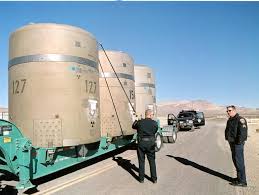 Famette/Rice: And the nuclear waste? 12 Aug 20,
What about Vermont Yankee’s nuclear waste? Or dealing with it?
High-Level Nuclear Waste (HLNW) is a byproduct of nuclear power plants and is extremely dangerous for thousands of years. The Vermont Yankee Nuclear Power Plant, in Vernon, has been shut down since 2014 and the HLNW it produced over the years of operation has been transferred into stainless steel and concrete dry casks stored onsite. Currently, our federal government has not come up with a permanent site to store HLNW safely over time.
NorthStar, the corporation which now owns Vermont Yankee, wants to transport that waste to a Centralized “Interim” Storage (CIS) site that it owns in Texas. To transport this waste is a dangerous proposition since an accident would likely result in great damage to the environment and the life forms in the surrounding area. We should only move the material once to a permanent repository. Also, if Vermont Yankee’s HLNW is allowed to be transported across the country on our highways, railways and waterways to a temporary open-air storage site, such a precedent would likely result in thousands of shipments across the country as other nuclear plants are shut down during the coming four decades.
Communities in the Southwest are speaking out in opposition to accepting our toxic waste. As members of the Vermont Yankee Decommissioning Alliance (VYDA), we support their concerns and are against the transportation and interim storage of Vermont Yankee’s waste at a CIS. We feel it is safer to keep our waste within our state in monitored, hardened, onsite storage in stainless steel and concrete dry casks while a scientifically-based permanent storage site is located.
For the above reasons, join us in contacting U.S. Rep. Peter Welch and urge him to vote against any bill that would authorize Centralized Interim Storage of High-Level Nuclear waste? https://www.timesargus.com/opinion/commentary/famette-rice-and-the-nuclear-waste/article_436e1a1b-deb3-5b6a-87a9-228cfb16afbc.html
Audrey Famette lives in Montpelier. Nancy Rice lives in Randolph Center.
Australia’s uranium fuelled the Fukushima reactors, but now, Japan’s not wanting to buy any more
 Japan’s nuclear fuel imports almost zero in 2019 as industry stagnates, Japan Times, 12 Aug 20, Japan’s imports of fuel to power nuclear plants were close to zero last year, reflecting the stagnating nuclear industry following the Fukushima disaster in 2011, official trade data showed Tuesday.The effective halt to imports of uranium — enriched, natural or their assemblies — is believed to be the first since the resource-poor country started securing the materials from overseas in the 1960s. Japan’s nuclear fuel imports almost zero in 2019 as industry stagnates, Japan Times, 12 Aug 20, Japan’s imports of fuel to power nuclear plants were close to zero last year, reflecting the stagnating nuclear industry following the Fukushima disaster in 2011, official trade data showed Tuesday.The effective halt to imports of uranium — enriched, natural or their assemblies — is believed to be the first since the resource-poor country started securing the materials from overseas in the 1960s.
Most nuclear plants in Japan remain idle as stricter safety measures were implemented after a massive earthquake and ensuing tsunami crippled the Fukushima No. 1 nuclear complex. The operations of fuel manufacturing plants have also been suspended……. Of the 54 nuclear reactors that were in operation before the Fukushima crisis, currently, only nine have come back online after clearing harsher safety measures. In the wake of the accident, 21 reactors have been flagged for decommissioning in consideration of the hefty cost of refurbishment. All four fuel manufacturing factories are offline as they are undergoing regulatory review under the new safety standards. Kansai Electric Power Co., Shikoku Electric Power Co. and Kyushu Electric Power Co., which operate the nine plants currently back online, said they have enough fuel to run their reactors for the next several years. …….https://www.japantimes.co.jp/news/2020/08/12/business/japan-nuclear-fuel-imports-zero/ |
|
Councils and community opposition to the transport of nuclear wastes
These nuclear waste cars are readily identifiable, given their huge dumbbell-like shape, size and weight, which makes them a potential target for terrorist attacks.
High-level radioactive waste is one of the most dangerous substances on earth, consisting of irradiated fuel rods that have been inside nuclear reactors. Exposure to unshielded nuclear waste is lethal.
A 2019 report of the U.S. Nuclear Waste Technical Review Board found that there is a substantial lack of data regarding potential damage of spent nuclear fuel during transport.
Many rails are only designed to carry 143 tons per car. The loaded casks for this waste weigh 210 tons or more. It is unclear whether tracks in Tarrant County would handle such weight.
And accidents can happen. A cask carrying low-level waste that was headed to Andrews caught fire in the Chicago area in June.
A better alternative would be to leave high-level waste at existing nuclear plants until a permanent repository is found to bury cannisters underground.
Tarrant County, along with the cities of Fort Worth and Arlington, should also oppose the transportation of high-level nuclear waste through our communities and advise our federal representatives and the Nuclear Regulatory Commission of our serious concerns. Our lives and economic well-being may depend upon preventive action now.
|
Fort Worth doesn’t need dangerous nuclear waste rolling through on Tarrant rail lines https://www.star-telegram.com/opinion/opn-columns-blogs/other-voices/article244891627.html BY PEGGY HENDON AND LINDA HANRATTY
AUGUST 12, 2020The Nuclear Regulatory Commission is considering licensing two different facilities to store the nation’s high-level nuclear waste.
One would be at the existing low-level storage facility in Andrews County, Texas. The second, known as the Holtec site, would be between Carlsbad and Hobbs, New Mexico. Why should Tarrant County be concerned? |
Hiroshima and the normalisation of atrocities
|
Death from the sky: Hiroshima and normalised atrocities https://www.onlineopinion.com.au/view.asp?article=21049
When US President Harry S Truman made the decision to drop the atomic bomb on Hiroshima on August 6, 1945, followed by another on Nagasaki a few days later, he was not acting as an agent untethered from history. In the wheels of his wearied mind lay the battered Marines who, despite being victorious, had received sanguinary lashings at Iwo Jima and Okinawa. A fear grew, and US military sources speculated about, the slaughter that might follow an invasion of the Japanese homeland. They also pondered the future role of the Soviets, and wondered whether there were other means by which Japan’s involvement in the war might be terminated before Moscow got its hands on the battered remains of North East Asia. Much is made about the moral dilemma Truman faced. He knew there was the nastiest of weapons at hand, born from the race to acquire it from Nazi Germany. But on a certain level, it was merely another weapon, one to use, a choice sample in the cabinet of lethal means and measures. By that stage of the war, killing civilians from the air, not to mention land, was banal and common place; enemy populations were to be experimented upon, burned, torched, gassed, shelled and eradicated in the program of total war. By the time Truman made his decision, Japan had become a graveyard of strategic aerial bombing. General Curtis E. LeMay of the US Air Force prided himself on incinerating the enemy, and was encouraged by various study commissions advocating the use of incendiary bombs against Japan’s flammable urban architecture. He was realising the dreams of such figures as the pioneering US aviator and air power enthusiast Billy Mitchell, who fantasised in the 1920s about Japanese cities being “the greatest aerial targets the world has ever seen”. In 1941, US Army chief of staff George Marshall spread the word to journalists that the US would “set the paper cities of Japan on fire”. Civilians would not be spared. Towards the end of the war, daylight precision bombing had fallen out of favour; LeMay preferred the use of Boeing B-29 Superfortresses, heavily laden with firebombs, to do the work. His pride of joy in conflagration was Tokyo. During the six-hour raid over the night of March 9 and 10, 1945, the US Strategic Bombing Survey concluded that 87,793 had perished, with 40,918 injuries. There was little novel in LeMay’s blunt approach. Britain’s Air Force Marshall Arthur “Bomber” Harris fertilised the ground, and the air, for such an idea. He made it his mission to not only kill Germans but kill German civilians with a cool determination. He did so with a workmanlike conviction so disturbing it chilled the blood of many Britons. As he put it, “The cities of Germany, including their working populations, are literally the heart of Germany’s war potential.” It was his intention to, he explained to personnel, “in addition to the horrors of fire … to bring masonry crashing down on top of the Boche, to kill the Boche and to terrify the Boche”. The Teutonic enemy came, not so much in all shades, but one. Saturation bombing, regarded after the Second World War as generally ineffective, a ghastly failure to bring the population to its knees, received its blessing in Bomber Command. This entire process neutered the moral compass of its executioners. Killing civilians had ceased to be a problem of war, one of those afterthoughts which served to sanction mass murder. Britain’s chief of the air staff for a good deal of the war, Charles Portal, called it a “fallacy” that bombing Germany’s cities “was really intended to kill and frighten Germans and that we camouflaged this intention by the pretence that we would destroy industry. Any such idea is completely false. The loss of life, which amounted to some 600,000 killed, was purely incidental.” When 600,000 becomes an incidental matter, we are well on the way to celebrating the charnel houses of indiscriminate war. When the issue of saturation bombing creased the legal minds behind the Nuremberg and Tokyo war crimes trials, an admission had to be made: all sides of the Second World War had made the air a realm of convenience in the killing of humanity, uniformed or not. To win was all that mattered. While the Nuremberg Charter left it open to criminalise German aerial tactics, the International Military Tribunal hedged. As chief of the Luftwaffe, Herman Göring was singled out for air attacks on Poland and other states but the prosecutors refrained from pushing the point, likely reflecting the cold fact, as Matthew Lippmann puts it, “that both Germany and the Allies engaged in similar tactics.” It is true that Germany and Japan gave a good pioneering go at indiscriminate aerial slaughter. But the Allied powers, marshalling never before seen fleets of murderous bombers, perfected the bloody harvest. The war had to be won, and, if needed, over the corpses of the hapless mother, defenceless child and frail grandparent. As the historian Charles S. Maier notes with characteristic sharpness, a tacit consensus prevailed after the Second World War that the ledger of brutality was all stacked on one side. German bombings during the Spanish Civil War, notably of Guernica; Warsaw, Rotterdam, London and Coventry during the world war that followed, were seen as “acts of wanton terror”. The Allied attacks on Italian, German and Japanese urban centres, in proportion and scale far more destructive, were seen as “legitimate military actions”. Distinctions about civilian and non-civilian vanished in the atomic cloud. Hiroshima’s tale is the apotheosis of eliminating distinctions in war. It propagated such dangerous beliefs that nuclear wars might be won, sparing a handful of specialists and breeders in bunkers planning for the new post-apocalyptic dawn. It normalised, even as it constituted a warning, the act of annihilation itself. Prior to the twin incinerations of Hiroshima and Nagasaki, the redoubtable nurse and writer Vera Brittain issued a warning that remains salient to those who wish to resort to waging death from the sky: “If the nations cannot agree, when peace returns, to refrain from the use of the bombing aeroplane as they have refrained from using poison gas, then mankind itself deserves to perish from the epidemic of moral insanity which today afflicts our civilisation.” |
|
|
One American State shows how to deter any plan for nuclear waste dumping
The Legislature passed a bill into law in 2019 that prohibits the disposal of high-level radioactive waste in North Dakota. For the rules to even take effect, “the first thing you have to do is get that law overturned or thrown out,” State Geologist Ed Murphy said.
What’s in the rulesRegulators prep for an industry few want: nuclear waste disposal, Bismarck Tribune, 10 Aug, 20
The state Industrial Commission approved the regulations in late July, as well as new rules surrounding deep geothermal wells, another industry that does not exist in North Dakota but could emerge one day.
The waste disposal rules spell out all the steps an entity would have to go through if it were to propose storing “high-level radioactive waste” in North Dakota. Such waste is highly radioactive material generated from the reprocessing of spent nuclear fuel, for example, and it requires permanent isolation……
The Legislature passed a bill into law in 2019 that prohibits the disposal of high-level radioactive waste in North Dakota. For the rules to even take effect, “the first thing you have to do is get that law overturned or thrown out,” State Geologist Ed Murphy said.
“We were writing rules for a program that, by law, is prohibited,” he said.
Roers said the thinking behind establishing the rules in light of the ban is that if the federal government were ever to try to trump North Dakota’s prohibition, it might still agree to follow the regulations established by the state.
If the entity wanted to move forward with a project, it would then need a “facility permit,” which would prompt a similar vetting process. Officials would have up to a year to decide whether to issue a permit.
Before granting a permit, the operator would need to deposit at least $100 million in a new state fund.
“The half-lives of some of the radioactive waste will be dangerous much longer than any sign, monument, or avoidance structures would remain unless they are maintained in perpetuity,” the regulations state. “This money is to be used to ensure the passive institutional controls are maintained for thousands of years.”
If a facility were to make it through the permitting process, it would have to pay an annual operating fee of at least $1 million to the state. It also would need to provide monthly reports on activities at the site and comply with reclamation rules when the site is no longer in use.
Documents regarding the location and depth of the site, as well as details about the half-life of the radioactive waste buried there, must be stored in local, state and national archives — an effort to ensure they last in perpetuity in case the information is needed hundreds or thousands of years down the road, Murphy said.
While counties cannot outright impose a ban on the disposal of the materials, any project would need to adhere to local zoning regulations as to the size, scope and location of the site.
Murphy said the state examined the regulations of 13 other states in developing its rules…………..
The new rules for high-level radioactive waste and deep geothermal energy have one final hurdle to clear before they become official — they will go to a legislative Administrative Rules Committee for approval. ….. https://bismarcktribune.com/news/state-and-regional/regulators-prep-for-an-industry-few-want-nuclear-waste-disposal/article_5afd3c76-9ac1-556f-be69-50f6c9811642.html
The human toll of nuclear testing in Australia and Oceania
Death in paradise: the aftermath of nuclear testing in Australia and Oceania https://diem25.org/death-paradise-the-aftermath-nuclear-testing-australia-and-oceania/ 10/08/2020 by Aleksandar Novaković The United States of America is the first nuclear power — and the only one to have used its weapons for a military purpose. During World War 2 in 1945, two Japanese cities were bombed by US nuclear bombs (Hiroshima on August 6th and Nagasaki August 9th ). The devastating result was approximately 225,000 people either dead or wounded. The number of deaths in Hiroshima and Nagasaki due to exposure to lethal radiation is still being discussed, but it is certainly in the thousands.
However, even though nuclear weapons were never used again for military purposes, nuclear testing took (and continues to take) a toll on thousands of lives in Australia and Oceania.
The United States conducted about 1,054 nuclear tests from 1945 to 1992, and 105 of them (1945-1962) were made at Pacific Test Sites (Marshall Islands, Kiribati) causing the contamination of huge areas controlled by US troops. In the Pacific, this caused rising numbers of cancer and birth defects, especially on the Marshall Islands where 67 tests were made and many Marshallese were forced to leave their homes in contaminated areas.
European nuclear powers, such as France and the UK, have also “contributed” to the deaths of thousands.
France has made over 193 nuclear tests in the Pacific between 1960 and 1996, mostly on Mururoa and Fangataufa atolls that belong to French Polynesia, as well as 17 tests in Algerian Sahara. Tahiti, the most populated island of French Polynesia, was exposed to 500 times the maximum accepted levels of radiation. The impact has spread as far as to the tourist island of Bora Bora.
Civilians and the military participating in nuclear tests (more than 100,000 of them) have experienced diarrhea, skin injuries, blindness, and cancer. Their children have additionally suffered from birth defects.
From 1953 to 1963, there were over 20 bigger and smaller British A- bomb tests in Emu Farm, and the Maralinga and Montebello Islands of Australia. Overall, over 1200 peoples were exposed to radiation in the country, most of them Anangu people living in the Maralinga area. The UK has also made nuclear tests on overseas territories such as the Malden Islands and Christmas Island ( the present Republic of Kiribati).
So, what was done by the governments of the US, UK, Australia and France to help those who have suffered from radiation related illnesses, or those who lost their loved ones?
There are two answers. One is that loss of loved ones, of the way you live your life, of the nature that surrounds you, the loss of home cannot be repaid or replaced with anything else. The other is that aforementioned governments did little.
The US has awarded more than $63 million to Marshallese with radiogenic illnesses despite the fact that the Tribunal only has $45.75 million to award for both health and land claims. France is still avoiding paying reparations to Tahitians.
As for the “joint venture” of the UK and Australia, the truth is that tests were approved and conducted in the first place because British officials were misinforming Australians. The Maralinga Tjarutja (Council) of Anangu people has a compensation settlement with the Australian government, and they are receiving $13.5 million.
75 years after Hiroshima and Nagasaki, we must ask ourselves: Why are we so callous about many “Hiroshimas” and “Nagasakis” that happened over the following decades? Did we let them happen just because they took place in far-off islands in the Pacific or in the Australian desert?
The only way to deal with these existing and future horrors that can eradicate life on Earth is to heal these existing wounds.
This means that the governments of the US, UK, France and Australia must pay just reparations to the affected countries and regions. Progressives of the world must act united against the threat of nuclear holocaust and create a political climate in which it would be possible to take action on an international level in order to ban the production, storage and use of nuclear weapons.
This can be done if nuclear powers, followed by all member states, sign the United Nation’s Treaty on the Prohibition of Nuclear Weapons.
Aleksandar Novaković is a historian and dramatist. He is a member of DSC Belgrade 1 and the thematic DSC Peace and International Policy 1
The nuclear close shaves that nearly brought World War 3 upon us
concentrating this power within a single individual is a big risk. “It’s happened a number of times that a president has been heavily drinking, or subject to medication he’s taking. He may be suffering from a psychological disease. All of these things have happened in the past,”
ways a country’s own technologies could be used against them. As we become more and more reliant on sophisticated computers, there is growing concern that hackers, viruses or AI bots could start a nuclear war. “We believe that the chance of false alarms has gone up with the increased danger of cyber-attacks,” says Collina. For example, a control system [like Pine Gap] could be spoofed into thinking that a missile is coming, which could mean a president is tricked into launching a counter-attack.
many experts agree that by far the biggest threat comes from the very launch systems that are supposed to be protecting us.
 The nuclear mistakes that nearly caused World War Three , From invading animals to a faulty computer chip worth less than a dollar, the alarmingly long list of close calls shows just how easily nuclear war could happen by mistake. https://www.bbc.com/future/article/20200807-the-nuclear-mistakes-that-could-have-ended-civilisation By Zaria Gorvett, 10th August 2020 The nuclear mistakes that nearly caused World War Three , From invading animals to a faulty computer chip worth less than a dollar, the alarmingly long list of close calls shows just how easily nuclear war could happen by mistake. https://www.bbc.com/future/article/20200807-the-nuclear-mistakes-that-could-have-ended-civilisation By Zaria Gorvett, 10th August 2020It was the middle of the night on 25 October 1962 and a truck was racing down a runway in Wisconsin. It had just moments to stop a flight. Mere minutes earlier, a guard at Duluth Sector Direction Center had glimpsed a shadowy form attempting to climb the facility’s perimeter fence. He shot at it and raised the alert, fearing that this was part of a wider Soviet attack. Instantly, intruder alarms were ringing at every air base in the area. The situation escalated remarkably quickly. At nearby Volk Field, an air base, someone flicked the wrong switch – so rather than the standard security warning, pilots heard an emergency siren telling them to scramble. Soon there was a frenzy of activity, as they rushed to take to the skies, armed with nuclear weapons. Continue reading |
UK offshore wind becomes cheaper than nuclear and gas
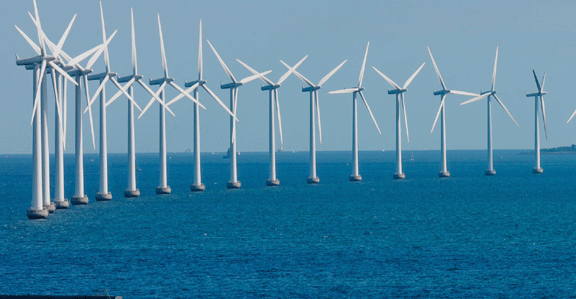 https://theenergyst.com/uk-offshore-wind-becomes-cheaper-than-nuclear-and-gas/, By Tim McManan-Smith, August 10, 2020 The Imperial College London conducted a study where it shows that the UK offshore wind generation costs have significantly declined in the last few years, bringing in the plausibility of the sector soon being subsidy negative as per their contract for difference (CfD). GlobalData anticipates that the declining costs not only make offshore wind cost-effective in diminishing the country’s carbon footprint but also drive the government to increase installations in an attempt to achieve its 2030 target.
Offshore wind CfD prices are expected to decline and become cheaper than gas, where the price is expected to surpass £55/MWh by 2023-24. Major projects such as Doggerbank A and Doggerbank B are in the permitting phase and anticipated to come online by this time. These are key projects that saw success in the third round of CfD, held in 2019. With the next round planned to be held next year, projects coming up in the future stand a strong chance of experiencing negative subsidies.
Das concluded: “Over the next few years, the offshore segment is expected to boom. More than 19GW of offshore wind projects are in the pipeline, either in the nascent or advanced stages of development. Players such as SSE Renewables, Scottish Power Renewables, Orsted, Engie and many more have flocked this space, trying to grab a piece of the pie. Many would be constructed as deep sea projects at more than 40km from the shore, at depths ranging from 20-70m – making the most of favorable wind speeds of 7-10m/s. Some of them are expected to have turbine capacities of more than 10MW, and rotor diameters ranging from a mere 113m to over 200m.
1 This month
7 April – WEBINAR – Australia and the Doomsday Clock – Preventing nuclear war through NoFirstUse and other policies
Online | Tuesday April 7, 4:00-5:30pm, Australian Eastern Time / 8:00-9:30am Central Europe Time
– Access the registration link
15 April – Zoom –Nuclear Power is Not the Solution
Apr 15, 2026 01:00 AM in Canberra, Melbourne, Sydney

Join the International Physicians for the Prevention of Nuclear War (IPPNW) on Tuesday, April 14th for a timely webinar exploring the risks associated with nuclear power and challenging the myth that it offers a simple, safe, carbon-free solution to the climate crisis

of the week – Australians for War Powers Reform (AWPR)
To see nuclear-related stories in greater depth and intensity
 Antinuclear