Muckaty Traditional owners in Court today, challenging nuclear waste dump plan
 From Muckaty to Melbourne* Dianne Stokes, Traditional Owner for Muckaty (600km north of Alice Springs in the Northern Territory) is speaking at Friends of the Earth on Monday the 15th July. The fight to stop the radioactive waste dump at Muckaty is six years strong and counting.
Come along to hear the Muckaty story and where the campaign and the community are at. The Muckaty Traditional Owners are challenging the Federal Government and the Northern Land Council in the Federal Court, there’s a hearing for the case on the morning of the 15th, so come along for court support if you’re able to (contact Gem on 0421 955 066 for details)!
 And later that day. From Muckaty to Melbourne Monday 15th July 2013 6pm to 7.30pm at Friends of the Earth, 312 Smith St Collingwood.
Speakers:
Dianne Stokes, Traditional Owner for Muckaty
Natalie Wasley, coordinator Beyond Nuclear Initiative
A group of traditional land owners opposing the dump are fighting the case in court
Fight Continues Over Australia’s First National Nuclear Dump, National Geographic, by Natalia A. Bonilla on April 6, 2012 “….. the Australian Senate approved the National Radioactive Waste Management Bill, which proposes the construction of a nuclear waste dump in Muckaty Station. Australia does not have any nuclear power plants, but needs a repository for its medical and uranium mining waste, which is currently being held at temporary sites around the country.
The Muckaty site, situated about 75 miles (120 kilometers) north of the Tennant Creek township on Aboriginal land, has been under consideration as a potential dump site for the past six years, and a group of traditional land owners formally nominated the site in exchange for a promised $12 million payment.
But other clans have disputed the right of that group to make such a nomination. “None of the Ministers have ever come to talk to us about the waste dump,” some of Muckaty’s traditional land owners wrote in a petition last year. “We have invited [Resources Minister] Martin Ferguson to meet with us but he has never said yes. We have travelled a long way to see him, but when we go to his office in Melbourne they lock the door and won’t let us in to deliver our letters.
“We have never been properly told or asked about this dump, either by the Northern Land Council or the federal government.” Continue reading
Australia’s democracy in thrall to the mining giants
The super-rich in this country, the owners of the mines and the banks in particular, exert huge pressure on the government to get exactly what they want, and to stall, co-opt or shut down any possible threat to their continual profit expansion.
It is also very clear that BHP, Rio Tinto other big fossil fuel companies simply will not stop until they have extracted every last drop of oil, pound of coal or gas from the ground in their insatiable search for profits. By that time it will be too late.
 This election, ‘fight for a meaningful democracy’ Green Left, , July 13, 2013 By Liam Flenady – We all know that Australia has experienced an unprecedented mining boom over the past decade. This boom is slowing now, but it is still producing huge wealth.
Over the last decade, profits of the mining companies have gone up by 400%. The big mining corporations now make almost a quarter of all profits in this country. Gina Rinehart now has a net wealth of $29 billion.
In the same period, the effective tax rate of the mining companies has plummeted from 40% down to just 13.9%. This is a disgracefully low figure.
The banks have also greatly benefited. At a time when the global economy is in crisis, Australia’s big four banks have been making huge profits. An article in the Sydney Morning Herald revealed that the four big banks made $27 billion in profit this year — a record.
And at the same time, nearly 3 million people in this country are living below the poverty line. The poorest 20% of the population own only 1% of the wealth, and the poorest 60% — that is, the majority — own less than 20%. Continue reading
Arnhem land Aboriginals to bring gas protest to Sydney
 Traditional owners bringing gas protest to Sydney , Green Left Saturday, July 13, 2013 By Jim McIlroy Aboriginal traditional owners and the Protect Arnhem Land community campaign, based in the town of Maningrida, Northern Territory, are seeking the assistance of environment groups and Indigenous networks in Sydney to help raise awareness of the threat to Arnhem Land from oil and gas exploration.
Five traditional owners are travelling from Maningrida to Sydney in mid-July and are holding a public protest in Martin Place outside the offices of exploration company Paltar Petroleum.
The Environment Centre NT said: “Arnhem Land is under threat from fossil fuel companies and need your help. Ninety per cent of the land and all the nearshore waters are being targeted for exploration. These are some of the most ecologically uintact areas left in Australia, and the ancestral lands of thousands of Indigenous Territorians”.
The Wilderness Society and the Australian Marine Conservation Society are sponsoring the visit to Sydney by the Maningrida traditional owners.
The visit follows a growing campaign by NT traditional owners against oil and gas exploration in Arnhem Land. On December 10 last year, a meeting of 250 gathered in Maningrida to protest moves by Paltar Petroleum to gain exploration permits for offshore and onshore exploration in the region.
On February 19 this year, a large public meeting in Darwin, addressed by a broad range of speakers from concerned organisations, including Eddie Mason from the Maningrida community, and Drew Hutton from the Lock the Gate Alliance, condemned the plans for oil and gas exploration in the NT.
On March 14, a large meeting of traditional owners in Maningrida strongly opposed all oil and gas mining on land or sea in the Arnhem Land region. Since then, another company, Empire Gas, has claimed to have signed a Native Title Agreement with the NT Land Council and some Native Title claimants in the Urapunga region of eastern Arnhem Land.
[The protest will be held at 32 Martin Place, noon on July 19. For more information, visit Environment Centre NT.] See more at: http://www.greenleft.org.au/node/54497#sthash.UJOG9Scb.dpuf
Uranium sales talks going on now between Australia and India
 Uranium sale: India, Australia to hold talks The Indian Express, Anubhuti Vishnoi : New Delhi, Sat Jul 13 2013 To arrive at a civil nuclear cooperation agreement that will create a framework for the sale of uranium, India and Australia will engage in a second round of negotiation by the end of this month in Australia.
Appointment of Maurice Newman to board of Tigerair damages its credibility
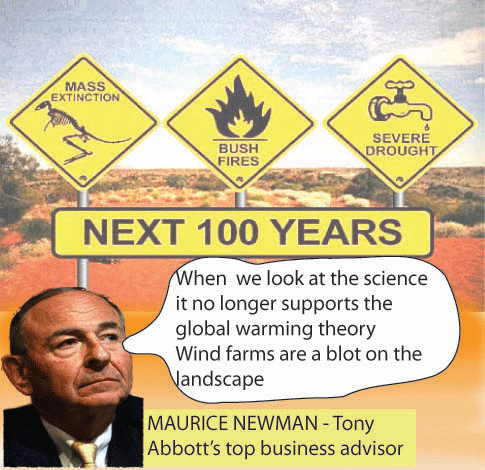 Tiger vows green future, but Newman’s got it by the tail, Crikey.com ANDREW CROOK | JUL 12, 2013 The appointment of Tony Abbott’s business adviser to the board of Tigerair has cast doubt on its green credentials. One renewables campaigner says it tarnishes the campaign.
Struggling discount airline Tiger Airways’ environmentally friendly fuselage is at risk of being torn apart by the appointment of a
well-known climate change sceptic to its board of directors this week.
Maurice Newman, a staunch anti-wind farm crusader who will head up Tony Abbott’s business advisory group …. (registered readers only) http://www.crikey.com.au/2013/07/12/tiger-vows-green-future-but-newmans-got-it-by-the-tail/
Tony Abbott’s chief advisor out to prevent wind farm development
Abbott’s chief business advisor claims first wind farm victim REneweconomy, By Staff Reporter on 8 July 2013 Tony Abbott’s main business advisor, the former head of the Australian Securities Exchange Maurice Newman, has claimed his first wind farm victim after the development of 100-turbine project near Goulburn – and one of Newman’s properties – abandoned the plan.
The Australian reported on Monday that Wind Prospect CWP let the project lapse last week, citing “wind resource, land security and grid connection issues”.
The newspaper said Newman, who opposes wind farms and argues that fluctuations in output from renewable energy sources have increased power costs for consumers – by requiring the construction of expensive backup generators – belongs to the Landscape Guardians, a community lobby group that actively campaigns against all wind farms in the Upper Lachlan shire, where he owns land.
The long term impacts of mining
Australia’s Mining Legacies, Arena, by Gavin M. Mudd, 11 July 13 The impacts of mining waste will be felt for years to come. Mining is, by its very nature, a dirty business—it excavates and processes billions and billions of tonnes of rock and dirt every year to extract a wide variety of metals and minerals demanded by modern industrial and technological society. These include metals used in pipes, electronics, buildings and gadgets, such as copper, zinc, iron, nickel and lithium, as well as energy resources for heating and electricity, such as coal, gas and uranium. Australia has, without doubt, a vast resource base in these metals and minerals and we commonly export most of our production to overseas customers who aren’t so luckily endowed. The great scale of modern mining, however, comes at a real cost whether on the local landscape, public health or the global environment, and it is understanding these real costs and how the environmental and social impacts intertwine with economic issues that is the crux of the great mining debate in Australia and globally. Continue reading
Austtralian founding documents – Aboriginal bark petitions
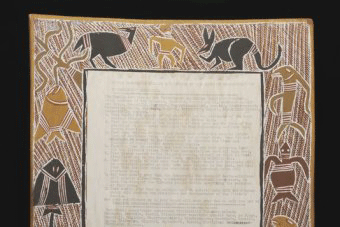 Yirrkala remembers bark petitions, The Age, July 11, 2013, Dan Harrison Health and Indigenous Affairs Correspondent “.…… Prime Minister Kevin Rudd described the petitions, the first traditional indigenous documents to be recognised by the Australian parliament, as ”two of Australia’s most important founding documents.”
”These bark petitions are the Magna Carta for the indigenous peoples of this land,” Mr Rudd said…… http://www.theage.com.au/federal-politics/federal-election-2013/yirrkala-remembers-bark-petitions-20130710-2pqfx.html#ixzz2YlghQfM4
Sea level rise likely to affect Wyong properties
Wyong Council Meeting: Sea Level Rises on the Agenda ABC News, Jul 4, 2013 A sea level-rise recommendation being made to Wyong Council could have ramifications for thousands of home owners.
The Tuggerah Lakes Estuary and Flood Plain Management Committee will tonight recommend to Council that the 1 in 100 flood level should be increased by 400 milimetres to cope with future sea level rises.
If the recommendation is accepted by council, homes would need to be built at 3.1 metres above sea level rather than the current 2.7 metres…..http://www.abc.net.au/news/2013-07-04/wyong-council-meeting3a-sea-level-rises-on-the-agenda/4800070
Australia’s new Climate Mkinister: what’s his score on renewable energy?
Australian Climate Minister’s Electorate And Solar http://www.energymatters.com.au/index.php?main_page=news_article&article_id=3822, 4 July 13 How does Mark Butler’s own electorate stack up in relation to solar power?
Mark Butler has been the Australian Labor Party representative for the electoral division of Port Adelaide, South Australia since the 2007 federal election. On Monday, he became Australia’s Minister for Climate Change; Minister for the Environment, Heritage and Water. So where does Minister Butler stand on the topic of solar and how does his own electorate shape up?
According to ‘Solar Revolution briefers’ sent out as part of 100% Renewable’s Solar Scorecard initiative, Port Adelaide has 11,775 solar homes. Based on an average size of 2.5kW; this represents a total capacity of 29.4MW.
The Port Adelaide brief says its constituents have invested approximately $88 million in solar power, are offsetting 36,797 tonnes of carbon dioxide annually and saving $6,594,000 a year on power bills.
The Climate Minister’s electorate is ranked number 20 among solar electorates nation-wide. The top solar electorate nationally is also in South Australia – Mayo, with 25.43% of homes in that region having rooftop solar panel systems installed.
A map created The Guardian’s Nick Evershed based on details from 100% Renewable’s Solar Scorecard project shows 17.19% of homes in Port Adelaide have solar installed.
Minister Butler’s Solar Scorecard can be viewed here; state briefers here and electorate briefers here.
The briefers have been sent to all Federal MPs and Senators, and the organisation is now disseminating the documents via local media and groups around the country. The briefers contain customised data by electorate on the number of solar homes, the amount of clean energy generated, the amount invested by constituents in solar, the amount of carbon emissions avoided and the amount saved on power bills.
100% Renewable is a community initiative working to build community and political support for renewable energy. It is non-partisan and not affiliated with any political party.
Another 100% Renewable project rapidly gaining steam is Solar Citizens, which is bringing together existing and future solar owners.
Australian Greens propose ambitious renewable energy plan
 Greens call for 90% clean energy by 2030 http://www.theage.com.au/business/carbon-economy/greens-call-for-90-clean-energy-by-2030-20130701-2p6g1.html#ixzz2XqON8QTl 1 July 13 The Greens will push for a 90 per cent renewable energy target by 2030, party leader Christine Milne has announced.
Senator Milne said on Monday that the target was achievable and she hoped that one day 100 per cent of energy would be from renewable sources.
She said critics had said a 20 per cent target by 2020 was too ambitious, but once a plan and technology development was in place business got behind it.
“Not only do I think it is achievable, I actually think by setting a road map, by setting an ambitious target, you are more likely to get there faster,” she told reporters in Melbourne. “But let’s actually set the target.”
Senator Milne said a move to be considered by the Labor cabinet to make an earlier move to an emissions trading scheme was a “populist pitch to the Australian Industry Group, to the big polluters”.
“What (Kevin Rudd) wants to do is make it cheaper for the big polluters to pollute,” she said.
“Why would you want to tinker with something that is working?”
Leadership struggle obscures Labor’s clean energy achievements
 The Labor government has much to be proud of with its clean energy record. It has put a price on carbon, established a renewable energy target of at least 20 per cent by 2020, placed a million solar panels on our roofs, put $10 billon into the Clean Energy Finance Corporation and $3 billion into the Australian Renewable Energy Agency and established the successful Carbon Farming Initiative.
This is a strong track record, but the story has been swamped by the ongoing struggle for leadership.
Much can be done to calm the nerves of the clean energy industry. Prime Minister Rudd must reaffirm his support for the Clean Energy Future package. The Coalition must affirm its support for the current fixed Renewable Energy Target.
Clean energy billions going begging Climate Spectator Fiona O’Hehir28 June 13 Now that the Labor leadership issue has finally been resolved, it is time for the government to get on with governing and to let business get on with investing, innovating and creating jobs.
The greatest barrier to investment in Australia’s clean energy future is political and regulatory uncertainty and that is something the industry is copping in spades.
The International Energy Agency has estimated that a staggering $16 trillion will need to be invested in low carbon technologies globally by 2035 if we are to contain temperature increases to 2 degrees. That’s a massive investment binge, but in Australia right now there is a clean energy investment strike. Continue reading
Petition : End fossil fuel subsidies for big mining companies
 End fossil fuel subsidies for big mining companies http://greensmps.org.au/content/end-fossil-fuel-subsidies-big-mining-companies 11 Apr 2013 | Christine Milne
Dear Prime Minister Gillard & Treasurer Swan:
I support ending fossil fuel subsidies for big mining companies.
The diesel fuel rebate and accelerated depreciation for assets and exploration will cost the Australian people more than $13 billion over the next four years.
That $13 billion would be far better spent caring for people, instead of the mining lobby. Imagine: what would that mean for our public school students?
It’s more than enough to increase Newstart by $50 a week, reverse your cuts to vital support for single parents, and more.
Your petitioners ask that you:
End these subsidies that drive the fossil fuel pollution driving global warming, and invest in people instead.
Let’s not forget- the blacks owned this country, and in many ways, still do
The Alice: problematic but never sad for long , Brisbane Times June 25, 2013 Jenna Price Columnist for The Canberra Times.Everyone in the supermarket is speaking Pitjantjatjara; and that includes the very young man behind the till at the checkout.
He doesn’t look black but because I live in Glebe, in Sydney’s inner-west, I no longer fall for the idea that you have to ”look black” to be black. When I say ”no longer”, I still have to slap myself sometimes to remember that I am on Aboriginal land. Really, I am.
This land may be colonised but it was still Aboriginal land first. No matter what any historian may say about how this land was acquired by white people, we mustn’t erode or ignore the fact that this was Aboriginal land first.
In the city, that moment is often lost on us white folk, except for the requisite acknowledgement of country. Which often feels to me like we are running our hands under water. Do this and it’s a way of ameliorating the damage. The ongoing disasters. Incarceration. Health. Education. Income management. Someone pretending to know how to manage my money better than I know myself………
we can help communities. Ebony Allen, a project manager with indigenous consultancy Winangali and this week’s guest tweeter on @IndigenousX, visited Alice in March this year. Like me, she didn’t find Alice sad. She stood in a queue at the Commonwealth Bank branch in Todd Mall.
”Everyone around me was speaking a [traditional] language, it was like music to my ears,” she said.
The health of the local languages says to her that ”they haven’t been as colonised as the rest of Australia”. She’s an east-coast woman (Kamilaroi and Dharug) and there, local indigenous communities are often regenerating their traditional languages. Here in Alice, English is sometimes a second, third or fourth language……..
Alice is a constant and obvious reminder that blacks owned this country. And in many ways, still do. http://www.brisbanetimes.com.au/comment/the-alice-problematic-but-never-sad-for-long-20130624-2oske.html#ixzz2XGF7mFdI
Youtube: Missy Higgins calls on young Australians to enrol to vote
Be heard.
Share it with your friends if you believe we should all have a say in the future of our country, or just to have a giggle at my expense. I would. I do! Then, go to: www.aec.gov.au/enrol.
Even if you think it won’t make a difference, or you’ve lost hope in our leaders (like a lot of us have)… let me tell you that every vote you make puts a little bit more power in the hands of the good people in the Senate. In other words, it’s not just about who becomes Prime Minister, there are plenty of other people in parliament who are doing great things, they just need your vote to give them a louder voice. And if anything, it will stop just one party from having COMPLETE CONTROL over everything. That’s a scary idea.
So get involved!
Be heard!
Thanks for watching.
luv missy.
1 This month
17 October, Free Public Talk on Nuclear Issues in South Australia
David Noonan will speak on public interest concerns over the new Roxby Downs Indenture Act 2026 on BHP copper-uranium mining and ore processing in SA, and on how AUKUS may face SA with a High-Level nuclear waste agenda.
Dr Jim Green will discuss international developments in the field of nuclear power including ‘small modular reactors’ and Generation 4 ‘advanced’ nuclear reactor concepts.


Help Aunty Sue Protect Her Land and Sacred Sites From Destructive Rocket Testing.
.

Australians deserve the truth
about
AUKUS – https://aukuspublicinquiry.com/

PETITION – To: Prime Minister Anthony Albanese and the Australian Labor Government

of the week – Australians for War Powers Reform (AWPR)
To see nuclear-related stories in greater depth and intensity

