Australia’s Northern Territory “Intervention” enables unfair deals allowing mining on Aboriginal land
Friends of the Earth tours, showing the nuclear impact on South Australia’s outback
 Green group stages uranium mining tour http://www.abc.net.au/news/2013-04-05/green-group-stages-uranium-mining-tour/4611798?§ion=news Apr 5, 2013 An environmental group is touring the South Australian outback this week to observe the impact of uranium mining on the environment. Friends of the Earth has been making the trip around mine sites almost every year since 1983.
Nuclear campaigner Jim Green says the group appreciates being shown mine sites such as Olympic Dam and Beverley, despite its presence causing tension. Dr Green says it is important to regularly observe what happens around a mine.
“Over the years we’ve taken many, many people out to the South Australian desert to see first-hand the impacts of the uranium mining industry,” he said.
“So it’s really important and of course with a long-term project like this one, going over 30 years, you get to witness long-term impacts that you otherwise wouldn’t.”
He says tours in recent years have included a presentation by a Maralinga veteran about nuclear weapons testing.
“There are those social impacts on the veterans of the nuclear bomb tests and we’ll also be speaking to Aboriginal traditional owners who are involved in debates about uranium mining, that’s at Roxby Downs and also at the Beverley mine,” he said.http://www.abc.net.au/news/2013-04-05/green-group-stages-uranium-mining-tour/4611798?§ion=news
Kevin Rudd called on China to quell North Korean aggression
Kevin Rudd says China must use its influence to quell North Korean aggression, news.com.au: AAP March 30, Rudd says world looking to China to influence North Korea FORMER prime minister and foreign minister Kevin Rudd has told officers of Beijing’s main defence academy that the world is looking to China to use its influence to quell the aggression of North Korea.
In a speech this week to China’s National Defence University, reported by The Australian today, Mr Rudd said North Korea’s nuclear program poses a serious threat to China’s relations with its neighbours.
The speech was made two days before North Korea announced that it had formally entered into a “state of war” with South Korea…….
Plans to evacuate Australians from North Korea
Evacuation plans for 7000 Australians living in South Korea as North prepares for nuclear strike against US, THE AUSTRALIAN BY:IAN MCPHEDRAN, DEFENCE WRITER April 05, 2013 AUSTRALIAN Defence officials are working on plans to evacuate thousands of Australians from South Korea, as Prime Minister Julia Gillard and Foreign Minister Bob Carr head to China tomorrow to urge Beijing to take stronger action against its close and unstable ally North Korea.…http://www.theaustralian.com.au/news/evacuation-plans-for-7000-australians-living-in-south-korea/story-e6frg6n6-1226612720574
Wiluna uranium mine’s threat to Western Australia’s tourist industry
Fears uranium mine threatens tourism ABC News Apr 4, 2013 The WA Nuclear Free Alliance says the development of a uranium mine near Wiluna will deter tourists. Toro Energy has this week received federal environmental approval to develop the mine near Wiluna.
The alliance’s Mia Pepper says access to internationally-recognised tourists sites near the town would be restricted if the project goes ahead.
She says Wiluna will miss out on an opportunity to capitalise on tourism if Toro goes ahead with its plans.
“I think people need to be informed to the right information and if they were informed and had access to the right information, then they would know that there are risks involved in being in areas with elevated radiation,” she said.
“I think it’s really a missed opportunity for Wiluna to be looking at becoming a centre for [a] uranium precinct in the Goldfields, rather than a precent … [for] tourism and celebrating the beauty of the culture and the country in that area.
“I think uranium mining in that region will really detract from what is a beautiful and special place and home to many people.”….. http://www.abc.net.au/news/2013-04-04/fears-uranium-mine-to-hurt-tourism/4609622
Toro casting around for money for its Wiluna uranium project
Toro turns to investors in uncertain market Justin Niessner
3 April 2013
TORO Energy is pivoting its focus toward financing as its newly approved Wiluna uranium project in Western Australia generates mixed reactions. – subscribers only
ABC calls you to get involved: Vote Compass
 Vote Compass: Time to get engaged, ABC News Mar 26, 2013 ABC News is launching an interactive online application to help voters engage on important policy issues during the coming federal election campaign.
Called Vote Compass, the tool will allow ABC audiences to compare their views in a number of policy areas with the platforms of political parties. http://www.abc.net.au/news/elections/federal/2013/votecompass/
No scientific basis for “ailments caused by wind energy”
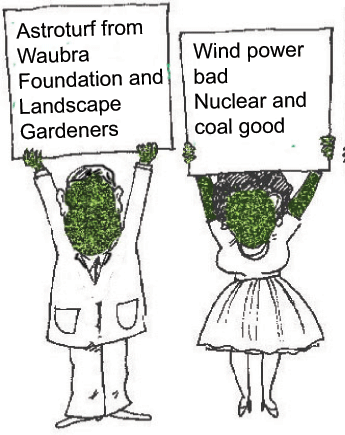 A University of Sydney study released this month concluded wind farm-associated health problems were “communicated” diseases of a psychogenic origin, based on non-physical causes such as fear and anxiety.
The study drew its data on the number of people complaining about health problems from wind farm developers, submissions to government public inquiries and news media articles.
Flannery derides wind farm sickness Weekly Times Now, 28 March 13
CLIMATE commissioner Tim Flannery has dismissed concerns about possible health effects from wind farm noise.
In Thursday’s The Australian, he says illness may be caused by stress or residents being “sick with envy” at not getting payment for turbines on their properties.
Speaking at a nurses’ forum yesterday about the relationship between climate change and health, Professor Flannery fended off a question from a regional Victorian nurse who said she supported wind energy but was seeing many patients with health problems attributed to a nearby wind farm.
”What I’ve read and experienced is that there are no proven health impacts directly from wind-related noise,” Professor Flannery said. “What we do see is people who are adversely affected by it through perhaps stress or tension or worry.” Continue reading
Australian’s especially vulnerable to UV radiation
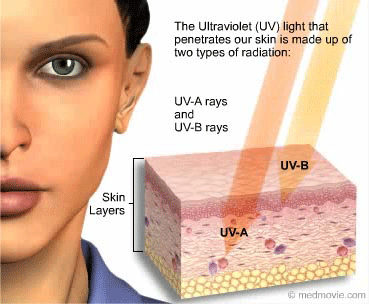 How does the ozone layer protect Earth from radiation? The Coversation by Stuart Henderson, and Peter GiesThis is bad, but it would be a lot worse without the ozone layer. garth.kennedy/Flickr
SAVING THE OZONE: Part three in our series exploring on the Montreal Protocol on Substances that Deplete the Ozone Layer – dubbed “the world’s most successful environmental agreement” – explains why we need an ozone layer.
The ozone layer acts as a filter for the shorter wavelength and highly hazardous ultraviolet radiation (UVR) from the sun, protecting life on Earth from its potentially harmful effects. When the sky is clear, there is an inverse relationship between stratospheric ozone and solar UVR measured at the Earth’s surface. That is,the lower the ozone levels, the higher the solar UVR.
The level of UVR from the sun measured at the Earth’s surface varies linearly with latitude. There are higher UVR levels nearer the equator and lower UVR nearer the poles (see Figure 1).
Australia has high levels of solar UVR, due mainly to its geographical position. We have capital cities at latitudes ranging from 12°30’S (Darwin) close to the equator down to 42°52’S (Hobart). Continue reading
Solid majority of Australians oppose nuclear power
Asia’s nuclear future The Monthly, 24 March 13 The Fukushima crisis has provoked a furious debate about the future of nuclear energy. Polling in Australia shows a return to a solid majority opposing nuclear power for Australia… (subscription only)
Energy storage project through Australian Renewable Energy Agency (ARENA)
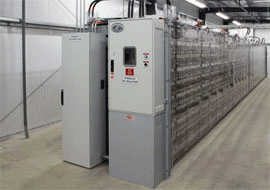 Ecoult awarded energy storage funding through Australian government Solar Server 25 Mar 13
On March 20th, 2013, Ecoult (Sydney, Australia) announced that it has received a funding from the Australian government to conduct small/mid-sized storage projects.
The funding, which was awarded through the Australian Renewable Energy Agency (ARENA), will be used by Ecoult to deliver cost effective storage solutions using Deka UltraBattery technology for homes and businesses in Australia and around the world.
The pilot project will develop a battery storage system prototype for three types of deficit charge/distributed energy applications including: off-grid renewable power solutions; distributed grid connected storage to support voltage and power fluctuations that arise where there is dense concentration of small roof-top solar installations in residential areas; and hybrid generation to improve fuel efficiencies.
Ecoult to extend storage solutions from MW-scale to commercial and residential applications…. http://www.solarserver.com/solar-magazine/solar-news/current/2013/kw12/ecoult-awarded-energy-storage-funding-through-australian-government.html
Saturday 23 March at 8.30 p.m – join the global switch off
Earth Hour 2013 is on at 8:30pm Saturday 23 March. Switch off for good this year and switch on to renewable energy – take the pledge at www.earthhour.org.au

Renewables: taking the heat out of the discussion March 20, 2013 by Earth Hour Australia
Before we get to that stage let’s set the record straight. Here are some of the more common myths, with some cool-headed facts…
Myth: Only coal can provide 24 hour (baseload) power
Fact: Wind and hydro can operate all hours and most energy is used during the daytime.
Of course technologies like hydro, geothermal and wind across the country can run 24 hours, so it is plain wrong to say otherwise. Also, it just so happens that the peak period for energy use – hot days in the early afternoon when everyone turns on their air-con – is also the best time for energy production from solar. Perfect!
Myth: Wind & solar are an expensive way to make energy.
Fact: Rooftop solar & some wind energy can compete with dirty energy sources on price.
The 850,000 Australian households with solar PV have already worked out that solar is cost competitive and saves them money. By 2020, the cheapest source of energy flowing into the grid is likely to be on-shore wind.
Myth: High electricity bills are because of renewable subsidies.
Fact: The largest component of electricity price rises is network charges.
The biggest contributor to price hikes over the last five years is the increasing cost of “poles and wires”. And the main reason these need to be upgraded is to cope with “peak” power – those few hours a year when it gets super hot and everyone switches on air-con.
Myth: Jobs will suffer if Australia moves to renewables by 2030.
Fact: 35,000 new jobs could be created from renewables….
Myth: Australia is a world leader in renewable energy.
Fact: Australia ranks 31st behind Paraguay (15), Mexico (17), Columbia (18), New Zealand (22) & Vietnam (24).
Myth: The carbon tax won’t help renewables.
Fact: The carbon price will make renewables cost competitive with fossil fuels.
Did you realise that at least $5 billion raised from the carbon price will be invested in renewable energy commercialisation like large scale solar. And the very nature of the carbon price – making polluting fossil fuels more expensive – will help renewable energy become more cost competitive sooner, a huge boost for future clean power and a healthier planet. Hooray!
If you want to get more info to wow your friends with your encyclopaedic knowledge on renewables, visit this page.
Earth Hour 2013 is on at 8:30pm Saturday 23 March. Switch off for good this year and switch on to renewable energy – take the pledge at www.earthhour.org.au
Why Earth Hour is still relevant, Climate Spectator, Kellie Caught, 21 March 13, “……..This year for Earth Hour we are asking Australians to make a change, by switching off fossil fuels ‘for good’, and switching on to renewable energy. We are also asking people to sign our petition calling on the federal government to increase the RET to 50 per cent by 2030.
We are using Earth Hour this year to raise awareness about renewables, provide information on how households can make the switch, and even bust a few myths about the carbon price. The online community have been very receptive with more likes and shares than previous Earth Hours.
Rather than wearing out its use, from its humble beginnings 7 years ago in Sydney, Earth Hour has become a global phenomenon that successfully captures the attention of hundreds of millions of people across the planet.
In 2012, 7001 cities and towns participated across 152 countries and territories.
Last year, the Russian parliament passed a long-awaited law to protect the country’s seas from oil pollution, after the voices of 120,000 Russians were presented to the government during the Earth Hour campaign.
This year, in Africa a 500,000 indigenous tree Earth Hour Forest has been inspired in the nation of Uganda. And in Botswana, former President Festus Mogae has made a four-year commitment to plant one million indigenous trees.
But meanwhile, we are heading for a 4 degree world, where the window to avert catastrophe and stop warming beyond 2 degrees Celsius from pre-industrial levels is fast shutting. So the need for Earth Hour to continue to raise awareness of the issue and to symbolise our desire for action has never been greater.
The beauty of Earth Hour is that it is very easy to participate, and the grass roots enthusiasm and positive feedback that we get here at WWF every year reinforces to us the value of the event.
For the other 364 days a year WWF will continue to raise awareness, encourage behaviour change, work with business to reduce their emissions, and lobby governments for policies that will facilitate the transition to a low carbon clean economy and avoid dangerous climate change.
Kellie Caught, National Manager Climate Change, WWF. http://www.businessspectator.com.au/article/2013/3/21/science-environment/why-earth-hour-still-relevant#ixzz2ODmyCnCg
Corporations exert their power in secret deals in the Trans Pacific Partnership (TPP)
The TPP will give big business additional leverage through regulatory ceilings and dispute resolution tribunals.
The chilling effect on regulation is greater in poorer countries that can be cowed by the panels…..
On the chilling effect on regulation, Wallach said there is “no limit to the amount of money tribunals can order governments to pay corporations.” ….
The majority of those in power are under overwhelming pressure from moneyed interests to pass the deal …
there is substantial evidence – not least, the enthusiasm among corporate lobbyists, their intense lobbying efforts…..to suggest that the TPP is going to contain deregulatory initiatives and measures that usher in the privatization of publicly owned enterprises and the fencing off of the creative commons.
Corporate-Backed Trans-Pacific Partnership Shrouded in Secrecy, 19 March 2013 By Sam Knight, Truthout | News Analysis The Trans-Pacific Partnership (TPP), a multilateral trade deal currently being hammered out by the United States and ten other countries, could end up affecting every human being and dollar of wealth on the planet. The extent to which it will is clear to no one, apart from negotiators.
But the deal, in its current form, has been in the works since 2010, involves Australia, Brunei, Canada, Chile, Malaysia, Mexico, New Zealand, Peru, Singapore, the United States and Vietnam, and is open to all 21 countries in the Asia Pacific Economic Cooperation (APEC) region. Continue reading
Earth Hour Saturday March 23 – energy conservation and a call for renewables
On Saturday; Australians are being asked to turn off their lights for one hour from 8.30pm to make a statement against climate change and as a showing of support for renewables.
Originally a one-city initiative in Sydney in 2007 involving two million individuals and 2,000 businesses, Earth Hour now occurs in more than 6,950 cities and towns in 152 countries and territories around the world.
A Renewable Energy Focus For Earth Hour 2013 http://www.energymatters.com.au/index.php?main_page=news_article&article_id=3646 20 March 13, This year’s Earth Hour falls on Saturday 23 March and the event’s main theme calls on Australians to “switch off for good and switch over to renewable energy”.
A related national survey of 1,283 Australians commissioned by WWF-Australia for Earth Hour shows 87% want more action by all sectors, including government, to make Australia a top ten producer of renewable energy.
Currently, Australia is ranked no. 31 – and two-thirds of those surveyed believe the nation would be ranked better.
It seems the Aussie public’s spirit is certainly willing to see Australia become a renewables powerhouse, but political will is still a little weak. The survey revealed participants believe renewable energy should account for 27% of our total energy mix by 2020; 35% more than the current national target of 20%.
Ms. Caught says it’s time Australia’s political leaders set ambitious targets and expand renewables, not hold them back. Continue reading
1 This month
17 October, Free Public Talk on Nuclear Issues in South Australia
David Noonan will speak on public interest concerns over the new Roxby Downs Indenture Act 2026 on BHP copper-uranium mining and ore processing in SA, and on how AUKUS may face SA with a High-Level nuclear waste agenda.
Dr Jim Green will discuss international developments in the field of nuclear power including ‘small modular reactors’ and Generation 4 ‘advanced’ nuclear reactor concepts.


Help Aunty Sue Protect Her Land and Sacred Sites From Destructive Rocket Testing.
.

Australians deserve the truth
about
AUKUS – https://aukuspublicinquiry.com/

PETITION – To: Prime Minister Anthony Albanese and the Australian Labor Government

of the week – Australians for War Powers Reform (AWPR)
To see nuclear-related stories in greater depth and intensity

