Northern Siberia’s new normal – forests on fire
The Moscow Times reports economic losses from thawing permafrost alone is expected to cost Russia’s economy up to $2.3 billion US per year. Last year’s fires likely cost rural communities in the region almost $250 million US. In March, Russia announced 29 measures it would be taking to try to deal with climate change over its vast landmass but critics complained the efforts have been more focused on exploiting natural resources in the Arctic than mitigating the impacts of a warming climate.
“They are actively going after every mineral and oil and gas deposit that they can,”
As permafrost thaws under intense heat, Russia’s Siberia burns — again, https://www.cbc.ca/news/world/siberia-burning-climate-change-russia-1.5645428
Russia’s northern landscape is being transformed by heat and fire, Chris Brown · CBC News : Jul 12, Right around now, University of British Columbia climatologist and tundra researcher Greg Henry would usually be up at Alexandra Fiord on the central-east coast of Canada’s Ellesmere Island experiencing the Arctic’s warming climate up close.
Instead, the pandemic has kept his research team grounded in Vancouver — and his focus has shifted to observing the dramatic events unfolding across the Arctic ocean in northern Siberia.
“It’s remarkable — it’s scary,” said Henry of the incredible run of high temperatures in Russia’s far north that have been breaking records for the past month.
This week, a European Union climate monitoring project reported temperatures in June were up to 10 degrees higher than usual in some parts of Russia’s Arctic, with an overall rise of five degrees.
The heat and dry tundra conditions have also triggered vast forest fires. Currently, 1.77 million hectares of land are burning with expectations that the total fire area could eventually surpass the 17 million hectares that burned in 2019.
Equally striking is where the fires are burning.
“Now we are seeing these fires within 15 kilometres of the Arctic Ocean,” said Henry. “Usually there’s not much fuel to burn there, because it’s kept cold by the ocean so you don’t get ignition of fires that far north.”
This year though, he said the heat has dried the ground out enough to change the dynamics.
“It’s a harbinger of what we are in for because the Arctic has been warming at twice the rate of the rest of the planet.”
Environmental disaster Continue reading
Movement in Japan to suspend Olympic Games
Increasing voices in Japan for the cancellation of the Tokyo Olympics https://wordpress.com/read/feeds/2663585/posts/2804625668
On 7th June Mr Yukio Hatoyama, former Prime Minister of Japan, addressed me a message, expressing his views on the Tokyo Olympics : ”I always thought that instead of spending money on the Tokyo Olympics, the state should use these funds for the decontamination of the affected areas and to compensate the Fukushima nuclear disaster victims.“
He has expressed deep sympathy for the athletes placed in unbearable uncertainties preparing for the postponed Olympics. He urges that the sooner the decision the better for the athletes, since we all know that the Corona pandemic will oblige the Tokyo Olympic Games to be cancelled.
This message has given rise to reactions both in Japan and abroad.As an example,I am sharing with you a mail sent to me by a Japanese living in Germany.
In addition to the Covid-19 crisis, Japan is being cruelly assailed by natural disasters, unprecedented rainfalls and subsequent floods and landslides among others.
Japan faces a national crisis.
With warmest and highest regards,
Mitsuhei Murata
(Former Japanese Ambassador to Switzerland)
——– Forwarded Message ——–Dear Dr Alex Dear Dr Jörg Schmid;
cc: Mr Mitsuhei Murata, Mr Etsuji Watanabe
Recently I have acquired interesting information from Mr Mitsuhei Murata, former Japanese Ambassador to Switzerland, and Mr Etsuji Watanabe, a member of the ACSIR (Association for Citizens and Scientists Concerned about Internal Radiation Exposures), who are two of the leading lights in the anti-nuclear movements in Japan, that there is increasing support within the Japanese society for the complete cancellation, rather than postponement of the Tokyo Olympic Games.
On 7th June Mr Yukio Hatoyama, former Prime Minister of Japan, wrote to Mr Mitsuhei Murata, expressing his views on the Tokyo Olympics : ”I always thought that instead of spending money on the Tokyo Olympics, the state should use these funds for the decontamination of the affected areas and to compensate the Fukushima nuclear disaster victims.“
Subsequently Mr Murata wrote to Mr Thomas Bach, President of the IOC in order to convey this important message :
Dear President Thomas Bach,
Please allow me to inform you of a message a sent to me yesterday from former Japanese Prime Minister Yukio Hatoyama.
He has expressed deep sympathy for the athletes placed in unbearable uncertainties preparing for the postponed Olympics. He urges that the sooner the decision the better for the athletes, since we all know that the Corona pandemic will oblige the Tokyo Olympic Games to be cancelled.
In a press interview article published in January 2016,he made public his plea to consecrate maximum efforts to bringing Fukushima under control.
He has proven himself to be far-sighted. His vision for the future is in conformity with the dawning new world.
With highest and warmest regards,
Mitsuhei Murata
(Former Japanese Ambassador to Switzerland)
Mr Etsuji Watanabe told me that an overwhelming number of anti-nuclear activists are calling for the immediate cancellation of the Olympics. There will be demonstrations on 24th July, on which the 2020 Tokyo Olympic games were to commence, in Kyoto, Osaka and Tokyo. They will be demanding to stop the Olympic Games.
Best regards,
Rie
90 Coronavirus cases among India’s nuclear workers, most at Rooppur Nuclear Power Plant
 Rooppur Nuclear Power Plant: Rising infections among workers, Daily Star, Ahmed Humayun Kabir Topu, 10 July 20, More and more workers of different sub-contracting firms at Rooppur Nuclear Power Plant in Ishwardi upazila are getting infected with the novel coronavirus.
Upazila Health Officer Dr AFM Asma Khatun said 103 people in the upazila have been diagnosed with the virus till July 6. Of them, around 90 workers were infected with Covid-19 in the last three days. The majority of the workers who tested positive for coronavirus work at Paharpur Cooling Tower Ltd, a sub-contracting firm of the Rooppur project.
The number of Covid-19 patients has increased as over 800 employees of the sub-contracting firms at the plant gave samples to the labs of different government and private institutions for Covid-19 testing in the last few days, said the doctor, adding that the number of infected workers is increasing every day.
Most of the Covid-19 patients are the workers of Paharpur Cooling Tower Ltd, a sub-contracting firm of the plant, said Dr Asma Khatun, adding that the authorities of different sub-contracting firms at Rooppur Nuclear Power Plant have collected samples of several hundred workers and sent those to the lab of a private institution in Dhaka for coronavirus testing but they are yet to get copy of the test reports from the private institution. …… https://www.thedailystar.net/city/news/rooppur-nuclear-power-plant-rising-infections-among-workers-1927965
People with mild coronavirus symptoms can get serious brain disorders
 Warning of serious brain disorders in people with mild coronavirus symptoms
UK neurologists publish details of mildly affected or recovering Covid-19 patients with serious or potentially fatal brain conditions, Guardian, Ian Sample Science editor, @iansample, Wed 8 Jul 2020 Doctors may be missing signs of serious and potentially fatal brain disorders triggered by coronavirus, as they emerge in mildly affected or recovering patients, scientists have warned.
Neurologists are on Wednesday publishing details of more than 40 UK Covid-19 patients whose complications ranged from brain inflammation and delirium to nerve damage and stroke. In some cases, the neurological problem was the patient’s first and main symptom.
A dozen patients had inflammation of the central nervous system, 10 had brain disease with delirium or psychosis, eight had strokes and a further eight had peripheral nerve problems, mostly diagnosed as Guillain-Barré syndrome, an immune reaction that attacks the nerves and causes paralysis. It is fatal in 5% of cases.
“We’re seeing things in the way Covid-19 affects the brain that we haven’t seen before with other viruses,” said Michael Zandi, a senior author on the study and a consultant at the institute and University College London Hospitals NHS foundation trust.
“What we’ve seen with some of these Adem patients, and in other patients, is you can have severe neurology, you can be quite sick, but actually have trivial lung disease,” he added. …….
The cases add to concerns over the long-term health effects of Covid-19, which have left some patients breathless and fatigued long after they have cleared the virus, and others with numbness, weakness and memory problems……..
The cases, published in the journal Brain, revealed a rise in a life-threatening condition called acute disseminated encephalomyelitis (Adem), as the first wave of infections swept through Britain. At UCL’s Institute of Neurology, Adem cases rose from one a month before the pandemic to two or three per week in April and May. One woman, who was 59, died of the complication……… https://www.theguardian.com/world/2020/jul/08/warning-of-serious-brain-disorders-in-people-with-mild-covid-symptoms?CMP=share_btn_tw
Call to avoid hasty decision on nuclear waste dump, during pandemic
Pandemic Allows for New Front in Fight Against Southwest Nuclear Waste Storage Contracts https://morningconsult.com/2020/07/10/nuclear-fuel-storage-texas-new-mexico/ Activists, industry, lawmakers push for delays to interim spent fuel storage facilities planned in Texas, New Mexico , Morning Consult BY LISA MARTINE JENKINS, July 10, 2020
Two proposals to send high-level spent nuclear fuel to sites in Texas and New Mexico are seeing renewed opposition as environmental activists, the oil and gas industry and lawmakers on both sides of the aisle have formed an unlikely and informal alliance leveraging the pandemic as a reason to delay.
The proposed Texas and New Mexico facilities — which are licensed by Interim Storage Partners LLC (a joint venture of Orano USA and Waste Control Specialists) and Holtec International, respectively — have applications under review by the Nuclear Regulatory Commission for consolidated interim storage facilities intended to serve as temporary repositories for high-level nuclear waste from all over the country.
The ISP facility already stores low-level waste, but the proposals would expand its license to store high-level waste, which is exponentially more radioactive, for at least 40 years. The Holtec facility would be built on undeveloped land; both facilities are located in the Permian Basin, home to more than 7,000 oil and gas fields.
While most of the country’s more than 90,000 metric tons of nuclear waste is stored where it is generated, the Nuclear Waste Policy Act amendments of 1987 mandated that the country use Nevada’s Yucca Mountain as its only permanent nuclear waste repository. But since the Obama administration scrapped those plans for Yucca in 2009, the United States has not had a long-term destination for the radioactive waste produced by its nuclear energy facilities.
Unlikely agreement
Now, the proposals for these two interim alternatives are eliciting pushback of their own, especially in light of the coronavirus. The pandemic has brought renewed vigor to the fight by both environmental activists and the oil and gas industry, all of whom are concerned about the inability of local stakeholders to sufficiently review and weigh in on the current proposals and statements.
“Just look at what’s happened in Texas today: COVID numbers are just going through the roof,” said Tommy Taylor, director of oil and gas development for the family-owned Fasken Oil and Ranch Ltd. in Midland, Texas. “It’s just hard enough to keep your businesses afloat; we need a lot more time to be able to respond effectively and say what we need to say.”
Taylor’s primary concern is about the potential damage that an accident involving nuclear waste could cause for the industry’s Permian Basin resources, as well as the health effects for those working and living in close proximity to the waste. Fasken is among a coalition of Permian Basin landowners and operators coordinating a resistance to the plan to bring high-level nuclear waste to the region.
“We’re not against nuclear energy,” he clarified. “But if you had to do interim storage in the U.S., there are a lot of better areas to put it than in the middle of our energy security blanket. It really tees it up for something bad to happen.”
Karen Hadden, executive director of the Austin, Texas-based Sustainable Energy and Economic Development Coalition, has been vocal for years on the issue of nuclear waste and told Morning Consult the proposals are “environmental justice of the largest magnitude imaginable.”
“They’re building a nuclear empire in West Texas,” Hadden said. “The communities do not have the resources to fight back.”
The ISP facility would be located in Andrews County, a largely Hispanic region of Texas where Hadden said language and technology barriers have compromised the community’s ability to stay informed about the proposal — issues that she said have been “compounded” by the pandemic. And the Holtec facility, which would be located just across the state border in New Mexico’s Lea County, has elicited concern from Native American communities in the region because of the likelihood that nuclear waste would have to pass through tribal land, including Navajo Nation. ……..
A push for delays
The proposals’ respective draft environmental impact statements are currently open for public comment; ISP’s 120-day comment period ends Sept. 4, while Holtec’s 180-day period concludes Sept. 22. Holtec’s was initially just 60 days, but has been extended twice, which NRC Public Affairs Officer David McIntyre said is due to “the effects of the COVID-19 public health emergency.”
The NRC has held two webinars for public comment on the Holtec project, with the latest eliciting strong reactions from local Indigenous groups. McIntyre said the agency hopes to schedule a webinar for the ISP project soon, and that “decisions on in-person meetings in New Mexico and Texas will be made later, and will depend on our assessment of the public health emergencies in each state.”
But both legislators and activists have seen these attempts at engagement as insufficient and are asking for delays of months, if not years.
Rep. Lloyd Doggett (D-Texas) represents a region of the state through which the waste is likely to pass, and he sent a letter to NRC leaders June 16 requesting that the agency hold in-person public meetings in six different Texas locations regarding the draft environmental impact statement. He asked that the agency schedule the hearings “at least six months after the COVID-19 risks are fully resolved and extend the comment period deadline as well.”
“The pandemic threatens our families now; nuclear waste could endanger us forever,” Doggett told Morning Consult via email. “It’s essential that the NRC not act prematurely when we are preoccupied with the immediate threat of a pandemic greatly worsened by failures of national and state leadership.”…..
These more recent pushes to pause the endeavor until after the pandemic echo a March letter from New Mexico’s congressional delegation to the NRC, which highlighted concerns about the fuel’s transport, as well as about local agriculture and industry and disproportionate impacts of the proposal on Native American communities in the state.
“I hope that the NRC will look at what these legislators are asking and really consider a significant delay,” Taylor said, “because I think they want to get this right, and it’s not going to be right just pushing it through during the pandemic.”
Anniversary of nuclear bomb test on Mururoa Atoll
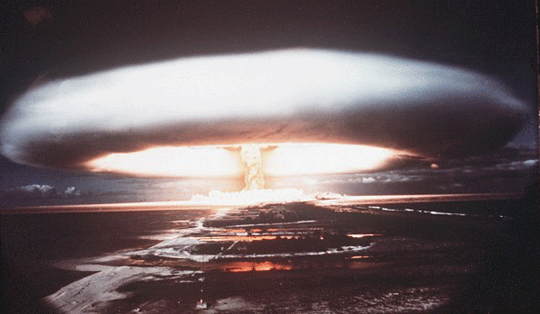
This day on July 2nd 1966, the first French nuclear test took place at Mururoa Atoll. [Image description: slides with blue and orange text on black background with text that reads, On this day in history, an orange radioactive mushroom cloud ruptured Pacific skies, seas and engulfed the atoll of Mururoa. It was the beginning of a toxic reign of radioactive negligence by the French in the Pacific region. The French President who upon witnessing the July 2nd detonation remarked, “It’s beautiful”.
The colonial power had been testing in Algeria, but as their independence became more evident, the French moved into the atolls of Polynesia. From 1966 to 1996, the French conducted 193 tests on the atoll; some of the explosions 200 times the strength of the bombs dropped on Hiroshima and Nagasaki. Information on safety, and the lasting impacts for environment and human health, was scarce if not, misleading. The sovereign peoples were led to believe testing was not only safe but would benefit their communities through military-based economic opportunity. People who worked only 15kilometres away from test sites often had no more protection than the shorts and t-shirts on their backs.
French testing, was a theatrical power display, an assertion of their priority to grasp tight to global dominance rather than world peace. Resistance to testing was prominent from the outset. Pouvanaa a Oopa, a fierce and enduring anti colonial leader, led the first protection action in 1950, collecting signatures for the Stockholm Peace Appeal. He remained an important leader and agitator, even throughout his political imprisonment and exile to France.
During the thirty years of French testing, condemnation swelled internally and across Pacific nations including Aotearoa and so called Australia. Mass protests, demonstrations, flotilla solidarity, trade union bans and boycotts on French products took place. “If it is safe to test, test it in Paris” was a phrase used by key collective, The Nuclear Free and Independent Pacific.
The radioactive fall out has had devastating impacts on both environment and human health. Tahiti the most populated island was exposed to 500 times the maximum accepted levels of radiation. Tahitian socialist, Richard Tuheiava outlines the continuing struggle for justice, ”The fact is since the nuclear testing most of the diseases were cancer, leukaemia. Most of the diseases were as a result of the nuclear testing, so we collectively also put a request for the state of France, the colonial power to not only compensate directly the veterans, but also compensate this fund, this public health care fund.”
Today, July 2nd 2020, we honour the ongoing impacts of nuclear colonialism in the Polynesia, and the enduring fight for justice, truth and accountability.] https://www.facebook.com/groups/1314655315214929/
Paul Ehrlich warns overpopulation and overconsumption are driving us over the edge
Paul Ehrlich: ‘Collapse of civilization is a near certainty within decades’ MAHB, Damian Carrington | July 9, 2020 This interview was first published in The Guardian on March 22, 2018
Fifty years after the publication of his controversial book The Population Bomb, biologist Paul Ehrlich warns overpopulation and overconsumption are driving us over the edge
A shattering collapse of civilisation is a “near certainty” in the next few decades due to humanity’s continuing destruction of the natural world that sustains all life on Earth, according to biologist Prof Paul Ehrlich.
In May, it will be 50 years since the eminent biologist published his most famous and controversial book, The Population Bomb. But Ehrlich remains as outspoken as ever.
The world’s optimum population is less than two billion people – 5.6 billion fewer than on the planet today, he argues, and there is an increasing toxification of the entire planet by synthetic chemicals that may be more dangerous to people and wildlife than climate change.
Ehrlich also says an unprecedented redistribution of wealth is needed to end the over-consumption of resources, but “the rich who now run the global system – that hold the annual ‘world destroyer’ meetings in Davos – are unlikely to let it happen”.
In 2020 Chernobyl is again at risk of radiological catastrophe
Chernobyl Is Again Close To A Disaster! What Happened There In 2020? http://www.thesentrybugle.com/2020/07/chernobyl-is-again-close-to-disaster.html#.XwZuet3J6Vg.twitter Ukrainian officials have sought calm after forest fires in the restricted zone around Chernobyl, scene of the world’s worst nuclear accident, led to a rise in radiation levels.
Climate action now will get results only after 20-30 years – that is the problem
 There’s no quick fix for climate change https://www.theverge.com/21315822/climate-change-global-temperature-study-decades-fixScientists looked for a ‘shortcut’ and didn’t find one There’s no quick fix for climate change https://www.theverge.com/21315822/climate-change-global-temperature-study-decades-fixScientists looked for a ‘shortcut’ and didn’t find one
By Justine Calma@justcalma Jul 7, 2020, It could take decades before cuts to greenhouse gases actually affect global temperatures, according to a new study. 2035 is probably the earliest that scientists could see a statistically significant change in temperature — and that’s only if humans take dramatic action to combat climate change.
Specifically, 2035 is the year we might expect to see results if we switch from business-as-usual pollution to an ambitious path that limits global warming to under 2 degrees Celsius — the target laid out in the Paris climate agreement. The world isn’t on track to meet that goal, so we might not see the fruits of our labor until even later. That means policymakers need to be ready for the long haul, and we’re all going to need to be patient while we wait for the changes we make now to take effect.
“I foresee this kind of train wreck coming where we make all this effort, and we have nothing to show for it,” says lead author of the study, Bjørn Samset. “This will take time.” It will be time well spent if we manage to cut emissions — even if we have to wait to see results. Humans have so far warmed up the planet by about 1 degree Celsius. That’s already come with more devastating superstorms and wildfires and has forced people from Louisiana to Papua New Guinea to abandon their homes as rising sea levels flood their lands. Even keeping the planet to the 2 degree goal would result in the near annihilation of the world’s coral reefs. Taking into consideration all of the commitments from world leaders to work together on climate change, we’re currently careening toward global warming of about 3 degrees Celsius above preindustrial levels. To avoid burnout and keep aspirations high when it comes to tackling climate change, scientists and policymakers will need to be realistic about what’s ahead. The first line of the new study, published today in the journal Nature Communications, reads: “This paper is about managing our expectations.” The study looks at the effects of cutting down on carbon dioxide, black carbon, and methane emissions. Carbon dioxide is the toughest greenhouse gas to tackle because so much of the world economy still relies on burning fossil fuels. Methane (a more potent greenhouse that comes from agriculture and natural gas production) and black carbon (a big component of soot) are, in theory, easier to cut back. Using climate models and statistical analysis, Samset and his colleagues wanted to know whether addressing these other pollutants might lead to faster results. Their analysis isolated the effects that reducing methane and black carbon might have. They found that temperatures might respond quicker to axing these pollutants, but it wouldn’t have as big of an effect in the long term as pushing down our carbon emissions. The best bet is to tackle all three at once. “We kind of break this apart and try to see, is there a shortcut? Is there anything we can do to give people the impression that things are having an effect? And unfortunately, the answer is no,” says Samset. “There’s no quick fix to this.” Part of the problem is that carbon dioxide can persist in the atmosphere for hundreds of years after being released by burning coal, oil, and gas. Natural variations in climate can also delay the impact that cutting down greenhouse gases has on global temperatures. “There is this fundamental misunderstanding of the climate system by non climate scientists trying to use trends on a 10 year time scale for climate change, when [with] climate change a 100 or 200-year timescale is relevant,” explains Natalie Mahowald, a climate scientist at Cornell University who was not involved in the study. “All our hard work today, we will not be able to see for 20 or 30 years — this is the crux of the problem,” Mahowald says. “Humans have a really hard time doing something for future generations.” |
|
Reducing radioactive waste in processes to dismantle nuclear facilities
 Reducing radioactive waste in processes to dismantle nuclear facilities Reducing radioactive waste in processes to dismantle nuclear facilitieshttps://www.eurekalert.org/pub_releases/2020-07/uotb-rrw070820.phpThe University of the Basque Country (UPV/EHU) has produced a methodological guide of in situ measurements for the purpose of optimizing waste management in nuclear dismantling processes UNIVERSITY OF THE BASQUE COUNTRY Recent years have seen a move into a phase to decommission and dismantle nuclear power stations and facilities, above all in Europe. By 2015, 156 reactors at nuclear facilities across the world had been shut down or were being decommissioned, and by 2050 over half of the current nuclear capacity of 400 GW across the world is programmed to be decommissioned so that it can be dismantled. “In Europe this will result in an increase in radioactive waste while current storage facilities have limited capacity. Optimizing this management is crucial,” said the UPV/EHU professor Margarita Herranz. The European H2020 INSIDER project –with funding of nearly five million euros over four years– is tackling the specification of the best strategy to optimize the production of radioactive waste during the dismantling of nuclear facilities; it is focussing on the characterization strategy and on improving the methodology, above all in constrained environments, by working to propose new and better solutions for dismantling nuclear and radioactive facilities, including power stations that produce electrical power, and for environment remediation, taking post-accident situations into consideration as well. Continue reading
|
European Union lawmakers ban nuclear from green transition fund
 EU lawmakers ban nuclear from green transition fund, leave loophole for gas https://www.reuters.com/article/us-climate-change-eu-transitionfund/eu-lawmakers-ban-nuclear-from-green-transition-fund-leave-loophole-for-gas-idUSKBN2472HN
By Kate Abnett and Marine Strauss, 8 July 20,
BRUSSELS (Reuters) – European Union leaders are split over which fuels deserve support from the bloc’s flagship green energy fund, after lawmakers on Monday called for rules that could allow the money to be spent on some fossil gas projects.
The European Commission wants to launch a 40 billion euro ($45 billion) Just Transition Fund using cash from the bloc’s coronavirus recovery fund and its budget for 2021-27, to help carbon-intensive regions launch green industries and retrain workers currently in polluting sectors.
All EU member states agreed last week that the new fund should exclude nuclear and fossil fuels projects, including natural gas projects – a position also shared by the EU Commission.
But on Monday a committee of lawmakers leading talks on the issue in the European Parliament broke ranks. They said that while nuclear energy projects should not be eligible, some fossil gas projects could get just transition funding.
The committee voted in favour of requiring green finance rules to be applied to funding of gas projects – which would effectively exclude such projects. But they also said the EU Commission could make exemptions to this rule and approve some gas projects that don’t meet the green criteria.
The full legislative assembly will vote in September on whether or not to approve the rules. Once the assembly has agreed its position, talks will start with the EU Commission and national governments in the EU Council on the final terms of the funding.
Gas emits roughly 50% less CO2 than coal when burned in power plants, but it is not a “zero-carbon” fuel and is associated with leaks of methane, a potent greenhouse gas.
Covid-19, climate change – what are we to do?
|
Both also interact – shutting down swathes of the economy and causing life as we know it to a virtual standstill. But it led to huge cuts in worldwide GHG daily emissions estimated at 17% below what they were in the same first week of April, last year. Global industrial GHG emissions are now expected to be about 8% lower in 2020, the largest annual drop since WWII. Still, the world will have more than 90% of the necessary decarbonisation left to do in the face of a pandemic, in order to be on track to meet the Paris Agreement’s ambitious goal: of a climate only 1.5 degree Celcius warmer than it was before the Industrial Revolution. Carbon pricing The challenges ahead create a unique chance to enact government policies that steer the economy away from carbon at a lower financial, social and political cost than might otherwise have been the case. Today’s low energy prices will make it easier to cut subsidies for fossil fuels; and more importantly, to introduce a tax on carbon. Revenues from the tax over the next decade can help repair battered government finances. Getting economies back on their feet through investment in friendly infrastructure will boost growth and create new jobs. Low interest rates today make it much cheaper. Carbon pricing can ensure that the shift happens in the most efficient way possible. The timing is particularly propitious because the costs of wind and solar power have tumbled. A relatively small push from a carbon price can give renewables a decisive advantage – one which can become permanent as wider deployment made them cheaper still. True, carbon prices are not popular with politicians. Even so, Europe is planning an expansion of its carbon-pricing scheme; and China is instituting a brand new one. Proceeds from a carbon tax can be over 1% of gross domestic product (GDP); and this money can either be paid as a dividend to the public or, help lower government debts (which will reach 122% of GDP in advanced nations, and will rise even further if green investments are debt-financed). Negative emissions To be sure, carbon pricing by itself is unlikely to create a network of electric-vehicle charging-points; more nuclear power plants and programmes to retrofit inefficient buildings; and to develop technologies aimed at reducing emissions that cannot simply be electrified away (such as those from large aircrafts and farms). They could be counterbalanced by “negative emissions” that take carbon dioxide (CO2) out of the atmosphere at a similar rate, i.e. through developing negative emission technologies; more gentle emissions cut in the near future to be made up by negative emissions later on; farming in ways that make the soil richer in organic carbon; restoring degraded forests and planting new ones; growing plantation crops, burning them to generate electricity and sequestering the carbon dioxide given off underground; and bioenergy with carbon capture and storage. In these areas, subsidies and direct government investment are needed. Some governments have already put efforts into greening their Covid-19 bailouts. In other countries, the risk is of climate damaging policies: US has been relaxing its environment rules; whereas China continues to build new coal plants. The International Energy Agency (IEA) estimated that emissions of CO2 in 2019 had remained the same (33.3 billion tonnes) as the previous years. Energy-related emissions (which include those produced by electricity generation, heating and transport) account for more than 70% of the world’s industrial CO2 pollution. The stall seems to have been caused by a fall in coal and oil use, combined with a rise in the use of renewable power. Some governments have already put efforts into greening their Covid-19 bailouts. In other countries, the risk is of climate damaging policies: US has been relaxing its environment rules; whereas China continues to build new coal plants. The International Energy Agency (IEA) estimated that emissions of CO2 in 2019 had remained the same (33.3 billion tonnes) as the previous years. Energy-related emissions (which include those produced by electricity generation, heating and transport) account for more than 70% of the world’s industrial CO2 pollution. The stall seems to have been caused by a fall in coal and oil use, combined with a rise in the use of renewable power. Historically, it acted as an absorbing sponge for CO2 by removing it from the atmosphere through photosynthesis. Researchers at Brazil’s National Institute for Space Research indicated that about one-fifth of south-east Amazon has lost its ability to soak up the gas, and is now a net source of emissions instead. Most disappointing. Carpe Covid I should say the Covid-19 pause is not inherently climate-friendly. Nations need to make it so, the aim being to show that by 2021, they will have made sufficient progress to meet the Paris target commitments. The pandemic demonstrated that the foundations of prosperity are precarious. Disasters come without warning, shaking all that seemed stable. Indeed, the harm from climate change will be slower than the pandemic, but more massive and longer lasting. There is a lesson to be learnt. What then are we to do? Warming depends on the cumulative emissions to date; a fraction of one year’s toll makes no appreciable difference. But returning the world to the emission levels of 2010 – for a 7% drop – raises the tantalising prospect of crossing a psychologically significant boundary. I think the peak in CO2 emissions from fossil fuels may be a lot closer than many assume. That such emissions have to peak, and soon, is a central tenet of climate policy. Precisely when they might do so, though, is policy dependent. We know the idea of stripping carbon dioxide out of the atmosphere is fraught with problems. One is the scale to make a difference. Imagine that in 2060 the world manages to renounce 90% of its fossil fuel use. To offset the remaining recalcitrant 10% will still mean soaking up about one billion tonnes of carbon a year. Industrial systems currently operate at barely a thousandth of that scale. Creating such a flow through photosynthesis will require, I think, a plantation the size of Mexico. The second problem: imaginary backstops are dangerous. They deter nations in undertaking the huge efforts required to make the needed negative emissions a reality. And a third: the known unknowns – high likelihood of drought and crop failures; changes to regional climate that upset whole economies; storms more destructive in both their winds and their rains; seawater submerging beaches and infiltrating aquifers – all add to more anxiety. And in the spaces in between, are the unknown unknowns – as surprising, and deadly, as a thunderstorm that kills and the great ice-sheets that are doomed slowly to collapse. Above all, only the pathway embodying the strongest climate action (much stronger than what is promised so far) can allow the world to keep the temperature rise since the 18th century well below two degree Celcius in the 21st. This had led a new generation of climate activists to demand greater commitments at the next UN Framework Convention on Climate Change. There remain serious problems: how to get people and nations who do not share their passion and commitment, to do more – much more. If governments really want to limit climate change, they must do more. They do not have to do everything; but need to send out clear signals. Around the world, they currently provide US$400bil a year in direct support for fossil fuel consumption; more than twice what they spend subsidising renewable production. A price on carbon, which hastens the day when new renewables are sustainably cheaper than old fossil fuel plants, is a crucial step. So is research spending aimed at those emissions which are hard to electrify away. Governments have played a vital role in the development of solar panels, wind turbines and fracking. There is a lot more to do. However much they do, though, and however well they do it, they will not stop what’s on-going. On today’s policies, I think the rise by the end of the century looks closer to three degree Celcius. Besides trying to limit climate change, I am afraid the world also needs to learn how to adapt to it. |
|

Jane Goodall on conservation, climate change and COVID-19
CBS News recently spoke to Goodall over a video conference call and asked her questions about the state of our planet. Her soft-spoken grace somehow helped cushion what was otherwise extremely sobering news: “I just know that if we carry on with business as usual, we’re going to destroy ourselves. It would be the end of us, as well as life on Earth as we know it,” warned Goodall.
What follows is a lightly edited transcript of our conversation.
Jeff Berardelli: Destruction of nature is causing some really big concerns around the world. One that comes to the forefront right now is emergent diseases like COVID-19. Can you describe how destruction of the environment contributes to this?
Dr. Jane Goodall: Well, the thing is, we brought this on ourselves because the scientists that have been studying these so-called zoonotic diseases that jump from an animal to a human have been predicting something like this for so long. As we chop down at stake tropical rainforest, with its rich biodiversity, we are eating away the habitats of millions of animals, and many of them are being pushed into greater contact with humans. We’re driving deeper and deeper, making roads throughout the habitat, which again brings people and animals in contact with each other. People are hunting the animals and selling the meat, or trafficking the infants, and all of this is creating environments which are perfect for a virus or a bacteria to cross that species barrier and sometimes, like COVID-19, it becomes very contagious and we’re suffering from it.
But we know if we don’t stop destroying the environment and disrespecting animals — we’re hunting them, killing them, eating them; killing and eating chimpanzees in Central Africa led to HIV/AIDS — there will be another one. It’s inevitable.
Do you fear that the next [pandemic] will be a lot worse than this one?
Well, we’ve been lucky with this one because, although it’s incredibly infectious, the percentage of people who die is relatively low. Mostly they recover and hopefully then build up some immunity. But supposing the next one is just as contagious and has a percentage of deaths like Ebola, for example, this would have an even more devastating effect on humanity than this one.
I think people have a hard time connecting these, what may look like chance events, with our interactions and relationship with nature. Can you describe to people why the way that we treat the natural world is so important?
Well, first of all, it’s not just leading to zoonotic diseases, and there are many of them. The destruction of the environment is also contributing to the climate crisis, which tends to be put in second place because of our panic about the pandemic. We will get through the pandemic like we got through World War II, World War I, and the horrors following the World Trade towers being destroyed. But climate change is a very real existential threat to humankind and we don’t have that long to slow it down.
Intensive farming, where we’re destroying the land slowly with the chemical poisons, and the monocultures — which can be wiped out by a disease because there is no variation of crops being grown — is leading to habitat destruction. It’s leading to the creation of more CO2 through fossil fuels, methane gas and other greenhouse gas [released] by digestion from the billions of domestic animals.
It’s pretty grim. We need to realize we’re part of the environment, that we need the natural world. We depend on it. We can’t go on destroying. We’ve got to somehow understand that we’re not separated from it, we are all intertwined. Harm nature, harm ourselves.
If we continue on with business as usual, what do you fear the outcome will be?
Well, if we continue with business as usual, we’re going to come to the point of no return. At a certain point the ecosystems of the world will just give up and collapse and that’s the end of us eventually too.
What about our children? We’re still bringing children into the world — what a grim future is theirs to look forward to. It’s pretty shocking but my hope is, during this pandemic, with people trapped inside, factories closed down temporarily, and people not driving, it has cleared up the atmosphere amazingly. The people in the big cities can look up at the night sky and sea stars are bright, not looking through a layer of pollution. So when people emerge [from the pandemic] they’re not going to want to go back to the old polluted days.
Now, in some countries there’s not much they can do about it. But if enough of them, a groundswell becomes bigger and bigger and bigger [and] people say: “No I don’t want to go down this road. We want to find a different, green economy. We don’t want to always put economic development ahead of protecting the environment. We care about the future. We care about the health of the planet. We need nature,” maybe in the end the big guys will have to listen……….https://www.cbsnews.com/news/jane-goodall-climate-change-coronavirus-environment-interview/?ftag=CNM-00-10aab7e&linkId=92720503
Michael Shellenberger mucked up the pro nuclear “climate action” propaganda
 The environmentalist’s apology: how Michael Shellenberger unsettled some of his prominent supporters
The American environment and energy commentator’s piece in the Australian has found praise in conservative media , Guardian Graham Readfearn @readfearn, 4 Jul 2020 Few things engage a particular subset of conservative media more than an environmentalist having an apparent change of heart and dumping all over the “climate scare”.
Earlier this week, the Australian newspaper ran an opinion piece that fitted this narrative so perfectly that room was found on its front page.
The American environment and energy commentator and nuclear power supporter Michael Shellenberger was the provider.
“On behalf of environmentalists everywhere, I would like to formally apologise for the climate scare we created over the past 30 years,” wrote Shellenberger in his 1,700-word article.
A long interview on Australia’s Sky television, known for airing derisory views of environmentalism and climate change in its evening schedules, soon followed.
Though he had almost no profile in Australia before the piece, Shellenberger has been a contrarian voice on environmental issues and a critic of aspects of environmentalism for more than 15 years.
But his “apology for the climate scare” has unsettled some supporters of his who spoke to Guardian Australia.
His op-ed was first published three days earlier on Forbes, but was removed by the outlet.
Shellenberger claimed on social media he had been censored and told rightwing site the Daily Wire he was grateful Forbes was committed to publishing viewpoints that “challenge the conventional wisdom, and thus was disappointed my editors removed my piece from the web”.
Forbes told Guardian Australia the article was removed “because it violated our editorial guidelines around self-promotion”.
 Before appearing in the Australian, the op-ed also ran on the website of Shellenberger’s thinktank, Environmental Progress, and on at least three other sites. The article heavily promoted Shellenberger’s new book, Apocalypse Never.
The article contained a list of “facts few people know” to buttress his claim that while climate change was happening, “it’s not even our most serious environmental problem”.
Among Shellenberger’s many claims was that climate change was not making natural disasters worse, fires had declined around the world since 2003, and the more dangerous fires being experienced in Australia and California were because of the build up of wood fuel and more houses near forests, not climate change.
Voices that have questioned human-caused climate change have embraced and applauded Shellenberger’s article.
At the same time, climate science experts have also offered qualified praise, while expressing concerns about the broader impact of the opinion article.
Respected MIT climate expert Prof Kerry Emanuel sits on a line-up of science advisers of Environmental Progress.
He told Guardian Australia he was “very concerned” about the opinion piece, and was consulting with other members of the advisory group before deciding whether to remain listed…….
He said: “For example, he states ‘climate change is not making natural disasters worse’ when there is plenty of evidence that it is.”….
One example of the more questionable claims in the opinion piece comes when Shellenberger claims fires in Australia and California were becoming more dangerous because of the “build-up of wood fuel and more houses near forests, not climate change”.
That claim is at odds with many studies showing higher temperatures driven by rising levels of greenhouse have already increased the risks of bushfires in Australia and will continue to do so in the future.
A review of the academic literature produced earlier this year in response to Australia’s devastating bushfire summer found “human-induced warming has already led to a global increase in the frequency and severity of fire weather, increasing the risks of wildfire”. …..
According to the latest publicly available financial records, Environmental Progress earned US$809,000 in revenue in 2017 from gifts, grants and donations.
In the process of researching this article, Guardian Australia emailed questions to Shellenberger to clarify why Forbes had removed his article and who funded his organisation.
A third question related to a 2017 internal report from the Nuclear Energy Institute (NEI) which said the institute, which represents the nuclear energy industry, had “engaged third parties to engage with media through interviews and op-eds” and named “environmentalist Michael Shellenberger” as one of those it had engaged……… https://www.theguardian.com/environment/2020/jul/04/the-environmentalists-apology-how-michael-shellenberger-unsettled-some-of-his-prominent-supporters
Rare type of leukaemia, other health effects, in British veterans of nuclear testing
“My task was to go in and pick up all the radioactive debris, load them into my truck and take them to the decontamination centre.
“I had no protection whatsoever. The only people who had protection on Christmas Island were civilian AWREs – Atomic Weapons Research Establishment people.”
A study undertaken by Sue Rabbitt Roff, a social scientist at Dundee University in 1999, found that of 2,261 children born to veterans, 39% were born with serious medical conditions. By contrast, the national incidence figure in Britain is around 2.5%.
“I want them to apologise to all the nuclear veterans for using us as experiments,” he said.
I still maintain that they wanted to find out the level of radiation that a person could survive the nuclear bombs with.
I want them to apologise to all the nuclear veterans for using us as experiments’, says Fife Christmas Island veteran, https://www.thecourier.co.uk/fp/news/local/fife/1377815/i-want-them-to-apologise-to-all-the-nuclear-veterans-for-using-us-as-experiments-says-fife-christmas-island-veteran/ July 4 2020 Michael Alexander. Here’s why nuclear test veteran Dave Whyte from Fife intends to campaign for justice “until the end”
In the 18 years that Christmas Island veteran Dave Whyte from Fife has been campaigning for “justice” for Britain’s nuclear test veterans, he has never held back with the language he has used to describe the Ministry of Defence’s treatment of British soldiers during the nuclear tests of the 1950s.
He has compared the nuclear tests with the “experiments of Nazi Doctor Joseph Mengele”, accused the MoD of treating soldiers as “guinea pigs” and made comparisons with the aftermath of “Chernobyl”.
He blames his exposure to the fallout from five atomic and hydrogen bomb blasts in 1958 for a catalogue of health problems he’s experienced over the years including the loss of all his teeth at 25 and the discovery in his mid-30s that he was sterile.
The Ministry of Defence, meanwhile, has said there is no valid evidence linking the nuclear tests to ill health.
But despite numerous attempts at legal action against the MoD over the years, which, he admits have “hit every brick wall available”, the now 83-year-old, of Kirkcaldy, is refusing to give up as he continues searching for an admission that he, and thousands of other servicemen – now dwindling in numbers – were exposed to more radiation than the authorities have ever admitted.
Born and raised in Montrose before a spell living in Edinburgh and Germany where his sergeant major father served with the Royal Artillery, Mr Whyte was 22-years-old and serving with the Royal Engineers when he was sent to Christmas Island in the South Pacific in 1958.
The Cold War was at its height and Mr Whyte was stationed there, off the north-eastern coast of Australia, to assist with British nuclear tests.
His job was to collect samples afterwards.
At the time the stakes were high. Amid real fears that the Cold War could escalate into open warfare with the USSR, Britain was determined that it should have its own nuclear deterrent.
In all, Britain and the USA caused some 40 nuclear test explosions in the Pacific region between 1952 and 1962.
Something like 21,000 British servicemen were exposed to these explosions.
But little did Mr Whyte and his colleagues realise that in years to come, some would suffer ill health and in some cases premature death.
Some would suffer from rare forms of leukaemia.
Others reported congenital deformities in their children with a disproportionate number of stillbirths.
“I was at Grapple Y – the largest hydrogen bomb exploded by Britain,” said Mr Whyte. Continue reading
1 This month
7 April – WEBINAR – Australia and the Doomsday Clock – Preventing nuclear war through NoFirstUse and other policies
Online | Tuesday April 7, 4:00-5:30pm, Australian Eastern Time / 8:00-9:30am Central Europe Time
– Access the registration link
15 April – Zoom –Nuclear Power is Not the Solution
Apr 15, 2026 01:00 AM in Canberra, Melbourne, Sydney

Join the International Physicians for the Prevention of Nuclear War (IPPNW) on Tuesday, April 14th for a timely webinar exploring the risks associated with nuclear power and challenging the myth that it offers a simple, safe, carbon-free solution to the climate crisis

21 April Webinar: No Nuclear Weapons in Australia
Start: 2026-04-21 18:00:00 UTC Canberra, Melbourne, Sydney (GMT+10:00)
End: 2026-04-21 19:30:00 UTC Canberra, Melbourne, Sydney (GMT+10:00)
Event Type: Virtual
A virtual link will be communicated before the event.
Host Contact Info: australia@icanw.org

of the week – Australians for War Powers Reform (AWPR)
To see nuclear-related stories in greater depth and intensity
 Antinuclear