Small modular nuclear reactors distract from real climate solutions
 Small modular nuclear reactors distract from real climate solutions, Regina Leader Post, Darrin Qualman, Glenn Wright Jul 03, 2020 •Last fall, the premiers of Saskatchewan, Ontario and New Brunswick pledged their support for small modular reactors (SMRs). Last week, Saskatchewan’s government announced a Nuclear Secretariat to oversee development of those reactors. Many in Saskatchewan took these announcements at face value and began questioning the cost, feasibility and safety of these units. To do so, however, is to misunderstand what’s really happening. The reality is that three premiers lacking adequate emission-reduction plans pledged themselves to speculative technologies that will take a decade or two to get up and running, if ever. SMRs are another distraction to shift the focus away from provincial records of increasing emissions. The SMR announcement follows a pattern of past policy declarations that serve to distract the public and delay effective policies…..
Solutions are within reach. Jobs await. SMRs are a distraction. Let’s not be fooled again. Let’s demand rapid, effective emissions reduction now as part of a revitalized Saskatchewan economy.
Germany is first major economy to phase out coal and nuclear
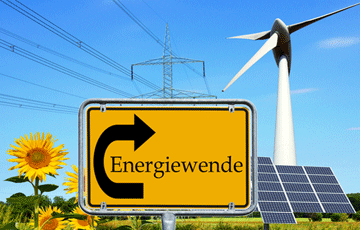 Germany is first major economy to phase out coal and nuclear, Economic Times, 3 July 20
The plan is part of Germany’s ‘energy transition’ – an effort to wean Europe’s biggest economy off planet-warming fossil fuels and generate all of the country’s considerable energy needs from renewable sources…….
The plan is part of Germany’s ‘energy transition’ – an effort to wean Europe’s biggest economy off planet-warming fossil fuels and generate all of the country’s considerable energy needs from renewable sources…….
The plan is part of Germany’s ‘energy transition’ – an effort to wean Europe’s biggest economy off planet-warming fossil fuels and generate all of the country’s considerable energy needs from renewable sources.
But the head of Germany’s main miners’ union, Michael Vassiliadis, welcomed the decision, calling it a “historic milestone.” He urged the government to focus next on an expansion of renewable energy generation and the use of hydrogen as a clean alternativ ..
No nuclear waste dump near Lake Huron: opposition of indigenous people, Saugeen Ojibway Nation, the deciding factor
OPG ends quest for nuclear waste dump on Lake Huron, Opposition of Saugeen Ojibway Nation is pivotal, The Voice By Jim Bloch For MediaNews Group Jun 30, 2020The quest for a deep geologic repository for nuclear waste on the lip of Lake Huron in Ontario is dead.
The 15-plus-year-old effort by Ontario Power Generation to build the underground dump for low and intermediate nuclear waste from Ontario’s 20 reactors appeared to end in January, following the vote of the Saugeen Ojibway Nation against the repository. Eighty-six percent of the first nation voted against the dump, 1,058-170.
SON is made up of the Chippewas of Nawash Unceded First Nation and the Chippewas of Saugeen First Nation. Their territory includes the Bruce Peninsula and runs down the coast of Lake Huron past Goderich and along the shores of Georgian Bay to just beyond Collingwood. SON has roughly 4,500 members.
OPG officially terminated the project on May 27 in a letter to Jonathon Wilkerson, the Federal Minister of Environment and Climate Change, asking for the withdrawal of its application for a building license and ending the environmental impact assessment for the DRG.
“… OPG has informed the Canadian Nuclear Safety Commission that we do not intend to carry out the Project and have asked that the application for a Site Preparation and Construction License be withdrawn,” said Lise Morton, vice president of OPG’s Nuclear Waste Management Division. “Similarly, OPG requests the minister to cancel the environmental assessment for the Project.”
Wilkerson responded on June 15.
“I accept Ontario Power Generation’s request to withdraw the project from the federal environmental assessment process…,” said the minister.
Wilkerson also forwarded his decision to Rumina Velshi, president of the Canadian Nuclear Safety Commission……..
The long term safety of the project — located less than a half-mile from Lake Huron, one of the five Great Lakes that provide drinking water to at least 34 million people in two countries — was at the heart of the controversy. …..
The underground dump was designed to store 200,000 cubic meters of nuclear waste, some of which would remain toxic for at least 100,000 years, roughly 10 times longer than the Great Lakes have been in existence; some of it would remain lethal for more than a million years.
Depositing so much toxic waste on the edge of 20% of the world’s surface fresh water was dubbed as insanity by critics, who pointed to the possibility of the DGR being overtopped by fresh water tsunamis like the Great Lakes Hurricane of 1912, breached by seismic activity in the region, of which there has been a significant amount, threatened by rising lake levels due to climate change, or even targeted by terrorists.
Critics noted that all major underground repositories for nuclear waste to date have failed. https://www.voicenews.com/news/opg-ends-quest-for-nuclear-waste-dump-on-lake-huron/article_9c8334ac-bb07-11ea-8003-7fbee9888ced.html
South Pole warming at triple the global average
‘Nowhere to hide’: South Pole warms up with climate change a factor, https://www.smh.com.au/environment/climate-change/nowhere-to-hide-south-pole-warms-up-with-climate-change-a-factor-20200629-p55797.html, by Peter Hannam, June 30, 2020 The South Pole, the most remote part of the planet, has been warming at triple the global average, as natural variability joins with climate change to produce an abrupt shift in temperature trends.The findings, published Tuesday in the Nature Climate Change journal, show surface temperatures at the South Pole were stable in the first couple of decades of instrument records into the 1980s.
A record-breaking cold for a spell then made way for even warmer temperature anomalies from the early 2000s. For the 1989-2018 period, the mercury rose an average of 0.6 degrees per decade, or three times the global warming rate, the researchers found.
The report on the flipping of temperature trends at the most southerly point comes as abnormal warmth continues to bake the planet’s other polar extreme. The Russian town of Verkhoyansk last week reported 38 degrees, the warmest reading ever recorded within the Arctic Circle.
For Antarctica, the recent accelerated warming is estimated to be about two-thirds the result of natural variability with the role of rising greenhouse gases contributing about one-third, said Kyle Clem, a post-doctoral research fellow at New Zealand’s Victoria University.
The rapid warming “lies within the upper bounds of natural variability”, Dr Clem said. “It’s extremely rare and it appears very likely that humans played a role.”
The research shows “there’s no place on earth that’s immune to global warming”, he said. “There’s nowhere to hide – not even up on the Antarctic Plateau.”
Sitting at 2835 metres above sea level – or 600 metres higher than Mt Kosciuszko – on a rocky continent, the South Pole is exposed to different weather processes than its polar opposite. By contrast, the North Pole rests on shifting sea ice with the seabed more than four kilometres below.
Dr Clem, along with other researchers from the US and the UK, found changing circulation patterns in the Pacific and Southern Ocean determine which parts of Antarctica warm or cool.
For instance, the western tropical Pacific has periods when is warmer or cooler than usual.
The warmer period – known as the negative phase of the so-called Interdecadal Pacific Oscillation – set in about 2000. During this phase, there is more storm activity in the tropics which in turn spawns more high- and low-pressure systems that send heat far into the high latitudes.
The circumpolar westerly winds, which have been strengthening and contracting polewards under climate change – also play a role in amplifying the transfer of warmth into Antarctica.
When those two patterns align, as they have in recent decades, the South Pole warms but some parts, such as western Antarctica warm at a slow pace or even cool, as the frigid air shifts around.
Michael Mann, Director of the Earth System Science Centre at the University of Pennsylvania, said the study provided “a very detailed and useful analysis” of the forces at play in the far south.
If anything, though, the researchers’ use of model simulations to reach conclusions about regional trends probably understates the role of human-caused climate change.
“In short, what the authors attribute to natural internal cycles might just be a shift in atmospheric circulation that is actually due to human-caused climate change but isn’t accurately captured in the average over models,” Professor Mann said, in an email that included those italics.
The recent polar extremes – including eastern Siberian temperatures above 40 degrees – were important because “what happens in the poles doesn’t stay in the poles”, the prominent climate scientist said.
Changes at the South Pole itself were not as critical as the warming of the Southern Ocean, which is leading to the collapse of the West Antarctic ice shelves and the destabilisation of the interior ice sheet.
“This was not well predicted by climate models, meaning we are further along when it comes to the destabilisation of ice sheets and the commitment to rising sea levels than we expected to be at this point,” Professor Mann said.
France’s EDF in a financial pickle over huge costs of UK’s Hinkley C nuclear project
Dave Toke’s Blog 27th June 2020, The chickens are coming home to roost for EDF for their questionable decision to go ahead with 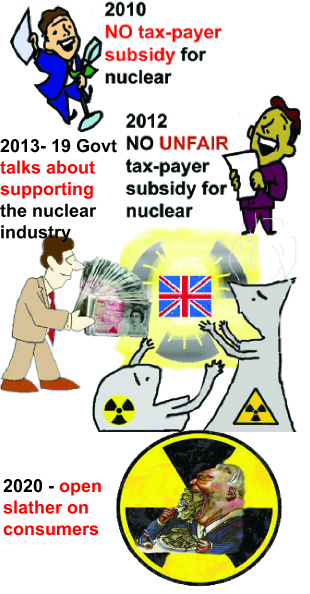 building Hinkley C -a decision they took despite the lack of certainty over whether they would get enough backing from the British Government.
Originally EDF was publicised as being offered UK Treasury loan guarantees that had been widely touted as a vital basis for building Hinkley C. But now the French Financial Markets Regulator has
sanctioned EDF for not flagging up how conditional such loan guarantees were. These loan guarantees have never materialised.
Essentially, EDF is now continuing to build Hinkley C using money borrowed on its own balance
sheets – borrowings which are much more costly than UK Government backed guarantees and which reduce its own (EDF) profitability.
The Finance Officer of EDF actually resigned at the time EDF decided to go ahead with building Hinkley C. Of course all this is happening at the same time when we are being asked to believe that the next EPR (at Sizewell C) is going to be delivered at low cost to the consumer if the risk of building the plant is transferred from EDF to the British taxpayer and consumer!
This is the so-called RAB mechanism, something that could well just turn out to be an
almost unlimited cash facility for EDF to park their financial black hole in the centre of British finances (as well as those of the French).
https://realfeed-intariffs.blogspot.com/2020/06/edf-sanctioned-by-french-regulators-for.html
Cloud with tiny levels of radioactivity detected over Scandinavia and European Arctic.
 Radioactivity is blowing in the air https://thebarentsobserver.com/en/ecology/2020/06/various-reactor-related-isotopes-measured-over-scandinavia-and-svalbard?fbclid=IwAR2UsXspMQZSLInvisible for humans, but detectable for radiation-filters. A cloud with tiny levels of radioactivity, believed to originate from western Russia, has been detected over Scandinavia and European Arctic. By Thomas Nilsen, June 26, 2020
First, in week 23 (June 2-8), iodine-131 was measured at the two air filter stations Svanhovd and Viksjøfjell near Kirkenes in short distance from Norway’s border to Russia’s Kola Peninsula. The same days, on June 7 and 8, the CTBTO-station at Svalbard measured tiny levels of the same isotope.
CTBTO is the global network of radiological and seismic monitoring under the Comprehensive Nuclear-Test-Ban Treaty Organization.
Norway’s nuclear watchdog, the DSA, underlines that the levels are very small.
“We are currently keeping an extra good eye on our air-monitoring system,” says Bredo Møller with DSA’s Emergency Preparedness unit at Svanhovd.
While iodine-131 is only measured in the north, in the Kirkenes area and at Svalbard, Swedish and Finnish radiation authorities inform about other isotopes blowing in the skies over southern Scandinavia.
Bredo Møller says to the Barents Observer that his agency can’t conclude there is a connection between what is measured up north and what his Scandinavian colleagues measured in week 24.
“As part of our good Nordic cooperation we are currently exchanging data,” he says.
Møller tells about radiation just above detectable levels. “We found 0,9 microBq/m3 at Svanhovd and 1,3 microBq/m3 at Viksjøfjell.”
Finland’s Radiation and Nuclear Safety Authority (STUK) detected on June 16 and 17 small amounts of the radioactive isotopes cobalt, ruthenium and cesium (Co-60, Ru-103, Cs-134 and Cs-137).
STUK says the measurements were made in Helsinki where analysis is available on the same day. “At other stations, samples are collected during the week, so results from last week will be ready later.”
Likely from a reactor
All these isotopes indicate that the release comes from a nuclear-reactor. Iodine-131 has a half-life of 8 days, and given the small amount measured in the north, this isotope could be gone before the radioactive cloud reached the southern parts of Finland and Sweden a week after the first measurements in the north. That be, if the release was somewhere in the Arctic or northwestern Russia and winds were blowing south or southwest.
Neither of the Scandinavian radiation agencies will speculate about the origin.
“It is not possible now to say what could be the source of the increased levels,” writes the Swedish Radiation Safety Authority in a statement. Also the Swedes underline that the levels are low and do not pose any danger to people or the environment.
In the Netherlands, though, the National Institute for Public Health and the Environment (RIVM) has analyzed the data from Scandinavia and made calculations to find out what may have been the origin of the detected radionuclides.
“These calculations show that the radionuclides came from the direction of Western Russia,” RIVM concludes.
Calls for info-exchange
Senior Nuclear Campaigner with Greenpeace Russia, Rashid Alimov, says to the Barents Observer that the composition of the isotopes strongly indicates that the source is a nuclear reactor or a spent fuel element from a reactor.
“The Russian monitoring systems have not reported any unusual levels of radioactivity in June,” Alimov says, emphasizing that could be due to delayed publication of data.
Greenpeace calls for rapid international cooperation that includes Russia.
“We think information exchange is crucial,” Rashid Alimov says.
Ukraine declassifies Chernobyl nuclear disaster documents
Ukraine declassifies Chernobyl nuclear disaster documents https://www.brusselstimes.com/all-news/119019/ukraine-declassifies-chernobyl-documents/
The archives, published in a book edited by the Ukrainian secret service, SBU, give an overview of the various construction errors, accidents and emergency interruptions at the plant between 1971 and the day of the disaster.
After Reactor 4 of the Soviet nuclear plant at Chernobyl exploded, a no-go zone was set up around the area due to the risk of radiation.
The biggest nuclear disaster in History caused the deaths of thousands of people, while tens of thousands had to be displaced.
On Sunday, a new fire occurred in the red zone around the plant, which is about three hectares in area. The Ukrainian authorities said on Monday that the fire had, for the most part, been put out.
In early April, a forest fire fed by gusty winds and unusually dry weather had broken out around the abandoned nuclear plant.
By the time it was brought under control in mid-May, about 11,500 hectares had been destroyed.
New Zealand a really independent nation – nuclear-free despite thr terrorism of the Rainbow Warrior bombing
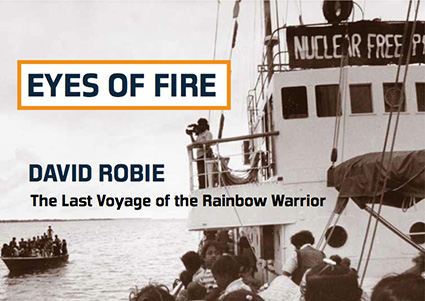
New Zealand established its credentials as an independent small nation after the fatal bombing of the Greenpeace flagship Rainbow Warrior in 1985, says an author and academic who spent weeks on the vessel shortly before it was attacked.
On 10 July 1985, the Rainbow Warrior was sunk at an Auckland wharf by two bombs planted on the hull of the ship by French secret agents.
The event is often referred to as the first act of terrorism in New Zealand.
LISTEN: The Afternoons with Jesse Mulligan Crime NZ interview with David Robie
WATCH: Eyes of Fire archival videos
READ: The Eyes of Fire book
Two French agents planted two explosives on the ship while it was berthed at Marsden wharf, the second explosion killing Greenpeace photographer Fernando Pereira.
Dr David Robie, who is an AUT professor of journalism and communication studies, as well as the director of the university’s Pacific Media Centre, had spent more than 10 weeks on the ship as a journalist covering its nuclear rescue mission in the Pacific.
He wrote about his experience in Eyes of Fire, a book about the last voyage of the first Rainbow Warrior – two other Rainbow Warrior ships have followed.
In 1985, Rongelap atoll villagers in the Marshall Islands asked Greenpeace to help them relocate to a new home at Mejato atoll. Their island had been contaminated by radioactive fallout from US atmospheric nuclear weapons testing in the Pacific.
Environmental journalism
“At the time I was very involved in environmental issues around the Pacific and in those days Greenpeace was very small, a fledgling organisation,” he tells Jesse Mulligan.
“They had a little office in downtown Auckland and Elaine Shaw was the coordinator and she was quite worried that this was going to be a threshold voyage.
“It was probably the first campaign by Greenpeace that was humanitarian, it wasn’t just environmental – to rescue basically the people who had been suffering from nuclear radiation.” ……….
Moruroa protest planned
The US had carried out 67 nuclear tests at the Marshall Islands. France was also carrying out 193 tests in the Pacific and Greenpeace had planned on confronting that situation at Moruroa Atoll after its Marshall Islands rescue effort.
New Zealand had already voiced disapproval of the testing in the region, with then Prime Minister David Lange in 1984 rebuking the French for “arrogantly” continuing the programme in the country’s backyard.
Dr Robie left the ship when it docked in Auckland after the Marshall Islands stage of the mission. Three days after the ship had docked, a birthday celebration was held for Greenpeace campaign organiser Steve Sawyer onboard. The attack happened after the party.
Just before midnight on the evening of 10 July 1985, two explosions ripped through the hull as the ship.
Portuguese crew member Fernando Pereira was killed after returning on board after the first explosion……..
Thirteen foreign agents were involved, operating in three teams. The first team brought in the explosives, the second team would plant these and the third was on stand-by in case anything went wrong with the first two teams.
“A commanding officer kept an overview of the whole operation. I think there was an element of arrogance, the same arrogance as with the testing itself. There was a huge amount of arrogance about taking on an operation like this in a peaceful country – we were allies of France at the time – and it is extraordinary that they assumed they could get away with this outrageous act.”
Two of the spies were caught. Two General Directorate for External Security (DGSE) officers, Dominique Prieur and Alain Mafart, were arrested on July 24. Both were charged with murder, pleaded guilty to manslaughter and were sentenced to 10 years’ imprisonment.
Repression of independence movements
“You have to see it within the context of the period of the time,” Dr Robie says.
He says that the French policy of repression against independence movements in New Caledonia and Tahiti, with assassinations of Kanak leaders like Eloi Machoro, needed to be understood to put the Rainbow Warrior attack in perspective. France was bitterly defending its nuclear force de frappe.
“New Zealand was unpopular with the major nuclear powers and there was certainly no sympathy for New Zealand’s position about nuclear testing. So, there wasn’t really any co-operation, even from our closest neighbour, Australia……..
The case was a source of considerable embarrassment to the French government.
“They did pay compensation after arbitration that went on with the New Zealand government and Greenpeace. But justice was never really served… the 10 years were never served, both Prieur and Mafart were part of the negotiations with French government.
NZ was held ‘over a barrel’
“Basically, France had New Zealand over a barrel over trade and the European Union, so compromises were reached and Prieur and Mafart were handed over to France for three years. Essentially house arrest at Hao atoll, the rear base of the French nuclear operations in Polynesia.”
Dr Robie said the rear base was widely regarded as a military “Club Med”.
He says they didn’t even spend three years there, but left for France within the time period.
While the attack was on an international organisation rather than New Zealand itself, most New Zealanders saw it as an attack on the sovereignty of the nation
Dr Robie says it left a long-lasting impression on New Zealanders.
“It was a baptism of fire. It was a loss of innocence when that happened. And in that context, we had stood up as a small nation on being nuclear-free. Something we should have been absolutely proud of, which we were, with all those who campaigned for that at the time. I think that really established our independence, if you like, as a small nation.
“I think we have a lot to contribute to the world in terms of peace-making and we shouldn’t lose track of that. The courage that was shown by this country, standing up to a major nuclear power. We should follow through on that kind of independence of thought.” https://asiapacificreport.nz/2020/06/29/nz-gained-international-creds-as-nuclear-free-nation-with-rainbow-warrior-bombing-says-author/
It’s 38°C in Siberia – need for action on global heating!
|
The Arctic heatwave: here’s what we know, https://www.theguardian.com/commentisfree/2020/jun/25/arctic-heatwave-38c-siberia-scienceTamsin Edwards
It’s 38°C in Siberia. The science may be complicated – but the need for action now couldn’t be clearer Fri 26 Jun 2020 There’s an Arctic heatwave: it’s 38°C in Siberia. Arctic sea ice coverage is the second lowest on record, and 2020 may be on course to be the hottest year since records began. For many people, such news induces a lurch of fear, or avoidance – closing the webpage because they don’t want to hear yet more bad news. A few might think “It’s just weather,” and roll their eyes. How can we make sense of such an event? Climate is subtle and shifting, with many drivers and timescales. But we can use this northern heatwave to illuminate the complexity of our planet. We can break this question into parts, from fast to slow. Fast: the immediate effect is to increase wildfires. Siberia has seen “zombie fires” reignited from deep smouldering embers in peatland. This is bad news, releasing particulate air pollution and more carbon in 18 months than in the past 16 years. The immediate cause? Here in the mid-high northern latitudes, we live in unstable weather under the influence of the polar jet stream. This rapid current of air high above our heads drags weather in a conveyor belt from west to east, with alternating patches of cold and warm air, low and high pressure. Sometimes the weather patterns get stuck, creating a stable period of weather, like a heatwave. This is one long, severe example. Does climate change make this “blocking” more likely? Maybe. The jet stream is created by the contrast between cold polar air and the warmer south. The Arctic is warming twice as fast as the global average: that means less north-south contrast, so the jet stream can become more wobbly and meandering. Loops break off like the oxbow lakes of school geography lessons, stranding particular weather patterns in one place. And why is the Arctic warming faster? Because sea ice and snow are so bright. When they melt with global warming, the ocean and land beneath are darker, so they absorb more of the sun’s heat. Their loss amplifies our warming. The current low in Arctic sea ice is itself partly the result of the Siberian heatwave, amplifying the usual year-to-year fluctuations. But the trend is down: the more CO2 we emit, the more the planet’s temperature rises, and the more sea ice we lose. Scientists predict the Arctic will start seeing summers without sea ice by 2050. But it’s not irreversible. It’s not a tipping point. The sea ice would return if we could cool the climate again. Unfortunately we know only three ways to do that: extract vast amounts of CO2 from the air with trees or technology; reflect the sun’s rays at a planetary scale; or wait, for many generations. This Arctic heatwave is a sharp spike on top of the global warming trend. That’s what makes it more intense, more likely and more of a warning: it’s a taste of the future predicted for Russia, if we burn quickly through our fossil fuels. The real fear around the Arctic for the longer term, I find when talking to people, comes from the idea of “runaway” warming from methane release. Warming could release stores of methane – a strong greenhouse gas – from permafrost or frozen sediments at the bottom of the ocean, which would add to the warming from our own activities. There is more than twice the amount of carbon in the permafrost as in the atmosphere, and thawing has already begun. There are big local impacts – damage to roads and buildings, because the ground can no longer bear so much weight, and an appalling story involving what appears to be anthrax release from thawing burial grounds. Permafrost thaw was even blamed by a Russian mining company for the recent collapse of a fuel reservoir, contaminating the river with 20,000 tonnes of diesel, though other factors were probably also involved. So could this Siberian heatwave, or ones like it, trigger catastrophic warming? I see much fear about amplifying methane feedbacks, including the false idea that climate scientists don’t consider them (we do, just separately to the main global climate models). Yet for several years there has been growing evidence that this risk is less than originally thought. Carbon stored in permafrost and wetlands is predicted to contribute around 100bn tonnes of CO2 this century. That’s a lot, but we add around 40bn tonnes ourselves every year. The methane at the bottom of the ocean would take centuries to release, so as long as we limit global warming we should keep those stores mostly locked up. There are uncertainties, of course, but the stores’ impact on warming is likely to be tenths of a degree, not several degrees. Yet every tonne of CO2 released from permafrost means one tonne fewer we can emit if we are to reach net zero emissions by 2050. Every year’s equivalent of our emissions brings our deadline closer. Every tenth of a degree of warming brings us closer to our target of 1.5°C and makes more permafrost thaw, and the impacts of climate change worse for the most vulnerable people and species of the world. The Arctic heatwave shows us that there are few simple stories in climate change. There is always a mix of natural and human influence, bad news and slightly-less-bad news, and occasionally even hopeful news. So, more than ever, we need to avoid over-simplifying or slipping into easy tropes like “We’re all doomed” or “It’s all weather,” but to try to understand the details. Perhaps there is one simple story though: every bit of warming we avoid will help keep our planet a more familiar and an easier place to live on. • Dr Tamsin Edwards is a senior lecturer in physical geography at King’s College London |
|
16th Century colonisation, slavery began the planet’s damage, 21st Century pandemic response could repair it.

We’ve made enough concrete to cover the entire surface of the Earth in a layer two millimetres thick. Enough plastic has been manufactured to clingfilm it as well. We annually produce 4.8 billion tonnes of our top five crops and 4.8 billion livestock animals. There are 1.4 billion motor vehicles, 2 billion personal computers, and more mobile phones than the 7.8 billion people on Earth.
All this suggests humans have become a geological superpower and evidence of our impact will be visible in rocks millions of years from now. This is a new geological epoch that scientists are calling the Anthropocene, combining the words for “human” and “recent-time”. But debate still continues as to when we should define the beginning of this period. When exactly did we leave behind the Holocene – the 10,000 years of stability that allowed farming and complex civilisations to develop – and move into the new epoch?
Five years ago we published evidence that the start of capitalism and European colonisation meet the formal scientific criteria for the start of the Anthropocene.
Our planetary impacts have increased since our earliest ancestors stepped down from the trees, at first by hunting some animal species to extinction. Much later, following the development of farming and agricultural societies, we started to change the climate. Yet Earth only truly became a “human planet” with the emergence of something quite different. This was capitalism, which itself grew out of European expansion in the 15th and 16th century and the era of colonisation and subjugation of indigenous peoples all around the world.
In the Americas, just 100 years after Christopher Columbus first set foot on the Bahamas in 1492, 56 million indigenous Americans were dead, mainly in South and Central America. This was 90% of the population. Most were killed by diseases brought across the Atlantic by Europeans, which had never been seen before in the Americas: measles, smallpox, influenza, the bubonic plague. War, slavery and wave after wave of disease combined to cause this “great dying”, something the world had never seen before, or since.
In North America the population decline was slower but no less dramatic due to slower colonisation by Europeans. US census data suggest the Native American population may have been as low as 250,000 people by 1900 from a pre-Columbus level of 5 million, a 95% decline.
This depopulation left the continents dominated by Europeans, who set up plantations and filled a labour shortage with enslaved workers. In total, more than 12 million people were forced to leave Africa and work for Europeans as slaves. ……….
In addition to the critical task of highlighting and tackling the racism within science, perhaps geologists and geographers can also make a small contribution to the Black Lives Matter movement by unflinchingly compiling the evidence showing that when humans started to exert a huge influence on the Earth’s environment was also the start of the brutal European colonisation of the world.
In her insightful book, A Billion Black Anthropocenes or None, the geography professor Kathryn Yusoff makes it very clear that predominantly white geologists and geographers need to acknowledge that Europeans decimated indigenous and minority populations whenever so-called progress occurred.
Defining the start of the human planet as the period of colonisation, the spread of deadly diseases and transatlantic slavery, means we can face the past and ensure we deal with its toxic legacy. If 1610 marks both a turning point in human relations with the Earth and our treatment of each other, then maybe, just maybe, 2020 could mark the start of a new chapter of equality, environmental justice and stewardship of the only planet in the universe known to harbour any life. It’s a struggle nobody can afford to lose. https://theconversation.com/why-the-anthropocene-began-with-european-colonisation-mass-slavery-and-the-great-dying-of-the-16th-century-140661
We are going to need to learn to live with the virus

The shifting strategies are an acknowledgment that even the most successful countries cannot declare victory until a vaccine is found.
They also show the challenge presented by countries like the United States, Brazil and India, where the authorities never fully contained initial outbreaks and from where the coronavirus will continue to threaten to spread.
How the world is learning to live with a deadly pandemic, https://thenewdaily.com.au/news/world/2020/06/26/coronavirus-pandemic-2/
South Korea tells people to carry two types of masks for differing risky social situations.
Germany requires communities to crack down when the number of infections hits certain thresholds.
Britain will target local outbreaks in a strategy that Prime Minister Boris Johnson calls “whack-a-mole”.
Around the world, governments that had appeared to tame the coronavirus are adjusting to the reality that the disease is here to stay.
But in a shift away from damaging nationwide lockdowns, they are looking for targeted ways to find and stop outbreaks before they become third or fourth waves.
While the details differ, the strategies call for giving governments flexibility to tighten or ease as needed.
They require some mix of intensive testing and monitoring, lightning-fast response times by authorities, tight border management and constant reminders to their citizens of the dangers of frequent human contact.
They require some mix of intensive testing and monitoring, lightning-fast response times by authorities, tight border management and constant reminders to their citizens of the dangers of frequent human contact.
The strategies often force central governments and local officials to share data and work closely together, overcoming incompatible computer systems, turf battles and other long-standing bureaucratic rivalries. Continue reading
Scientists just beginning to grasp how bad this Coronavirus is
 Scientists just beginning to understand the many health problems caused by COVID-19
CHICAGO (Reuters) 26 June 20, – Scientists are only starting to grasp the vast array of health problems caused by the novel coronavirus, some of which may have lingering effects on patients and health systems for years to come, according to doctors and infectious disease experts.
Besides the respiratory issues that leave patients gasping for breath, the virus that causes COVID-19 attacks many organ systems, in some cases causing catastrophic damage.
“We thought this was only a respiratory virus. Turns out, it goes after the pancreas. It goes after the heart. It goes after the liver, the brain, the kidney and other organs. We didn’t appreciate that in the beginning,” said Dr. Eric Topol, a cardiologist and director of the Scripps Research Translational Institute in La Jolla, California.
In addition to respiratory distress, patients with COVID-19 can experience blood clotting disorders that can lead to strokes, and extreme inflammation that attacks multiple organ systems. The virus can also cause neurological complications that range from headache, dizziness and loss of taste or smell to seizures and confusion.
And recovery can be slow, incomplete and costly, with a huge impact on quality of life.
The broad and diverse manifestations of COVID-19 are somewhat unique, said Dr. Sadiya Khan, a cardiologist at Northwestern Medicine in Chicago.
With influenza, people with underlying heart conditions are also at higher risk of complications, Khan said. What is surprising about this virus is the extent of the complications occurring outside the lungs.
Khan believes there will be a huge healthcare expenditure and burden for individuals who have survived COVID-19.
LENGTHY REHAB FOR MANY
Patients who were in the intensive care unit or on a ventilator for weeks will need to spend extensive time in rehab to regain mobility and strength.
“It can take up to seven days for every one day that you’re hospitalized to recover that type of strength,” Khan said. “It’s harder the older you are, and you may never get back to the same level of function.”
While much of the focus has been on the minority of patients who experience severe disease, doctors increasingly are looking to the needs of patients who were not sick enough to require hospitalization, but are still suffering months after first becoming infected. …….. https://www.reuters.com/article/us-health-coronavirus-effects/scientists-just-beginning-to-understand-the-many-health-problems-caused-by-covid-19-idUSKBN23X1BZ
Renewable generation eclipses coal, nuclear for 2nd straight month
Renewable generation eclipses coal, nuclear for 2nd straight month in April, S and P Global Market Intelligence,
Krizka Danielle Del Rosario, 26 June 20, Although U.S. net generation in April fell 6.6% below the same month in 2019, renewable generation has continued to grow as a source of the nation’s supply and surpassed nuclear and coal for the second month in a row.
Renewables accounted for 23.3% of the total, expanding its lead on nuclear generation as the second-largest source of power supply. Nuclear generation made up 21.5% of the nation’s electricity, while gas-fired generation remained the largest supplier of power with a 39.3% share……. https://www.spglobal.com/marketintelligence/en/news-insights/blog/essential-energy-insights-june-11-2020
Fukushima mothers still testing food etc for radiation

Nine years on, Fukushima’s mental health fallout lingers
As radiation from the Fukushima nuclear accident subsides, a damaging social and psychological legacy continues, Wired
Iida, who is 35, forbids her children from entering the sea or into forests. She agonises over which foods to buy. But no matter what she does, she can’t completely protect her children from radiation. It even lurks in their urine.
“Maybe he’s being exposed through the school lunch,” she says, puzzling over why her nine-year-old son’s urine showed two-and-a-half times the concentration of caesium that hers did, when she takes such care shopping. “Or maybe it’s from the soil outside where he plays. Or is it because children have a faster metabolism, so he flushes more out? We don’t know.”
Iida is a public relations officer at Tarachine, a citizens’ lab in Fukushima, Japan, that tests for radioactive contamination released from the 2011 accident at the Fukushima Daiichi nuclear plant. Agricultural produce grown in the area is subject to government and supermarket testing, but Tarachine wants to provide people with an option to test anything, from foraged mushrooms to dust from their home. Iida tests anything unknown before feeding it to her four children. Recently, she threw out some rice she received as a present after finding its level of contamination – although 80 times lower than the government limit – unacceptably high. “My husband considered eating it ourselves, but it’s too much to cook two batches of rice for every meal. In the end we fed it to some seagulls.”
Tarachine is one of several citizen labs founded in the wake of the Tōhoku earthquake and tsunami on March 11, 2011, which obliterated a swathe of the country’s northwest coast and killed more than 18,000 people. The wave knocked out cooling systems at the Fukushima Daiichi nuclear plant, triggering a meltdown in three of the reactor cores and hydrogen explosions that sprayed radionuclides across the Fukushima prefecture. More than 160,000 people were forced to evacuate. A government decontamination programme has allowed evacuation orders to be lifted in many municipalities, but one zone is still off limits, with only short visits permitted.
Driven by a desire to find out precisely how much radiation there was in the environment and where, a group of volunteers launched Tarachine in Iwaki, a coastal city that escaped the worst of the radioactive plume and was not evacuated, through a crowdfunding campaign in November 2011. It is now registered as a non-profit organisation, and runs on donations.
In a windowless room controlled for temperature and humidity and dotted with screens showing graphs, two women sort and label samples, either collected by staff or sent in by the public: soil from back gardens, candied grasshoppers, seawater. In the beginning, mothers sent in litres of breastmilk. Tarachine initially charged a tenth of what a university lab would charge to make the testing accessible to as many people as possible; last year, they made it free.
To test for caesium-137, the main long-term contaminant released from the plant, staff finely chop samples and put them inside a gamma counter, a cylindrical grey machine that looks like a centrifuge. Tarachine’s machines are more accurate than the more commonly accessible measuring tools: at some public monitoring posts, shoppers can simply place their produce on top of a device to get a reading, but this can be heavily skewed by background radiation (waving a Geiger counter over food won’t give an accurate reading for the same reason). Tarachine tries to get as precise readings as possible; the lab’s machines give results to one decimal place, and they try to block out excess background radiation by placing bottles of water around the machines.
Measuring for strontium, a type of less penetrative beta radiation, is even more complicated: the food has to first be roasted to ash before being mixed with an acid and sifted. The whole process takes two to three days. Tarachine received training and advice from university radiation labs around the country, but the volunteers had to experiment with everyday food items that scientists had never tested. “There was no recipe like ‘Roast the leaf for two hours at so-and-so Celsius’, you know?” says Iida. “If it’s too burnt it’s no good. We also had to experiment with types of acid and how much of the acid to add.”
Japanese government standards for radiation are some of the most stringent in the world: the upper limit of radioactive caesium in food such as meat and vegetables is 100 becquerels per kilogram, compared with 1,250 in the European Union and 1,200 in the US (the becquerel unit measures how much ionizing radiation is released due to radioactive decay). Many supermarkets adhere to a tighter limit, proudly advertising that their produce contains less than 40 becquerels, or as few as 10. Tarachine aims for just 1 becquerel.
“How I think about it is, how much radiation was there in local rice before the accident? It was about 0.01 becquerel. So that’s what I want the standard to be,” says Iida. Continue reading
2,000 Covid-19 Cases in Severodvinsk, city that builds Russia’s nuclear submarines
 The City That Builds Russia’s Nuclear Submarines Now Has Over 2,000 Covid-19 Cases, By The Barents Observer, 24 June 20,
Two naval construction yards in a northern Russian city near the site of last year’s mysterious nuclear testing accident have become new hotbeds for the coronavirus.
Severodvinsk is near the Nyonoksa testing site where an August 2019 explosion during a rocket engine test killed five nuclear workers and led to a radiation spike. The building of nuclear subs and other naval vessels continues despite the increasingly serious virus situation.
Approximately 43% of all infections in the Arkhangelsk region are in Severodvinsk, regional authorities recently announced.
That indicates that there now are more than 2,000 cases in the city.
The lion’s share of the people infected are affiliated with Sevmash and Zvezdochka, the two naval yards.
Despite the introduction of protective measures, the virus has continued to spread among the local population of about 180,000.
In the past week alone, more than 320 new cases have been registered in town, most of them among the shipbuilders, a statistics overview said.
Temperature testing is conducted at entry points to the yards as well as on the construction premises, and workers are required to wear masks.
But the mask requirement is not observed, a local employee told the Sever.Realii newspaper in early June. Every worker is given 10 masks every five days along with a liter of antiseptic.
But most workers still do not wear the masks and ignore social distancing rules, the worker said.
There are about 30,000 employees at the Sevmash and about 11,000 workers at the Zvezdochka.
While the Zvezdochka engages primarily in vessel repair and upgrades, the Sevmash builds nuclear submarines. At the moment, there are at least eight new vessels under construction onsite, among them four Borey-class and four Yasen-class subs. AT TOP https://www.themoscowtimes.com/2020/06/24/the-city-that-builds-russias-nuclear-submarines-now-has-over-2000-covid-19-cases-a70681
1 This month
7 April – WEBINAR – Australia and the Doomsday Clock – Preventing nuclear war through NoFirstUse and other policies
Online | Tuesday April 7, 4:00-5:30pm, Australian Eastern Time / 8:00-9:30am Central Europe Time
– Access the registration link
15 April – Zoom –Nuclear Power is Not the Solution
Apr 15, 2026 01:00 AM in Canberra, Melbourne, Sydney

Join the International Physicians for the Prevention of Nuclear War (IPPNW) on Tuesday, April 14th for a timely webinar exploring the risks associated with nuclear power and challenging the myth that it offers a simple, safe, carbon-free solution to the climate crisis

of the week – Australians for War Powers Reform (AWPR)
To see nuclear-related stories in greater depth and intensity
 Antinuclear