Due to First Nation’s opposition, Canadian nuclear company ends plan to dump nuclear waste near Lake Huron
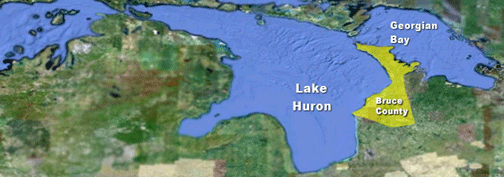 Ontario Power Generation Formally Ends Effort To Place Nuclear Storage Site Near Lake Huron, WKAR
In letters sent in May, Ontario Power Generation officially withdrew from an environmental assessment of the project and an application for a construction license. Those withdrawals were first reported in the Detroit Free Press.
Fred Kuntz is with OPG. He said after fifteen years the company decided to look elsewhere to build a storage facility.
“You need three things in Ontario for a project like this to proceed. You need good geology, which we had, you need municipal support, which we had, and you need indigenous support. Without that, we couldn’t proceed with the project.”
Kuntz said the company will begin looking for alternate locations. …….
In letters sent in May, Ontario Power Generation officially withdrew from an environmental assessment of the project and an application for a construction license. Those withdrawals were first reported in the Detroit Free Press.
Fred Kuntz is with OPG. He said after fifteen years the company decided to look elsewhere to build a storage facility.
“You need three things in Ontario for a project like this to proceed. You need good geology, which we had, you need municipal support, which we had, and you need indigenous support. Without that, we couldn’t proceed with the project.”
Kuntz said the company will begin looking for alternate locations. …..A second, high-level nuclear storage facility could still be built near Lake Huron. The Canadian Nuclear Waste Management Organization is considering two possible sites for a facility, one of which is near the lake.
A spokesperson for the organization said the Saugeen-Ojibway vote was not a referendum on their plan
The organization is expected to select a site for the facility by 2023. https://www.wkar.org/post/ontario-power-generation-formally-ends-effort-place-nuclear-storage-site-near-lake-huron#stream/0
Yes, Virginia, accidents in transport of nuclear wastes DO happen
 Brattleboro Reformer 22nd June 2020, An oversized flatbed truck carrying an empty nuclear waste cask headed to the Vermont Yankee nuclear power plant drove onto a soft shoulder on Route 11 in Andover and tipped over Friday morning, setting off a 36-hour effort to retrieve the cask and reopen the busy east-west highway. The cask is slated to be used at the Vernon nuclear power plant which is undergoing demolition and decommissioning. The cask, which weighs upwards of 50 tons, is used as an on-site cask to transfer waste on site, according to Curtis Roberts, a spokesman for Orano, one of the companies involved in the
decommissioning project with main owner NorthStar Vermont Yankee LLC.
He said the cask is owned and manufactured by Orano [Ed note: formerly AREVA, which went bankrupt] . Orano is disassembling the nuclear reactor core, which contains high levels of radioactivity.
https://www.reformer.com/stories/truck-carrying-empty-nuclear-waste-cask-crashes,607654
The inflexibility of nuclear power is becoming a costly problem for the UK
Because of the inflexibility of the AGRs, RE suppliers are shut off first. This is explained in a recent report by the newly-formed pressure  group, 100 percentrenewable uk, which explains that the inflexible nature of nuclear power is instrumental in forcing the National Grid to turn off large amounts of wind power (ie in the jargon to be ‘constrained’) in Scotland when there is too much electricity on the network.
This appears nonsensical as the Grid is turning off cheap renewables to preserve expensive nuclear, and then paying large compensation payments to them to do so.
UK Electricity: Renewables and the problem with inflexible nuclear, Ian Fairlea, June 21, 2020
In recent years, the share of the UK’s electricity supplied by renewable energy (RE) sources has increased substantially to the point that RE is now the second largest source after gas: It now supplies 20% to 25% of our electrical needs. This is greater than the amount supplied by nuclear – about 15% to 18%. Coal, hydroelectric, and mainly gas (~40%) constitute the other sources. See chart [on original] for Britain’s electrical power supplies in 2019.
Why are AGR reactors inflexible? Continue reading
Inside the new US policy on financing nuclear abroad
 Daily on Energy, presented by API: Inside the new US policy on financing nuclear abroad, Washington
  Examiner, by Josh Siegel, Energy and Environment Reporter & Abby Smith, Energy and Environment Reporter | June 22, 2020
INSIDE NEW POLICY ON FINANCING NUCLEAR ABROAD: The U.S. International Development Finance Corporation mostly had small nuclear reactors in mind when it proposed this month lifting its ban on funding nuclear projects overseas. But a senior official from the DFC – a greatly expanded successor to the Overseas Private Investment Corporation – says the agency also envisions select situations for funding traditional large reactors, despite recent projects being delayed or canceled by cost overruns……..
The official cited a move by Congress a year after lawmakers passed the BUILD Act in 2018, which authorized the DFC, that called on the U.S. government to support energy diversification projects in Europe as a counter to Russia’s “energy dominance.”
The DFC offers direct equity financing, loans, and political risk insurance, while Ex-Im can only offer credit or lending. The DFC has a total investment limit of $60 billion, amounting to about a $1 billion maximum per project, the official said.
“I am not aware we have anyone on staff who has built a nuclear power plant,” the official said. “What we do have is very strong policies and procedures and frameworks to look at big complicated projects.” https://www.washingtonexaminer.com/policy/energy/daily-on-energy-presented-by-api-inside-the-new-us-policy-on-financing-nuclear-abroad
UK’s planning inspectorate should shut down the plan for Sizewell nuclear power, vulnerable to climate change
|
Spoiler alert: it’ll be a miracle if the project falls at that hurdle, radioactive though it is. It just starts the planning They include Nick Scarr, from the Nuclear Consulting Group, a collection of academics and experts. The consulting engineer believes Sizewell C is in a “dangerous location”, a position set out in a peer-reviewed paper. But, when his views were reported here almost a fortnight ago, EDF dismissed them. It claimed his analysis of th protective effects of the offshore Sizewell-Dunwich bank and a coralline crag was both confused and wrong. EDF made its point in a background briefing, since when it has repeatedly refused to provide any on-the-record statement to back its opinion. So, having given the company plenty of time, here’s one conclusion to draw. That Mr Scarr is bang-on. As he points How untrustworthy does it want to look? Big nuclear’s already toxic enough: exploding costs, endless delays, pricey https://www.thetimes.co.uk/article/shabby-treatment-of-go-outdoors-staff-nwst5btnl |
|

Foreign ownership of Victorian water hits whopping high
Herald Sun , 21 June
A shocking report has revealed just how much of our water is now owned by overseas interests, with China continuing to buy up to buy up precious Australian resources. – (subscribers only)
Learning about ionising radiation – this film helps
Invisible Fallout https://beyondnuclearinternational.org/2020/06/21/invisible-fallout/,June 21, 2020
There are many ways to teach people about radiation. But if you want to make that lesson accessible, compelling and even moving, then this film is the way to do it.
Let’s go on a journey. A journey to learn about radiation exposure from fallout after a nuclear power plant accident. We have the perfect guide. It is the independent French radiation research laboratory known as CRIIRAD, and its director, Dr. Bruno Chareyron.
The organization’s full name in French is Commission de Recherche et d’Information Indépendantes sur la RADioactivité, hence the acronym. In English it is translated as Commission for Independent Research and Information about RADiation.
For those not familiar with CRIIRAD, our journey begins with a little history, and so does CRIIRAD’s brilliant new 45-minute film — Invisible Fallout (Invisibles retombées is the French title), which can be viewed in its entirety on YouTube and above. The film, written and produced by CRIIRAD staff and directed by Cris Ubermann, is in French and Japanese with English subtitles.
When the Chernobyl nuclear disaster hit in April 1986, the French government engaged in a notorious cover-up, claiming that France “has totally escaped any radioactive fallout.” The whole thing was a lie. Five days before the government denial, Chernobyl’s radioactive cloud had covered all of France.
As Invisible Fallout recounts, after Chernobyl, it took 15 years until the French government published fallout maps of France. But the CRIIRAD laboratory, formed right after Chernobyl precisely to establish that France’s immunity was a myth, had already done the work that debunked the official line that the disaster was just a Soviet problem. French citizens not only got dosed by Chernobyl fallout, but would live in perpetual danger of a similar catastrophe at home, with a country almost 80% reliant on nuclear-generated electricity from its 58 reactors.
But Invisible Fallout does not linger long in the past. It segues quickly to the next nuclear catastrophe — the 2011 Fukushima-Daiichi meltdowns in Japan — and it is there that the CRIIRAD team, led by Chareyron, take us to learn about the effects of radiation exposure from nuclear power plants.
Just sixteen days after the Fukushima disaster, Japanese citizens began to detect fallout. They desperately needed to do independent monitoring but found it hard to get their hands on Geiger counters. The downplays and cover-ups by Japanese authorities, attempting to minimize the dangers and avoid mass evacuations, meant official figures could not be trusted.
An unlikely leader stepped forward in the person of composer and artist, Wataru Iwata, who, one month after the disaster, asked CRIIRAD for Geiger counters. They sent them, along with email tutorials on radioactivity, its health risks and how to protect against them. The laboratory also prepared a series of simple, clear, instructional “emergency” videos in English, designed for non-specialists, which they put online for everyone to access. This included an instructional segment on how to use a Scintillometer, one of the dozen devices CRIIRAD had sent to the Japanese activists.
We then get a short instructional video of our own on exactly how the Scintillometer is able to rapidly detect Gamma radiation in counts per second, and what those measurements mean. It glides into clarity for us, abetted by the smooth tones of the film’s excellent French narrator, Nicolas Planchais. We forget completely we are in class. Everything is, indeed, illuminated.
And we see Iwata taking his device into Fukushima Prefecture where he helps others measure the radiation levels. At a restaurant 55km away from the destroyed reactors, where people were going about their daily lives, he is shocked to record radiation levels that are 50 times higher than normal. In other areas, levels are 1,000 times higher.
Two months after the accident, CRIIRAD decided to show up in person, and Japan’s Citizens Radioactivity Monitoring Stations (CRMS), were born. CRIIRAD set up nine CRMS in Fukushima Prefecture and one in Tokyo.
Quickly realizing that ingestion of radioactively contaminated foodstuffs was as much of a threat as external exposure, Iwata asked for ways to measure radiation in food. This would help the people who had stayed — or who had been forced to remain — in contaminated areas to make informed choices about the food they consumed. CRIIRAD brought over a device sensitive enough to detect radiation in food, then conducted a seminar for residents of Fukushima City on on how to use it. We too, as viewers, get the tutorial.
Indeed, all of these lessons in science are subtly woven into the film, but cleverly attached to the lived experiences of real people in Japan, making it relevant and relatable.
And then, as we learn how to measure radiation levels and what they mean, we start to meet the people to whom it matters the most. We encounter a farmer who abided by the rules not to sell contaminated crops but whose family ate the food themselves so it would not go to waste. And we watch his palpable emotion as he recounts his attachment to the land and the known risks he and his family took.
CRIIRAD and its Japanese partners begin to find radioactive particles everywhere— on rooftops, in soil and vegetation, at the foot of trees, in the cracks of tarmac, even inside greenhouses.
At a school which, in denial, refused to have radiation measurements taken, Iwata is shown taking readings in the school grounds. They start at 6,000 to 7,000 counts per second, but rise to 27,000 counts per second at ground level.
The CRIIRAD team encounter what they describe as their most difficult moment when an elderly peasant farmer asks them to conduct measurements on her land just 30km away from the nuclear site. She herself was forced to evacuate, but her farm was not in the zone designated for permanent evacuation. So she came back with CRIIRAD to assess the situation.
We watch them take measurements, then gently show the results to her. She begins to sob. Then she tells them, “Thank you for coming all this way. I was in darkness and you have brought me light.” But, she knows she must now abandon the farm forever.
After an interlude for another lesson, this time on gamma rays, we are back to some chilling truths about their effects. In Fukushima City, we learn that at an elementary school there, children are asked to frequently change places in class so that the same children are not always sitting by the window where the radiation levels are higher.
This prompts CRIIRAD to remind us that, “when it comes to radiation protection, there is no threshold below which it is harmless.” And they point out that the Japanese decision to raise the annual allowable radiation dose from 1mSv to 20mSv, “means accepting a risk of cancer 20 times higher, and this applies equally to children and pregnant women” for whom such doses present a far higher risk.
CRIIRAD warns that people living in the contaminated region will be exposed for decades and across vast areas. They will be exposed to external radiation from powerful gamma rays emitted by the soil and contaminated surfaces. They will be exposed through inhalation of radioactive dust suspended every time the wind blows, and by activities such as sowing crops, ploughing and construction work. And they will be exposed through eating foodstuffs cultivated on contaminated land in contaminated soil.
But thanks to CRIIRAD, many of them will now know how to measure these levels, what they mean and how to protect themselves. It’s a lesson that’s well worth learning for all of us.
For more information, please see the CRIIRAD website, in its original French, and in English.
Anti-nuclear resistance in Russia: problems protests, reprisals
Standing up to Rosatom
Anti-nuclear resistance in Russia: problems protests, reprisals
The following is a report from the Russian Social Ecological Union (RSEU)/ Friends of the Earth Russia, slightly edited for length. You can read the report in full here. It is a vitally important document exposing the discrimination and fear tactics used against anti-nuclear organizers in Russia and details their courageous acts of defiance in order to bring the truth of Russia’s nuclear sector to light.
Rosatom is a Russian state-owned corporation which builds and operates nuclear power plants in Russia and globally. The state-run nuclear industry in Russia has a long history of nuclear crises, including the Kyshtym disaster in 1957 and Chernobyl in 1986. Yet Rosatom plans to build dozens of nuclear reactors in Russia, to export its deadly nuclear technologies to other countries, and then to import their hazardous nuclear waste.
This report is a collection of events and details about the resistance to Russian state nuclear corporation, Rosatom, and other activities that have led to the pollution of the environment and violation of human rights. Social and environmental conflicts created by Rosatom have been left unresolved for years, while at the same time, environmental defenders who have raised these issues, have consistently experienced reprisals.
Nuclear energy: failures and Lies
For a safe world climate, we need to transform the economy, not grow it
“So, we have to get away from our obsession with economic growth – we really need to start managing our economies in a way that protects our climate and natural resources, even if this means less, no or even negative growth.
 “In Australia, this discussion isn’t happening at all – economic growth is the one and only mantra preached by both main political parties. It’s very different in New Zealand – their Wellbeing Budget 2019 is one example of how government investment can be directed in a more sustainable direction, by transforming the economy rather than growing it.”
Overconsumption and growth economy key drivers of environmental crises https://www.eurekalert.org/pub_releases/2020-06/uons-oag061820.php
21 June, 20, ,
Scientists’ warning on affluence, UNIVERSITY OF NEW SOUTH WALES, A group of researchers, led by a UNSW sustainability scientist, have reviewed existing academic discussions on the link between wealth, economy and associated impacts, reaching a clear conclusion: technology will only get us so far when working towards sustainability – we need far-reaching lifestyle changes and different economic paradigms.
In their review, published today in Nature Communications and entitled Scientists’ Warning on Affluence, the researchers have summarised the available evidence, identifying possible solution approaches.
“Recent scientists’ warnings have done a great job at describing the many perils our natural world is facing through crises in climate, biodiversity and food systems, to name but a few,” says lead author Professor Tommy Wiedmann from UNSW Engineering.
“However, none of these warnings has explicitly considered the role of growth-oriented economies and the pursuit of affluence. In our scientists’ warning, we identify the underlying forces of overconsumption and spell out the measures that are needed to tackle the overwhelming ‘power’ of consumption and the economic growth paradigm – that’s the gap we fill.
“The key conclusion from our review is that we cannot rely on technology alone to solve existential environmental problems – like climate change, biodiversity loss and pollution – but that we also have to change our affluent lifestyles and reduce overconsumption, in combination with structural change.”
During the past 40 years, worldwide wealth growth has continuously outpaced any efficiency gains.
“Technology can help us to consume more efficiently, i.e. to save energy and resources, but these technological improvements cannot keep pace with our ever-increasing levels of consumption,” Prof Wiedmann says. Continue reading
Exposing the false claims about China and coronavirus
 Debunking Trump and Corporate Media’s WHO/China Coverup Conspiracy Theories FAIR
The Trump administration suspended funding to WHO in April—the UN’s primary infectious disease–fighting body—accusing it of “severely mismanaging and covering up the spread of the coronavirus,” and of taking China’s allegedly deceptive claims about its handling of Covid-19 at “face value.” But corporate media had already been boosting these same talking points.
The Wall Street Journal’s “The World Health Organization Draws Flak for Coronavirus Response” (2/12/20) effectively accused WHO of being “too deferential to China in its handling of the new virus,” and criticized WHO Director-General Tedros Ghebreyesus for “bending to Beijing” after lauding China’s unquestionably effective swift quarantine of 60 million people, and for declaring that “China is actually setting a new standard for outbreak response” and identifying the virus in “record time.” The Journal further expounded the conspiracy theory of a seemingly omnipotent China having WHO under its thumb:
Over its decades of battling epidemics, the WHO has rarely had to deal with an entity as politically and economically powerful as China today. It can’t afford to alienate the country’s leadership, whose clout and financial largess it aims to attract to global health causes. It needs Beijing’s cooperation in preventing a full-blown pandemic—and this may not be the last time. China is the source of many emerging pathogens, which jump from animals to humans in its teeming live markets and can cause deadly epidemics.
According to the Journal’s logic, when WHO praises China for an effective response containing Covid-19 and giving the rest of the world ample time to take health precautions, it is “compromising its own epidemic response standards, eroding its global authority, and sending the wrong message to other countries that might face future epidemics.” When Dr. Bruce Aylward—a Canadian medical expert with 30 years of experience combating polio, Ebola and other global health emergencies—concluded that he “didn’t see anything that suggested manipulation of numbers,” after leading a team of experts visiting China for WHO, that can’t be an accurate observation. For corporate journalists, it can only be because he was duped by the devious Chinese government “underreporting both total cases and deaths it’s suffered from the disease” (Bloomberg, 4/1/20).
The Journal flimsily explained that China wields such formidable control over the WHO because China is a “future source of funds and a partner with which to tackle the biggest global health problems,” and not as a “current donor.” That would be because a cursory examination of WHO’s funding would reveal that the US donated more than 10 times more money to WHO ($893 million) than China ($86 million), despite the US having almost $200 million in arrears before suspending payments (Axios, 4/15/20).
Neither does the Journal explain how or why WHO could possibly withhold information from Western nations even if it wanted to, when its leadership is stacked with Americans and Europeans, and 15 US officials were embedded with the WHO in Geneva, given that the US is the most “politically and economically powerful” nation on Earth. This makes the Trump administration’s declaration of the US terminating its membership in WHO after threats to permanently cut funding especially egregious.
Nor can the Journal explain the source of China’s fearsome influence over independent and prestigious medical journals like Nature (5/4/20), Science (3/28/20) and the Lancet (3/7/20), which also credited the effectiveness and transparency of China’s response for saving thousands of lives (CGTN, 5/1/20, 5/10/20). Does China’s mysterious and awe-inspiring influence extend over Western medical journals as well?
When Foreign Policy (5/12/20) reported on the exclusive scoop of a leaked dataset of coronavirus cases and deaths from the Chinese military’s National University of Defense Technology, it confirmed that the leaked information “matches” the publicly available numbers the Chinese government posts online—which poses an inconvenience to those spouting conspiracy theories of a Chinese government coverup. Corporate media accounts of Chinese deception and fake statistics also fail to explain how the Chinese government possesses the fantastical ability to deceive governments and independent medical experts around the world, even if it wanted to. As FAIR’s Jim Naureckas (4/2/20) pointed out earlier:
The reality is that it’s very hard to hide an epidemic. Stopping a virus requires identifying and isolating cases of infection, and if you pretend to have done so when you really haven’t, the uncaught cases will grow exponentially. Maintaining a hidden set of real statistics and another set for show would require the secret collusion of China’s 2 million doctors and 3 million nurses—the kind of improbable cooperation that gives conspiracy theories a bad name…. If China is merely pretending to have the coronavirus under control, the pathogen will rapidly surge as people resume interacting with their communities. Once international travel is restored, it will be quite obvious which countries do and don’t have effective management of Covid-19.
Countries revising their figures upon receiving new information is to be expected, and is not necessarily evidence of deceit, as plenty of nations besides China revise their data upwards. Yet only China is singled out as being exceptionally deceptive. For example, in the same week New York revised its death toll upwards by nearly 3,800, China’s adding almost 1,300 dead to its Wuhan data was presented as a possible coverup (Politico, 4/14/20; Guardian, 4/17/20). The Moon of Alabama blog (4/1/20) explained some of the complexities in reporting numbers during a pandemic in real-time:
Does one include co-morbids or not in the count? What about casualties of a car accident that also test positive for Covid-19 when they die? What about those who died with Covid-19 symptoms but could not be tested for lack of test kits? Are the tests really working reliably?… What about asymptomatic cases that test positive. Are these false positives, or do these people really have the virus? One can only know that by testing them a month later for antibodies………
this manipulation of public opinion by the US government and corporate media appears to be working. According to a recent Ipsos survey, more than 30% of Americans have witnessed someone blaming Asian people for the coronavirus pandemic (even though new research indicates that travel from New York City was the primary source of the US outbreak, with New York’s outbreak originating in Europe). Pew Research (4/21/20) found that around two-thirds of Americans have an unfavorable view of China, which is the most negative rating for the country since Pew began asking the question in 2005. This suggests that public opinion has been turned against China, despite it being the first to detect the virus, alert the world and provide a model for containing it.https://fair.org/home/debunking-trump-and-corporate-medias-who-china-coverup-conspiracy-theories/
Time to let ANSTO sink!
Paul Waldon Fight To Stop Nuclear Waste In The Flinders Ranges, 20 June 20,
A farmer come nuclear profiteer maybe reckless and foolish enough to embrace a radioactive dump in the agriculture backyard of his community.
But remember that backyard could be your pantry!
When the Department of Industry, Innovation and Science has reduced the value of Kimba and South Australia’s premium agriculture environment to that of a sacrificial anode, it’s time to let ANSTO sink. https://www.facebook.com/groups/941313402573199/
Who will work in a radioactive waste dump in the dwindling community of Kimba?
You can bet it wont be a farmer come nuclear profiteer or his retired old man, whom are both selling the kid inheritance, and it wont be the small coterie of sell up farmers following their lead.
Then again, do you think it might be an ageing politician void of a statue, bust or plaque in the towns square a politician trying to earn brownie points before his destined retirement with a guaranteed government pension.
What about the operators of the stay afloat businesses with plenty of time on their hand watching the reduced community going to other regions for their supplies.
You never know council workers maybe called upon to serve time at the coal face. Scary, Huh!
This just maybe another proposal to mimic a nuclear program of placing the cart before the horse. https://www.facebook.com/groups/941313402573199/
Record-breaking heatwave in Siberia
Climate crisis: alarm at record-breaking heatwave in Siberia https://www.theguardian.com/environment/2020/jun/17/climate-crisis-alarm-at-record-breaking-heatwave-in-siberia
Thu 18 Jun 2020 A prolonged heatwave in Siberia is “undoubtedly alarming”, climate scientists have said. The freak temperatures have been linked to wildfires, a huge oil spill and a plague of tree-eating moths.
On a global scale, the Siberian heat is helping push the world towards its hottest year on record in 2020, despite a temporary dip in carbon emissions owing to the coronavirus pandemic.
Temperatures in the polar regions are rising fastest because ocean currents carry heat towards the poles and reflective ice and snow is melting away.
Russian towns in the Arctic circle have recorded extraordinary temperatures, with Nizhnyaya Pesha hitting 30C on 9 June and Khatanga, which usually has daytime temperatures of around 0C at this time of year, hitting 25C on 22 May. The previous record was 12C.
In May, surface temperatures in parts of Siberia were up to 10C above average, according to the EU’s Copernicus Climate Change Service (C3S). Martin Stendel, of the Danish Meteorological Institute, said the abnormal May temperatures seen in north-west Siberia would be likely to happen just once in 100,000 years without human-caused global heating.
Freja Vamborg, a senior scientist at C3S, said: “It is undoubtedly an alarming sign, but not only May was unusually warm in Siberia. The whole of winter and spring had repeated periods of higher-than-average surface air temperatures.
“Although the planet as a whole is warming, this isn’t happening evenly. Western Siberia stands out as a region that shows more of a warming trend with higher variations in temperature. So to some extent large temperature anomalies are not unexpected. However, what is unusual is how long the warmer-than-average anomalies have persisted for.”
Marina Makarova, the chief meteorologist at Russia’s Rosgidromet weather service, said: “This winter was the hottest in Siberia since records began 130 years ago. Average temperatures were up to 6C higher than the seasonal norms.”
Robert Rohde, the lead scientist at the Berkeley Earth project, said Russia as a whole had experienced record high temperatures in 2020, with the average from January to May 5.3C above the 1951-1980 average. “[This is a] new record by a massive 1.9C,” he said.
In December, Russia’s president, Vladimir Putin, commented on the unusual heat: “Some of our cities were built north of the Arctic Circle, on the permafrost. If it begins to thaw, you can imagine what consequences it would have. It’s very serious.”
Thawing permafrost was at least partly to blame for a spill of diesel fuel in Siberia this month that led Putin to declare a state of emergency. The supports of the storage tank suddenly sank, according to its operators; green groups said ageing and poorly maintained infrastructure was also to blame.
Wildfires have raged across hundreds of thousands of hectares of Siberia’s forests. Farmers often light fires in the spring to clear vegetation, and a combination of high temperatures and strong winds has caused some fires to burn out of control.
Swarms of the Siberian silk moth, whose larvae eat at conifer trees, have grown rapidly in the rising temperatures. “In all my long career, I’ve never seen moths so huge and growing so quickly,” Vladimir Soldatov, a moth expert, told AFP.
He warned of “tragic consequences” for forests, with the larvae stripping trees of their needles and making them more susceptible to fires.
Hauling dangerous nuclear waste across America
Say NO to hauling dangerous nuclear waste across America, NIRS, 17 June 20 The Nuclear Regulatory Commission (NRC) is accepting comments on two proposals to build Consolidated Interim Storage (CIS) facilities in New Mexico and Texas. Building these so-called ‘interim’ sites would require hauling dangerous, high-level nuclear waste all over the country twice: Once to the ‘interim’ sites, then once again to the permanent site—if that is ever built. If the permanent site is not built, the ‘interim’ sites could become de-facto permanent storage sites. Communities in New Mexico and Texas would become the latest sacrifice to the nuclear industry.
We can’t allow this dangerous, high-level nuclear waste to be hauled around the country to storage sites that won’t be permanent solutions to our nuclear waste problem. Tell the NRC and your member of Congress to say NO to the CIS facilities in New Mexico and Texas….. https://org2.salsalabs.com/o/5502/p/dia/action4/common/public/?action_KEY=27069
Total renewable investment on renewable energy predicted to $16 trillion over the next decade – Goldman Sachs
 Goldman Sachs says renewable-energy spending will surpass oil and gas for the first time ever in 2021 — and sees total investment spiking to $16 trillion over the next decade, Business Insider, 17 June 20,
- Green-energy investing will account for 25% of all energy spending in 2021 and, for the first time ever, surpass spending on traditional fuel sources like oil and gas, Goldman Sachs said in a Tuesday note.
- Should the US aim to hold global warming within 2 degrees Celsius, the pivot to renewable energy sources will create between $1 trillion and $2 trillion in yearly infrastructure spending, the team of analysts added, or an investment opportunity as big as $16 trillion through 2030.
- While past economic downturns halted efforts to lift clean energy initiatives, the coronavirus recession “will be different,” the firm said.
- Green technologies “are now mature enough to be deployed at scale,” and the transition can benefit massively from cheap capital and “an attractive regulatory framework,” according to Goldman.
The transition to renewable power from traditional fuels will create a $16 trillion investment opportunity through 2030 as spending shifts to new infrastructure, Goldman Sachs analysts said Tuesday.
The bank projects green-energy spending to pass that of oil and gas for the first time ever next year and account for roughly 25% of all energy spending. The share stood at just 15% in 2014, but a dive in fossil-fuel investing over the past decade shifted more dollars to clean energy initiatives.
If the nation aims to hold global warming within 2 degrees Celsius, the move toward renewable energy would create between $1 trillion and $2 trillion in yearly infrastructure spending, the team led by Michele Della Vigna wrote in a note to clients.
Economic downturns have historically slowed efforts to boost clean energy investing, but Goldman sees the coronavirus downturn bucking that trend and accelerating the nationwide pivot. …… https://markets.businessinsider.com/news/stocks/renewable-energy-trillion-investment-opportunity-surpass-oil-first-time-goldman-2020-6-1029318482
1 This month

of the week – Australians for War Powers Reform (AWPR)
To see nuclear-related stories in greater depth and intensity
 Antinuclear