More new data indicates another record hot year for 2020
 Global warming pushes April temperatures into record territory, as 2020 heads for disquieting milestone, WP, By Andrew Freedman, May 5 Last month tied for the warmest April on record for the globe, as 2020 hurtles toward the warmest year milestone.New data, released Tuesday from the European Union’s Copernicus Climate Change Service, lends further support to the prediction that 2020 will rank among the top two warmest years recorded.
In April, the National Oceanic and Atmospheric Administration, using its own temperature monitoring data, reported that there is a 75 percent chance that 2020 will become the planet’s warmest year since instrument records began in 1880, and very likely long before that.
Human-caused climate change from increasing amounts of planet-warming greenhouse gases is vaulting temperatures higher, making it easier for a given month or year to set a new warmth milestone. Carbon dioxide is the most important long-lived greenhouse gas in the atmosphere, released by the burning of fossil fuels such as coal and oil for energy and transportation.
Daily carbon dioxide levels measured at the summit of Mauna Loa in Hawaii have reached 418 parts per million this month, the highest level in at least 3 million years. It’s expected that the monthly average value for 2020 will be set this month, and will be near 417 ppm, compared with last year’s measurement of 414.7 ppm.
The new Copernicus data shows a huge area of crimson red for the month of April, denoting much-above-average temperatures, across northern Asia, especially Siberia.
Temperatures were also well above average for the month across northern and coastal central Greenland, parts of Antarctica, areas of Alaska and the Arctic Ocean……. https://www.washingtonpost.com/weather/2020/05/05/global-warming-pushes-april-temperatures-into-record-territory-2020-heads-disquieting-milestone/
Is Trump losing the opportunity to end America’s useless endless wars, as the military are affected by COVID 19?
 Trump Must Choose Between a Global Ceasefire and America’s Long Lost Wars
Like his predecessors from Truman to Obama, Trump has been caught in the trap of America’s blind, deluded militarism. Portside, May 5, 2020 Medea Benjamin and Nicolas J. S. Davies
As President Trump nears the end of his first term, he knows that at least some Americans hold him responsible for his broken promises to bring U.S. troops home and wind down Bush’s and Obama’s wars. Trump’s own day-in-day-out war-making has gone largely unreported by the subservient, tweet-baited U.S. corporate media, but Trump has dropped at least 69,000 bombs and missiles on Afghanistan, Iraq and Syria, more than either Bush or Obama did in their first terms, including in Bush’s invasions of Afghanistan and Iraq.
Undercover of highly publicized redeployments of small numbers of troops from a few isolated bases in Syria and Iraq, Trump has actually expanded U.S. bases and deployed at least 14,000 more U.S. troops to the greater Middle East, even after the U.S. bombing and artillery campaigns that destroyed Mosul in Iraq and Raqqa in Syria ended in 2017. Under the U.S. agreement with the Taliban, Trump has finally agreed to withdraw 4,400 troops from Afghanistan by July, still leaving at least 8,600 behind to conduct airstrikes, “kill or capture” raids and an even more isolated and beleaguered military occupation.
Now a compelling call by U.N. Secretary General Antonio Guterres for a global ceasefire during the Covid-19 pandemic has given Trump a chance to gracefully deescalate his unwinnable wars – if indeed he really wants to. Over 70 nations have expressed their support for the ceasefire. President Macron of France claimed on April 15th that he had persuaded Trump to join other world leaders supporting a U.N. Security Council resolution backing the Secretary General’s call. But within days it became clear that the U.S. was opposing the resolution, insisting that its own “counterterrorism” wars must go on, and that any resolution must condemn China as the source of the pandemic, a poison pill calculated to draw a swift Chinese veto.
So Trump has so far spurned this chance to make good on his promise to bring U.S. troops home, even as his lost wars and ill-defined global military occupation expose thousands of troops to the Covid-19 virus. The U.S. Navy has been plagued by the virus: as of mid-April 40 ships had confirmed cases, affecting 1,298 sailors. Training exercises, troop movements and travel have been canceled for U.S.-based troops and their families. The military reported 7,145 cases as of May 1, with more falling sick every day.
Trump to divert aid money for poor countries to bolster the nuclear industry
 Trump’s push to use global aid for nuclear projects alarms development groups, The Hill, BY REBECCA BEITSCH – 05/06/20 A new effort by the Trump administration to bolster the nuclear industry is eyeing a surprising source of financing — a fund designed to fight poverty in developing countries. Trump’s push to use global aid for nuclear projects alarms development groups, The Hill, BY REBECCA BEITSCH – 05/06/20 A new effort by the Trump administration to bolster the nuclear industry is eyeing a surprising source of financing — a fund designed to fight poverty in developing countries.
In a list of official recommendations to President Trump last month, the Nuclear Fuels Working Group argued the U.S. needs to sell nuclear power technology abroad and battle the influence of countries like China and Russia that have become dominant suppliers. One way to do that, the group said, is to lift restrictions at the U.S. International Development Finance Corporation (DFC) to let the agency fund nuclear projects alongside other development work. But development groups worry that tapping the DFC to greenlight nuclear projects will do more to promote American interests than alleviate poverty.
“I struggle to see it as something they should be doing,” Conor Savoy, executive director of the Modernizing Foreign Assistance Network. There’s also a concern that the projects won’t benefit the poorer countries the DFC is charged with helping. Setting up nuclear power systems requires a higher level of infrastructure, meaning overseas projects might be more likely to find a home in Eastern Europe than Sub-Saharan Africa. “The DFC was supposed to invest in those countries very sparingly,” Savoy said of wealthier nations.
To access DFC funds for an initiative of this kind, the agency would have to lift its prohibition on supporting nuclear projects, a move that only requires an internal policy change, without any congressional action. The agency has signaled a willingness to make that change. “DFC welcomes the recommendation in the administration’s Nuclear Fuel Working Group report to remove DFC’s prohibition on financing nuclear power projects in developing countries. Access to affordable and reliable power is essential for developing countries to advance their economies,” the agency said in a statement Monday…….
The DFC was started in 2019, replacing its predecessor — the Overseas Private Investment Corporation — with double the funding and fewer restrictions on how to spend it. But the $60 billion agency also has an expanded mission: elevating the world’s poorest countries while also advancing U.S. foreign policy. Development experts, however, say there’s been an imbalance between those two goals in the agency’s short history…….
There’s been a skewing toward more national security areas. They’ve tried to counter that by highlighting their more development-focused projects, but in terms of volume of commitments, in terms of sheer volume of money, it does seem to be skewing more toward national security priorities and less toward development,” Savoy said…….. https://thehill.com/policy/energy-environment/496295-trumps-push-to-use-global-aid-for-nuclear-projects-alarms
|
|
It would be worthwhile to act on climate change, to prevent rapid global heat rise

|
‘Blown away’: Safe climate niche closing fast, with billions at risk, https://www.theage.com.au/environment/climate-change/blown-away-safe-climate-niche-closing-fast-with-billions-at-risk-20200504-p54pod.html By Peter Hannam, May 5, 2020 As much as one-third of the world’s population will be exposed to Sahara Desert-like heat within half a century if greenhouse gas emissions continue to rise at the pace of recent years.Scientists from China, the US and Europe found that the narrow climate niche that has supported human society would shift more over the next 50 years than it had in the preceding 6000 years.
As many as 3.5 billion people will be exposed to “near-unliveable” temperatures averaging 29 degrees through the year by 2070. Less than 1 per cent of the Earth’s surface now endures such heat. That heat compares with the narrow 11- to 15-degree range that has supported civilisation over the past six millennia, according to research published Tuesday in the journal Proceedings of the National Academy of Sciences. “Absent climate mitigation or migration, a substantial part of humanity will be exposed to mean annual temperatures warmer than nearly anywhere today,” the paper said. Xu Chi, a researcher at China’s Nanjing University and one of the paper’s authors, said: “We were frankly blown away by our own initial results. As our findings were so striking, we took an extra year to carefully check all assumptions and computations.” “Clearly we will need a global approach to safeguard our children against the potentially enormous social tensions the projected change could invoke.” Among the most exposed nations will be India – where many people live in “already-hot places” – with as many as 1.2 billion people likely to be forced to move if population and warming trends continue. For Nigeria, the number exposed could be 485 million, according to a media release distributed along with the paper. The scenario used projected the total populations in India and Nigeria to reach 2.2 billion and 600 million, respectively, by 2070, Dr Xu told the Herald and The Age. In Australia, areas of Western Australia and the Northern Territory home to about 200,000 people will be at risk. The research extended current population and greenhouse gas emissions trends into the future, and excluded impacts from the coronavirus pandemic on both. The researchers also considered possible rainfall changed. “The global pattern of population distribution seems less constrained by precipitation – while there is also an optimum around 1000 mm [of rainfall a year ] – so we focused on temperature,” Dr Xu said. “Changes of precipitation regime would definitely have impacts, but such impacts together those of temperature change would be more complex to foresee.”
Compared with pre-industrial-era conditions, temperatures globally will be about 3 degrees hotter by 2070. But as land warms faster than the oceans, the rise for people on average will be about 7.5 degrees, the paper found. Should the world adopt strong emissions reductions – the so-called Representative Concentration Pathway 2.6 – it would “substantially reduce the geographical shift in the niche of humans and would reduce the theoretically needed movement to about 1.5 billion people”, the paper said. Still, that number would account for about one in seven of the world’s population. “Each degree of temperature rise above the current baseline roughly corresponds to 1 billion humans left outside the temperature niche, absent migration,” it said.
The researchers added that upheavals among populations – and the ecosystems that support them – could happen well before 2070. “Migration inevitably causes tension, even now, when a relatively modest number of about 250 million people live outside their countries of birth.” Tim Lenton, director of the Global Systems Institute at the University of Exeter and one of the paper’s authors, said: “The good news is that these impacts can be greatly reduced if humanity succeeds in curbing global warming.” Marten Scheffer, a professor at Wageningen University and an author of the report, said the response to the coronavirus should give cause for some optimism that climate change’s looming threats could also be tackled. “The COVID-19 response revealed that if a problem appears to be urgent and serious, humanity globally is able to act massively if needed, even if there are economic costs,” he told the Herald and The Age. “Perhaps this may serve to make it feel more doable to address global warming too. Our findings indicate that that would be worthwhile.” |
|
The human species destroys nature at its peril – pandemic a warning sign
|
As Tasmania prepares to enter the recovery phase of the COVID-19 pandemic, calls are growing for the crisis to be seen as a warning for the future. The pandemic has had widespread health and economic ramifications across Tasmania. Thirteen people have died, thousands have been quarantined and more than 20,000 people have lost their jobs. While we don’t know exactly what animal species the virus originated from, scientists widely consider bats the likely source. Dr Scott Carver is a senior lecturer at the University of Tasmania who specialises in the ecology and epidemiology of infectious diseases. He said human impacts on the environment can create new contacts with animals and increase risk of pathogens transferring between animals and humans.
“Pathogen spillover between species … happens quite often,” Mr Carver said. “It is just that most pathogens don’t cause really significant health outcomes. Some of them, however, do. “The chance of any one spillover event resulting in an epidemic is low, but if you increase the opportunity for that to happen, through increasing new contacts, then the probability increases.” He said implementing policies to limit the risk of potential future pandemics would benefit both public health and biodiversity. “With a growing human population size and growing human impacts on the environment it is not surprising that you get more of these events happening,” Dr Carver said. “It is incumbent upon us to really take a serious look at the way we treat the environment and think about policies that can limit these sorts of things.” UTAS’s Dr Olivia Hasler believes legislating a law of ecocide could be one way to approach establishing these policies. “Ecocide is an attempt to criminalise human activities that destroy and diminish the well-being and health of ecosystems and species within an ecosystem,” she said. She said the COVID-19 pandemic had highlighted how connected we were as a society, and she hoped that would not be forgotten in the recovery effort. “A law against ecocide would provide accountability to those that are in positions of power to make decisions about the use of our resources and shared land,” Dr Hasler said…… https://www.examiner.com.au/story/6743091/human-impacts-on-the-environment-could-be-increasing-the-risk-of-pandemics/?cs=95 |
|

Solar heating
 Renew Extra 2nd May 2020, Dave Elliott: Solar power prospects are looking good, but for solar heat as
well as solar electricity. It is clear than solar photovoltaic power generation is booming around the world, with over 580 GW of PV solar installed by the end of 2019, and much more expected, but it’s worth noting that there is also a large amount of direct solar heating system capacity in use (470 GW thermal), and that too is also growing.
large inter-seasonal heat stores, allowing summer heat to be used for winter warming via local district heating networks.
augments heat supplied by other means, including from biomass combustion, but new approaches are being adopted which enhance the solar and bioenergy input using large heat pumps. Although (fossil) gas fired heating still often has the edge, solar heating with heat stores can be competitive with other heating sources if district heating networks already exists, as they do in Denmark. And of course the carbon emissions associated with using
fossil gas are then avoided.
https://renewextraweekly.blogspot.com/2020/05/solar-heats-up.html
Fatigued or unwell experts in charge? -the special pandemic danger for the nuclear industry
The Hidden Nuclear Risk of the Pandemic The coronavirus crisis highlights the resilience problem of civilian nuclear power plants. https://thebulwark.com/the-hidden-nuclear-risk-of-the-pandemic/ by VICTOR GILINSKY AND HENRY SOKOLSKI APRIL 27, 2020
The coronavirus crisis has revealed a significant Achilles’ heel in civilian nuclear power: The plants can’t operate if their relatively few highly skilled operators get sick or become contagious and have to be quarantined, a situation that, according to news reports, some plants are getting close to. That puts a dent in nuclear-industry assertions that its plants provide a level of protection against natural events far beyond that of most other electricity suppliers.
In recent weeks, several vital institutions—police forces, food-processing plants, the U.S. Postal Service, not to mention health care providers—have reportedly been strained as personnel have become sick with COVID-19. As the pandemic spreads, it could create a problem for the smooth functioning of nuclear plants, as well. Just operating in safe shutdown state could be challenging. The details differ from plant to plant and are spelled out in technical specifications that are part of each plant’s federal license, but generally it takes a supervisor and several operators to man the control room and some number of maintenance staff. Altogether, counting all shifts, there may be a couple of dozen operators per plant. That doesn’t sound like much, but these are highly skilled personnel who are licensed to operate an individual plant. You can’t just pull in operators from elsewhere. If the licensed operators are unavailable because of disease or medical concerns, you are out of luck.
The Nuclear Energy Institute also argues that by contributing reliable power to military installations, nuclear energy “supports the nation’s ability to defend itself.” Yet here we have a type of emergency—involving a possible lack of operating staff—in which the nuclear plants could become a serious liability rather than an asset.
Nuclear plants are not without their advantages. But they also come with serious disadvantages, one of which—the safety imperative for constant, highly trained staffing no matter what—has become evident during the current pandemic. They are an inflexible source of energy that carries an enormous overhead in terms of safety and security, when what we need in our energy system for dealing with inevitable emergencies is not rigidity, but resilience.
Sea level rise ‘could threaten nuclear power station’ planned for UK
Sea level rise ‘could threaten nuclear power station’ planned for UK, report claims, Independent UK, EDF about to submit planning application for major development at Sizewell on Suffolk coast, Harry Cockburn, 1 May 20
Rising sea levels and coastal erosion could pose a threat to two nuclear reactors planned to be built on the low-lying Suffolk coast, according to local councils and analysis by an independent environmental group.
East Suffolk Council and Suffolk County Council have already lodged various concerns about French company EDF Energy’s plans for the new facilities at Sizewell C, and a new analysis by experts at the Nuclear Consulting Group suggests planned sea defences may be inadequate in future climate change scenarios.
EDF is reportedly about to submit its official planning application for the project, and has been working with Chinese state-owned nuclear company.
The Nuclear Consulting Group’s paper, written by structural engineer, Nick Scarr, suggests the Suffolk coast where the Sizewell development is planned, is inherently “unstable”, and that due to erosion by the sea the site could become an island before the station reaches the end of its active life, thereby risking a serious accident. Mr Scarr told the Climate News Network:
“Any sailor, or lifeboat crew, knows that east coast banks need respect — they have dynamic patterns, and even the latest charts cannot be accurate for long. “I was deeply concerned by EDF’s premise that there is micro-stability at the Sizewell site, which makes it suitable for new-build nuclear. It is true if you restrict analysis to recent historical
data, but it is false if you look at longer-term data and evidence-based climate science predictions…….. (subscribers only) https://www.independent.co.uk/independentpremium/nuclear-power-sea-rise-sizewell-c-edf-suffolk-a9492901.html
Russia: big rise in coronavirus cases, and the pandemic’s danger to their secret nuclear cities.

|
Concern as coronavirus threatens Russia’s closed ‘nuclear cities’ https://www.theguardian.com/world/2020/apr/28/concern-as-coronavirus-threatens-russias-closed-nuclear-cities
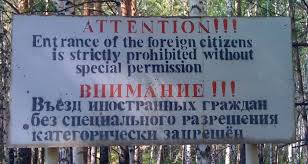
Rosatom nuclear chief warns of ‘particularly alarming situation’ in three areas as country reports biggest daily rise in cases, Reuters in Moscow 29 Apr 2020 Alexei Likhachev, Rosatom chief, said the pandemic ‘creates a direct threat’ to Russia’s nuclear cities. The head of Russia’s state-run nuclear corporation has expressed concern about the spread of the new coronavirus to three “nuclear cities”, including one that houses a top-secret research institute that helped develop the Soviet atomic bomb. The cities are closely linked to Russia’s nuclear industry, which is managed by the Rosatom corporation. Several are closed to foreigners and Russians require special clearance to enter them as facilities located there are closely guarded secrets. Rosatom chief Alexei Likhachev said special deliveries of ventilators and personal protection equipment (PPE) were being sent to the closed town of Sarov, east of Moscow, and other towns where dozens of cases of the virus have been registered. “This [pandemic] creates a direct threat to our nuclear towns. The situation in Sarov, Elektrostal [and] Desnogorsk is today particularly alarming,” he said in an online speech to Russia’s nuclear industry workers. “The situation in Sarov is exacerbated by an outbreak of the illness in the nearby Diveyevo monastery,” he said, without elaborating further. Likhachev made his remarks on a day when Russia reported its biggest daily rise in new coronavirus cases. Russia now ranks eighth worldwide with 93,558 confirmed cases, though its death toll of 867 is still far below that of many other countries. Moscow, which accounts for more than half of Russia’s cases, and many other regions have imposed stay-at-home orders to curb the spread of the virus. Sarov, which was so secret that it did not appear on maps until the breakup of the Soviet Union in 1991, remains an important part of Russia’s nuclear military complex, defence experts say. It is home to a research institute that gained prominence last year when five of its scientists died in a mysterious accident at a military testing site in the far north. Rosatom said the incident had occurred during a rocket engine test on a sea platform. Some US experts said they suspected it had been a botched test of a new missile vaunted by the president, Vladimir Putin. Last week, Rosatom said seven people at Sarov’s All-Russian Scientific Research Institute of Experimental Physics had been diagnosed with coronavirus, bringing the total number of cases in the city – which has a population of about 95,000 – to 23. It said the outbreak in Sarov had begun when a retired couple returned to the city from a Russian holiday resort and that more than 100 people had since been isolated to stop it spreading further. |
|
For General Electric, offshore wind looks like a winner, but Small Nuclear Reactors a costly folly.
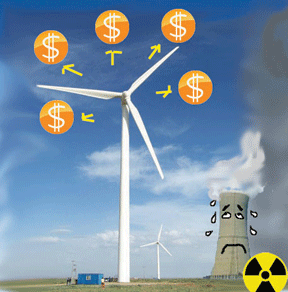 GE Power Plays: Wind Might Blow Coal, Gas And Nuclear Away, Seeking Alpha, Apr. 29, 2020 Keith Williams
GE offshore wind: massive offshore turbine Haliade-X 12MW looks like a winner.
GE-Hitachi Nuclear Energy may be a receding opportunity.
GE might sell its steam power business and rationalise its fossil fuel interests.
The power and renewables businesses are important in considering investment in GE.
………. Nuclear Small Modular Reactors : GE-Hitachi BWRX-300
There is a lot of talk in the nuclear industry and also in political circles from groups who are opposed to solar PV and wind developments, yet who acknowledge the need for low emissions technologies. The World Nuclear Association (WNA) has an excellent summary of many proposed developments in the area of Small Modular Nuclear Reactors (SMRs). The list of projects is long but many (most) seem to be struggling. A key point from the WNA report is the following : “Licensing is potentially a challenge for SMRs, as design certification, construction and operation licence costs are not necessarily less than for large reactors.” This is a huge red flag for any SMR project.
A second objection is cost of nuclear power versus solar PV/wind plus storage. There is a lot of information about these relative costs, including well into the future. I am not aware of any studies that suggest that any nuclear technology will be able to compete with renewables and storage on price. A recent study (December 2019) by the Australian Energy Market Operator (AEMO) and CSIRO concluded that SMR nuclear reactors will generate power costing ~8x that of rooftop or solar PV and wind, with solar and wind costs of power generation being similar.
……. With Small Modular Reactors the poster child of nuclear power supporters, it is clear that there is a lot riding on this potential saviour for the nuclear industry after Fukushima and recent delays and cost blowouts in the European (especially UK, French and Finnish) nuclear industries.
With current focus on emissions reductions and the climate emergency, this is an excellent time for low emissions technologies. However, the need is now and renewables (solar PV and wind) plus storage (pumped hydro and batteries) are making a lot of progress in addressing the needs. My question is whether the cost structure and long lead times mean that nuclear technology is too expensive and late to play a part.
A recent summary of the current state of the nuclear industry as a whole is depressing reading for someone who is enthusiastic about the nuclear industry’s prospects. A lot has to happen in the next decade and SMR technology isn’t ready yet. Is GE investing a lot in a technology that can’t compete with the dramatic advances in solar PV, wind and battery storage?……
GE’s adventures in nuclear developments seem like the kind of speculative play GE could happily fund when it was one of the world’s biggest and most powerful engineering companies. It doesn’t have that status anymore and my take is that it needs to cut its cloth and focus on projects that will have more immediate commercial outcomes. Of course, that is asking for a big rethink about how GE sees itself, but does it really have a choice if it wants to survive?
Offshore wind business
While there is some apprehension in the wind industry, especially in the US and China, as changes in regulations come into force next year, and 2020 has been messed up by COVID-19, there is a long-term future for wind power; offshore wind prospects look huge………
GE Renewable Energy is a major wind turbine supplier, with more than 42,000 of its turbines (mostly onshore) installed. Its role in the wind industry is extensive, from manufacture, digital optimization, operations and maintenance. Its onshore turbines range in size from 1MW to 5MW. GE installed ~50% of onshore turbines in the US last year, a 40% increase compared with the number of onshore turbines it installed in the US in 2018.
The offshore market is still emerging, with turbines substantially bigger than those used onshore. …..
The area that looks to me as if it could become a big winner is in offshore wind turbine developments, ….
A lot of investors have GE in their portfolios and a lot more are probably reflecting on whether GE might once again become a secure safe-haven investment. My biggest issue with GE is that it seems to me it is yet to understand that it is no longer the huge and dominant business that can afford to make big bets that burn a lot of cash. The current SMR nuclear programs in GE seem to be in this category. They have a very low chance of success but require major resources. I’d prefer not to have these distractions in a company I invest in….. https://seekingalpha.com/article/4340805-ge-power-plays-wind-might-blow-coal-gas-and-nuclear-away
South Korea’s government dismissed rumours about North Korean leader Kim Jong Un being gravely ill
|
North Korean leader Kim Jong-un health rumours dismissed by South Korean intelligence, ABC News, 27 Apr 20, South Korea’s Government has dismissed rumours that North Korean leader Kim Jong-un is in a fragile condition, as speculation about his health intensifies amid the North’s silence on his whereabouts. Unification Minister Kim Yeon-chul told a closed-door forum in Seoul that South Korea had “enough intelligence to confidently say that there are no unusual developments” in rival North Korea that would back up speculation about Mr Kim’s health, his ministry said. The minister did not reveal what specific intelligence led to that conclusion, but stressed that it was reached after a thorough analysis. His comments are a reiteration of earlier South Korean statements that Mr Kim appeared to be handling state affairs normally and that no unusual activities had been detected in North Korea. Those comments, however, failed to dispel the rumours about Mr Kim, partly because past outside intelligence reports on developments in North Korea have sometimes turned out to be wrong. ….. As the absolute leader of a country with a nuclear weapons program, Mr Kim’s health is a matter of intense interest both regionally and globally. If something were to happen to him, it could lead to instability in North Korea. Mr Kim hasn’t publicly anointed a successor, and that has prompted questions about who would take control of North Korea if he is gravely ill or dies….. serious unrest could occur if a power struggle erupts between those supporting the Kim dynasty and those who want non-Kim rule…….. https://www.abc.net.au/news/2020-04-28/kim-jong-un-health-rumours-south-korea-intelligence/12191504 |
|
International climate ministers meet to discuss green recovery post COVID-19
 International climate ministers meet to discuss green recovery post COVID-19 https://www.miragenews.com/international-climate-ministers-meet-to-discuss-green-recovery-post-covid-19/ This week environment ministers from 30 countries will meet in a two-day (27 – 28 April) online conference to discuss how to organise a green economic recovery after the worst of the COVID-19 pandemic is over. They will also aim to agree on how to proceed with ambitious carbon reductions despite the postponement of this year’s UN Climate Change Conference (COP26).
The ‘Petersberg Climate Dialogue’ will be hosted by Svenja Schulze, Germany’s Federal Environment Minister and Alok Sharma, the UK Secretary for Business and Energy and designated President of COP26.
Helen Clarkson, CEO of The Climate Group, an international non-profit with a mission of accelerating climate action said:
“The impact of COVID-19 has been devastating. As the world seeks to address the longer-term impact of this crisis, there is an opportunity for governments to help rebuild society differently. A side effect of the reduced economic activity we are seeing is cleaner air and clearer skies – through positive international cooperation we can begin to understand how we keep those things without compromising on economic growth.
“We have received signals from our partners, including 300 of the world’s largest businesses, that their commitment to climate action overwhelmingly remains in spite of the challenging circumstances. Just last week, nine members of our global electric vehicles initiative EV100, including the likes of Ingka Group, Unilever and LeasePlan, called on the EU to retain 2020 CO2 targets for cars, vans and trucks.
“Electric vehicles and renewable, efficient energy are profitable, long term investments. We need these smart green stimulus policies to not just maintain momentum but rapidly ramp-up investment to another level, and help deliver the halving of emissions we need in this decade.”
Animals in radiation zones are not doing well

above – Chernobyl bird at right has facial tumour
Not thriving, but failing https://beyondnuclearinternational.org/2018/03/11/not-thriving-but-failing/ https://beyondnuclearinternational.org/2018/03/11/not-thriving-but-failing/ Animals in radiation zones are not doing well, By Linda Pentz Gunter
It started with wolves. The packs around the Chernobyl nuclear plant, which exploded on April 26, 1986, were thriving, said reports. Benefitting from the absence of human predators, and seemingly unaffected by the high radiation levels that still persist in the area, the wolves, they claimed, were doing better than ever.
Appearances, however, can be deceptive. Abundant does not necessarily mean healthy. And that is exactly what evolutionary biologist, Dr. Timothy Mousseau and his team began to find out as, over the years, they traveled to and researched in and around the Chernobyl disaster site in the Ukraine. Then, when a similar nuclear disaster hit in Japan — with the triple explosions and meltdowns at Fukushima Daiichi on March 11, 2011 — Mousseau’s team added that region to its research itinerary.
Mousseau has now spent more than 17 years looking at the effects on wildlife and the ecosystem of the 1986 Chernobyl nuclear disaster. He and his colleagues have also spent the last half dozen years studying how non-human biota is faring in the wake of Fukushima. Ninety articles later, they are able to conclude definitively that animals and plants around Chernobyl and Fukushima are very far indeed from flourishing.
Mousseau’s findings strongly contradicted earlier work including the 2006 Chernobyl Forum report which claimed the Chernobyl zone “has become a wildlife sanctuary,” and a subsequent article published in Current Biology in 2015 that said wildlife was “thriving”around Chernobyl.
“I suppose everyone loves a Cinderella story,” speculated Mousseau, who is based at the University of South Carolina. “They want that happy ending.” But Mousseau felt sure the moment he read the Forum report, which, he noted, “contained few scientific citations,” that the findings “could not possibly be true.
What Mousseau found was not unexpected given the levels of radiation in these areas and what is already known about the medical effects of such long-term exposures. Birds and rodents had a high frequency of tumors.
“Cancers are the first thing we think about,” Mousseau said. “We looked at birds and mice. In areas of higher radiation, the frequency of tumors is higher.” The research team found mainly liver and bladder tumors in voles and tumors on the head, body and wings of the birds studied.
But Mousseau wanted to look beyond cancers, which is what everyone expects to find and what researchers had looked for, but only in humans. There were few wildlife studies, a fact Mousseau found surprising, given nature’s ability to act as a sentinel for likely impending human health impacts.
Mousseau and his fellow researchers found cataracts in birds and rodents. Male birds had a high rate of sterility. And the brains of birds were smaller. All of these are known outcomes from radiation exposure.
“Cataracts in birds is a problem,” Mousseau said. “A death sentence.”
Mental retardation has been found among children exposed to radiation in utero. Mousseau and colleagues discovered the same pattern in the birds they studied. “Birds already have small brains, so a smaller brain size is a definite disadvantage,” he said.
There were also just fewer animals in general. “There were many fewer mammals, birds and insects in areas of higher radiation,” Mousseau said. And they had their hunch as to why.
He and his colleagues extracted sperm from the male birds they caught and were shocked to find that “up to 40% of male birds in the radiologically hottest areas were sterile.”
The birds’ sperm were either deformed or dead. None would be able to reproduce. The discovery, he said, was “not at all surprising. These are the levels of radiation known to influence reproduction. At the same time, there is no safe level of radiation below which there aren’t detectable effects.”
Fewer birds have already been observed in the contaminated areas around Fukushima, said Mousseau. “Although it’s too early to assess the long term impact on abundance and diversity around Fukushima, there are very few butterflies and many birds have declined in the more contaminated areas. If abundance is compressed, biodiversity will follow.”
The consequences of radiation exposure, says Mousseau, “will have a tremendous impact on the quality of life of these animals, and the length of quality of life. It need not necessarily be cancers,” that cause these damages he said. “There is no doubt that the levels of radiation in Chernobyl and Fukushima generate genetic damage.”
Read more about Dr. Timothy Mousseau’s work.
Chernobyl nuclear disaster marks 34 years
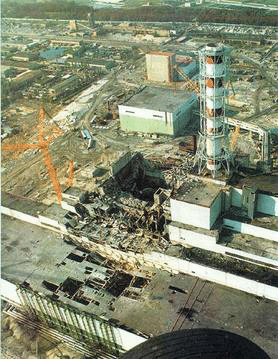 , Nearly 8.4M people exposed to radiation, over 400,000 displaced in wake of 1986 Chernobyl nuclear disaster, AA, Satuk Bugra Kutlugun |26.04.2020 ANKARA
The catastrophic Chernobyl nuclear accident in Ukraine, then part of the Soviet Union, marked its 34th anniversary on Sunday.
On April 26, 1986, a sudden surge of power during a reactor systems test destroyed Unit 4 of the nuclear power station at Chernobyl, some 110 kilometers (68.3 miles) from Ukraine’s capital, Kiev.
“Sunday is International Chernobyl Disaster Remembrance Day. The women, men & children affected by radioactive contamination must never be forgotten,” the UN said on Twitter, designating April 26 the International Chernobyl Disaster Remembrance Day.
31 people were killed in the immediate aftermath of the accident, while millions more were affected.
According to the official numbers, roughly 8.4 million people in the former Soviet territories of Belarus, Russia, and Ukraine got the largest exposure to radiation in the form of a cloud.
Around 155,000-square-kilometer (nearly 60,000-square-mile) area of these three countries were contaminated, and over 400,000 people were displaced.
Later research into the accident showed that the radioactive clouds reached as far as the US and China……..https://www.aa.com.tr/en/europe/chernobyl-nuclear-disaster-marks-34-years/1819033
Eleven of 12 hottest years have occurred since 2000, new climate report warns
 Eleven of 12 hottest years have occurred since 2000, new climate report warns, Independent, Isabelle Gerretsen @izzygerretsen 23 Apr 20
Last year was the hottest year on record for Europe after scorching heatwaves led to record-breaking temperatures in February, June and July
Eleven out of the 12 hottest years to date have all occurred since 2000, according to a new report by the European Union’s climate monitoring service.
Last year was the hottest year on record for Europe after scorching heatwaves led to record-breaking temperatures in February, June and July, scientists from the Copernicus Climate Change Service (CS3) said in the annual European State of the Climate report.
“The number of days with high heat stress levels are increasing in both northern and southern Europe,” they said.
An intense heatwave at the end of July led to record melting of Greenland’s ice sheet and all-time records being broken in northern Scandinavia, the Copernicus report noted.
According to recent research, Greenland’s ice sheet and the polar ice caps are melting six times faster than they were in the 1990s. The high melt rate fits with the worst-case scenario outlined by the UN’s Intergovernmental Panel on Climate Change (IPCC), which states that sea levels will rise 17cm without sweeping reductions in greenhouse gas emissions…..
Concentrations of CO2 and methane in the atmosphere continue to increase. “It is only possible to find concentrations as high as they were in 2019 by going back millions of years in history,” the Copernicus scientists said.
Professor Martin Siegert, co-director of the Grantham Institute for Climate Change at Imperial College London, told The Independent that the current level of CO2 in the atmosphere is “unnaturally high”.
He said it should be 280 parts per million (ppm) but is currently 415ppm and could reach 1000ppm by the end of the century if CO2 emissions continue to rise at their current rate…… https://www.independent.co.uk/environment/climate-change-global-warming-hottest-years-on-record-a9477796.html
1 This month

of the week – Australians for War Powers Reform (AWPR)
To see nuclear-related stories in greater depth and intensity
 Antinuclear