Tsunami could overtake Fukushima Daiichi Nuclear Plant’s seawall
Tsunami could overtake Fukushima Daiichi’s seawall, https://www3.nhk.or.jp/nhkworld/en/news/20200422_03/
An estimate by a Japanese government panel suggests that tsunami could overwhelm a new seawall at the Fukushima Daiichi nuclear power plant, if a mega-quake occurs in a deep-sea trench off northeastern Japan.
The panel of experts on Tuesday released its projection of the scale of tsunami that could be triggered by a massive quake along the Japan Trench.
The panel expects that waves as high as 13.7 meters could hit Futaba Town, Fukushima Prefecture, where the plant is located.
That is higher than the 11-meter-high seawall being built on the ocean side of the compound. The wall is one of the anti-tsunami measures taken by Tokyo Electric Power Company as it decommissions the plant.
Other measures include blocking the openings of the reactor buildings and deploying power supply vehicles on higher ground to continue cooling spent nuclear fuel.
TEPCO says it will examine the estimate and consider what measures to take.
- Nearly 1,000 tanks of radioactive wastewater are stored in the compound. The operator says the projected tsunami won’t reach the higher ground where they are located
Pandemic side-effects offer glimpse of alternative future on Earth Day 2020
Pandemic side-effects offer glimpse of alternative future on Earth Day 2020 https://www.theguardian.com/environment/2020/apr/22/environment-pandemic-side-effects-earth-day-coronavirus
Coronavirus has led to reduced pollution, re-emerging wildlife and plunging oil prices and shown the size of the task facing humanity Oliver Milman. @olliemilman, Wed 22 Apr 2020 The skies are clearing of pollution, wildlife is returning to newly clear waters, a host of flights have been scrapped and crude oil is so worthless that the industry would have to pay you to take it off their hands – a few months ago, environmentalists could only dream of such a scenario as the 50th anniversary of Earth Day hove into view.
But this disorientingly green new reality is causing little cheer given the cause is the coronavirus pandemic that has ravaged much of the world.
“This isn’t the way we would’ve wanted things to happen, God no,” said Gina McCarthy, former head of the US Environmental Protection Agency in the Obama administration. “This is just a disaster that pointed out the underlying challenges we face. It’s not something to celebrate.”
Wednesday’s annual Earth Day event, this year largely taking place online, comes as public health restrictions to prevent the spread of Covid-19 have resulted in a sharp dip in air pollution across China, Europe and the US, with carbon emissions from the burning of fossil fuels heading for a record 5% annual drop.
The waters of Venice are now clear, lions lounge on roads normally frequented by safari-goers in South Africa and bears and coyotes wander around empty accommodation in Yosemite national park in California.
Meanwhile, nearly eight in 10 flights globally have been canceled, with many planes in the US carrying just a handful of people. The oil industry, a key driver of the climate crisis and direct environmental disaster, is in turmoil, with a barrel of crude hitting an unprecedented minus-$40 on Monday.
These would perhaps be the sort of outcomes seen had stringent environmental policies been put in place in the wake of the first Earth Day in 1970, which saw 20 million Americans rally in support of anti-pollution measures.
Instead, the pain of the Covid-19 shutdown has highlighted how ponderous the world’s response has been – the expected cut in emissions, for example, is still less than what scientists say is needed every year this decade to avoid disastrous climate impacts for much of the world.
“It’s the worst possible way to experience environment improvement and it has also shown us the size of the task,” said Michael Gerrard, an environmental law expert at Columbia University.
How people react to the return of normalcy after the pandemic will help define the crises racking the environment, according to Gerrard. “A key question will be do we have a green recovery, do we seize the opportunity to create jobs in renewable energy and in making coastlines more resilient to climate change?” he said. “The current US president clearly has no inclination to do this.”
McCarthy, now head of the Natural Resources Defense Council, noted that some Indian people were seeing the Himalayas for the first time due to the veil of air pollution lifting.
“You wonder if people will want to go back to what it was like before,” she said. “The pandemic has shown people will change their behavior if it’s for the health of their families. This has been the lost message on climate, that it’s a human problem, not a planetary problem. We have to show you can have a stable environment and your job, too.”
The problems in the natural world haven’t suddenly vanished – this week various researchers found that the Arctic is very likely to be free of sea ice in summers before 2050, that the bushfires that torched Australia earlier this year released more carbon than the country’s annual CO2 output and that the first quarter of 2020 was the second-warmest on record.
Donald Trump has signaled that he will try to provide a bailout to the US oil and gas industry, with $25bn already handed out by the US government to prop up airlines. In China, it’s not certain that the wildlife-packed “wet markets” where Covid-19 is believed to have originated will be shut down.
Conservationists warn that returning the world to its pre-pandemic settings will quickly wipe out any environmental benefits of the shutdown.
“It’s a serious wake-up call,” said Thomas Lovejoy, an ecologist who coined the term “biological diversity”. “We bulldoze into the last remaining places in nature and then are surprised when something like this happens. We have done this to ourselves by our continual intrusion into nature. We have to re-chart our course.”
This story is a part of Covering Climate Now’s week of coverage focused on Climate Solutions, to mark the 50th anniversary of Earth Day. The Guardian is the lead partner in Covering Climate Now, a global journalism collaboration committed to strengthening coverage of the climate story.
Action on coronavirus – paving the way for a green energy future?

|
CORONAVIRUS CRISIS FAST-FORWARDS GREEN ENERGY 10 YEARS INTO THE FUTURE https://www.euronews.com/living/amp/2020/04/06/coronavirus-crisis-fast-forwards-renewable-green-energy-10-years-into-the-future–By Rosie Frost As businesses shut down and many work from home
around the world, electricity demand has reduced in COVID-19 hotspots. This could have a knock-on effect for the renewable sector.China, where the outbreak first took hold, is the world’s biggest electricity consumer. Output from factories has been substantially diminished with many unable to return to their jobs in manufacturing. Due to the curtailing of industrial electricity use, cuts in energy consumption for 2020 could be equivalent to the power used by the whole of Chile, according to IHS Markit. In Europe, peak power consumption has also gone down. Italy, Spain, and the UK have all seen an average 10 per cent drop in energy usage with bars, restaurants, offices and factories, which remain closed as social distancing measures continue. In particular, fossil fuel based sources of electricity have been impacted by reduced requirements. Coal, usually one of the cheapest options, has now become the most expensive fuel in the world in the face of cheap green alternatives and natural gas, according to Bloomberg Green. PAVING THE WAY FOR A GREEN FUTURE?Renewable energy sources seem to have been given an unexpected boost. Around 40 per cent of the electricity generated in the UK on Sunday 5th March came from wind farms, with nearly a fifth being provided by solar energy. This was due to the unusually sunny day, says the National Grid ESO carbon intensity tracker. These conditions have meant that renewable sources generated more than enough energy to cover the country’s reduced needs. Green supplier, Octopus Energy, even paid some customers to use energy during the day, using a scheme that has previously only been available during the night when demand is very low. “In most economies that have taken strong confinement measures in response to the coronavirus – and for which we have available data – electricity demand has declined by around 15%, largely as a result of factories and businesses halting operations,” Dr Fatih Birol, Executive Director of the International Energy Agency wrote in a blog post. “In this way, the recent drop in electricity demand fast-forwarded some power systems 10 years into the future, suddenly giving them levels of wind and solar power they wouldn’t have had otherwise without another decade of investment in renewables.” He went on to explain that this increase in renewable energy usage could even help some countries figure out how to deal with the drop in power that comes from the sun setting or a strong wind dying down. Previously, these kinds of fluctuating energy sources have proved challenging for those who work to keep our lights on. Managing them more ntelligently by shutting off solar panels at midday when there is more electricity than usual and slowing down wind power as demand decreases at night are just some options Dr Birol suggests. These new findings have also put the spotlight on more reliable and often neglected sources of green energy, like hydropower, which are essential to making sure we have a consistent supply of energy. In exceptional situations like the current pandemic, where a fluctuation in energy supply could put lives and employment at even greater risk, this is particularly important. |
|
|
Covid 19 shows that Australia’s security means a lot more than military preparedness
We are facing existential threats to human security that are not amenable to solution by military forces.
The catastrophic summer bushfires incinerated the livelihoods and the lifestyles of so many Australians who live along our coastal fringe. And while the landscape is recovering, albeit slowly, their circumstances are not. Indeed, the arrival of the pandemic has smashed their personal and economic security even further. The hit to the national economy from the combined events will be comparable to that of the second world war, the debt taking decades to run down.
Investment in green energy could drive Covid-19 recovery
|
Green energy could drive Covid-19 recovery with $100tn boost, Speeding up investment could deliver huge gains to global GDP by 2050 while tackling climate emergency, says report, Guardian, Jillian Ambrose, Mon 20 Apr 2020 Renewable energy could power an economic recovery from Covid-19 by spurring global GDP gains of almost $100tn (£80tn) between now and 2050, according to a report.
 The International Renewable Energy Agency found that accelerating investment in renewable energy could generate huge economic benefits while helping to tackle the global climate emergency. The International Renewable Energy Agency found that accelerating investment in renewable energy could generate huge economic benefits while helping to tackle the global climate emergency.
The agency’s director general, Francesco La Camera, said the global crisis ignited by the coronavirus outbreak exposed “the deep vulnerabilities of the current system” and urged governments to invest in renewable energy to kickstart economic growth and help meet climate targets. The agency’s landmark report found that accelerating investment in renewable energy would help tackle the climate crisis and would in effect pay for itself. Investing in renewable energy would deliver global GDP gains of $98tn above a business-as-usual scenario by 2050 by returning between $3 and $8 on every dollar invested. It would also quadruple the number of jobs in the sector to 42m over the next 30 years, and measurably improve global health and welfare scores, according to the report. “Governments are facing a difficult task of bringing the health emergency under control while introducing major stimulus and recovery measures,” La Camera said. “By accelerating renewables and making the energy transition an integral part of the wider recovery, governments can achieve multiple economic and social objectives in the pursuit of a resilient future that leaves nobody behind.” The report also found that renewable energy could curb the rise in global temperatures by helping to reduce the energy industry’s carbon dioxide emissions by 70% by 2050 by replacing fossil fuels. Renewables could play a greater role in cutting carbon emissions from heavy industry and transport to reach virtually zero emissions by 2050, particularly by investing in green hydrogen…… The call for a green economic recovery from the coronavirus crisis comes after a warning from Dr Fatih Birol, head of the International Energy Agency, that government policies must be put in place to avoid an investment hiatus in the energy transition. “We should not allow today’s crisis to compromise the clean energy transition,” he said. “We have an important window of opportunity.”….. https://www.theguardian.com/environment/2020/apr/20/green-energy-could-drive-covid-19-recovery-international-renewable-energy-agency |
|
USA’s new rules for nuclear workers – two weeks straight of 12 -hour days
 New rules for nuclear plant workers: 12-hour days for two weeks straight, Crains Chicago Business,20 Apr 20,
Exelon Corp., operator of the biggest U.S. nuclear fleet, says the move allows for “healthy workers to remain on site for more hours, reducing the need to bring in outside travelers and vendors.”
The Nuclear Regulatory Commission is already allowing six U.S. power plants to extend workers’ shifts, to as long as 12 hours a day for two weeks, and more may be coming. That’s up significantly from current standards that require people to get two-to-three days off a week when pulling shifts that long. Employees can also work as many as 86 hours in a week now, up from 72 hours.
To curb transmission of the virus, utilities also say they want to delay inspections that require people to work in close proximity. Environmental groups, though, warn the changes could have disastrous results, and worry they could lead to further deviations from safety rules.
“This is a step backward,” said Eric Epstein, chairman of Three Mile Island Alert, a Pennsylvania non-profit group. “It’s not a good idea to stretch workers and marginalize safety standards.”
The new rules come as at least 42 construction workers have tested positive for the coronavirus at a nuclear plant in Georgia where Southern Co. is building two new reactors. Last week, the utility and its partners announced they would reduce the 9,000-person workforce by 20 percent to slow the spread of the virus. The government considers nuclear power plants to be essential, and reactors will supply almost 21 percent of the country’s electricity this year…….
watchdog groups are concerned that employees may be overworked, leading to fatigue and potentially errors. “You want an alert workforce,” said Paul Gunter, a director at Beyond Nuclear. “You don’t do this with bus drivers, but they’re saying it’s OK for nuclear power plant workers.”
he NRC is also granting utilities utilities permission to defer some inspections as dozens of reactors go through the annual spring refueling cycle. These projects can involve more than 1,000 people converging on a power plant for a month or more of maintenance and testing.
Postponed Inspection
Pinnacle West Capital Corp. also has approval for longer hours and is postponing an inspection of components on the bottom of the reactor vessel at the 3.9-gigawatt Palo Verde nuclear plant in Arizona, the biggest U.S. nuclear plant. The company had initially planned to conduct the evaluation during its refueling outage this spring, but has now pushed that out until the next one, in late 2021. The utility owner determined that the task posed a potential risk of spreading the deadly virus, and could be safely delayed…….
Entergy Corp. is planning to defer some leak tests at pipes at its Grand Gulf reactor in Mississippi. The tests typically are due every 11 1/2 years, but will now be rescheduled for the next refueling outage in 18 months. Pushing that period out to 13 years won’t affect safety, the company said by email. And at the Indian Point facility north of New York City, Entergy is also seeking permission to postpone annual physical evaluations for firefighters……..https://www.chicagobusiness.com/utilities/new-rules-nuclear-plant-workers-12-hour-days-two-weeks-straight
Climate Change Multiplies the Threats of Infectious Diseases
 Climate Change Multiplies the Threats of Infectious Diseases, BY Daniel Ross, Truthout, April 19, 2020
As the novel coronavirus continues to rage like a wildfire across the planet, its devastating toll has left many asking whether climate change — another multifaceted phenomenon with global reach — has played a part in spreading, even triggering, the pandemic. Some, like Katharine Hayhoe, a climate change scientist and professor of public policy at Texas Tech University, have been able to provide answers.
“Climate change didn’t cause the pandemic, and climate change directly causes very few of them,” Hayhoe told Truthout. “But what climate change does is it interacts with, and in many cases has the potential to exacerbate the impacts.”
For those well-versed in the mechanics of climate change, this comes as no surprise — scientists, policy makers and other experts have long acknowledged the links between global warming and the spread of infectious diseases, promulgating the sorts of findings described in the wide-ranging 2018 Intergovernmental Panel on Climate Change report, detailing what efforts are needed to limit global warming to 1.5 degrees Celsius.
Dig down, and this multilayered issue has knock-on effects — from the way rising temperatures exacerbate certain health problems to the disruptions that extreme weather events have on the global supply chain — that are inextricably linked with one another. What’s more, the governmental response to the coronavirus crisis, say experts, offers a troubling glimpse into what might happen in the future as the global thermometer inches upwards.
“What it underscores in the first instance is how underprepared we are,” said Sherri Goodman, a senior fellow at the Wilson Center’s Environmental Change and Security Program and Polar Institute.
As a former first deputy undersecretary of defense in environmental security, she coined the term “threat multiplier” to describe climate change’s kaleidoscopic impacts.
“Our systems — institutional, infrastructure, health, emergency response — could all be overwhelmed from the climate crisis,” Goodman said, warning that the time for wholesale climate resiliency preparedness is upon us. “What we have now is history accelerating itself — things are happening so fast.”
“Where Can These People Go?”
Perhaps most salient in terms of current events is the issue of zoonotic diseases spread between animals and humans, like the COVID-19 virus, which is believed to have originated in bats before being transferred to humans via scaly animals like pangolins. As the world’s population growth continues to rise, natural habitats will continue to be encroached upon and destroyed, not only removing valuable carbon sinks like rainforests but creating environments in which notorious zoonotic disease carriers like bats and rats thrive.
Climate change is also likely to encourage the spread — both in terms of seasonal risk and geographic reach — of “vector-borne” diseases. These are illnesses like West Nile Virus and Lyme Disease that are borne by mosquitoes, ticks and fleas, and already account for a significant number of deaths annually.
According to Sheri Weiser, a professor of medicine at the University of California, San Francisco (UCSF), there’s still much to learn about how rising temperatures are impacting the spread of infectious diseases. “But we know the common cause of climate change and COVID-19 — the globalization that’s driving fossil fuel emissions — contributes to the pre-conditions that pave the way for viruses like that,” Weiser said.
Indeed, there’s already an extensive library of medical literature detailing how climate change can impact human health. Extreme weather events — a symptom of a warming planet — can lead to fluctuating temperatures which have been shown to contribute to and worsen cardiovascular and cerebrovascular diseases, kidney disorders and a host of other illnesses. On top of that, extreme heat and humidity can limit the effectiveness of certain medications used to treat these conditions………
the Trump administration’s slash-and-burn approach to the scientific wing of the federal government is the elephant in the room during the COVID-19 pandemic.
Last September, for example, the U.S. Agency for International Development (USAID) effectively shuttered its PREDICT program, which was charged with identifying and combating new emerging viruses. With the COVID-19 death toll in the U.S. now well into five figures, USAID has injected more than $2 million to kickstart the program, at least temporarily. The Environmental Data and Governance Initiative recently found that the Trump administration has repeatedly, “and sometimes successfully,” sought to cut funding aimed at the Centers for Disease Control and Prevention for fighting global pandemics. Nevertheless, the Trump administration isn’t alone in neglecting science and research; for nearly two decades now, the amount of federal funds funneled toward basic research has shrunk markedly……. https://truthout.org/articles/climate-change-multiplies-the-threats-of-infectious-diseases/?eType=EmailBlastContent&eId=71649a96-ad00-4169-afc2-bb1b572e3345
David Attenborough – humans have last chance to save the planet
|
Attenborough’s grim warning on last chance, Herald Sun, Alison Kershaw, Press Association
April 19, 2020 Sir David Attenborough has urged people to “stop waste of any kind”, saying the world is precious and should be “celebrated and cherished”.
The broadcaster and naturalist warns humans have a “last chance” to change their behaviour and save the planet, as he urged politicians to address “the biggest problem humanity has ever faced”. In an interview on the BBC’s Andrew Marr Show, Attenborough, 93, said it will be the younger generation who will have to make changes because “they will be able to see the consequences of what they do”. He added: “My lot are dying off and we are the ones that caused the problem.” He suggested people should see the world and their time in it as precious, saying “that’s the fundamental attitude”. ….. Attenborough has worked with Netflix to produce an upcoming documentary called A Life On Our Planet which looks at the challenges facing earth and what can be done to address them. https://www.heraldsun.com.au/news/breaking-news/attenboroughs-grim-warning-on-last-chance/news-story/f0dd55d3c63f52df76909dbf4701c4ff |
|
After the pandemic, – the need for a new economic consensus
New Statesman 16th April 2020, To tackle the climate crisis, the world cannot return to normal after
Covid-19. This moment must be used to build a new economic consensus founded on justice, care and sustainability. The same fractures exposed by this pandemic are the fault lines along which the battle for climate justice is fought.
Many of the people most vulnerable in the current crisis will be worst affected by environmental breakdown, while those who are enriched by this pandemic are likely to benefit in the future. Reports this week that UK hedge funds are cashing in on Covid-19 ring eerily similar to now regular stories of investors betting on climate collapse, water
scarcity and crop failure, and investing in the infrastructures and technologies of disaster.
And just as many nations and communities have been abandoned in our response to this pandemic, it is all too easy to imagine a future in which communities from Jakarta to east Yorkshire are left to fend for themselves amid accelerating climate breakdown. Indeed, to imagine it one has only to look at the present.
Post-crisis stimulus should be directed towards green infrastructure and innately low carbon forms of work like health and social care, proven so vital and so undervalued by this crisis. Debts must be written off to allow those countries most vulnerable to climate crisis to build resilience against it. And having exposed austerity as an ideological choice, rather than a necessity, we must ensure these mistakes are never repeated, and social safety nets are both valued and strengthened.
Rapid Transition Alliance 16th April 2020, Andrew Simms: In the debate over the global response to Covid19 a battle of hashtags has broken out between those urging a quick return to ‘normal’, and those saying that ‘normal’ had many problems and the crisis has revealed both the need and an opportunity for changing direction, and a shift of economic purpose.
Scientists predict that 2020 is likely to be the planet’s hottest year on record
2020 expected to be Earth’s warmest year on record, scientists say, Doyle Rice, USA TODAY, 17 Apr 20,
- This year’s warmth is “unusual,” given the lack of a strong El Niño.
- Already, through the first three months of the year, it’s the second-warmest on record.
- There’s a 99.9% chance that 2020 will end among the five warmest years on record.
Federal scientists announced Thursday that 2020 has nearly a 75% chance of being the warmest year on record for the planet Earth.
Already, through the first three months of the year, it’s the second-warmest on record, trailing only the El Niño fueled year of 2016, the National Oceanic and Atmospheric Administration (NOAA) said.
This year’s warmth is “unusual,” given the lack of a strong El Niño, a natural warming of tropical Pacific Ocean water that influences temperatures worldwide, according to Deke Arndt of NOAA’s National Centers for Environmental Information.
He said both February and March were the warmest months on record without an El Niño present. The long-term trend of ongoing heat the planet continues to see is primarily because of the emission of greenhouse gases from the burning of fossil fuels, he said.
Even if 2020 ends up not being the warmest year, NOAA said there’s a 99.9% chance that 2020 will end among the five warmest years on record.
The warmth has been nearly global so far this year: “Record-hot January-through-March temperatures were seen across parts of Europe, Asia, Central and South America, as well as the Atlantic, Indian and western Pacific Oceans,” NOAA said. “No land or ocean areas had record-cold temperatures during this period.”
Climate change:Antarctic glacier retreated 3 miles in 22 years, threatening global sea-level rise
What winter?:Earth just had its second-warmest December-February on record……
Sea-level rise:Greenland and Antarctica are now melting six times faster than in the 1990s https://www.usatoday.com/story/news/nation/2020/04/16/global-warming-2020-expected-warmest-year-record-noaa-said/5144767002/
With dry and windy conditions, new areas of ‘smoldering’ reported near Chernobyl nuclear plant
The fire began to burn in the region back on April 3, near the town of Pripyat, located over two hours north of the country’s capital of Kiev and near the border with Belarus.
Police say they arrested a 27-year-old man who is being accused of starting the fire last week. On Monday, police said that another local resident burned waste and accidentally set dry grass ablaze.
The location of the fire was reportedly only one kilometer (less than one mile) away from the Chernobyl nuclear power plant, the site of the world’s largest nuclear catastrophe back in April 1986.
However, Greenpeace Russia, on Monday, warned that the fire being in close proximity of the power plant posed a radiation risk.
“Higher-than-usual” radiation levels were first reported by the AP on April 5, and are being carefully monitored as the fire continues.
According to Reuters, Chernobyl tour operator, Yaroslav Yemelianenko, shared on Facebook that the fire was only two kilometers away from where “the most highly active radiation waste of the whole Chernobyl zone is located.” He called on officials to warn people of the danger.
Emergency services said on Tuesday morning that there were still some acreage “smoldering” in the Chernobyl Exclusion Zone, but that the zone contained no open fire.
Acting Chairman of the State Environmental Inspectorate, Yegor Firsov, later said that the fire in the Chernobyl exclusion zone was extinguished, and cited some rain that moved through the region as one helpful factor.
Hundreds of firefighters, as well as several planes and helicopters, battled the blaze for 10 days.
………Strong winds increased the difficulty in containing what’s left of the blaze and new areas of “smoldering” were reported in the Exclusion Zone, but did not pose a threat to any critical facilities, reported officials……..
Dry weather across much of eastern Europe has allowed for a more volatile environment for fire to thrive.
Through April 13, only two percent of the month’s normal rainfall has fallen in Kiev. Since the beginning of 2020, the city has been much drier than normal, only recording 81 mm of rain instead of the average 150 mm.
The dry weather has also caused crop losses already this year across Ukraine, with further damage possible should the dry stretch continue.
Keep checking back on AccuWeather.com and stay tuned to the AccuWeather Network on DirecTV, Frontier and Verizon Fios.
Changing the rules to make nuclear waste look ‘safer’ – USA leads the way
 Nuclear agency proposes deregulating disposal of some US radioactive waste, https://www.chemistryworld.com/news/nuclear-agency-proposes-deregulating-disposal-of-some-us-radioactive-waste/4011533.articleBY REBECCA TRAGER 1 16 APRIL 2020.The US Nuclear Regulatory Commission (NRC) is facing protests after proposing that low-level radioactive waste be disposed of in commercial landfills not explicitly designed to hold it, rather than at licenced radioactive waste sites. The NRC’s proposal, issued in March, declares that the agency’s intent is to limit this deregulation to ‘very low level radioactive wastes’, but Public Employees for Environmental Responsibility (Peer) states that the actual proposal allows doses to the public equivalent to more than 900 chest x-rays over a lifetime, with a cancer risk 20 times higher than the upper end of the US Environmental Protection Agency’s acceptable risk range.
For its part, the NRC anticipates that its proposal would provide ‘an efficient means’ for it to issue specific exemptions for disposal, or for licensees to transfer appropriate material to these exempt facilities. Comments on the NRC’s proposal are due by 20 April.
Wildfires getting close to Chernobyl nuclear station, radiation rises in smoke
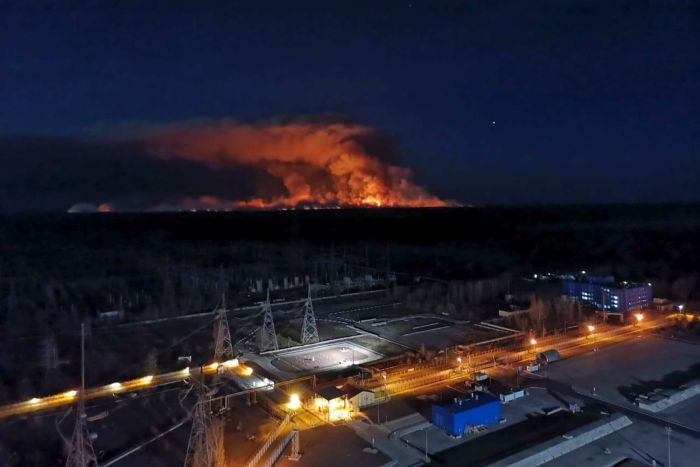
Radiation levels rise as fires burn near Chernobyl’s former nuclear power plant https://www.abc.net.au/news/2020-04-13/chernobyl-fires-crews-battle-contain-blaze-nuclear-power-plant/12144956?utm_medium=spredfast&utm_content=sf232669694&utm_campaign=abc_news&utm_source=m.facebook.com&sf232669694=1 13 Apr 20 A photo taken from the roof of Chernobyl’s old nuclear power plant has revealed how close the bushfires raging through Ukraine’s forests are from the site of the 1986 nuclear disaster.
Key points:
- Crews are working to contain the forest fires burning through the territory surrounding the Chernobyl nuclear power plant
- Radiation levels near the fires have been elevated, with the blazes producing swirling smoke
- Winds are blowing smoke towards Kiev though authorities say radiation levels in the city remain normal
Firefighters are working to control the blazes burning through the irradiated forests in the territory surrounding the former nuclear plant.
Radiation levels near the wildfires have risen, and the blazes have produced swirling smoke which is being blown towards neighbouring regions.
Winds had blown the smoke towards rural areas of Russia and nearby Belarus, but they shifted in the direction of Ukrainian capital Kiev over the weekend.
Authorities in Kiev, which has a population of about 3 million people, say radiation levels in the city remain normal.
Its citizens are already in lockdown due to the coronavirus pandemic.
The winds are more of a significant headache for the site of Chernobyl’s closed nuclear power plant. Strong gusts could spread the fires towards what is left of the facility as well as the abandoned equipment used to clean up the disaster.
“At the moment we cannot say the fire is contained,” acting head of the State Agency of Ukraine on Exclusion Zone Management Kateryna Pavlova said.
What stands in the fire’s path?
Fires are common inside the “Zone of Alienation”, a circle with a 30-kilometre radius that surrounds the old nuclear plant and is fenced in barbed wire. But the current blazes are larger than normal and are stirring up radiation as they burn grass and forests.
Winds could spread fires to remnants of the nuclear plant and authorities are trying to protect the critical infrastructure in the exclusion zone.
This includes the plant itself (and its radiation-containing sarcophagus), as well as the so-called “graves” — parking lots of abandoned, contaminated trucks and vehicles left behind from the original disaster.
“We have been working all night, digging firebreaks around the plant to protect it from fire,” Ms Pavlova said. Access to the 2,600 square kilometre area is limited to workers and tourists on guided excursions.
What happens when an irradiated tree burns down?
In the 34 years since the disaster, radiation has settled into the exclusion zone’s soil and been absorbed by the roots of trees and vegetation. While many plants in the immediate vicinity of the plant died when the nuclear reactor exploded, the plant life within the exclusion zone adapted over the decades to come.
However, the radioactive particles are brought back to the surface of the soil and released in smoke when the plants burn in fires.
The exclusion zone was established after the April 1986 disaster which saw a reactor explosion send a cloud of fallout over the European continent. The Zone of Alienation is largely unpopulated, save for about 200 people who have remained in the area despite government orders to leave.
The Chernobyl Exclusion Zone was established after the April 1986 disaster at the plant sent a cloud of radioactive fallout over much of Europe.
People are not allowed to live within 30 kilometres of the old power station, where a giant protective dome was put over the fourth reactor in 2016.
The dome, called the New Safe Confinement, enclosed the temporary “sarcophagus” built around the reactor immediately after the disaster.
Chernobyl’s three other nuclear reactors continued to generate electricity until the plant finally closed in 2000.
The Coronavirus and Climate Action: We must advocate now for immediate and significant investments in green infrastructure
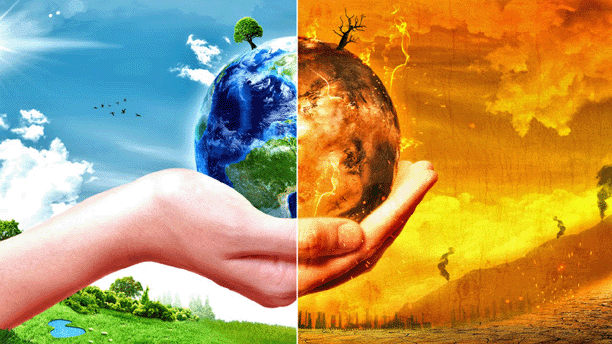
The major impact of coronavirus on the trajectory of climate change must not be a temporary reduction in emissions from cars, trucks and airplanes. It must be a collective recognition that rapid and significant voluntary changes in our behavior are possible. For individual climate action to be sustained, people must find honor and joy in it. And that action must also be supported by government leadership and coordination. We must advocate now, as vocally as we can, for immediate and significant investments in green infrastructure. To avert disaster, we must change how we live.
The Coronavirus and Climate Action https://blogs.scientificamerican.com/observations/the-coronavirus-and-climate-action/ Confronting global warming will take a completely different approach from confronting the pandemic, By Laura J. Martin on April 10, 2020
In recent weeks, many Americans have voluntarily and radically altered their behavior in order to protect others from the novel coronavirus. Those who are less vulnerable are making sacrifices in order to protect those who are more vulnerable: the elderly, the immunocompromised, and—in our country, with its broken social safety net—the uninsured and the poor.
Climate scientists have been quick to draw parallels between the need to “flatten the curve” of coronavirus spread and the need to flatten the carbon emissions curve. The Intergovernmental Panel on Climate Change states that we must reduce emissions by about 45 percent from 2010 levels by 2030 in order to lessen the severity of future emergency; to reduce, but not eliminate, the probability of catastrophic changes in sea level, ocean acidity, extreme weather, food security and biodiversity.
But confronting climate change will require a completely different generational politics than confronting coronavirus. Rather than young people changing their lifestyles to protect the elderly, the large and growing proportion of older citizens in industrialized countries will have to change their lifestyles in order to protect children and those not yet born. Those with power and resources today will have to change their lifestyles dramatically in order to protect the world’s poorest and most marginalized, those who will not be able to move away from climate hazards. This is the message that youth activists like Zero Hour, Isra Hirsi and Greta Thunberg implore us to heed. It is also the premise of DearTomorrow, a storytelling project where people write climate messages to loved ones living in the future.
Who is right? Continue reading
What is needed is a green recovery, but will governments promote that?
 The Guardian view on the climate and coronavirus: global warnings, https://www.theguardian.com/commentisfree/2020/apr/12/the-guardian-view-on-the-climate-and-coronavirus-global-warnings 13 Apr 20, Editorial Steep falls in emissions have been the pandemic’s immediate effect. But what’s needed is a green recovery. So far, discussions of a coronavirus exit strategy have mainly focused on the steps that could bring an end to the lockdown. In the short term, both in the UK and elsewhere, there is nothing more desirable than letting people resume their lives, once it is safe to do so. The Guardian view on the climate and coronavirus: global warnings, https://www.theguardian.com/commentisfree/2020/apr/12/the-guardian-view-on-the-climate-and-coronavirus-global-warnings 13 Apr 20, Editorial Steep falls in emissions have been the pandemic’s immediate effect. But what’s needed is a green recovery. So far, discussions of a coronavirus exit strategy have mainly focused on the steps that could bring an end to the lockdown. In the short term, both in the UK and elsewhere, there is nothing more desirable than letting people resume their lives, once it is safe to do so.But the speed of the “return to normal” is not the only thing that matters. The manner in which the world’s leaders manage the colossal economic and political shocks caused by the virus is also of the utmost importance. And at the top of their list of priorities, alongside human welfare, must be the biosphere and its future. It’s too soon to say with any confidence what impact coronavirus will have on the climate emergency. The brakes placed on economic activities of many kinds, worldwide, have led to carbon emission cuts that would previously have been unthinkable: 18% in China between February and March; between 40% and 60% over recent weeks in Europe. Habits and behaviours once regarded as sacrosanct have been turned on their heads: road traffic in the UK has fallen by 70%. Global air traffic has halved. Meanwhile, a much-needed spotlight has been thrown on humans’ troubling relationship to wildlife, with some experts arguing that the degradation of the natural world and exploitation of other species is among the pandemic’s causes. In human terms, the economic contraction precipitated by the virus – and predicted by the World Bank to lead to a severe depression – is sure to be brutal. No one, and least of all an elected government, would have chosen to limit emissions in this way. But if further savage waves of destruction to people’s livelihoods are to be avoided, rather than simply stored up or ignored until they become unignorable, just as coronavirus was, every possible effort must now be made to ensure that the recovery, when it comes, is as green as possible; that any and every stimulus package is directed towards renewable energy and zero- or low-carbon infrastructure and transport. The urgency and desperation surrounding all such efforts are likely to militate against progressive measures. Already, governments are coming under huge pressure to bail out oil and gas companies (in the US and Canada this has already begun). But while in the short term the low oil price, which is also the result of a price war being waged by Saudi Arabia and Russia, could have the damaging effect of making oil more competitive against renewables, plunging demand and turmoil in the industry provide an opportunity that must be seized by all who oppose the continued dominance of fossil fuels. There are other questions besides the future of oil that the crisis has opened up in unexpected ways. Huge political shifts are under way, with fiscally conservative governments such as Boris Johnson’s intervening in economies to an unprecedented extent. What was once impossible (socialist, reckless) now turns out not to be, at all. Could the renewed shock of human vulnerability in the face of Covid-19 make way for an increased willingness to face other perils, climate chaos among them? Impossible to say at this stage, perhaps. Certainly not without a fight against all those who will promote a return to business (and emissions) as usual. But with the postponement of crucial UN biodiversity and climate conferences, it has never been more important to keep up the pressure. There is no exit strategy from our planet. |
|
1 This month

of the week – Australians for War Powers Reform (AWPR)
To see nuclear-related stories in greater depth and intensity
 Antinuclear