Global response to Covid-19 is rapid. Response to climate change is too damn slow
Climate Policy Times 15th March 2020
The deadly threat posed by the rapid spread of Covid-19 has resulted in
unprecedented action from governments around the world. There’s a lesson
here for climate change: it’s too damn slow. What would happen, for
example, if we learnt that the polar icecaps had reduced by almost half
overnight, rather than since the 1980s? What if some of the world’s
largest lakes mysteriously dried up over January, not over the past decade?
What sort of panic would ensue if a quarter of the world’s population
found their homes under water tomorrow, instead of being told it would
happen in 80 years?
Christiana Figueres’ message of climate hope
“So, for me, optimism is not simply the result of having attained something. It is rather a strategy, the input, the approach with which we must face climate change because it is the only way to enhance the probability of success.”
It’s an arresting thought – the only way to succeed, or merely survive, is to hope. Not a passive hope, but a hungry and angry hope, one that will force us to act.

No wonder people are overwhelmed about the future of the planet, feel helpless, overcome with grief and worried nothing is being done, that nothing can be done, that it’s all too late. Our children are having nightmares, wracked with a sense of loss before they full possessed anything. The term “eco-anxiety” was defined by the American Psychological Society as “”a chronic fear of environmental doom” in a 2017 report which cited evidence of people “deeply affected by feelings of loss, helplessness, and frustration due to their inability to feel like they are making a difference in stopping climate change”.
Greta Thunberg calls for Friday climate rallies to be held online
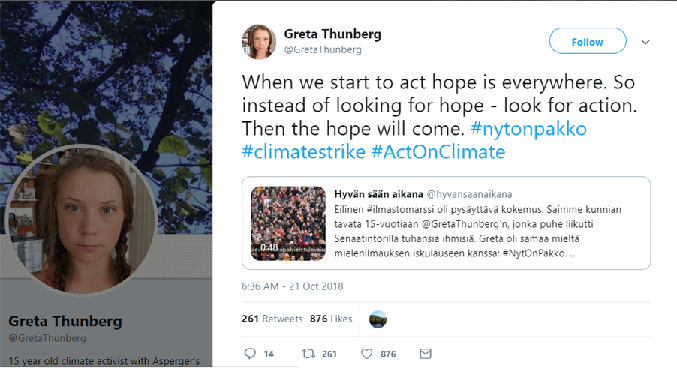
Greta Thunberg calls for Friday climate rallies to be held online, https://www.sbs.com.au/news/greta-thunberg-calls-for-friday-climate-rallies-to-be-held-online Climate activist Greta Thunberg has called on fellow climate activists to move their weekly rallies online to prevent the spread COVID-19.
Increasing speed of melting in polar ice caps
 Polar ice caps melting six times faster than in 1990s https://www.theguardian.com/environment/2020/mar/11/polar-ice-caps-melting-six-times-faster-than-in-1990s
Thu 12 Mar 2020 The polar ice caps are melting six times faster than in the 1990s, according to the most complete analysis to date.
The ice loss from Greenland and Antarctica is tracking the worst-case climate warming scenario set out by the Intergovernmental Panel on Climate Change (IPCC), scientists say. Without rapid cuts to carbon emissions the analysis indicates there could be a rise in sea levels that would leave 400 million people exposed to coastal flooding each year by the end of the century.
Rising sea levels are the one of the most damaging long-term impacts of the climate crisis, and the contribution of Greenland and Antarctica is accelerating. The new analysis updates and combines recent studies of the ice masses and predicts that 2019 will prove to have been a record-breaking year when the most recent data is processed.
The previous peak year for Greenland and Antarctic ice melting was 2010, after a natural climate cycle led to a run of very hot summers. But the Arctic heatwave of 2019 means it is nearly certain that more ice was lost last year.
The average annual loss of ice from Greenland and Antarctica in the 2010s was 475bn tonnes – six times greater than the 81bn tonnes a year lost in the 1990s. In total the two ice caps lost 6.4tn tonnes of ice from 1992 to 2017, with melting in Greenland responsible for 60% of that figure.
The IPCC’s most recent mid-range prediction for global sea level rise in 2100 is 53cm. But the new analysis suggests that if current trends continue the oceans will rise by an additional 17cm.
“Every centimetre of sea level rise leads to coastal flooding and coastal erosion, disrupting people’s lives around the planet,” said Prof Andrew Shepherd, of the University of Leeds. He said the extra 17cm would mean the number of exposed to coastal flooding each year rising from 360 million to 400 million. “These are not unlikely events with small impacts,” he said. “They are already under way and will be devastating for coastal communities.”
Erik Ivins, of Nasa’s Jet Propulsion Laboratory, in California, who led the assessment with Shepherd, said the lost ice was a clear sign of global heating. “The satellite measurements provide prima facie, rather irrefutable, evidence,” he said.
Almost all the ice loss from Antarctica and half of that from Greenland arose from warming oceans melting the glaciers that flow from the ice caps. This causes glacial flow to speed up, dumping more icebergs into the ocean. The remainder of Greenland’s ice losses are caused by hotter air temperatures that melt the surface of the ice sheet.
The combined analysis was carried out by a team of 89 scientists from 50 international organisations, who combined the findings of 26 ice surveys. It included data from 11 satellite missions that tracked the ice sheets’ changing volume, speed of flow and mass.
About a third of the total sea level rise now comes from Greenland and Antarctic ice loss. Just under half comes from the thermal expansion of warming ocean water and a fifth from other smaller glaciers. But the latter sources are not accelerating, unlike in Greenland and Antarctica.
Shepherd said the ice caps had been slow to respond to human-caused global heating. Greenland and especially Antarctica were quite stable at the start of the 1990s despite decades of a warming climate.
Shepherd said it took about 30 years for the ice caps to react. Now that they had a further 30 years of melting was inevitable, even if emissions were halted today. Nonetheless, he said, urgent carbon emissions cuts were vital. “We can offset some of that [sea level rise] if we stop heating the planet.”
The IPCC is in the process of producing a new global climate report and its lead author, Prof Guðfinna Aðalgeirsdóttir, of the University of Iceland, said: “The reconciled estimate of Greenland and Antarctic ice loss is timely.”
She said she also saw increased losses from Iceland’s ice caps last year. “Summer 2019 was very warm in this region.”
The danger and the cost – Small Nuclear Reactors for the Military
 Pentagon hands out contracts for PORTABLE nuclear reactors… yet another gold vein for cash-savvy military? https://www.rt.com/news/482942-us-military-nuclear-microreactor/ 13
 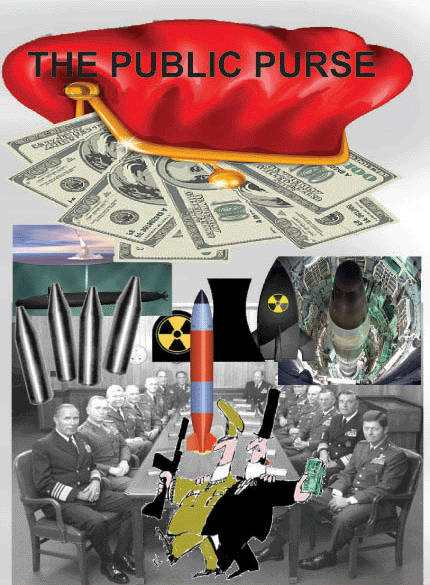 Mar, 2020 There’s no shortage of hefty defense deals awarded by the US Department of Defense, but the $40 million contract for micro-reactors definitely stands out, as it hides safety risks and raises doubts over its economic efficiency.
The nuclear device that the DoD strategists want must have the capability to be safely and rapidly transported by road, rail, sea or air (sic!) as well as swiftly set up and shut down. The project split between three companies — BWX Technologies, Westinghouse Government Services and X-energy — calls for a “safe, mobile and advanced nuclear micro-reactor.”
The safety part sounds particularly soothing, but how would it look on the ground? What if those miniature reactors, when moved by land, become targets of high-profile terrorist attacks? And will it prove to be a real alternative (which means cheaper price, of course) to conventional energy sources?
‘The more reactors — the greater the danger’
“Any nuclear reactor attracts terrorists,” Andrey Ozharovsky, nuclear scientist, program expert at the Russian Social Ecological Union, told RT. “It doesn’t matter if it’s located at a nuclear power plant [or inside a portable device]… if you remember, the terrorists planned directing one of the planes at a nuclear plant during 9/11.”
The logic here is simple, he pointed out: “the more reactors are out there — the greater the danger.” If the US builds hundreds, or even dozens of such devices, it’ll be really hard for them to properly defend them all.
Another vital safety issue is the reliability of the nuclear micro-reactors. Interestingly enough, the US military had already experimented with them back in the 1950s and 1960s — and it ended in a tragedy.
Several portable reactors were built and setup in Greenland and Panama, but one of them blew up in 1961, killing three operators. The Army Nuclear Power Program was shut down shortly after that.
“There were eight US micro-reactors and one of them exploded. That’s how safe they are,” Ozharovsky said, adding that the Pentagon’s idea of bringing them back will “likely create more risks instead of solving any problems.”
‘Micro-reactors yet to prove their economic efficiency’
But even if the portable reactors will be shielded from the perils of the battlefield and operate without failure, what’s the Pentagon’s rationale behind bringing the radioactive fuel to their military bases? For decades, the army had been successfully running on gasoline, diesel and fuel oil; when going off-grid, it would switch to generators and high-power accumulators.
“The main problem has nothing related to safety,” Anton Khlopkov, director of Energy and Security Center and member of Russian Security Council’s Scientific Council argued.
Micro-reactors must prove their viability from the economic point of view, since such plants always have alternatives.
It is yet to be proven that micro-reactors won’t be “many times more” expensive than other conventional sources of energy. Electricity produced by such devices should be at least comparable in cost to the one produced by diesel generators, he said.
‘Some kind of a soap bubble’
If micro-reactors are such a questionable solution, why is the Pentagon pushing for their development? The answer isn’t lying on the surface, but it isn’t buried too deep.
“They work against the trends,” Ozharovsky suggested. And those trends are that the world is giving up on the use of civilian nuclear energy due to being too expensive.
Washington may be trying to “support the US the nuclear industry that’s dying out with the use of the military budget; sponsor their research and development — which is an expensive thing.”
Ozharovsky didn’t rule out the possibility that the whole thing “is some kind of a soap bubble.” The research will be made, some prototypes may even be put together, but no actual mini-reactors will be ordered by the Pentagon, he said.
The DoD’s was never shy to spend the US taxpayer dollars: its F-35 program was worth a whopping $1.4 trillion in procurement and operating costs over its lifetime, while Pentagon also acquired such items of prime necessity as… $640 toilet seats and $7,600 coffee makers. The micro-reactors may well become another entry in this wasteful list.
Starting the Olympic torch relay in Fukushima should remind us of the dangers of nuclear power
Starting the Olympic torch relay in Fukushima should remind us of the dangers of nuclear power https://www.japantimes.co.jp/opinion/2020/03/13/commentary/japan-commentary/starting-olympic-torch-relay-fukushima-remind-us-dangers-nuclear-power/#.XmvxdqgzbIU
BY CASSANDRA JEFFERY AND M. V. RAMANA If the Tokyo Olympics are held on schedule, thousands of athletes will soon come to Japan. Considering the multiple reactors that melted down there nine years ago, in March 2011, the government’s decision to start the ceremonial torch relay in Fukushima Prefecture seems a bit odd, to say the least.
While radiation levels may have declined since 2011, there are still hot spots in the prefecture, including near the sports complex where the torch relay will begin and along the relay route. The persistence of this contamination, and the economic fallout of the reactor accidents, should remind us of the hazardous nature of nuclear power.
Simultaneously, changes in the economics of alternative sources of energy in the last decade invite us to reconsider how countries, including Japan, should generate electricity in the future. Continue reading
Olympic Games – the pièce de résistance of Japan’s Fukushima coverup

Japan’s Nuclear Cover-up Continues, Nine Years after the Fukushima Disaster, Fairewinds Energy Education, March 10, 2020 by Arnie Gundersen “……. 2020 Olympics
In order for Japan to win its Olympic bid in 2013, two years later, Japan’s next Prime Minister Abe stated that the Fukushima disaster was ‘under control’. This statement was also a blatant lie that succeeded in winning the bid to hold the 2020 Olympics in Tokyo at the expense of the taxpayers and residents of Japan. Don’t take Fairewinds word for it! Read what Japan’s former Prime Minister, Junichiro Koizumi said to Reuters in September 2016. Entitled Abe’s Fukushima ‘under control’ pledge to secure Olympics was a lie: former PM, Reuters wrote,
Japanese Prime Minister Shinzo Abe’s promise that the crippled Fukushima nuclear plant was “under control” in his successful pitch three years ago for Tokyo to host the 2020 Olympic Games “was a lie”, former premier Junichiro Koizumi said on Wednesday.
Frequent readers of the Fairewinds newsletter will remember last year’s posts entitled Atomic Balm 1 and Atomic Balm 2 in which Fairewinds Energy Education described in detail the path of deception that Japan has used to take the world’s attention off of the lives of its own people, who are still being compromised by the Fukushima Daiichi nuclear tragedy. The 2020 Olympics puts the media focus onto something else – so that the world continues to believe that nuclear power reactors are still a safe form of generating electricity.
This nine year legacy of lies by the government of Japan, nuclear incentivized governments worldwide, and the atomic industry are a harbinger for the seemingly inevitable approach of the 2020 Tokyo Olympics. Hopefully mainstream media covering the summer games will finally see through this glamorous marketing scam and identify the fact that Fukushima Prefecture remains severely radiologically contaminated. Real people, who are citizens of Japan, are seeing their health and that of their families being compromised for generations as they are forced to return to radiologically contaminated areas. Entire families and their communities are facing significant health risks simply to enable corporate profiteering of those investors, energy producers, banks, and government officials associated with the ongoing operation of nuclear power plants in Japan and around the world. https://www.fairewinds.org/demystify/japans-nuclear-cover-up-continues-nine-years-after-the-fukushima-disaster
The planet’s largest ecosystems could collapse faster than we thought
 The planet’s largest ecosystems could collapse faster than we thought https://www.ehn.org/ecosystems-collapse-2645447028.html?rebelltitem=1#rebelltitem1
Massive, vital ecosystems that have existed for thousands of years could breakdown in just a few decades, according to a new study
If put under the kind of environmental stress increasingly seen on our planet, large ecosystems —such as the Amazon rainforest or the Caribbean coral reefs—could collapse in just a few decades, according to a study released today in Nature Communications.
In the case of Amazon forests, stressors could cause collapse in just 49 years. In Caribbean coral reefs, it could take as little as 15 years.
“The messages here are stark,” said lead researcher John Dearing, a professor in physical geography at the University of Southampton, in a statement.
Those estimates come from Dearing and colleagues who examined data on how 42 natural environments—small and large, and on both land and water—have transformed. They found that larger ecosystems may take longer than small ones to collapse, but the rate of their decline is much more rapid.
Ecosystem stress can come in many forms such as climate change, deforestation, overfishing, pollution and ocean acidification.
Humanity now needs to prepare for changes in ecosystems that are faster than we previously envisaged through our traditional linear view of the world, including across Earth ‘s largest and most iconic ecosystems, and the social–ecological systems that they support,” the authors wrote.
Larger ecosystems are made up of smaller “sub-systems” of species and habitats, which provide some resilience against rapid change. However, once these smaller systems start to collapse, the new study finds the large ecosystems as a whole fall apart much faster than previously expected.
Researchers pointed to the destructive Australian and Amazon rainforest wildfires as recent examples of this dangerous fast rate of collapse.
“These findings are yet another call for halting the current damage being imposed on our natural environments that pushes ecosystems to their limits,” Dearing added.
See the full study in Nature Communications.
The continuing cover-up of the Fukushima nuclear disaster
 Japan’s Nuclear Cover-up Continues, Nine Years after the Fukushima Disaster, Fairewinds Energy Education, March 10, 2020 by Arnie Gundersen
The six atomic power reactors at the Fukushima Daiichi nuclear site were severely damaged 9-years ago when a Richter 9 earthquake in the Pacific Ocean occurred at 2 p.m. on March 11, 2011 ravaging the nuclear reactors, flooding safety systems, and causing three atomic power meltdowns.
Fairewinds is using the 9th commemoration of the meltdowns at Fukushima to discuss how the government of Japan, TEPCO (Tokyo Electric Co), the International Atomic Energy Agency (IAEA), and the worldwide nuclear industries have perpetuated their coverup of the tragedy of the Fukushima meltdowns. These corporate and governmental groups and agencies have consistently misinformed the International Press, the citizens of Japan, and people around the world about the true consequences of the Fukushima Daiichi meltdowns.
The Government of Japan, the nuclear industry, and its regulators have “framed” what happened at Fukushima Daiichi and thereby have controlled the Fukushima narrative for 9-years. ‘Framing’ is choosing the right words to portray and control any narrative. George Lakoff and his co-authors explain how controlling that framework of words controls how people view an issue. You may read more in their book that discusses ‘framing’ any issue entitled “Don’t Think of an Elephant!: Know Your Values and Frame the Debate”. …….
The nuclear industry downplayed the radioactive danger being unleashed
While the Japanese government kept denying that meltdowns had even occurred, the rest of the nuclear industry and the governments in the thrall of atomic lobbyists for the nuclear power and nuclear weapons industries actively downplayed the tragedy occurring right before our eyes.
In a brilliant analysis from the UK newspaper The Guardian, reporters uncovered a coordinated coverup that began within two-days of the onset of the Fukushima disaster:
British government officials approached nuclear companies to draw up a coordinated public relations strategy to play down the Fukushima nuclear accident just two days after the earthquake and tsunami in Japan and before the extent of the radiation leak was known.
Internal emails seen by the Guardian show how the business and energy departments worked closely behind the scenes with the multinational companies: EDF Energy, Areva and Westinghouse to try to ensure the accident did not derail their plans for a new generation of nuclear stations in the UK.
“This has the potential to set the nuclear industry back globally,” wrote one official at the Department for Business, Innovation and Skills (BIS), whose name has been redacted. “We need to ensure the anti-nuclear chaps and chapesses do not gain ground on this. We need to occupy the territory and hold it. We really need to show the safety of nuclear.”
On March 18, 2011, seven-days after the disaster began, US Department of Energy Secretary Chu said that Fukushima was at a Level-5 on the nuclear incident scale, which is similar to the level the US Government assessed at Three Mile Island (TMI), but not the level-7 that the world assessed for Chernobyl. On CNN that night, I was the first expert in the world to say publicly on mainstream media that Fukushima and its radioactive releases were already as bad as Chernobyl.
CNN’s John King: “Secretary Chu called it worse than Three Mile Island…”
Arnie: “I actually think it’s at Chernobyl level right now…100 time worse than the worst case we imagined a year ago.”
Every time Fairewinds released a video, podcast, newsletter or I appeared on television or radio, I was publicly slammed and called a liar and fear monger by the nuke industry that I had been directly been employed with for 20-years. I began my career first as a nuclear engineer and reactor operator and later progressed to become Senior Vice President of a nuclear power corporation – until I became a nuclear power whistleblower. After being fired for telling the truth, I took on the role of nuclear safety critic, which I have had for the last 30-plus-years. In Fairewinds opinion, these corporate coverups were obvious to anyone who focused on the real science of nuclear engineering and was not afraid to look behind the curtain, where the Wizard of Oz was manipulating the truth.
Only 11-months after the meltdowns, I was flown to Japan in February 2012 by Shueisha Publishing to unveil the publication of Fairewinds book [entitled Fukushima Daiichi: The Truth and the Way Forward] and to speak at various venues in Tokyo, including the Japanese Foreign Correspondents Press Club. Here is a portion of what I said:
I was an expert on the Three Mile Island nuclear accident, and I see in Fukushima the same mistakes that the Americans made at Three Mile Island. At Three Mile Island and at Fukushima, the plant management – the people in the plant – really understood the severity of the accident. But in both cases, 30 years apart, when the plant management contacted offsite management – it was General Public Utilities in the United States, and of course, it was Tokyo Electric in Japan – the process began to slow down.
What I saw on Three Mile Island was that the corporate office was trying to protect the corporate assets and they actually told the plant manager not to order an evacuation, despite the fact that the plant manager wanted an evacuation. And I see the same thing at Fukushima. I believe that the management onsite in the first day and the first week really understood the severity of it. But senior management working up the chain, for whatever their motivations were, failed to act quickly enough…. it seems to me like the lesson at Three Mile Island and the lesson at Fukushima really are institutional problems in that the corporate officers and corporate offices simply don’t respond quick enough. In addition to the internal problems between the plant and Tokyo Electric offices, there of course were the problems between Tokyo Electric and the Nation of Japan.
Following the triple meltdowns in 2011, I became acquainted with Naoto Kan, the Prime Minister of Japan at the time of the meltdown. At a venue where we were both keynote speakers, I told him that I thought he had not been given the correct information about the meltdowns. He replied,
“The information I received from both TEPCo and METI (Japan’s nuclear regulator) was neither timely nor accurate.”
Please think about the enormity of that single sentence! Any industry so powerful that it does not feel compelled to tell the truth to the leader of a nation is failing its country and their people……….
The bottom line is that in Japan during the Fukushima Daiichi meltdowns, the lives of women and children were sacrificed to create the appearance that TEPCO had the triple meltdowns under control.
Grossly underestimating the cost of the Disaster
People living and working in Japan and the country’s own citizens were clearly deceived about the severity of the meltdowns, the urgent need to evacuate, and the significant health impact for generations of families following the Fukushima disaster. And, these people were also deceived about the astronomical cost to dismantle the four severely damaged reactors at the Fukushima Daiichi site, protect the ocean and surrounding areas from the ongoing migration of radioactivity, and the total cost to complete the partial remediation of Fukushima Prefecture. I say partial remediation, because the remediation [the removal of radioactivity] will always be partial. So much radioactivity blew into the mountains, and the mountains and forests are so contaminated with highly radioactive isotopes including plutonium, that it will take tens of thousands of years for that radioactivity to dissipate [the industry term is decay away].
Every time in rains or the snow melts or the wind blows from or through the mountains, that radioactivity is spread farther away and also back into areas that were allegedly cleaned. The government informed people that these contaminated areas are clean and that they should now move back into their old communities and homes, and that the government stipends they had been receiving were ending and all the evacuee housing was being closed. What are people to do when they have no place to live and no money to live on except to go back to their old community?
A “lowball” price estimate showing that recovery from the meltdowns would be inexpensive was designed to show Japan’s citizens that the meltdowns were not that bad after all. ………https://www.fairewinds.org/demystify/japans-nuclear-cover-up-continues-nine-years-after-the-fukushima-disaster
The ocean as a dump for nuclear wastes
Radioactive dumping ground, The main reason behind the radiation along the northern French coastline isn’t the underwater barrels, but rather the nuclear fuel reprocessing plant at La Hague. It is located directly on the coast and “legally discharges 33 million liters of radioactive liquid into the sea each year,” says Rousselet. He thinks it’s scandalous.
Spike in cancer rates, According to a study by the European Parliament, statistics show cancer rates are significantly higher in the region surrounding La Hague.
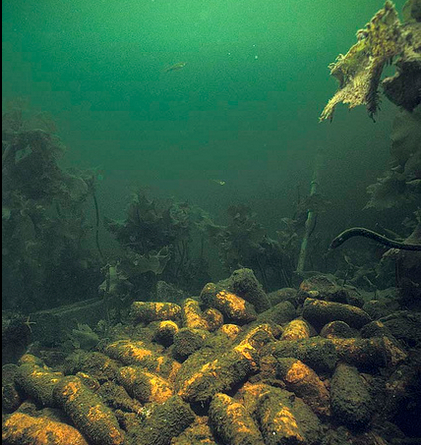
Fukushima: How the ocean became a dumping ground for radioactive waste, DW, 11 Mar 20 The nuclear disaster at Fukushima sent an unprecedented amount of radiation into the Pacific. But, before then, atomic bomb tests and radioactive waste were contaminating the sea — the effects are still being felt today…….
A study from the European Parliament reached a similar conclusion. The research found that “even the smallest possible dose, a photon passing through a cell nucleus, carries a cancer risk. Although this risk is extremely small, it is still a risk.”
And that risk is growing. Radioactive pollution in the ocean has been increasing globally — and not just since the disaster at Fukushima.
Atomic bomb tests
In 1946, the US became the first country to test an atomic bomb in a marine area, in the Pacific Bikini Atoll. Over the next few decades, more than 250 further nuclear weapons tests were carried out on the high seas. Most of them (193) were conducted by France in French Polynesia, and by the US (42), primarily in the Marshall Islands and the Central Pacific.
But the ocean wasn’t just being used as a training ground for nuclear war. Until the early 1990s, it was also a gigantic dump for radioactive waste from nuclear power plants.
From 1946 to 1993, more than 200,000 tons of waste, some of it highly radioactive, was dumped in the world’s oceans, mainly in metal drums, according to the International Atomic Energy Agency (IAEA). Several nuclear submarines, including nuclear ammunition, were also sunk during this time.
Is the ocean a perfect storage site?
The lion’s share of dumped nuclear waste came from Britain and the Soviet Union, figures from the IAEA show. By 1991, the US had dropped more than 90,000 barrels and at least 190,000 cubic meters of radioactive waste in the North Atlantic and Pacific. Other countries including Belgium, France, Switzerland and the Netherlands also disposed of tons of radioactive waste in the North Atlantic in the 1960s, 70s and 80s.
“Under the motto, ‘out of sight, out of mind,’ the dumping of nuclear waste was the easiest way to get rid of it,” says Horst Hamm. Continue reading
Nuclear is too risky – say protestors
And they say that Small Nuclear Reactors have nothing to do with the military!
The department awarded contracts to BWX Technologies, Inc. of Virginia, for $13.5 million; Westinghouse Government Services of Washington, D.C. for $11.9 million; and X-energy, LLC of Maryland, for $14.3 million, to begin a two-year engineering design competition for a small nuclear microreactor designed to potentially be forward deployed with forces outside the continental United States.
The combined $39.7 million in contracts are from “Project Pele,” a project run through the Strategic Capabilities Office (SCO), located within the department’s research and engineering side. The prototype is looking at a 1-5 megawatt (MWe) power range. The Department of Energy has been supporting the project at its Idaho National Laboratory…….
If the testing goes well, a commercially developed, Nuclear Regulatory Commission licensed reactor will be demonstrated on a “permanent domestic military installation by 2027,” according to DoD spokesman Lt. Col. Mike Andrews. “If the full demonstration proves to be a cost effective energy resilience alternative, NRC-licensed [reactors] will provide an additional option for generating power provided to DoD through power purchase agreements.”
The best way to differentiate between the programs may be to think of the A&S effort as the domestic program, built off commercial technology, as part of an effort to get off of local power grids that are seen as weak targets, either via physical or cyber espionage. Pele is focused on the prototyping a new design, with forward operations in mind — and may never actually produce a reactor, if the prototype work proves too difficult…… https://www.defensenews.com/smr/nuclear-arsenal/2020/03/09/pentagon-to-award-mobile-nuclear-reactor-contracts-this-week/
The price paid by those who did not evacuate via The half lives of the abandoned — Beyond Nuclear International
The price paid by those who did not evacuate

via The half lives of the abandoned — Beyond Nuclear International
The price of staying — Beyond Nuclear International
Family who stayed in Fukushima was unwarned and exposed

Nuclear reactors, large or small, are NOT “zero carbon”
On the international media, so many articles swallow the line that nuclear power, whether large or small is “zero carbon”. In reality, nuclear reactors themselves DO emit a tiny amount of Carbon 14, – so they’re not “zero”. But when you look at the entire chain of construction through to demolition, and the fuel chain through from mining to waste disposal, – nuclear power is a huge carbon emitter. The whole nuclear propaganda seems now to based on this “zero carbon”story – although nuclear enthusiasts previously were often climate change deniers. The length of time needed to set up millions of these little reactors means that they’d be irrelevant to climate change action. However, that same delay would help the coal industry to just keep on going for much longer than it should. Nuclear and coal – partners in this cover-up of the truth.
1 This month

of the week – Australians for War Powers Reform (AWPR)
To see nuclear-related stories in greater depth and intensity
 Antinuclear