USA fails to stop G20 finance ministers and central bank governors warning on climate change
 G20 sounds alarm over climate emergency despite US objections,Group’s first ever reference to global heating signals growing economic concerns over climate change, Guardian, Richard Partington Economics correspondent @RJPartington, Mon 24 Feb 2020 The G20 group of the world’s wealthiest nations have agreed for the first time to collectively sound the alarm over the threat to the financial system posed by the climate emergency.Overcoming objections from Donald Trump’s US administration, G20 finance ministers and central bank governors meeting in Saudi Arabia over the weekend agreed to issue their first ever communique with references to climate change, according to reports from Reuters. G20 sounds alarm over climate emergency despite US objections,Group’s first ever reference to global heating signals growing economic concerns over climate change, Guardian, Richard Partington Economics correspondent @RJPartington, Mon 24 Feb 2020 The G20 group of the world’s wealthiest nations have agreed for the first time to collectively sound the alarm over the threat to the financial system posed by the climate emergency.Overcoming objections from Donald Trump’s US administration, G20 finance ministers and central bank governors meeting in Saudi Arabia over the weekend agreed to issue their first ever communique with references to climate change, according to reports from Reuters.
Sources told the news agency that the statement of priorities included the importance of examining the implications of global heating for financial stability, as part of the work of the G20’s Financial stability Board, the steering group for international banking industry rules. The language represented a compromise to overcome opposition from US officials at the first major meeting of Saudi Arabia’s year-long presidency of the G20, according to the sources. An attempt to include references to the downside risks for global growth posed by the climate crisis was dropped……. The International Monetary Fund included climate-related disasters in a list of the risks facing a highly fragile recovery in the global economy this year. However, the increasing focus comes as US officials resist naming global heating as an economic risk, following Trump’s move at the outset of his presidency to withdraw the world’s largest economy from the Paris climate accords. https://www.theguardian.com/world/2020/feb/23/g20-sounds-alarm-over-climate-emergency |
|
USA at G20 tried to stop any mention of climate change
US blocking mention of climate change in G20 statement, diplomats say Independent UK, ‘Oliver O’Connell, New York, 24 Feb 20,
1 day ago G20 diplomats say the US is against mentioning climate change in the communique of the world’s financial leaders.
A new draft of the joint statement shows the G20 considering including it as a risk factor to growth.
Finance ministers and central bankers from the world’s 20 largest economies are discussing the main challenges to the global economy in Riyadh, Saudi Arabia, this weekend.
G20 sources told Reuters that the US was reluctant to accept language on climate change as a risk to the economy.
The US is represented at the meeting by treasury secretary Steven Mnuchin…….. G20 diplomats say the US is against mentioning climate change in the communique of the world’s financial leaders.
A new draft of the joint statement shows the G20 considering including it as a risk factor to growth. Finance ministers and central bankers from the world’s 20 largest economies are discussing the main challenges to the global economy in Riyadh, Saudi Arabia, this weekend.
U.S. Pentagon toys with a plan to win a “limited nuclear war” against Russia
 US staged ‘limited’ nuclear battle against Russia in war game US staged ‘limited’ nuclear battle against Russia in war game
The Pentagon has briefed about the simulated exchange in a move that could signal readiness to fight and win nuclear conflict, Guardian, Julian Borger in Washington, Tue 25 Feb 2020 The US conducted a military exercise last week which simulated a “limited” nuclear exchange with Russia, a senior Pentagon official has confirmed.The war game is notable because of the defence department’s highly unusual decision to brief journalists about the details and because it embodied the controversial notion that it might be possible to fight, and win, a battle with nuclear weapons, without the exchange leading to an all-out world-ending conflict. The exercise comes just weeks after the US deployed a new low-yield submarine-launched warhead commissioned by Donald Trump, as a counter to Russian tactical weapons and intended to deter their use. According to a transcript of a background briefing by senior Pentagon officials, the defence secretary, Mark Esper, took part in what was described as a “mini-exercise” at US Strategic Command in Nebraska. Esper played himself in the simulated crisis, in which Russia launched an attack on a US target in Europe…… The official said that “in the course of [the] exercise, we simulated responding with a nuclear weapon”, but described it as a “limited response”. The limited response could suggest the use of a small number of nuclear weapons, or an existing low-yield weapon, or the new W76-2 low-yield submarine-launched missile which was deployed in the Atlantic for the first time at the end of last year. The deployment only became public at the end of January…… The briefing was first reported by National Defense, a trade magazine of the National Defense Industrial Association. Hans Kristensen, the director of the nuclear information project at the Federation of American Scientists, pointed out that it was extremely rare for the Pentagon to give such detailed briefings about nuclear exercises and suggested it could have been a marketing exercise for the new weapons being added to the US arsenal. “Remember, it’s only a few weeks ago that we had the official confirmation that this new low-yield warhead had been deployed,” Kristensen said. “And we’re now moving into a new budget phase where they have to go to Congress and try to justify the next new nuclear weapon that has a low-yield capability which is a sea-launched cruise missile. So all of this has been played up to serve that process.”…… Arms control advocates are concerned that the leadership in both the US and Russia are developing a mindset in which their vast nuclear arsenals are not just the ultimate deterrent but weapons that could be used to win “limited” conflicts. https://www.theguardian.com/world/2020/feb/24/limited-nuclear-war-game-us-russia |
|
New tech takes radiation out of cancer screening
 New tech takes radiation out of cancer screening, Science Daily, February 24, 2020, University of Waterloo
- Summary:
- Researchers have developed a new, inexpensive technology that could save lives and money by routinely screening women for breast cancer without exposure to radiation. The system uses harmless microwaves and artificial intelligence (AI) software to detect even small, early-stage tumors within minutes.
-
Researchers have developed a new, inexpensive technology that could save lives and money by routinely screening women for breast cancer without exposure to radiation.
The system, developed by researchers at the University of Waterloo, uses harmless microwaves and artificial intelligence (AI) software to detect even small, early-stage tumors within minutes.
“Our top priorities were to make this detection-based modality fast and inexpensive,” said Omar Ramahi, a professor of electrical and computer engineering at Waterloo. “We have incredibly encouraging results and we believe that is because of its simplicity.”
A prototype device — the culmination of 15 years of work on the use of microwaves for tumor detection, not imaging — cost less than $5,000 to build.
It consists of a small sensor in an adjustable box about 15 centimetres square that is situated under an opening in a padded examination table………
- In addition to reducing patient wait times and enabling earlier diagnosis, Ramahi said, the device would eliminate radiation exposure, improve patient comfort and work on particularly dense breasts, a problem with mammograms.
It would also save health-care systems enormous amounts of money and, because of its low cost and ease of use, dramatically increase access to screening in the developing world.
Researchers have applied for a patent and started a company, Wave Intelligence Inc. of Waterloo, to commercialize the system and hope to begin trials on patients within six months. Three rounds of preliminary testing included the use of artificial human torsos known as phantoms. https://www.sciencedaily.com/releases/2020/02/200224111415.htm
What happens when the oceans heat up? PODCAST
 happens when the oceans heat up? PODCAST https://www.theguardian.com/australia-news/audio/2020/feb/24/what-happens-when-the-oceans-heat-up As we continue to see impacts from global heating around the world, research in the places first affected becomes increasingly more important. Off the coast of Tasmania the oceans are heating and it’s one of a handful of places around the world that have seen an increase of 2C in a short time. In this episode of Full Story, we go to Tasmania to see how this has impacted on fishing industries and marine ecosystems
Collapse of insect populations heralds doom for human species?
 Fates of humans and insects intertwined, warn scientists Fates of humans and insects intertwined, warn scientists
Experts call for solutions to be enforced immediately to halt global population collapses, Guardian Damian Carrington Environment editor @dpcarrington, Thu 20 Feb 2020 .The “fates of humans and insects are intertwined”, scientists have said, with the huge declines reported in some places only the “tip of the iceberg”.The warning has been issued by 25 experts from around the world, who acknowledge that little is known about most of the estimated 5.5 million insect species. However, enough was understood to warrant immediate action, they said, because waiting for better data would risk irreversible damage. The researchers said solutions were available and must be implemented immediately. These range from bigger nature reserves and a crackdown on harmful pesticides to individual action such as not mowing the lawn and leaving dead wood in gardens. They also said invertebrates must no longer be neglected by conservation efforts, which tend to focus on mammals and birds…….https://www.theguardian.com/environment/2020/feb/20/fates-humans-insects-intertwined-scientists-population-collapse |
|
Secret recording made of Julian Assange’s private discussions with lawyers
Julian Assange and lawyers secretly recorded The Age Video https://www.theage.com.au/world/julian-assange-and-lawyers-secretly-recorded-20200223-p543kd.htmlFebruary 23, 2020 A security company is under investigation amid revelations Julian Assange and his Australian lawyers were secretly recorded.
Large number of climate denialism tweets sent from bots
 Revealed: quarter of all tweets about climate crisis produced by bots Revealed: quarter of all tweets about climate crisis produced by bots
Draft of Brown study says findings suggest ‘substantial impact of mechanized bots in amplifying denialist messages’ Guardian, Oliver Milman in New York @olliemilman, Fri 21 Feb 2020 The social media conversation over the climate crisis is being reshaped by an army of automated Twitter bots, with a new analysis finding that a quarter of all tweets about climate on an average day are produced by bots, the Guardian can reveal.The stunning levels of Twitter bot activity on topics related to global heating and the climate crisis is distorting the online discourse to include far more climate science denialism than it would otherwise. An analysis of millions of tweets from around the period when Donald Trump announced the US would withdraw from the Paris climate agreement found that bots tended to applaud the president for his actions and spread misinformation about the science. The study of Twitter bots and climate was undertaken by Brown University and has yet to be published. Bots are a type of software that can be directed to autonomously tweet, retweet, like or direct message on Twitter, under the guise of a human-fronted account…….. An analysis of millions of tweets from around the period when Donald Trump announced the US would withdraw from the Paris climate agreement found that bots tended to applaud the president for his actions and spread misinformation about the science. The study of Twitter bots and climate was undertaken by Brown University and has yet to be published. Bots are a type of software that can be directed to autonomously tweet, retweet, like or direct message on Twitter, under the guise of a human-fronted account…….. Trump has consistently spread misinformation about the climate crisis, most famously calling it “bullshit” and a “hoax”, although more recently the US president has said he accepts the science that the world is heating up. Nevertheless, his administration has dismantled any major policy aimed at cutting planet-warming gases, including car emissions standards and restrictions on coal-fired power plants……. number of suspected bots that have consistently disparaged climate science and activists have large numbers of followers on Twitter. One that ranks highly on the Botometer score, @sh_irredeemable, wrote “Get lost Greta!” in December, in reference to the Swedish climate activist Greta Thunberg……. ohn Cook, an Australian cognitive scientist and co-author with Lewandowsky, said that bots are “dangerous and potentially influential”, with evidence showing that when people are exposed to facts and misinformation they are often left misled. “This is one of the most insidious and dangerous elements of misinformation spread by bots – not just that misinformation is convincing to people but that just the mere existence of misinformation in social networks can cause people to trust accurate information less or disengage from the facts,” Cook said. .. https://www.theguardian.com/technology/2020/feb/21/climate-tweets-twitter-bots-analysis The stunning levels of Twitter bot activity on topics related to global heating and the climate crisis is distorting the online discourse to include far more climate science denialism than it would otherwise.ast |
|
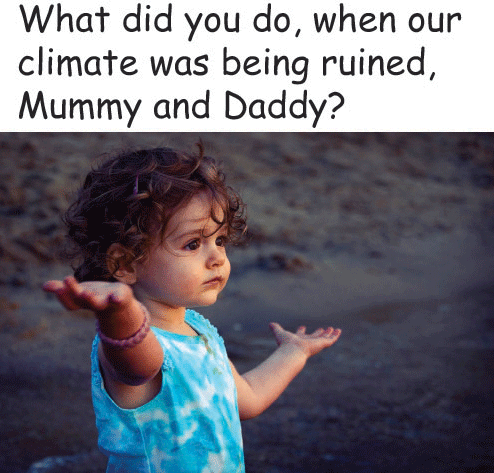
Every country on Earth failing to provide world fit for children, landmark report warns, Australia among the worst
|
Every country on Earth failing to provide world fit for children, landmark report warns‘Predatory marketing’ and wealthy countries’ high carbon emissions among chief concerns for health of future generations, says major WHO, Lancet and Unicef report Independent UK, Harry Cockburn, 20 Feb 20, Every country in the world is failing to protect children’s health, their environment and their futures, a landmark report for the World Health Organisation has found.
The damning findings pull back the curtain on an increasingly fragile world in which unbridled industrialism is already sabotaging the lives of younger generations. The report, based on a commission of more than 40 child and adolescent health experts from around the world, said every child on Earth is now “under immediate threat from ecological degradation, climate change and exploitative marketing practices that push heavily processed fast food, sugary drinks, alcohol and tobacco at children”. Despite improvements in child and adolescent health over the past 20 years, progress has stalled, and is set to reverse,” said Helen Clark, the former prime minister of New Zealand and co-chair of the commission. The report, by the WHO, the United Nations Children’s Fund (Unicef) and the Lancet Commission, ranked 180 countries on the conditions they provide for a child to “thrive and survive”…….. The report said while wealthier countries generally have better child health and development outcomes it is them in particular who “threaten the future of all children through carbon pollution, on course to cause runaway climate change and environmental disaster”. When authors took per capita CO2 emissions into account, the rankings told a very different story. Norway ranked 156th, the Republic of Korea 166 and the Netherlands 160. Each of these countries emits 210 per cent more CO2 per capita than their 2030 target. The UK ranked 136th on this measure. The US, Australia and Saudi Arabia are among the 10 worst emitters. “It has been estimated that around 250 million children under five years old in low- and middle-income countries are at risk of not reaching their developmental potential, based on proxy measures of stunting and poverty. But of even greater concern, every child worldwide now faces existential threats from climate change and commercial pressures,” Ms Clark said. The authors of the report said: “Governments must harness coalitions across sectors to overcome ecological and commercial pressures to ensure children receive their rights and entitlements now and a liveable planet in the years to come.”…….
Dr Tedros Adhanom Ghebreyesus, the director-general of the WHO, described the report as a “wakeup call”. He said: “This report shows that the world’s decision-makers are, too often, failing today’s children and youth: failing to protect their health, failing to protect their rights, and failing to protect their planet…… To protect children, the independent commission authors call for a new global movement driven by and for children. Specific recommendations include: Stop CO2 emissions with the utmost urgency, to ensure children have a future on this planet; Place children and adolescents at the centre of our efforts to achieve sustainable development; New policies and investment in all sectors to work towards child health and rights; Incorporate children’s voices into policy decisions;……. Henrietta Fore, Unicef’s executive director, said: “From the climate crisis to obesity and harmful commercial marketing, children around the world are having to contend with threats that were unimaginable just a few generations ago. ….. https://www.independent.co.uk/environment/children-future-planet-world-health-organisation-report-climate-crisis-capitalism-advertising-lancet-a9343856.html |
|
A war correspondent turns to today’s war on climate change, as he studies Antarctica
THE ONE WAR THAT THE HUMAN SPECIES CAN’T LOSE The New Yorker, By Robin Wright, 20 Feb 2020 “……… For almost a half century, I’ve covered wars, revolutions and uprisings on four continents, many for years on end. I’ve always been an outside observer watching as others killed each other. I lamented the loss of human life—and the warring parties’ self-destructive practices—from an emotional distance. In Antarctica, I saw war through a different prism. And I was the enemy. “ “Humans will be but a blip in the span of Earth’s history,” Wayne Ranney, a naturalist and geologist on the expedition, told me. “The only question is how long the blip will be.”
Last week, the temperature in Antarctica hit almost seventy degrees—the hottest in recorded history. It wasn’t a one-day fluke. Famed for its snowscapes, the Earth’s coldest, wildest, windiest, highest, and most mysterious continent has been experiencing a heat wave. A few days earlier, an Antarctic weather station recorded temperatures in the mid-sixties. It was colder in Washington, D.C., where I live. Images of northern Antarctica captured vast swaths of barren brown terrain devoid of ice and with only small puddle-like patches of snow.
The problem is not whether a new record was set, “it’s the longer-term trend that makes those records more likely to happen more often,” John Nielsen-Gammon, the director of the Texas Center for Climate Studies at Texas A. & M. University, told me this week……
The iceberg that I watched break off from Antarctica was part of a process called calving. It’s normal and a necessary step in nature’s cycle, except that it’s now happening a lot faster and in larger chunks—with existential stakes. The ice in Antarctica is now melting six times faster than it did forty years ago, Eric Rignot, an Earth scientist at the University of California, Irvine, and a co-author of a major study of the continent’s ice health, told me.
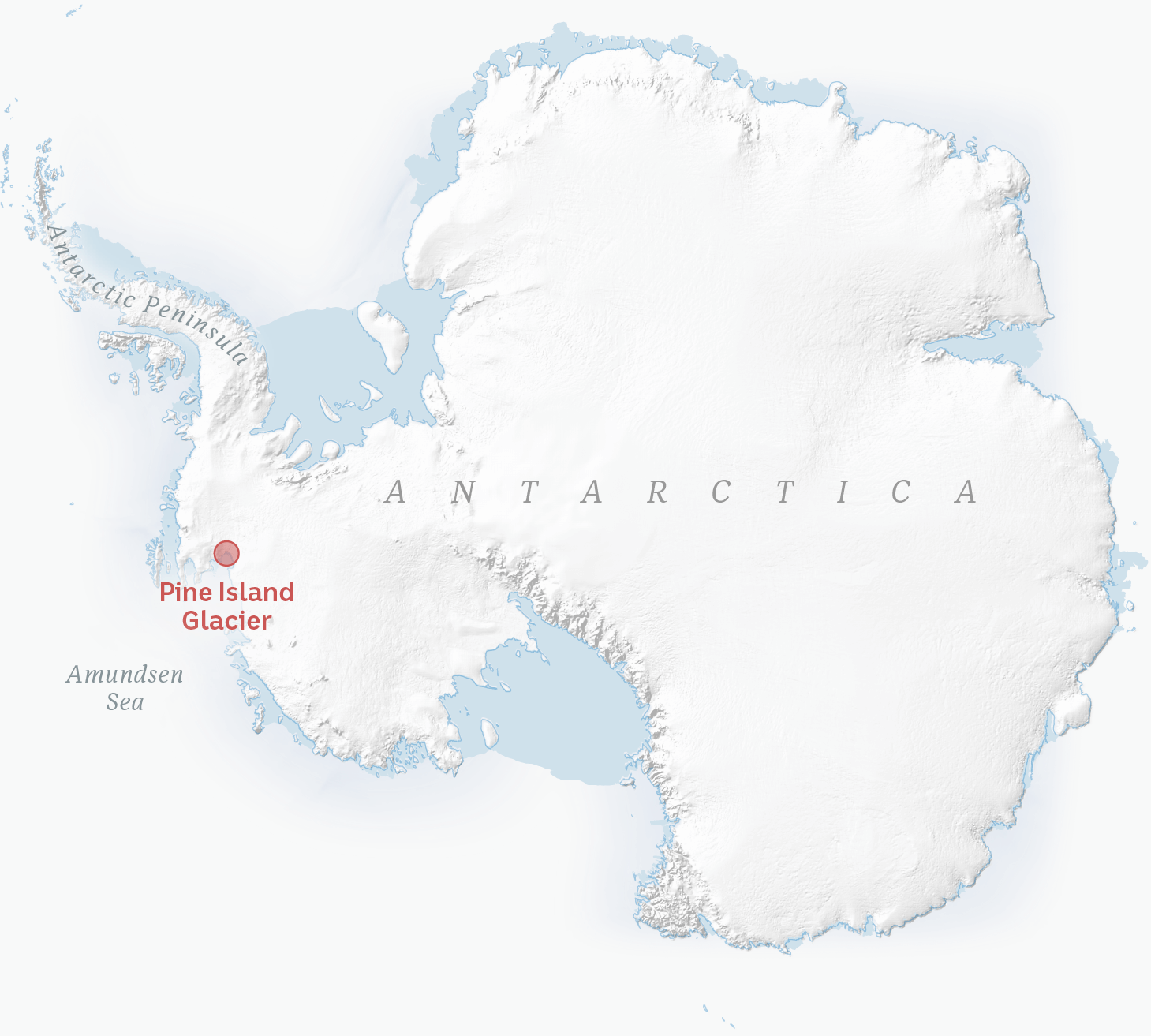
This month, an iceberg measuring more than a hundred square miles—the size of the Mediterranean island of Malta, or twice the size of Washington, D.C.—broke off the Pine Island Glacier (lovingly known as pig, for short) in West Antarctica. It then broke up into smaller “pig-lets,” according to the European Space Agency, which tracked them by satellite. The largest piglet was almost forty square miles.
The frozen continent is divided into West Antarctica and East Antarctica. (The South Pole is in East Antarctica.) Most of the melting and much of the big calving has happened in the West and along its eight hundred-mile peninsula. But, in September, an iceberg measuring more than six hundred square miles—or twenty-seven times the size of Manhattan—calved off the Amery Ice Shelf, in East Antarctica. Calving has accelerated in startling style. Two other huge soon-to-be bergs are being tracked as their crevices and cracks become visible from space. One is from pig in the West, the other is forming off the Brunt Ice Shelf in the East……….
“By 2035, the point of no return could be crossed,” Matthew Burrows, a former director at the National Intelligence Council, wrote in a report last year about global risks over the next fifteen years. That’s the point after which stopping the Earth’s temperature from rising by two degrees Celsius—or 3.6 degrees Fahrenheit—will be extremely difficult, if not impossible, in turn triggering “a dangerous medley of global disasters.”
And that, in turn, goes back to ice and its role in fostering human civilization. “What’s coming—or is happening—is the end of the earth’s stability,” Glendon told me. “In human terms, that means a return to migration, but in a population of not just a few million, but several billion.”
Before I went to Antarctica, I checked in with Donald Perovich, a geophysicist at Dartmouth who tracks sea ice. We got to talking about wars. “You can argue that in all wars, there are winners and losers. Afterward, societies go on. There’s an opportunity to recover and move forward. If you approach climate change as a war, there are some really severe consequences across the board,” he told me. “This,” he added, “is the one war we can’t lose.” https://www.newyorker.com/news/dispatch/antarcticas-ice-the-one-war-that-the-human-species-cant-lose?source=EDT_NYR_EDIT_NEWSLETTER_0_imagenewsletter_Daily_ZZ&utm_campaign=aud-dev&utm_source=nl&utm_brand=tny&utm_mailing=TNY_Daily_022020&utm_medium=email&bxid=5bea00ac3f92a404693b7a69&cndid=46508601&esrc=&mbid=&utm_term=TNY_Daily
Germany is shutting down its coal industry for good, so far without sacking a single worker
 Germany is shutting down its coal industry for good, so far without sacking a single worker, ABC News Foreign Correspondent By Eric Campbell in Germany 17 Feb, 20, “…….. Germany shut down its last black coal mine in 2018.
Miners were offered a new job or an early retirement and a centuries-old way of life came to a sudden end.
But Germany is not looking back. A nation that built its fortunes on coal has decided the fossil fuel’s days are numbered.
As Australia looks to expand coal exp
orts and build new mines, like Adani’s proposed Carmichael project, Europe’s biggest economy is phasing out its entire coal industry for good.
Having already extinguished black coal, Germany is now doing the same to brown coal — a cheaper, dirtier fossil fuel that spews even more carbon emissions.
Berlin has announced a timetable to close not only every remaining brown coal mine but all the carbon-emitting power plants that burn coal to make electricity, by 2038.
In a grand compromise that many Australians might find hard to fathom, trade unions, energy companies, green groups and government have all agreed that the coal industry must go.
And the Government will give tens of billions of dollars to coal regions to create new jobs and industries………
in 2007, the government, coal companies and trade unions struck a historic deal to wind down black coal for good.
“[The government] asked us how much time you need to do that without any problems, not to bring the people off the working market,” Mr Beike said.
Mr Beike said they were given plenty of time — and money — to make the transition.
RAG maintains only a skeleton staff to administer workers’ pensions and contract mine restorations. Mr Beike says only 100 workers are still in need of a job.
One former miner tells Foreign Correspondent he found work as a research scientist; another has been retrained for a job as a trade union secretary.
Government subsidies were used to transform an old RAG coking plant into a World Heritage site, preserved as a piece of history for international tourists. It now has solar panels on the roof.
Black coal may have been shut down for economic reasons but a new move to phase out brown coal is purely environmental.
Renewables currently account for 40 per cent of Germany’s energy generation but there are plans to increase that to 65 per cent by the end of the decade. To meet its Paris targets, the country must do more.
Unlike Australia, where the Federal Government’s response to climate change is being debated after a season of catastrophic fires, there is broad agreement in Germany that coal’s demise is inevitable.
The successful closure of the black coal industry is now providing a blueprint for how to finish the job.
Under what’s known as the Coal Compromise, struck in January 2019, the rest of Germany’s coal industry will soon start retiring their mines and power plants.
Corporations have been given nearly two decades to completely shut down and the Government has promised 40 billion euros ($65 billion) to coal regions to ease the transition…….. https://www.abc.net.au/news/2020-02-18/australia-climate-how-germany-is-closing-down-its-coal-industry/11902884
Global Optimism – The Future We Choose
 Observer 15th Feb 2020, Christiana Figueres is
  a founder of the Global Optimism group and was head of the UN climate change convention when the Paris agreement was achievedin 2015.
Your new book is called The Future We Choose. But isn’t it too
late to stop the climate crisis? We are definitely running late. We have
delayed appallingly for decades. But science tells us we are still in the
nick of time. We can only choose it this decade.
Our parents did not have this choice, because they didn’t have the capital, technologies and understanding. And for our children, it will be too late.
So this is the decade and we are the generation. If we all reduce our emissions,
collectively we give a signal to the market. Obviously, corporations have
their own responsibilities but it’s helpful to have a strong demand from
the public. Once you get governments, corporations and the public moving in
the same direction towards low carbon, it can grow exponentially [such as
with renewable energy and electric cars]. People reducing their emissions
– by flying less, eating less meat and using clean energy, for example
– is important.
The harm caused by the nuclear industry SHOULD make us emotional
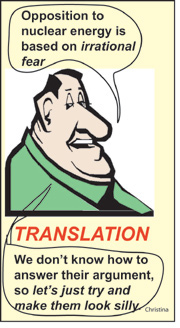 Hysteria isn’t killing nuclear power, But the harm it causes should stir emotions, Beyond Nuclear, By Linda Pentz Gunter, 16 Feb 20 Hysteria isn’t killing nuclear power, But the harm it causes should stir emotions, Beyond Nuclear, By Linda Pentz Gunter, 16 Feb 20
Time was, that a woman suffering from menopause, pre-menstrual syndrome, a heightened libido or lack thereof, was labeled “hysterical.” Her very real medical or psychological troubles were put down to an “emotional reaction.” For a while these symptoms were even attributed to a “wandering womb.” What? Yes, really. For years, if you were a woman who opposed nuclear power, you were likely subjected to exactly the same treatment (although luckily not the one for the “wandering womb,” which I won’t go into here). How many of us were told, usually by men, that we were simply far too “emotional”? (Implication? We just didn’t understand the actual “science”.) But as the long-term survival of nuclear power became ever more unlikely, the pro-nuclear forces ramped up their rhetoric to sweep everyone into the “hysteria” basket. That’s where you belonged if you dared to claim that nuclear power is too dangerous a technology to continue. A hysteric. A fear-mongerer. And, these days, a purveyor of “fake news.” You’ll find it everywhere. ……. Those illustrious scientists Penn & Teller called their takedown show on Helen Caldicott — who has certainly borne the brunt of the “too emotional” slur in our movement — “Penn & Teller vs Dr. Helen Caldicott, Candles & Anti-Nuclear Fearmongering.” …… And here’s what well known columnist, Fareed Zacharia, just wrote in a February 14 column in the Washington Post that appeared to have been cribbed from the cliff notes of any number of pro-nuclear front groups: “Fears about nuclear power, which Sanders clearly shares, are largely based on emotional reactions to the few high-profile accidents that have taken place over the past few decades.” But it’s not fear that has done in nuclear power. It’s the very real risks — along with its exorbitant cost. It’s the fact that it can poison people, animals, air, land and water for millennia. It’s the fact that, despite their ivory tower pontificating, people like Zacharia have never met the mothers of children suffering as a result of the Fukushima disaster or even, still, Chernobyl. Those children may be immaterial statistics to lofty columnists and bloggers, but they aren’t immaterial to those mothers. And it’s not fear that drives politicians like Bernie Sanders to oppose nuclear power. It’s that the subsidies we would squander, and the time we would waste on propping it up, costs us time we don’t have, and money we sorely need to fix climate change fast. So, yes, Mr. Zacharia, I have an “emotional reaction” when I see small children who should be carefree and playing outside, confined indoors, or worse, coming down with thyroid cancer they would never have suffered without Fukushima. I have an “emotional reaction” when I see the sad faces of mentally and physically disabled children dumped into Belarusian orphanages, children harmed by the 1986 Chernobyl nuclear disaster, which happened long before they were born. I even have an “emotional reaction” when I see the photos and videos of dead or dying cows abandoned in Fukushima, their bellowing cries echoing around cowsheds already strewn with the corpses of their herdmates. And yes, I have an “emotional reaction” even when there isn’t an accident. I am disturbed at the alarming increase in leukemias among children living close to nuclear power plants. I get emotional hearing the stories of Navajo uranium miners and their families, who must battle radiation exposure-induced diseases along with deprivation and discrimination. I am disturbed, emotionally, at the toll taken on endangered sea turtles, captured and killed at operating nuclear plants. And I get upset when I see that, once again, the only plans for dealing with radioactive waste are to dump it on poor communities of color…… The American Psychiatric Association dropped the term hysteria in 1952. The pro-nuclear lobby should stop using it to dismiss the very real, medical harms of nuclear power, which most often impact communities the least resourced to fight back. If you don’t have an “emotional reaction” when confronted with the tragedies wrought by nuclear power, then you are the one who needs a doctor. https://wordpress.com/read/feeds/72759838/posts/2591560323 |
|
100% renewables by 2050: a technology, market, system, business model toolset for your nation
 100% renewables by 2050: a technology, market, system, business model
toolset for your nation.
Energy Post 10th Feb 2020, A growing number of countries are announcing
increasingly ambitious renewable energy targets. But how do you deliver the
results? IRENA’s Elena Ocenic explains that they have developed a toolset
for countries to plot their unique pathway to success.
Those tools range widely across technology, market design and regulation, system operation practices, and business models. The article lists the tools, and runs through some notable successes.
Ocenic emphasises that, today, there is enough evidence to show that 80-100% renewables within decades is a realistic goal for many countries. She looks at the tailored solution they have created for Sweden, in collaboration with the Swedish Energy Agency, to achieve 100% renewable power by 2040.
An important observation is that technology alone is never enough: the right policy frameworks must be put in place too. And one of the biggest challenges is how to maximise renewables beyond the power sector and in to the industrial, transport and buildings sectors while making use of all the innovations now coming to the fore.
Due 28 February 2020- Submissions to the Victorian Parliamentary Inquiry into Nuclear Prohibition
 Submission to the Victorian Parliamentary Inquiry into Nuclear Prohibition Due 28 February 2020

Nuclear power is a dangerous distraction from real movement on the pressing energy decisions and climate actions we need. Rather than fuel carbon emissions and radioactive risk through domestic coal power plants and the export of coal and uranium, Australia should embrace the fastest growing global energy sector ‒ renewables ‒ and become a driver of clean energy thinking and technology. For more information, see our report: Nuclear Power – No Solution to Climate Change. The easiest (and quickest) way to make a submission is to use the proforma here. You can adapt it as you like. Or email to nuclearprohibition@parliament.vic.gov.au Or send a hardcopy to: The Committee Manager | Standing Committee on Environment and Planning | Parliament House, Spring Street EAST MELBOURNE VIC 3002 | All submissions should include; your full name, contact details (either a postal address or phone number), the text of your submission or an attachment containing your submission and a clear indication if you are seeking confidentiality. The submission closing date is Friday 28 February 2020.
1 This month

of the week – Australians for War Powers Reform (AWPR)
To see nuclear-related stories in greater depth and intensity
 Antinuclear