5.2-magnitude earthquake near Fukushima
|
Japan is rattled by 5.2-magnitude earthquake near Fukushima, Daily Mail UK
By TIM STICKINGS , 12 February 2020 Japan was rattled by a 5.2-magnitude earthquake off the coast of Fukushima province today. The quake struck just over 50 miles from the city of Fukushima where the nuclear disaster occurred in 2011. Witnesses said they had felt a 10-second long shake during the tremor at around 7.30pm local time. No tsunami warning has been put in place by Japan’s meteorological agency. The US Geological Survey said today’s earthquake had struck at a depth of around 50 miles under the sea. One witness told earthquake monitoring service EMSC that the quake produced a ‘weak but long shake’ lasting about 10 seconds. Another said their heater had moved around on its four wheels while making a sound. Officials in Fukushima prefecture warned residents that there could be aftershocks and directed them to official public safety advice. Energy company TEPCO, which runs four nuclear power plants in the prefecture, said it was awaiting further information about the earthquake’s impact. …..https://www.dailymail.co.uk/news/article-7995301/Japan-rattled-5-2-magnitude-earthquake-near-Fukushima.html |
|
Despite historically low uranium prices, nuclear power cannot compete
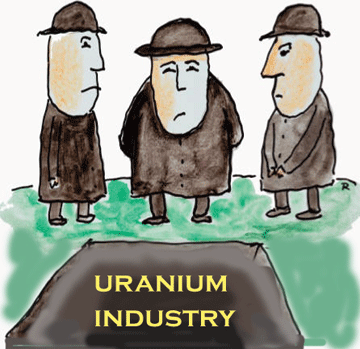 Uranium Week: The Nuclear Conundrum https://www.fnarena.com/index.php/2020/02/11/uranium-week-the-nuclear-conundrum/ Uranium Week: The Nuclear Conundrum https://www.fnarena.com/index.php/2020/02/11/uranium-week-the-nuclear-conundrum/
By Greg Peel, Lack of demand continues to drag on uranium prices despite ongoing production curtailments, yet nuclear energy remains a matter of cost. -Uranium spot prices drift lower he world’s largest mining investment conference, now in its 26th year, began in Cape Town last week. Given the tenuous state of South Africa’s energy supply, the focus this year of the “Investing in African Mining Indaba” is on a transition from coal toward renewable and clean energy resources to deal with power shortages across the African continent. (Indaba means meeting.) The five-day conference brought together representatives from 94 countries and regions, including more than 38 ministers, under the theme “Optimizing Growth and Investment in the Digitized Mining Economy.” The CEO of the Minerals Council South Africa said at the conference the Council fully supports a transition from coal to non-fossil fuel forms of power generation such as wind and solar power and, where cost is not prohibitive, nuclear power. “Where cost is not prohibitive” underscores the dilemma facing the global nuclear power and uranium mining industries at present. The US experience is one of US uranium miners being unable to compete with cheaper imports from the likes of Canada and Kazakhstan, with uranium prices near historically low levels. Yet the US nuclear power industry cannot compete with gas-fired and renewable power, despite historically low uranium prices.
|
|
Correcting Anti-Renewable Energy Propaganda
Correcting Anti-Renewable Energy Propaganda, Clean Technica B1 By Georg Nitsche, 12 Feb 20, In 1989, pro-nuclear lobbyists claimed that wind power couldn’t even provide 1% of Germany’s electricity. A few years later, pro-nuclear lobbyists ran ads in German newspapers, claiming that renewables wouldn’t be able to meet 4% of German electricity demand. After the renewable energy revolution took off, in 2015, the pro-nuclear power “Breakthrough Institute” published an article claiming solar would be limited to 10–20% and wind to 25–35% of a power system’s electricity. In 2017, German (pro-nuclear power) economist Hans-Werner Sinn tweeted that more than 50% wind and solar would hardly be possible. And in 2018, Carnegie Science reported a study claiming that “wind and solar could meet most but not all U.S. electricity needs.” According to one of the authors, their research indicates that “huge amounts of storage” or natural gas would need to supplement solar and wind power. From a pro-renewable perspective, this is encouraging. The claims about the limits of renewable energy have moved from “not even 1% of electricity” to “most but not all of the electricity.” And yet, the anti-renewables message has always been the same: renewables will lead to a dead end. In order to underscore their point, anti-renewable energy propagandists now publish incorrect cost figures that claim a fully renewable electric grid would be unaffordable or way more expensive than other options, such as, you guessed it, nuclear power. Continue reading |
|||||||||

Australia’s global opportunity to lead on solar power
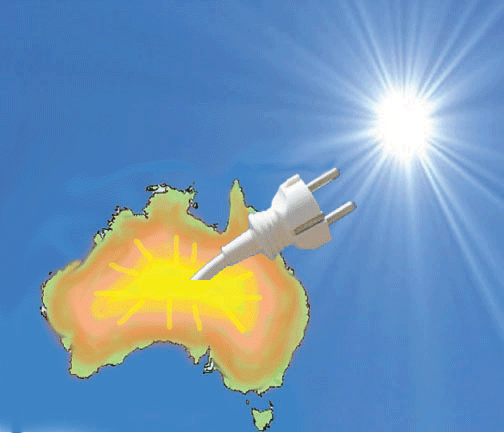 Australia should be leading the way on solar power https://www.crikey.com.au/2020/02/12/daily-fix-solar-power/ We have sunshine falling on vast areas of land that are too hot and dry to be productive in other ways, and we have the scientists and engineers to develop and apply the best available technology.
|
FEB 12, 2020 Australia should become a world leader in solar electricity generation, both on rooftops and on a larger scale. We have sunshine falling on vast areas of land that are too hot and dry to be productive in other ways, and we have the scientists and engineers to develop and apply the best available technology for electricity generation and storage. The federal government needs to facilitate the shift from fossil fuels to solar for most of our electricity generation, and we could become an exporter to Singapore. Once we have abundant clean and cheap electricity, we can shift to electric cars. That will leave meat and dairy as our major source of greenhouse gas emissions. It will be more difficult, politically, for the government to do something about that — but the way people are switching to plant-based foods means that it may happen anyway. Peter Singer is the Ira W. DeCamp Professor of Bioethics at Princeton University. |
|
|
Coronavirus likely to be connected to climate change – bats the likely first vector
The Wuhan Coronavirus, Climate Change, and Future Epidemics…...TIME, 10 Feb 2020,
Nuclear power – the industry in its terminal agonies
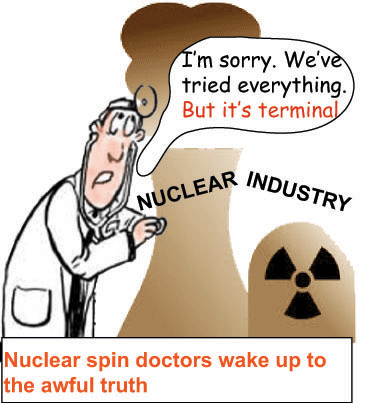
| Nuclear power went backwards in 2019, and the outlook is bleak
Jim Green, RenewEconomy, 11 Feb 2020 https://reneweconomy.com.au/nuclear-power-went-backwards-in-2019-and-the-outlook-is-bleak-61834/ Nuclear power went backwards last year with the permanent shutdown of nine power reactors and the startup (grid connection) of six. Startups were concentrated in Russia (three) and China (two), with one in South Korea. The shutdowns were spread across eight countries. Worse still for the industry – much worse – is the paucity of reactor construction starts. There were just three construction starts in 2019: one each in China and Russia, and Bushehr-2 in Iran which faces an uncertain future. No countries entered the nuclear power club in 2019 (construction starts or grid connections). The average age of the global reactor fleet passed 30 years in 2019. That’s an old fleet, increasingly prone to accidents, large and small; increasingly prone to extended outages and thus increasingly uncompetitive in electricity markets. As a result of the ageing of the reactor fleet, the International Atomic Energy Agency (IAEA) anticipates the closure of up to 139 GW from 2018‒2030 – more than one-third of current global capacity of 395 GW (including idle reactors in Japan). Based on IAEA figures, the industry will need about 10 new reactors (10 GW) each year just to match shutdowns. The industry did indeed average nearly 10 construction starts from 2008‒13. But the number has sharply declined in the aftermath of the Fukushima disaster and catastrophic cost overruns. There were more construction starts in 2010 (16) than in 2016‒19 combined (15). This table captures the birth, mid-life crisis (Fukushima) and death of the nuclear power mini-renaissance:
Diana Ürge-Vorsatz, Vice-Chair of an Intergovernmental Panel on Climate Change Working Group, notes in the foreword to the World Nuclear Industry Status Report 2019: “Trend indicators in the report suggest that the nuclear industry may have reached its historic maxima: nuclear power generation peaked in 2006, the number of reactors in operation in 2002, the share of nuclear power in the electricity mix in 1996, the number of reactors under construction in 1979, construction starts in 1976. As of mid-2019, there is one unit less in operation than in 1989.” The number of power reactors under construction has been falling slowly but steadily in recent years, from 68 in 2013 to 46 as of Jan. 2020 (52 according to the IAEA). The Era of Nuclear Decommissioning Currently, nuclear power reflects two contradictory dynamics. The earlier mini-renaissance is evident but will subside by the mid-2020s. The Era of Nuclear Decommissioning is in its infancy (with nine reactor closures, historians may mark 2019 as the beginning of this qualitatively new era) and will be in ever-sharper focus by the mid-2020s. The Era of Nuclear Decommissioning will be characterised by a decline in the number of operating reactors; an increasingly unreliable and accident-prone reactor fleet as aging sets in; countless battles over lifespan extensions for aging reactors; an internationalisation of anti-nuclear opposition as neighbouring countries object to the continued operation of aging reactors; and escalating battles over and problems with decommissioning and waste disposal. Until such time as the rot sets in, the nuclear industry can console itself with these 10-year figures indicating a marginal increase or decrease depending on whether reactors in long-term outage (most of them in Japan) are included or excluded. Including reactors in long-term outage is “misleading” and “clearly ridiculous” according to former World Nuclear Association executive Steve Kidd, because many of them may never operate again.
Pro-nuclear spin So how are the nuclear industry and its supporters responding to the industry’s miserable state? Mostly with denial and delusion. Here are the ‘top 6 nuclear power achievements‘ of 2019 according to the executive editor of POWER magazine. 1. World’s first EPR nuclear power plant enters commercial operation with the Sept. 2019 commencement of commercial operation of the second of two EPR reactors in Taishan, China. The original 2013/14 startup dates for Taishan 1 and 2 were missed by five years due to construction problems and safety concerns (including the extraordinary Creusot Forge scandal in France). Excavation work for the Taishan reactors began in 2008 and construction of the two reactors formally began in 2009 and 2010. China General Nuclear Power Corporation acknowledged a cost increase of 40 percent for the two Taishan reactors to US$11 billion. As a result of delays and cost overruns, the market for EPRs in China has all but evaporated. The EPR reactor under construction at Flamanville, France, is 10 years behind schedule: construction began in Dec. 2007, the planned startup date was 2012, and EDF now says that commercial operation cannot be expected before the end of 2022. The current cost estimate of €12.4 billion (US$13.7 billion) is 3.8 times greater than the original estimate of €3.3 billion (US$3.6 billion). The EPR reactor under construction at Olkiluoto, Finland, is 10 years behind schedule: construction began in April 2005, startup was anticipated in 2010, and startup is now scheduled in 2020. The current cost estimate of about €11 billion (US$12.2 billion) is 3.7 times greater than the original €3 billion (US$3.3 billion) price tag. The estimated combined cost of the two EPR reactors under construction at Hinkley Point, UK, including finance costs, is £26.7 billion (US$35.0 billion) (the EU’s 2014 estimate of £24.5 billion plus a £2.2 billion increase announced in July 2017). A decade ago, the estimated construction cost for one EPR reactor in the UK was almost seven times lower at £2 billion. The UK National Audit Office estimates that taxpayer subsidies for Hinkley Point will amount to £30 billion (US$39.4 billion), while other credible estimates put the figure as high as £50 billion (US$65.6 billion). Undeterred, POWER magazine claims that a 6-unit EPR project in India will be the world’s largest nuclear power plant “if completed as planned”. It would be a miracle if the project is completed as planned; indeed it would be a minor miracle if it even begins given funding constraints. 2. World’s first ACPR-1000 nuclear power plant begins commercial operation in China Grid connections of ACPR-1000 reactors in China in 2018 and 2019 mark a significant achievement. But the broader picture is highly uncertain. There has only been one reactor construction start in China in the past three years. The number of reactors under construction has fallen sharply from 20 in 2017 to 10 currently. No-one knows whether or not the Chinese nuclear program will regain momentum. Wind and solar combined generated nearly double the amount of electricity as nuclear in 2018. 3. Akademik Lomonosov connects to grid Estimated construction costs for Russia’s floating nuclear power plant (with two 32-MW ice-breaker-type reactors) increased more than four-fold and eventually amounted to well over US$10 million / megawatt (US$740 million / 64 MW). A 2016 OECD Nuclear Energy Agency report said that electricity produced by the plant is expected to cost about US$200 / MWh, with the high cost due to large staffing requirements, high fuel costs, and resources required to maintain the barge and coastal infrastructure. The primary purpose of Russia’s floating nuclear power plant is to help exploit fossil fuel reserves in the Arctic – fossil fuel reserves that are more accessible because of climate change. That isn’t anything to celebrate; it is disturbing and dystopian. 4. Vogtle nuclear expansion progresses Construction of the twin-AP1000 project in the US state of Georgia began in 2013 and the planned startup dates were April 2016 and April 2017. The project is 5.5 years behind schedule and it is unlikely that the revised completion dates of Nov. 2021 and Nov. 2022 will be met. In 2006, Westinghouse claimed it could build one AP1000 reactor for as little as US$1.4 billion. The current cost estimate for the two Vogtle reactors – US$27‒30+ billion – is 10 times higher. The Vogtle project only survives because of mind-boggling, multi-billion dollar taxpayer subsidies including US$12+ billion in loan guarantees, tax credits and much else besides. Westinghouse declared bankruptcy in 2017, largely as a result of its failed AP1000 projects in South Carolina (abandoned after the expenditure of at least US$9 billion) and Georgia, and Westinghouse’s parent company Toshiba was almost forced into bankruptcy and survives as a shadow of its former self. 5. NRC approves Clinch River nuclear site for small modular reactors (SMRs) 6. NuScale’s SMR design clears Phase 4 of NRC review process But who will pay for SMRs? Industry won’t budge without massive taxpayer subsidies. A 2018 US Department of Energy report states that to make a “meaningful” impact, about US$10 billion of government subsidies would be needed to deploy 6 gigawatts of SMR capacity by 2035. And the pro-nuclear authors of a 2018 article in the Proceedings of the National Academy of Science argue that for SMRs to make a significant contribution to US energy supply, “several hundred billion dollars of direct and indirect subsidies would be needed to support their development and deployment over the next several decades”. The prospects for SMRs are just as bleak in other countries. And as the AEMO/CSIRO GenCost 2019-20 report notes, SMRs in Australia would be 2-4 times more expensive per kW than wind and solar. Dr. Jim Green is the national nuclear campaigner with Friends of the Earth Australia and editor of the Nuclear Monitor newsletter. |
Some climate models now predict unexpected , unprecedented spike in global temperatures
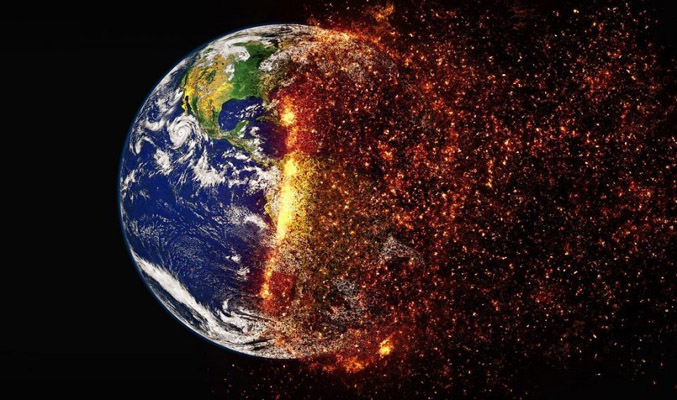
A few climate models are now predicting an unprecedented and alarming spike in temperatures — perhaps as much as 5 degrees Celsius, Business Insider, CONNOR PERRETT FEB 9, 2020
- A handful of climate projections are predicting much higher rise in global temperatures than scientists have seen in the models before.
- While there’s concern over the number, some scientists hope the latest projections are outliers.
- A 2-degree rise in temperature could lead sea level to jump, coral reefs to die, and water to become dangerously scarce in some parts of the world. Some models right now predict a 5-degree rise.
The startling anomaly first appeared in models from the National Centre for Atmospheric Research (NCAR), which suggested that if Earth’s atmospheric carbon-dioxide concentration doubles (as it’s expected to do by the end of the century), the planet could wind up 5.3 degrees hotter. That’s 33% higher than the group’s previous estimate.
Scientists hope the models are an “overshot,” Bloomberg reported. It will take scientists a significant amount time – at least months – to figure out how to interpret the results.
The climate models estimate “climate sensitivity,” which tells scientists how much warmer the planet will get as a result of rising CO₂ concentrations. For four decades, the expected temperature rise if CO2 levels double has been about 3 degrees.
These models have a proven track record of accurately forecasting climate change. A recent study from the American Geophysical Union found that climate projections over the past five decades have largely been accurate – actual climate observations aligned with the models’ predictions.
UK Campaigners demand a ‘no new nuclear’ clause in climate emergency planning
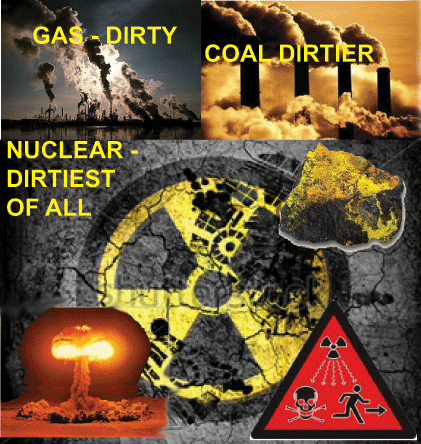
The nuclear and fossil fuel industry are mutually intertwined.
“There is no such thing as a zero or near-zero-emission nuclear power plant”
the mean value is about 66 grams of carbon dioxide for every kWh produced by nuclear power. This compares to about 9g for wind, 32g for solar and 443 for gas.
“This puts nuclear as the third highest carbon emitter after coal-fired plants and natural gas….
|
No new nuclear https://theecologist.org/2020/feb/06/no-new-nuclear
Radiation Free Lakeland, 6th February 2020
Campaigners demand a ‘no new nuclear’ clause in climate emergency planning. Climate activists across the world are uniting to protect the planet from continuing fossil fuel use. There is much talk of a green industrial revolution and a Green New Deal. This sounds good, but what does it mean?
Kevin Frea, co-chair of the Climate Emergency Network and deputy leader of Lancaster City Council has worked hard to sign local councils up declaring a climate emergency. He said: “This movement is being led by every political group and is involving local people in planning the actions needed to cut carbon.” But there’s an important thing missing here. Last September members of Radiation Free Lakeland lobbied Lancaster City Council asking the council to include a No New Nuclear clause in their climate emergency planning. Continue reading |
Arctic ice melt is changing ocean currents
|
Arctic ice melt is changing ocean currents https://www.sciencedaily.com/releases/2020/02/200207095705.htm
|
South Australian Premier Steven Marshall visiting Eyre Peninsula, keeping a very low profile on nuclear wastes
Record-high temperature of 18.3C recorded in Antarctica
|
Record-high temperature of 18.3C recorded in Antarctica, https://www.sbs.com.au/news/record-high-temperature-of-18-3c-recorded-in-antarctica An Antarctic research station has provisionally recorded the continent’s hottest temperature of 18.3C, beating the previous record by 0.8C.
The continent of Antarctica has experienced its hottest temperature on record, with a research station provisionally recording 18.3C. The reading beats the previous record on the Earth’s southernmost continent of 17.5C in March 2015 by 0.8C, according to the Argentine station Esperanza, which collected the data. The tweet reporting the news from Argentina’s meteorological association was shared by the United Nations’ World Meteorological Organisation (WMO). The Antarctic Peninsula, the northwest tip near South America, is among the fastest-warming regions on earth, with temperatures rising almost 3C during the past 50 years, the WMO said. About 87 per cent of the glaciers along its west coast have “retreated” during those decades and had shown an “accelerated retreat” in the past 12 years, it said. Professor James Renwick, a climate scientist at Victoria University of Wellington, told the Guardian Australia the WMO committee would likely reconvene to ratify the record. “The reading is impressive as it’s only five years since the previous record was set and this is almost one-degree centigrade higher. It’s a sign of the warming that has been happening there that’s much faster than the global average,” he said. “To have a new record set that quickly is surprising but who knows how long that will last? Possibly not that long at all.” Esperanza, near the northern tip of the Peninsula, has been collecting data since 1961. he reading breaks the 2015 record for the Antarctic continent, defined as the main continental landmass and adjoining islands by the WMO. The record for the Antarctic region – defined as all land and ice south of 60 degrees latitude – is 19.8C recorded on Signy Island in January 1982, the WMO said. |
|
|
New nuclear debate driven by spill fallout
New nuclear debate driven by spill fallout Courier Mail 7 Feb 20, A Queensland MP who has rocketed into a Cabinet position has already caused a stir, with his views on nuclear power set to put the controversial topic back on the agenda…. (subscribers only)
Combined environmental crises could trigger ‘global systemic collapse’, scientists warn
Apocalypse now: Combined impacts of rising temperatures, dwindling food supplies and biodiversity loss could trigger ‘global systemic collapse’, scientists warn https://www.dailymail.co.uk/sciencetech/article-7975245/Multiple-overlapping-environmental-crises-trigger-global-systemic-collapse.html
- Report that surveyed 200 scientists warns of effect of environmental crises
- Future Earth says five global risks are connected and can amplify each other
- Climate change, extreme weather, biodiversity and food and water sources are a ‘monumental challenge’ to humanity in the 21st century, the report warns
By JONATHAN CHADWICK FOR MAILONLINE, 7 February 2020
|
Overlapping environmental crises could tip the planet into a ‘global systemic collapse’, more than 200 global scientists have warned. Climate change, biodiversity loss, dwindling sources of fresh water and food, and extreme weather events from hurricanes to heatwaves will provide a monumental challenge to humanity in the 21st century. Out of 30 global-scale risks, these five topped the list both in terms of likelihood and impact, according to scientists surveyed by Future Earth, an international research organisation. The report, published on Thursday, called on the world’s academics, business leaders and policymakers to ‘pay urgent attention’ to the five risks and consider them as interlinked. Continue reading |
Arctic permafrost thaw plays greater role in climate change than previously estimated
|
UNIVERSITY OF COLORADO AT BOULDER ABRUPT THAWING OF PERMAFROST WILL DOUBLE PREVIOUS ESTIMATES OF POTENTIAL CARBON EMISSIONS FROM PERMAFROST THAW IN THE ARCTIC, AND IS ALREADY RAPIDLY CHANGING THE LANDSCAPE AND ECOLOGY OF THE CIRCUMPOLAR NORTH, A NEW CU BOULDER-LED STUDY FINDS. Continue reading |

Weathercasters Are Talking About Climate Change—and How We Can Solve It
 Weathercasters Are Talking About Climate Change—and How We Can Solve It https://www.motherjones.com/environment/2020/02/weathercasters-are-talking-about-climate-change-and-how-we-can-solve-it/
In recent years there’s been a seismic shift on climate change within the weather reporting community. MADDIE STONE THIS piece was originally published in Grist and appears here as part of our Climate Desk PARTNERSHIP.
For many years, as the science of human-caused climate change grew ever clearer, TV meteorologists avoided discussing the topic on air. Today, many weathercasters bring up climate change regularly. By embracing the science and presenting it in a simple, locally-relevant manner, TV meteorologists have managed to become some of the most effective and trustworthy climate change educators in the country.
Now some meteorologists are taking the conversation a step further and talking not just about the science of climate change, but how we can solve it.
At the 100th annual meeting of the American Meteorological Society (AMS) in Boston earlier this month, a panel of broadcast meteorologists, climate communicators, and policy experts assembled to discuss how solutions to the climate crisis can be woven into TV weather reporting. While wading into politics on the air can carry career risks for many meteorologists, weathercasters are also uniquely positioned to educate the public about climate solutions in a nonpartisan way, whether that’s by delivering locally tailored forecasts of renewable power production or discussing climate resilience strategies in the wake of a major storm.
“Broadcasters have an unusually good platform from which to engage,” said Ed Maibach, the director of the Center for Climate Change Communication at George Mason University, during the panel. “You not only have the access but consistency of relationships with an audience.”
In recent years there’s been a seismic shift on climate change within the weather reporting community. In a 2011 survey of AMS members and the National Weather Association, less than 20 percent felt sure humans are the primary driver of global warming, a statistic that Maibach attributes, in part, to an “aggressive misinformation campaign by the Heartland Institute,” a climate change–denying think tank. But by 2017 that figure had jumped to 80 percent. That’s thanks largely to the efforts of the educators who organized Climate Matters, a climate reporting resource developed by the nonprofit Climate Central, the AMS, and various governmental and academic partners.
1 This month

of the week – Australians for War Powers Reform (AWPR)
To see nuclear-related stories in greater depth and intensity
 Antinuclear