How the ocean is gnawing away at glaciers,

|
How the ocean is gnawing away at glaciers, https://www.sciencedaily.com/releases/2020/02/200203114350.htm
|
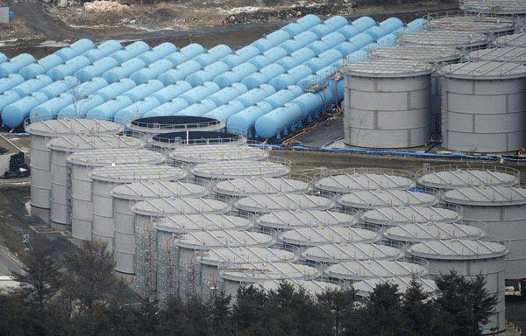
‘An Appalling Act of Industrial Vandalism’: Japanese Officials Do PR for Plan to Dump Fukushima Water Into Ocean
|
|
‘An Appalling Act of Industrial Vandalism’: Japanese Officials Do PR for Plan to Dump Fukushima Water Into Ocean https://www.commondreams.org/news/2020/02/03/appalling-act-industrial-vandalism-japanese-officials-do-pr-plan-dump-fukushima The Japanese government told embassy officials from nearly two dozen countries that releasing the water into the ocean was a “feasible” approach that could be done “with certainty.”
According to Kyodo News, officials from the Ministry of Economy, Trade, and Industry claimed releasing the water and evaporating it are both “feasible methods” but said the former could be done “with certainty” because radiation levels could be monitored. There’s more than one million tons of contaminated water already stored at the plant, with 170 tons more added each day. Utility TEPCO says there will be no more capacity for tanks holding contaminated water by 2022. As Agence France-Presse reported, “The radioactive water comes from several different sources—including water used for cooling at the plant, and groundwater and rain that seeps into the plant daily—and is put through an extensive filtration process.” That process still leaves tritium in the water and “has been found to leave small amounts of other radioactive materials,” Kyodo added. The session for embassy officials followed Friday’s recommendation by a Japanese government panel that releasing the water into the ocean was the most feasible plan. As Reuters reported Friday:
Local fishermen oppose the plan and Reuters noted it is “likely to alarm neighboring countries.” They’re not alone. Nuclear policy expert Paul Dorfman said Saturday, “Releasing Fukushima radioactive water into ocean is an appalling act of industrial vandalism.” Greenpeace opposes the plan as well. Shaun Burnie, a senior nuclear specialist the group’s German office, has previously called on Japanese authorities to “commit to the only environmentally acceptable option for managing this water crisis, which is long-term storage and processing to remove radioactivity, including tritium. |
|
Behind the mask of “medical necessity” the nuclear lobby prepares the way for its birth-to-grave nuclear cycle dream
 Dennis Matthews, 3 Feb 2020 It is obvious to me that the nuclear industry’s nuclear dump campaign is based on connecting the dump with nuclear medicine, just look at the last 2 issues of The Advertiser (1st and 3rd Feb).
Once the public accepts that we need to have a centralized dump for the dangerous but necessary nuclear waste from hospitals then the rest is easy – throw money, promise of jobs, etc, etc and it’s all over bar the shouting.
By volume, most of the waste will be from hospitals, universities, mining companies. However, from the point of view of radioactivity and hence hazard, by far the most dangerous and difficult to manage material is from the nuclear reactor at Lucas Heights in NSW. This material will remain highly dangerous for our children, grandchildren, great grandchildren, and so on for many more generations.
Moving long-lived radioactive nuclear waste from a place (Lucas Heights in NSW), where it is already stored and which has more nuclear scientists than the rest of Australia put together, to a remote place like Kimba is not scientifically, environmentally or morally defensible.
The initial dump is highly likely to be the thin edge of the wedge. When people get tired of complaining the nuclear industry can slowly and quietly up the ante.
Indigenous community votes down proposed nuclear waste bunker near Lake Huron,
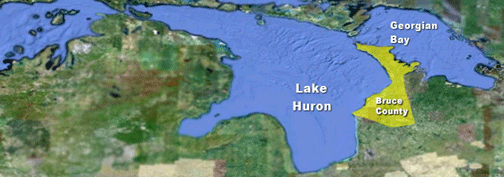 ‘We were not consulted when the nuclear industry was established in our territory’,https://nationalpost.com/news/canada/indigenous-community-votes-down-proposed-nuclear-waste-bunker-near-lake-huron The Canadian Press , Colin Perkel, February 1, 2020
TORONTO — An Indigenous community has overwhelmingly rejected a proposed underground storage facility for nuclear waste near Lake Huron, likely spelling the end for a multibillion-dollar, politically fraught project years in the making.
After a year of consultations and days of voting, the 4,500-member Saugeen Ojibway Nation announced late Friday that 85 per cent of those casting ballots had said no to accepting a deep geologic repository at the Bruce nuclear power plant near Kincardine, Ont.
“We were not consulted when the nuclear industry was established in our territory,” SON said in a statement. “Over the past 40 years, nuclear power generation in Anishnaabekiing has had many impacts on our communities, and our land and waters.” Continue reading
Europe to be the first carbon neutral continent, and WITH NUCLEAR POWER EXCLUDED
 Renew Extra 1st Feb 2020, Dave Elliott: With Climate Change at the top of the agenda, the EU aims to be the first carbon neutral continent, working towards net zero greenhouse gas emissions by 2050, with a new climate law being enacted soon. That’s taken some fighting for and fiddling, given the opposition from heavy coal users like Poland, but there’s a proposed Just Transition mechanism to help countries like that move to carbon neutrality, with nuclear excluded from support for this.
So renewables should boom even more. Renewables have
certainly been doing well. Germany will soon get around half of its power
from renewables, Portugal is already at over 54%, Denmark near 60%, while
Sweden is at 66% and Austria over 70%. By 2030 some of these countries
could be getting near 100% of their electricity from renewables and should
also be beginning to meet significant shares of their heat and transport
needs using renewables. Sweden already gets around 54% of all its energy
from renewables, Norway and Iceland are both at around 70%.
https://renewextraweekly.blogspot.com/2020/02/there-have-been-divergent-views-on.html
“Mercenary science”- crooked science funded by corporations
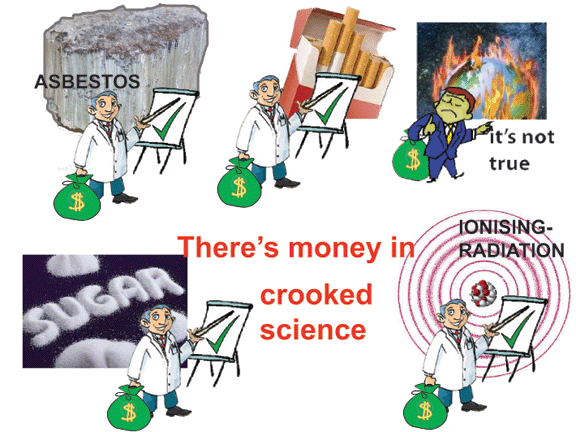 Why is the nuclear industry not mentioned in relation to “mercenary science”?
  Independent Russian scientists gave comprehensive accounts of the effects of the Chernobyl disaster – they were vilified by both Russia and the West . That’s another side of this issue -destroy the credibility of honest scientists.
While the vast majority of scientists, both employed publicly and privately, are honest and do their work as part of a larger quest for truth, there are a few notable exceptions. Specifically, a few mercenary science consulting firms have been very effective at helping corporations continue selling harmful chemicals and drugs long after they should have stopped.
Michaels, who has a new book on the topic titled “The Triumph of Doubt: Dark Money and the Science of Deception,” has been studying this problem for years, in part by virtue of his 8-year tenure at OSHA. Now a public health professor at George Washington University, Michaels’ book pulls back the curtain on the way that dark money and for-profit science is quite literally killing Americans.
David Michaels: Mercenary science means [when scientists] produce studies that aren’t designed to better understand the world, or they help make the world a better place — which is why most scientists are in the business of science – but to defend products and to defend corporations. And often to influence regulation or to slow the compensation of victims.
This is the Enron-ization of science. It’s created a fiction in order to promote an actual game, fiction around science. And it is quite mercenary. In fact, this phrase is not one that I invented, but actually is used by these consulting companies whose business model is to provide some using reports and testimonies to corporations, so they can continue to market dangerous products or activities without being hindered by regulation or by compensating the people they’ve hurt.
What would you say is the most shocking, real-life example of something like this — of mercenary science becoming embedded in mainstream discourse?
I think the most famous [example] is in the tobacco industry… who didn’t invent it, but who certainly gained the most from it — and in climate change. There’s actually some overlap between some of the same mercenary scientists in both examples.
But as I write [in my book], this is now become standard operating procedure for virtually every industry, and in many cases, it’s the same so-called scientists who are involved in doing it. Nowadays, the instinct of corporate leaders — CEOs and executives —when there’s an allegation that their product could be causing harm is to say, “How can we show that it isn’t causing harm?” Not, “how can we determine whether or not we cause harm,” and then figure out what to do about it.
Other examples [include] opioids, and essentially how a few pharmaceutical companies misrepresented the studies to make it look like these opioids were not addictive. We have a death toll of tens of thousands a year as a result of that…………
David Michael’s new book, “The Triumph of Doubt: Dark Money and the Science of Deception,” is out from Oxford University Press on February 3, 2020. https://www.salon.com/2020/02/02/the-art-of-scientific-deception-how-corporations-use-mercenary-science-to-evade-regulation/
Katherine Hayhoe on A BETTER WAY TO TALK ABOUT THE CLIMATE CRISIS
Don’t start with fear, judgment, condemnation, or guilt. And don’t start with just overwhelming people with facts and figures. Do start by connecting the dots to what is already important to both of us, and then offer positive, beneficial, and practical solutions that we can engage in.
climate change affects the economy, the availability of natural resources, prices, jobs, international competition, and more. Failing to account for climate change in future long-range planning could lose us a competitive edge even in a best-case scenario, and potentially mean the end of a product line or an entire business in the worst case. By connecting climate impacts to what we already care about, we can recognize the importance and urgency of taking action.
|
A BETTER WAY TO TALK ABOUT THE CLIMATE CRISIS GRETCHEN GAVETT, Harvard Business Review, JANUARY 30, 2020 Many of us care about the climate, but it can be challenging to talk about. It’s easy to get bogged down in stats and statistics, for one. And it can be nerve-racking to approach someone if you don’t already know what their beliefs on the topic are. Sometimes, it’s easier to just keep our mouths shut. Given the urgency of the climate crisis, however, many of us feel that silence is no longer an option. And Dr. Katharine Hayhoe, a climate scientist at Texas Tech University, is the person to talk to about how to talk about climate change. Continue reading |
30 years of Australia’s hollow promises on climate policy- podcast
 30 years of Australia’s hollow promises on climate policy, https://www.theguardian.com/australia-news/audio/2020/feb/03/30-years-of-australias-hollow-promises-on-climate-policy This summer, Scott Morrison has faced international criticism over his climate change policies. But this government is just the latest in a long line that have either failed on meaningful climate policy at home, or blocked stronger climate action on the world stage.In this episode of Full Story, Guardian Australia editor Lenore Taylor explores Australia’s long track record of stalling on climate
 |
ReplyForward
|
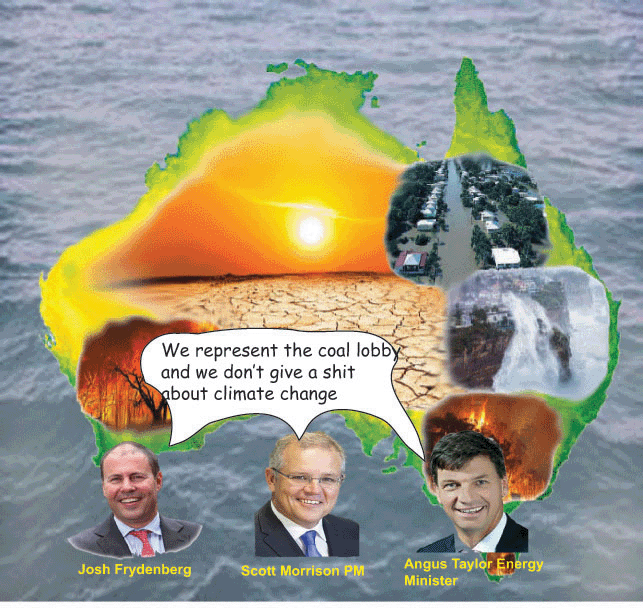
#ScottyFromMarketing is dodging the need for real action on climate change
|
Climate change calls for action, not adaptation, SMH January 31, 2020 Judy Dillon, Garran ACT In the midst of our horrific summer, polls show the majority of people want to see urgent action on climate change, (”PM’s bushfire response must include climate change: experts”, January 30). We don’t want a focus on ”resilience and adaptation” or ”meeting and beating” pathetically low targets with the use of accounting tricks. Emissions are continuing to rise while the Morrison government uses weasel words to pretend they are doing something effective, all while handing billions to the fossil fuel industry.
The House of Representatives is scheduled to sit for a total of 72 days in 2020, so politicians have no time to lose. If they are not prepared to get on with the mammoth task of taking real and significant climate action in the interests of all Australians, and indeed the whole world, then they should get out of the way now so politicians who are so motivated can take their place. Quiet Australians have had enough – we will not be silent. –
– Peter Spencer, Castle Hill The PM is setting up an inquiry that avoids the real cause of of this and future bushfires – climate change. Once again, he gives the impression he is doing something when he is avoiding the real issue. Another opportunity wasted.
Adrian Owen, Killawarra , The PM now reluctantly concedes our continent is warming and drying. By saying the effects of the emissions already in the atmosphere will be felt for decades regardless of any action, he seeks to portray emissions mitigation as a lost cause. He must imagine the public will willingly surrender to warming beyond two degrees. His new focus on resilience and adaptation will lead to the absurd situation in which the coal industry will continue apace while federal government will spend money elsewhere to try to protect the rest of us from the ravages of a warming climate. –
– Mike Reddy, Vincentia After listening to Morrison talk about climate change action, I think his government is focused on hope. Hope that individuals keep putting solar panels up. Hope that the states keep pulling their weight. Hope that the rest of the world reduces its emissions. Hope that no one notices he is doing nothing. Hope that rising sea levels don’t swamp Waikiki.
Graham Lum, North Rocks Barilaro claims that Matt Kean’s comments on climate change are unhelpful and do not represent the whole of government. That may be so, but I suggest they do represent the views of the majority of Australians. -… https://www.smh.com.au/national/nsw/climate-change-calls-for-action-not-adaptation-20200129-p53vwp.html
|
|
Japan planning to release over a million tonnes of radioactive water into sea from Fukushima power plant
|
Japan planning to release over a million tonnes of radioactive water into sea from Fukushima power plant https://www.independent.co.uk/environment/japan-nuclear-waste-fukushima-power-station-tsunami-water-sea-olympics-a9312246.htmlCoolant contains toxic element which cannot be removed, Harry Cockburn 31 Jan 2020, Massive amounts of radioactive water being stored at Japan’s Fukushima power plant could be released into the sea under plans provisionally accepted by the country’s government.
Tokyo Electric has collected nearly 1.2 million tonnes of contaminated water from cooling pipes used to keep fuel cores from melting since the plant was devastated by the earthquake and tsunami which hit eastern Japan in 2011. The water, containing 62 radioactive elements, is stored in huge tanks on the site of the now disabled power plant, but Tokyo Electric has said it will run out of room to store the water by 2022. Continue reading |
Meet the scientists quitting academia for climate activism
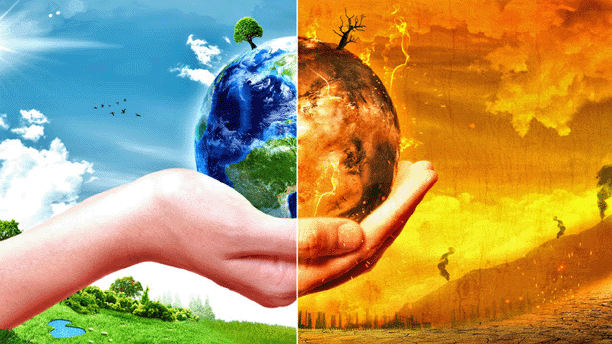 Meet the scientists quitting academia for climate activism, https://www.dw.com/en/meet-the-scientists-quitting-academia-for-climate-activism/a-51452337
Emotional stress, burnout, and a sense of frustration at policy makers are driving some academics to take a different path in tackling climate change. DW spoke to three people to find out why they became activists.
Most people have the option to switch off from the terrifying media stories of how climate change is affecting the planet. This isn’t so easy for environmental scientists and academics who spend their days researching the consequences of climate change.
In a letter published in Science magazine in October this year, biologists Andy Radford, Stephen Simpson and Tim Gordon, said the loss of nature for people with a strong emotional attachment to it “triggered strong grief responses.”
They argued institutes needed to adapt strategies from “healthcare, disaster relief, law enforcement and military” for environmental scientists so they can manage their “emotional stress.”
After the letter a number of colleagues reached out to Radford, a professor at the University of Bristol, to express their comfort at the views being made public.
Caught between frustration at the disconnect between climate science and policy, and a hope inspired by burgeoning global climate protests in the last year, DW spoke to three people shunning academia in favor of activism. Continue reading
Geoengineering strategies could help tackle climate change
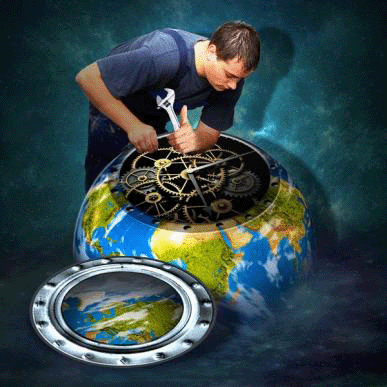 Could geoengineering strategies help tackle climate change? DW, 31 Jan 2020, A range of technologies — loosely defined as ‘geoengineering’ — are being explored as responses to climate change. Yet their effectiveness, and whether they should be implemented at all, is debated among scientists.Australia’s bushfires have brought the devastating consequences of a warming world into sharp relief. And with modelling pointing to temperature increases of between three and four degrees Celcius by 2100 in a business-as-usual scenario, predictions suggest such extreme events are set to become more frequentV.
What if we could reverse the warming that is fueling drought and causing flooding around the world?
That is exactly what organizations like the US-based non-profit Foundation for Climate Restoration (F4CR), are proposing. The group wants to restore carbon dioxide levels in the atmosphere to under 300 parts per million, as was the case in the pre-fossil fuel age. Today, the global average measures more than 400 parts per million.
“I’m very interested in leaving [behind] a world where our children can survive,” Pieter Fiekowsky, an MIT-trained physicist who founded F4CR in 2015, told DW. To him, “that clearly requires getting CO2 back to safe levels.”
According to the foundation, achieving that involves “climate restoration,” that is, making sure we’re collectively removing more greenhouse gases from the atmosphere than we produce. The foundation believes around a trillion tons of carbon dioxide needs to be extracted.
That would require large-scale implementation of nature-based or artificial technologies to suck vast quantities of greenhouse gases out of the atmosphere to cool the planet — strategies that fall under the loose definition of “geoengineering.” However, which technologies are best suited, and whether to implement them at all, is hotly debated among scientists.
Climate benefits
Rob Jackson, an earth systems scientist at Stanford University,believes that restoring the climate to what it once was is a better goal than merely stabilizing Earth’s temperatures.
“We need a new story, a new narrative around climate change,” says Jackson, who argues this should involve ambitions that go beyond merely limiting the damage of climate change. “[Climate restoration] will bring climate benefits. It will save lives by reducing air pollution. It will provide a host of other benefits.”
One solution proposed by F4CR in awhite paper last year entails restoring marine habitats that store carbon, such as underwater kelp forests. Another is a form of concrete that binds carbon as it’s made, which was used recently to build a new terminal at San Francisco airport……….
“I think these long-term goals [of climate restoration] take away focus from the really important challenge that we have today of bending the emissions curve downward,” says Joeri Rogelj, a climate scientist at Imperial College London.
There is also concern that geoengineering technologies could create a false sense of security that increased emissions could be removed. Rogelj says ecosystems unable to adapt to current warming are not likely to return even if temperatures decrease……..
A middle ground?
Bhowmik believes it should be possible to achieve a net decline in greenhouse gases without resorting to the most radical geoengineering approaches. The Exponential Roadmap report published in 2019, in which Bhowmik led the modelling work, lays out a strategy focused heavily on nature-based solutions.
To follow that roadmap, the world would need to halve global greenhouse gas emissions every decade from 2020 onwards, improve agricultural practices so farmland absorbs rather than emits carbon, restore large areas of forest and protect carbon-storing ecosystems like peatlands.
“If you follow that route, it would actually be possible by the end of this century to have a substantial reduction in the atmosphere greenhouse gas concentrations. And soon thereafter we will reach the level that was in the preindustrial period,” Bhowmik believes.
Climate restoration got a boost in September 2019 when F4CR joined scientists, venture capitalists and youth activists at a UN Forum aiming to spur investment for a range of nascent technologies to reverse global warming.
Even though there’s disagreement on what — if any — form climate restoration should take, most scientists do agree that it shouldn’t be a replacement for mitigating climate change or helping communities around the world cope with the impacts of rising temperatures.
That includes F4CR. “Climate restoration is a critical third pillar,” says Rick Parnell, CEO of the organization. “[It’s] a third leg of the stool, along with mitigation and adaptation.” https://www.dw.com/en/geoengineering-projects-climate-change/a-52117714
Stainless steel canisters for nuclear wastes may be dangerous
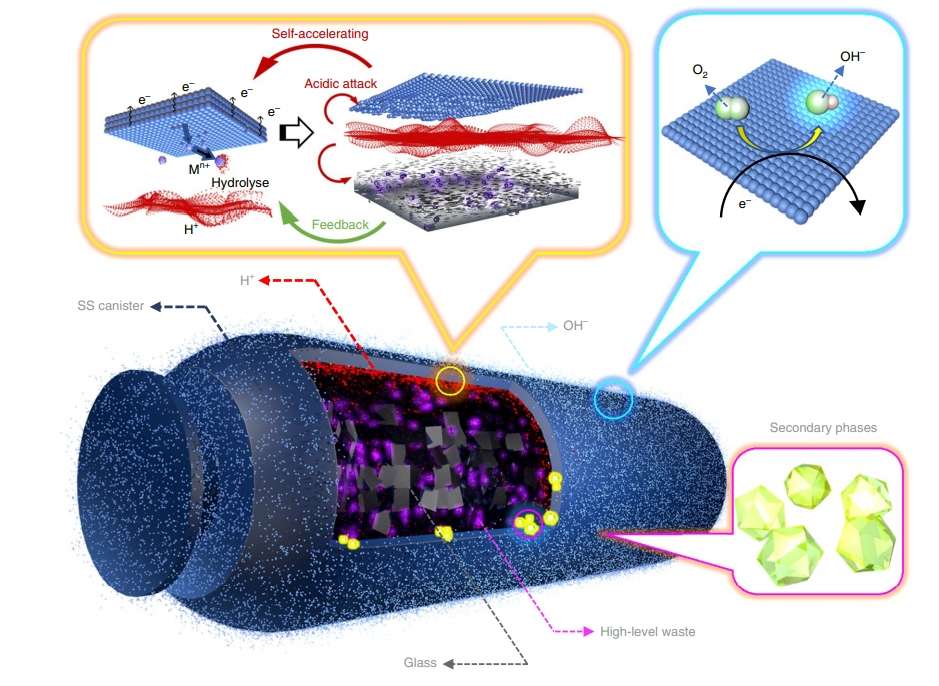
Schematic of a stainless steel nuclear waste canister, with radioactive particles (purple) trapped inside in glass and the acidic spiral that starts when water, steel, and glass are brought together. Guo et al/Nature Materials
|
By David Szondy January 28, 2020 A new study by researchers at Ohio State University suggests that stainless steel may not be the best choice for containing high-level nuclear waste. By simulating long-term storage conditions, the team found that the storage materials interact with each other more than previously thought, causing them to degrade faster.
The storage of nuclear waste is more than a perennial political football, it is an existential problem. Whatever one’s opinions about nuclear power or weapons, there are thousands of tons of nuclear waste temporarily stored around the world, meaning that a way must be found to store it all
safely in the long term.
The most important type of nuclear waste is the high-level waste left over from reprocessing nuclear fuel or from nuclear weapon production. Such waste is made up of a complex mixture of radioactive isotopes with half-lives ranging from years to millennia. Though reactors have been operating all over the world for over 75 years, only Finland has started to build a permanent storage facility for such very dangerous waste.
That may show a remarkable lack of political will or even courage, but perhaps this reluctance will turn out to be serendipitous. That’s because the favored way of storing high-level waste is to vitrify it. That is, to mix the isotopes with molten glass or ceramics to form a chemically inert mass that can be sealed in stainless steel canisters before being sealed in an underground storage facility.
That plan may now have to change if the Ohio study is correct. Led by Xiaolei Guo, the team took glasses and ceramics and put them in close contact with stainless steel in various wet solutions for 30 days in conditions similar to those that would be found in the proposed US Yucca Mountain nuclear waste repository.
In the real-life scenario, the glass or ceramic waste forms would be in close contact with stainless steel canisters,” says Xiaolei. “Under specific conditions, the corrosion of stainless steel will go crazy. It creates a super-aggressive environment that can corrode surrounding materials.”
They found that the steel interacted with the glass or ceramic to produce severe and localized corrosion that both damaged the steel and corroded and cracked the glass and ceramics. According to the team, this is because the iron in stainless steel has a chemical affinity with the silicon in glass, accelerating corrosion. This indicates that the current models may not be sufficient to keep this waste safely stored,” says Xiaolei. “And it shows that we need to develop a new model for storing nuclear waste.” The research was published in Nature Materials. Source: Ohio State University |
|

Inflexible baseload power no longer needed. Surplus nuclear power has become an embarrassment
Out of earshot of the politicians, the question of what to do with all the surplus power when demand is low is being tackled by increasing storage capacity but also by making green hydrogen. Some nuclear buffs are even suggesting hydrogen production might be the only viable hope for using up their spare power.
The tide is coming: why our beaches are vanishing
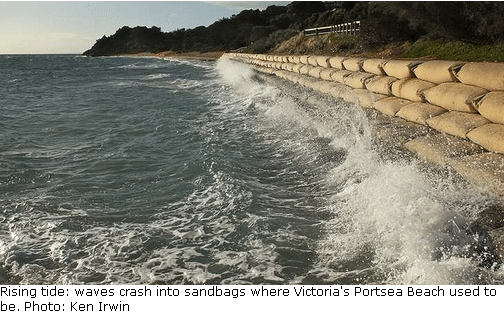
Communities around the country are coming face-to-face with the growing threat of coastal erosion. And as the climate crisis hastens, the problem is only going to get worse…
CHARLIE LEWIS AND KISHOR NAPIER-RAMAN JAN 28, 2020, Australia is crumbling into the sea. Experts estimate there are hundreds of beaches and coastal communities around the country at risk from coastal erosion. Within decades, as sea levels rise, that number could be in the thousands….. (subscribers only) https://www.crikey.com.au/2020/01/28/australias-collapsing-coast-beach-erosion/
1 This month

of the week – Australians for War Powers Reform (AWPR)
To see nuclear-related stories in greater depth and intensity
 Antinuclear