World’s first public database of mine tailings dams aims to prevent deadly disasters

|
World’s first public database of mine tailings dams aims to prevent deadly disasters https://www.eurekalert.org/pub_releases/2020-01/g-wfp012320.php Previously unreleased data offer unprecedented view into mining industry’s waste storage practices GRID-ARENDAL 24 JAN 2020 ENVIRONMENTAL ORGANIZATION GRID-ARENDAL HAS LAUNCHED THE WORLD’S FIRST PUBLICLY ACCESSIBLE GLOBAL DATABASE OF MINE TAILINGS STORAGE FACILITIES. THE DATABASE, THE GLOBAL TAILINGS PORTAL, WAS BUILT BY NORWAY-BASED GRID-ARENDAL AS PART OF THE INVESTOR MINING AND TAILINGS SAFETY INITIATIVE, WHICH IS LED BY THE CHURCH OF ENGLAND PENSIONS BOARD AND THE SWEDISH NATIONAL PENSION FUNDS’ COUNCIL ON ETHICS, WITH SUPPORT FROM THE UN ENVIRONMENT PROGRAMME. THE INITIATIVE IS BACKED BY FUNDS WITH MORE THAN US$13 TRILLION UNDER MANAGEMENT. Until now, there has been no central database detailing the location and quantity of the mining industry’s liquid and solid waste, known as tailings. The waste is typically stored in embankments called tailings dams, which have periodically failed with devastating consequences for communities, wildlife and ecosystems. “This portal could save lives”, says Elaine Baker, senior expert at GRID-Arendal and a geosciences professor with the University of Sydney in Australia. “Dams are getting bigger and bigger. Mining companies have found most of the highest-grade ores and are now mining lower-grade ones, which create more waste. With this information, the entire industry can work towards reducing dam failures in the future.” The database allows users to view detailed information on more than 1,700 tailings dams around the world, categorized by location, company, dam type, height, volume, and risk, among other factors. “Most of this information has never before been publicly available”, says Kristina Thygesen, GRID-Arendal’s programme leader for geological resources and a member of the team that worked on the portal. When GRID-Arendal began in-depth research on mine tailings dams in 2016, very little data was accessible. In a 2017 report on tailings dams, co-published by GRID and the UN Environment Programme, one of the key recommendations was to establish an accessible public-interest database of tailings storage facilities. “This database brings a new level of transparency to the mining industry, which will benefit regulators, institutional investors, scientific researchers, local communities, the media, and the industry itself”, says Thygesen. The release of the Global Tailings Portal coincides with the one-year anniversary of the tailings dam collapse in Brumadinho, Brazil, that killed 270 people. After that disaster, a group of institutional investors led by the Church of England Pensions Board asked 726 of the world’s largest mining companies to disclose details about their tailings dams. Many of the companies complied, and the information they released has been incorporated into the database. For more information on tailings dams, see the 2017 report “Mine Tailings Storage: Safety Is No Accident” and the related collection of graphics, which are available for media use. About GRID-Arendal GRID-Arendal supports environmentally sustainable development by working with the UN Environment Programme and other partners. We communicate environmental knowledge that motivates decision-makers and strengthens management capacity. We transform environmental data into credible, science-based information products, delivered through innovative communication tools and capacity-building services. |
|
Secret research reveals rift in the Liberals, over climate change
 Secret research deepens Liberal divisions over climate Daily Telegraph , 26 Jan 2020, The results of secret research focus groups, conducted by the federal government nationally in November, reveal climate change is a key concern among voters after the devastating bushfire season across the country…. (Subscribers only)
UK planning deep disposal of nuclear wastes
 How To Solve Nuclear Energy’s Biggest
  Problem https://oilprice.com/Alternative-Energy/Nuclear-Power/How-To-Solve-Nuclear-Energys-Biggest-Problem.html By Haley Zaremba – Jan 22, 2020, Nuclear waste is a huge issue and it’s not going away any time soon–in fact, it’s not going away for millions of years. While most types of nuclear waste remain radioactive for mere tens of thousands of years, the half-life of Chlorine-36 is 300,000 years and neptunium-237 boasts a half-life of a whopping 2 million years.
All this radioactivity amounts to a huge amount of maintenance to ensure that our radioactive waste is being properly managed throughout its extraordinarily long shelf life and isn’t endangering anyone. And, it almost goes without saying, all this maintenance comes at a cost. In the United States, nuclear waste carries a particularly hefty cost.
Last year, in a hard-hitting expose on the nuclear industry’s toll on U.S. taxpayers, the Los Angeles Times reported that “almost 40 years after Congress decided the United States, and not private companies, would be responsible for storing radioactive waste, the cost of that effort has grown to $7.5 billion, and it’s about to get even pricier.”
How much pricier? A lot. “With no place of its own to keep the waste, the government now says it expects to pay $35.5 billion to private companies as more and more nuclear plants shut down, unable to compete with cheaper natural gas and renewable energy sources. Storing spent fuel at an operating plant with staff and technology on hand can cost $300,000 a year. The price for a closed facility: more than $8 million, according to the Nuclear Energy Institute.”
With the United States as a poster child of what not to do with your nuclear waste, the United Kingdom is taking a much different tack. The UK is currently undertaking what the country’s Radioactive Waste Management (RWM) department says “will be one of the UK’s largest ever environmental projects.” This nuclear waste storage solution comes in the form of a geological disposal facility (GDF), a waste disposal method that involves burying nuclear waste deep, deep underground in a cocoon of backfill, most commonly comprised of bentonite-based cement. This type of cement is able to absorb shocks and is ideal for containing radioactive particles in case of any failure. The GDF system would also be at such a depth that it would be under the water table, minimizing any risk of contaminating the groundwater.
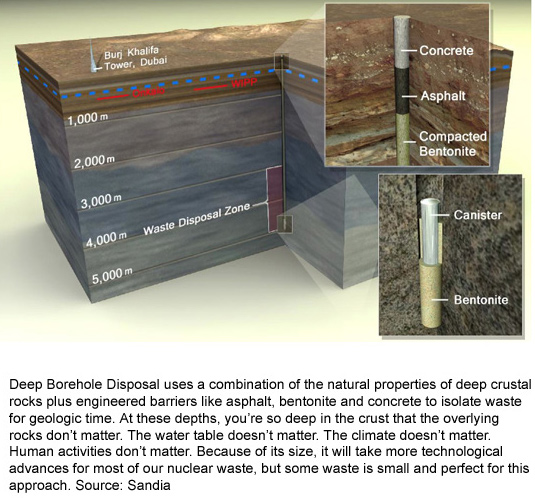
According to reporting from Engineering & Technology, nuclear waste is a mounting issue in Europe and in the UK in particular. “Under European law, all countries that create radioactive waste are obliged to find their own disposal solutions – shipping nuclear waste is not generally permitted except in some legacy agreements. However, when the first countries charged into nuclear energy generation (or nuclear weapons research), disposal of the radioactive waste was not a major consideration. For several of those countries, like the UK, that is now around 70 years ago, and the waste has been ‘stored’ rather than disposed of. It remains a problem.”
In fact, not only does it remain a problem, it is a mounting problem. As nuclear waste has been improperly or shortsightedly managed in the past, the current administration can no longer avoid dealing with the issue. In the past the UK used its Drigg Low-Level Waste Repository on the Cumbrian Coast to treat low and intermediate level waste, but now, thanks to coastal erosion, the facility will soon begin leeching radioactive materials into the sea, although that might not be quite as scary as it sounds.
Back in 2014, the Environment Agency raised concerns that coastal erosion could result in leakage from the site within 100 to 1,000 years, although it was counter-claimed that the levels of radioactivity after such a time would be low enough to be harmless,” Engineering & Technology writes. “This would definitely not be the case for high-level wastes, where radioactivity could remain a hazard into and beyond the next ice age, hence the need for longer-term disposal.”
Where exactly will that longer-term disposal be based? That’s up for debate. And it won’t be an easy thing to decide, as the RWM says that they will need a community to volunteer to be involved in such a costly, lengthy, and potentially unpopular project. And it’s not just an issue for the current inhabitants of potential locations in the UK, but for many generations to come over the next tens of thousands of years of radioactivity
‘Money talks’: Outrage at billionaire climate sceptic’s political donations
‘Money talks’: outrage at billionaire climate sceptic’s political donations
Justine Landis-Hanley and Kishor Napier-Raman
Andrew Wilkie, Adam Bandt and Stirling Griff condemn Australia’s donations system which can effectively block action on climate change…. (subscribers only) https://www.crikey.com.au/2020/01/24/michael-hintze-donations-outrage/
Greta Thunberg says climate demands ‘completely ignored’ at Davos
|
Greta Thunberg says climate demands ‘completely ignored’ at Davos, https://www.sbs.com.au/news/greta-thunberg-says-climate-demands-completely-ignored-at-davos 24 Jan 2020, Greta Thunberg says she isn’t surprised that calls to disinvest in fossil fuels have fallen on deaf ears at the World Economic Forum in Davos.
Teenage climate activist Greta Thunberg said calls to the corporate elite meeting in Davos to immediately disinvest in fossil fuels had been ignored. “We had a few demands (coming into the World Economic Forum). Of course these demands have been completely ignored. We expected nothing less,” Thunberg told reporters in the Swiss ski resort on the last day of the conference. Thunberg was a highlight of the 50th edition of the conference, drawing massive attention including barbs by US Secretary Steven Mnuchin who on Thursday told the teen to go “study economics”. Asked about Mnuchin’s comments, the Swede said: “Of course it has no effect. We are being criticised like that all the time.” “If we cared about that, we would not be able to do what we do. We put ourselves in the spotlight.” The spat between Mnuchin and Thunberg underlined the tensions over climate change at the World Economic Forum (WEF) in Davos, where governments and major firms have come under pressure to act now on global warming. Asked about the 17-year-old’s demand for an immediate halt to investment in fossil fuels, Mnuchin said on Thursday: “Is she the chief economist? Who is she? I’m confused,” adding after a pause that it was “a joke”. “After she goes and studies economics in college, she can come back and explain that to us.” In a speech on Tuesday, US President Donald Trump castigated the “prophets of doom” that predict a climate “apocalypse”, in comments widely seen as an attack on Thunberg who sat in the audience. But either by accident or design, there was no meeting between Trump and Thunberg at the forum. |
|
Olympic events close to radioactive sites: Fukushima’s nuclear wastes’anxiety hangs over Olympics

On an exclusive tour of the plant, spread over 3.5 million square meters (865 acres), Reuters witnessed giant remote-controlled cranes dismantling an exhaust tower and other structures in a highly radioactive zone while spent fuel was removed from a reactor.
Officials from Tokyo Electric, which owns the plant, also showed new tanks to hold increasing amounts of contaminated water.
About 4,000 workers are tackling the cleanup, many wearing protective gear, although more than 90% of the plant is deemed to have so little radioactivity that no extra precautions are needed. Photography was highly restricted and no conversations were allowed with the workers.
Work to dismantle the plant has taken nearly a decade so far, but with Tokyo due to host the Olympics this summer – including some events less than 60 km (38 miles) from the power station – there has been renewed focus on safeguarding the venues…….
The buildup of contaminated water has been a sticking point in the cleanup, which is likely to last decades, and has alarmed neighboring countries. In 2018, Tepco said it had not been able to remove all dangerous material from the water – and the site is running out of room for storage tanks.
Officials overseeing a panel of experts looking into the contaminated water issue said in December choices on disposal should be narrowed to two: either dilute the water and dump it in the Pacific Ocean, or allow it to evaporate. The Japanese government may decide within months, and either process would take years to complete, experts say……..
Athletes from at least one country, South Korea, are planning to bring their own radiation detectors and food this summer.
Baseball and softball will be played in Fukushima City, about 60 km (38 miles) from the destroyed nuclear plant. The torch relay will begin at a sports facility called J-Village, an operations base for Fukushima Daiichi in the first few years of the disaster, then pass through areas near the damaged station on its way to Tokyo.
In December, Greenpeace said it found radiation “hotspots” at J-Village, about 18km south of the plant.
When Tokyo won the bid to host the 2020 Summer Olympics Prime Minister Shinzo Abe declared that Fukushima was “under control” in his final pitch to the International Olympic Committee.
In 2016, the Japanese government estimated that the total cost of plant dismantlement, decontamination of affected areas, and compensation would be 21.5 trillion yen ($195 billion) – roughly a fifth of the country’s annual budget at the time.
(Reporting by Aaron Sheldrick: Editing by Gerry Doyle) https://mobile.reuters.com/article/amp/idUSKBN1ZK0CV?__twitter_impression=true
Europe, too, is already affected by wildfire climate emergencies
 Wildfires show us how the climate emergency is already affecting Europe, Guardian, Imogen West-Knights We look at the devastation of Australia’s bushfires and don’t believe it could happen here. But it already is, 22 Jan 2020 “……… what we’re seeing in Australia. Since the fire season began there, in the middle of last year, 29 people have died, along with more than a billion animals, and an area comparable in size to the whole of England has been ablaze. It’s a vicious reminder that, for all the sophistication of the modern world, something as primitive as fire can still bring us to our knees. As shocking as the scale of the destruction has been, though, it’s easy to see it on our computer screens here on the other side of the world, in the middle of a British winter, and feel disconnected from it. We accept that the climate emergency is now truly upon us yet still feel that it’s mostly happening to other people, elsewhere.wildfires are increasingly a problem for everyone, including in the UK. Last August, there were almost five times as many of them around the world as there had been the previous August. In the EU, the number of wildfires in the first half of 2019 was three times the annual average for the previous decade. And while they used to be a serious problem only in hotter, southern European countries such as Portugal and Spain, now northern Europe is in trouble too.
The Swedish fires of 2018 were by far the most severe in the country’s history, burning an area almost twice as large as the worst previous wildfire, in 2014. In the UK, 2018 and 2019 were the worst two years on record for wildfires, particularly on moors in the north-west of England and parts of Scotland. One fire last year, at Marsden Moor in Yorkshire, destroyed almost three square miles of land. The damage is on a very different scale to the almost 30,000 square miles that have burned in Australia, of course, but this is still a development we can’t afford to ignore.
Aside from all the more immediate effects – the threat to humans, livestock and wildlife – the recent increase in wildfires has been linked to severe air quality problems. People living up to 62 miles (100km) downwind of fires in the Pennines in 2018 were exposed to toxic fumes. And as there is no sign of cooler weather in the years ahead, it is reasonable to expect more fires in 2020. The EU has now established a fleet of firefighting planes, and the European Forest Institute has warned that unless we take steps to protect the countryside – for instance, by planting less-flammable species and creating barriers to the spread of flames – emergency services won’t be able to prevent the rapid spread and firestorms that have characterised the Australian crisis.
This isn’t all because of the climate crisis – changes to land use and increased urbanisation over several decades are also factors. Weather patterns are noisy data, and it’s difficult to attribute any single wildfire to the climate crisis. The scientific consensus, however, is that it is increasing the intensity and frequency of fire-conducive weather across the world.
Even those fires that are eventually linked to human error, like a still-lit disposable barbecue, are increasingly likely due to warming temperatures. Hotter summers mean more barbecues lit in the first place. The climate crisis is going to change the way we behave in every aspect of our lives. And with the probability of another summer of extreme weather coming, we will need to adapt to new dangers that won’t just be on the other side of the planet but, quite literally, in our own backyards.
It’s not at all clear that we’re ready for what might be coming. There is still a cognitive jump yet to be made when those of us in Europe read about the fires in Australia, from mourning the destruction there to recognising that we face some version of the same threat. When we look at Australia, we’re not looking at the future that might await Europe. That future is already here.
• Imogen West-Knights is a writer and freelance journalist
Climate change could unlock new microbes and increase heat-related deaths
Climate change could unlock new microbes and increase heat-related deaths, Science Daily, January 22, 2020, Source: Johns Hopkins Medicine
- Summary:
- Scientists warn that global climate change is likely to unlock dangerous new microbes, as well as threaten humans’ ability to regulate body temperature…..
- Ahima, director of Johns Hopkins’ Division of Endocrinology, Diabetes and Metabolism, wrote in the journal that “global warming threatens human thermoregulation and survival.” ……
- Casadevall’s article explores “the specter of new infectious diseases” as a result of the changing climate.
“Given that microbes can adapt to higher temperatures,” writes the professor of molecular microbiology and immunology, and infectious diseases, at Johns Hopkins’ schools of medicine and public health, “there is concern that global warming will select for microbes with higher heat tolerance that can defeat our endothermy defenses and bring new infectious diseases.”
Endothermy allows humans and other warm-blooded mammals to maintain high temperatures that can protect against infectious diseases by inhibiting many types of microbes.
Casadevall cites a particular climate threat from the fungal kingdom.
“We have proposed that global warming will lead many fungal species to adapt to higher temperatures,” he writes, “and some with pathogenic potential for humans will break through the defensive barrier provided by endothermy.”….
- In all four JCI “Viewpoint” articles, long-term strategies are urged to reduce greenhouse gas emissions and slow the trend of rising temperatures. ….https://www.sciencedaily.com/releases/2020/01/200122122105.htm
Youth in Bangladesh speak out on need for climate action
What it’s like to grow up as your country succumbs to the impacts of climate change, School students in Bangladesh are speaking out about the need to protect the planet and reduce emissions. SBS NEWS, 23 JAN 2020, BRETT MASON SBS chief political correspondent Brett Mason reports from Dhaka, Bangladesh
If some of the more severe projections play out, Bangladesh could be ground zero for the climate crisis.
A sea level rise of half a metre by 2050 would see 12 per cent of Bangladesh’s landmass disappear, which would potentially displace 15 million people.
The United Nations has warned that one in three Bangladeshi children are now at risk from climate-linked disasters.
It’s a point that many young Bangladeshis are acutely aware of.
A number of students in the capital Dhaka have joined ‘green clubs’ that are funded by Australian aid.
In one school, a club is using donations to its ‘oxygen bank’ to plant a rooftop garden above its classrooms to try and mitigate emissions and slow the impact of global warming…….
Dhaka is home to 21 million people, with 1,000 more new residents arriving every day.
A staggering 82 per cent of the city is now concrete, with just six square kilometres of open space across the entire city……
The students had a message for the leaders of nations where emissions are rising not falling.
“Many people say the climate is not changing, but the climate is changing, very slowly. We need to be aware of this because our world is going to be destroyed if we aren’t,” Zilani said……… HTTPS://WWW.SBS.COM.AU/NEWS/WHAT-IT-S-LIKE-TO-GROW-UP-AS-YOUR-COUNTRY-SUCCUMBS-TO-THE-IMPACTS-OF-CLIMATE-CHANGE
A warning on the disappearance of insect species
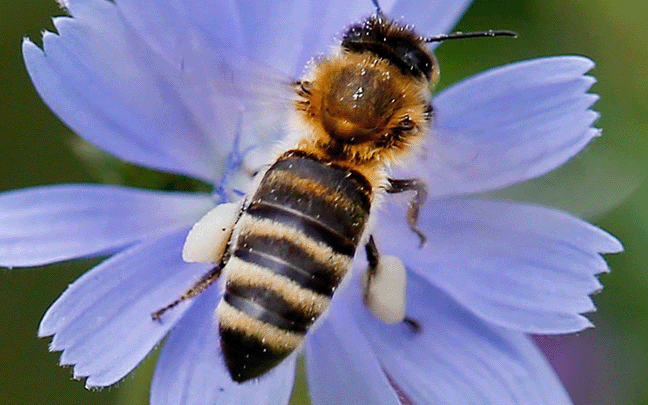 Call for action on decline of insects: ‘Without them we’d be in big trouble NZ Herald, By Karoline Tuckey for RNZ, 22 Jan 2020
Governments around the world are being warned more must be done to prevent declining insect numbers, or the consequences could be severe and wide-reaching.
More than 70 scientists from 21 countries have written an appeal for immediate steps to reduce threats to insect species, and a roadmap to recovery, which has been published in the journal Nature Ecology & Evolution.
“There is now a strong scientific consensus that the decline of insects … and biodiversity as a whole, is a very real and serious threat that society must urgently address,” the group said.
Waikato University’s Dr Christina Painting contributed to the text, and said a decline in insects could mean “big trouble” for humans because they were crucial to agriculture and healthy ecosystems.
Insect pollinators were needed for growing crops, to keep our forests healthy, and insects were the main food source for many of our native fish and birds, she said.
The group have praised the German government for committing €100 million ($NZ168m) to the problem, which they say is a “clarion call to other nations”.
What do they say should be done?
Painting said there were smart and achievable steps that could be taken to make an immediate difference.
“They’re ideas we think scientists, policymakers, land managers and communities can all use together to help insect conservation.”
High on the list is for natural areas to be planned for within urban and “homogenous” environments, which could provide havens for insects, and support species diversity.
“I think in New Zealand we’re pretty good and very proactive about trying to come up with restoration areas in both urban and in our conservation estate. But perhaps we haven’t really been thinking about what’s good for insects while we’ve been designing those programmes,” she said.
The group have also called for “aggressive steps to reduce greenhouse gas emissions, reversing agricultural intensification, including reduced [use of] synthetic pesticides and fertilisers and pursuing their replacement with agroecological measures.”
Phasing out pesticides could be one of the trickiest challenges, but it was important to start, Painting said.
“There are problems because they’re generally not that specific in the species they target – so if you put a broad-spectrum pesticide out it’s going to knock off not just the pest species you’re worried about for your crop, but also anything else that might be there. ……
more support was needed from the public and for government to recognise just how important insects ewre.
“We fund things that people value, and to date there has been a much lower appreciation of insects than other species, so it makes sense that we’ve seen less money put into insect conservation.”
More public education could lead to more appreciation for insects and the roles they play – and then should translate to more justification for policy-makers to commit funding to protect them, she said.
“Some of us think insects are gorgeous and very cute, but it’s crucial to understand that without them we’d be in big trouble – they’re just so incredible because it’s such an intricate system of interactions between different species and within communities – and we’re just in our infancy of understanding just how those pieces together.
“Those questions and the mystery around that alone, I think, is something we should really be excited about.”………https://www.nzherald.co.nz/nz/news/article.cfm?c_id=1&objectid=12302483
Human race over-consuming the planet’s natural resources
And don’t let’s forget – the nuclear industry is counting on this!
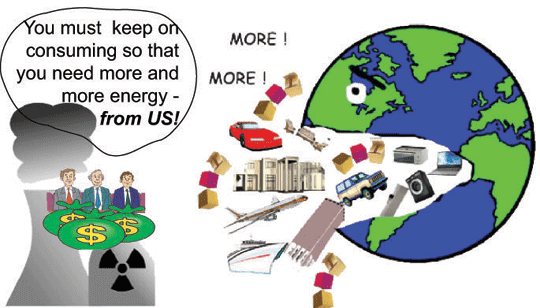
World’s consumption of materials hits record 100bn tonnes a year, https://www.theguardian.com/environment/2020/jan/22/worlds-consumption-of-materials-hits-record-100bn-tonnes-a-year Unsustainable use of resources is wrecking the planet but recycling is falling, report finds, Damian Carrington Environment editor @dpcarrington, Wed 22 Jan 2020 . The amount of material consumed by humanity has passed 100bn tonnes every year, a report has revealed, but the proportion being recycled is falling.
The climate and wildlife emergencies are driven by the unsustainable extraction of fossil fuels, metals, building materials and trees. The report’s authors warn that treating the world’s resources as limitless is leading towards global disaster.
The materials used by the global economy have quadrupled since 1970, far faster than the population, which has doubled. In the last two years, consumption has jumped by more than 8% but the reuse of resources has fallen from 9.1% to 8.6%.
The report, by the Circle Economy thinktank, was launched at the World Economic Forum in Davos. Continue reading
Japan’s nuclear safety costs – $123 billion
 Costs for managing Japan’s nuclear plants to total 13 trillion yen, https://english.kyodonews.net/news/2020/01/8722fafaff9b-costs-for-managing-japans-nuclear-plants-to-total-13-trillion-yen.html
KYODO NEWS – Jan 15, 2020 The total costs to implement government-mandated safety measures, maintain facilities and decommission commercially operated nuclear power plants in Japan will reach around 13.46 trillion yen ($123 billion), a Kyodo News tally showed Wednesday.
The amount, which could balloon further and eventually lead to higher electricity fees, was calculated based on financial documents from 11 power companies that own 57 nuclear reactors at 19 plants, as well as interviews with the utilities. Continue reading
Watch the 2020 Doomsday Clock Announcement on January 23
 Watch the 2020 Doomsday Clock Announcement on January 23By Gayle Spinazze, January 8, 2020 The Bulletin of the Atomic Scientists will host a live international news conference at 10 a.m. EST/1500 GMT on Thursday, January 23, 2020, to announce the 2020 time of the Doomsday Clock. The news conference will take place at the National Press Club in Washington, D.C. Watch the announcement live on our website or on our Facebook page………. https://thebulletin.org/2020/01/watch-the-2020-doomsday-clock-announcement/?utm_source=Newsletter&utm_medium=Email&utm_campaign=ThursdayNewsletter01092020&utm_content=DoomsdayClock_ClockEvent_01082020
Vast locust swarm in Africa destroying livelihoods, climate change partly to blame
Locust swarm 37 miles long and 25 miles wide threatens crops across swathes of east Africa, ITV News, 17 Jan 2020, A swarm of locusts measured at 37 miles long and 25 miles wide has been tracked in Kenya – and the insects are now threatening to decimate crops across swatches of east Africa.
The most serious outbreak of desert locusts in 25 years is posing an unprecedented threat to food security in some of the world’s most vulnerable countries, authorities say.
Unusual climate conditions are partly to blame.
Kenya’s Intergovernmental Authority on Development said: “A typical desert locust swarm can contain up to 150 million locusts per square kilometre.
“Swarms migrate with the wind and can cover 100 to 150 kilometres in a day. An average swarm can destroy as much food crops in a day as is sufficient to feed 2,500 people.”
Roughly the length of a finger, the insects fly together by the millions and are devouring crops and forcing people in some areas to bodily wade through them.
The outbreak of desert locusts, considered the most dangerous locust species, also has affected parts of Somalia, Ethiopia, Sudan, Djibouti and Eritrea and IGAD warns that parts of South Sudan and Uganda could be next.
The “extremely dangerous” outbreak is making the region’s bad food security situation worse, the United Nations’ Food and Agriculture Organisation has warned.
Hundreds of thousands of acres of crops have been destroyed……. https://www.itv.com/news/2020-01-17/locust-swarm-37-miles-long-and-25-miles-wide-threatens-crops-across-swathes-of-east-africa/?fbclid=IwAR1cn3AzYPruUHLGk_0dgXtQvDvh9bjrehBk7AeCTXeru2AjLKdlmmrYz_g
Refuting the claims of Jim Hansen about nuclear power
1 This month

of the week – Australians for War Powers Reform (AWPR)
To see nuclear-related stories in greater depth and intensity
 Antinuclear