International coverage of Australia’s climate and fires
There has been coverage, especially in USA, of Australia’s climate change conditions, and extreme events. For example, the Washington Post (subscribers only) reported yesterday on Tasmania’s risk from ocean warming and climate change.
|
Australia Faces Catastrophic Fire Conditions, From VOA News:
“Australia Faces Catastrophic Fire Conditions New South Wales has seen the largest ever deployment of its emergency services. About 100 fires are burning across Australia’s most populous state. About half are out of control. Residents in the path of a mega-blaze near Sydney have been told it is too late to leave. They have been advised to seek shelter in a ‘solid structure’ to avoid the heat of the flames. A heatwave has exacerbated the fire threat, while a long drought has made the ground tinder dry. Rob Rodgers, the New South Wales Deputy Rural Fire Service Commissioner, says the dangers are extreme. “We cannot guarantee that every time someone wants a fire truck we are going to have someone there,” said Rodgers. “So do not be expecting a fire truck to be there. We will do our best but do not rely on that. Do not wait for a warning. Think about what you are going to do if you are in the path of these fires. Think about what you are going to do well ahead of time as in now.” There are emergency fire warnings in Victoria and South Australia, where already one person has been found dead and another left critically injured. A blaze about 330 kilometers east of Melbourne became so big it began “generating its own weather,” according to the authorities. For a second day, protestors have gathered outside the prime minister’s official residence in Sydney. Scott Morrison was criticized for going on holiday to Hawaii during the bushfire crisis. He’s apologized and is heading home. Many Australians have accused Morrison and his conservative government of inaction on climate change. Bushfires have always been part of the Australian story. But officials say this fire season has not only started earlier than usual, it is far more intense. Worse may yet be to come, with summer temperatures normally peaking in January and February. https://www.voanews.com/east-asia-pacific/australia-faces-catastrophic-fire-conditions |
|
How Radiation Can Affect Brain Connections
|
How Radiation Can Affect Brain Connections https://www.technologynetworks.com/neuroscience/news/how-radiation-can-affect-brain-connections-328547 Dec 17,| 2019 Original story from University of Rochester Medical Center, One of the potentially life-altering side effects that patients experience after cranial radiotherapy for brain cancer is cognitive impairment. Researchers now believe that they have pinpointed why this occurs and these findings could point the way for new therapies to protect the brain from the damage caused by radiation.
The new study – which appears in the journal Scientific Reports – shows that radiation exposure triggers an immune response in the brain that severs connections between nerve cells. While the immune system’s role in remodeling the complex network of links between neurons is normal in the healthy brain, radiation appears to send the process into overdrive, resulting in damage that could be responsible for the cognitive and memory problems that patients often face after radiotherapy. Continue reading |
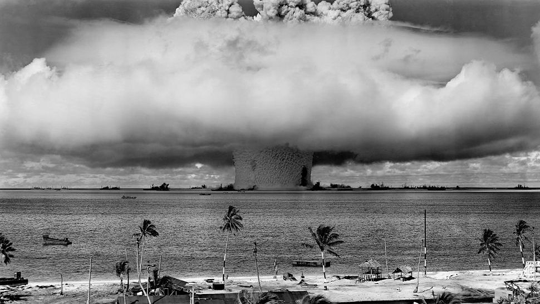
The degradation of the Bikini seafloor from nuclear explosions
|
Bikini Seafloor Hides Evidence of Nuclear Explosions, Seafloor mapping has revealed a crater and several shipwrecks persisting 73 years after the world’s first underwater nuclear test. Eos, Amanda Heidt 28 Dec 19
Seventy-three years after serving as the site of the world’s first underwater nuclear test, the seafloor around the Bikini Atoll remains scarred by finely detailed craters and littered with derelict ships. Today, an interdisciplinary team of scientists is using sonar to assess the complex submarine environment. The results provide a sobering assessment of humanity’s capacity to alter nature….. Unleashing the Power of the AtomIn the aftermath of World War II, the U.S. Navy chose the Bikini Atoll for a series of controlled nuclear explosions. Between 1946 and 1958, 23 confirmed tests were conducted throughout the area. Trembanis and his team studied Able and Baker, a pair of tests conducted in July 1946 as part of Operation Crossroads. Both Able and Baker involved plutonium fission bombs with a yield of between 21 and 23 kilotons, but they were deployed differently………. Clustering around a laptop, Trembanis and his team witnessed the real-time rendering of an underwater crater more than 800 meters across—big enough to fit three Roman Colosseums. …. Littered throughout the atoll are the husks of strategically placed ships—decommissioned dreadnaughts, aircraft carriers, and submarines meant to bear the brunt of the Able and Baker explosions. ….. Even independent of their place in nuclear history, the Pilotfish and other Bikini shipwrecks attest to the long-lived effects of human activities on the environment. As old ships decompose, they become ecological burdens, and researchers found that several wrecks on the Bikini seafloor are leaching plumes of oil. Trembanis and his team looked at sketches from surveys the National Park Service conducted in the late 1980s and saw the degradation of the past 40 years……. https://eos.org/articles/bikini-seafloor-hides-evidence-of-nuclear-explosions
|
|
Radioactive waste dome in the Pacific is a top worry for Hawaii
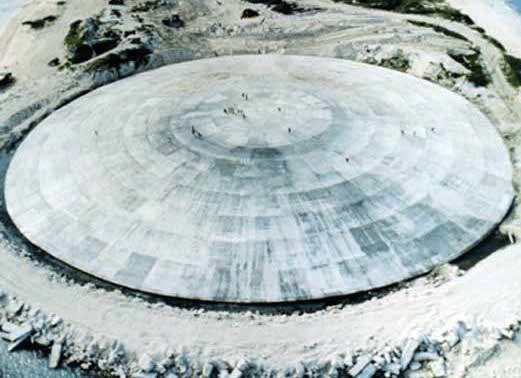
How A Nuclear Waste Site 2,800 Miles Away Became A Hawaii Priority https://www.civilbeat.org/2019/12/how-a-nuclear-waste-site-2800-miles-away-became-a-hawaii-priority/
The Runit Dome in the Marshall Islands is cracked and in danger of spilling its radioactive contents into the Pacific Ocean. By Nick Grube / December 26, 2019 WASHINGTON — A concrete dome built decades ago by the U.S. government on a Marshall Islands atoll 2,800 miles from Hawaii has the state’s federal lawmakers worried.
The Runit Dome is a relic of America’s atomic past. It’s home to 3 million cubic feet of radioactive waste that was buried there as part of the government’s effort to clean up the mess left from dozens of nuclear tests in the 1940s and ’50s that decimated the atoll.
A warming climate and rising sea levels now threaten the integrity of the saucer-shaped structure, which, if it fails, could spill its radioactive contents into the Pacific, a scenario that would threaten both people and the surrounding environment. Continue reading
Germany’s exit from nuclear power is proceeding in planned stages
|
German nuclear exit continues as planned with next reactor to close Dec 31, https://www.spglobal.com/platts/en/market-insights/podcasts/crude/122319-capitol-crude-oil-market-top-geopolitical-risks-2020. Andreas Franke Editor. Dan Lalor — Germany’s planned phasing out of nuclear power will continue with the closure next Tuesday of the 1.5 GW Philippsburg 2, leaving six reactors with a combined 8 GW online for the next 2-3 years.
Federal environment minister, Svenja Schulze, said in a statement that the consensus in Germany behind the nuclear phase-out was “rock solid”. The last reactor will close by the end of 2022. “The nuclear exit makes our country safer [as it avoids radioactive waste]…It is important to emphasize in times when some propagate nuclear power as supposed climate savior that it solves no single problem, but creates new problems for a million years,” Schulze said. Germany decided in 2011 amid the aftermath of the Fukushima nuclear accident in Japan to immediately close reactors built before 1980 and reverse a planned run-time extension for modern nuclear plants by setting final closure dates. Nuclear operators still had to pay a combined Eur23 billion ($25.6 billion) into a state-run fund for the financing of mid- and long-term nuclear storage in Germany. So far, two modern reactors were shut in 2015 and 2017, with Philippsburg 2 the third reactor to close. The final shutdowns are more concentrated with three reactors set to close in December 2021 and the final three by the end of 2022. |
|
32 eminent academics and authors refute the claim that “nuclear power is sustainable”
|
Global investment in nuclear is in stark decline https://www.ft.com/content/75ea3180-0a02-11ea-bb52-34c8d9dc6d84 From Dr Paul Dorfman et al
We write in response to James E Hansen et al’s letter (“EU must include nuclear power in its list of sustainable sources”, December 17), which mistakenly advocates nuclear energy to address climate change. In fact, spending on new nuclear power significantly reduces our chances in effectively responding to climate change. This is because, for nuclear to be considered a feasible option, new reactors should be able to be completed economically, efficiently and on time — however, practical experience proves otherwise. Nuclear new-build represents a high-risk technical, regulatory and investment option, with significant delay and cost overrun. Market analysis shows investment in nuclear power to be uneconomic — this holds for all plausible ranges of investment costs, weighted average costs of capital, and wholesale electricity prices.
In the end, the fate of new nuclear seems inextricably linked with, and determined by, that of renewable energy technology rollout. Worldwide, market trends for new nuclear are in stark decline and renewables are markedly rising.
The, perhaps obvious, explanation for this dynamic can be found in the ramping costs of the former and the plummeting costs of the latter.
Please use the sharing tools found via the share button at the top or side of articles. Copying articles to share with others is a breach of FT.com T&Cs and Copyright Policy. Email licensing@ft.com to buy additional rights. Subscribers may share up to 10 or 20 articles per month using the gift article service. More information can be found here.
https://www.ft.com/content/75ea3180-0a02-11ea-bb52-34c8d9dc6d84 AUTHORS:
|
50 year guarantee on nuclear waste casks- pretty useless contents remain radioactive for as long as 7 billion years.when
 Paul Waldon Fight To Stop Nuclear Waste In The Flinders Ranges 20 Dec 10, The reassurance of a 50 year guarantee on a TN81 Dry-Cask that can not be remedied when compromised adds no comfort when its contents remain radioactive for as long as 7 billion years.
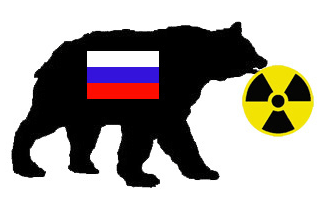
Russia covered up a major nuclear accident. Scientists now locate the source
|
Russia appears to have kept a major nuclear accident secret. But scientists called the ‘Ring of 5’ tracked the plume of radiation to its source. https://www.businessinsider.com.au/russia-nuclear-accident-radiation-timeline-2017-2019-12?r=US&IR=T, ARIA BENDIX
DEC 21, 2019
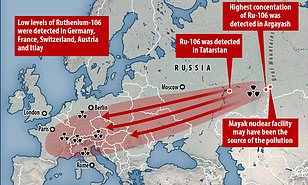
A group of scientists called the “Ring of Five” noticed something unusual in the atmosphere in late 2017: Air across Europe showed “unprecedented” levels of the radioactive isotope ruthenium-106.
The isotope is often made when reprocessing nuclear fuel. “We were stunned,” Georg Steinhauser, a professor at the University of Hanover in Germany who is part of the group, told Business Insider in August. “We did not have any anticipation that there might be some radioactivity in the air. We were just measuring air filters as we do on a weekly basis, 52 times a year, and suddenly there was an unexpected result.” The Ring of Five, which had been monitoring Europe’s atmosphere for elevated levels of radiation since the mid ’80s, spent the next two years looking for the cause of the spike.
The culprit, according to a study released in July, was an undisclosed nuclear accident at the Mayak nuclear facility in Russia, which was once the centre of the Soviet nuclear-weapons program. Mayak was also the site of the 1957 Kyshtym explosion, the world’s third-worst nuclear accident. More than 10,000 nearby residents were forced to evacuate at the time. Russia has never acknowledged that any nuclear accident happened at the Mayak facility in 2017, and has not responded to any findings from the Ring of Five. But now, the scientists have unravelled the mystery even further.A second study published last month offers even more evidence that an accident occurred at Mayak in 2017. It even pinpoints a timeline: Most of the ruthenium was emitted on September 26, 2017.
Tracing a radioactive plume across EuropeThe Ring of Five is so named because the group was originally made up of scientists from five nations – Sweden, Germany, Finland, Norway, and Denmark – but it now includes researchers from 22 countries. Their monitoring work takes takes place 24 hours a day, 365 days a year. The new study suggests that the Mayak facility likely released 250 terabecquerels (a measurement of radioactivity) of ruthenium into the atmosphere. The Kyshtym explosion, by comparison, released around 2,700 terabecquerels of ruthenium. The world’s worst nuclear accident, Chernobyl, released around 5.3 million terabecquerels of radioactive material, according to a 2013 analysis.
To find out where the 2017 radioactive plume came from, scientists traced the path of the wind at the time using more than 1,100 measurements from the fall of that year. That required studying the wind’s altitude and direction, as well as weather conditions that may have changed its course.
The scientists determined that the plume started out in the Southern Urals, where the Mayak facility is located, then was driven towards southwest Russia. It arrived in Romania on September 29, then split in two. The main part of the plume spread toward Central Europe, where it encountered rain in Bulgaria. Plant and soil samples taken in the country showed elevated levels of ruthenium at the time. After that, the plume moved north to Scandinavia before arriving in Italy on October 2, 2017. That day, Italian scientists sent an alert to the Ring of Five about elevated levels of ruthenium in Milan. Steinhauser called this the “single greatest release from nuclear-fuel reprocessing that has ever happened.” Russia has not responded to the Ring of Five’s findingsAt the time of the alleged accident in 2017, Russian officials said the Mayak facility wasn’t the source of the release, even though the nation showed elevated levels of ruthenium. Instead, officials in Russia attributed the radiation to a satellite that burned up in the atmosphere. Russia still hasn’t issued a response to either of the studies the Ring of Five published this year. “We should not forget that Mayak is a military facility – and, of course, the Russian Federation is very reluctant when it comes to talking about military facilities,” Steinhauser said. “I presume this would not be much different for other superpower nations.” The scientists don’t consider the levels of radiation they detected to be an immediate threat to people’s health. Last year, France’s Institute for Radiological Protection and Nuclear Safety determined that the levels of ruthenium-106 in the atmosphere do not pose danger to human health or the environment. But the long-term consequences are unknown. Another unanswered question, Steinhauser said, is whether the population near the Mayak facility breathed any radiation into their lungs. He added that there could be reason to monitor food safety if radiation leaked into the soil and water. “We would like to get some more in-depth information on what actually happened,” he said. “There’s a good chance that we’ll catch every single accident – but, in the present case, surprise was on our side.” |
|
Safety costs rise for Japanese nuclear power plant
The apocalyptic worldview hidden in Trump’s letter to Pelosi
|
The apocalyptic worldview hidden in Trump’s letter to Pelosi, By Thomas Lecaque , WP, Thomas Lecaque is an assistant professor of history at Grand View University in Des Moines, Iowa.
Dec. 19, 2019 There are moments fertile for apocalyptic anxiety — numerologically specific dates, perhaps, or seemingly significant ones like the year 2000 — but nothing sparks the apocalyptic imagination like a time of existential distress. For President Trump, that moment is now. In response to an impending impeachment vote in the House of Representatives, he sent a letter to House Speaker Nancy Pelosi (D-Calif.) on Tuesday that reveals more than now-familiar tantrums and rage. This text is a window into his own eschatology, his theology of the End Times. For Trump, impeachment is not a political problem: It is the climax of a holy war that he must win.
………what Trump’s letter is: a warning framed as a missive, meant not for Pelosi’s eyes alone but as a broader declaration of Trump’s worldview, a chronicle of his reign, a threat of impending peril for the United States and a vision of history centered on Trump himself. It is, in effect, an apocalyptic text, more reminiscent of the eschatological letter-chronicles of the past than any legal document of rebuttal. The only things missing are the horsemen.
The text opens with the president protesting “the partisan impeachment crusade” of the Democrats in the House. The word choice of crusade, of course, no longer reflects the papally issued holy wars of the Middle Ages — indeed, “crusade” is used routinely for any political movement seen as being overly zealous against a particular target. But Trump’s use of “crusade” gives a framework for the central apocalyptic crutch of his entire administration: the notion of an existential, good-vs.-evil, apocalyptic duality surrounding his term of office that includes him as a semi-messianic figure.
And that framework of holy war never really leaves the text. Its tenor suggests that to challenge Trump is, somehow, to violate the righteousness of Trump’s presidency itself. But the text goes further, arguing that the Democrats are attacking America at its core. Impeachment, according to Trump, “display[s] unfettered contempt for America’s founding and your egregious conduct threatens to destroy that which our Founders pledged their very lives to build.” The very next line argues that Pelosi’s claims to pray for the president are “offending Americans of faith,” that the statement “is not true, unless it is meant in a negative sense. It is a terrible thing you are doing, but you will have to live with it, not I!”
……… in the form of quasi-religious dogma, suggests that Democrats opposing Trump are at war with the righteous. The framing of Trump’s letter builds on this foundation, suggesting that the conflict is a holy war: a war for American democracy, as well as a war between “Americans of faith” and those who oppose Donald Trump: the Democrats, the liberals, secular America, etc.
All of this constitutes a claim to ongoing authority and righteousness, but as with other apocalyptic texts, it is also a call to action for those who would preserve that righteous authority. True patriots, it suggests, must enlist in the holy war to preserve the Trump era — one that goes on and on and on, time everlasting. The president himself acknowledges as much. “I write this letter to you for the purpose of history and to put my thoughts on a permanent and indelible record.” The letter is not meant to be read by Pelosi and the House Democrats, though it certainly will be — it is meant to rouse his supporters, to announce the great revelation: They are living in a time of great change, of great hope in the form of Trump’s millenarian kingdom, and of great fear, from the forces of darkness assaulting American democracy in the form of the Democratic Party. This is the eschatology of Trump: The final battle is here, in the impeachment, and must be fought to give them the Kingdom of Trump on the other side. https://www.washingtonpost.com/outlook/2019/12/18/apocalyptic-worldview-hidden-trumps-letter-pelosi/
|
|
The world needs the insights of women at male-dominated climate conferences
|
Climate conferences are male, pale and stale – it’s time to bring in women https://theconversation.com/climate-conferences-are-male-pale-and-stale-its-time-to-bring-in-women-128060 16 Dec 19, The COP25 climate meeting in Madrid concluded over the weekend. As in past meetings, the talks failed to make much progress on international climate action. And again, the views and needs of women were largely ignored.Among the aims of the COP, or conference of parties to the Paris Agreement, was working towards “ambitious and gender-inclusive climate action”. That is, recognising the need to integrate gender considerations into national and international climate action.
The first step to achieving this aim would be gender parity at international climate conferences such as the Madrid COP. While we don’t yet know how many of the 13,000 registered governmental delegates were women, based on past numbers they are unlikely to make up more than a quarter. This is not the only forum where the experiences of women are ignored. Our research, spanning Kenya, Cambodia and Vanuatu, has found women are working collectively to strengthen their communities in the face of climate change. But their knowledge about climate risk is dismissed by scientists and political leaders. Bridging climate awareness When women are excluded from local and national-level governance, the absence of their voices at regional and global levels, such as COP meetings, is virtually assured. Our work across Africa, Asia and the Pacific found scientists – generally male – lack awareness of the knowledge women hold about the local consequences of climate change. At the same time, those women had little access to scientific research. In places where the labour is divided by gender, women and men learn different things about the environment. Though the women in our research generally did not know about government policies or programs on climate change and disaster risk reduction, they were very aware of environmental change. In Kenya, the pastoralist women we spoke to are acutely aware of the link between their physical insecurity and extreme drought. Continue reading |
Nuclear colonialism – a cautionary tale about Russia’s drive to export nuclear power to South Africa
 costly projects such as the one pushed by Zuma typically make little economic sense for the purchasing country
SUMMARY
Nuclear power toxifies EU sustainable finance debate
Nuclear power toxifies EU sustainable finance debate EU28 ambassadors meet on Monday morning to see if they can come up with a compromise that can keep all sides happy Mehreen Khan 16 Dec 19,
Australia has enough environmental degradation, without degrading SA with nuclear waastes
|
Roy Ramage, Commenting on the story: Kimba firms as nuclear dump site after Hawker ruled out Readercomments, In Daily , 17 Dec 19 Just as we realise our planet is suffocating in our own waste and filth, along comes another politician wanting to further degrade our nation. In an effort to understand the magnitude of dangerous waste, here are a few stats from the International Energy Agency (IEA) which expects a wave of nuclear reactor retirements from here out to 2050. The IEA reports that as of September 2019 there are: 94 nuclear reactors abandoned construction, 46 nuclear reactors under construction, 415 nuclear reactors in operation, 28 nuclear reactors in a long-term outage and 183 nuclear reactors in a permanent shutdown mode. So there are untold tonnes of this dangerous and lethal waste that the minister wants to store in our backyard. It will never be safe. Perhaps it can be stored where he lives. – https://indaily.com.au/opinion/reader-contributions/2019/12/16/your-views-on-service-sa-closures-park-lands-booze-bans-and-nuclear-dumps/ |
|
Anxiety in Utah, over the dangers of transporting nuclear wastes to “interim storage”

“Congress should be pursuing hardened on-site storage for this waste at or near its current location. This is the solution that can most safely contain it and not put others at-risk,”
“Washington is bowing to the political clout of industry while placing unnecessary and potentially costly risks on public health
|
Nuclear Waste Policy Amendments Act hurts Utah http://suindependent.com/nuclear-waste-policy-amendments-act-hurts-utah/
The Nuclear Waste Policy Amendments Act of 2019 inherently puts innocent citizens at risk should an accident occur during transportation. By Steve Erickson, 13 Dec 19, On Dec. 11, organizations announced their opposition to House Resolution 2699, the Nuclear Waste Policy Amendments Act of 2019, and urged the Utah’s federal delegation to vote against this bill. These organizations include the Healthy Environment Alliance of Utah, Citizens Education Project, Utah Physicians for a Healthy Environment, Uranium Watch, the Nevada Nuclear Waste Task Force, and the Utah Sierra Club.
HR 2699 aims to open consolidated interim storage facilities for high-level radioactive waste throughout the southwest. Continue reading
|
1 This month

of the week – Australians for War Powers Reform (AWPR)
To see nuclear-related stories in greater depth and intensity
 Antinuclear