Clean Technica reiterates its case against thorium nuclear power
 There’s little reason to consider thorium, molten salt reactors and Gates’ “traveling wave” TerraPower technology when considering the future of energy. We have solutions today. They may be boring and low-tech, but they are cheap, fast to build, reliable, predictable, and have incredibly low negative externalities.
CleanTechnica‘s policy will be to continue to ignore them in favor of the actually transformative technologies reshaping our world for the better.
Why Thorium Nuclear Isn’t Featured on CleanTechnica Redux, https://cleantechnica.com/2019/10/30/why-thorium-nuclear-isnt-featured-on-cleantechnica-redux/?utm_source=dlvr.it&utm_medium=twitter 30 Oct 19, Seven years ago, CleanTechnica published its policy position to not cover thorium nuclear reactors. Today, the United States has a Democratic presidential candidate in the top 10 who loves thorium, yet CleanTechnica still ignores it. Why is that? Continue reading
Greenland ice cap melt measured by satellites — and it’s enough to cover Tasmania in almost 5m of water
 Greenland ice cap melt measured by satellites — and it’s enough to cover Tasmania in almost 5m of water ABC Weather By Ben Deacon, 30 Oct 19, In late July, polar scientist Martin Stendel was sweltering at his desk in Copenhagen as Europe suffered its worst ever heatwave.
Key points:
- Greenland’s ice cap is melting, and that water is draining into the ocean, contributing to sea level rise
- In July this year, it’s estimated more than 30 billion tonnes of ice melted in three days
- Australian scientists have been able to use NASA satellites to accurately weigh how much ice is melting
As temperatures climbed to more than 15 degrees Celsius above average, the meteorologist realised the record heat was about to hit the arctic.
“I looked at the forecast, and one could see that this heatwave, or this anomalous temperature, was on its way to Greenland,” Dr Stendel said.
Greenland holds the second-largest reserves of fresh water on the planet, after Antarctica.
But year in, year out, the Greenland ice cap has been melting, and that water is draining into the ocean, contributing to sea level rise.Second greatest ice melt event
PHOTO: Danish climate scientist Martin Stendel’s team estimated over 30 billion tonnes of ice melted in a three-day event over summer. (Supplied: Martin Stendel)
Over the next week, Martin Stendel looked on as Greenland suffered the second greatest melt event in recorded history.
“Gigatonnes and gigatonnes melted. And actually, this contributed in a measurable way to sea level rise,” Dr Stendel said.
Martin Stendel’s team at the Danish Meteorological Institute estimated that more than 30 billion tonnes of ice melted in just three days.
Even more troubling, the highest point in Greenland — above 3,000m in altitude — reached temperatures above zero.
“This has happened only seven times, seven times over the past 2,000 years,” Dr Stendel said…….https://www.abc.net.au/news/2019-10-30/melting-greenland-glaciers-weighed-by-australian-scientists/11630970
Tilman Ruff discusses radiation risks regarding Olympic events at Fukushima
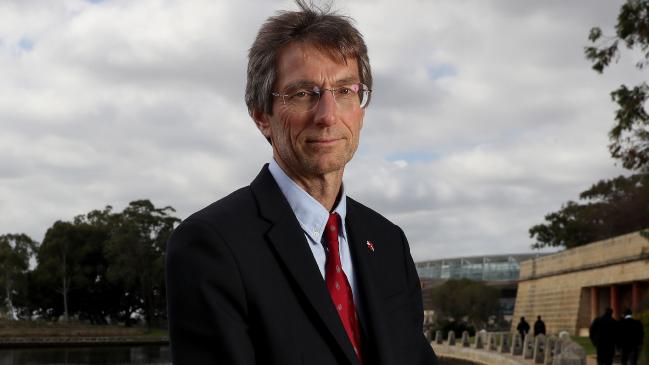 Warning on Fukushima fallout for Tokyo 2020 Olympians, https://www.theaustralian.com.au/sport/olympics/warning-on-fukushima-fallout-for-tokyo-2020-olympians/news-story/ed7bf1f0415ca7eb05ce9587b6d1989f, VICTORIA LAURIE. SENIOR REPORTER. OCTOBER 29, 2019
The Australian Olympic Committee has been urged to inform its athletes and team members about the ongoing health effects of the 2011 Fukushima nuclear reactor disaster for those attending the 2020 Tokyo Games.
Tilman Ruff, a public health expert who co-founded the Nobel Peace Prize-winning International Campaign to Abolish Nuclear Weapons (ICAN) in Melbourne, said he had written to the AOC to warn that levels of radioactivity in certain areas could be above the recommended maximum permissible exposure level. He said the Japanese Olympic Committee planned to host baseball and softball competitions and part of the torch relay in Fukushima City, 50km away from the ruins of the Fukushima Dai-ichi nuclear power plant.
In 2011, multiple nuclear meltdowns at the damaged facility caused radioactivity to leak out across Japan and the Pacific.
“It was a catastrophe comparable only to the nuclear meltdown of Chernobyl,” he said. While contamination was not as severe as at Chernobyl, “it was widespread and persists”.
At least 50,000 residents have not yet been able to return to the most affected areas in Fukushima prefecture. “The Japanese government is making a concerted effort to present the Fukushima nuclear disaster as over and effectively dealt with in the lead-up to the Olympics. Some of these efforts are misleading and should not be accepted at face value,” Dr Ruff said.
He said thyroid cancers had notably increased among young people in Fukushima, with a total of about 200 cases.
He has made several visits to Fukushima since 2011, the latest in May when he provided radiation health advice to the Fukushima prefectural government.
Dr Ruff said he then wrote to the AOC urging it to “properly inform and safeguard the best interests of the Australian staff and team, and their accompanying families, especially women who may be pregnant and young children”.
He said short-term visits to areas contaminated by radioactive fallout “now involve low to minimal risk”.
“However, if any (AOC) members or athletes plan to be based in Fukushima or neighbouring contaminated prefectures for weeks or months, they should be informed about the health risks of radiation exposure,” Dr Ruff said.
International physician groups have criticised the Japanese government’s decision shortly after the 2011 disaster to increase the maximum permissible radiation dose for Japanese citizens from one to 20 millisieverts. “Eight years later, it has not reversed that decision,” Dr Ruff said. “No other government in the world has ever accepted such a high level of radiation beyond the immediate emergency phase of a nuclear disaster for its citizens.”
An AOC spokesman said Tokyo 2020 provided regular updates to the IOC regarding the situation. “We have been given assurances that radiation levels in Fukushima City are safe, noting that the IOC Co-ordination Team has made several visits to the region and that ongoing monitoring is conducted independently of the Japanese government,” the spokesman said.
Climate change – more costly than we realised
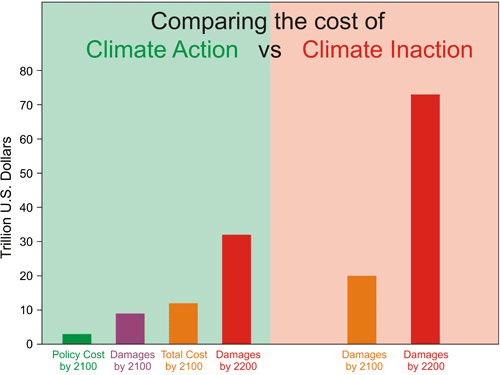
- But it’s worse than that. A set of assumptions and practices in economics has led economists both to underestimate the economic impact of many climate risks and to miss some of them entirely. That is a problem because, as the report notes, these “missing risks” could have “drastic and potentially catastrophic impacts on citizens, communities and companies.”One problem involves the nature of risk in a climate-altered world. Right now, carbon dioxide is at its highest concentration in the atmosphere in three million years (and still climbing). The last time levels were this high, the world was about five degrees Fahrenheit warmer and sea level 32 to 65 feet higher. Humans have no experience weathering sustained conditions of this type……..
A second difficulty involves parameters that scientists do not feel they can adequately quantify, like the value of biodiversity or the costs of ocean acidification. Research shows that when scientists lack good data for a variable, even if they know it to be salient, they are loath to assign a value out of a fear that they would be “making it up.”……A third and terrifying problem involves cascading effects. One reason the harms of climate change are hard to fathom is that they will not occur in isolation, but will reinforce one another in damaging ways. In some cases, they may produce a sequence of serious, and perhaps irreversible, damage…….
The urgency and potential irreversibility of climate effects mean we cannot wait for the results of research to deepen our understanding and reduce the uncertainty about these risks. This is particularly so because the study suggests that if we are missing something in our assessments, it is likely something that makes the problem worse.
This is yet another reason it’s urgent to pursue a new, greener economic path for growth and development. If we do that, a happy ending is still possible. But if we wait to be more certain, the only certainty is that we will regret it. https://www.nytimes.com/2019/10/23/opinion/climate-change-costs.html
Misuse of funds in South Africa”s nuclear reactor project
Is this outfit similar to ANSTO and the Lucas Heights reactor? They both seem like mavericks running their own show without accountability
The letter reveals that Necsa has been making massive operating losses since 2014, which have deteriorated over the years, and has resulted in various ring-fenced funds being irregularly used to meet operating expenses, including salaries. Continue reading
Science journalism – run by white men, but should be more diverse
 More Inclusive Science Journalism Is Better Science Journalism, Undark, 25 Oct 19 By expanding our pool of storytellers, we produce work that more fully reflects how science is done and why it matters. THIS YEAR, as in the past, the Nobel Prize’s science awards overwhelmingly went to white men. Nine of the 12 laureates in chemistry, physics, physiology or medicine, and economics were white men from North America or Europe, and only one was female. Many commenters noted the gender imbalance. Fewer pointed out the racial and ethnic imbalance. Although the skewed distribution of this year’s laureates doesn’t reflect the reality of today’s scientific workforce, it does drive public perception of what a scientist looks like……… More Inclusive Science Journalism Is Better Science Journalism, Undark, 25 Oct 19 By expanding our pool of storytellers, we produce work that more fully reflects how science is done and why it matters. THIS YEAR, as in the past, the Nobel Prize’s science awards overwhelmingly went to white men. Nine of the 12 laureates in chemistry, physics, physiology or medicine, and economics were white men from North America or Europe, and only one was female. Many commenters noted the gender imbalance. Fewer pointed out the racial and ethnic imbalance. Although the skewed distribution of this year’s laureates doesn’t reflect the reality of today’s scientific workforce, it does drive public perception of what a scientist looks like………
I’m also learning from my students. And here’s what they’ve shown me: More inclusive science journalism is better journalism. When we expand our pool of storytellers and broaden our horizons beyond the kinds of stories we’ve long told, we will produce work that more fully reflects the spectrum of how science is done and why it matters to society.
Indeed, I’ve already seen this in the time that I’ve directed the UC Santa Cruz program, which trains 10 young science writers each year. As a first step toward diversifying the field of science journalism, our program has worked to recruit a more diverse corps of science writing students. Our recent classes have included students of color; students from underrepresented communities; lesbian, gay, and bisexual students; nonbinary students; and students from all over the U.S. and the rest of the world. All of our incoming students are required to have science degrees and research experience. So my students have often experienced the inequities that frequently hamper the careers of female scientists and scientists of color. And they’ve seen that science journalism too often takes its cues from science: We tend to cover the topics and people that powerful and influential scientists themselves say are noteworthy. This perpetuates the very forces that distort science to begin with. https://undark.org/2019/10/24/more-inclusive-science-journalism-is-better-science-journalism/ |
|
Inexplicable silence on the danger of transporting nuclear wastes across Australia
 Paul Waldon Fight To Stop Nuclear Waste Dump In
  Flinders Ranges SA October 26 2019
Transportation of nuclear waste maybe one of the biggest, non talked about mediums responsible for the migration of radioactive contamination. If we don’t ship it to Hawker or Kimba it reduces the risk of contaminating such environments. Remember Australia has a “high grade” nuclear waste dump, it’s called ANSTO, Lucas Heights, and will remain so for more than ten years after it shuts its doors. https://www.facebook.com/groups/941313402573199/
USA’s Plowshare anti-nuclear activists found guilty of all charges

The seven defendants, known together as the Kings Bay Plowshares 7, are Elizabeth McAlister, 79; Jesuit Fr. Stephen Kelly, 70; Martha Hennessy, 64; Patrick O’Neill, 63; Clare Grady, 60; Mark Colville, 58; and Carmen Trotta, 57. Five of the seven — all but Hennessy and McAlister — represented themselves.
Bill Quigley, who represented McAlister and is a law professor at Loyola University New Orleans, said in a statement outside the courthouse that it was an “honor to be with these seven brave, courageous, faithful people.”
“They have told the truth despite the cost. They have taken their actions despite the risks. And they still have more consequences to go in their efforts to try and save all of our lives, and the lives of all of our children and grandchildren, and the lives of everybody around the world,” Quigley said.
The group was arrested in the early morning hours of April 5, 2018, on Kings Bay Naval Base where they broke in to perform a non-violent protest known as a “plowshares action,” taking its name from a verse in the book of Isaiah that says “nations will beat swords into plowshares.” The protest included symbolically hammering on statues of nuclear missiles, pouring human blood around the base and hanging banners with messages denouncing nuclear weapons.
In August 2019, a federal judge denied the activists’ request to dismiss charges under the Religious Freedom Restoration Act
During the trial, O’Neill told the jury that a dramatic protest was necessary to alert the world to the dangers of nuclear weapons.
Evidence presented by the prosecution suggested the protestors did a total of around $30,000 worth of damage to government property.
Following the verdict, the defendants remained positive and continued to pronounce their message of peace as they gathered with friends and family at a press conference outside the courthouse. They thanked their supporters, told stories, sang hymns and even danced around the sidewalk to profess their continued belief in their mission.
“It’s been an incredible experience and it’s not over yet,” said Hennessy. “The efficiency of the state can never be underestimated yet we proceed in humility. The weapons are still there, the treaties are being knocked down one after the next, but we are called to keep trying and we will do this together. We have no other choice.”
Judge Lisa Godbey Wood, who tried the case, ruled Oct. 18 that the defendants would not be allowed to bring in expert witnesses to speak to the dangers of nuclear weapons or the motivations of the defendants.
owever, following the verdict, O’Neill expressed gratitude that he and his co-defendants were able to testify about their beliefs concerning the immorality of nuclear weapons.
“I think collectively we said what needed to be said,” O’Neill said.
With the exception of Kelly — who remains in custody for outstanding charges in another state — all defendants were allowed to leave the courthouse on bond while they await their sentencing hearing.
Multiple defendants, all of whom are white, connected their case to issues with the criminal justice system and mass incarceration.
“The Pentagon has many installations and we just walked out of one of them,” said Colville. “It’s a place where they weaponize the law and they wield it mostly against the poor. … Once in a while people of privilege like us get a taste of it, and when we do, we should hear the word ‘guilty’ as a blessing on us because it gives us an opportunity to stand with people who hear ‘guilty’ all the time, every day.”
After the verdict was announced, Wood told the defendants they have 14 days to file a motion for a new trial, acquittal or any other motion they see fit.
[Jesse Remedios is an NCR Bertelesen intern. His email address is jremedios@ncronline.org.]
As in South Australia, indigenous people in USA oppose “temporary” nuclear waste storage, and its transport dangers
 Native American Pueblo leaders oppose nuclear facility near Carlsbad, Hobbs, https://www.oilandgas360.com/native-american-pueblo-leaders-oppose-nuclear-facility-near-carlsbad-hobbs-2/ in Press by— 360 Feed Wire
Oct. 24– Oct. 24–A group of Native American leaders opposed a plan to temporarily store nuclear waste at proposed facilities in southeast New Mexico and West Texas before a permanent repository is available.
The All Pueblo Council of Governors, which represents 20 sovereign nations in New Mexico and Texas held a meeting on Thursday where members affirmed their opposition to the projects, read a Monday news release from the group.
Concerns with the transportation of spent nuclear fuel rods drove the group’s opposition to two proposed consolidated interim storage (CIS) sites, one near the border of Eddy and Lea counties in New Mexico and another in Andrews, Texas. Continue reading
Governments increasingly able to manipulate social media
Media Ignore Unmasking of Twitter Exec as British Psyops Officer https://fair.org/home/media-ignore-unmasking-of-twitter-exec-as-british-psyops-officer/comment-page-1/#comment-3169114
Government penetration and control over media of little interest to those who are subject to it, ALAN MACLEOD, 24 Oct 19, A recent investigation from independent news outlet Middle East Eye (9/30/19) uncovered that a senior Twitter executive is, in fact, an officer in the British Army’s 77th Brigade, a unit dedicated to psychological operations (psyops), propaganda and online warfare.
For media so committed to covering news of foreign interference with US public opinion online (see FAIR.org, 8/24/16, 12/13/17, 7/27/18), the response was distinctly muted. Continue reading
The “water footprint”of solar and wind power is far less than for coal and nuclear
 Solar, wind power can alleviate water stress https://www.businesstimes.com.sg/energy-
 commodities/solar-wind-power-can-alleviate-water-stress MON, OCT 21, 2019 –
That’s the conclusion of research published this week by the European Union’s Joint Research Centre, which is urging the bloc’s leaders to pay closer attention to the amount of water used by traditional coal, natural gas and nuclear power plants.
It takes more than 1,300 litres of water – enough to fill four bathtubs – to generate the electricity each European resident uses each day.
“For the EU, to decarbonise and increase the share of renewables of its energy supply, it needs to formulate policies that take the water use of energy sources into account,” wrote water and energy researchers led by Davy Vanham. Solar, wind, geothermal and run-of-river hydropower account for a “small fraction” of water used compared with what is consumed by biofuels and traditional thermal plants, they said.
The findings focus attention on the rising competition for water resources among households, industry and agriculture, exacerbated by a string of heatwaves and lower rainfall levels that have prompted shutdowns at power plants across the continent during periods of peak strain. Some of those incidents have been traced back to climate change.
The issue has been replicated in the US, India and China, underscoring how policies that touch on water, energy and food supplies tend to have impacts in all three spheres.
Coal, oil and nuclear plants account for about 30 per cent of the water needed to produce the electricity that Europeans consume. That compares with a 1.7 per cent share for all renewables combined, including solar, wind, geothermal and hydropower combined.
“The choice of which renewables to promote is essential to alleviate water stress and maintain ecosystems and their services,” the peer-reviewed paper said. “Policies on future energy investments therefore need to consider which renewables have low unit water footprints.”
Thermal power plants need water to cool reactions and use the steam to turn giant turbines for electricity. Solar panels and wind turbines can turn sunshine and air currents directly into electricity without producing the residual heat.
The researchers looked at energy consumption and generation data from the 28 EU nations, overlayed with information on climate change and water resources. They pinpointed areas in France, Poland and Spain where big power plants rely on large volumes of water.
“Recent summer droughts and heatwaves, such as in 2003, 2006, 2015 and 2018, which will only become more frequent due to climate change, have already led to water being a limiting resource for energy production throughout the EU,” they wrote. BLOOMBERG
Nuclear costs – accidents, wastes – copped by the tax-payer
 This brings me to my biggest concern — the fact that those in our society whose business it is to determine risk will not insure nuclear power.
If you own a home, look at your homeowner’s insurance policy. You are not covered in the event of a nuclear accident. No one is. The nuclear industry exists only due to the liability limitations granted by Congress in the Price Anderson Act. Price Anderson requires the nuclear industry to fund an account of $12.6 billion. Any liability above that is supposed to be covered by taxpayers.
|
Nuclear energy is too costly and risky; better alternatives exist Common Ground / By Paul W. Hansen , 23 Oct 19, “……… Looking at the troubled history, poor economics, attendant risk and unsolved problem of nuclear waste disposal, I think there are much better alternatives for producing carbon free energy.
Today, there are 97 nuclear reactors in 29 states that produce electricity. Thirty-four reactors have been shut down. More orders for nuclear plants have been canceled than plants have been built. Only one plant has come online in the last 25 years. Early claims that nuclear power would be “too cheap to meter” proved false. Despite extensive public subsidies, nuclear plants across America have faced significant cost overruns……… Attempts to build new nuclear plants have been even more challenging. During the 1980s, the cost of Plant Vogtle’s first two nuclear units near Augusta, Georgia, jumped from an estimated $660 million to $8.87 billion. Regardless, 20 years later Georgia Power wanted to build the “next generation” of nuclear power plants. In August 2008, it was estimated that Plant Vogtle reactors 3 and 4 would cost $14.3 billion and begin operations in 2017. Today, updated estimates put the cost at $28 billion with an operation date of November 2022. The project is projected to be $14 billion over budget and more than 5 years behind schedule. The builder of the reactors, Westinghouse, has declared bankruptcy. In 2017, a similar two-unit plant in South Carolina, the V.C. Summer plant, was abandoned — costing about $5 billion. Concerns over the transportation and storage of highly radioactive spent nuclear fuel have prevented any nuclear waste repositories from being developed in the U.S. Spent fuel rods are stored onsite at nuclear plants. When uranium fuel is used up, usually after about 18 months, the spent rods are generally moved to deep pools of circulating water to cool down for about 10 years. The radioactive material is then transferred to metal casks. The waste remains dangerously radioactive for about 10,000 years. There is no plan for permanent disposal of this waste. This brings me to my biggest concern — the fact that those in our society whose business it is to determine risk will not insure nuclear power. If you own a home, look at your homeowner’s insurance policy. You are not covered in the event of a nuclear accident. No one is. The nuclear industry exists only due to the liability limitations granted by Congress in the Price Anderson Act. Price Anderson requires the nuclear industry to fund an account of $12.6 billion. Any liability above that is supposed to be covered by taxpayers. Then there are the issues of long-term decommissioning costs, nuclear accidents or terrorists. In Chernobyl and Fukushima, nuclear accidents have left large areas uninhabitable. What if the 9/11 terrorists had managed to crash those planes into the Indian Point Nuclear Power Plant north of New York City? While the reactor containment vessel might have survived the impact, the spent fuel rod pools may not have, leaving much of the New York metropolitan area uninhabitable. Nuclear energy has not worked out as planned. Far more carbon-free power can be generated at far less cost and risk by renewable energy and energy efficiency programs. https://www.jhnewsandguide.com/opinion/columnists/common_ground/nuclear-energy-is-too-costly-and-risky-better-alternatives-exist/article_71a11439-581d-572f-87c7-88dad34ddf74.html |
|
|
David Attenborough says humans have made ‘tragic, desperate mess’ of planet,
David Attenborough says humans have made ‘tragic, desperate mess’ of planet,
Broadcaster urges people to look after natural world as he launches new series with conservation ‘at its heart’ , Independent UK, Chris Baynes 21 Oct 19, Humanity has made a “tragic, desperate mess” of the planet, Sir David Attenborough has said.
The veteran broadcaster urged people to “look after the natural world” and waste nothing, as he prepared for his latest series to air this week.
Seven Worlds, One Planet, breaks with the tradition of previous BBC Natural History Unit programmes by putting a conservation message “at its heart”, instead of being tagged on at the end of each episode.
The series, which has been four years in the making, features wildlife firsts and has already been bought by broadcasters around the world.
Producers took drones over “volcanoes, waterfalls, icebergs and underground into caves” to shoot heart-wrenching “animal dramas” in all seven continents, the BBC said.
Dramatic scenes include a lone, grey-headed albatross chick in Antarctica being blown off its nest as a result of increasingly intense storms in the region.
Speaking at the launch, Sir David, who presents the programme, said: “We are now universal, our influence is everywhere. We have it in our hands, and we made a tragic, desperate mess of it so far. But, at last, nations are coming together and recognising that we all live on the same planet … and we are dependent on it for every mouthful of food we eat and every breath of air we take.”
Asked what we can do to save the planet, Sir David, 93, said: “The best motto … is not to waste things.
“Don’t waste electricity, don’t waste paper, don’t waste food – live the way you want to live, but just don’t waste.”
The broadcaster added: “Look after the natural world, the animals in it and the plants in it too. This is their planet as well as ours. Don’t waste.”
The seven-part series will reveal “new species and behaviours,” producers said……..
Antarctica, North America, South America, Europe, Africa, Asia and Australia will feature over different episodes in the seven-part series.
Seven Worlds, One Planet begins on Sunday 27 October at 6.15pm on BBC One. https://www.independent.co.uk/news/media/tv-radio/david-attenborough-new-series-seven-worlds-one-planet-climate-change-a9161866.html?fbclid=IwAR1hZAJJwhms9zcQNCCcn-PP4-D3vAjhHLZxHL9lFGUTmL1I1IWN5q3u4KE
A new wave of anti-nuclear action in Washington
On Sept. 29, Washington Physicians for Social Responsibility held a town hall on Washington’s history with nuclear weapons that brought together anti-war, environmental and Indigenous rights activists. Activists marched on the Federal Building in Seattle the following day to protest Trump’s nuclear policies. Continue reading
Jane Fonda arrested with Sam Waterston in climate change protest
“We can do this!” Waterston, 78, said during the protest. “We need something to push for that’s as big as the problem.”
“This is an ongoing action to draw attention and a sense of urgency to the climate crisis,” Fonda said before her arrest. “Make no mistake, change is coming, whether we like it or not. Change is coming by disaster, or change is coming by design.”
The actors were seen with zip ties around their wrists by police following a demonstration in Washington, D.C, in front of the Library of Congress.
“We can do this!” Waterston, 78, said during the protest. “We need something to push for that’s as big as the problem.”
“This is an ongoing action to draw attention and a sense of urgency to the climate crisis,” Fonda said before her arrest. “Make no mistake, change is coming, whether we like it or not. Change is coming by disaster, or change is coming by design.”
The actors were seen with zip ties around their wrists by police following a demonstration in Washington, D.C, in front of the Library of Congress. …… https://www.msn.com/en-au/news/world/jane-fonda-arrested-with-sam-waterston-in-climate-change-protest/ar-AAIZPb1?ocid=spartandhp
1 This month

of the week – Australians for War Powers Reform (AWPR)
To see nuclear-related stories in greater depth and intensity
 Antinuclear