Hurricane Hagibis Spreads Fukushima Radiation (But No, 2,667 Bags of Decontaminated Waste were NOT Washed Away!)
https://nuclear-news.net/2019/10/17/hurricane-hagibis-spreads-fukushima-radiation-but-no-2667-bags-of-decontaminated-waste-were-not-washed-away/ Nuclear HotSeat BY NHADMIN OCTOBER 16, 2019 Fukushima Hurricane Hagibis Flooding – deluge of water washes full bags of “decontaminated” soil, plants, and other radioactive matter into Furumichi river near the Japanese city of Tamura in Fukushima Prefecture (above). No report yet on how much radioactive material from the decomposing, torn waste bags was washed back into the environment. http://nuclearhotseat.com/2019/10/16/fukushima-hurricane-hagibis-flooding-spreads-radiation-risks/
|
Below are brief extracts – transcript from this important podcast.
Hurricane Hagibis – Alarms went off – City said an unknown number of radioactive waste bags were lost…
Each bag weighs more than one tonne…. some bags not swept away but still damaged
Nancy Faust of SimplyInfo.org. “- not enough information yet… Tepco did have time to prepare for the typhoon.
Tepco phrased it vaguely about the readings of radioactivity – equipment is monitored – readings showed that rain-water was leaking in to various facilities. They measured only the water itself, not radiation. Tepco has not talked about how much water is coming in to the reactor. We worry about how much water is coming in , and then washing things out.”
Question: Do we know how many bags of radioactive material were washed away?
“One report from one city Tamara City – has 2667 bags onsite – did not say how many were washed away -said that 6 were found….. We don’t know yet how many were washed away
We also don’t know the condition of these bags at the storage site. Older bags at higher risk of breaking. They have a lifespan of about 6 years. Also we don’t know what the level of radioactivity is in these bags.
We may get some bits of information about how much radiation was dispersed over the next weeks. Simply Info will be looking for differences in radiation level reports. Tepco not legally obliged to give this information.
From Arnie Gunderson.
Sean McGee reminds that there will be dispersal of radiatioactive material after the area dries out, and from the mountains.
The story that all 2667 bags were swept away is incorrect . That imprecision in the report was in the headline.
The Japanese government and Tepco will try to obscure the facts. It’s incumbent upon us to be accurate. |
|
Building dams and praying for rain is not a drought policy

Building dams and praying for rain is not a drought policy. We are in a climate emergency and it is our farmers and the environment who are suffering because of inaction from this government
Typhoon Hagibis floods carry away thousands of Fukushima’s radioactive nuclear waste bags
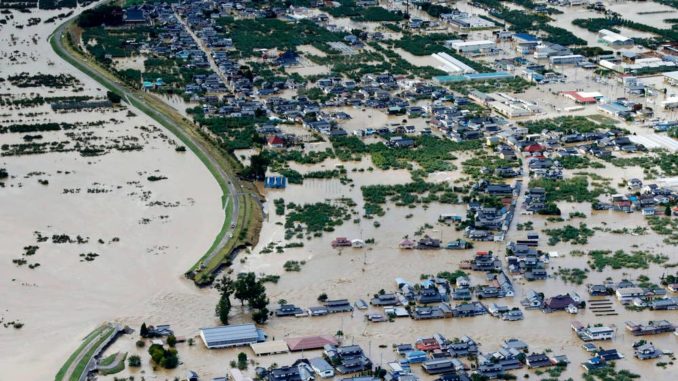
2,667 Radioactive Bags From Fukushima Swept Away By Typhoon Hagibis https://newspunch.com/1667-radioactive-bags-fukushima-swept-away-typhoon-hagibis/, October 14, 2019 Baxter Dmitry As Typhoon Hagibis hammered Japan on Saturday, thousands of bags containing radioactive waste at Fukushima were reportedly carried into a local stream by floodwaters.Experts warn the radioactive bags could have a devastating environmental impact across the entire Pacific region, reports Taiwan News.
According to Asahi Shimbun, a temporary storage facility containing 2,667 bags storing radioactive contaminants from the 2011 Fukushima nuclear disaster were “unexpectedly inundated by floodwaters brought by Typhoon Hagibis.“
Torrential rain flooded the storage facility and released the bags into a waterway 100 meters from the site.
Officials from Tamara City in Fukushima Prefecture said that each bag is approximately one cubic meter in size.
Authorities were only able to recover six of the bags by 9 p.m. on Oct. 12 and it is uncertain how many remain unrecovered while the potential environmental fallout is being assessed.
The radioactive waste swept away by Typhoon Hagibis represents the latest setback for Fukushima officials who have struggled to adequately quarantine the radiation.
StatesmanJournal reports: Seaborne radiation from Japan’s Fukushima nuclear disaster has been detected on the West Coast of the United States.
Cesium-134, the so-called fingerprint of Fukushima, was measured in seawater samples taken from Tillamook Bay and Gold Beach in Oregon, researchers from the Woods Hole Oceanographic Institution are reporting.
Because of its short half-life, cesium-134 can only have come from Fukushima.
Also for the first time, cesium-134 has been detected in a Canadian salmon, the Fukushima InFORM project, led by University of Victoria chemical oceanographer Jay Cullen, is reporting.
In both cases, levels are extremely low, the researchers said, and don’t pose a danger to humans or the environment.
Massive amounts of contaminated water were released from the crippled nuclear plant following a 9.0 magnitude earthquake and tsunami in March 2011. More radiation was released to the air, then fell to the sea.
Japan’s typhoon sweeps away radioactive waste bags in Fuushima Prefecture

TAMURA, Fukushima Prefecture–Bulk bags filled with greenery collected during decontamination efforts after the nuclear disaster at the Fukushima No. 1 nuclear power plant were swept into a river during Typhoon No. 19 on Oct. 12.
According to the Tamura city government, the bags were among 2,667 that have been stored temporarily at a site in the Miyakoji-machi district here.
The facility was flooded after heavy rains brought by the typhoon, and the water carried an unknown number of the bags to a river about 100 meters away.
A city government official received a phone call at around 9:20 p.m. on Oct. 12 from a nearby civil engineering firm, saying six of the bulk bags had been recovered from the river.
Each of the bulk bags was 1 cubic meter in size. No sheets had been placed over the bags as a precaution against the rain and wind from the typhoon.
A city official said consultations will be held with the Environment Ministry to determine possible effects on the environment.
The decontamination effort involved removing debris, such as soil, leaves and plants, containing radioactive substances released after the 2011 triple meltdown at the Fukushima No. 1 plant.
 |
ReplyForward
|
A radioactive dump is not an economic rainmaker.
Paul Waldon Fight To Stop Nuclear Waste Dump In Flinders Ranges SA, October 13, 19
One early report has Bill Gates, the owner of 108,502,519 Republic Services shares, valued at $6.9 billion deliver a recent return of $3 billion. Yes he is a wealthy man, but what about the people living adjacent to the nuclear waste belonging to the company, the company that Gates owns more than 30% of. The radioactive waste I refer to is adjacent to the working class suburb of Bridgeton, St Louis where sub-surface fires regularly produce noxious odors that waft across such neighbourhoods.
So is this the case of the truly needy and the truly greedy, could this be Hawker or Kimba, remember these sites failed to meet any and more of the Department of Industry, Innovation and Science criteria for the safe abandonment of deadly radioactive waste. https://www.facebook.com/groups/1021186047913052/
Devastating effect of Typhoon Hagibis on Japan, including on Fukushima
|
Why Typhoon Hagibis packed such a deadly, devastating punch in Japan, The Age, 15 Oct 19 Typhoon Hagibis proved to be extraordinarily devastating for northern Japan when it struck on the weekend, unleashing nearly one metre of rain in just 24 hours in some locations, causing widespread flash flooding as well as river flooding……
………….As the core of the storm pulled away from Tokyo Sunday, it dumped heavy rains across Toshigi as well as Fukushima Prefecture. Floodwaters there have raised concerns about radioactive contamination following the 2011 Fukushima nuclear disaster.
Typhoon Hagibis will go down in Japanese history as a multibillion-dollar disaster. The storm’s widespread impacts and high death toll are unusual for Japan, since the country is one of the best-prepared in the world for natural disasters
Climate studies suggest that the Japanese Archipelago could see more frequent and stronger typhoons in the future, due in large part to warming seas as a result of human-caused global warming. There is evidence showing that tropical cyclones in the Northwest Pacific Ocean Basin are reaching their maximum intensities further north than they used to, a trend some scientists attribute in part to climate change. This could send more intense storms into areas that typically see weaker storms, such as Honshu and other parts of northern and northeastern Japan.
One trend that is especially clear is that damage costs from typhoons in Japan are escalating, with three of the top 10 most expensive Japanese typhoons since 1950 occurring in the past 2 years alone. Typhoon Faxai, which affected Tokyo in early September. Typhoon Hagibis is extremely likely to increase this number to four. https://www.theage.com.au/world/asia/why-typhoon-hagibis-packed-such-a-deadly-devastating-punch-in-japan-20191015-p530o7.html
|
|
|
‘Curse of Flamanville’ strikes again as cost of EDF’s nuclear reactor soars
 ‘Curse of Flamanville’ strikes again as cost of EDF’s reactor soars, 14 Oct 19, The French energy group that is building Britain’s new nuclear reactors has admitted that a similar project in Normandy will cost almost four times the original estimate.
EDF said that its European pressurised reactor in Flamanville was now expected to cost €12.4 billion. This is €1.5 billion more than the previous estimate.
Initially it was supposed to cost €3.3 billion and the reactor was supposed to come on stream in 2012. The company says that under the revised plan it hopes to load fuel at Flamanville at the end of 2022, a decade late.
EDF is an electrity business with interests worldwide, including operating 58 nuclear reactors in its home country. It is majority-owned by the French state, which holds an 83.7 per cent stake…(subscribers only) https://www.thetimes.co.uk/edition/business/edf-admits-flamanville-reactor-will-cost-four-times-original-estimate-k55qjn9b5?fbclid=IwAR0-APtlBA77Q8ixdA4VPMl3YCO24A_ivA0dL9Xf_Hyo0mwKn4w0898zmjY
Buried nuclear waste stays dangerous for a million years
Quite apart from the technological challenges and ethical issues these solutions present, both have one major drawback: to be successful they rely on external, uncontrollable factors. How could the knowledge required to interpret these things this be guaranteed to last?
Semiotician Thomas Sebeok recommended the creation of a so-called Atomic Priesthood. Members of the priesthood would preserve information about the waste repositories and hand it on to newly initiated members, ensuring a transfer of knowledge through the generations.
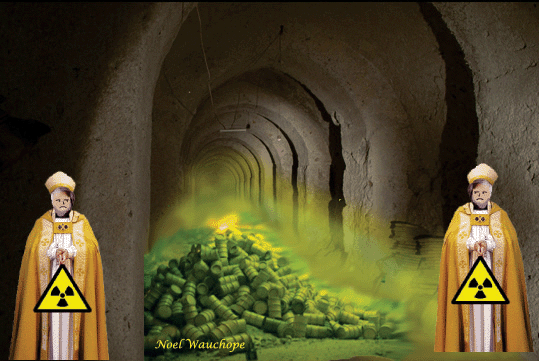
Buried nuclear waste stays dangerous for a million years — here’s how scientists plan to stop a future disaster
In thousands of years’ time, will they even understand the language written on our ‘keep out’ signs? https://inews.co.uk/news/long-reads/buried-nuclear-waste-danger-underground-future-disasters-814704
Here, deep beneath the sleepy fields and quiet woods along the border of the Meuse and Haute-Marne departments in north-east France, the French National Radioactive Waste Management Agency (Andra) has built its underground research laboratory.
The laboratory’s tunnels are brightly lit but mostly deserted, the air dry and dusty and filled with the hum of a ventilation unit.
Blue and grey metal boxes house a series of ongoing experiments – measuring, for example, the corrosion rates of steel, the durability of concrete in contact with the clay. Using this information, Andra wants to build an immense network of tunnels here.
It plans to call this place Cigéo, and to fill it with dangerous radioactive waste. It is designed to be able to hold 80,000 cubic metres of material.
Long-term risks of nuclear waste Continue reading
The impossibility of nuclear power solving climate change

|
Two nuclear power plants a week nwi times.com Eric Peters, 14 Oct 19, “…………According to a very interesting analysis by professor Roger Pielke of the University of Colorado published recently by Forbes, [to reach zero carbon emissions] it would entail putting at least one new nuclear reactor online every week until 2030 or 2050 (the number of new reactors needed to get to “net zero” carbon-dioxide emissions depending on how soon we want to get there). Leaving aside the regulatory hurdles involved in permitting a single new plant — and the money that would be have to be found to finance the construction of scores of new plants.
Pielke is a mathematician who has done the math, and the numbers are daunting. ……
Pielke, who is also a climate scientist who worked at the National Center for Atmospheric Research, says the only way to replace that much fossil fuel energy with “carbon-neutral” energy using actually feasible technology would be to use nuclear energy. A lot of it.
In his Forbes article, Pielke explains that one nuclear power plant like the Turkey Point reactor complex in Homestead, Florida, generates the equivalent of about 1 million metric tons (1 mteo) of fossil-fueled energy each year. That’s a lot of juice but it hardly puts a dent in the problem………..
Pielke cites International Energy Projections about world energy demand tomorrow. The IEA estimates that “global energy consumption will increase by at least 1.25 percent per year to 2040.”
This will mean a lot more mteos and reactors (or some other carbon-neutral way) to produce them.
“To achieve net-zero carbon dioxide emissions by 2050, the world would need to deploy three Turkey Point nuclear plants’ worth of carbon-free energy every two days, starting tomorrow and continuing to 2050,” Pielke writes. “And at the same time,” he adds, the fossil-fueled equivalent of one Turkey Point plant would have to be “decommissioned every day, starting tomorrow and continuing to 2050.” This isn’t just a tall order. It’s an impossible one……. https://www.nwitimes.com/opinion/columnists/guest-commentary/guest-commentary-two-nuclear-power-plants-a-week/article_a206346c-d2f9-55d7-b935-6782b4001cd5.html |
|
Typhoon #Hagibis re-spreads #nuclear contamination far and wide – Workers heightened risk at #Fukushima
Shaun McGee, nuclear-news.net 13 Oct 19, The latest typhoon to hit Japan has slammed into the area around the Fukushima nuclear plant triggering nuclear contamination of land and waterways that means TEPCO will need to redo a lot of the cleanup they have already done.
Also, contamination workers will have to sort out the damaged remaining nuclear waste plastic bags which will be a risky procedure because of the high Gamma “dose” levels, as well as the particulates of isotopes that can be ingested, inhaled and in the case of micro particles through safety clothing and skin.
Just when we thought TEPCO might be getting a handle on the waste issue (in limited areas) and therefore the health risks, we see 8 years hard work and health risks being repeated again.
Rivers, waterways and drinking water are at risk from these contaminants with both radiological and toxic dangers. Food in the fields, fish in the sea and both human and animals are all at risk.
Taiwan has made representations on the issue of Sea contamination; In fact not only were the bags of nuclear waste damaged but many were completely washed away;
Also, inside the nuclear plant itself radiation alarms went of as the typhoon struck. TEPCO maintain that it was only a malfunction but if that is the case it still shows that the sensitive areas on the devastated nuclear site are insecure and now exposed to the air;
Also, inside the nuclear plant itself radiation alarms went of as the typhoon struck. TEPCO maintain that it was only a malfunction but if that is the case it still shows that the sensitive areas on the devastated nuclear site are insecure and now exposed to the air;
The temperatures after the Typhoon meant that high humidity and the more general damage in the Fukushima Prefecture will hamper repair and cleanup. Also, clean up will prove difficult as there are radioactive hotspots possibly all over the Fukushima prefecture and along the coastline. I am sure testing for the spread of radiation will be left to a few dedicated citizen radiation monitors (whose work is often shared on this blog – nuclear-news.net).
Once again the citizens of Fukushima who remained or who have returned and have battled to reconstruct their homes and business`s suffer another double whammy of natural disaster and nuclear disaster.
Here at nuclear-news.net, our hearts and prayers go to the people of Fukushima and other effected areas, wishing a speedy recovery. Our thoughts too to the injured and to those that have died. Namaste. …… https://nuclear-news.net/2019/10/14/typhoon-hagibis-re-spreads-nuclear-contamination-far-and-wide-workers-heightened-risk-at-fukushima/
Hundreds of climate scientists back Extinction Rebellion protest movement
|
Hundreds of climate scientists call on protesters to step up efforts to save the planet, https://thenewdaily.com.au/news/world/2019/10/13/climate-scientists-call-for-more-protests/ More than 300 scientists have endorsed a civil disobedience campaign aimed at forcing governments to take rapid action to tackle climate change, warning that failure could inflict “incalculable human suffering”.In a joint declaration made in London, climate scientists, physicists, biologists, engineers and others from at least 20 countries, including Australia, broke with the caution traditionally associated with academia to side with peaceful protesters from The Netherlands to Australia.
Wearing white laboratory coats to symbolise their research credentials, a group of about 20 of the signatories gathered on Saturday to read out the text outside London’s Science Museum. “We believe that the continued governmental inaction over the climate and ecological crisis now justifies peaceful and non-violent protest and direct action, even if this goes beyond the bounds of the current law,” said Emily Grossman, a science broadcaster with a PhD in molecular biology, who read the declaration on behalf of the group. “We therefore support those who are rising up peacefully against governments around the world that are failing to act proportionately to the scale of the crisis,” she said. The declaration was co-ordinated by a group of scientists who support Extinction Rebellion, a civil disobedience campaign that formed in Britain a year ago and has since sparked offshoots in dozens of countries. The group launched a fresh wave of international actions on Monday, aiming to get governments to address an ecological crisis caused by climate change and accelerating extinctions of plant and animal species. A total of 1,307 volunteers had since been arrested at various protests in London by Saturday, Extinction Rebellion said. A further 1,463 volunteers have been arrested in the past week in another 20 cities, including Brussels, Amsterdam, New York, Sydney and Toronto, according to the group’s tally. More protests in this latest wave are due in the coming days. While many scientists have tended to shun overt political debate, preferring to confine their public pronouncements within the parameters of their research, the academics backing Extinction Rebellion say they feel compelled to speak out. “The urgency of the crisis is now so great that many scientists feel, as humans, that we now have a moral duty to take radical action,” Grossman told Reuters. Other signatories included several scientists who contributed to the UN-backed Intergovernmental Panel on Climate Change, which has produced a series of reports underscoring the urgency of dramatic cuts in carbon emissions. Extinction Rebellion has electrified supporters who said they had despaired at the failure of conventional campaigning to spur action. But its success in paralysing parts of London has also angered critics who complained the movement has inconvenienced thousands of people and diverted police resources. The group said more than half the signatories of the declaration are experts in the fields of climate science and the loss of wildlife. Although British universities and institutes were well represented, signatories also worked in countries including Australia, the United States, Spain and France. |
|
Marshall Islands, stuck with low lying nuclear waste, declares a Climate Emergency
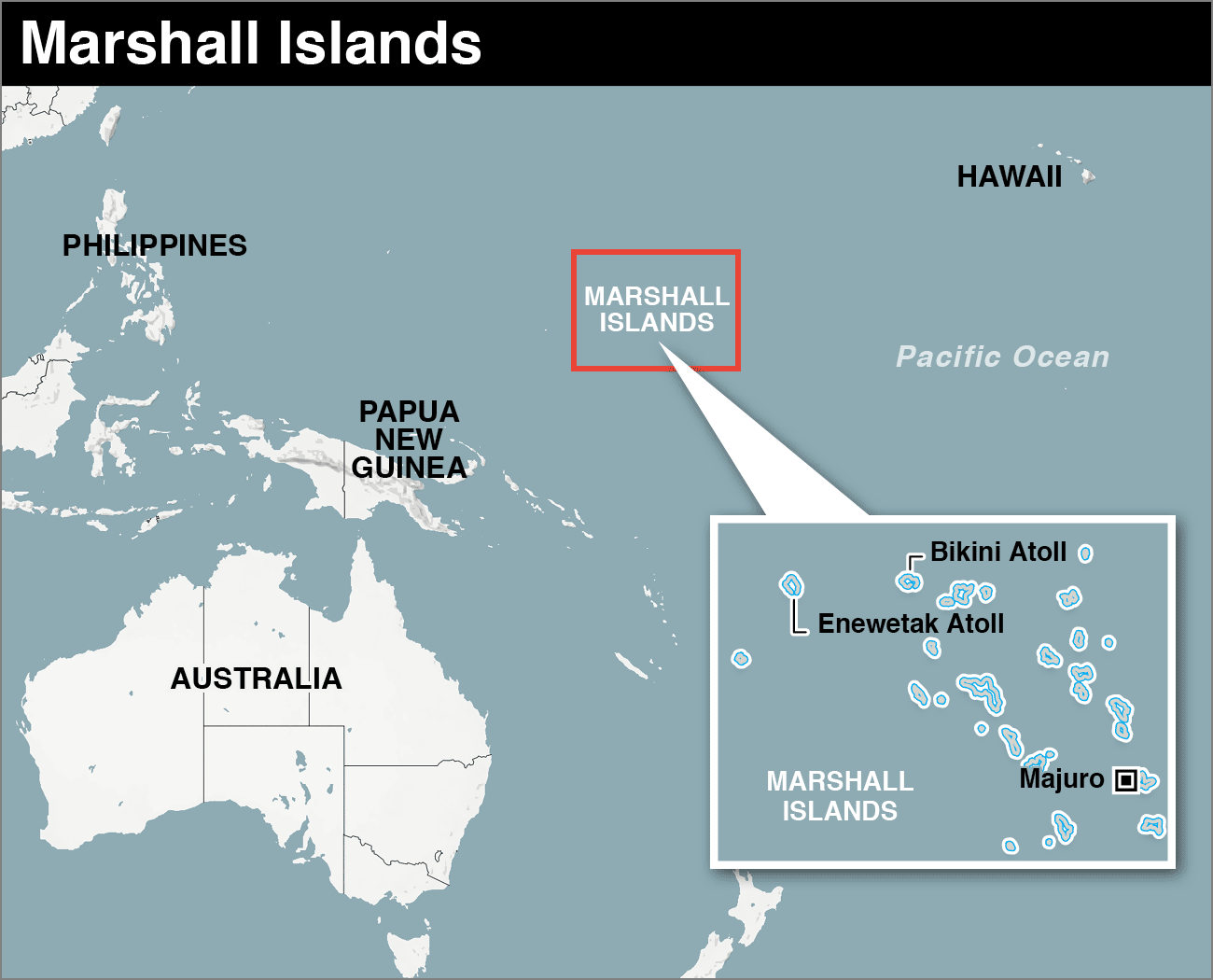
Marshall Islands, low-lying US ally and nuclear testing site, declares a climate crisis https://www.heraldmailmedia.com/news/nation/marshall-islands-low-lying-us-ally-and-nuclear-testing-site/article_4b37cc0d-040d-5b2a-b83e-1df6d71dfb74.html, By Susanne Rust Los Angeles Times (TNS), Oct 11, 2019
-
- The Marshall Islands, a low-lying chain of atolls and key U.S. ally in the Central Pacific, has declared a national climate crisis because of the mounting risk of sea-level rise, the nation’s president announced this week.
The nation’s parliament, the Nitijela, overwhelmingly supported a measure that calls upon the international community to step up its efforts to mitigate global warming and provide aid to nations unable to finance safeguards against rising seas.
“As one of only four low-lying coral atoll nations in the world, the failure of the international community to adequately respond to the global climate crisis of its own making holds particularly grave consequences,” wrote President Hilda Heine in a tweet Wednesday.
Low-lying coral atoll nations such as the Marshall Islands, Kiribati and Tuvalu in the Pacific and the Maldives in the Indian Ocean are particularly vulnerable to rising oceans, averaging just a few feet above sea level. There have already been episodes of “King Tide” flooding in the Marshall Islands, which consists of 29 coral atolls, located about 5,000 miles from Los Angeles and 2,000 from Hawaii.
A recent Intergovernmental Panel on Climate Change report warned that sea level could rise by 1 to 4 feet by 2100, potentially submerging many of these nations, and by 2050, making many uninhabitable.
The report echoes research sponsored by the Department of Defense, which found Kwajalein Atoll, where the U.S. leases a strategic military base, could become unlivable by 2030, if the Antarctic ice sheet were to melt. Mid-century inhabitability due to flooding, storm waves and ground water contamination by salt water was predicted in a more conservative model.
The resolution calls upon the Nitijela to “unite fully and unequivocally behind the science” and to recognize the rights of the Marshallese youth to grow up in a “climate safe future.”
It asks the international community to “consider additional ways to respond to and support the extreme vulnerability and special circumstances” unique to low-lying coral atoll islands, such as the Marshall Islands.
“Prolonged and unseasonal droughts are hitting us real hard, and saltwater is creeping into our freshwater lands,” said Heine last month at the United Nations Climate Action conference in New York. “We are on the very front line of climate change.”
The United States used the Marshall Islands as a nuclear testing ground during the Cold War, detonating 67 nuclear bombs on the nation between 1946 and 1958.
The U.S. is committing $10 million to the Pacific region for disaster resilience, weather forecasting and “to address environmental challenges,” said a U.S. State Department spokesperson Friday. “The United States recognizes that addressing environmental degradation and climate change is a priority in the Pacific — especially for the Marshall Islands — due to the threat posed by sea level rise and the region’s vulnerability to natural disasters.”
An example , from UK, of media’s mindless and incorrect spin on ‘Rediscover Nuclear’
 Radiation Free Lakeland 12th Oct 2019, New Nuclear** On the anniversary of the Windscale disaster and in the midst of the building of a new gas plant especially for Sellafield, the North West Evening Mail publishes a press release from the nuclear industry touting the ‘Rediscover Nuclear’ campaign.
Some of the laughable descriptions include “homegrown” “safe” “low carbon”. Each of these claims is a big fat lie. As Phil Johnstone tweets: UK “homegrown” nuclear. “UK only ever sold 2 reactors back in 60s, British Energy no longer exists. The UK doesn’t really have much of a civil nuclear industry. What is “homegrown” about it? Electricite de France? China General Nuclear Power Corporation?
https://mariannewildart.wordpress.com/2019/10/12/homegrown-dont-make-me-laugh/
Energy – the most effective, but most neglected, way to cut back carbon emissions
Business Green 10th Oct 2019, Energy Efficiency. The public needs reminding that saving energy is good for the planet, argues Andrew Warren.
British people are very confused about what they should most usefully be doing, in order to assuage any guilt they might feel about damaging the climate. A Smart Energy GB study released this week found just three in 10 people think being energy efficient would have the biggest impact on protecting the environment.
This startling finding was backed up another a survey of 2,000 people undertaken by Opinium Research. That found saving energy tends to come way down the list of possible practical response under consideration. The most popular response to the Opinium survey was to “avoid throwing away food”. This was followed by various moves to reduce plastic wastage – buying plastic-packed groceries, single-use plastic bottles, using plastic shopping bags – or simply not recycling enough.
Steven Day, co-founder of Pure Planet, which sponsored the opinion survey, commented: “It is great that the majority of people are thinking more about their impact on our environment. But it looks like they
are feeling guilty about the smaller things – not the biggest-impact
activities causing the greatest harm.”
This lack of awareness of the potential for saving energy contrasts enormously with similar surveys undertaken twenty years ago, admittedly when overall awareness of the threat of climate change was far lower. Then, the vast majority of people would always respond to questions to the threat of climate change by emphasising the need to save energy, both at home and at work.
Since 2010 there have been no publicly funded awareness campaigns supporting energy efficiency funded by central government. Their abandonment directly followed the privatisation of the two main public advice agencies, the Energy Saving Trust and the Carbon Trust.
Google invests in climate-denying think tanks

Google and other companies were engaged in a “functional greenwashing” given the contradiction in their public pronouncements and private donations.
Revealed: Google made large contributions to climate change deniers https://www.theguardian.com/environment/2019/oct/11/google-contributions-climate-change-deniers
Firm’s public calls for climate action contrast with backing for conservative thinktanks. The obscure law that explains why Google backs climate deniers, Stephanie Kirchgaessner in Washington @skirchy Email 11 Oct 2019
Google has made “substantial” contributions to some of the most notorious climate deniers in Washington despite its insistence that it supports political action on the climate crisis.
Among hundreds of groups the company has listed on its website as beneficiaries of its political giving are more than a dozen organisations that have campaigned against climate legislation, questioned the need for action, or actively sought to roll back Obama-era environmental protections.
The list includes the Competitive Enterprise Institute (CEI), a conservative policy group that was instrumental in convincing the Trump administration to abandon the Paris agreement and has criticised the White House for not dismantling more environmental rules.
Google said it was disappointed by the US decision to abandon the global climate deal, but has continued to support CEI.
Google is also listed as a sponsor for an upcoming annual meeting of the State Policy Network (SPN), an umbrella organisation that supports conservative groups including the Heartland Institute, a radical anti-science group that has chided the teenage activist Greta Thunberg for “climate delusion hysterics”.
SPN members recently created a “climate pledge” website that falsely states “our natural environment is getting better” and “there is no climate crisis”.Google has defended its contributions, saying that its “collaboration” with organisations such as CEI “does not mean we endorse the organisations’ entire agenda”
It donates to such groups, people close to the company say, to try to influence conservative lawmakers, and – most importantly – to help finance the deregulatory agenda the groups espouse.A spokesperson for Google said it sponsored organisations from across the political spectrum that advocate for “strong technology policies”.“We’re hardly alone among companies that contribute to organisations while strongly disagreeing with them on climate policy,” the spokesperson said.
Amazon has, like Google, also sponsored a CEI gala, according to a programme for the event reported in the New York Times.CEI has opposed regulation of the internet and enforcement of antitrust rules, and has defended Google against some Republicans’ claims that the search engine has an anti-conservative bias.
But environmental activists and other critics say that, for a company that purports to support global action on climate change, such tradeoffs are not acceptable.“You don’t get a pass on it. It ought to be disqualifying to support what is primarily a phoney climate denying front group. It ought to be unacceptable given how wicked they have been,” said Sheldon Whitehouse, a Democratic senator from Rhode Island who is one of the most vocal proponents of climate action in Congress.“What all of corporate America should be doing is saying if you are a trade organisation or lobby group and you are interfering on climate, we are out. Period,” he added.On its website, Google says it is committed to ensuring its political engagement is “open, transparent and clear to our users, shareholders, and the public”.
Bill McKibben, a prominent environmentalist who has been on the frontline of the climate crisis for decades, said Google and other companies were engaged in a “functional greenwashing” given the contradiction in their public pronouncements and private donations. He said Google and other technology companies had also not used their own lobbyists to advocate for change on climate.
“Sometimes I’ll talk to companies and they will be going on and on about their renewable server farm or natural gas delivery, and I say thank you, but what we really need is for your lobbying shop in Washington to put serious muscle behind it. And they never do,” McKibben said. “They want some tax break or some regulations switch and they never devote the slightest muscle behind the most important issue of our time or any time.”A spokesperson for Google said: “We’ve been extremely clear that Google’s sponsorship doesn’t mean that we endorse that organisation’s entire agenda – we may disagree strongly on some issues.“Our position on climate change is similarly clear. Since 2007, we have operated as a carbon neutral company and for the second year in a row, we reached 100% renewable energy for our global operations.”The company said it called for “strong action” at the climate conference in Paris in 2015 and helped to sponsor the Global Climate Action summit in San Francisco last year.But that position is at odds with the support it gives to CEI.The group’s director of energy and environment policy, Myron Ebell, helped found the Cooler Heads Coalition 20 years ago, a group of libertarian and rightwing organisations that have sowed the seeds of climate denial with funding from the fossil fuel industry.
When Donald Trump was elected to the White House in 2016, Ebell joined the transition team and advised the new president on environmental issues, successfully lobbying Trump to adhere to a campaign promise and abandon the Paris agreement.
Kert Davies, the founder of the Climate Investigations Center, a research group that examines corporate campaigning, said Ebell had led the anti-climate-action crusade for decades.
“They’re extremists,” he said, referring to the Cooler Heads Coalition. “They are never finished,” he said. “Myron has taken a lot of credit for Trump’s actions and is quite proud of his access.”
Recently, however, Ebell – who declined a request for an interview – has criticised the White House for not rolling back environmental protections aggressively enough, even though the Trump administration has gutted every major environmental act established under Obama.
His wishlist now includes reversing a 2009 finding by the Environmental Protection Agency that CO2 and other greenhouse gases endanger the health and welfare of Americans.
CEI said it “respects the privacy of its donors” and declined to answer questions about Google. A CEI spokesperson told the Guardian: “On energy policy, CEI advances the humanitarian view that abundant and affordable energy makes people safer and economies more resilient. Making energy accessible, especially for the most vulnerable, is a core value.”
One source who is familiar with Google’s decision-making defended the company’s funding of CEI.
“When it comes to regulation of technology, Google has to find friends wherever they can and I think it is wise that the company does not apply litmus tests to who they support,” the source said.
1 This month

of the week – Australians for War Powers Reform (AWPR)
To see nuclear-related stories in greater depth and intensity
 Antinuclear