UN bars coal nations from climate stage. (especially Australia)
THE AUSTRALIAN 18 Sept 19, Australia has been barred from speaking at a UN climate summit in New York next week….. (subscribers only)
Hot, dry summer to increase Vic bushfire risk
Herald Sun, 18 Sep 19 The state’s emergency services are urging Victorians to “be prepared” for an increased risk of bushfires ahead of predicted warm temperatures and lack of rain….. (Subscribers only)
France to give out free iodine tablets to 2.2 million people
|
France will give out free iodine tablets to around 2.2 million people living close to nuclear plants to help protect them from radiation in case of an acciden https://eutoday.net/news/environment/2019/france-to-distribute-out-free-iodine-tablets-to-2-2-million-peoplet, Euronews reports. The country’s nuclear regulator agency ASN said on Tuesday people living within 10-20 kilometres from one of EDF’s 19 nuclear plants, as well as some 200,000 institutions including schools, will receive a letter in the incoming days informing them they can pick up the tablets from the nearest pharmacy. Previously, France distributed iodine tablets to people living within a 10 kilometre radius from a nuclear plant but has now decided to widen the radius. During nuclear accidents, radioactive iodine is released into the atmosphere that when inhaled or swallowed by the thyroid gland can cause cancer in later years. When the thyroid gland is saturated with stable iodine, it no longer absorbs the radioactive iodine. ASN said that in case of a nuclear accident, people should seek shelter in buildings and not go pick up their children from school. France is the world’s most nuclear-reliant nation, with three-quarters of its electricity produced by state-owned EDF’s 58 nuclear reactors in 19 plants spread all over the country. |
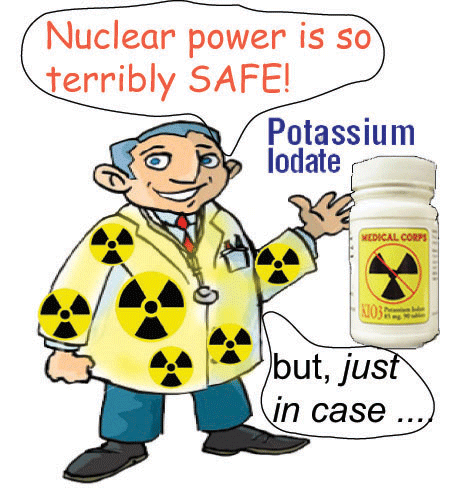
In the lead-up to Tokyo Olympics, the world is being lied to, about the Fukushima radiation situation
 Fukushima’s Radioactive Water Crisis, https://www.counterpunch.org/2019/09/16/
 fukushimas-radioactive-water-crisis/
SEPTEMBER 16, 2019 Tokyo Electric Power’s Fukushima Daiichi Nuclear Power Station, which experienced three massive meltdowns in 2011, is running out of room to store radioactive water. No surprise! But now, what to do about phosphorescent water?
Addressing the issue, Japan’s environmental minister Yoshiaki Harada held a news conference (September 2019). Unfortunately, he proffered the following advice: “The only option will be to drain it into the sea and dilute it.” (Source: Justin McCurry in Tokyo, Fukushima: Japan Will Have to Dump Radioactive Water Into Pacific, Minister Says, The Guardian, Sept. 10, 2019)
“The only option”… Really?
Over the past 8 years, Tokyo Electric Power (TEPCO) has scrambled like a Mad Hatter to construct emergency storage tanks (1,000) to contain upwards of one million tonnes of contaminated radioactive water, you know, the kind of stuff that, over time, destroys human cells, alters DNA, causes cancer, or produces something like the horrific disfigured creature in John Carpenter’s The Thing! That’s the upshot of a triple nuclear meltdown that necessitates constant flow of water to prevent further melting of reactor cores that have been decimated and transfigured into corium or melted blobs. It’s the closest to a full-blown “china syndrome” in all of human history. Whew! Although, the truth is it’ll be a dicey situation for decades to come.
Ever since March 11, 2011, TEPCO has scrambled to build storage tanks to prevent massive amounts of radioactive water from pouring into the ocean (still, some lesser amounts pour into the ocean every day by day). Now the government is floating a trial balloon in public that, once the tanks are full, it’ll be okay to dump the radioactive water into the ocean. Their logic is bizarre, meaning, on the one hand, the meltdown happens, and they build storage tanks to contain the radioactive water, but on the other hand, once the storage tanks run out of space, it’s okay to dump radioactive water into the ocean. Seriously?
Meantime, the Fukushima meltdown brings the world community face to face with TEPCO and the government of Japan in an unprecedented grand experiment that, so far, has failed miserably. Of course, dumping radiation into the Pacific is like dumping radiation into everybody’s back yard. But, for starters, isn’t that a non-starter?
Along the way, deceit breeds duplicity, as the aforementioned Guardian article says the Japanese government claims only one (1) death has been associated with the Fukushima meltdown but keep that number in mind. Reliable sources in Japan claim otherwise, as explained in previous articles on the subject, for example, “Fukushima Darkness, Part Two” d/d November 24, 2017, and as highlighted further on in this article.
When it comes to nuclear accidents, cover-ups reign supreme; you can count on it.
As such, it is believed the Japanese government is lying and should be held accountable for hoodwinking the world about the ravages of Fukushima, especially with the Olympics scheduled for next year.
For example, the following explains how death by radiation is shamefully hidden from the public via newspeak: Fukushima Daiichi Nuclear Power Station worker deaths “that expire at home” are not officially counted. Accordingly, how many workers on a deathbed with radiation sickness leave home to go to work (where deaths are counted) just before they die? Oh, please!
Meanwhile, the last thing the world community needs in the face of an uncontrollable nuclear meltdown, like Fukushima, is deceptiveness and irresponsibility by the host government. Too much is at stake for that kind of childish nonsense. And just to think, the 2020 Olympics are scheduled with events held in Fukushima. Scandalously, the International Olympic Committee (IOC) is A-Okay with that.
In contrast, a Greenpeace International March 8th 2019 article entitled: Japanese Government Misleading UN on Impact of Fukushima Fallout on Children, Decontamination Workers: “The Japanese government is deliberately misleading United Nations human rights bodies and experts over the ongoing nuclear crisis in areas of Fukushima… In areas where some of these decontamination workers are operating, the radiation levels would be considered an emergency if they were inside a nuclear facility.” Enough said! Continue reading
Japan says Dumping Fukushima’s Radioactive Water Into Pacific Ocean Is ‘Only Option’
 Dumping Fukushima’s Radioactive Water Into Pacific Ocean Is ‘Only Option’, Japan Says https://www.sciencealert.com/fukushima-is-running-out-of-space-to-store-contaminated-water ARIA BENDIX, BUSINESS INSIDER 12 SEP 2019 On March 11, 2011, Japan was struck by the most powerful earthquake in the nation’s history – a magnitude 9 temblor that triggered a tsunami with waves up to 133 feet (40 meters) high. The disaster set off three nuclear meltdowns and three hydrogen explosions at the Fukushima Daiichi Nuclear Power Plant.
Eight years later, Fukushima holds more than 1 million tons of contaminated water.
The water comes from two main sources. First, the tsunami caused the reactor cores to overheat and melt, so cleanup workers injected water into the cores to cool them. In the wake of the accident, groundwater also seeped in beneath the reactors and mixed with radioactive material.
To store this contaminated water, the plant currently has 1,000 sealed tanks. But the water is still accumulating. There’s enough room to keep the liquid contained through summer 2022, but after that, there will be no space left.
At a news briefing in Tokyo, Japan’s environment minister, Yoshiaki Harada, said that come 2022, “the only option will be to drain it into the sea and dilute” the contaminated water.
The Japanese government, however, is waiting on a verdict from a panel of experts before making a final decision about what to do with the water.
Meanwhile, the environmental group Greenpeace said in a statement that the “only environmentally acceptable option” would be to continue to store the water and filter it for contaminants.
But that would require more tanks and an expensive filtration process.
Dumping the water could reduce cleanup costs
‘Like a sunburn on your lungs’: how does the climate crisis impact health?
 ‘Like a sunburn on your lungs’: how does the climate crisis impact health? ‘Like a sunburn on your lungs’: how does the climate crisis impact health?
Children, pregnant women and the elderly are the most at risk from extreme weather and heat – but the impact is already felt across every specialty of medicine ‘Americans are waking up’: two thirds say climate crisis must be addressed Guardian, Emily Holden in Washington 16 Sep 2019 The climate crisis is making people sicker – worsening illnesses ranging from seasonal allergies to heart and lung disease. Children, pregnant people and the elderly are the most at risk from extreme weather and rising heat. But the impact of the climate crisis – for patients, doctors and researchers – is already being felt across every specialty of medicine, with worse feared to come……..
|
|
An Australian’s memories of the Chernobyl nuclear disaster
Chernobyl’s dark history: Australian returns home 33 years after the world’s worst nuclear disaster, News 7 Steve Pennells 15 September 2019
Chernobyl – just the word is enough to evoke visions of a nuclear holocaust.
But for thousands of Australians, the nightmare was all too real. They are the children of Chernobyl – scarred by their experiences – and now, more than 30 years on, determined to confront the past.
Inna Mitelman grew up in Belarus, in the shadow of Chernobyl. 33 years later, she’s happily settled in Melbourne with two children of her own. Her parents, Irina and Ilia, live close by.
“I remember it as a very beautiful place to grow up,” Inna tells Sunday Night’s Steve Pennells. “The people were lovely. I had a very beautiful childhood, I can tell you that much.”
For Inna, it was an idyllic existence, with her best friend Natasha living in the apartment right next door.
“We were pretty much inseparable,” Inna explains. “Our parents were very close friends, they were like family. We used to come into each other’s houses without knocking. My house was her house, her house was my house.”
Chernobyl was 100 kilometres away – but on the 26th of April 1986, that was much too close.
The explosion in Reactor Number 4 at the Chernobyl Nuclear Power Plant would be the worst nuclear accident in history. A safety test gone wrong ruptured the reactor core and caused a fire that released vast clouds of radioactive contamination. But the Soviet authorities supressed the true scale of the disaster – and only after 36 hours was the order given to evacuate the nearby city of Pripyat, home to the power plant workers and their families.
Inna Mitelman was only 11 years old when the refugees from Pripyat arrived on her doorstep, but the memory is still vivid.
“The first thing I remember is seeing new kids in our yard in the morning when we walked out to go to school,” Inna recalls. “There were wrapped up in blankets.”
As the fire continued to rage in the reactor, badly injured power plant workers and fireman were brought to the Pripyat hospital.
Today, the hospital at Pripyat stands abandoned, like the rest of this once-thriving city. But 33 years ago, the reactor was spewing out 400 times more radioactive material than the Hiroshima and Nagasaki atomic bombs combined.
Sergii Mirnyi soon learnt the truth. He was the commander of a radiation reconnaissance unit. It was his job to seek out the worst of the hot zones……..
“I’ve got thyroid nodules which were discovered when I was pregnant with my second child,” Inna reveals. “The surgeon said I’ve got [a] 50 per cent chance of developing thyroid cancer, so let’s just get it out now.”
Now, Inna wants to return to her homeland, to understand a tragic event from her past that still haunts her.
“I’m terrified,” Inna admits. “There’s a reason why we haven’t been back. But you need to do this to confront it and deal with it and move on. Because the worst thing that ever happened to me [was] probably my best friend dying when I was 11, and I think having to deal with that freaks me out as well.”
“We first found out that something was wrong with her when she became cross-eyed. They found a brain tumour, they operated, but she died the next morning.”
“This was my best friend. This was the person that I grew up with. Her death, it destroyed me.”
Natasha’s family moved out after the death of their daughter. But Inna is determined to find them.
Inside the exclusion zone
2,500 square kilometres of contaminated territory – including Pripyat – are now abandoned after the Chernobyl nuclear disaster.
Pripyat was a brand new city, right next to the nuclear power plant. It was a jewel in the Soviet crown, with a thriving population of 50,000 people. It was emptied in the course of a single day, with residents forced to leave with only what they could carry…….
For many new mothers here in Belarus, there’s a profound fear that the effects of Chernobyl might be passed on to a second generation.
At the local Children’s Hospital, chief doctor Irina Kalmanovich has been treating Chernobyl survivors for more than 30 years. She has no doubt she is still seeing children suffering from the disaster – and unlike other doctors in this repressive regime, she’s willing to risk saying it.
“It’s my opinion. It can be [a] result of Chernobyl because we have many patients even in our hospital, children with tumour, different parts of body, we have tumour of brain, leukaemia, so we have many patients.”……. https://7news.com.au/sunday-night/chernobyls-dark-history-australian-returns-home-33-years-after-the-worlds-worst-nuclear-disaster-c-454567
Just as important as the poles, Minyong Glacier is melting

The world has a third pole – and it’s melting quickly An IPCC report says two-thirds of glaciers on the largest ice sheet after the Arctic and Antarctic are set to disappear in 80 years Guardian, Gaia Vince Sun 15 Sep 2019 “…….. . Over the past two decades, the Mingyong glacier at the foot of the mountain [ Khawa Karpo, Tibet] has dramatically receded. …….
Joseph Shea, a glaciologist at the University of Northern British Columbia, calls the loss “depressing and fear-inducing. It changes the nature of the mountains in a very visible and profound way.”
Government secrecy on the true hazard of radioactive fallout
 [in 1992] Baverstock and his colleagues published a letter on their findings in the scientific journal Nature, in which they concluded, “the consequences to the human thyroid, especially in fetuses and young children, of the carcinogenic effects of radioactive fallout is much greater than previously thought.”
Now, after more than 30 years, U.N.-sponsored researchers have backed away from the 1992 UNSCEAR study by concluding that “studies of clean-up workers/liquidators suggest dose-related increases of thyroid cancer and hematological malignancies in adults,” as well as “increases in cardiovascular and cerebrovascular disease. If confirmed, these would have significant public health and radiation protection implications.”
The United States’ involvement with the Chernobyl aftermath was shaped largely, and shamefully, by the desire to avoid potential legal liabilities associated with the 166 U.S. open-air nuclear weapons tests in Nevada and the Marshall Islands. At the time of the Chernobyl accident, compensation radiation claims for injuries and deaths from bomb testing were looked upon by the nuclear weapons program as a dagger aimed at the heart of U.S. national security.
 Why Government Secrecy Is More Damaging to Public Health Than Nuclear Fallout https://washingtonspectator.org/alvarez-nuclear-fallout/?fbclid=IwAR3GipEEqcUnFhvI7hEcKW8_aLhv-ZHGd3JVtLACnjQETGjnZktuXMvaDCU September 11, 2019, By Robert Alvarez Why Government Secrecy Is More Damaging to Public Health Than Nuclear Fallout https://washingtonspectator.org/alvarez-nuclear-fallout/?fbclid=IwAR3GipEEqcUnFhvI7hEcKW8_aLhv-ZHGd3JVtLACnjQETGjnZktuXMvaDCU September 11, 2019, By Robert Alvarez Much has been written about the strengths and flaws of Chernobyl—the HBO miniseries nominated for 19 Emmys that chronicles the catastrophe at the eponymous Russian nuclear power plant in 1986. In the mind of this reviewer, it’s a riveting if sobering television gem, and highly recommended. And to this newly enlivened debate over nuclear power we can now add Kate Brown’s book, Manual for Survival: A Chernobyl Guide to the Future, a tour de force about the radiological aftermath of the Chernobyl disaster. A science historian at the Massachusetts Institute of Technology, Brown peels away the layers of long-held mythologies—that in the end, the accident only killed 54 people, and that “radiation phobia” among the people who sustained heavy radioactive fallout was a bigger problem than any of the other health outcomes. Brown, who is conversant in Russian, devoted years to extensive archival research (much of which was scattered and hidden from official attempts at confiscation). She conducted interviews with villagers, military officials, factory workers, medical doctors, Soviet nuclear experts, emergency responders, KGB operatives (who assumed control over much of the data from the accident), and international nuclear safety and radiation health experts. The result is a rich and deeply disturbing picture of the environmental perils of extensive and lasting nuclear contamination. She digs prodigiously, much to the disfavor of defenders of nuclear power, into the widespread practice of secrecy and deception regarding the radiological harm from elevated, long-term, chronic exposures. Continue reading |
Much touted “advanced” nuclear reactors nonexistent and just not practical
“The Guardian”now toes the line for UK security services, including smearing Julian Assange
Getting Julian Assange The Guardian also appears to have been engaged in a campaign against the WikiLeaks publisher Julian Assange, who had been a collaborator during the early WikiLeaks revelations in 2010.
It seems likely this was innuendo being fed to The Observer by an intelligence-linked individual to promote disinformation to undermine Assange.
In 2018, however, The Guardian’s attempted vilification of Assange was significantly stepped up. A new string of articles began on 18 May 2018 with one alleging Assange’s “long-standing relationship with RT”, the Russian state broadcaster. The series, which has been closely documented elsewhere, lasted for several months, consistently alleging with little or the most minimal circumstantial evidence that Assange had ties to Russia or the Kremlin.
 How the UK Security Services neutralised the country’s leading liberal newspaper. https://www.dailymaverick.co.za/article/2019-09-11-how-the-uk-security-services-neutralised-the-countrys-leading-liberal-newspaper/ By Matt Kennard and Mark Curtis• 11 September 2019, The Guardian, Britain’s leading liberal newspaper with a global reputation for independent and critical journalism, has been successfully targeted by security agencies to neutralise its adversarial reporting of the ‘security state’, according to newly released documents and evidence from former and current Guardian journalists.
The UK security services targeted The Guardian after the newspaper started publishing the contents of secret US government documents leaked by National Security Agency contractor Edward Snowden in June 2013.
Snowden’s bombshell revelations continued for months and were the largest-ever leak of classified material covering the NSA and its UK equivalent, the Government Communications Headquarters. They revealed programmes of mass surveillance operated by both agencies.
According to minutes of meetings of the UK’s Defence and Security Media Advisory Committee, the revelations caused alarm in the British security services and Ministry of Defence. Continue reading
Japan’s new Environment Minister looks to the shutdown of nuclear power
New Japanese environment minister touts end of nuclear power https://www.pv-magazine.com/2019/09/12/new-japanese-environment-minister-touts-end-of-nuclear-power/?fbclid=IwAR0wa5N2qxBhKPMOibQzKmgxNxwLF_0wOxorChWnD2uYe7w1OfH8K2aE-nI
A day later Japan inaugurated a new environment minister who, at his very first press conference, flew in the face of prime minister Shinzo Abe’s plans to restart the nation’s nuclear power plants.
Shinjiro Koizumi took office yesterday and within hours revealed his intentions regarding the nuclear fleet, which comes under his ministerial purview.
“I would like to study how we will scrap them, not how to retain them,” said Koizumi of the reactors. “We will be doomed if we allow another nuclear accident to occur.” Continue reading
How do you leave a warning that lasts as long as nuclear waste?
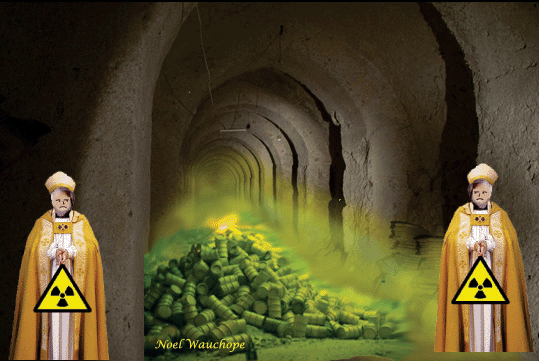
How do you leave a warning that lasts as long as nuclear waste? Phys Org, by Helen Gordon, 13 Sep 19 “……. First, it is difficult to predict how future generations will behave, what they will value and where they will want to go. Second, creating, maintaining and transmitting records of where waste is dumped will be essential in helping future generations protect themselves from the decisions we make today. Decisions that include how to dispose of some of today’s most hazardous material: high-level radioactive waste from nuclear power plants.
The red metal lift takes seven juddering minutes to travel nearly 500 metres down. Down, down through creamy limestone to reach a 160-million-year-old layer of clay. Here, deep beneath the sleepy fields and quiet woods along the border of the Meuse and Haute-Marne departments in north-east France, the French National Radioactive Waste Management Agency (Andra) has built its underground research laboratory.
The laboratory’s tunnels are brightly lit but mostly deserted, the air dry and dusty and filled with the hum of a ventilation unit. Blue and grey metal boxes house a series of ongoing experiments—measuring, for example, the corrosion rates of steel, the durability of concrete in contact with the clay. Using this information, Andra wants to build an immense network of tunnels here.
It plans to call this place Cigéo, and to fill it with dangerous radioactive waste. It is designed to be able to hold 80,000 cubic meters of waste……
High-level radioactive waste is primarily, spent fuel from nuclear reactors or the residues resulting from reprocessing that fuel. This waste is so potent that it must be isolated from humans until its levels of radiation, which decrease over time, are no longer hazardous. The timescale Andra is looking at is up to one million years……. Some scientists call this long-lived waste “the Achilles heel of nuclear power,” and it’s a problem for all of us—whatever our stance on nuclear. Even if all the world’s nuclear plants were to cease operating tomorrow, we would still have more than 240,000 tonnes of dangerously radioactive material to deal with.
Currently, nuclear waste is stored above ground or near the surface, but within the industry this is not considered an acceptable long-term solution. This kind of storage facility requires active monitoring. As well as regular refurbishment it must be protected from all kinds of hazards, including earthquakes, fires, floods and deliberate attacks by terrorists or enemy powers.
This not only places an unfair financial burden on our descendants, who may no longer even use nuclear power, but also assumes that in the future there will always be people with the knowledge and will to monitor the waste. On a million-year timescale this cannot be guaranteed.
So, after considering a range of options, governments and the nuclear industry have come to the view that deep, geological repositories are the best long-term approach. Building one of these is an enormous task that comes with host of complex safety concerns.
Finland has already begun construction of a geological repository (called Onkalo), and Sweden has begun the licensing process for its site. Andra expects to apply for its construction license within the next two years.
If Cigéo goes into operation it will house both the high-level waste and what is known as intermediate-level long-lived waste—such as reactor components. Once the repository has reached capacity, in perhaps 150 years’ time, the access tunnels will be backfilled and sealed up. If all goes according to plan, no one will ever enter the repository again……..
For waste buried deep underground, the major threat to public health comes from water contamination. If radioactive material from the waste were to mix with flowing water, it would be able to move relatively swiftly through the bedrock and into the soil and large bodies of water such as lakes and rivers, finally entering the food chain via plants, fish and other animals.
To prevent this, an underground repository such as Cigéo will take great care to shield the waste it stores. Within its walls there will be metal or concrete containers to block the radiation, and liquid waste can be mixed into a molten glass paste that will harden around it to stop leakage…….
Deep geological repositories are designed as passive systems, meaning that once Cigéo is closed, no further maintenance or monitoring is required. Much more difficult to plan for is the risk of human intrusion, whether inadvertent or deliberate.
In 1980, the US Department of Energy created the Human Interference Task Force to investigate the problem of human intrusion into waste repositories. What was the best way to prevent people many thousands of years in the future from entering a repository and either coming into direct contact with the waste or damaging the repository, leading to environmental contamination?
Over the next 15 years a wide variety of experts were involved in this and subsequent projects, including materials scientists, anthropologists, architects, archaeologists, philosophers and semioticians—social scientists who study signs, symbols and their use or interpretation………
In the very long term, though, these plans also have a major drawback: how can we know that anyone living one million years in the future will understand any of the languages spoken today?
Think of the differences between modern and Old English. Who of us can understand “Ðunor cymð of hætan & of wætan”? That—meaning “Thunder comes from heat and from moisture”—is a mere thousand years old.
Languages also have a habit of disappearing. Around 4,000 years ago in the Indus Valley in what is now Pakistan and north-west India, for example, people were writing in a script that remains completely indecipherable to modern researchers. In one million years it is unlikely that any language spoken today will still exist……. https://phys.org/news/2019-09-nuclear.html?fbclid=IwAR2Kyunn90VCKgkNnwyGsMDYSYi3-UghDX7UNKcZNILzBuflZq2Gkq7daZE
Climate change pushing Queensland’s bushfire and cyclone seasons on a collision course
Heatwave-like conditions across the two eastern states were expected to push bushfire alerts to “very high” with potentially dangerous fire conditions forecast. …… https://thenewdaily.com.au/news/national/2019/09/13/bushfires-queensland-nsw-weather/
Nuclear power is too costly and too risky,
Nuclear power raises all the dangers inherent in working with radioactive materials. Mining uranium produces tailings that create radon emissions and also pollutes soil and water with sulfuric acids and cyanic salts. Spent nuclear fuel can remain radioactive for thousands of years.
These renewable technologies are already cost competitive with fossil fuels, unlike nuclear power, where plants under construction regularly experience multiple delays and cost overruns, making them prohibitively expensive.
1 This month

of the week – Australians for War Powers Reform (AWPR)
To see nuclear-related stories in greater depth and intensity
 Antinuclear