France’s nuclear electricity production ‘threatened by heatwaves’, Rfi, 27 July 19, By RFI with Alison Hird French electricity giant EDF closed down nuclear reactors at two plants in the south of France this week due to the heatwave. Supporters of nuclear power vaunt its role in de-carbonising energy production but can it still be an energy of the future if the future is likely to be hotter?
This week’s scorching temperatures, over 40°C in many parts of the country, led EDF to close down production at the Golfech (Tarn-et-Garonne) and Tricastin (Drôme) nuclear power plants.
Nuclear reactors need large amounts of water to cool them down and around two thirds of France’s 58 reactors get their water supplies from nearby rivers. Once the cooling done, the warmed water is discharged back into the river. But recent droughts have lowered water levels in the Garonne and Rhône and the heatwave has increased the temperature of the water.
EDF followed French regulations which stipulate that in order to protect plant and animal life, power generation must be cut when water temperatures go above 28°C or when river levels and flow rate are low. But the electricity giant insisted there would be no impact on power supply. …….
t the risk of power cuts would increase if temperatures reach what is known as “grand chaud” (high heat) in the French nuclear power industry when the reactor is no longer considered safe enough to run.
“Electricity generation through reactors is threatened by heatwaves, especially those on rivers as is the case in France where two thirds are on rivers,” Marignac explains. “If heatwaves are more intense and frequent, in the range of 45°C and lasting for some days, there’s also risk of failure of equipment due to “grand chaud”.
“We’re not up to that yet, but as climate science tells us there’s going to be more heatwaves and they could be longer and they could be warmer that means we could get to that point in coming years and decades.”……
anti-nuclear groups like Sortir du Nucléaire (exit nuclear) have seized on the latest heatwave to show “nuclear is vulnerable to climate change”. What’s more they claim “it won’t save the climate” because it does, for example, produce greenhouse gases through its waste management, building of nuclear plants and processes for mining and refining uranium ore.
The statement, following a gathering in May, says: “the Tokyo Electric Power Company Fukushima Daiichi Nuclear Power Station disaster and subsequent damage which occurred as a result of the March 11, 2011 Great East Japan Earthquake completely shattered the myth of safety and made us aware of the extreme danger of nuclear power generation.”
It states that as long as nuclear power generation is operative, it continues to create dangerous radioactive waste and there is a risk that the technology can at any time be diverted to nuclear weapons and threaten the right to live in peace.
It continues: “no longer should we continue as a society with the economic priority of reliance upon nuclear power generation; we should take a new path, of course practicing power saving and energy conservation, and we should make policy changes to renewable energy . . . Also, we have recognised that, when a nuclear power plant accident occurs, it is irreparable, and is more hazardous than with any other energy source. While on the one hand, grave effects remain now, after eight years have passed, with the passage of time we have become forgetful of the pain and suffering of those afflicted by the disaster.” Continue reading →
Ohio Governor Signs Coal and Nuclear Bailout at Expense of Renewable Energy
Opponents fear the law will send the growing wind and solar industry to neighboring states while Ohio homeowners are stuck boosting old, uneconomical power plants. Inside Climate News, Dan Gearino, 26 July 19,
In a year when several states have taken big steps to embrace a future that runs on renewable energy, Ohio is taking a leap in the opposite direction.
The Ohio legislature passed a measure Tuesday that cuts renewable energy and energy efficiency programs while adding subsidies for nuclear and coal-fired power plants—a policy cocktail that opponents say is backward-looking and harmful to the economy, consumers and the environment. Continue reading →
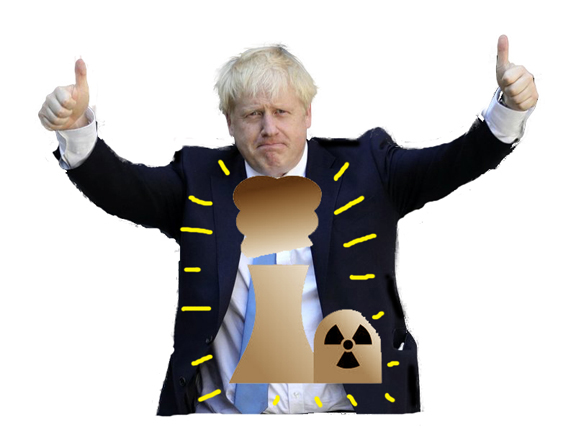
In Cumbria 25th July 2019 New Prime Minister Boris Johnson has pledged his support for a nuclear
renaissance, the Barrow-based Dreadnaught submarine programme and Northern
Powerhouse Rail in his maiden speech. On nuclear, Copeland MP Trudy
Harrison asked him: “Does the Prime Minister agree that the time is now
for a nuclear renaissance and that Copeland is the centre of nuclear
excellence?”
Mr Johnson replied: “It is time for a nuclear renaissance
and I believe passionately that nuclear must be part of our energy mix and
she is right to campaign for it and it will help us to meet our carbon
targets.”
His comments were made just days after the Government launched
a consultation into funding large-scale nuclear power stations and an £18
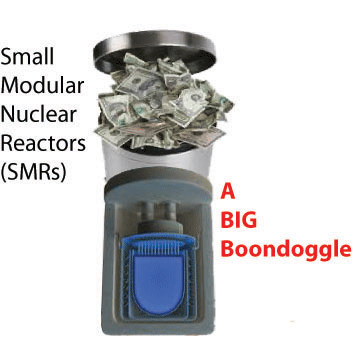
million Government investment into the development of small modular
reactors through a consortium led by Rolls-Royce, and including the
National Nuclear Laboratory, Wood and Nuvia. Opinions are being sought
between now and October 14 on a proposed Nuclear Regulated Asset Base (RAB)
model to fund large power stations.
At a global level, the report concludes that, as with the much-heralded ‘nuclear renaissance’ of recent times, SMRs will not be built in any significant scale.
Whether the economies claimed from the use of production line techniques can be achieved will only be known if reactors are built in very large numbers, and at significant cost.
Spending so much time and effort pursuing such an uncertain technology, at a time when the ‘climate emergency’ has now reached the political and public lexicon in requiring urgent attention, does not appear to be an effective use of taxpayer resources.
In the overall view of the report authors, the prospects for SMRs in the UK and Worldwide are limited and not worth the huge levels of effort or finance being proposed for them.
NFLA support joint report with the Nuclear Consulting Group which looks at the prospects of Small Modular Nuclear Reactors in the UK and globally and concludes they will not be built to any significant scale http://www.nuclearpolicy.info/news/nfla-joint-ncg-report-on-smrs/25 Jul 19
The Nuclear Free Local Authorities (NFLA) welcomes cooperating with the Nuclear Consulting Group (NCG) in its development of one of the most detailed analyses of the technologies being developed to create small modular nuclear reactors (SMRs) in the UK and around the world. This report concludes there remains fundamental barriers to any significant development of this new nuclear technology, and its prospects for creating some kind of ‘nuclear renaissance’ are unlikely to be realised.
The report has been developed by Professor Stephen Thomas of Greenwich University, Dr Paul Dorfman of University College London and NCG Founder, Professor M V Ramana of British Columbia University, and the NFLA Secretary. (1) The global nuclear industry has put forward SMRs as a panacea to the problems of high cost and the difficulty of financing large nuclear reactors; a ready-made alternative that can fill the gap.
However, as the NCG / NFLA report outlines in detail, there are huge obstacles to overcome. Some of these are technical issues, others are around building up an effective supply chain, while the financing of such schemes will only be possible with significant and large subsidy from the public purse.
The report starts with considering the failures in delivering larger nuclear reactors, and then takes in turn each type of SMR technology that has been put forward by companies involved in the nuclear industry. Continue reading →
By Reuters• last updated: 22/07/2019 –PARIS (Reuters) – French utility EDF <EDF.PA> could prolong planned outages at its two Golfech nuclear reactors because of a heatwave expected across France this week, the power utility said on Monday.
EDF plans to halt production at the 1,300 megawatt (MW) Golfech 2 reactor from Tuesday until July 29 and will stop power generation at Golfech 1 on Wednesday until same day next week.
The utility had said on Friday that it could halt electricity generation at the 2,600 megawatt (MW) Golfech plant in southern France because of high temperatures forecast on the Garonne river, water from which is used to cool the reactors.
EDF said on Monday that the current forecast for the end of the outages was based on available temperature forecasts and that the outages at both reactors could be prolonged.
The company’s use of water from rivers to cool its reactors is regulated by law to protect plant and animal life. It is forced to cut output when water temperatures rise or when river levels and the flow rate are low.
Another spell of sizzling temperatures is expected in France and much of western Europe this week, the second heatwave this summer. A record temperature of 46 degrees Celsius (114.8 Fahrenheit) was set in southern France last month.
Separately, EDF delayed the restart of its 1,500 MW Chooz 2 nuclear reactor by a couple days to Aug. 1, saying that the planned maintenance outage could be extended because of the amount of work required for its second 10-year overhaul.
(Reporting by Bate Felix; Editing by David Goodman)
Greta Thunberg awarded first Normandy Freedom Prize
Teen climate activist Greta Thunberg wins France’s first Freedom Prize, SBS News, A 16-year-old Swedish climate champion has received the first Freedom Prize in France, and has urged people to recognise the link between climate change and “mass migration, famine and war.”
Swedish teen climate change activist Greta Thunberg, whose Friday school strikes protesting government inaction over climate change helped spark a worldwide movement, has received the first Freedom Prize in France.
Flanked by two WWII veterans who sponsor the prize, the 16-year-old accepted the award at a ceremony in the northwestern city of Caen, Normandy, on Sunday.
“This prize is not only for me,” Greta said. “This is for the whole Fridays for Future movement because this we have achieved together.”
She said she would donate the AU$28,000 prize money to four organisations working for climate justice and helping areas already affected by climate change.
The prize was awarded before an audience of several hundred people and in the presence of several D-Day veterans, including France’s Leon Gautier and US native American Charles Norman Shay.
Greta said she had spent an unforgettable day with Mr Shay on Omaha Beach, one of the sites of the 1944 Normandy landings that launched the Allied offensive that helped end World War II.
Paying tribute to their sacrifice, she said: “the least we can do to honour them is to stop destroying that same world that Charles, Leon and their friends and colleagues fought so hard to save for us.”
Mr Shay said that young people should be prepared to “defend what they believe in.”………
She said the “link between climate and ecological emergency and mass migration, famine and war was still not clear to many people” and urged change.
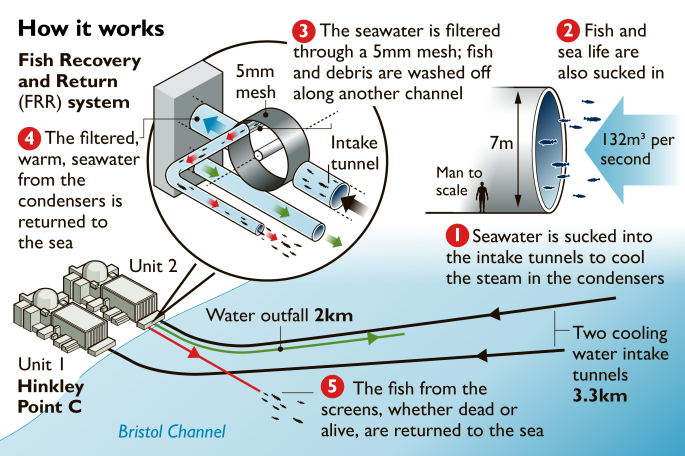
Times 20th July 2019 Nuclear power plant will suck fish to their deaths, The Times, Ben Webster,, Oceans Correspondent, July 20 2019 It has been described as a giant plughole under the sea, sucking in 130,000 litres of water a second along with vast numbers of fish. The twin inlet tunnels stretching two miles out into the Severn estuary are so big that a
double-decker bus could drive through them.
The system will cool a new
nuclear power station being built at Hinkley Point in Somerset but
conservation groups say it will kill up to 250,000 fish a day and must be
altered or scrapped. They say that EDF, the French state-owned energy
group, has grossly underestimated the system’s impact on marine life in the
estuary, a special conservation area.
A 5mm mesh will be installed to
prevent larger fish being swallowed but the groups, including the Blue
Marine Foundation, Wildfowl & Wetlands Trust and Somerset Wildlife Trust,
say many fish will be fatally injured when pressed against it. Small fish,
eels and the fry of many species, such as salmon, whiting and cod, will be
sucked through the mesh and into the cooling system.
The groups say it
could damage the population of twaite shad in the UK, a small herring-like
fish that used to spawn in the estuary by the millions but has dwindled to
tens of thousands.
EDF says the system will kill about 650,000 fish a year.
It has asked to vary its original permits and planning permission for the
power station to allow it to remove an “acoustic fish deterrent” from the
cooling system. It argues that, even without it, the impact of the system
on fish populations will still be “negligible”. EDF says fish will be
adequately protected by other measures, one which will slow the water
entering the system and another which will return to the sea the fish
sucked in.
Conservation groups argue that scientific analysis they obtained
of the cooling system shows far greater harm to marine life. This analysis
is partly based on measurements of fish swallowed by the cooling system of
Hinkley Point B, a nearby nuclear power station which consumes a quarter of
the sea water that will be extracted to cool Hinkley C.
They want the
government to reject EDF’s application and, if the company cannot mitigate
the damage, force it to use other ways to cool the station, such as cooling
towers or ponds.
James Robinson, of the Wildfowl & Wetlands Trust, said:
“The authorities must decide if it’s worth building a giant plughole to
suck millions of sea animals to their deaths, in one of our most important
protected marine areas, in order to produce electricity.” Charles Clover,
director of Blue Marine Foundation, said the groups would also challenge
plans by EDF for a similar system at its proposed new nuclear power station
at Sizewell in Suffolk.https://www.thetimes.co.uk/article/e0c7e83e-aa68-11e9-89e4-5e7e89de8df9
I watched the “Chernobyl” miniseries, and I was struck by the accuracy. The scene on the roof of the reactor as depicted in the fictional episode, was accurate in so much detail, compared to the 1986 real film.
There were many who risked their lives after the Chernobyl disaster — but none more so than a man desperate to show the world what happened,LJ Charleston, 21 July 19 When Soviet filmmaker Vladimir Shevchenko took his camera onto the roof of Chernobyl’s reactor four in the aftermath of the fatal explosion, he had no idea he was right in the middle of what was — in April 1986 — the most dangerous place on earth.
He also had no idea that his chilling documentary Chernobyl: Chronicle of Difficult Weeks, about the clean-up of the radioactive material at Chernobyl, would be his very last.
He died of acute radiation sickness a year later.
The award-winning film director, who was working for Ukrainian TV at the time, was said to have been quite unaware of the dangers he was putting himself in when he agreed to film from the roof next to reactor four.
He’d been hired to film in the exclusion zone. But his gravest error was agreeing — along with two assistants — to climb up to the most lethal area of all, just days after one of the worst man-made disasters of all time.
Even 33 years after the explosion, Shevchenko’s film is still an eerie reminder of the sacrifices made by those who risked their lives in the clean-up efforts at Chernobyl.
Today, as the world focuses once again on those events due to HBO’s series Chernobyl, it’s worthwhile putting the spotlight on the courageous Shevchenko.
He gave his life so that we could see with our own eyes what went on during the clean-up. It was, at times, incredibly basic and put so many lives at risk.
And, by doing so, Shevchenko was unknowingly filming his own death……
Shevchenko, who was the first and only film maker allowed on location in the exclusion zone of Chernobyl, is best known for Chernobyl — Chronicle of Difficult Weeks. You can watch the full cut of his film here.
The film is entirely in Russian, although it’s believed people are currently working on English subtitles. It includes interviews with beleaguered scientist Valery Legasov, now famous due to the HBO series in which he’s played by Jared Harris.
Legasov committed suicide two years after the disaster, on the anniversary, due to the horror of his experiences and the lies he had to tell the International Atomic Agency in Vienna to cover up Soviet mishandling of the event.
Shevchenko’s footage of Chernobyl has not been widely seen and the fact he lost his life a year after the explosion has been completely obscured, as his name isn’t listed on official records of deaths. At the time, his two assistants were receiving hospital treatment, but there is no word of what became of them.
Sydney archaeologist Mr Robert Maxwell, the only archaeologist who has worked in Chernobyl across two field excursions, told news.com.au Shevchenko was well-respected and trusted to film the clean-up efforts, as it was such a highly sensitive time for the Soviets.
“He was granted permission to film the clean-up, including the incredibly dangerous work of the ‘biobots’,” Mr Maxwell said, referring to the name given to the workers sent in to clean up……..
THE ‘BIOBOT FOOTAGE’
One of the most memorable and unbelievable scenes in the TV series Chernobylfeatures liquidation workers on the roof, using shovels to throw highly radioactive material back into the core.
If it wasn’t for Shevchenko’s 1986 footage, we would not know that this happened. The men could only work in frantic 90 second shifts; any longer and their exposure to the radiation would be fatal.
What makes the footage so compelling is that we can clearly see some men picking up the radioactive graphite with gloved hands. We also see Shevchenko filming from the roof top, wearing only a flimsy mask and cap for protection. Then we can see how badly damaged the footage is as the radiation makes an impact on the film itself.
It’s harrowing to see how much work the men are doing with their hands.
This is Shevchenko’s footage focusing on the rooftop clean-up.
Chernobyl. Cleaning the roofs. Soldiers (reservists). 1986.
“To us as an environmental group, we hope that the environmental damage can stop and that these external [pollution costs] could be internalized in the cost” of products, Ma Jun, a leading Chinese environmentalist and director of the Institute for Public and Environmental Affairs, said in a phone interview.
Ma’s fear is that other regions around the world could suffer a similar fate if they become, like China, the supplier of cheap rare earth elements, with little or no environmental price attached
China has been a major source of rare earth metals used in high-tech products, from smartphones to wind turbines. As cleanup of these mining sites begins, experts argue that global companies that have benefited from access to these metals should help foot the bill.
BY MICHAEL STANDAERT•JULY 2, 2019 The mountains north of the village of Lingbeizhen in southern Jiangxi province no longer echo with the rumble of bulldozers and trucks. New bamboo groves climb the ravines. Tropical pines and navel orange trees grace terraces carved from the mountainsides, covering what was a hive of activity a few years back. Continue reading →
Low doses of radiation promote cancer-capable cells, Science Daily
New research in mice helps to understand the risks around exposure to low doses of radiation, such as CT scans and X-rays
Date
July 18, 2019
Source:
Wellcome Trust Sanger Institute
Summary:
New research finds that low doses of radiation equivalent to three CT scans, which are considered safe, give cancer-capable cells a competitive advantage over normal cells.
Low doses of radiation equivalent to three CT scans, which are considered safe, give cancer-capable cells a competitive advantage over normal cells in healthy tissue, scientists have discovered. Researchers at the Wellcome Sanger Institute and the University of Cambridge studied the effects of low doses of radiation in the esophagus of mice.
The team found that low doses of radiation increase the number of cells with mutations in p53, a well-known genetic change associated with cancer. However, giving the mice an antioxidant before radiation promoted the growth of healthy cells, which outcompeted and replaced the p53 mutant cells.
The results, published today (18 July) in Cell Stem Cell show that low doses of radiation promote the spread of cancer-capable cells in healthy tissue. Researchers recommend that this risk should be considered in assessing radiation safety. The study also offers the possibility of developing non-toxic preventative measures to cut the risk of developing cancer by bolstering our healthy cells to outcompete and eradicate cancer-capable cells……..
Low doses of radiation equivalent to three CT scans, which are considered safe, give cancer-capable cells a competitive advantage over normal cells in healthy tissue, scientists have discovered. Researchers at the Wellcome Sanger Institute and the University of Cambridge studied the effects of low doses of radiation in the esophagus of mice.
The team found that low doses of radiation increase the number of cells with mutations in p53, a well-known genetic change associated with cancer. However, giving the mice an antioxidant before radiation promoted the growth of healthy cells, which outcompeted and replaced the p53 mutant cells.
The results, published today (18 July) in Cell Stem Cell show that low doses of radiation promote the spread of cancer-capable cells in healthy tissue. Researchers recommend that this risk should be considered in assessing radiation safety. The study also offers the possibility of developing non-toxic preventative measures to cut the risk of developing cancer by bolstering our healthy cells to outcompete and eradicate cancer-capable cells…….
Dr Kasumi Murai, an author from the Wellcome Sanger Institute, said: “Giving mice an antioxidant before exposing them to low doses of radiation gave healthy cells the extra boost needed to fight against the mutant cells in the esophagus and make them disappear. However, we don’t know the effect this therapy would have in other tissues — it could help cancer-capable cells elsewhere become stronger. What we do know is that long term use of antioxidants alone is not effective in preventing cancer in people, according to other studies.” … https://www.sciencedaily.com/releases/2019/07/190718150933.htm
PARIS (Reuters) – French utility EDF may have to shut down electricity generation at its 2,600 megawatt (MW) Golfech nuclear power plant in the south of France from Tuesday July 23 because of high temperatures forecast on the Garonne river.
The power utility uses water from the river to cool the two reactors at the plant, but French meteorological services have forecast hot and dry weather next week, with a risk of a heatwave in the southeastern parts of the country.
“Due to the temperature forecasts on the Garonne, production restrictions are likely to affect EDF’s nuclear power plant at Golfech from Tuesday July 23,” the company said, adding that both reactors could be unavailable.
EDF operates France’s 58 nuclear reactors, which account for more than 75 percent of the country’s electricity needs. Its use of water from rivers as a reactor coolant is regulated by law to protect plant and animal life.
The company is obliged to reduce output from its reactors when water temperatures rise or when river levels and the flow rate are low.
Low flow rate for the Rhone river because of drought conditions has also curtailed power generation in recent weeks at EDF’s St. Alban, Bugey, Cruas and Tricastin nuclear power plants. St Alban has capacity of 2,600 MW while the other three each have 3,600 MW of capacity.
In a separate note on its website on Friday EDF said that power generation could be reduced by about 30 percent at its 1,300 MW St. Alban 1 nuclear reactor on Saturday.
Idea to develop nuclear energy receives strong opposition in Indonesia, The Jakarta Post
Jakarta / Fri, July 19, 2019 A lawmaker’s revival of an idea to build a nuclear power plant in Indonesia has triggered public debate over the pros and cons of the technology, particularly about its safety and efficiency.The proposal came from Kurtubi, a member of House of Representatives Commission VII for energy affairs, among others, who demanded the government include that type of energy generation in the 2019 to 2038 National Electricity General Plan (RUKN)……..
In response, Jonan said the government would be very cautious when considering the idea, while there were still many other energy resources in the country that had lower development costs than a nuclear power plant. “The prices of electricity from nuclear energy is less competitive,” he added. …….
Greenpeace Asia Tenggara’s climate change and energy head Tata Mustafa expressed his rejection of the idea, stressing that the country needed to focus on the development of other renewable energy resources.
“The potential of solar energy is 207 gigawatts (GW), while the potential of wind farm energy reached 66 GW,” he said as quoted by kontan.co.id, adding that he doubted the safety of nuclear energy, particularly because of the country’s position on the Ring of Fire that was frequently hit by earthquakes.
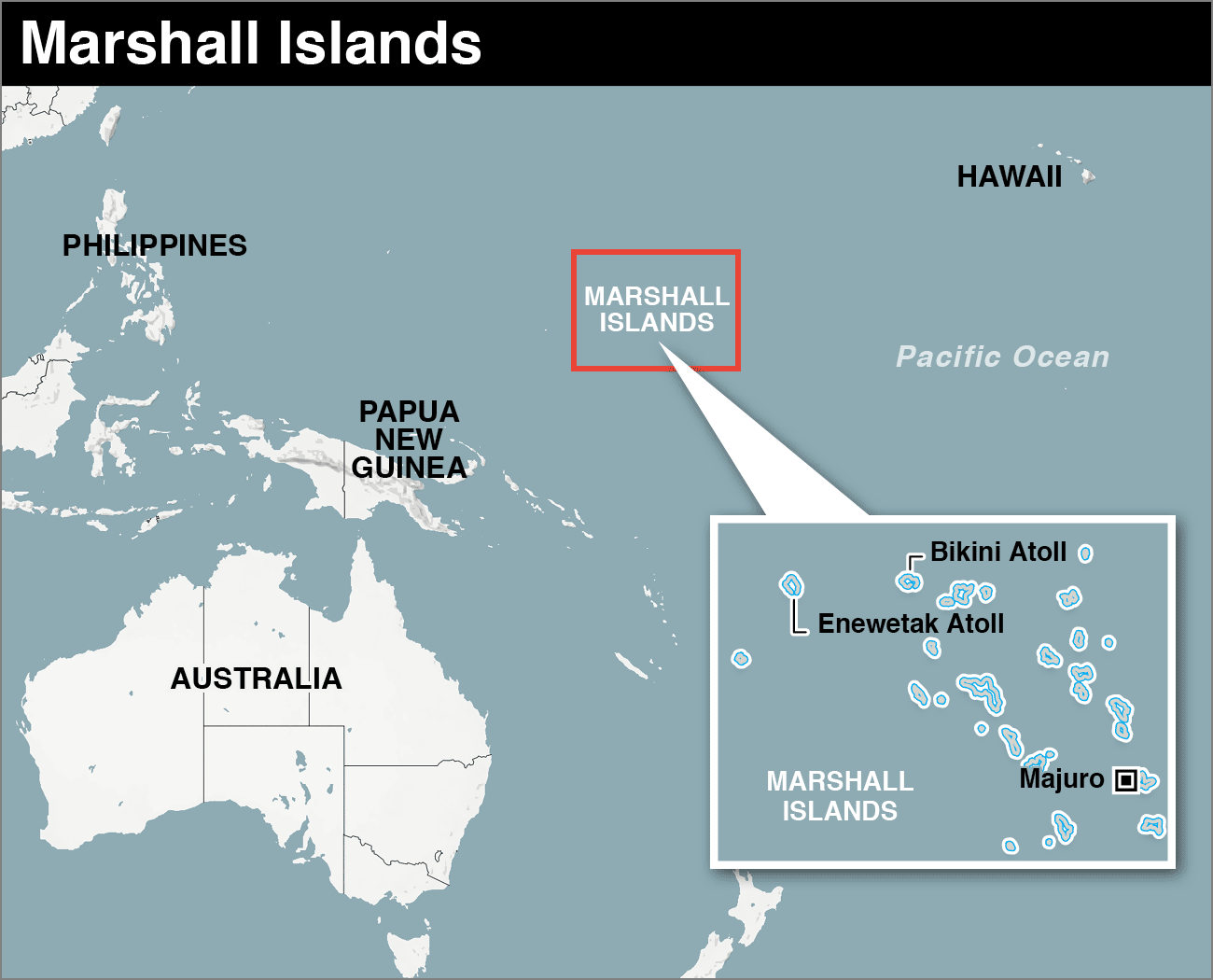
New research shows a tiny island halfway between Australia and Hawaii has concentrations of nuclear material up to 1000 times higher than at two well-known meltdown locations in Ukraine and Japan.
Research carried out by Columbia University and published this week shows deadly plutonium levels are far higher than previously thought on the Marshall Islands. The group of 29 atolls was subject to 67 US nuclear tests between 1946 and 1958, with locals forced to flee as the country dropped bomb after bomb in paradise.
The United States entombed nuclear waste under a dome on the island of Runit that some believe is leaking into the Pacific Ocean. However the real impact of the contamination is only now being realised.
Researchers wrote that two atolls, Bikini and Enewetak, “were used as ground zero” and took the brunt of the impact.
On Enewetak, the first-ever hydrogen bomb was tested. But Bikini was the site of the world’s largest-ever hydrogen bomb test — known as Castle Bravo.
The tests, researchers say, “caused unprecedented environmental contamination and, for the indigenous peoples of the islands, long-term adverse health effects”.
Researchers tested levels of radioactive isotopes in soil and food sources and found “a real concern” on Runit where the huge dome was designed to contain radiation but is not working.
“The presence of radioactive isotopes on the Runit Island is a real concern, and residents should be warned against any use of the island,” researchers said.
“Moreover, wash-off of existing isotopes off the islands into the ocean from weathering and continued sea level rise continues to threaten, further contaminating the lagoon and the ocean at large.”
On Bikini, researchers found concentrations of particular radioactive material “were up to 15-1000 times higher than in samples from areas affected by the Chernobyl and Fukushima disasters”.
Though residents were banished from the Marshall Islands during the height of the Cold War, many have returned. The Los Angeles Times reports more than 600 people call Enewetak, Runit and Enjebi home.
Jan Beyea, a retired radiation physicist, told the newspaper: “Implicitly, I think these results might caution efforts to return because of the readings found.”
News.com.au previously reported rising sea levels were degrading the concrete dome at Runit, and the US Department of Energy concluded the “burial site” was leaking highly toxic waste.
Locals refer to it as “the poison” and have already been complaining of birth defects and high cancer rates.
After Castle Bravo, islanders more than 160km away mistook fallout for snow. It “caused skin burns, hair loss, nausea and eventually cancer” in many who were exposed, the Times reports.
The warnings from researchers clash with advice from the US Government, which signed a memorandum of understanding with the Republic of the Marshall Islands agreeing it was safe for those who wished to return home.
In the Marshall Islands, the most common cause of death is diabetes, which is related to a thyroid disorder. The second most common cause of death is cancer.
The population of the Marshall Islands is around 70,000 people, with local Marshallese people allowed to live and work in the US without a visa as part of the reparations for the nuclear testing that took place.
Over a third have already moved to the US. It is said when you leave the Marshall Islands, you buy a one-way ticket.
French state-controlled utility EDF said on Tuesday that due to flow forecasts for the Rhone river, electricity generation could be restricted at its Bugey, St-Alban and Tricastin nuclear power plants from Saturday, July 20.
The nuclear plants, with a combined capacity of around 10,800 megawatts, use water from the river as coolant.
EDF’s use of water is regulated by law to protect plant and animal life. It is obliged to reduce output during hot weather when water temperatures rise, or when river levels and the flow rate are low.
The company said two nuclear reactors at the St. Alban plant and one at Bugey could be impacted over the weekend, but production losses are expected to be lower from Monday……… http://saudigazette.com.sa/article/572195






 Antinuclear