Not Impressed with Professor Hugh White’s pro nuclear weapons stance
Margaret Grove, Abbotsford, To Professor Hugh White: That nuclear umbrella you talk about looks awfully like a mushroom cloud of fallout to me, and I don’t really want to be under it. – Helen Lewin, Tumbi Umbi
UN agency to meet regarding Iran: countries other than USA try to keep the nuclear deal
 UN nuclear watchdog to hold special meeting on Iran at request of US, RTE, 6 July 19 The United States has called an emergency meeting of the UN atomic watchdog’s 35-nation Board of Governors to discuss Iran, according to the US mission to the agency.
It comes after Tehran breached its 2015 nuclear deal with major powers.
Any country on the board can call a meeting, and the International Atomic Energy Agency confirmed in a note to member states that the meeting would be held next Wednesday after the IAEA this week said Iran had exceeded the maximum stock of enriched uranium allowed under the deal……..
The IAEA is in charge of verifying the restrictions on Iran’s nuclear activities imposed by the deal, which also lifted international sanctions against Tehran. The IAEA has repeatedly said it is up to the parties to the deal to decide whether there has been a breach of its terms.
Iran has said it will go over the deal’s nuclear restrictions one by one in retaliation against crippling economic sanctions Washington has imposed on it since the US withdrawal. It has said that as of 7 July it will enrich uranium beyond the 3.67% purity cap imposed by the deal.
Other signatories to the 2015 deal, apart from Iran and the United States, are Russia, China, France, Britain and Germany. Those five countries are trying to keep the deal alive. https://www.rte.ie/news/2019/0706/1060486-un-nuclear-watchdog-iran/
Experts refute the “Small Modular Reactors” propaganda from the failing nuclear industry
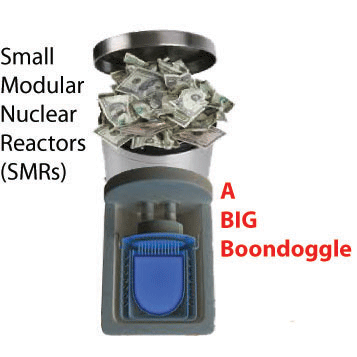 “Even if a safe and affordable design were to emerge from the current research projects, the
  whole concept relies on there being a sufficient guaranteed pipeline of orders for the construction and ramping up to scale of a large and expensive production facility,” NCG said.
“Without such a pipeline – itself requiring an unlikely level of long-term policy consistency – it is difficult to see the private sector being willing to finance such a facility.”
“We need to rapidly scale up investments in clean, safe renewable power and improving energy efficiency rather than fall for the latest sales pitch of the failing nuclear industry.”
Small nuclear reactors for Scotland? No thanks, say experts, The Ferret, Jenny Tsilivakou on July 7, 2019
The disastrous effects of the Chernobyl nuclear catastrophe continue
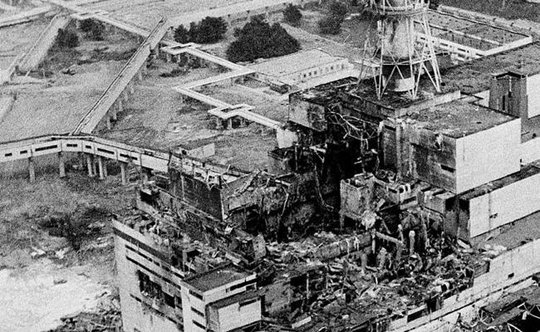 You’ve seen the TV series, now understand the Chernobyl catastrophe is far from over. https://www.smh.com.au/national/you-ve-seen-the-tv-series-now-understand-the-chernobyl-catastrophe-is-far-from-over-20190625-p5217u.html By Helen Caldicott, 4 July 19 It is 33 years since the radioactive accident at Chernobyl. The HBO miniseries Chernobyl has re-awakened interest in this dreadful moment in history. But Chernobyl is by no means over. And with commentators once again flagging the idea of overturning Australia’s long-standing opposition to a home-grown nuclear industry – and even suggesting our own nuclear weapons – it is timely to revisit its consequences.
Their book – while the subject of both positive and negative reviews, and not peer-reviewed by Western standards – concludes some 985,000 people died prematurely, mainly of cancer, as a result of the Chernobyl accident. Despite its limitations, it “is a treasure trove of data that if taken as a whole is overwhelming”, according to the noted evolutionary biologist Tim Mousseau.
Millions were initially exposed to very high doses of radiation from short-lived isotopes. But the report indicates that medical effects will continue to impact millions of exposed people because 40 per cent of the European land mass is polluted , and will remain contaminated for thousands of years by long-lived isotopes – plutonium 239, 238 and 241, americium 241, cobalt 60 and technetium 132. Parts of Turkey and Britain also received high fallout, which affected their crops and livestock.
A large body of literature now records the medical impact. In Belarus and nearby regions, 90 per cent of children were once healthy, now only 20 per cent, says the Chernobyl study. A million children still live in highly radioactive areas.
The study reports ongoing abnormalities of the immune system led to increased cases of bacterial and fungal infections, chronic joint and bone pain, osteoporosis, periodontal disease and fractures. Strontium 90 and plutonium concentrate in bones and teeth.
Premature ageing with heart attacks, hypertension, strokes and type 2 diabetes and alopecia are recorded in children. Multiple endocrine abnormalities including diabetes, hypo and hyperthyroidism and Hashimoto’s disease, as well as menstrual disorders, have increased as cesium concentrates in endocrine organs and cardiac muscle.
Intellectual retardation was recorded in babies who were in utero at the time of the accident. A noted embryologist, Wladimir Werteleki, recorded high incidences of microcephaly and microphthalmia in babies and severe neural tube defects in the Polissia region of the Ukraine related to very high levels of cesium 137 and 134 in the food eaten by pregnant women. Increased incidence of congenital cataracts, retinal pathology and adult cataracts occur in many European countries.
The Chernobyl study indicated that thyroid carcinoma arose two to four years after the accident, in Belarus increasing to 7000 cases by 2000 and, despite surgery, 30 per cent were aggressive and had metastasised. Congenital thyroid cancer in newborns also was documented.
Increases in a wide range of cancers – including stomach, colon, bladder, pancreas, breast and leukemia – are still recorded in the Ukraine, Belarus, Russia, Germany, the UK, Greece, Rumania and Europe.
Many thousands of children have been born with severe teratogenic deformities and homes around the Chernobyl area house hundreds of these children.
The Chernobyl study also found that of the 830,000 mainly young men known as ‘‘liquidators’’ – who were recruited from all over the Soviet Union to help clean up the contaminated area and were exposed to massive doses of radiation –112,000 to 125,000 died within the first 19 years.
Tim Mousseau has also conducted surveys of wildlife and birds in the exclusion zones, revealing genetic and chromosomal abnormalities, sterility in male swallows, small brains, tumours, and other anatomical abnormalities.
A huge and ill-informed debate persists about how many people have died as a result of Chernobyl. Sadly, the World Health Organisation has supported the International Atomic Energy Agency, which promotes nuclear power, in the estimate of about 4000 deaths related to Chernobyl.
Much of the data is more than a decade old. There is an urgent need for further extensive epidemiological studies on the exposed populations in Russia, the Ukraine, Europe, England, Turkey and other countries, and for treatment and support to be instituted for the many thousands of victims now and in the future. Because the long-lived radiological contamination of the soil and subsequent bio-concentration of the radioactive isotopes in the food chain will continue to poison children and adults for hundreds if not thousands of years.
Russia’s nuclear submarine disaster a blow to Putin and his much touted navy
 Russia’s nuclear submarine disaster will test President Vladimir Putin and his navy. ABC News, By Alexey Muraviev 4 July 19, Russia’s Ministry of Defence has officially acknowledged an incident this week with one of its deep-submergence vehicles (DSV) within Russian territorial waters.
The incident seems to point to one of Russia’s most closely guarded naval assets — the Project 10831 AS-31 (AS-12) Kalitka (Norsub-5), more commonly known as Losharik.
It is named after a popular Soviet cartoon character because of its design specifications — a series of titanium spheres under the hull designed to withstand extreme water pressure.
A secret assignment According to the latest reports, all those killed onboard were assigned to a secret naval unit stationed in St Petersburg, which is responsible for operations of Project 18510 Nel’ma (X-Ray) “autonomous deep-sea stations” — Russia’s official description of the DSV-type platforms — the AS-21 and the AS-35.
However, the declared number of casualties and the seniority of the deceased personnel is unclear…….
Covert trials of a nuclear-armed torpedo? While official word suggests the submarine was undertaking scanning of the seabed in one sector of the Barents Sea, the actual mission being undertaken may be different.It is possible the submarine was taking part in the covert sea trials of the Poseidon sub-sea strategic combat system (a large calibre nuclear torpedo) .
The tragedy would be the first reported large-scale fatality sustained by GUGI’s secret force.
But it cannot be compared with previous disasters involving Russian nuclear-powered submarines such as the RFS Kursk Oscar II class catastrophe back in 2000 or the incident onboard RFS Nerpa Akula IIclass back in 2008.
This disaster has happened within a unit designed specifically to operate in extreme physical environments where the safety and professionalism of the crew is a key to survival and success. The crew comprises only middle-to-senior rank officers…….
Was a nuclear disaster averted?
It is understood that the fire onboard led to the fatal intoxication of more than half of the crew — about 14 out of some 25 onboard — and serious injuries of another four or five onboard.
Any submariner would concur that a fire onboard a submarine on deployment poses a serious risk. Fire onboard a nuclear-powered submarine is even worse.
While it is unknown what triggered that fatal fire, a mechanical failure or a human error, the fact is clear: the crew, at the cost of their lives, prevented a potentially major environmental disaster if the DSV had sunk to the bottom of the ocean, or exploded…… https://www.abc.net.au/news/2019-07-03/russias-nuclear-submarine-disaster-test-vladimir-putin-navy/11274964
Climate change is damaging the nuclear industry: nuclear reactors can’t cope with heat and drought
 Nuclear Power, Once Seen as Impervious to Climate Change, Threatened by Heat Waves
The nuclear power sector is often portrayed as resistant to unpredictable weather associated with climate change. Heat waves, however, are punching holes in that narrative. US News, By Alan Neuhauser, Staff Writer July 1, 2019, THERE’S A REASON nuclear plants are built close to water.
Harnessing the enormous power of nuclear fission, plants generate steam, which shoots through pipes to spin a turbine that generates massive amounts of electricity. To keep from getting dangerously hot, the plants suck up surrounding water from the nearby rivers, lakes or oceans around which they’re built to cool the steam.
Now, increasingly, more frequent heat waves and hotter average temperatures are making those waters so warm that engineers are concerned that it can’t do the job. Analysts say climate change is to blame.
In little-noticed but publicly available reports to regulators, nuclear plant owners revealed that unusually hot temperatures last year forced them to reduce the plants’ electricity output more than 30 times – most often in the summer, when demand from nuclear plants is at its highest. In 2012, such incidents occurred at least 60 times. At one plant in Connecticut a reactor was taken offline for nearly two weeks when temperatures in the Long Island Sound surged past 75 degrees.
The incidents, submitted to the Nuclear Regulatory Commission, reflect a sharp uptick from even a decade ago, when plants appear to have submitted only nine such reports in 2009. In 1988, 1989 and 1991, there was just one such report. The dramatic increase mirrors the rise in average U.S. and global temperatures spurred by climate change.
“I’ve heard many nuclear proponents say that nuclear power is part of the solution to global warming,” says David Lochbaum, a retired nuclear engineer who compiled the reports based on data submitted to the NRC, and former director of the Nuclear Safety Project at the Union for Concerned Scientists. “It needs to be reversed: You need to solve global warming for nuclear plants to survive.”
Regulations set strict temperature limits for the water around each plant: 75 degrees for Millstone Generating Station in Connecticut, 85 degrees for Braidwood Generating Station outside Chicago, as high as 90 degrees for Turkey Point Generating Station south of Miami. Nuclear plants are now more regularly bumping up against those limits.
And even when water temperatures only approach those thresholds, plants can still be forced to dial down their output if the water used to cool their reactors will cause the temperatures in surrounding waterways to rise so much that it will endanger the habitats of fish and plants.
Limerick Generating Station outside Philadelphia, for example, reported turning down its output 79 times between 2008 and 2016……..
Climbing temperatures are not the first climate impact to strike nuclear power plants: The sector has also faced challenges from periodic but increasingly frequent droughts that can cause local water sources to run low.
And it’s not just water temperatures that plants have to contend with. Air temperatures can also cause conditions inside the plant to get too hot to operate. So desperate was a power plant in France during last year’s heat wave that it began spraying water on the outside of the building to keep the interior from overheating. Plants in the U.S., meanwhile, have regularly slashed their output by anywhere from 3% to 60%.
Such dynamics could cause output from nuclear plants to fall by as much as 16% in the coming decades, according to a 2012 analysis. Moreover, climate concerns threaten to pierce nuclear’s carefully constructed – and increasingly embattled – narrative that it’s the only reliable source of zero-emissions power. Already, the country’s aging fleet of nuclear plants is facing stiff competition from cheap natural gas and, more recently, falling prices for solar and wind paired with battery storage.
Rising temperatures, by forcing nuclear plants to reduce their output, have “made this already problematic resource even less viable in the current energy environment and economy, says Dan Kammen, a professor of nuclear engineering at the University of California-Berkeley…… https://www.usnews.com/news/national-news/articles/2019-07-01/nuclear-power-once-seen-as-impervious-to-climate-change-threatened-by-heat-waves
The high carbon emissions of UK’s nuclear reactor project
 Nuclear power is helping to drive the climate crisis, Guardian, 3 July 19
As the CBI looks for investment from abroad, UK taxpayers will pick up the bill for the likely time and cost overruns of new nuclear build under the regulated asset-based funding proposals so welcomed by the CBI. Nuclear has failed to achieve the investment needed so far because it is no longer seen as economically viable. Even Hitachi (one of the world’s largest multinationals) cannot magic Wylfa Newydd into a commercially viable business. In January this year, Hitachi announced it had failed to squeeze the UK government for the very high levels of subsidies desired by large investors upfront for Wylfa. Nobody can afford the costs or the many risks attached to building new nuclear power stations. PAWB (Pobl Atal Wylfa B/People Against Wylfa B) https://www.theguardian.com/environment/2019/jul/02/nuclear-power-is-helping-to-drive-the-climate-crisis
Nuclear power is the ultimate unsustainable form of energy.
The simple reason why nuclear power is finished – Dr Richard Dixon https://www.scotsman.com/news/opinion/columnists/the-simple-reason-why-nuclear-power-is-finished-dr-richard-dixon-1-4957211
Half of Scotland’s nuclear reactors are off-line over safety concerns, but the lights still stayed on, writes Dr Richard Dixon. July 3 2019
Nuclear power is the ultimate unsustainable form of energy. For some electricity today, we are leaving a thousand generations of future humans dangerous radioactive waste.
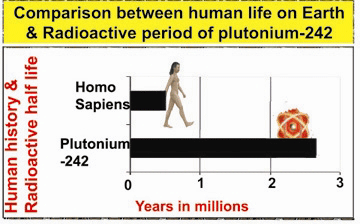
I thought it was terribly clever but it took me quite a while to realise that Roman Britain was far too close at hand. To cover the generally accepted 25,000 years, it would need to have referred to Cro-Magnon humans.
The politics of Scotland mean that new reactors here are almost unthinkable and the price of the renewable energy alternatives has fallen so far below the cost of nuclear that you would have to be crazy to go for new nuclear.
Labour’s Jack McConnell was the First Minister who said he would block new nuclear plants until there was a solution to the waste problem (14 years later, there is none). And while it is in the SNP’s DNA to oppose nuclear power. EDF and some unions do still try to lobby Scottish Ministers and officials, but to no avail. Meanwhile the industry is doing a great job of showing how terrible a bet nuclear is.
The nuclear industry is almost unique in that every new reactor costs more than the last, while everything else gets cheaper, including offshore wind power which is now coming in at just over half the price of nuclear for a unit of energy.
Hinkley Point C, the only nuclear station under construction in the UK, was supposed to be cooking the Christmas turkey in 2017. It is now expected to be producing electricity at the end of 2025 at the earliest. The only way it could be built was for the UK Government to agree that electricity consumers would pay bills well over the odds for the next 35 years.
The same sort of reactor is being built in Finland. It may start producing electricity next year – 11 years late. The other one of the same design is in France and is currently running 12 years late, at twice the original budget.
The latest wheeze the industry has come up with is to ask the UK Government to agree to pay any costs more than 30 per cent above the original budget for any more reactors. Not a good bet given their history.
Of course we already have four reactors in Scotland. The two at Torness are the second newest in the UK, having been opened by Margaret Thatcher in 1989. The two at Hunterston in Ayrshire are already well past their sell-by date, having started up in 1976. They were supposed to have closed in 2006 but have had three extensions with planned closure now in 2023. Because of a large number of cracks in their cores one reactor stopped generating in March last year and the other in October. Owners EDF are arguing with regulators about whether they can safely restart.
Did you notice the lights going out across Scotland with Hunterston not producing a single electron for eight months? No, thanks largely to renewables having a record first quarter of 2019 and supplying nine out of ten households in Scotland.
We certainly don’t need new nuclear and, with renewables rapidly on the rise, we should not take the unnecessary risk of starting up the Hunterston reactors ever again.
Dr Richard Dixon is director of Friends of the Earth Scotland.
Nuclear Weapons and the 2020 USA Presidential Candidates
iframe width=”560″ height=”315″ src=”https://www.youtube.com/embed/K8FVeoMQ_Ck” frameborder=”0″ allow=”accelerometer; autoplay; encrypted-media; gyroscope; picture-in-picture” allowfullscreen></iframe>
The Other Existential Threat: Nuclear Weapons & the 2020 Presidential Campaign https://blog.ucsusa.org/sean-meyer/nuclear-weapons-candidates-primaries
This should not be surprising: recent polling shows that in key primary states, including New Hampshire and Iowa, over 80% of respondents want to know what candidates think about nuclear weapons. We also know from recent national polling that more than 80% of people support arms control treaties with Russia.
Unfortunately, current US policies put the public at danger from nuclear use. Today, the United States retains the right to use nuclear weapons first in a crisis and maintains hundreds of land-based missiles on hair trigger alert. New, more usable nuclear weapons are being developed as part of a trillion-dollar plan to re-build and maintain the entire nuclear arsenal (a proposal mind you that dates to the Obama administration). For its part, the Trump administration has pulled out of crucial nuclear agreements that have kept us safe, including the Iran nuclear deal and the Intermediate-Range Nuclear Forces (INF) Treaty, and seems poised to walk away from the New START Treaty as well.
These kinds of policies should be a major topic of discussion among candidates in the 2020 election, and candidates are already being asked about their positions on the campaign trail. Their responses and comments show a range of thought and understanding on the topic. You can see videos of the conversations with the presidential candidates about nuclear weapons on our YouTube channel.We’ll keep adding videos to this channel as members of the public and activists around the country continue to have these conversations with the candidates in the months ahead.
Indeed, voters have a critical role to play by raising the profile of these discussions and helping to elevate this important conversation and debate—both within our communities and online.
Nuclear weapons and climate change are the two existential threats facing humanity. They are serious. They are growing. They are urgent. And our country and leaders must act—before it’s too late.
So that’s where “we the people” come in. Let’s educate others. Let’s raise our voices. Let’s insist that those who wish to lead our country do just that—lead us on a path that reduces the risks these horrible weapons pose.
The Union of Concerned Scientists aims to increase public discussion about the use of nuclear weapons; we are posting these videos to highlight such discussion by candidates for president. As a 501c3 nonpartisan organization, UCS does not support or oppose any candidate for election.
Eye witnesses to Russian nuclear submarine disaster
Fishermen witnessed nuclear submarine drama, The sub quickly surfaced and there were subsequent signs of panic on the deck, the local fishermen say. The accident might have been caused by a gas explosion. Barents Observer, By Atle Staalesen,July 03, 2019
They were out doing illegal fishing and do not want to reveal their names. But the men who late Monday evening were onboard a small local fishing boat off the coast of the Kola Peninsula told news agency SeverPost that they witnessed what appeared as a state of emergency.
Eye witnesses
It happened around 9.30 pm near the Ura Bay, one of the witnesses says.
«We were heading towards Kildin, and then, about half past nine in the evening, a submarine surfaces. Suddenly and completely surfaces. I have never seen anything like it in my life. On the deck, people were running around and making fuss,» he told SeverPost.
The fishermen hid in nearby bay from where they saw that a navy vessel and two tugs quickly arrived on site. Around 11 pm, the vessels accompanied the submarine away from the area. There was no sign of smoke, they say.
Other locals later reported that they saw bodies being taken out of the submarine and to an approaching ship.
A source in the Russian Navy later told SeverPost that the submarine seen by the local fishermen was most likely the «Podmoskovie», the mother vessel of the special purpose submarine «Losharik» (AS-31). The «Podmoskovie» is a rebuilt Delta-IV class submarine designed to carry the much smaller «Losharik».
Sources in the Navy on Tuesday told Russian media that the accident had happened in the «Losharik». …… https://thebarentsobserver.com/en/security/2019/07/fishermen-witnessed-nuclear-submarine-drama
14 Russian Sailors Killed in Fire on Nuclear Submarine
14 Russian Sailors Killed in Fire on Nuclear Sub https://www.themoscowtimes.com/2019/07/02/14-russian-sailors-killed-in-fire-on-nuclear-sub-reports-a66257 3 July 19 Fourteen submariners on board a Russian Defense Ministry research vessel were killed in a fire while carrying out a survey of the sea floor off Russia’s Arctic coast, the ministry was quoted as saying by Russian news agencies.
The incident took place on the AS-31 deep-sea nuclear submarine nicknamed Losharik, an unnamed source in the security forces told the RBC news website. Launched in 2003, Losharik was designed for research, rescue and special military operations and can hold up to 25 crew members.
The fire broke out at 8:30 p.m. on Monday, RBC cited its source as saying, nearly a day before the ministry released the news. “On July 1 in Russian territorial waters a fire broke out on board a deep-water scientific research vessel that was studying the marine environment of the world ocean on behalf of the Russian navy,” Interfax cited a ministry statement as saying.
“Fourteen submariners died as the result of smoke inhalation … Work is underway to establish the cause of the incident. The investigation is being conducted by the commander-in-chief of the navy.”
The fire has been extinguished and the submarine is now at the Russian Northern Fleet’s base in Severomorsk on the Barents Sea, Interfax quoted the ministry as saying. The statement as cited by the agencies did not identify the type or model of the underwater vessel.
This is the largest accident to take place on a Defense Ministry submersible since 2008, when a freon gas leak on the nuclear-powered submarine Nerpa killed 20 and injured 21.
In August 2000, the Russian nuclear-powered submarine Kursk sank to the floor of Barents Sea after two explosions in its bow, killing all 118 men aboard.That accident, soon after President Vladimir Putin took office, focused official attention on the state of the military and its hardware, which had been subject to underfunding and neglect after the collapse of the Soviet Union.
Since then, Putin has overseen a massive increase in military funding that has allowed the armed forces to renew their equipment and improve training and morale.
However, accidents have continued to happen as the military, used by the Kremlin to project its growing international muscle, has ramped up its activities and extended into new theatres of operation.
In December 2016, a Russian military plane carrying 92 people, including dozens of Red Army Choir singers, crashed into the Black Sea en route to Syria where Russian forces are deployed. Everyone on board was killed.
Epidemic of cancer at Basra – city affected by depleted uranium weapons
 Cancer hits Iraqi oil city of Basra, https://menafn.com/1098716339/Cancer-hits-Iraqi-oil-city-of-Basra
MENAFN – Iraq Business News) By Mustafa Saadoun forAl Monitor 3 July 19, The deputy governor of Basra province, Zahra al-Bijari, claimed June 6 that cancer rates have been growing dramatically in the province as a result of pollution, both from oil production and from depleted uranium dust that a doctor says is causing “another Hiroshima.”
The province of Basra is registering 800 new cases of cancer per month, according to Iraq’s High Commission for Human Rights, which attributed the cause to ‘multiple reasons, including environmental pollutants, whether in the air such as emanating from oil combustion, in water and soil, and resulting from effects of war.’
Los Angeles’ cheap solar + battery-storage project spells doom for nuclear power
 New Solar + Battery Price Crushes Fossil Fuels, Buries Nuclear, Forbes, Jeff McMahon ,2 July 19. Los Angeles Power and Water officials have struck a deal on the largest and cheapest solar + battery-storage project in the world, at prices that leave fossil fuels in the dust and may relegate nuclear power to the dustbin.Later this month the LA Board of Water and Power Commissioners is expected to approve a 25-year contract that will serve 7 percent of the city’s electricity demand at 1.997¢/kwh for solar energy and 1.3¢ for power from batteries.
“This is the lowest solar-photovoltaic price in the United States,” said James Barner, the agency’s manager for strategic initiatives, “and it is the largest and lowest-cost solar and high-capacity battery-storage project in the U.S. and we believe in the world today. So this is, I believe, truly revolutionary in the industry.”
It’s half the estimated cost of power from a new natural gas plant.
Mark Z. Jacobson, the Stanford professor who developed roadmaps for transitioning 139 countries to 100 percent renewables, hailed the development on Twitter Friday, saying, “Goodnight #naturalgas, goodnight #coal, goodnight #nuclear.”
The anti-nuclear activist Arnie Gunderson, who predicted storage prices under 2¢/kwh four years ago on the night Elon Musk unveiled the Tesla Powerpack, noted Saturday that his 2015 prediction was too high. He too said, “Goodbye coal, nukes, gas!”……….. https://www.forbes.com/sites/jeffmcmahon/2019/07/01/new-solar–battery-price-crushes-fossil-fuels-buries-nuclear/#59a3e2355971
Climate change increases heat waves across Europe
 ‘Worst is still to come’: Sizzling Europe battles wildfires, health risks, New records are being set as Europe swelters, sparking forest fires – and debates over public nudity. SBS News, 29 June 19, Wildfires raged across Catalonia and French authorities stepped up restrictions on water use and driving in cities as swathes of western Europe remained in the grip of an intense heatwave.Temperatures climbed towards 44 degrees Celsius (111 degrees Fahrenheit) in parts of northern Spain and southern France, driving many people to seek relief in the sea, rivers, lakes, fountains and swimming pools.
Grid operator RTE said French electricity demand on Thursday was close to a summer record seen two years ago, as people turned on fans and coolers to full blast for relief from the scorching temperatures……….
The stifling heat has elsewhere prompted traffic restrictions in France and fanned debate in Germany over public nudity as sweltering residents stripped off. …….
Exceptional for arriving so early in summer, the heatwave will on Thursday and Friday likely send thermometers above 40 degrees in France, Spain and Greece.
In Spain, hundreds of firefighters and soldiers, backed by water-dropping aircraft, battled on Wednesday to put out a wind-fuelled forest fire that erupted in Torre del Espanol in the northeastern region of Catalonia…….
Scientists warn that global warming linked to human fossil fuel use could make such scorchers more frequent.
“Global temperatures are increasing due to climate change,” said Len Shaffrey, professor of climate science at the University of Reading.
“The global rise in temperatures means the probability that an extreme heatwave will occur is also increasing.”………
European heatwave could be the norm in a climate change affected world…….. https://www.sbs.com.au/news/worst-is-still-to-come-sizzling-europe-battles-wildfires-health-risks
The continuing saga of the stalled negotiations between Trump and Kim
Keeping Up With the Plot of the Trump-Kim Nuclear Show, Bloomberg, By Jon Herskovitz and Youkyung Lee, July 1, 2019, Three meetings between the leaders of the U.S. and North Korea resulted in no concrete plans to end Pyongyang’s atomic ambitions. President Donald Trump and Kim Jong Un have toned down hostile rhetoric since they first shook hands in Singapore in June 2018. They were cordial even after their second summit broke down in Hanoi in February, and took an historic stroll together into North Korea four months later. All the while, Pyongyang’s nuclear program quietly advanced as U.S.-backed sanctions choked its moribund economy. The two countries can’t agree on what the denuclearization of North Korea means and what rewards should be given, if any, in response to Pyongyang’s moves toward disarmament. But Trump has invited Kim to the White House, while a top aide to Kim has touted the “mysteriously wonderful” chemistry between the two leaders.
1. What have they agreed to?
The first summit resulted in a bare-bones declaration that contained four main items: To normalize ties between the U.S. and North Korea, formally end the 1950-53 Korean War, repatriate U.S. war remains and — crucially — “to work toward complete denuclearization of the Korean Peninsula.” But “work toward” is undefined. It’s also unclear whether the U.S. nuclear umbrella over South Korea is included. U.S. Secretary of State Michael Pompeo says that Kim accepted the “final, fully verified denuclearization of North Korea.” North Korea points out the agreement referred to the entire peninsula and insists U.S. weapons must go at the same time, or it would be left vulnerable to attack. A meeting between Kim and Trump within the Demilitarized Zone in June 2019 led to an agreement to resume working-level talks that could iron out details of any deal.
2. What does the U.S. want?
To start, the U.S. wants North Korea to provide an inventory of weapons, facilities and fissile material it has produced. Kim’s regime calls that akin to asking for a “target list.” Further steps would include inspections, closing facilities and destroying weapons, and even surrendering nuclear material, according to proliferation experts. Past talks have faltered on the question of inspections and verification.
3. What does North Korea want?
Kim wants “corresponding measures,” or immediate rewards, for any steps his regime makes. In a televised New Year’s address, Kim threatened to take a “new path” if Washington didn’t relax crippling economic sanctions.
He signaled that any deal might require weakening the U.S.-South Korean alliance, urging Seoul not to resume military exercises with the American side. And he made clear that he believed the denuclearization pledge includes “strategic assets” such as America’s nuclear-capable planes and warships. But his language was less bellicose than past years, possibly reflecting his limited options.
4. What has North Korea offered?
In Hanoi, North Korea offered to shut down parts of its Yongbyon nuclear complex, which has served as the crown jewel of its atomic program, in return for sanctions relief. The aging facility about 60 miles north of Pyongyang was once the main source of its fissile material, turning out roughly enough plutonium each year for one atomic bomb. But North Korea has since turned to uranium enrichment for weapons. Still, Yongbyon remains its main atomic research facility and a complete closure would affect its nuclear program…….. https://www.bloomberg.com/news/articles/2019-07-01/keeping-up-with-plot-of-the-trump-kim-nuclear-show-quicktake
1 This month

of the week – Australians for War Powers Reform (AWPR)
To see nuclear-related stories in greater depth and intensity
 Antinuclear