Russia is secretive about its nuclear wastes. Europe’s environmentalists are concerned.
Environmentalists concerned about where Andreyeva Bay spent nuclear fuel is being sent Bellona, June 24, 2019 by Anna Kireeva, translated by Charles Digges
Representatives from Rosatom, Russia’s nuclear corporation, have sought to sooth environmentalist over concerns that removing tons of spent nuclear fuel from an old submarine base near Murmansk won’t cause further contamination risks at Mayak, the country’s notorious fuel reprocessor, located 3,000 kilometers to the south.
The submarine base is Andreyeva Bay, situated 60 kilometers east of Russia’s Norwegian border, and its cleanup is one of the most important joint environmental efforts that Oslo and Moscow have taken on in decades. Bellona has been at the forefront of advocating for the removal of the base’s 22,000 spent nuclear submarine fuel rods, which threaten to contaminate the Barents Sea.
After years of negotiations among Bellona, and the governments of Norway and Russia, removal of the fuel at Andreyeva Bay finally began in June of 2017. From there it is taken to Mayak, near the Ural Mountain city of Chelyabinsk, for treatment and reprocessing.
But Mayak has a checkered past. Now one of he world’s most voluminous nuclear fuel reprocessing facilities, the Mayak Production Association is also responsible for decades of nuclear contamination throughout the Ural region.
The Russian government also has a history of covering up that contamination, and it was these concerns that some environmentalists brought to a press conference in Tromsø, Norway when a joint Russian-Norwegian Commission on nuclear submarine disposal wrapped up on Friday.
Vitaly Servetnik, co-chairman of the Russian Social-Ecological Union, was among the environmentalists who attended the press conference, which was a first time event for the Commission, which has traditionally closed its doors to the press and the public.
“Sending spent nuclear fuel and radioactive waste from the Murmansk region to the Chelyabinsk Region, in our opinion, is not only moving the problem from one region to another through the whole country, but also aggravating existing problems in the areas around the Mayak plant,” Servetnik said, addressing the commission. “In addition, there is no information available to us about how much and what kind of waste is being brought there.”
It’s necessary to point out that Russia doesn’t view spent nuclear fuel as waste. The Russian nuclear industry — like the ones Britain and France but unlike the one in the United States — adopts a closed nuclear fuel cycle. This means that it treats spent nuclear fuel – including the submarine fuel found at Andreyeva Bay, as a resource from which more fuel can be synthesized.
At present, and for the foreseeable future, Mayak is the only facility in Russia capable of reprocessing spent nuclear fuel. Simply not taking the spent nuclear fuel from Andreyeva Bay to Mayak, as Servetnik suggests, is therefore a technological impossibility for Russia’s nuclear industry.
Servetnik also expressed concern about the transparency about how Mayak is run, and how difficult it is to get information about its procedures if an environmental group is not a member of Rosatom’s public council.
“The real situation at Mayak is much worse than what Rosatom representatives are telling us about it,” he said at the conference.
Rosatom representatives who were present fundamentally disagreed with Servetnik’s statement……….
After the conclusion of the conference, Servetnik and other environmentalists who attended weren’t reassured by Rosatom’s insistence that they need not worry about the fuel transfers from Andreyeva Bay to Mayak.
“The state corporation views the movement of radioactive waste and spent nuclear fuel as part of an integrated process,” he said. “If that’s the case, then all of the attention the Russian and international community devoted to the project of cleaning up Andreyeva Bay should now be devoted to Chelyabinsk Region [where Mayak is located].”
Andrei Zolotkov, who heads Bellona’s Murmansk office, agrees that much of Mayak’s environmental history leaves much to be desired, that that its transparency about its activities past and present is required.
Deep Isolation – a nuclear waste disposal method that could be part of shutting down the nuclear industry
 I don’t usually post James Conca’s work, as he is a propaganda voice for the nuclear industry. Here he’s praising a nuclear waste disposal technology, because Conca sees it as being able to ensure that the radioactive trash might later be retrieved, and, miraculously, function as fuel for nuclear fast breeder reactor.
However, this technology has advantages in the cause of PERMANENT disposal of used nuclear fuel rods – disposal that could be done fairly close to the point of origin – each nuclear power station.
This has promise as a viable technique, as part of PERMANENT SHUTDOWN OF THE NUCLEAR INDUSTRY.
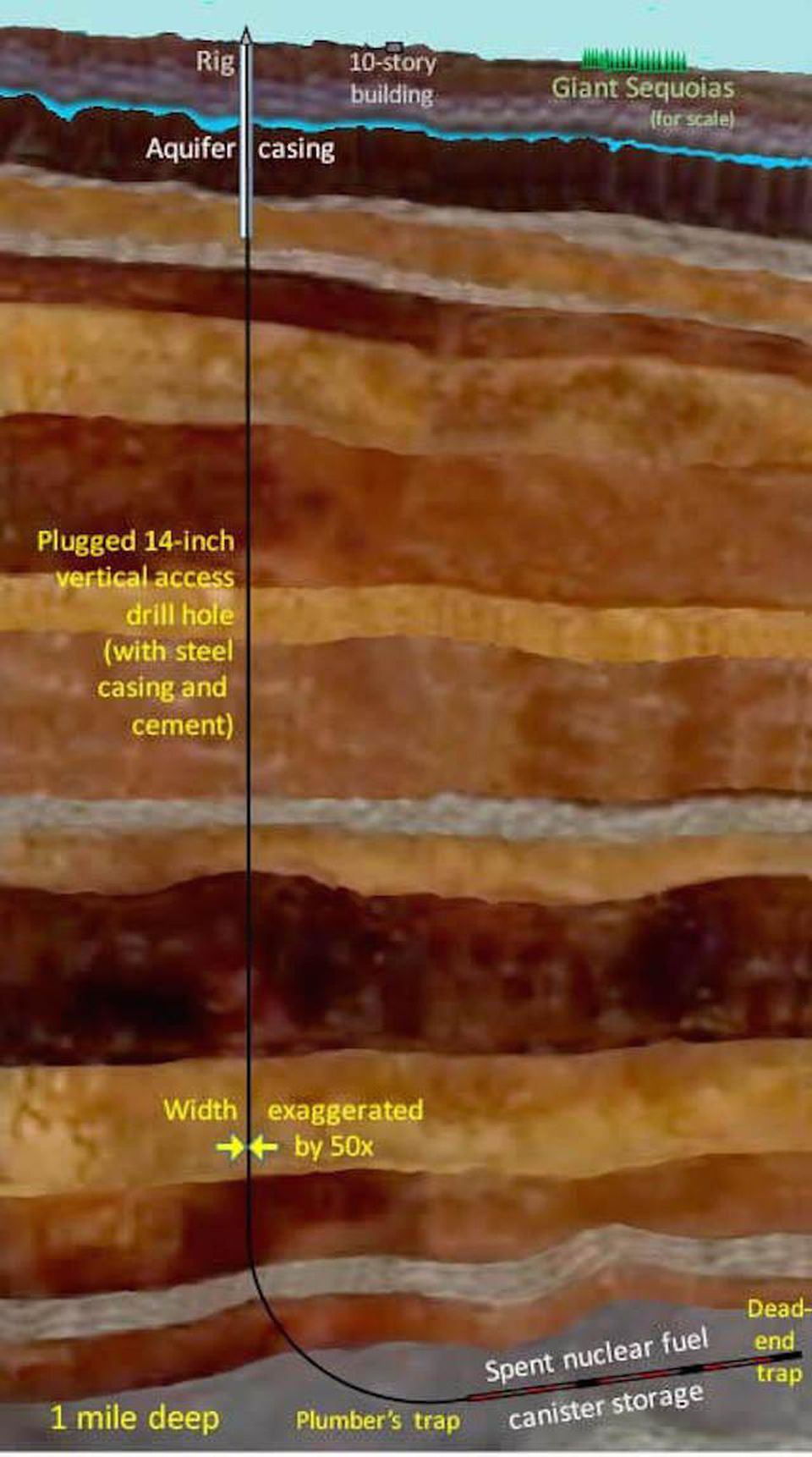 Deep Borehole Nuclear Waste Disposal Just Got A Whole Lot More Likely, Forbes, James Conca, 24 June 19 Deep Isolation is a recent start-up company from Berkeley that seeks to dispose of nuclear waste safely at a much lower cost than existing strategies.
The Deep Isolation strategy begins with a one-mile vertical access drillhole that curves into a two-mile horizontal direction where the waste is stored. The horizontal repository portion has a slight upward tilt that provides additional isolation, and isolating any mechanisms that could move radioactive constituents upward. They would have to move down first, then up, something that cannot occur by natural processes.
DEEP ISOLATION
The borehole technology was developed to frack natural gas and oil wells, but Deep Isolation realized it could dispose of nuclear waste just as well.
Today the company announced it was partnering with nuclear giant Bechtel National, Inc. to bring Deep Isolation’s patented technology to fruition……. The idea of deep borehole disposal for nuclear waste is not new, but Deep Isolation is the first to consider horizontal wells and is the first to actually demonstrate the concept in the field (see figure), showing that the technology is not just theoretical. The field demonstration occurred on January 16th when it placed and retrieved a waste canister from thousands of feet underground.
The technology takes advantage of recently developed fracking technologiesto place nuclear waste in a series of two-mile-long tunnels, a mile below the Earth’s surface, where they’ll be surrounded by a very tight rock known as shale. This type of shale is so tight that it takes fracking technology to get any oil or gas out of it at all. ……..
Under this new agreement, Bechtel will provide support such as project management, financial/business and engineering capability for Deep Isolation’s sales in both domestic and international markets, including those with the U.S. Department of Energy. Deep Isolation will provide options to support Bechtel’s cleanup work at federal government sites around the country. Deep Isolation could also be a key player in Bechtel’s decommissioning contracts at commercial nuclear power plants in the U.S. and worldwide.
James Taylor, general manager of Bechtel’s Environmental business line, said, “Deep geologic disposal is the scientific consensus for permanently removing and disposing used nuclear fuel and high-level waste from their current locations around the country. We have long-term expertise in design, engineering and licensing, as well as the boots-on-the-ground experience with the everyday challenges of cleaning up radioactive waste. “….. https://www.forbes.com/sites/jamesconca/2019/06/24/deep-borehole-nuclear-waste-disposal-just-got-a-whole-lot-more-likely/#489747b767c8
Climate change and damaged ozone layer are having a feedback effect on each other
 Damage to the ozone layer and climate change forming feedback loop
New report finds that impacts of ozone-driven climate change span the ecosystem https://www.sciencedaily.com/releases/2019/06/190624111536.htm June 24, 2019 Rensselaer Polytechnic Institute
- Summary:
- Increased solar radiation penetrating through the damaged ozone layer is interacting with the changing climate, and the consequences are rippling through the Earth’s natural systems, effecting everything from weather to the health and abundance of sea mammals like seals and penguins.
- Increased solar radiation penetrating through the damaged ozone layer is interacting with the changing climate, and the consequences are rippling through the Earth’s natural systems, effecting everything from weather to the health and abundance of sea mammals like seals and penguins. These findings were detailed in a review article published today in Nature Sustainability by members of the United Nations Environment Programme’s Environmental Effects Assessment Panel, which informs parties to the Montreal Protocol.
What we’re seeing is that ozone changes have shifted temperature and precipitation patterns in the southern hemisphere, Continue reading
Australia is unprepared for the idea of “the circular economy” – but it is already core policy for many countries
 A radical economic shift is coming but Canberra isn’t talking about it, SMH, By Lisa McLean, June 25, 2019 Over the next decade, the Australian economy will be hit with a radical transformation that will forever change our approach to consumption – but no one is talking about it in Canberra yet.
The transition away from our linear economy where we use and then throw away nearly all of the products we buy and consume to a circular economy where we repair, reuse and share is already gaining traction around the world.
When the G20 meets in Osaka this Friday, June 28, this phenomenon – already happening at the grass roots up, kick started by many communities and regions who rely on bartering and communal vegetable patches – is set to be raised as one of the few viable economic pathways out of our global consumption-climate-biodiversity crisis.
The world simply doesn’t have enough virgin resources to support the 10 billion people who will be on our planet by 2050.
We have exceeded our planetary boundaries and as a consequence the rapid and significant destruction of our biosphere is going to impact on health and livelihood of all people. It will lead to collapse of fish stocks, water scarcity, soil erosion, air pollution, global deforestation, biodiversity loss and the list goes on.
The circular economy is now core policy for a growing number of countries with leadership from Finland, the European Union and Canada, but it is also taking a strong hold in Asia as Japan and China implement circular economic policies to transition them to a sustainable inclusive future……… https://www.smh.com.au/environment/sustainability/a-radical-economic-shift-is-coming-but-canberra-isn-t-talking-about-it-20190620-p51ziu.html
Why nuclear energy is not the answer to solve climate change
 There is no such thing as a zero- or close-to-zero emission nuclear power plant. Even existing plants emit due to the continuous mining and refining of uranium needed for the plant. Emissions from new nuclear are 78 to 178 g-CO2/kWh, not close to 0. Of this, 64 to 102 g-CO2/kWh over 100 years are emissions from the background grid while consumers wait 10 to 19 years for nuclear to come online or be refurbished, relative to 2 to 5 years for wind or solar. In addition, all nuclear plants emit 4.4 g-CO2e/kWh from the water vapor and heat they release. This contrasts with solar panels and wind turbines, which reduce heat or water vapor fluxes to the air by about 2.2 g-CO2e/kWh for a net difference from this factor alone of 6.6 g-CO2e/kWh.
In fact, China’s investment in nuclear plants that take so long between planning and operation instead of wind or solar resulted in China’s CO2 emissions increasing 1.3 percent from 2016 to 2017 rather than declining by an estimated average of 3 percent. The resulting difference in air pollution emissions may have caused 69,000 additional air pollution deaths in China in 2016 alone, with additional deaths in years prior and since.
The 7 reasons why nuclear energy is not the answer to solve climate change, https://www.leonardodicaprio. org/the-7-reasons-why-nuclear-energy-is-not-the-answer-to-solve-climate-change/, Mark Z. Jacobson , Professor of Civil and Environmental Engineering, Director, Atmosphere/Energy Program, Stanford University, 21 June 19
One nuclear power plant takes on average about 14-1/2 years to build, from the planning phase all the way to operation. According to the World Health Organization, about 7.1 million people die from air pollution each year, with more than 90% of these deaths from energy-related combustion. So switching out our energy system to nuclear would result in about 93 million people dying, as we wait for all the new nuclear plants to be built in the all-nuclear scenario.
Utility-scale wind and solar farms, on the other hand, take on average only 2 to 5 years, from the planning phase to operation. Rooftop solar PV projects are down to only a 6-month timeline. So transitioning to 100% renewables as soon as possible would result in tens of millions fewer deaths.
This illustrates a major problem with nuclear power and why renewable energy — in particular Wind, Water, and Solar (WWS)– avoids this problem. Nuclear, though, doesn’t just have one problem. It has seven. Here are the seven major problems with nuclear energy:
An American State Opposes Transport of Nuclear Wastes and Federal Waste Dump Plan
 Political opposition grows to nuclear waste storage plan, SF Chronicle, By SUSAN MONTOYA
  BRYAN, Associated Press June 21, 2019 ALBUQUERQUE, N.M. (AP) — Plans by a New Jersey-based company to temporarily store spent nuclear fuel from commercial reactors in the New Mexico desert is running into more political trouble, as some of the state’s top elected officials are raising red flags.
Congresswoman Deb Haaland became the latest member of the delegation to weigh in Friday, sending a letter to the U.S. Energy Department and the Nuclear Regulatory Commission.
The first-term Democratic lawmaker suggested existing railways weren’t built to withstand the weight of the special casks that would be used to transport the high-level waste from sites around the country to southeastern New Mexico.
Haaland said there are no plans for new construction or renovations as part of the project proposed by Holtec International and that cities and states shouldn’t bear the cost of the infrastructure improvements needed to ensure safe transportation.
“I believe such a facility poses too great a risk to the health and safety of New Mexicans, our economy and our environment,” Haaland wrote.
Holtec is seeking a 40-year license from federal regulators to build what it has described as a state-of-the-art complex near Carlsbad……….
n her letter, Haaland pointed to past studies done by the Energy Department when it was considering Yucca Mountain. She said modeling predicted rail accidents at a rate of 1 in 10,000 shipments.
She also said the agency has found that a severe accident involving one cask of radioactive waste has the potential to contaminate dozens of square miles and result in hundreds of millions of dollars in cleanup costs.
State and industry officials also have concerns about potential effects on oil and gas development, as Holtec’s proposed site is located within the Permian Basin — one of the world’s most prolific energy production regions. https://www.sfchronicle.com/news/article/Political-opposition-grows-to-nuclear-waste-14028381.php
China’s new solar thermal power plan to reduce carbon dioxide emissions by 350,000 metric tonnes yearly
 Energy Live News 21st June 2019 China’s first 100MW molten salt solar thermal power plant has
successfully hit its maximum power levels. Built by Beijing Shouhang IHW
Resources Saving Technology, the three billion yuan (£345m) project in
Dunhuang uses 12,000 mirrors to concentrate sunlight onto a receiver, which
is then used to heat the molten salt. It is capable of generating 390
million kWh of clean power each year, enough to reduce carbon dioxide
emissions by 350,000 metric tonnes – engineers at the facility say it has
already reached or exceeded its designed values.
Russia has a nuclear priesthood – quite literally
 BLESSED BE THY NUCLEAR WEAPONS: THE RISE OF RUSSIAN NUCLEAR ORTHODOXY, War on the Rocks, MICHAEL KOFMAN June 21 2019 Dmitry Adamsky, Russian Nuclear Orthodoxy: Religion, Politics, and Strategy (Stanford University Press, 2019).
Russia’s Federal Nuclear Center, the All-Russian Institute of Experimental Physics (RFNC-VNIIEF), recently placed a somewhat unusual government tender: It is seeking a supplier of religious icons with the images of Saint Seraphim of Sarov and Saint Fedor Ushakov. Meanwhile, a private foundation, backed by President Vladimir Putin and Minister of Defense Sergei Shoigu, has been gathering funds to build a massive temple to the Russian Armed Forces at Patriot Park,. Artisans are crafting a new icon for the temple, while the steps are to be made from melted-down Nazi equipment captured by the Red Army in World War II.
Viewed in isolation, these may seem to be the occasional eccentric habits of a latter-day authoritarian state. However, Dima Adamsky’s new book, Russian Nuclear Orthodoxy: Religion, Politics, and Strategy, demonstrates convincingly that there are indeed important signs being missed all around us, pointing to a longstanding nexus between the Russian Orthodox Church and the country’s nuclear-military-industrial complex.
Adamsky’s groundbreaking book lays out the largely unstudied history of how a nuclear priesthood emerged in Russia, permeated the units and commands in charge of Russia’s nuclear forces, and became an integral part of the nuclear weapons industry. Continue reading
To comply with Paris climate agreement, France could switch to 100% renewables
Le Point 18th June 2019 “France could switch to 100% renewable energy” INTERVIEW. According to Rana
Adib, head of the network of experts REN21, the effort in favor of
renewable energies must be relaunched to comply with the Paris agreement.
German climate activists storm open cut coal mine
western Germany to campaign against fossil fuels. BBC 23rd June 2019 https://www.bbc.co.uk/news/world-europe-48734321
Russia perturbed, as USA government turning towards a ‘limited nuclear war’
Washington’s mindset sliding back to ‘limited nuclear war’ says Russian Foreign Ministry, https://tass.com/politics/1065118 23 June 19.
Statements by the US officials are clearly designed to justify expanding the Pentagon’s arsenal of nuclear weapons to support the projection of military force around the world,” the diplomat said
MOSCOW, In its approaches to the use of nuclear weapons, the United States is returning to the concept of “limited nuclear war” and for this they could be planning to abandon the Comprehensive Nuclear-Test-Ban Treaty (CTBT), Deputy Director of the Information and Press Department of the Russian Foreign Ministry Artem Kozhin said on Saturday in a statement.
“It causes great concern to reiterate that the United States is going 60 years back in its approaches to nuclear planning, when the ‘limited nuclear war’ between superpowers seemed acceptable to them and seemed to give a chance to win,” Kozhin said. “This, apparently, is connected to the growing signs of Washington’s desire to renounce its obligations under the Comprehensive Nuclear-Test-Ban Treaty,” the diplomat said.
The United States is ready to make low-yield nuclear warheads a means of blackmailing states for global projection of US military power, Kozhin said. “Statements by the US officials are clearly designed to justify expanding the Pentagon’s arsenal of nuclear weapons to support the projection of military force around the world,” the diplomat said. With such actions, the United States reduces the threshold for the use of nuclear weapons, the statement said.
USA war crimes – mass deaths in Fallujah, depleted uranium effects linger
there is no credible official figure for civilian casualties because the U.S. commanders and the Pentagon played down the  killing of civilians in the Iraq conflict, though some estimates place deaths in the Mideast country at between a half-million and 1 million.
 it was the widespread deployment of depleted uranium (DU) munitions that was to have lasting human damage.
The British scientific report entitled “Cancer, Infant Mortality, and Birth-Sex Ratio in Fallujah, Iraq 2005-2009” confirmed that DU was in shells and also in bullets that were fired in large, unreported quantities, causing radiation contamination. DU’s effects can last for a long period and resulted over time in physical deformities among children.
Ghosts of Fallujah Haunting America http://americanfreepress.net/ghosts-of-fallujah-haunting-america/
By Richard Walker
The admission by Rep. Duncan Hunter (R-Calif.) that his Marine Corps unit may have killed hundreds of civilians, including women and children, in the city of Fallujah in Iraq in April 2004 once again raises the question of whether U.S. forces committed war crimes and used chemical and other unnamed weapons during major battles in Iraq that year. Continue reading
Veteran of Chernobyl nuclear clean-up: HBO TV episode was very accurate
Chernobyl Episode 4 Scene | HBO | Graphite Clearing
This man knows what it’s really like shovelling radioactive debris on top of Chernobyl’s reactor ABC News , 21 June 19
Key points:
- At age 32, Jaan Krinal was forced to go to Chernobyl and clean the roof of the reactor
- He says men were initially enthusiastic to help eliminate the radiation
- One-third of the men of his town he served with in Chernobyl have died
When he left his wife and two children on May 7, 1986 and went to work, Jaan Krinal didn’t know he would be one of those people.
The 32-year-old was working on a state-owned farm in Soviet-occupied Estonia.
Because he’d been forced to complete the Soviet military’s retraining a year before, he was confused when officers surprised him at work and said he’d been called up again — immediately.
Jaan and 200 other men were taken to a nearby school. Once they’d walked through the door, no-one was allowed to leave.
The men’s passports were seized before they were loaded onto buses and taken to a forest, where they were told to slip into brand new army uniforms.
“That’s when I first questioned what’s really going on here,” Jaan recalls………
Workers told radiation could have health benefits
It all happened fast.
Hundreds of men boarded a Ukraine-bound train on May 8. By the next evening, they were setting up camp on the edge of Chernobyl’s exclusion zone.
They were just 30 kilometres away from the site of the world’s worst nuclear disaster — the still-smouldering wreckage of a reactor torn apart by a series of explosions and spewing radiation in a plume across Europe.
Jaan was among the first group sent to clean up in the aftermath of the catastrophe.
Tasked with hosing down radiation on the houses in nearby villages, he was thrown into the thick of it……
Despite the apparent uselessness of the job, they continued to work 11-hour days without a day off until the end of June. After that, they had two days of downtime a month.
As the weeks rolled on, suspicions grew.
“We started to have doubts. But all the officers said, ‘Why are you fretting, the radiation levels aren’t that high.”
In a cruel irony, the commanders told the men that being exposed to radiation would actually have health benefits.
“They joked that whoever has cancer can now get rid of it — because the radiation helps,” Jaan says.
Men unaware of deadly reason behind roof time limit
By the end of September, whatever enthusiasm the men initially felt had faded.
As many developed a cough, concerns grew about whether they were being lied to about the radiation being harmless. The respirators the men were given wouldn’t stay on because of the heat and were used until they got holes in them.
Later they found they should have been replaced every day…….
A rumour had it that the very last leg of the assignment was going on the roof of the reactor to clean up as much debris as possible.
Humans were going to be given a task that remote-control robots had previously attempted, but failed. The machines simply stopped working due to the unprecedented levels of radiation.
“When they told us, ‘You have to go to the roof’, we thought, ‘Oh, this means we can go home soon’,” he says.
On the day, he changed his army uniform for a protective suit, glasses and a gas mask, and a metal groin guard.
“We were all lined up and told, ‘who doesn’t want to go on the roof, step forward’. But only a couple of us did,” he says.
“There was no mass rejection. Most people went up there.
“It had to be done. We couldn’t just leave it. I think everyone realised the longer the reactor would have stayed open, the more dangerous it would have become.”
Jaan was shown on a small screen exactly which piece of debris he had to pick up with a shovel and throw off the roof of the reactor, but strictly warned against going too close to the edge.
He had two minutes to complete the assignment — a bell would ring to tell him when to run back.
The two-minute timeframe was to limit exposure to radiation, which could kill a man.
But this wasn’t communicated to the men at the time.
Jaan says the roof-cleaning scene depicted in HBO’s mini-series Chernobyl mirrored real life events…….
A staggering one-third of the men of his town who went to Chernobyl have died.
The average age of death has been 52.
“Over the past couple of years, just a couple of us have died. But not too long ago it was around 10 men a year,” he says.
“There have been cancers. There have been suicides too, but thankfully not too many.”……
he hopes tourists won’t start flocking to the ghost city.
“I hope they’ll never start sending large groups of tourists there. It’s still a dangerous zone,” he says.
He hasn’t seen the mini-series, but welcomes the attention Chernobyl disaster is getting — he thinks it acts as a warning to the human kind. https://www.abc.net.au/news/2019-06-22/chernobyl-what-it-was-really-like-on-top-of-reactor/11223876
Poor market prospects for nuclear power
 Nuclear Power: The Future of the Global Market, 2024 — Unprecedented Rise of Renewable Energy Set to Dent Market Prospects for Nuclear Power
Unprecedented Rise of Renewable Energy Set to Dent Market Prospects for Nuclear Power
Wind and Solar Expansion Lead to Renewable Power Revolution
High Capital Intensiveness of Nuclear Power Plants
Despite Ongoing Evolution in Nuclear Reactor Technologies, Nuclear Construction Hits Numerous Roadblocks
Construction Status of Major Generation III+ Nuclear Power Plants Worldwide
Factors Responsible for Construction Delays and Ongoing Efforts for Extending Operational Lifetime of NPPs…..https://finance.yahoo.com/news/nuclear-power-future-global-market-174500315.html
Climate Crisis: the window of opportunity for effective action is fast closing
|
No System of Government Designed by Human Beings Can Survive What the Climate Crisis Will Bring https://www.esquire.com/news-politics/politics/a28102591/india-drought-chennai-climate-change-five-years-transform/, The window to prevent the worst of it is closing. Fast. BY CHARLES P. PIERCE, JUN 19, 2019 It is a long held belief here in the shebeen that, thanks to those clever Chinese climate hoaxsters, the next world wars are going to be fought not over oil, but over water. This is especially true in places like India, which is currently in the middle of a murderous heat wave in which temperatures regularly top out at 120 degrees Fahrenheit, and where hugely populated cities are running out of water. From the BBC: Residents have had to stand in line for hours to get water from government tanks, and restaurants have closed due to the lack of water. “Only rain can save Chennai from this situation,” an official told BBC Tamil. The city, which, according to the 2011 census, is India’s sixth largest, has been in the grip of a severe water shortage for weeks now. As the reservoirs started to run dry, many hotels and restaurants shut down temporarily. The Chennai metro has turned off air conditioning in the stations, while offices have asked staff to work from home in a bid to conserve water.. The water crisis has also meant that most of the city has to depend solely on Chennai’s water department, which has been distributing water through government trucks across neighborhoods. “The destruction has just begun,” an official said. “If the rain fails us this year too, we are totally destroyed.” And, as the Times of London reports, the combination of heat and drought not only is killing people, but also is emptying villages in the northern part of India. (Gee, I wonder where everyone will go and how welcome they’ll be when they get there?) And things among the people who have stayed so far are getting ugly. In the worst-hit areas many villages starved of water have been abandoned until the arrival of the monsoon brings relief, after weeks of temperatures topping 50 degrees. In the northern states of Uttar Pradesh, Bihar and Rajasthan fighting has broken out over scarce water supplies, with police deployed to protect water trucks and wells. People have the misapprehension that we can recover from this state just by reducing carbon emissions, Anderson said in an appearance at the University of Chicago. Recovery is all but impossible, he argued, without a World War II-style transformation of industry—an acceleration of the effort to halt carbon pollution and remove it from the atmosphere, and a new effort to reflect sunlight away from the earth’s poles. This has to be done, Anderson added, within the next five years. “The chance that there will be any permanent ice left in the Arctic after 2022 is essentially zero,” Anderson said, with 75 to 80 percent of permanent ice having melted already in the last 35 years. This is a part of the new normal, and it’s coming soon to a theater near you. But, not to worry. According to this guy, if we don’t turn things around on those clever Chinese climate hoaxsters in the next half-decade, we’re all screwed anyway. From those noted tree-hugging libs at Forbes: “We have exquisite information about what that state is, because we have a paleo record going back millions of years, when the earth had no ice at either pole. There was almost no temperature difference between the equator and the pole,” said James Anderson, a Harvard University professor of atmospheric chemistry best known for establishing that chlorofluorocarbons were damaging the Ozone Layer. “The ocean was running almost 10ºC warmer all the way to the bottom than it is today,” Anderson said of this once-and-future climate, “and the amount of water vapor in the atmosphere would have meant that storm systems would be violent in the extreme, because water vapor, which is an exponential function of water temperature, is the gasoline that fuels the frequency and intensity of storm systems.”… No system of government devised by human beings can withstand what’s coming, any more than overbuilt coastal enclaves can. |
|
1 This month

of the week – Australians for War Powers Reform (AWPR)
To see nuclear-related stories in greater depth and intensity
 Antinuclear