THE MELTING ARCTIC IS RELEASING POISON, DISEASE AND NUCLEAR WASTE
|
THE MELTING ARCTIC IS RELEASING POISON, DISEASE AND NUCLEAR WASTE https://futurism.com/the-byte/melting-arctic-releasing-poison-disease-nuclear-waste JUNE 17TH 19__DAN ROBITZSKI_Wakey Wakey
As rising temperatures cause Arctic ice to melt, it’s freeing many things that we would be better off keeping trapped. Alongside the ancient fossils now peeking up from the disappearing permafrost lie frozen toxins, nuclear waste, and enough sequestered carbon to double the amount of greenhouse gases in the atmosphere today, according to BBC News. It’s a dire situation — failing to address global climate change has turned the Arctic into a ticking time bomb. Based on current fossil fuel usage, 70 percent of Arctic ice will be gone by 2100, but there will be more immediate effects as it thaws, according to the BBC story. Swedish Nuclear Waste Management, which stores nuclear waste for Sweden, Finland, and Canada, depends on permafrost to safely trap its spent fuel. The Doomsday Vault, a giant repository for plant seeds, also relies on a frozen Arctic. Dangerous diseases such as the Spanish flu, smallpox, and even the bubonic plague also lie dormant in the permafrost ready to spring back to life as temperatures rise. The solutions to the melting Arctic problem are the same as for the rest of climate change — decarbonize and cut emissions as quickly as possible. “The actions taken by the international community will have a substantial impact on just how much carbon will be released and how much of the permafrost will thaw,” Woods Hole Research Center scientist Sue Natali told the BBC. “We need to keep as much of the permafrost as we can frozen. And we do have some control of that.” |
|
|
Chernobyl workers are adopting the site’s contaminated dogs, but not all of them are safe to pet
|
Chernobyl workers are adopting the site’s contaminated dogs, but not all of them are safe to pet, Business Insider ARIA BENDIX, JUN 19, 2019,
|
|
Deaths that have occurred due to Chernobyl nuclear accident – estimates range from 4,000 to 27,000
Derby Telegraph 16th June 2019 A Burton woman who grew up close to the Chernobyl nuclear plant has told
how families knew little about the disaster and where told ‘everything was
fine’ by the authorities. While she was at school, youngsters were given a
series of tablets but were never told what they were for; only later did
she learn they were to deal with radiation caused when a reactor exploded
at the nuclear plant in 1986. Elina Oliferuk, 32, was born in October 1986,
in the Ukrainian city of Lviv, just six months after the catastrophic
nuclear accident near the city of Pripyat.
Estimates of the number of
people who died due to Chernobyl range from 4,000 to 27,000 according to
the Union of Concerned Scientists, although Greenpeace estimates that
between 93,000 and 200,000 people died as a result of the disaster.
https://www.derbytelegraph.co.uk/burton/chernobyl-woman-story-ukraine-burton-2978192
Indigenous Canadians fight small reactors on First Nations territory
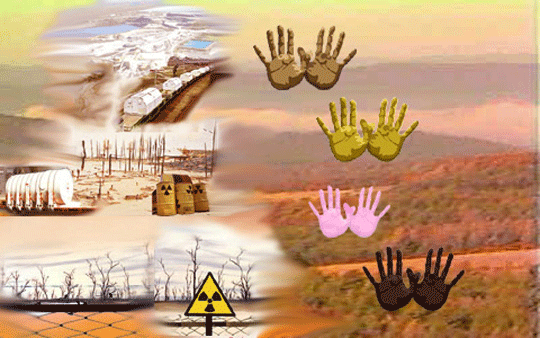 Chiefs oppose small reactors on First Nations territory https://www.thesudburystar.com/news/local-news/chiefs-oppose-small-reactors-on-first-nations-territory Sudbury Star Staff Chiefs oppose small reactors on First Nations territory https://www.thesudburystar.com/news/local-news/chiefs-oppose-small-reactors-on-first-nations-territory Sudbury Star Staff
|
|
USA has large uranium resources, now looking to cease importing uranium from Australia?
 Oil Price 15th June 2019 This month, the United States’ Uranium Committee of the Energy
  Minerals
Division, a group responsible for monitoring the actions and movements of
the uranium industry and the nuclear power industry, released their 2019
Annual Report at the annual meeting of the American Association of
Petroleum Geologists in San Antonio.
The report assessed that the U.S. has
more uranium than we would need to fuel hundreds of years of nuclear power
generation, even if nuclear power was being relied on as a much more
significant source of energy in the U.S. This is great news for nuclear
supporters in the United States, though historically the country has not
mined its own uranium but imported the radioactive metal from other
countries–and there’s a reason for that.
Kyrgyzstan considering law to ban exploration and mining of uranium
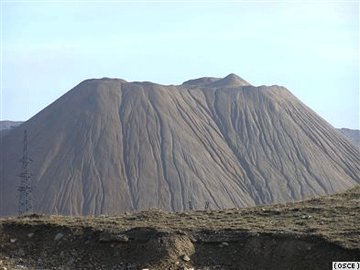
above – uranium tailings wastes in nearby Tajikistan
Parliament committee approves draft law banning geological exploration and mining of uranium deposits in Kyrgyzstan AKIPRESS.COM 17 June 19.- Parliament committee for agrarian policy considered and approved the draft law banning geological exploration and mining of uranium and thorium deposits in Kyrgyzstan in the first reading… (subscribers only) https://akipress.com/news:620767:Parliament_committee_approves_draft_law_banning_geological_exploration_and_mining_of_uranium_deposits_in_Kyrgyzstan/
Nuclear energy is NOT emissions free
 Nuclear energy not emissions-free, too lethal https://www.toledoblade.com/opinion/letters-to-the-editor/2019/06/15/nuclear-energy-not-emissions-free-dangerous/stories/20 Nuclear power is not a panacea for climate change and doesn’t deserve bailouts like House Bill 6. It is a catastrophically dangerous, dirty, expensive, deteriorating technology that is not “clean”, “indispensable”, “carbon-free”, or “renewable.”
Gregory Jazcko, former Nuclear Regulatory Commission chairman, warned, “I oversaw the U.S. nuclear power industry. Now I think it should be banned. The danger from climate change no longer outweighs the risks of nuclear accidents.”
Perry and Davis Besse cost a whopping $8.7 billion to build and billions more in maintenance, repairs, and subsidies. Grid operator PJM has determined that closing Perry and Davis-Besse would not destabilize the grid.
The nuclear power life cycle produces copious carbon and other greenhouse gases from uranium mining, milling, refining, conversion, and enrichment; fuel fabrication; transportation; reactor construction, maintenance, decommissioning; and radioactive waste management.
While nuclear generated electricity is low in carbon, it has never been zero emissions. Reactors emit methane, a greenhouse gas, and radioactive Carbon-14, with a 5,700-year half-life. The scientific and medical communities have determined that there is no safe dose of radiation exposure.
Ingested or inhaled radioactive strontium-90 and cesium-137 replace calcium and potassium respectively, irradiating bones and muscles for decades. Carcinogenic radioactive iodine-131 is absorbed by the thyroid which is why potassium iodide is provided to residents near reactors. Cobalt-60 is a liver, kidney, and bone carcinogen. Specks of inhaled plutonium-239, with a half-life of 24,000 years, can cause lung cancer. Miles of buried, inaccessible, deteriorating pipes have leaked tritium, which is radioactive hydrogen; no technology can remove it from contaminated water.
Over 32 years, disasters occurred at Three Mile Island, Chernobyl, and Fukushima. The U.S. has 23 Fukushima-type reactors at 16 sites. The NRC and other researchers postulate a 50 percent chance of another catastrophic accident in approximately the next 20 years.
 To limit utility liability, Congress passed the 1957 Price Anderson Act which caps accident compensation at $12.6 billion; a 1982 NRC study calculated a severe accident could cause 50,000 fatalities and $314 billion in property damage which is $720 billion today.
A 1,000-megawatt reactor contains as much long-lived radiation as 1,000 Hiroshima-sized bombs from which humans and the environment must be protected forever, but the NRC admits that no engineered structure can last the time required to isolate these wastes and that leakage will occur.
Early warnings to resolve radioactive waste before licensing new reactors were ignored. There are 88,000 tons of irradiated fuel “temporarily” stored in problematic pools and casks at 75 environmentally unsuitable reactor sites in 33 states because no permanent repository exists.
In 2012, Ohio was 13th in the U.S. for wind capacity and investment; this virtually ceased due to a 2014 law which mandated the country’s most restrictive wind turbine setbacks and severely impeded Ohio’s 2008 renewable energy and efficiency standards. HB 6 will finish the job.
Even conservative voters prefer solar, wind, and efficiency and oppose fees to keep old nuclear plants operating. Conservative groups testified against HB 6, as corporate welfare and a glorified slush fund.
Ohio needs to strengthen renewable energy and efficiency standards, stop throwing good money after bad, close Perry and Davis Besse as scheduled, and retrain workers in renewable energy jobs.
The writer is past chairman, Ohio Sierra Club Nuclear-Free Committee, of Willoughby Hills, Ohio.
“Chernobyl” TV series – based on the testimony of those who were there
“The official position of the state is that global nuclear catastrophe is not possible in the Soviet Union.”
It was not possible, so in the days and months after the world’s worst such accident, on 26 April, the Kremlin kept up its pretence. It dissembled, deceived and lied. I began investigating Chernobyl in the late 1980s after Ukrainian friends insisted authorities in the USSR were covering up the extent of the human tragedy of those – many of them children – contaminated by radiation when the nuclear plant’s Reactor 4 exploded, blasting a cloud of poisonous fallout across the USSR and a large swathe of Europe.
When photographer John Downing and I first visited, the Soviet Union, then on its last political legs, was still in denial about what happened despite president Mikhail Gorbachev’s new era of glasnost. Continue reading
Sydney Morning Herald- review of HBO’s hit show “Chernobyl”, now showing on Foxtel
Apocalyptic mini-series Chernobyl is the year’s unlikely TV hit, SMH, By Craig Mathieson, June 11, 2019 “…… Chernobyl, a grimly compelling series screening weekly on Foxtel with all five episodes streaming online, is particularly incisive. By using events in 1986, set under a totalitarian regime that subsequently collapsed into the dustbin of history, the show is able to comment on 2019…..
“I prefer my opinion to yours,” a local party boss dismissively tells Ulana Khomyuk (Emily Watson), a nuclear physicist who tries to raise the alarm about how serious the accident is. Chernobyl is an indictment on the official fictions of Russia’s one party communist state, a system of crippling shortcuts and absurd obeisance to power, but the blank and bureaucratic system has a familiar feel. One dissenter is threatened not with the bullet but professional obliteration, so that there’s no trace of their life’s work. That’s only more relevant now.
Written by Craig Mazin and directed by Johan Renck, the drama begins in the moments after the devastating eruption, unfolding as a ticking clock clean-up thriller, a mystery about the cause of the accident, and a study of individuals confronting the power that has nurtured them. Both nuclear scientist Valery Legasov (Jared Harris) and government minister Boris Shcherbina (Stellan Skarsgard) are insiders, lying about the risk to first responders or asking miners to risk life-threatening contamination to help prevent a complete nuclear meltdown.
Like all historic recreations it changes details and amalgamates characters into fictionalised representations such as Watson’s Khomyuk, but it succeeds through a dry tone that has the bitterest of aftertaste. It mostly doesn’t allow for sentimentality: when the mining crew foreman asks Shcherbina if his men will be looked after properly for their sacrifice, the political party boss replies “I don’t know” and the phlegmatic miner is actually satisfied. It’s a dreadful answer, but for once he’s been told the truth.
People are evacuated from an Exclusion Zone, animals are shot, and the very earth itself is dug up for 100 square kilometres to be buried elsewhere. The lessons are terrible but instructive: stemming the damage is not the same as fixing the problem. Chernobyl has been an unlikely success with viewers, growing its American audience with each episode and becoming the top-rated show on the website IMDb.com. Its appeal is readily apparent. It reflects our present and gives form to our inexplicable future.https://www.smh.com.au/entertainment/tv-and-radio/apocalyptic-mini-series-chernobyl-is-exploding-on-screens-20190610-p51w8v.html
Escalating collapse of global insect populations
The Great Insect Dying: How to save insects and ourselves, MONGABAY, BY JEREMY HANCE 13 JUNE 2019
- The entomologists interviewed for this Mongabay series agreed on three major causes for the ongoing and escalating collapse of global insect populations: habitat loss (especially due to agribusiness expansion), climate change and pesticide use. Some added a fourth cause: human overpopulation.
- Solutions to these problems exist, most agreed, but political commitment, major institutional funding and a large-scale vision are lacking. To combat habitat loss, researchers urge preservation of biodiversity hotspots such as primary rainforest, regeneration of damaged ecosystems, and nature-friendly agriculture.
- Combatting climate change, scientists agree, requires deep carbon emission cuts along with the establishment of secure, very large conserved areas and corridors encompassing a wide variety of temperate and tropical ecosystems, sometimes designed with preserving specific insect populations in mind.
- Pesticide use solutions include bans of some toxins and pesticide seed coatings, the education of farmers by scientists rather than by pesticide companies, and importantly, a rethinking of agribusiness practices. The Netherlands’ Delta Plan for Biodiversity Recovery includes some of these elements……….. https://news.mongabay.com/2019/06/the-great-insect-dying-how-to-save-insects-and-ourselves/
“Chernobyl” TV series gets high rating, highly viewed in Russia and Kazakhstan
BBC 12th June 2019 , Hours after the world’s worst nuclear accident, engineer Oleksiy Breus
entered the control room of the No. 4 reactor at the Chernobyl nuclear
power plant in Ukraine. A member of staff at the plant from 1982, he became
a witness to the immediate aftermath on the morning of 26 April 1986.
The story of the reactor’s catastrophic explosion, as told in an HBO/Sky
miniseries, has received the highest ever score for a TV show on the film
website IMDB. Russians and Ukrainians have watched it via the internet, and
it has had a favourable rating on Russian film site Kinopoisk. Mr Breus
worked with many of the individuals portrayed and has given his verdict of
the series. https://www.bbc.co.uk/news/world-europe-48580177
The huge health damage from the Chernobyl nuclear accident, and why the West has whitewashed this
Soviet doctors treating Chernobyl-exposed suddenly had an unwelcome crash course in this medical problem. They found that radioactive contaminants, even at relatively low levels, infiltrated the bodies of their patients, who grew sicker each year. Gradually, health officials understood they had a public health disaster on their hands. Thousands of archival records document the catastrophe. Ukrainian doctors registered in the most contaminated regions of Kiev province an increase between 1985 and 1988 in thyroid and heart disease, endocrine and GI tract disorders, anaemia and other maladies of the blood-forming system.
In two closely watched regions of the province, infants born with congenital malformations grew from 10% to 23% between 1986 and 1988. And 46% of newborns in some fallout regions died within 28 days of life. Half of these deaths were stillborn, the other half had congenital malformations “that were not compatible with life”.
Consultants from UN agencies dismissed the findings of scientists in Ukraine and Belarus…
Why would UN officials whitewash evidence of Chernobyl health damage? At the time the US, Russia, France and the UK faced huge lawsuits from their own exposures of people to radioactive contamination during four decades of reckless bomb production. If they could assert that Chernobyl was “the worst disaster in human history” and only 54 people died, then those lawsuits could go away. And that is indeed what happened.
Chernobyl horror has nuclear lessons for SA https://www.businesslive.co.za/bd/life/2019-06-04-chernobyl-horror-has-nuclear-lessons-for-sa/
As we consider this energy option it is key to bear in mind that the manipulation following this disaster means the full scale of damage can only be guessed at, 04 JUNE 2019 – 05:10 Powerful storms, record-breaking temperatures and rising water levels remind us daily of the impact of climate change and our need to address it. Policymakers are debating what shape the post-carbon future will take and SA is one country where that conversation is taking place.
Proponents of nuclear power argue that nuclear energy is the most viable and powerful alternative to fossil fuels. Opponents point to waste storage problems, plus the slow pace and high cost of building new reactors. And, they ask, what about when something goes wrong?
I recently published a book called Manual for Survival: A Chernobyl Guide to the Future, about the 1986 explosion of reactor number four at the Chernobyl nuclear power plant in Ukraine, which was at the time a republic in the Soviet Union. I found as I worked through 27 archives that much of what we are told about the Chernobyl accident is incomplete or incorrect. People were far sicker and far more people died than we are led to believe. Chernobyl contaminants were not safely enclosed within the Chernobyl Zone. Nor has the chapter been closed. We are still ingesting Chernobyl fallout from 33 years ago.
The official tally records 300 people hospitalised after the accident. These were mostly firemen and plant operators, but I found that Soviet leaders gave orders to release information on Chernobyl patients from only one Moscow hospital. In the months after the accident, villagers in contaminated regions streamed into many other hospitals. Archival records show that not 300 but 40,000 people were hospitalised for Chernobyl exposures in the summer after the accident. Many of them were children. Continue reading
Nuclear power – violent from the very beginning
Born Violent: The Origins of Nuclear Power, Asian Journal of Peacebuildling, 2019, Robert (Bo) Jacob
Please excuse the “t”s and “f”s which have somehow turned into squares – my copying problems.
“…his article traces the origins o nuclear power technology as it was speciically developed to produce nuclear weapons or use against a civilian population in war……
It will trace numerous radiological disasters during the production history o the Hanord reactor fleet and at other military plutonium production reactor sites during the early Cold War.It will describe the later emergence o the nuclear power production industry which used nuclear reactors to also produce energy or civilian use and the history o partial and ull nuclearuel meltdowns that accompanied that industry……..
Hanford during the Cold War…..During the Cold War, the United States produced over 60,000 nuclear weapons, most o them with the plutonium produced at Hanord. This includes both ission weapons like the one used in the nuclear attack on Nagasaki, and also in thermonuclear weapons. While nuclear weapons were not used in wararea ater 1945, over 2,000 weapons have been detonated in nuclear tests, roughly hal o those (1,054) by the United States. The United States tested 928 nuclear weapons at the Nevada est Site, and another 67 at the Pacific Proving Grounds in the Marshall Islands. wo hundred and sixteen o those tests were in the
atmosphere, which distributed vast quantities o radioactive allout in heavy quantities close to the test sites, and also globally when the atmospheric clouds reached the upper atmosphere.
A 2015 article in The Lancet describes how “risk modelling studies o exposure to ionising radiation rom the Nevada est Site in the United States suggest that an extra 49,000 (95 percent CI 11 300–212 000)cases o thyroid cancer would be expected to occur among U.S. residents alive at the time o the testing—an excess o about 12 percent over the 400,000 cases othyroid cancer expected to develop in the absence o allout” (Simon and Bouville 2015, 407-408).
The Marshall Islands had ar ewer tests than the Nevada test site, however the United States tested its thermonuclear weapons exclusively at the Pacific Proving Ground which resulted in massive amounts o radioactive allout aecting the local population and also entering into the Paciic Ocean rom which the radionuclides could disperse throughout the Pacific Rim.
One test, the Bravo test o 1954, which was the largest weapon ever tested by the United States, created a vast and lethal allout cloud that enguled numerous Marshallese atolls. he entire population o Rongelap Atoll suered rom radiation sickness after the Bravo test. The Japanese tuna fishing boat the DaigoFukuryu Maru , among many others, was also exposed to the allout cloud. When it came to port in Yaizu, Japan two weeks after the test, its crew was hospitalized or radiation sickness. One crew member, radioman Aikichi Kuboyama, died ocomplications rom his exposure six months later,even though he was physically located about 100km rom the actual detonation point. All of these illnesses and deaths can be traced back to the nuclear reactors at Hanford.
During its years o production, Hanord was the site o numerous substantial radiological releases that endangered the local population as well as those downwind. …….. Large releases o radiation into the nearby ecosystem would be routine during the operation o the Hanord reactors and especially the plutonium extraction procedures. hese activities would leave a disastrous legacy once the plants were closed……
Historical Disasters at Plutonium Production Sites
Hanord did not suffer a major uel meltdown or catastrophic fire. However, all other nuclear weapon states have also operated multiple plutonium production reactors and the first two large-scale nuclear disasters occurred in such reactor complexes, happening within two weeks o each other.
On September 29, 1957, writes Kate Brown, as a soccer game was beingplayed in a stadium in Ozersk, in the Chelyabinsk Oblast near the Ural Mountainsin Central Russia, where the Mayak Production Association was located, a loudexplosion was heard nearby.Te source o the blast was an underground storage tank holding highly radioactivewaste that overheated and blew, belching up a 160-ton cement cap buried twenty-oureet below the ground and tossing it seventy-five eet in the air. Te blast smashedwindows in the nearby barracks and tore the metal gates off the perimeter ence.
The explosion and subsequent radiological disaster, known as the KyshtymDisaster, occurred just eight years and one month after the detonation o the firstnSoviet nuclear weapon made with plutonium produced at Mayak, the plutonium production that was the target o surveillance motivating the Green Run at Hanord.
he radioactive cloud rom the explosion, “settled over an area o 20,000square kilometers, home to 270,000 people” (Rabl 2012). Te Soviet authorities were slow to react to the crisis. “A week after the explosion,” writes Brown, who did extensive fieldwork in the region as well as at Hanord, “radiologists ollowed the cloud to the downwind villages, where they ound people living normally,children playing bareoot. hey measured the ground, arm tools, animals and people. he levels o radioactivity were astonishingly high” (Brown 2013, 239-240). he contaminated area would eventually be known as the East Urals Radioactive race (Ichikawa 2015).
Eleven days later a fire ignited in one o the reactors at the Windscale Works, the plutonium production site o the United Kingdom located in Cumbria in Northwest England. he ire burned inside o the reactor or three days and released massive amounts o radiation blanketing surrounding communities and downwind areas. “While the authorities denied large releases o radioactivity at the time, this was not a correct portrayal o the situation…On 12 October, authorities stopped the distribution o milk originating rom seventeen areaarms. However, just three days later, milk rom a ar wider area (200 square miles compared to the previous 80) was restricted” (Makhijani et al. 1995, 418). Falloutrom the accident was detected in Ireland, and the confiscated milk was dumped into the Irish Sea (Bertell 1985)
The Establishment of Commercial Nuclear Power……. Many o these plants would experience occasional leaks or releases oradiation into their local ecosystems. Several would have catastrophic nuclear accidents. In addition to the accidents at plutonium production reactors citedabove, partial core meltdowns would occur at Santa Susana in Simi Valley,Caliornia (1957), Fermi-1 in Detroit, Michigan (1966), the Lucens reactor inVaud, Switzerland (1969), Leningrad-1 in Leningrad, USSR (1975), and hreeMile Island-2 in Harrisburg, Pennsylvania (1979). A ull, catastrophic nuclearmeltdown occurred at Chernobyl-4 (1986) and three ull meltdowns occurred at Fukushima 1-2-3 in 2011.
In addition to these dire nuclear accidents, the spent uel rom normal operations at nuclear power plants pose a vexing problem or tens o thousands o generations. hese spent uel rods will need to be eectively contained or millennia as they will remain highly dangerous or over 10,000 years, and seriously dangerous or over 100,000 years. Almost all o this spent uel, millions o tons, sit in temporary or intermediate storage on the grounds o the reactors where the uel was burned. Finland will be the very irst nation to attempt to permanently store the spent uel rom its very limited nuclear power program in deep geological storage at the Onkalo site on the Baltic Sea, beginning in the2020s. All o the spent nuclear uel rom the long history o operation at Hanord still sits in temporary storage, some o it or over seventy years now (Deense Nuclear Facilities Saety Board 1997).
he challenges o containing this highly toxic waste or millennia and insuring that the sites are not damaged by geologicalorces or breached by uture human societies is speculative at best. The ongoing capacity o nuclear power to damage the health o human beings and other creatures or millennia, through the risks posed by this waste, means that we can never adequately grasp the ull violence that will result rom its production (Jacobs2018). o date, over seventy years after the successul operation o CP-1, not one spent uel rod has been placed in “permanent” storage anywhere on the planet………
The world is losing plant species at a frightening rate
|
‘Frightening’ number of plant extinctions found in global survey https://www.theguardian.com/environment/2019/jun/10/frightening-number-of-plant-extinctions-found-in-global-survey
Study shows 571 species wiped out, and scientists say figure is likely to be big underestimate, Damian Carrington Environment editor @dpcarringtonTue 11 Jun 2019 |
|
|
Japan’s Prime Minister Abe touts the 2020 Olympic Games with the lie that Fukushima nuclear plant is “under control”
 Abe pushing idea that Fukushima nuclear disaster is ‘under control’, http://www.asahi.com/ajw/articles/AJ201906110001.html THE ASAHI SHIMBUN, 10 June 19 Without special protection against radiation, Prime Minister Shinzo Abe stood on elevated ground about 100 meters from the three melted-down reactors at the Fukushima No. 1 nuclear power plant.
“I was finally able to see the view just wearing a normal suit without having to wear protective clothing and a mask (for radiation),” he said on April 14 after hearing explanations from Tokyo Electric Power Co. officials. “The decommissioning work has been making progress in earnest.”
An act of bravado, perhaps. But it was more likely one of the ways Abe and his government want to show that the Fukushima disaster is, as he famously said, “under control.”
Progress has been made, albeit slowly, for the monumental task of decommissioning TEPCO’s crippled nuclear plant.
But radiation levels in certain areas of the plant are still lethal with extended exposure. The problem of storing water contaminated in the reactors continues.
And only recently was TEPCO able to make contact with melted nuclear fuel in the reactors through a robot. The means to extract the fuel has yet to be decided.
However, the government keeps touting progress in the reconstruction effort, using evacuee statistics, which critics say are misleading, to underscore its message.
Abe’s previous visit to the nuclear plant was in September 2013.
“When I conducted an inspection five years ago, I was completely covered in protective gear,” he said at a meeting with decommissioning workers in April. “This time I was able to inspect wearing a normal suit.”
Officials in Abe’s circle acknowledged that they wanted to “appeal the progress of reconstruction” by letting the media cover the prime minister’s “unprotected” visit to the site.
His visit in a business suit was possible largely because the ground was covered in mortar and other materials that prevent the spread of radioactive substances, not because decommissioning work has lowered radiation levels as a whole.
The radiation level at the elevated inspection ground still exceeds 100 microsieverts per hour, making it dangerous for people who remain there for extended periods.
Abe’s inspection ended in six minutes.
The prime minister raised eyebrows, particularly in Fukushima Prefecture, in 2013 when he gave a speech to promote Tokyo’s bid to host the 2020 Summer Olympics.
Concerning the Fukushima nuclear plant, he told International Olympic Committee members, “Let me assure you, the situation is under control.”
An hour before he inspected the plant in April, Abe attended the opening ceremony of the new government building of Okuma, one of the two towns that host the nuclear plant.
The ceremony followed the lifting of an evacuation order for part of the town on April 10.
“We were able to take a step forward in reconstruction,” Abe said.
The central government uses the number of evacuees to show the degree of progress in reconstruction work.
In April 2018, Abe said in the Diet that the lifting of evacuation orders has reduced the number of evacuees to one-third of the peak.
According to the Reconstruction Agency, the number of people who evacuated in and outside of Fukushima Prefecture, including those who were under no orders to leave, peaked at about 160,000. But the initial evacuation orders for 11 municipalities in Fukushima Prefecture have been gradually lifted, and the agency now puts the total number at about 40,000.
About 71,000 people were officially registered as residents of areas that were ordered to evacuate. Now, only about 11,000 people live in those zones.
This means that about 60,000 people have not returned to the homes where they were living before the nuclear accident unfolded in March 2011.
The gap of 20,000 can be attributed to how the agency classifies or declassifies evacuees.
NOT COUNTED AS EVACUEES
The Reconstruction Agency sent a notice in August 2014 to all prefectures that have counted the number of evacuees.
It defined “evacuees” as people who moved to different places because of the nuclear disaster and have the “will” to return to their original homes.
The notice also said that if it is difficult to perceive their “will,” they can be regarded as people who have ended their evacuation if they bought new homes or made arrangements for new accommodations.
Based on the notice, people in Fukushima Prefecture who have bought new homes during their evacuation or settled down in public restoration housing or disaster public housing are regarded as living “stable” lives and are not counted as evacuees.
“It is not a problem because we continue supporting them even if they are removed from the evacuee statistics,” a prefectural government official said.
An official of the Reconstruction Agency said, “The judgment is made by each prefecture, so we are not in a position to say much.”
However, the prefecture has not confirmed all evacuees’ will to return to their homes. In addition, those who are removed from the list of evacuees are not informed of their new status.
Many people bought homes in new locations during their prolonged evacuations although they still hope to return to their hometowns in the disaster area.
Yumiko Yamazaki, 52, has a house in Okuma in a “difficult-to-return” zone.
But because she moved to public restoration housing outside of the town, she is not considered an evacuee by the agency and the prefecture.
“I had to leave my town although I didn’t want to,” Yamazaki said. “It is so obvious that the government wants to make the surface appearance look good by reducing the number of evacuees.”
“I can’t allow them to try to pretend the evacuation never happened,” Yamazaki said.
Critics say the central government’s emphasis of positive aspects and the downplaying of inconvenient truths in the evacuee statistics have much in common with its response to the suspected nepotism scandals involving school operator Moritomo Gakuen and the Kake Educational Institution.
1 This month

of the week – Australians for War Powers Reform (AWPR)
To see nuclear-related stories in greater depth and intensity
 Antinuclear