As the death toll in Oklahoma rose to six Monday amid an outbreak of nearly 200 tornadoes across the Midwest in recent days—as well as in areas far less accustomed to them—climate scientists said such patterns may carry warnings about the climate crisis and its many implications for extreme weather events.
In Oklahoma, tornadoes touched down in at least two cities, including El Reno and Sapulpa, over the weekend, injuring dozens and leveling a number of homes. The tornado that hit El Reno, a suburb of Oklahoma City, was given an EF3 rating, with wind speeds up to 165 miles per hour. Only about five percent of tornadoes are given an EF3 rating or higher.
The tornadoes hit after much of the state endured severe flooding last week, following powerful storms that overflowed the Arkansas River and damaged about 1,000 homes.
While tornadoes have long been a fixture in the Midwest, meteorologist Eric Holthaus tweeted last week that there is “reason to believe major outbreak days…are getting worse,” while climate scientists are examining links between the storms and the climate crisis.
The so-called “Tornado Alley,” which covers parts of Texas and Kansas as well as Oklahoma, appears to be growing, according to a study published in Nature last year—making tornadoes more frequent in states that rarely saw them previously including Arkansas, Mississippi, and eastern Missouri.
“What all the studies have shown is that this particular part of the U.S. has been having more tornado activity and more tornado outbreaks than it has had in decades before,” Mike Tippett, a mathematician who studies the climate at Columbia University toldPBS Newshour earlier this year.
As the Kansas City Starreported on Sunday, scientists believe the warming of the globe—fueled by human activities like fossil fuel extraction—is contributing to higher amounts of water vapor in the atmosphere, causing heavier rainfalls which can spawn tornadoes.
The increase in destructive tornadoes across wider swaths of the country than in previous decades “may be suggestive of climate change effects,” Purdue University researcher Ernest Agee told the Star. And the unusual occurrence of tornadoes in far more densely-populated areas than those that frequently see such weather events has led to concerns that tornadoes will become more deadly and destructive than they’ve been in the past
M.V. Ramana is the Simons Chair in Disarmament, Global and Human Security at the School of Public Policy and Global Affairs at UBC, and the author of The Power of Promise: Examining Nuclear Energy in India, Penguin Books, New Delhi (2012).
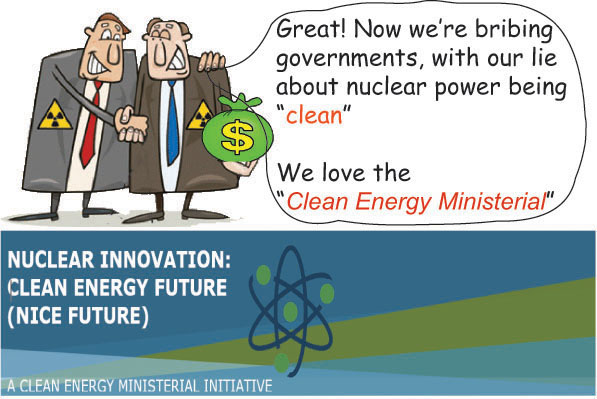
This week Vancouver is host to a summit of ministers from over 25 countries gathered “to accelerate progress toward a clean energy future.
Created in 2010, the Clean Energy Ministerial describes itself as a “high-level global forum to promote policies that advance clean energy technology” and “to encourage the transition towards a global clean energy economy.”
As we face massive environmental challenges, a transition is clearly needed. The problem is that one significant focus of the CEM is to find ways of preserving the existing energy infrastructure while greenwashing it.
Case in point: the cleverly termed NICE Future, which stands for Nuclear Innovation: Clean Energy Future, that was set up in 2018 by the CEM initiative. Its stated aim is “to initiate a dialogue on the role that clean and reliable nuclear energy can play in bolstering economic growth, energy security and access, and environmental stewardship.”
But nuclear energy is not clean except in some narrow definition, and our experience over the decades with this technology has shown that it cannot “bolster” any of the other goals.
Dirty truths about ‘clean energy’
Before going further, it would help to beVanctter understand the term clean energy. For years now, there is an open and growing preference for renewable energy among the public around the world.
This was a problem for the large private and public sector organizations that owned other forms of electricity generation technologies, particularly coal, nuclear, or natural gas. One of the strategies that these large organizations, and supportive politicians and government officials, have been undertaking is to sweep these, or slight variants thereof, under the term clean energy.
The key word is clean, and its use has been promoted by multiple fossil fuel and other industry groups. In the mid-2000s, dozens of coal and utility companies formed something called the American Coalition for Clean Coal Electricity. It then spent tens of millions of dollars on advertisement campaigns about “clean coal” being a solution to global warming. Continue reading →
Carbon dioxide soars to record-breaking levels not seen in 800,000 years, Fox News, 26 May 19, There is more carbon dioxide in the atmosphere than there has been for 800,000 years — since before our species evolved.
On Saturday (May 11), the levels of the greenhouse gas reached 415 parts per million (ppm), as measured by the National Oceanic and Atmospheric Administration’s Mauna Loa Observatory in Hawaii. Scientists at the observatory have been measuring atmospheric carbon dioxide levels since 1958. But because of other kinds of analysis, such as those done on ancient air bubbles trapped in ice cores, they have data on levels reaching back 800,000 years. [8 Ways Global Warming Is Already Changing the World]
During the ice ages, carbon dioxide levels in the atmosphere were around 200 ppm. And during the interglacial periods — the planet is currently in an interglacial period — levels were around 280 ppm, according to NASA.
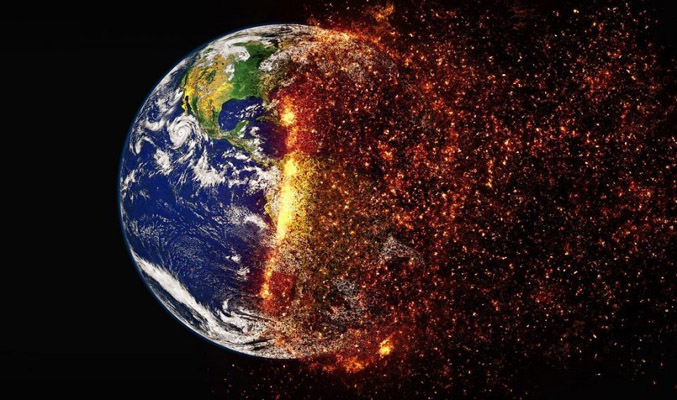
But every story has its villains: Humans are burning fossil fuels, causing the release of carbon dioxide and other greenhouse gases, which are adding an extra blanket on an already feverish planet. So far, global temperatures have risen by about 1.8 degrees Fahrenheit (1 degree Celsius) since the 19th century or pre-industrial times, according to a special report released last year by the United Nation’s Intergovernmental Panel on Climate Change……
“We keep breaking records, but what makes the current levels of CO2 in the atmosphere most troubling is that we are now well into the ‘danger zone’ where large tipping points in the Earth’s climate could be crossed,” said Jonathan Overpeck, the dean of the School for Environment and Sustainability at the University of Michigan. “This is particularly true when you factor in the additional warming potential of the other greenhouse gases, including methane, that are now in the atmosphere.”
The last time atmospheric carbon dioxide levels were this high, way before Homo sapienswalked the planet, the Antarctic Ice Sheet was much smaller and sea levels were up to 65 feet (20 meters) higher than they are today, Overpeck told Live Science.
“Thus, we could soon be at the point where comparable reductions in ice sheet size, and corresponding increases in sea level, are both inevitable and irreversible over the next few centuries,” he said. Smaller ice sheets, in turn, might reduce the reflectivity of the planet and potentially accelerate the warming even more, he added…….. https://www.foxnews.com/science/carbon-dioxide-soars-to-record-breaking-levels-not-seen-in-800000-years
Skipping School to Stop The Climate Crisis: Greta Thunberg and the Student Protests
A fight for the future as climate change school strikes grow for fourth month running
An estimated 4,000 teenagers and young people turn out in Manchester – and another 1.5m around the world – to demand they inherit a planet that is not dying, The Independent, 27 May 19, Colin Drury, Manchester@colin__drury I t is a hot, sunny day in Manchester and 14-year-old Carmen King is dressed in full black funeral garb, complete with veil and thick white face paint.
“It’s pretty warm,” she says of her outfit. “But then, if adults don’t get it sorted, it’s only going to get hotter anyway.”
The year nine student was one of some 4,000 children, teenagers and young people who flooded into the city centre on Friday to protest against climate change.
They themselves were among an estimated 1.5 million-plus youngsters doing the same in hundreds of towns and cities across the world: in London, Paris and Berlin, of course, but, crucially, in the provinces too, in places – like Manchester – where the battles for hearts and minds are often truly won.
They went on strike from school classes and university lectures, as they have done one Friday a month since February, to demand adults do just one thing: save the planet and their futures…….
Nationally the strikes have been coordinated by the UK Student Climate Networkand come partially in response to a UN report in October, which stated the world’s carbon emissions needed to be halved within 12 years to prevent some of the severest effects of global warming – flooding, droughts, mass displacement – becoming inevitable.
But, because this month’s protest coincided with exam season, there were some expectations that numbers may be down. They decidedly were not……
Japan to push for int’l conference on nuclear waste disposal at June G-20 meet https://mainichi.jp/english/articles/20190525/p2a/00m/0in/006000c 26 May 19, TOKYO — The Japanese government announced May 24 that it plans to arrange an international meeting to consider how to dispose of highly radioactive nuclear waste.
Tokyo is set to get approval for the plan at the Group of 20 Ministerial Meeting on Energy Transitions and Global Environment for Sustainable Growth scheduled for mid-June in Karuizawa, Nagano Prefecture, and aims to launch the first roundtable this autumn.
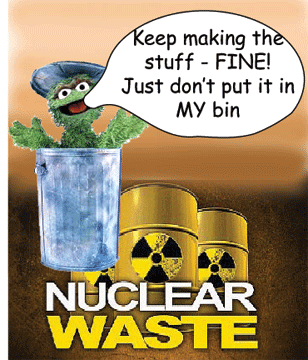
Nuclear waste is a problem for all countries operating nuclear power plants, and the Japan-backed international summit on cooperating to dispose of it will be a world first. Participating nations are expected to aim for improved cooperation and formulation of an international “basic strategy” on dealing with radioactive waste.
High-level nuclear refuse is usually “vitrified” — mixed with melted glass and solidified — before being deposited in an underground storage facility. Japan’s own disposal plans call for holding the waste for 30 to 50 years to cool it before burying it in stable rock formations at least 300 meters below ground. Finland is already building a major underground disposal site, while its neighbor Sweden is conducting a safety evaluation at the location of its own planned facility. However, there is no precedent for actually operating such an installation, and Japan has not yet even begun the survey process to choose a site.
The Japanese government will thus use the June 15-16 G-20 environment and energy summit meeting to urge member nations to cooperate on realistic solutions. Specifically, Japan will press nations with advanced nuclear disposal technology including those in Europe to share their know-how, and also promote international collaboration among research facilities and staff exchanges. The international roundtable will put together a collection of proposals on a basic nuclear waste disposal cooperation strategy and how to explain the issue to the citizens of member nations.
(Japanese original by Hajime Nakatsugawa, Business News Department)
US conducted nuclear explosion experiment in February, NHK,26 May19,
A US government laboratory says the country held a subcritical nuclear test in the state of Nevada on February 13.
The Department of Energy’s Lawrence Livermore National Laboratory made the announcement on Friday.
The test was the first of its kind since December 2017, and the second under the administration of President Donald Trump. It was the 29th in the United States.
The laboratory says the experiment, dubbed “Ediza,” used high explosives to implode plutonium and captured “numerous, detailed scientific measurements.” ……
The latest test was conducted just before the second US-North Korea summit in February, meaning the Trump administration was demanding Pyongyang abolish its nuclear weapons while it was trying to enhance its own.
France acknowledges Polynesian islands ‘strong-armed’ into dangerous nuclear tests, Telegraph UK Henry Samuel, Paris, 24 MAY 2019 France has officially acknowledged for the first time that French Polynesians were effectively forced into accepting almost 200 nuclear tests conducted over a 30-year period, and that it is responsible for compensating them for the illnesses caused by the fallout.
The French parliament issued the much-awaited admission in a bill reforming the status of the collectivity of 118 islands in the South Pacific, with MPs saying the change should make it easier for the local population to request compensation for cancer and other illnesses linked to radioactivity.
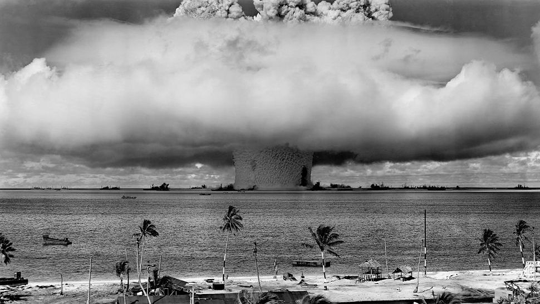
From 1966 to 1996, France carried out 193 nuclear tests around the paradise islands, including Bora Bora and Tahiti, immortalised by Paul Gauguin. Images of a mushroom cloud over the Moruroa atoll, one of two used as test sites along with Fangataufa, provoked international protests.
Charles De Gaulle and subsequent presidents had thanked French Polynesians for their role in assuring the grandeur of France by allowing it to conduct the tests.
But in the parliamentary bill, France acknowledges that the islands were “called upon” – effectively strong-armed – into accepting the tests for the purposes of “building (its) nuclear deterrent and national defence”.
It also stipulates that the French state will “ensure the maintenance and surveillance of the sites concerned” and “support the economic and structural reconversion of French Polynesia following the cessation of nuclear tests”.
Patrice Bouveret of the Observatoire des armements (Armaments Observatory), an independent organisation that has been assessing the impacts of French nuclear testing in Polynesia since 1984, welcomed the reform.
“It recognises the fact that local people’s health could have been affected and thus the French state’s responsibility in compensating them for such damage. Until now, the entire French discourse was that the tests were ‘clean’ – that was the actual word used – and that they had taken all due precautions for staff and locals.”
May. 23, 2019 09: By Grant SmithFrom 2009 to 2012, Gregory Jaczko was chairman of the Nuclear Regulatory Commission, which approves nuclear power plant designs and sets safety standards for plants. But he now says that nuclear power is too dangerous and expensive — and not part of the answer to the climate crisis.
“Nuclear power was supposed to save the planet,” Jaczko wrote in a recent op-ed for The Washington Post. As an atomic physicist, he once endorsed that view. But his years on the NRC changed his mind:
This tech is no longer a viable strategy for dealing with climate change, nor is it a competitive source of power. It is hazardous, expensive and unreliable, and abandoning it wouldn’t bring on climate doom. The real choice now is between saving the planet and saving the dying nuclear industry. I vote for the planet.
Jaczko describes how his experience revealed the pervasive political influence of the nuclear power industry in Congress and among his fellow commissioners. Their opposition derailed much of the safety measures he proposed in the wake of the Fukushima nuclear disaster in Japan. In 2011 an investigative series by the Associated Press detailed the collusion between regulators and the industry to weaken safety standards to keep existing plants economically viable.
Jaczko’s efforts to protect the American public likely cost him his career at the NRC. He now leads an offshore wind power startup and is speaking out at an important juncture for the nation’s energy future.
Electric utilities that operate nuclear plants are boasting of being “carbon free” by mid-century. They insist that their aging nuclear plants must be part of the equation to keep costs down. But even though Japan closed most of its reactors after Fukushima, carbon emissions went down, because the Japanese ramped up energy efficiency and solar investments.
“It turns out that relying on nuclear energy is actually a bad strategy for combating climate change,” Jaczko wrote. “One accident wiped out Japan’s carbon gains. Only a turn to renewables and conservation brought the country back on target.”
Jaczko’s heightened concern for a nuclear accident in the U.S. is also well founded. The former director of the nuclear safety project at Union of Concerned Scientists, David Lochbaum, determined that the industry’s efforts to continue to run aging nuclear plants 20 to 30 years or even longer than their initial licenses allowed for is akin to playing Russian roulette.
Since Fukushima, Germany has ordered the shutdown of all nuclear plants by 2022. Japan has reopened only a few reactors. Even France, long a champion of nuclear power, is ramping down its nuclear fleet because of safety concerns. But in the U.S., the Trump administration and lawmakers in some states continue to support taxpayer-financed subsidies to bail out money-losing nuclear plants. On grounds of both economics and safety, that’s a fool’s bet.
Donald Trump needs to reclaim control over his policy toward Iran. National Interest, by Paul R. Pillar 22 May 19,The current crisis atmosphere in U.S.-Iranian relations, in which the risk of open warfare appears greater than it has been in years, is solely, unequivocally due to the policies and actions of the Trump administration. To point this out does not mean that actions of the Iranian regime have not come to be part of the crisis atmosphere as well. It instead means that such an atmosphere would never have existed in the first place if the administration had not turned its obsession with Iran into the relentless campaign of stoking hostility and tension that has become one of the single most prominent threads of the administration’s foreign policy.Without that campaign, and without the administration’s assault on the Joint Comprehensive Plan of Action (JCPOA)—the agreement that restricts Iran’s nuclear program—Iran would continue to comply with its obligations under the JCPOA and all possible paths to an Iranian nuclear weapon would remain closed. Continue reading →
The warming temperatures of the world’s oceans have already done significant damage to marine reefs; one only need to look at what’s happened to the Great Barrier reef for confirmation.
What Is the Impact of Ocean Acidification?https://www.envirotech-online.com/news/water-wastewater/9/breaking-news/what-is-the-impact-of-ocean-acidification/49250 Ocean acidification could have a massively damaging impact on millions of people all over the world in the coming years and decades, according to a new study from the University of Plymouth. By concentrating on heavily acidified hotspots in Japan and the Mediterranean, the study’s authors claim they can predict what may happen on a global scale if carbon continues to seep into the sea.The study is just latest in a growing body of work from its two authors, who have demonstrated that acidification can have a potentially devastating effect on marine ecosystems, with reefs under particular threat. This not only endangers the coral and oysters which comprise the reefs themselves, but also the myriad fish, crustaceans and other marine organisms which call them home. Continue reading →
What if we covered the climate crisis like we did the start of the second world war?Bill Moyers Guardian, 22 May 19 In the war, the purpose of journalism was to awaken the world to the catastrophe looming ahead of it. We must approach our climate crisis the same way
I have been asked to bring this gathering to a close by summing up how we can do better at covering the possible “collapse of our civilizations and the extinction of much of the natural world,” to quote the noted environmentalist David Attenborough, speaking at the recent United Nations climate summit in Poland.
There Is No Check on Trump’s Rage Going Nuclear An angry, entitled man has total control over devastating weapons. Foreign Policy, BYANNE HARRINGTON,CHERYL ROFER, MAY 22, 2019, DONALD TRUMP IS TAKING THE UNITED STATES BACK TO AN EARLIER TIME – ONE MOST PEOPLE THOUGHT HAD BEEN LEFT BEHIND. HIS AGGRESSIVE BOORISHNESS, ENTITLEMENT, AND BELIEF THAT HE CAN DO WHATEVER HE WANTS ARE QUALITIES FROM AN AGE WHEN MEN’S CONTROL WAS ASSUMED, AND OTHERS STAYED SILENT. AND NOWHERE IS HIS RETROGRADE MASCULINITY MORE DANGEROUS THAN IN HIS CONTROL OF THE NUCLEAR BUTTON.
Since renewable sources of energy are getting more promising in the country, and domestic gas production has risen, it is time to close the door on nuclear projects and rely more on other sources of energy.
Replace nuclear with renewables http://www.jordantimes.com/opinion/editorial/replace-nuclear-renewables May 22,2019 Head of the Lower House’s Energy and Mineral Resources Committee Haytham Ziadin raised recently, and rightly so, the viability of the plan to build a nuclear plant to satisfy the energy needs of the country. Ziadin went as far as calling for ending altogether all plans to build such a plant, and called them simply as squandering of badly-needed funds.
May 22, 2019 (Mainichi Japan) NAGASAKI— On May 9, there was a sit-in hibakusha gathering in front of the Peace Statue at Nagasaki Peace Park. The meeting takes place on the ninth of every month, marking the Aug. 9, 1945, U.S. atomic bombing of Nagasaki. This month’s congregation marked the 444th time for such an event.
Koichi Kawano, 79, took to the microphone to speak about the stand-off between the United States and Iran. “This is a crisis,” he said to the around 100 people in attendance, continuing, “Our hearts are one when wishing for the abolition of nuclear weapons.”
Born in North Pyongan Province on the Korean Peninsula, now part of North Korea, Kawano was brought back to his parents’ hometown Nagasaki as a child. Aged 5 in August 1945, he was around 3.1 kilometers away from the atomic bomb’s hypocenter. Now a resident of the nearby town of Nagayo, he has been an activist for the end of nuclear weaponry in roles including his long tenure as chairman of the Hibakusha Liaison Council of the Nagasaki Prefectural Peace Movement Center.
“While enduring untold misery, we have won our rights with our own strength,” he says, looking back on the messages their hibakusha meetings have sent against the government’s constitutional amendment policies and security legislation designed to allow Japan to exercise the right to collective self-defense in a limited manner.
“Perseverance is power” has been Kawano’s guiding motto in engaging in the movement’s activities, but this spring he faced a difficult reality. Masanori Nakashima, president of the Nagasaki Prefecture A-bomb Health Handbook Friendship Society, died aged 89 on March 15. The two men were allies in peace activism. Representatives of five local hibakusha groups, including Nakashima and Kawano, announced a joint statement on peace issues and handed a written request to the prime minister on Aug. 9.
Of the five hibakusha group representatives who were alive in 2015 on the 70th anniversary of the bombing, three including Nagasaki Atomic Bomb Survivors Council chair Sumiteru Taniguchi have passed away. Taniguchi died in 2017 at 88 years of age. “Even with his limp, he dragged himself to that office to hear other hibakusha speak,” Kawano reminisced, while looking ahead to an uncertain future, saying, “What will happen to these groups after we die?”
Kawano himself underwent surgery for esophageal cancer in 2017. Due to ill health he was forced to pull out of a survey of hibakusha in North Korea as a member of the Japan Congress Against A- and H-Bombs in fall 2018. Despite setbacks, his drive for peace remains unchanged. Kawano confronted Prime Minister Shinzo Abe over the Japanese government’s disinclination to sign and ratify the United Nations Treaty on the Prohibition of Nuclear Weapons in a face-to-face meeting in 2017, asking, “What country’s prime minister are you?”
As time marches on from the events of August 1945, Kawano is putting his faith in the next generation. “The increasingly quiet voices of the hibakusha must not be drowned out,” he says. At the monthly sit-ins in Nagasaki Peace Park, the number of high school age attendees has increased. As he welcomes the last summer of his 70s, Kawano’s resolve remains strong. “Peace activism is powered by people. I want the movement to continue, to carry on the wish never to see another generation of hibakusha in this world.”
(Japanese original by Yuki Imano, Nagasaki Bureau)
Government workers were kept in the dark about their toxic workplace
As US modernizes its nuclear weapons, NCR looks at the legacy of one Cold War-era plant,National Catholic Reporter, May 20, 2019 by Claire Schaeffer-Duffy
Editor’s note: As the government invests in the modernization of the U.S. nuclear arsenal, while weakening environmental regulations and federal laws protecting worker safety, National Catholic Reporter looks at the toxic legacy of one shuttered weapons plant in Kansas City, Missouri.
In a three-part series about the Kansas City Plant on Bannister Road and its successor 8 miles south, NCR reviews hundreds of pages of government reports and environmental summaries, and interviews more than two dozen sources, including five plant workers and their families, three former federal employees who worked nearby, nuclear industry and government officials, health experts, business sources, state environmental regulators and a former city councilman.
This is Part 1.
“………… Debbie blames Bob’s painful and untimely passing on his worksite. For 27 years, he worked as an engineer at the Kansas City nuclear bomb components plant, a proud and dedicated employee of what is now Honeywell Federal Manufacturing and Technologies LLC. Sworn to secrecy, Bob never discussed his work assignments with his wife. And she never asked. She is now convinced that whatever he did out there probably killed him.
During the decades of the Cold War, the Department of Energy (DOE) and its predecessor agencies employed hundreds of thousands of Americans in more than 350 secretive, hazardous worksites across the country, according to federal records. Scientists, engineers, machinists and laborers were hired to design, test and construct a stockpile of 70,000 nuclear warheads. Inadequately protected from carcinogens and toxins and often exposed without their knowledge, many nuclear workers became ill and died. They devolved into early dementia, endured high rates of miscarriages, suffered nerve disorders, and succumbed to a host of debilitating respiratory illnesses and cancers.
How many Americans died producing nuclear weapons is not a statistic the government tracks. “Irradiated,” a 2015 investigative series by McClatchy DC, the Washington bureau of the media chain that owns The Kansas City Star, put the total at 33,480, four times the number of casualties in Iraq and Afghanistan. In its interpretation of the McClatchy DC data, the Columbia Journalism Review notes 33,480 is the number of American nuclear workers compensated by a government program who have died. “The government has acknowledged 15,000 of those deaths were due to work-related illnesses,” the magazine writes. “The rest only had illnesses linked to their nuclear work and may have died of old age or unrelated causes.”
Wayne Knox, a former industrial hygienist for DOE, thinks the death toll is “much, much higher” than 33,480.
The tally represents a price paid in American lives for the U.S. nuclear arsenal. Cities and communities that hosted weapons plants saw other costs: sick workers and their families who felt betrayed by the industry’s indifference, and persistent environmental contamination.
As the government invests in the modernization of the U.S. nuclear arsenal, while weakening environmental regulations and federal laws protecting worker safety, National Catholic Reporter looks at the toxic legacy of one shuttered weapons plant in Kansas City, Missouri. Continue reading →









 Antinuclear