963 climate protesters arrested in London, as “Extinction Rebellion” gathers force.
|
Extinction Rebellion: The People Risking Their Freedom For Climate Change | HuffPost Reports: UK Extinction Rebellion arrests close to 1,000 as protesters ‘pause rebellion’ ITV 21 Apr 19 Climate change protesters who have stopped traffic in a series of peaceful demonstrations across London will “pause” their rebellion in a bid to achieve their political aims, as the arrest total nears 1,000.Extinction Rebellion (XR) have announced they are switching disruptive tactics for political negotiations as they enter a second week of campaigning to have the Government declare a climate emergency.
The number of people arrested in connection with the protests has hit 963 and 40 people have been charged. Continue reading |
Great Thunberg at London Extinction Rebellion protest
We will never stop fighting’: Greta Thunberg joins London climate protest
Humanity is at a crossroads, Greta Thunberg tells Extinction Rebellion, Guardian, Vikram Dodd , Damien Gayleand Mattha Busby 22 Apr 2019
Swedish climate activist’s speech comes amid police action to clear protesters from Waterloo Bridge, Governments will no longer be able ignore the impending climate and ecological crisis, Greta Thunberg, the teenage climate activist, has told Extinction Rebellion protesters gathered at Marble Arch in London.
In a speech on Sunday night where she took aim at politicians who have for too long been able to satisfy demands for action with “beautiful words and promises”, the Swedish 16-year-old said humanity was sitting at a crossroads, but that those gathered had chosen which path they wish to take…….
Her speech came amid police efforts to forcibly clear Extinction Rebellion protesters from Waterloo Bridge as the group debated whether to continue its campaign of mass civil disobedience. Police said on Sunday night they had cleared all the protesters from Parliament Square ……. https://www.theguardian.com/environment/2019/apr/21/extinction-rebellion-london-protesters-offer-pause-climate-action
Criminal negligence of our leaders ignoring climate change – Tim Winton
Humanity survived the cold war because no one pushed the button. On climate change, the button has been pushed again and again.
I’ve been asking myself a question – and even posing it makes me queasy.
Is it too late – are we beyond saving?
As a culture and a polity, when it comes to climate change, have we arrived at a point where we are now expected – even trained – to abandon hope and submit to the inevitable?
OK, I guess that’s two questions. In good faith I can still say that the answer to the first is no. But I’d be a liar and a fool to give the same response to the second.
No, it isn’t too late. But we’ve squandered decades of opportunities to mitigate and forestall impacts and we’re making a pig’s breakfast of responding to what is now a crisis. Even so, humans are not yet beyond saving themselves from the worst ravages of global warming. There’s fight in us yet, even if it’s a bit shapeless.
The problem – and it’s an existential threat both profound and perverse – is that those who lead us and have power over our shared destiny are ignoring global warming to the point of criminal negligence. Worse than that, their policies, language, patronal obligations and acts of bad faith are poisoning us, training citizens to accept the prospect of inexorable loss, unstoppable chaos, certain doom. Business as usual is robbing people of hope, white-anting the promise of change. That’s not just delinquent, it’s unforgivable.
Over the last 15 years in Australia our national governments have failed to respond effectively to the challenge of climate change, and for most of that time we actually gave ourselves the luxury of calling it a challenge. Now it’s more of a crisis. And it’s not as if our leaders are incapable of producing a timely response to a crisis. After all, in 2009 the government took bold steps to avoid an economic depression….
The message implicit in our governments’ refusal to act is that we should all just suck it up – as in “climate change is bullshit, and even if it’s not there’s nothing you can do about it”. Once internalised, this narrative is profoundly dangerous, not only for individuals, but for the entire community. ……
So what hope for our kids? Why should we be surprised they’d walk out of school and march? Their futures are being traded away before their eyes. They see what many of their elders and betters refuse to acknowledge. That they’re being robbed…….
t’s time to make sharp demands of our representatives, time to remove those who refuse to act in our common interest, time to elect people with courage, ingenuity and discipline, people who’ll sacrifice pride, privilege and even perks for the sake of something sacred. Because there’s something bigger at stake here than culture wars and the mediocrity of so-called common-sense. It’s the soil under our feet, the water we drink, the air we breathe……https://www.theguardian.com/environment/2019/apr/20/our-leaders-are-ignoring-global-warming-to-the-point-of-criminal-negligence-its-unforgivable
Adani did not accept key scientific advice
Expert scientific advice on how to limit the impact of the Adani coal mine wasn’t accepted by the company, despite the environment minister saying so. SBS 18 Apr 19 Indian mining company Adani didn’t accept expert scientific advice by Geoscience Australia and CSIRO on how to limit the environmental impact of its Carmichael coal mine, documents have revealed.
Earlier this month, federal environment minister Melissa Price said Adani had “accepted in full” the advice from Geoscience Australia and the CSIRO, prompting her to approve the company’s groundwater management plans.
But documents from Geoscience Australia show Adani did not accept key advice and recommendations for its groundwater plan, the ABC reported on Thursday.. The findings included that the model used to determine the Carmichael coal mine’s impact was not fit for purpose.
Adani also refused to accept that a new model could show the mine would breach environmental approvals.
The company would not commit to corrective action if a new model showed greater environmental impacts than Adani said would occur.
The revelations come from handwritten notes by Geoscience Australia’s chief James Johnson from a briefing with the Department of Environment and Energy…….
Queensland Premier Annastacia Palaszczuk wants to see Adani’s rail plan before giving the Galilee Basin coal mine the final tick of approval, which has been met with resistance from the Indian company.
Former Greens leader Bob Brown is currently leading a convoy from Tasmania to Queensland, protesting against the controversial project. https://www.sbs.com.au/news/adani-did-not-accept-key-scientific-advice
The slow path to a carbon free Britain
Extinction Rebellion: what pushes people to drastic action on climate change?
Slow burn? The long road to a zero-emissions UK, Guardian, Robin McKie, Observer science editor, Sun 21 Apr 2019
Extinction Rebellion protesters want a carbon-free UK by 2025. But can the financial and political hurdles be overcome?
Many experts disagree, however. They argue that such an imminent target is completely impractical. “Yes, you could decarbonise Britain by 2025 but the cost of implementing such vast changes at that speed would be massive and hugely unpopular,” says Lord Turner, former chairman of the climate change committee.
Most expect the climate change committee will plump for 2050 as Britain’s ideal decarbonisation date. “2050 is do-able and desirable and would have an insignificant overall cost to the economy,” states Turner, who is now chairman of the Energy Transitions Commission. According to this scenario, developed nations, including Britain, would aim to achieve zero-emissions status by 2050 and then use the decarbonising technologies they have developed to achieve this goal – hydrogen plants, carbon dioxide storage vaults and advanced renewable generators – to help developing nations halt their greenhouse gas emissions by 2060.
Many experts disagree, however. They argue that such an imminent target is completely impractical. “Yes, you could decarbonise Britain by 2025 but the cost of implementing such vast changes at that speed would be massive and hugely unpopular,” says Lord Turner, former chairman of the climate change committee.
Most expect the climate change committee will plump for 2050 as Britain’s ideal decarbonisation date. “2050 is do-able and desirable and would have an insignificant overall cost to the economy,” states Turner, who is now chairman of the Energy Transitions Commission. According to this scenario, developed nations, including Britain, would aim to achieve zero-emissions status by 2050 and then use the decarbonising technologies they have developed to achieve this goal – hydrogen plants, carbon dioxide storage vaults and advanced renewable generators – to help developing nations halt their greenhouse gas emissions by 2060.
And the change has already been reflected in Britain’s power statistics. In 2013, 62.5% of UK electricity was generated by oil, coal and gas stations, while renewable provided only 14.5%. In 2018, the figure for oil, coal and gas had been reduced to 44% while renewables were generating 31.7%. It is a distinct improvement – though we have yet to be given a date when engineers expect the last UK fossil-fuelled power plant to produce its final watts of electricity and to emit its last puffs of carbon dioxide
“Decarbonising UK power production is going well,” says George Day, head of policy for the technology and innovation centre Energy Systems Catapult. “There is a clear path forward.” But as he points out, there are many other sources of carbon dioxide in the UK. “The next big challenge will be heating. Gas boilers are major carbon emitters and dealing with them is going to be very difficult.”
According to Day, about 90% of British people have gas boilers in their homes, most having been fitted relatively recently …
………In the end, it will simply not be possible to reduce Britain’s fossil-fuel emissions to zero, say scientists. To compensate, we will have to take carbon dioxide back out of the atmosphere. “That is the logical, inevitable consequence of trying to achieve zero net emissions in this country,” argues Corinne Le Quéré, of the University of East Anglia. “If you are looking for any net zero target then you have to remove carbon dioxide from the atmosphere.”
This can be done in three ways: naturally, by planting trees and shrubs that absorb carbon dioxide. Or artificially – on a larger scale – the gas can be removed as it is produced at a factory or power station that burns trees for energy.
Or it can be removed by huge numbers of man-made air filters, known as direct air capture. The carbon dioxide can be liquefied and stored underground in underground caverns, or old, depleted gas fields under the North Sea. This is known as carbon capture utilisation and underground storage (CCUS).
“In the end, your choice of replanting or of building underground storage facilities depends on how much carbon you will need to remove,” says Le Quéré. “Most calculations suggest Britain will need to take quite a lot of carbon dioxide out of the atmosphere to keep its net emissions at zero.”……….
UK carbon emissions have fallen for the sixth year running
This need for speed is shared by many other parts of the zero-emissions programme, as we have seen. It may seem odd given it is unlikely it will reach its conclusion for another three decades. Nevertheless, scientists are adamant that even if choose 2050 for our decarbonisation date, we need to act now.
This urgency of the task is emphasized by Joeri Rogelj at Imperial College London. “If the world limits emissions of carbon dioxide to no more than 420 billion tonnes this century, we will have a two in three chance of keeping global warming down to around 1.5C.
“However, if we go above to 580 billion tonnes then our chances will be reduced to 50-50. The problem is that in 2017 alone, a total of 42 billion tonnes of carbon dioxide was emitted in a single year. By that calculation, we clearly do not have a lot of time to waste.”https://www.theguardian.com/environment/2019/apr/21/long-road-to-zero-emissions-uk
Daunting task faces Japan as removal of Fukushima’s radioactive fuel rods is commenced
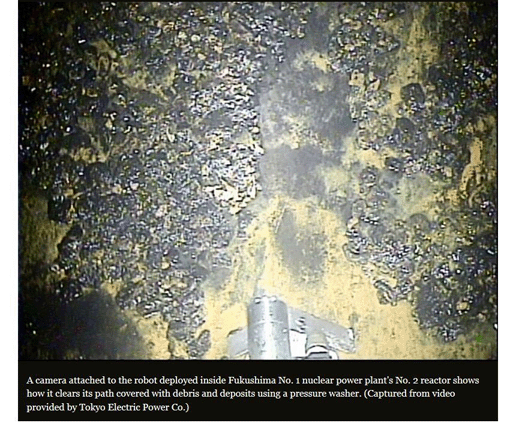
Nuclear fuel removal is small step in cleanup at Fukushima http://www.asahi.com/ajw/articles/AJ201904190031.html
April 19, 2019 Tokyo Electric Power Co., the operator of the crippled Fukushima No. 1 nuclear power plant, has started removing radioactive fuel rods from the fuel storage pool for one of the three reactors that melted down in the 2011 nuclear disaster.
Massive amounts of melted nuclear fuel debris remain in the cores or containment vessels of the No. 1 to No. 3 reactors, which melted down. In addition, many fuel rods, batched into assemblies, are stored in storage pools within the reactor buildings.
These pools could be seriously damaged if the plant is hit by another big earthquake or tsunami. Moving spent fuel from these pools to the safe common pool within the premises is an important step to preventing accidents and ensuring steady progress in the process of decommissioning the reactors.
All the 1,535 nuclear fuel assemblies that were in the No. 4 reactor building, which did not melt down because it was shut down at the time of the accident, were removed by the end of 2014. Since workers could enter the building, the operation was conducted in a normal manner.
By contrast, areas around the fuel storage pool for the No. 3 reactor remain inaccessible due to high levels of radiation. The situation requires the removal operation to be remotely conducted from a control room about 500 meters from the No. 3 reactor building.
The work involves putting nuclear fuel assemblies into special containers under water and lifting them up with a crane and putting them down onto the ground for transportation to the common pool. This is a tricky and risky mission that has to be carried out with great care and caution by using a monitor.
Initially, the process of removing the fuel rods from the storage pool for the No. 3 reactor was scheduled to start at the end of 2014. But it has been repeatedly postponed due to technical mishaps and other reasons. It was finally started after a delay of more than four years.
The plant operator, known as TEPCO, plans to relocate all 566 nuclear fuel assemblies that have been kept in the storage pool in the No. 3 reactor building by the end of March 2021.
To reduce the risks posed to the process by possible earthquakes and tsunami, it is desirable to carry out the work quickly. But making undue haste could cause problems and accidents that disrupt the process. Meeting the schedule should not be the top priority.
Experience and expertise to be accumulated through the work with the No. 3 reactor will come in handy for the same fuel removal work with the Nos. 1 and 2 reactors, which could be initiated as early as in fiscal 2023, which starts in April 2023.
The other two reactors, however, will pose even tougher challenges. The debris situation of the No. 1 reactor building is worse, while radiation levels within the No. 2 reactor building are higher.
It is vital to obtain sufficient experience and know-how through the process of removing fuel rods from the No. 3 reactor.
TEPCO needs to ensure steady progress in the process through effective and close information sharing with related manufacturers and other actors involved.
No decision has yet been made as to what to do with the spent fuel after being transferred to the common pool. This is a complicated and knotty issue that does not lend itself to an easy, quick solution, just like the problem of a rapidly increasing amount of radiation-contaminated water the plant is generating as the reactors are being flooded to cool the melted fuel debris and underground water keeps flowing in the reactor buildings.
In 2021, the utility plans to launch the even more challenging mission of removing melted fuel debris from one of the three reactors.
Prime Minister Shinzo Abe recently visited the Fukushima No. 1 nuclear plant for the first time in five years and promised the government’s committed leadership for the efforts to decommission the reactors and deal with polluted water.
The Abe administration should provide really strong and effective leadership for the long, grueling process in line with the prime minister’s pledge.
Both the government and TEPCO have a duty to move the decommissioning process steadily forward while winning support from the local communities through sincere and serious dialogue.
Nuclear power plants not designed, not built, to cope with climate change

U.S. Nuclear Power Plants Weren’t Built for Climate Change, [excellent pictures on original] Bloomberg , By Christopher Flavelle and Jeremy C.F. Lin, April 18, 2019
In 2011, after an earthquake and tsunami caused a meltdown at Japan’s Fukushima-Daiichi power plant, Gregory Jaczko, then the chairman of the U.S. Nuclear Regulatory Commission, had to worry about two things: whether radioactive fallout would harm the U.S. and whether a similar accident could befall an American plant. The answer to the first question turned out to be no. The second question preoccupies him still.
The NRC directed the operators of the 60 or so working U.S. nuclear power plants to evaluate their current flood risk, using the latest weather modeling technology and accounting for the effects of climate change. Companies were told to compare those risks with what their plants, many almost a half-century old, were built to withstand, and, where there was a gap, to explain how they would close it.
That process has revealed a lot of gaps. But Jaczko and others say that the commission’s new leadership, appointed by President Donald Trump, hasn’t done enough to require owners of nuclear power plants to take preventative measures—and that the risks are increasing as climate change worsens.
….. After Fukushima, U.S. regulators told operators to calculate their exposure to various flood risks and compare that with what the plant was designed for. Ninety percent of plants had at least one risk exceeding their design.
According to a Bloomberg review of correspondence between the commission and plant owners, 54 of the nuclear plants operating in the U.S. weren’t designed to handle the flood risk they face. Fifty-three weren’t built to withstand their current risk from intense precipitation; 25 didn’t account for current flood projections from streams and rivers; 19 weren’t designed for their expected maximum storm surge. Nineteen face three or more threats that they weren’t designed to handle.
The industry argues that rather than redesign facilities to address increased flood risk, which Jaczko advocates, it’s enough to focus mainly on storing emergency generators, pumps, and other equipment in on-site concrete bunkers, a system they call Flex, for Flexible Mitigation Capability. Not only did the NRC agree with that view, it ruled on Jan. 24 that nuclear plants wouldn’t have to update that equipment to deal with new, higher levels of expected flooding. It also eliminated a requirement that plants run Flex drills………
The commission’s three members appointed by President Trump wrote that existing regulations were sufficient to protect the country’s nuclear reactors. Jaczko disagrees. “Any work that was done following Fukushima is for naught because the commission rejected any binding requirement to use that work,” he says. “It’s like studying the safety of seat belts and then not making automakers put them in a car.”
The commission “is carrying out the Trump deregulatory philosophy,” says Edwin Lyman, head of the Nuclear Safety Project at the Union of Concerned Scientists. “The NRC basically did everything the industry wanted.” The two Democratic appointees objected to the NRC’s ruling. “The majority of the commission has decided that licensees can ignore these reevaluated hazards,” commissioner Jeff Baran wrote in dissent. His colleague Stephen Burns called the decision “baffling.” Through a spokesman, the Republican appointees declined to comment.
“Nuclear power is weird—it exists to produce electricity, and at the same time it can’t exist without electricity,” says Allison Macfarlane, who chaired the NRC from 2012 through 2014. Plants need constant power to pump cool water into a reactor’s core; if flooding interrupts that power supply for long enough, as happened in Fukushima, the core can overheat, melting through its container and releasing deadly levels of radiation.
The true risk to U.S. nuclear facilities may be even greater than what the documents from the nuclear commission show. The commission allowed nuclear plant operators not only to perform their own estimates of current flood risk but also to decide what assumptions to make—for example, the maximum likely hurricane speed or how much rain would fall in an extreme storm. (The commission reviews that work.) The commission also rejected a recommendation by their own staff that would require nuclear power plants to update their risk assessments periodically to reflect the advancing threat of climate change.
While plant owners weren’t required to project their future storm surge risk, the Union of Concerned Scientists has done its own estimates for some of those regions. The images included here show that projected increase.
Turkey Point Nuclear Generating Station, 35 miles south of Miami, was designed to withstand a storm surge of 16 feet, according to documents submitted to regulators by its owner, Florida Power & Light Co. But the updated storm surge is expected to range from 17.4 feet to 19.1 feet at different parts of the plant. Last year, Florida Power & Light sought permission from regulators to extend Turkey Point’s operating license until 2053.
……….. The Waterford power plant, a half-hour drive up the Mississippi River from New Orleans, was designed to withstand a maximum storm surge of 23.7 feet above sea level, according to documents provided to the NRC by Entergy Corp., which owns the plant. The company told regulators that a combination of storm surge and river flooding would create a maximum surge of 31.8 feet.
……… One of the largest gaps in storm surge protection is at Dominion Energy Inc.’s Surry Power Station, whose two reactors sit on a peninsula jutting into the James River just north of Norfolk, Va. The plant’s east side, which is most exposed to a potential storm surge, was designed to withstand a wall of water as high as 28.6 feet above sea level, Dominion told regulators. The company found that under current conditions, a storm surge combined with river flooding would bring a surge of as much as 38.8 feet. “
…… Dominion asked the NRC to extend its license for Surry to 2053. The commission has yet to rule on that request.
…….. According to documents provided to the commission by Exelon Corp., which owns Peach Bottom, the plant wasn’t designed for its current flood risk from heavy precipitation, storm surge, ice-induced flooding, or a standing wave called a seiche.
The fight over regulation and climate change comes when the nuclear industry, under pressure from cheap natural gas and still viewed with suspicion by many environmentalists, can least afford it, according to Peter Bradford, a former commissioner. “Anything that increases their costs now threatens their existence,” he says.
…… Macfarlane, the former NRC chairman, says the lesson of Fukushima is that the nuclear industry, including regulators, needs to prepare for seemingly unlikely threats. “Boy, did we misjudge natural hazards,” she says. “If something happens and you don’t learn from it, woe unto you.”https://www.bloomberg.com/graphics/2019-nuclear-power-plants-climate-change/
Earth’s ‘skin temperature test’ shows undeniable evidence of global warming
 https://metro.co.uk/2019/04/17/earths-skin-temperature-test-shows-undeniable-evidence-global-warming-9230191/ Jeff Parsons, Wednesday 17 Apr 2019
Satellite measurements of the Earth’s ‘skin temperature’ have confirmed that global warming is heating up the planet. The infra-red sensitive system was used to record temperature trends from 2003 to 2017. It showed a warming pattern consistent with other land-based measurements. Dr Joel Susskind, from Nasa’s Goddard Space Flight Centre, said: ‘Both data sets demonstrate the Earth’s surface has been warming globally over this period, and that 2016, 2017, and 2015 have been the warmest years in the instrumental record, in that order.’
The satellite system, called Airs (Atmospheric Infra-Red Sounder), records temperature at the surface of the ocean, land and snow-covered regions. Its findings were compared with station-based data from the Goddard Institute for Space Studies Surface Temperature Analysis (Gistemp).
Extinction Rebellion: The activists risking prison to save the planet
 DW, 17 Apr 19, In the face of runaway climate chaos, governments around the world are in denial, say the activists hoping to land themselves in jail in defence of our planet — and the survival of our species.Many environmentalists — particularly the major international NGOs — have long argued that frightening people will only put them off engaging with climate protection. If the problem feels too big, we feel hopeless and switch off to think about something else.
But with scientists telling us that the planet’s sixth mass extinction is already underway, and that we have scarcely more than a decade to avert devastating, irreversible climate change, a growing number of activists now believe it’s too late to sugar coat the the truth.
This week, they will be taking to streets around the world in acts of mass civil disobedience, with the message that unless we take immediate action humankind itself faces extinction.
“Emissions are still going up, so we need to disrupt normal life,” says Nick Holzberg, who works full time for Extinction Rebellion in Berlin. “The only way to do that is peaceful civil disobedience.”
State of emergency
Extinction Rebellion first emerged in fall last year, when thousands of demonstrators took to the streets of London. UK “Extinction Rebels” have since occupied bridges over the Thames and stripped off in the British Parliament. And their movement has expanded to 35 countries around the world………
The group is demanding that governments declare a “climate emergency,” to shift into a crisis mode where “business as unusual” is suspended to make climate protection the priority.
More concretely, they want governments to commit to carbon neutrality by 2025 — instead of mid-century as the European Union and many national governments are aiming for. ….
With little faith in governments taking such radical action alone, Extinction Rebellion is also demanding a “people’s assembly” to oversee the transition. …… https://www.dw.com/en/extinction-rebellion-the-activists-risking-prison-to-save-the-planet/a-48302957
Thousands of climate activists block London roads
Roadblocks will continue night and day at each site and the demonstrators say the protests could last at least a week….
The group is demanding the government declare a climate and ecological emergency, reduce greenhouse gas emissions to net zero by 2025, and create a citizen’s assembly of members of the public to lead on decisions to address climate change. ….
Extinction Rebellion wrote to Prime Minister Theresa May on Monday outlining their demands and asking for face-to-face talks, warning that they will escalate their disruptive actions over the coming weeks unless the government acts.
“Make no mistake, people are already dying,” the letter states. “In the majority world, indigenous communities are now on the brink of extinction. This crisis is only going to get worse … Prime Minister, you cannot ignore this crisis any longer. We must act now.”
Organisers of the protests circulated legal advice to anyone planning to attend, requesting they refrain from using drugs and alcohol, and asking them to treat the public with respect.
London’s police have advised people travelling around the city in the coming days to allow extra time for their journey in the event of road closures and general disruption. …… Extinction Rebellion wrote to Prime Minister Theresa May on Monday outlining their demands and asking for face-to-face talks, warning that they will escalate their disruptive actions over the coming weeks unless the government acts.
“Make no mistake, people are already dying,” the letter states. “In the majority world, indigenous communities are now on the brink of extinction. This crisis is only going to get worse … Prime Minister, you cannot ignore this crisis any longer. We must act now.”
Organisers of the protests circulated legal advice to anyone planning to attend, requesting they refrain from using drugs and alcohol, and asking them to treat the public with respect.
London’s police have advised people travelling around the city in the coming days to allow extra time for their journey in the event of road closures and general disruption………https://www.sbs.com.au/news/climate-change-rallies-block-london-roads
Donald Trump’s administration – the revolving door between the Pentagon and nuclear weapons companies
 Tomgram: Smithberger and Hartung, The Pentagon’s Revolving Door Spins Faster
Japanese public face a move by government, to bring U.S. nuclear weapons into Japan
The Pain and Politics of Hiroshima
Nuclear Weapons in the Reiwa Era https://allthingsnuclear.org/gkulacki/nuclear-weapons-in-the-reiwa-era, GREGORY KULACKI, CHINA PROJECT MANAGER AND SENIOR ANALYST | APRIL 11, 2019 Japan will soon have a new emperor and a new dynastic name to mark the traditional Japanese calender: Reiwa (令和). Interminable commentary on the significance of the name is just beginning, but in the end it will be defined not by words but by deeds. One of the most important acts the Japanese people may be compelled to take as the new era begins is to decide whether to allow their government to introduce US nuclear weapons into Japan. They may have to choose between continuing to honor the LEGACY OF HIROSHIMA and the warnings of the HIBAKUSHA or abandoning Japan’s longstanding role as a leading voice for peace and nuclear disarmament.
UCS obtained a document that contains a detailed description of the Japanese foreign ministry’s requirements for US nuclear weapons. Multiple conversations with the Japanese official who presented this document to his US counterparts not only confirmed its content, they also revealed this small group of hawkish officials wants to train Japanese military personnel to deliver US nuclear weapons. They would even like the United States to grant Japanese leaders the authority to decide when to use them. Japanese officials refer to this arrangement as “nuclear sharing.”
Public opinion polls indicate many Japanese people would like to make the use or threat to use nuclear weapons illegal, which is the purpose of the recently adopted UN Treaty on the Prohibition of Nuclear Weapons (TPNW). A large majority of their elected representatives, even within Abe’s ruling LDP, want to uphold Japan’s Three Non-Nuclear Principles, which forbid “nuclear sharing.” Many Japanese people take pride in the belief that their country plays a leading role in advancing nuclear disarmament.
Abe appears to have injected his nationalist agenda into the selection of the name for the new era. Press reports highlight that Reiwa (令和) is the first Japanese dynastic name not taken from the Chinese classics. The collection of Japanese poetry that inspired Abe’s selection was popular among the military officers of Imperial Japan who led their nation into World War II. Critics panned Reiwa as a cold expression of Abe’s authoritarian tendencies, but it seemed to be well-received and gave an immediate lift to the popularity of a man on track to become the longest serving prime minister in Japanese history.
Only time will tell. Japanese attitudes towards nuclear weapons may be the most important window into the ultimate meaning of Reiwa. Making sure the Japanese people know what their government is saying and doing about nuclear weapons may be the best way to ensure that window is clear.
Tens of thousands of young people in Britain and abroad are demonstrating for climate action in the latest wave of strikes
 Youth climate change protests across Britain – as it happened
Tens of thousands of young people in Britain and abroad are demonstrating for climate action in the latest wave of strikes, https://www.theguardian.com/environment/live/2019/apr/12/youth-climate-change-protests-across-britain-live Sarah Marsh 13 Apr 19,
- Students across the UK took to the streets on Friday to call for the government to act to tackle the climate change crisis. Protests took place everywhere from Birmingham, to Newcastle and beyond. Jake Woodier, from the UK Youth Climate Coalition, who took part in London, said: “It’s been a really fantastic day, with thousands and thousands of students protesting across the country, and continuing to build the movement.”
- A further 30 countries across the globe also held events today. Many shared their experiences over social media. It included activity in New Delhi in India, Istanbul in Turkey and Helsinki, Finland’s capital.
- Politicians, broadcasters, scientists and artists showed their support for young activists. David Attenborough was asked about the young people who have been marching all over the world. The Washington Post asked: when you look at that, what do you see, as someone generations ahead of them? Attenborough said: “I mean, strikes are a way of expressing a strong feeling that you have, but they don’t solve it. You don’t solve anything by striking. But you do change opinion, and you do change politicians’ opinions. And that’s why strikes are worthwhile.”
- The march in London brought Oxford street to a standstill. Organiser Cyrus Jarvis, 16, a year 11 student from London Academy school in Barnet, North London, said: “The police tried to frighten us with arrests but we just moved on. “We are really sorry for anyone who did have issues because of us, but unfortunately this is what we have to do to get our point across to the government.”
- On 22 April, the Guardian is hosting an event with Greta Thunberg and Anna Taylor, from the UK Student Climate Network, with an introduction from Caroline Lucas MP, and chaired by the Guardian’s Zoe Williams.
You can find out more about this event here.
Key expert in USA Congress says there is little hope for consent-based siting for nuclear waste
 House Appropriator Throws Cold Water on Consent-Based Siting for
  Nuclear Waste BY EXCHANGEMONITOR 10 Apr 19, There is little hope for a consent-based approach to selecting the site for a U.S. radioactive waste repository, a key appropriator in the House of Representatives said Tuesday.
“I know of no community that will become a permanent repository for nuclear waste based on consent,” said Rep. Mike Simpson (R-Idaho), ranking member of the House Appropriations energy and water development subcommittee.
Simpson was responding to a plea against funding the planned waste disposal site under Yucca Mountain, Nev., from Rep. Dina Titus (D-Nev.). Titus was among more than 20 lawmakers who appeared before the subcommittee during a member day hearing to argue their case for programs to be included or excluded in the upcoming House energy and water appropriations bill for fiscal 2020.
“We don’t use nuclear energy, we don’t produce nuclear waste, and we shouldn’t be forced to store it,” she said.,,,,, https://www.exchangemonitor.com/house-appropriator-throws-cold-water-consent-based-siting-nuclear-waste/
The Chernobyl syndrome

With bountiful, devastating detail, Brown describes how scientists, doctors, and journalists—mainly in Ukraine and Belarus—went to great lengths and took substantial risks to collect information on the long-term effects of the Chernobyl explosion, which they believed to be extensive.
Other researchers have issued a much sunnier picture of post-Chernobyl ecology, but Brown argues persuasively that they are grossly underestimating the scale of the damage, in part because they rely too heavily on simplistic measurements of radioactivity levels.
Radiation has a special hold on our imagination: an invisible force out of science fiction, it can alter the very essence of our bodies, dissolve us from the inside out. But Manual for Survival asks a larger question about how humans will coexist with the ever-increasing quantities of toxins and pollutants that we introduce into our air, water, and soil. Brown’s careful mapping of the path isotopes take is highly relevant to other industrial toxins, and to plastic waste. When we put a substance into our environment, we have to understand that it will likely remain with us for a very long time, and that it may behave in ways we never anticipated. Chernobyl should not be seen as an isolated accident or as a unique disaster, Brown argues, but as an “exclamation point” that draws our attention to the new world we are creating.
The Chernobyl Syndrome, The New York Review of Books SophiePinkham, APRIL4, 2019
Manual for Survival: A Chernobyluie to the Futur
Midnight in Chernobyl: The Untold Story of the World’s Greatest Nuclear Disaster
Chernobyl: The History of a Nuclear Catastrophe
“………As her book’s title, Manual for Survival, suggests, Kate Brown is interested in the aftermath of Chernobyl, not the disaster itself. Her heroes are not first responders but brave citizen-scientists, independent-minded doctors and health officials, journalists, and activists who fought doggedly to uncover the truth about the long-term damage caused by Chernobyl. Her villains include not only the lying, negligent Soviet authorities, but also the Western governments and international agencies that, in her account, have worked for decades to downplay or actually conceal the human and ecological cost of nuclear war, nuclear tests, and nuclear accidents. Rather than attributing Chernobyl to authoritarianism, she points to similarities in the willingness of Soviets and capitalists to sacrifice the health of workers, the public, and the environment to production goals and geopolitical rivalries. Continue reading
1 This month

of the week – Australians for War Powers Reform (AWPR)
To see nuclear-related stories in greater depth and intensity
 Antinuclear