New procedure treats irregular heartbeat without radiation
 https://www.fox16.com/health/new-procedure-treats-irregular-heartbeat-without-radiation/1877143492, By: SUSANNE BRUNNER : Mar 25, 2019 CDTLITTLE ROCK, Ark. – A new procedure at Arkansas Heart Hospital is eliminating radiation exposure.
Protesters disrupt Brexit debate by baring bottoms over inaction on climate change
 ABC News 2 Apr 19, While some view the British parliament as a symbol of political stasis since the 2016 Brexit referendum, other Brits have utilised Westminster’s symbolic power to press — literally and figuratively — for faster action on climate change.
On Monday, members of climate change action group Extinction Rebellion stripped half-naked in the House of Common’s glass-walled public gallery during a Brexit debate, and some appeared to have glued themselves to the glass.
As MPs started yet another day of lengthy debate on how or even whether the country should leave the European Union, 14 protesters stripped to their underpants to show slogans painted on their backs, including: “Climate justice now”.
……. more acts of civil disobedience would occur in the lead up to the group’s ‘International Rebellion’ on climate change inaction slated for April 15.
In the moments afterward, numerous people took to Twitter to poke fun at a parliament that has otherwise been considered stale and mired in a prolonged Brexit debate….. https://www.abc.net.au/news/2019-04-02/british-protesters-bare-bottoms-in-parliament-to-protest-climate/10961468
How a British writer downgraded the effect of Maralinga atomic tests, on Aboriginal people
Paul Waldon Fight To Stop Nuclear Waste Dump In Flinders Ranges SA
The British Nuclear Legacy: The Black Mist of Maralinga.
Main Culprit: Sir Robert Menzies, PM of Australia.
Damage Done: Unknown numbers of British and Australian servicemen and aboriginal tribes died over 40 years.
Why: Last chance for the Brits to keep up their pretensions of world power-at any cost.
This is not my words but the way it went to print, yes the British casualties get top billing and the word Aboriginal was all in lower case, this maybe an oversight, or error of the author but Aboriginal land was decimated and the custodians deserve the respect that they have been void of. https://www.facebook.com/groups/344452605899556/
Despite substantial UK govt bribes, Anglesey Council will not take part in govt search for nuclear dump site
 North Wales Chronicle 30th March 2019 Anglesey Council has confirmed that it will not volunteer the island to take part in a government search for sites to bury the UK’s stockpile of its most dangerous radioactive waste despite the promise of substantial financial incentives and “well paid jobs.”
permanent geological waste sites.
Trump handed Kim a piece of paper, ordering him to hand over nuclear weapons to USA

With a piece of paper, Trump called on Kim to hand over nuclear weaponshttps://www.reuters.com/article/us-northkorea-usa-document-exclusive/exclusive-with-a-piece-of-paper-trump-called-on-kim-to-hand-over-nuclear-weapons-idUSKCN1RA2NR, Lesley Wroughton, David Brunnstrom, WASHINGTON (Reuters) 30 Mar 19– On the day that their talks in Hanoi collapsed last month, U.S. President Donald Trump handed North Korean leader Kim Jong Un a piece of paper that included a blunt call for the transfer of Pyongyang’s nuclear weapons and bomb fuel to the United States, according to the document seen by Reuters.
Trump gave Kim both Korean and English-language versions of the U.S. position at Hanoi’s Metropole hotel on Feb. 28, according to a source familiar with the discussions, speaking on condition of anonymity. It was the first time that Trump himself had explicitly defined what he meant by denuclearization directly to Kim, the source said.
A lunch between the two leaders was canceled the same day. While neither side has presented a complete account of why the summit collapsed, the document may help explain it.
The document’s existence was first mentioned by White House national security adviser John Bolton in television interviews he gave after the two-day summit. Bolton did not disclose in those interviews the pivotal U.S. expectation contained in the document that North Korea should transfer its nuclear weapons and fissile material to the United States.
The document appeared to represent Bolton’s long-held and hardline “Libya model” of denuclearization that North Korea has rejected repeatedly. It probably would have been seen by Kim as insulting and provocative, analysts said.
Trump had previously distanced himself in public comments from Bolton’s approach and said a “Libya model” would be employed only if a deal could not be reached.
Public will never know truth behind Three Mile Island
Chaos at Three Mile Island
|
Public will never know truth behind Three Mile Island, anti-nuclear energy advocates say https://www.witf.org/news/2019/03/public-will-never-know-truth-behind-three-mile-island-anti-nuclear-energy-advocates-say.phpWritten by Ivey DeJesus/PennLive | Mar 26, 2019 he public will never know the truth behind some of the most basic facts about the nation’s worst nuclear disaster nor the actual amount of radiation that was released.Those were some of the messages underscored on Monday by the head of Three Mile Island Alert, an anti-nuclear advocacy group, and other advocates at a press conference in the Main Rotunda of the state Capitol. Just days shy of the 40th anniversary of the partial meltdown at the Three Mile Island nuclear plant in Londonderry Township, TMI Alert’s Eric Epstein excoriated the nuclear industry for misrepresenting the facts of the accident, and in the process misleading and misinforming the public. “Three Mile Island is an accident without an ending,” Epstein said. “There’s no bookends to it. If you look at the holy trinity of nuclear accidents, Three Mile Island, Chernobyl and Fukushima, we can probably pretty much tell you when they started. The reality is there is no ending. This is a funeral where the pallbearers need to stand in place for 500 years. That’s tough for a society that has the memory of a fruitfly.” Epstein was joined by Tim Judson, executive director of Nuclear Information and Resource Service, and Arnie Gundersen, a nuclear engineer, who over the years converted from a proponent to an ardent critic. Judson and Gundersen outlined the chain of events that took place on March 28, 1979, the start of the partial meltdown, as well as the levels of radiation released and subsequent impact on the health of the region. Judson said the Three Mile Island story amounted to a “mistelling of history” of what could have been a preventable accident. He said that as a result of inconsistencies provided by the nuclear industry, the public was not given – nor will never have – a clear picture of the facts and the risks surrounding the meltdown. Gundersen explained that because inadequate radiation monitors were in place at the time, officials were never able to get an accurate reading of radiation levels. All analysis of radiation releases were based on mathematical corrections to estimates derived from off-site dose readings, he said. “How much radiation was released? Nobody knows,” said Gundersen, who began a change of heart on nuclear energy in the 1990s when he served as an expert witness for plaintiffs in a lawsuit against Three Mile Island. He is today chief engineer of Fairewinds Associates, an advocacy group for clean, renewable energy. The Nuclear Regulatory Commission has long stood by its 40-year-old estimate that 10 million Curies of radiation were released. The NRC has also long held that the radiation released during the accident was well within levels deemed safe. The industry has reiterated that no one died or was harmed as a result of the accident. Gundersen said that according to his own analysis of raw data, he calculated that 10 times that amount was released. Epstein further excoriated legislative efforts to “bail out” Pennsylvania’s nuclear power plants, including Exelon Corp., current owner of TMI-1. He said proposals to bail out the nuclear industry in Pennsylvania – to the tune of nearly $3 billion – were “fundamentally and manifestly unfair,” adding that Three Mile Island Alert categorically opposed any bailout.Proposed legislation would lead to the reclassification of Pennsylvania’s nuclear plants as “zero emission energy” and create new requirements on how electric companies purchase power. Among the members of the audience, were several visitors from Fukushima, Japan, site of the 2011 post-tsunami nuclear disaster that led to the evacuation of a quarter of million people. “The same (tactics) used to minimize the damage and risk of health is the same between Fukushima and TMI,” said Hiroko Aihara, a journalist from Fukushima. She said citizen engagement has been pivotal in the case of Three Mile Island and continues to be so in the Fukushima aftermath. “It’s very important to work together. To know we are not alone,” she said. Aihara said the Japanese people – like residents of central Pennsylvania 40 years ago – were not provided with the truth. “Many people are still suffering… about evacuation, radiation, contamination and economic situation,” she said. “We are still suffering or fighting the situation.” |
|
Cyclone Idai Lays Bare Deadly Reality of Climate Change in Africa
 https://allafrica.com/view/group/main/main/id/00066940.html Although experts have said it was too early to draw specific conclusions from Idai, for a continent already wracked by the effects of climate change, the Tropical Cyclone has been another chilling reminder of the destructive power of the kind of storms that will become more common in the future. It has been described as the worst weather-related disaster to hit the southern hemisphere, and the UN says more than 2 million people have been affected.
VERDADE By Adérito Caldeira 24 Mar 19,
A week after Tropical Cyclone IDAI “massacred” the center of Mozambique, there are still people under siege in the trees and on the roofs of houses in the provinces of Sofala and Manica.
“The affected area is much larger than we thought, there are almost 125 kilometers of flood areas” said Saviano Abreu of the United Nations Office for the Coordination of Humanitarian Affairs (OCHA). The location of 92 more corpses raised the number of fatalities to 294.
In Nhamatanda in Sofala province 47 bodies were found. Government official Toze Joseph said that there are other communities under water with which communication is impossible
The remaining 45 bodies were located and removed at Dombes administrative post in Sussundenga, Manica province.
In the neighboring province of Manica other 45 bodies were removed from the water at the Administrative office of Dombe in Sussendenga district, said the governor Manuel Rodrigues.
Since Tuesday, March 19, the Government has not publicly updated the number of affected people or fatalities.
“We are still updating the numbers. When the flood waters subside, more bodies will be discovered. When I addressed the nation and world, I said the numbers of dead will increase and that is what is happening,” said President Philip Nyusi in Tete.
Nyusi had earlier said that the number of deaths could rise to a thousand.
Cost estimates for Small and Medium Nuclear Reactors (SMRs) and costs of SMRs under construction
 SMR cost estimates, and costs of SMRs under construction, Nuclear Monitor Issue: #872-873 4777 07/03/2019Jim Green ‒ Nuclear Monitor editor
Little credible information is available on the cost of China’s demonstration 2×250 MW high-temperature gas-cooled reactor (HTGR). If the demonstration reactor is completed and successfully operated, China reportedly plans to upscale the design to 655 MW (three modules feeding one turbine, total 655 MW) and to build these reactors in pairs with a total capacity of about 1,200 MW (so much for the small-is-beautiful SMR rhetoric). According to the World Nuclear Association, China’s Institute of Nuclear and New Energy Technology at Tsinghua University expects the cost of a 655 MWe HTGR to be 15-20% more than the cost of a conventional 600 MWe PWR.3
A 2016 report said that the estimated construction cost of China’s demonstration HTGR is about US$5,000/kW ‒ about twice the initial cost estimates.4 Cost increases have arisen from higher material and component costs, increases in labor costs, and increased costs associated with project delays.4 The World Nuclear Association states that the cost of the demonstration HTGR is US$6,000/kW.5
The CAREM (Central Argentina de Elementos Modulares) SMR under construction in Argentina illustrates the gap between SMR rhetoric and reality. Argentina’s Undersecretary of Nuclear Energy, Julián Gadano, said in 2016 that the world market for SMRs is in the tens of billions of dollars and that Argentina could capture 20% of the market with its CAREM technology.6 But cost estimates have ballooned: Continue reading
Despite £1 million just to listen, UK councillors reject plan for nuclear waste dumping
Daily Post 22nd March 2019 , Any plans to find a site to store nuclear waste in Denbighshire will be strongly resisted despite an offer of £1 million just to listen to a government pitch for the plans. The UK government is searching for sites that will allow nuclear waste to be buried.
As part of the process county councils have been offered £1 million to listen to the government sales pitch for the scheme. If a council agrees to the start of work on taking in the waste they will be then given £2.5 million if authorities take part in
the planning stage. Denbighshire councillors will be presented with details of the scheme when they meet next week but already opposition councillors have said there is no way they would support such a move.
https://www.dailypost.co.uk/news/north-wales-news/1m-sweetener-store-nuclear-waste-16015159
UK Council strongly rejects hosting a nuclear waste dump
Leader Live 22nd March 2019 , HOLYWELL councillors were quick to back a bid to reject nuclear waste being dumped in the town. Earlier this year, North Wales residents were consulted in the search for a site to dump 60 years’ worth of the UK’s most dangerous radioactive waste.
At their monthly meeting, town council members were quick to support the motion that Holywell would not become the host of a nuclear waste dump. Plaid Cymru’s Jill Evans MEP sent the town council an email on the subject that was read out at the meeting. “We are writing to you to urge your council to pass a motion stating that your community
will not volunteer to host an underground waste dump.
CND Cymru will keep a record of every community, town and county council that passes such a motion, and submit a list to the government’s consultation as part of our submission to the consultation.” From the end of March, this list of
councils who support this motion will be available on the Campaign for Nuclear Disarmament’s website
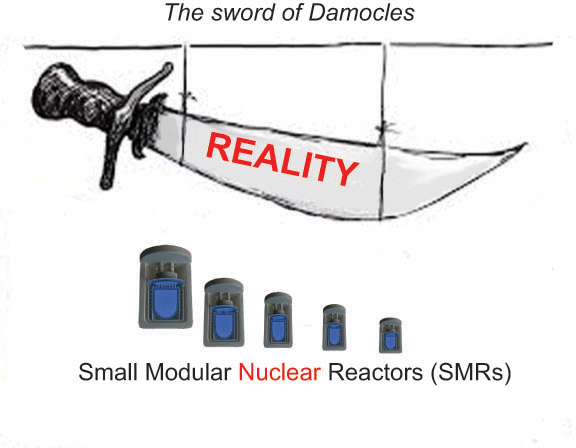
Poor outlook for small nuclear reactors – they have a dismal history of failure
 Many of the expenses associated with constructing and operating a reactor do not change in linear proportion to the power generated. For instance, a 400 MW reactor requires less than twice the quantity of concrete and steel to construct as a 200 MW reactor, and it can be operated with fewer than twice as many people.
In the face of this prevailing wisdom, proponents of small reactors pinned their hopes on yet another popular commercial principle: “economies of mass production.”
In 1968, the same year Elk River shut down, the last of the AEC’s small reactors was connected to the grid: the 50 MW La Crosse boiling water reactor.19 That plant operated for 18 years; by the end, its electricity cost three times as much as that from the coal plant next door, according to a 2012 news account about the disposal of the plant’s spent fuel. Dealing with the irradiated uranium-thorium fuel proved difficult too. Eventually, the spent fuel was shipped to a reprocessing plant in southern Italy.
Since then, not a single small reactor has been commissioned in the United States.
Without exception, small reactors cost too much for the little electricity they produced, the result of both their low output and their poor performance.
The forgotten history of small nuclear reactors Nuclear Monitor Issue: #872-873 4775 07/03/2019 M.V. Ramana ‒ Simons Chair in Disarmament, Global and Human Security at the School of Public Policy and Global Affairs at the University of British Columbia
the technology remains in stasis or decline throughout the Americas and Europe. …..
A fundamental reason for this decline is indeed economic. Compared with other types of electricity generation, nuclear power is expensive. Continue reading
The bugocalypse – study after study shows the dramatic declines in insect populations
 Why are insects dying in such numbers? https://www.smh.com.au/environment/conservation/why-are-insects-dying-in-such-numbers-20190319-p515hb.html By Greg Callaghan March 23, 2019 It’s been dubbed the bugocalypse – study after study rolling in from countries across the globe pointing to dramatic declines in insect populations. In Germany, an 82 per cent fall in midsummer invertebrate populations across 63 nature reserves between 1990 and 2017; in the Puerto Rico rainforest, a 75 per cent reduction in the volume of insects between 1976 and 2013; in the UK, a one-third fall in the honeybee population over the past 10 years. Across the US, monarch butterfly and ladybird beetle numbers are at record lows.
In alpine NSW, there’s been a collapse in bogong moth populations, resulting in starving pygmy possums, who feed on them. Most worrying, a research review of 73 existing surveys, released last month by the University of Sydney’s Institute of Agriculture, discovered that 40 per cent of insect species will likely be in catastrophic decline within a century.
So what’s going on? Just more scary headlines, or a real indicator of an eco-crisis ahead? A bit of both. While certain “beneficial” insect populations (butterflies, grasshoppers, mayflies, dragonflies, ground beetles, fireflies) appear to be in unprecedented retreat, others considered pests and a risk to human health (tsetse flies, ticks, mosquitoes) are on the offensive again.
We’re all sure a decline is happening,” explains Dr David Yeates, director of the Australian National Insect Collection in Canberra. “But to obtain a useful measure, we need to compare insect numbers today with those of 30, 40 or 50 years ago – but invertebrate counts weren’t being done then.”
So what’s causing the bug die-off? The top culprit is likely to be wilderness loss – many insects feed off native plants, and the relentless spread of single-crop farmland and insecticides has shrivelled their range, says Yeates. Another culprit: global warming, which favours some insects over others. Cut out insects and you lose all the creatures that feed on them, including frogs, lizards and birds. Of course, a large proportion of the food we eat comes from plants pollinated by insects, and they also clean up the environment, notes Yeates. “Waking up in a world without insects would be like waking up in a garbage dump.”
The spectacularly rising costs of cleaning up the Fukushima nuclear catastrophe
Think tank puts cost to address nuke disaster up to 81 trillion yen http://www.asahi.com/ajw/articles/AJ201903100044.html By ATSUSHI KOMORI/ Staff Writer, 23 Mar 19
March 10, 2019 In a startling disparity, a private think tank puts the cost of addressing the 2011 Fukushima nuclear disaster between 35 trillion yen and 81 trillion yen ($315 billion and $728 billion), compared with the government estimate of 22 trillion yen.
The calculation, by the Tokyo-based Japan Center for Economic Research, showed that the total could soar to at least 60 percent more and up to 3.7 times more than the 2016 estimate by the Ministry of Economy, Trade and Industry.
In releasing the latest estimates on March 7, the center said it is time for serious debate over the role nuclear energy should play in the nation’s mid- and long-term energy policy.
Of the highest price tag of 81 trillion yen, 51 trillion yen would go toward decommissioning the crippled Fukushima No. 1 nuclear power plant and treating and disposing of radioactive water. The ministry put the cost for these tasks at 8 trillion yen.
The center calculated the compensation to victims at 10 trillion yen, while the comparable estimate by the ministry was 8 trillion yen.
Although the center’s estimate for the decontamination operation was 20 trillion yen, the ministry’s projection was 6 trillion yen.
The biggest disparity in the estimates between the think tank and the ministry is that the former put the treatment and disposal of contaminated water at 40 trillion yen and included the cost for disposing of polluted soil produced during cleanup operations in the overall costs.
If contaminated water is released in the sea after it is diluted with water, the overall costs could be 41 trillion yen, including 11 trillion yen estimated for decommissioning and disposal for tainted water.
The least expensive way of coping with the accident–35 trillion yen–would be to encase the plant in a concrete sarcophagus, rather than undertaking the formidable challenge of retrieving melted nuclear fuel from the reactors, and releasing contaminated water into the sea. In this case, it would cost 4.3 trillion yen to close down the plant and dispose of the radioactive water.
But this scenario drew fire from residents in the affected municipalities as they view covering nuclear fuel debris with a massive structure would be tantamount to asking them to give up hope of eventually returning to their hometowns.
The center’s latest projections followed its estimates two years ago, in which the number varied from 50 trillion yen to 70 trillion yen.
It updated its projections based on the findings about treatment and disposal of radioactive water and progress in cleanup operations over the past years.
Nuclear transport an attractive target for terrorists, example Brazil –
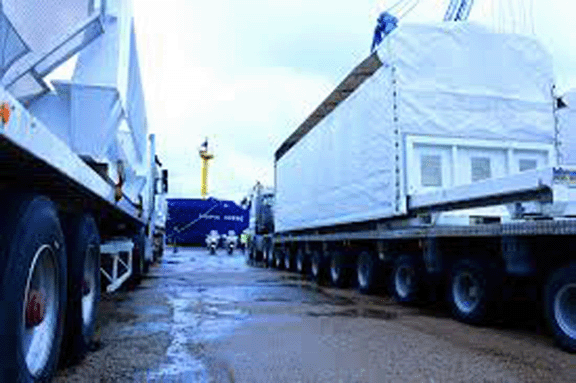
Brazilian drug gang opens fire on convoy of trucks carrying nuclear fuel, Guardian Dom Phillips in Rio de Janeiro 20 Mar 2019 Latest incident raises concerns about Brazil’s nuclear security in a state struggling with violent crime A convoy of trucks carrying nuclear fuel came under armed attack on a highway in Rio de Janeiro state on Tuesday as it drove past a community controlled by a drug gang. Gang members armed with rifles opened fire on the convoy, Rio’s O Globo newspaper said.
Armed police escorting the convoy exchanged fire with armed gang members as the trucks carrying uranium continued to a nearby nuclear plant. The attack is the latest of several violent incidents in the area where Brazil has two nuclear reactors and has raised concerns about its nuclear security in a state struggling with high levels of violent crime.
The attack happened as the convoy passed the Frade community around noon near the tourist town of Angra dos Reis in the Green Coast (Costa Verde), around 200km from Rio de Janeiro. It reached the Angra 2 nuclear plant less than half an hour later, Brazil’s nuclear agency said……
Typically, such convoys have around five or six trucks and are escorted by regular police and motorbike outriders from Brazil’s Federal Highway police, the Eletronuclear spokesman Marco Antonio Alves told the Guardian. It was carrying uranium fuel to supply the Angra 2 nuclear power plant, which began operating in 2001. ……. https://www.theguardian.com/world/2019/mar/20/brazilian-drug-gang-opens-fire-on-convoy-of-trucks-carrying-nuclear-fuel?CMP=share_btn_fb&fbclid=IwAR3RPlZ7l2eqbDbUKOavFnccBnocR5AjCpeedTMeCQT7686-HKxuii8rfwE
Comment by Raymond John Cockram I‘m figuring the probability that it was refined into fuel rods is closer to the truth given it was on its way to the reactor site, what you need to remember is that the Brazilian President is a self confessed fascist so media manipulation MUST be expected.
A very worrying milestone reached: Fukushima No. 1 nuclear plant now stores over 1 million tons of radioactive water
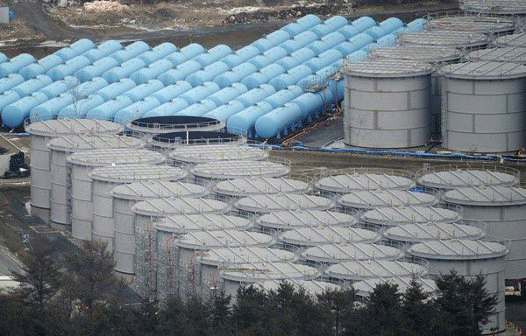
Toyoshi Fuketa, chairman of the Nuclear Regulation Authority, has repeatedly said a decision must be made soon on how to deal with the contaminated water.
“We are entering a period in which further delays in deciding what measure to implement will no longer be tolerable,” Fuketa recently said.
Groundwater becomes contaminated when it flows into the buildings of the three reactors that suffered meltdowns in 2011 following the Great East Japan Earthquake and tsunami. Water that is used to cool the nuclear fuel debris is processed to remove radioactive substances, but the system cannot get rid of tritium.
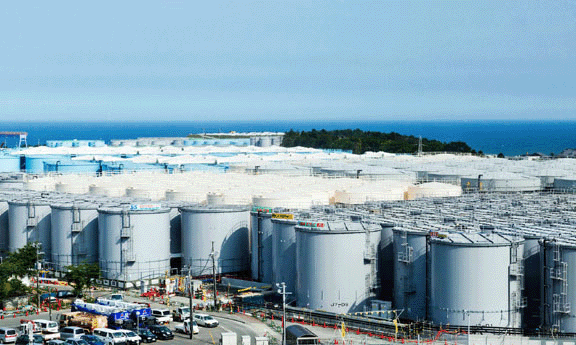
These problems have forced TEPCO to store the contaminated water in hundreds of tanks installed at the Fukushima plant.
If more storage tanks are constructed, the overall capacity of 1.37 million tons at the site will likely be reached by the end of 2020.
Fukushima fishermen are already on alert for the one option they have already criticized–diluting the water and dumping it into the Pacific Ocean.
The economy ministry in 2016 said that measure could be implemented in the shortest time frame and at a low cost.
Fuketa has also said this is the most realistic option, but he noted that it would require years of preparation.
Some experts said the go-ahead for the dilution measure should have been given at the end of 2018 to start the process before the storage tanks reach capacity.
Economy ministry officials tried to explain various measures being considered at a public hearing in Fukushima in August 2018, including releasing the diluted water into the ocean.
“It will have a devastating effect on fishing in Fukushima,” said Tetsu Nozaki, who heads the Fukushima prefectural federation of fisheries cooperative associations.
Fukushima fishermen have slowly resumed operations since all forms of fishing were prohibited after high levels of radiation were found in fish caught off the Fukushima coast.
Fish auctions restarted at Fukushima ports in spring 2017, but the volume of fish brought in is still only about 20 percent of levels before the 2011 nuclear accident.
The last thing Fukushima fishermen want is an increase of negative publicity about their catches if the diluted water is dumped into the Pacific.
The government has spent about 34.5 billion yen ($309 million) to build a frozen underground earth wall around the three reactor buildings to divert the groundwater to the ocean. The “ice wall” has cut down the flow of groundwater, which at one time reached about 500 tons a day.
But still, groundwater continues to flow into the three reactor buildings at a rate of about 100 tons daily.
(This article was compiled from reports by Chikako Kawahara, Hiroshi Ishizuka, Toshio Kawada and Kazumasa Sugimura.)
1 This month

of the week – Australians for War Powers Reform (AWPR)
To see nuclear-related stories in greater depth and intensity
 Antinuclear