NEEDLES — The Fort Mojave Indian Tribe hosted the 21st annual Ward Valley Spiritual Gathering on Feb. 16.
FMIT, along with supporters from the other five tribes along the Colorado River and environmental activists and allies, gathered to commemorate a 113-day occupation that led to defeating a proposal for a nuclear waste dump at Ward Valley.
In addition to honoring the individuals and organizations for the hard work, courage and dedication they brought to the successful occupation, the event was also a remembrance filled with songs from the Fort Mojave Tribal Band, traditional Bird Singing and Dancing, a Spirit Run, tributes, recognition and a history of Ward Valley.
In 1998 the occupation of the proposed dump site by the five river tribes: the Fort Mojave, Chemehuevi, Quechan, Cocopah and Colorado River Indian Tribes; along with environmental activists, took place at the Ward Valley site to fight and stop the proposed dump.
The resistance efforts prevented law enforcement from the Bureau of Land Management from entering the site, effectively stopping any test drilling or development.
Protesting that the waste dump would have desecrated sacred land, the tribes and activists prevailed when the U.S. Department of the Interior rescinded an eviction notice and canceled the test drilling.
The Interior Department terminated all actions regarding the Ward Valley dump proposal on Nov. 2, 1999, ending the fight with victory for the tribes and activists.
Ward Valley is about 25 miles west of Needles along Interstate 40 at Water Road
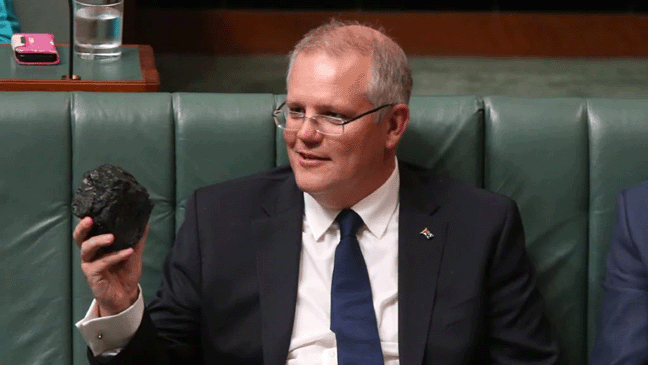
As of today, the federal government will be using taxpayer dollars to cut emissions and keep the left happy while, to keep the right happy, underwriting new coal fired power…. (Subscribers only )
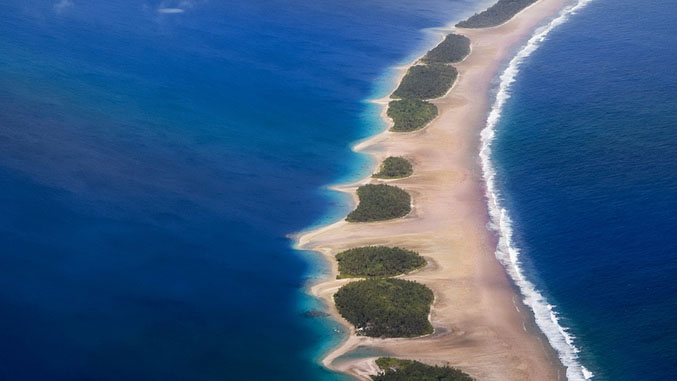
Climate change forces low-lying Marshall Islands to ‘elevate islands’, Climate change has left the low-lying Marshall Islands with little choice but to consider drastic measures. https://www.sbs.com.au/news/climate-change-forces-low-lying-marshall-islands-to-elevate-islands, 24 Feb 19, The far-flung Marshall Islands needs to raise its islands if it is to avoid being drowned by rising sea levels, President Hilda Heine has warned.
It cited an increasing frequency of “inundation events, severe droughts, coral bleaching events, and… looking forward, there is very good reason to believe that conditions and prospects for survival will only worsen.”
Most of the islands are less than two metres (6.5 feet) above sea level and the government believes physically raising the islands was the only way to save the Marshall Islands from extinction.
They have not yet outlined specifics of how this would be achieved expect to have plans formulated by the end of the year. In the meantime, they are keeping a close watch on the ambitious City of Hope project on an artificial island in the Maldives as a viable option.
To lay the foundations of the city – which is expected to accommodate 130,000 people when completed in 2023 – sand is being pumped onto reefs from surrounding atolls and it is being fortified with walls three metres above sea level, which will make it higher than the tallest natural island in the Maldives.
“Whatever approach is selected, it will involve selecting islands to raise, add to, or build upon” Heine said.
“All Marshallese stakeholders, but especially traditional landowners, need to be at the forefront of this discussion if we are ever going to move the conversation forward.”
The Marshall Islands also aims to increase engagement with the three other all-atoll nations – Kiribati, Tuvalu and the Maldives – on climate issues.
“As a group, the atoll nations need to come together to formulate their unique concerns and develop their positions and plans and identify financial needs related to climate impacts,” said Heine, who chairs the Coalition of Atoll Nations Against Climate Change.
The Sea of Galilee: A Sea of Miracles Disappearing
Where Jesus once preached, the holy waters are draining away,Climate change and conflict have left the river Jordan a stagnant stream and the Sea of Galilee critically low, Guardian, Oliver Holmes Sun 24 Feb 2019
If Jesus were alive today, he might reconsider a baptism in the river Jordan; there’s a good chance he’d pick up an eye infection. Faecal bacteria in the pungent, murky waters have risen in recent years to up to six times the recommended levels.
Once a raging torrent, the lower Jordan has been starved of water to become a stagnant stream, filled with sewage and dirty run-off from farms. Around 95% of its historical flow has been diverted by agriculture during the past half-century. And the river’s primary source, the Sea of Galilee – where Christians believe the son of God walked on water – has for years been dammed to prevent its demise.
Biblical bodies of water in the Holy Land, eternalised in Christian, Jewish and Muslim ancient texts as godly, are now facing very human threats: climate change, mismanagement and conflict.
Following five consecutive years of drought, the Sea of Galilee has sunk to a 100-year low. A number of small islands have emerged at the water’s surface, and several holiday homes that were built on the shoreline now stand at least 100 metres from the boggy edge.
Overuse has also taken its toll. Last summer, the level of the lake dropped close to a black line, a level at which it could lose its status as a freshwater body. “The black line is our best guess of that point,” says Gidon Bromberg, the Israeli director of EcoPeace, an organisation of Israeli, Palestinian and Jordanian environmentalists. “It was tens of centimetres above the black line,” he says, adding that such a shallow depth has not been seen in records taken over the past century.
As the lake’s level falls, it cannot wash away salt fast enough, and its salinity rises. If the Sea of Galilee’s waters were left to hover around the black line, its flora and fauna would start to perish. A glimpse of the lake’s grim future might be seen 350km downriver at the lowest place on the planet: the Dead Sea, a body almost devoid of fish and plant life. “Once the lake becomes saline, that could be irreversible,” says Bromberg, speaking at the muddy edge of the water, reeds poking up behind him………
As long as the Sea of Galilee is under threat, the river Jordan will be too. And their eventual deaths could have explosive ramifications as water in this region has been a key source of conflict. The river Jordan is shared by Israel, the occupied Palestinian territories, Jordan and Syria, all of which use its depleting reserves………
EcoPeace hopes that good water management will spur on peace to the region. Bromberg is now advocating for a deal in which Israel, which is on the Mediterranean, supplies desalinated water to Jordan. In exchange, Jordan, which is low on water but full of open desert with 320 sunny days a year, will supply solar power.
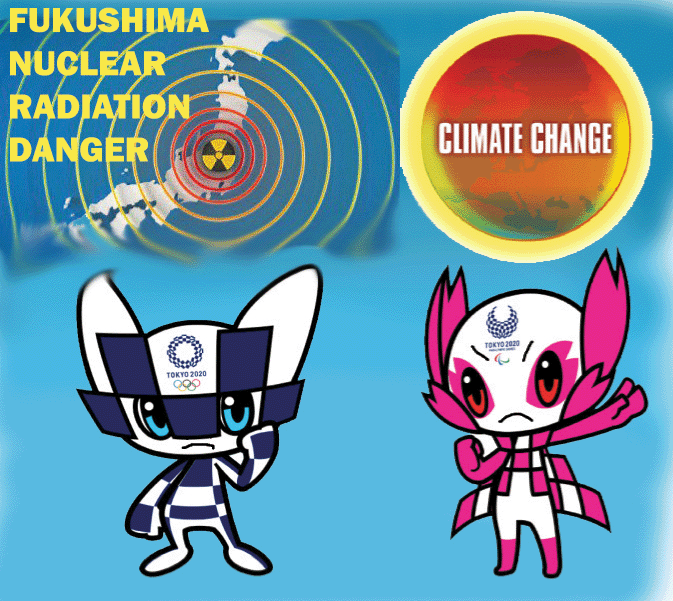
Disaster-hit Fukushima still short of 2020 Games volunteers, Japan Today Feb. 24 FUKUSHIMA
Fukushima Prefecture is still well short of its target for recruiting volunteers to help it stage some events at the 2020 Tokyo Olympics and Paralympics — a setback to its efforts to showcase its recovery from the 2011 earthquake, tsunami and nuclear disaster.
With the deadline for recruitment approaching at the end of this month, the northeastern prefecture, which is to host several softball and baseball games, was only a third of the way to its target of 1,500 volunteers.
Of the 503 people who had applied as of early February, 70 percent were in their 40s or above, with much lower participation from those in their teens and 20s, according to the prefecture.
Prefectural officials said the low number of applicants may be because the schedules for most of the games have yet to be set, while also acknowledging that promotion efforts have barely paid off.
One of the main themes of the Tokyo games is to demonstrate Japan’s reconstruction from the 2011 disasters and Fukushima, one of the hardest-hit areas, wants to use the opportunity to show the progress it has made and convey a message of gratitude for support. It also hopes to promote inbound tourism.
The prefecture has increased events for recruiting volunteers at company offices and colleges, while seeking to reassure potential volunteers that they can always change their minds later and withdraw their applications……..
By Mark Waghorn, SWNS, February 21, 2019 Earth is facing global warming Armageddon in just 140 years, warns a new study.
Scientists say, New York Post the concentration of carbon dioxide is rising faster than at any time since the age of the dinosaurs.
And our planet is just 140 years away from a climate change event similar to one that triggered mass extinctions, according to the research.
It could lead to species being wiped out on a massive scale in fewer than five generations.
Lead author Professor Philip Gingerich, of the University of Michigan, said: “You and I won’t be here in 2159, but that’s only about four generations away.
“When you start to think about your children and your grandchildren and your great-grandchildren, you are about there.”
That sparked an event known as the Paleocene-Eocene Thermal Maximum (PETM) when temperatures rose by five to eight degrees Celsius (9 to 14 degrees Fahrenheit).
It killed off both land and sea animals — and took more than 150,000 years for the planet to return to normal. This has been used as a benchmark for modern climate change in the past. But the latest finding shows we are on track to meet it much sooner than feared.
The pace of today’s warming far outstrips any climate event that has happened since the extinction of the dinosaurs.
Professor Gabriel Bowen, a geophysicist at the University of Utah who reviewed the research for the journal, said: “Given a business-as-usual assumption for the future, the rates of carbon release that are happening today are really unprecedented, even in the context of an event like the PETM…….. https://nypost.com/2019/02/21/earth-facing-global-warming-armageddon-in-less-than-150-years/
Science 22 Feb 2019: Vol. 363, Issue 6429, pp. 809 DOI: 10.1126/science.363.6429.809
Summary
For all their innovations, NuScale Power’s small modular reactors remain conventional in one way: They would use ordinary uranium-based reactor fuel that’s meant to be used once and safely disposed of. But for decades, nuclear engineers envisioned a world powered by “fast reactors” that can breed an essentially boundless supply of plutonium that can be reprocessed into fuel. Early in the atomic age, experts believed nuclear energy would one day supply most of the world’s power, raising the specter of a uranium shortage and boosting interest in fast breeder reactors.
However, the reactors are complex and must be cooled with substances such as liquid sodium or molten salt. The chemically intensive recycling process produces plenty of its own hazardous waste. And the closed fuel cycle also would establish a global market for plutonium, the stuff of atomic weapons, raising proliferation concerns. Perhaps most important, the world is in no danger of running out of uranium. So some experts doubt fast reactors will ever become mainstream.
the millions in subsidies thorium will require to become commercially viable would be better spent on solar, wind and other alternative energy sources.
Can Thorium Offer a Safer Nuclear Future? Thomas net by David Sims. Staff WriterFeb 21, 2019
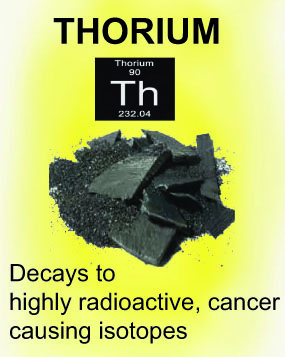
Is thorium the great hope for a clean, viable and safe nuclear-fuel alternative to uranium, or is it an impractical and overly expensive option that could never be adopted by the nuclear industry?
Nuclear energy has numerous advantages, but there are drawbacks as well: nuclear waste poses a significant environmental threat, meltdowns are a possibility and nuclear materials can be used to create weapons of mass destruction.
However, advocates of using thorium as a nuclear fuel instead of uranium point out that it solves many of these problems……. (unsuitable for nuclear weapons, wastes last less long, can’t melt down )
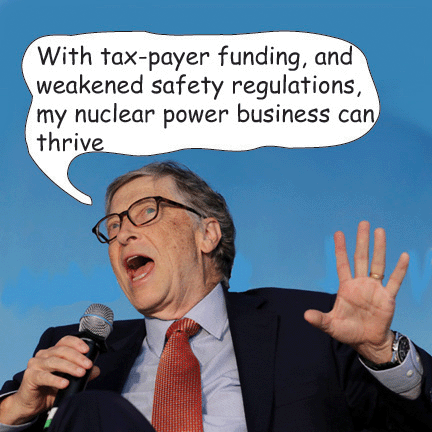
Paul Waldon Fight To Stop Nuclear Waste Dump In Flinders Ranges SA, 22 Feb 19, Stanford Energy, has touted Bill Gates as a entrepreneur while denouncing wind and solar calling it unreliable, at a recent Global Energy Form.
However the uncomfortable looking Bill Gates fails to mention his vested interest in the nuclear arena with 108,502,519 shares worth about $7 billion in the company “Republic Services” that manages radioactive waste, and has failed at satisfying the general public and residents of St Louis with the cleanup of Bill and other shareholders toxic waste. Placing money before the health of people in a estranged community can be easy when void of a conscience. https://www.facebook.com/groups/344452605899556/
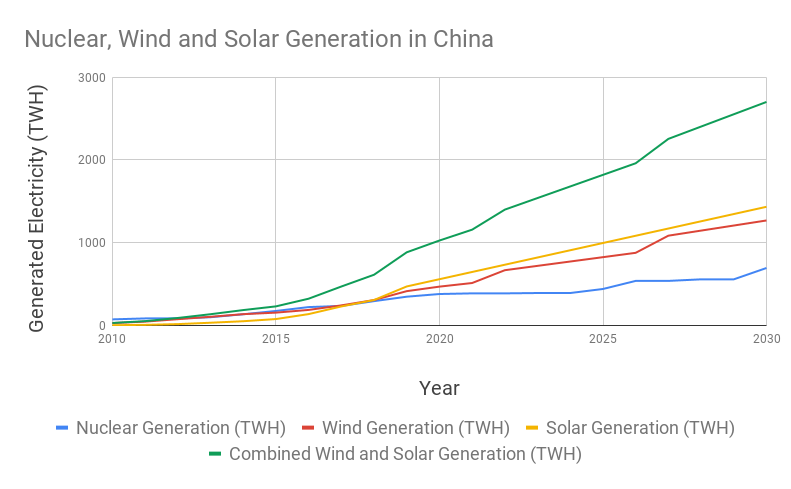
Wind & Solar In China Generating 2× Nuclear Today, Will Be 4× By 2030, Clean Technica, February 21st, 2019 by Michael Barnard, Close to five years ago I published an assessment of nuclear scaling vs wind and solar scaling using China as the proving ground in the CleanTechnica article “Wind Energy Beats Nuclear & Carbon Capture For Global Warming Mitigation.” Today, the China example is more clear proof that wind and solar are the better choice for global warming mitigation than nuclear generation.China’s example is meaningful because it disproves several arguments of those in favor of increased nuclear generation. It’s not suffering under regulatory burden. It’s mostly been using the same nuclear technologies over and over again, not innovating with every new plant. It doesn’t have the same issues with social license due to the nature of the governmental system. The government has a lot of money. The inhibitors to widespread deployment are much lower.
Yet China has significantly slowed its nuclear generation rollout while accelerating its wind and solar rollout. Even strong industry insiders accept this, ones such as former World Nuclear Association executive Steve Kidd, writing in Nuclear Engineering International in 2017.
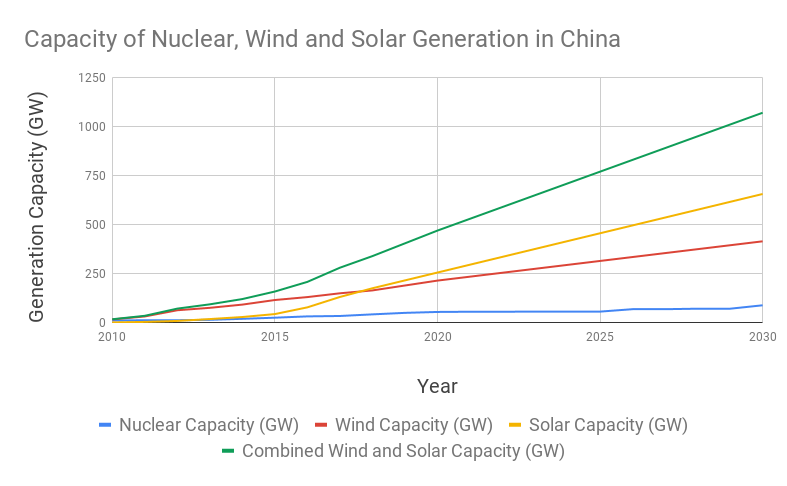
Kidd estimates that China’s nuclear capacity will be around 100 gigawatts (GW) by 2030, well below previous expectations. Forecasts of 200 GW by 2030 were “not unusual only a few years ago,” he writes, but now seem “very wide of the mark.” And even the 100 GW estimate is stretching credulity ‒ nuclear capacity will be around 50 GW in 2020 and a doubling of that capacity by 2030 won’t happen if the current slow-down sets in.
Why is China slowing its nuclear rollout so drastically? Because nuclear is turning out to be more expensive than expected, new nuclear designs are proving to be uneconomical, and new wind and solar are dirt cheap and much easier to build.
Recently I published an assessment of the potential for wind and solar to massively exceed US CO2 reductions from nuclear in the CleanTechnica article US Could Achieve 3× As Much CO2 Savings With Renewables Instead Of Nuclear For Less Money. As usual, many of the comments from nuclear advocates related to the relative success of China, its speed of deployment compared to other jurisdictions and similar things.
In the discussion threads, I attempted to find apples-to-apples comparisons of China’s nuclear, solar, and wind generation compared, but none seemed to exist. As a result, I developed a model spanning 2010 to 2030, core years for all three programs. The charts are generated from the model
As I noted in 2014, the wind generation program had started much later than the nuclear program yet had been able to build much more capacity much more quickly, roughly six times more real wind energy capacity than nuclear per year over the years of 2010 through 2014. At the time, I used best of breed capacity factors for both wind and nuclear. One of the arguments against this at the time and on an ongoing basis is that China is curtailing wind and solar generation and achieving lower capacity factors. However, China is also experiencing less than best of breed capacity factors with its nuclear fleet, averaging 80% instead of 90%. This would have put the real world generation in the range of 3–4 times better for wind than for nuclear.
It doesn’t really matter as even with the diminished capacity factors for wind and solar currently experienced, they generated more than double the electricity generated by nuclear in 2018. Wind and solar each generated more electricity last year than nuclear did. By 2030, the ratio is very likely to be 4:1 in favor of wind and solar. And as Lazard has shown, wind and solar are much, much cheaper than nuclear, so China will be getting a lot more electricity at a lower cost point.
The chart above uses the capacity factors being experienced for wind, solar and nuclear to date in China and projects that all three will improve over the coming decade as operational efficiencies and grid connections improve………….
The quote from Kidd above suggests China might achieve only 100 GW of nuclear capacity by 2030. That’s an overestimation according to the actual data. Nuclear reactors in construction today only bring Chinese nuclear capacity to 55 GW by 2023. Reactors scheduled to start construction in the next three years only bring that number to 66 GW. Reactors planned but not scheduled at all are only likely to see 88 GW by 2030. There is no planned capacity that achieves even 100 GW, never mind the heady days when 200 GW was thought to be possible.
And to be clear, even if 200 GW of nuclear had been realized, it still would have been less actual generation than wind and solar.
As I indicated in the recent article on US ability to decrease carbon load, nuclear is much lower carbon per MWh than either coal or gas generation, as well as being free of chemical and particulate pollution. However, wind is still quite a bit lower than nuclear in CO2e per MWh and solar is around the same. Given the speed of deployment per GW of capacity and the much lower price per MWh of wind and solar, nuclear as part of the mix doesn’t make a lot of sense in most places…………https://cleantechnica.com/2019/02/21/wind-solar-in-china-generating-2x-nuclear-today-will-be-4x-by-2030/
The US is rushing to transfer sensitive nuclear power technology to Saudi Arabia, according to a new congressional report.
A Democratic-led House panel has launched an inquiry over concerns about the White House plan to build nuclear reactors across the kingdom.
Whistleblowers told the panel it could destabilise the Middle East by boosting nuclear weapons proliferation.
Firms linked to the president have reportedly pushed for these transfers.
The House of Representatives’ Oversight Committee report notes that an inquiry into the matter is “particularly critical because the Administration’s efforts to transfer sensitive US nuclear technology to Saudi Arabia appear to be ongoing”.
President Donald Trump met nuclear power developers at the White House on 12 February to discuss building plants in Middle Eastern nations, including Saudi Arabia.
And Mr Trump’s son-in-law, White House adviser Jared Kushner, will be touring the Middle East this month to discuss the economics of the Trump administration’s peace plan.
Lawmakers have been critical of the plan as it would violate US laws guarding against the transfer of nuclear technology that could be used to support a weapons programme.
They also believe giving Saudi Arabia access to nuclear technology would spark a dangerous arms race in the volatile region. Continue reading →
Trump Accidentally Just Triggered Global Nuclear Proliferation
Before the United States killed it, the INF Treaty didn’t just stem the arms race with Russia—it stopped the spread of nuclear weapons around the world.
|FEBRUARY 21, 2019 O n Feb. 1, the Trump administration made good on its threats and began the official withdrawal process from the 1987 Intermediate-Range Nuclear Forces (INF) Treaty between the United States and Russia. As others have pointed out, this was a short-sighted decision. By withdrawing from the INF Treaty, the Trump administration has eliminated any consequences of Moscow’s alleged noncompliance, leaving it free to deploy as many intermediate-range missiles as it wants. U.S. President Donald Trump’s decision to throw out the rulebook instead of trying to enforce it greases the wheels for a return to U.S.-Russian nuclear arms racing—with potentially dire consequences for international security.
But there is another outcome of the end of INF Treaty that is less examined and no less dangerous: It will undermine global efforts to prevent the spread of nuclear weapons to countries that don’t yet have them. As an instrument of arms control, the INF Treaty has done much more than limit the capabilities of the individual parties involved. For over 30 years, it has quietly been a central part of the international nonproliferation regime, too. This collection of treaties, informal agreements, and institutions that keep the spread of nuclear weapons in check is often cast in architectural terms: an edifice held up by pillars built on a weathered but enduring foundation. In reality, the nonproliferation regime is a complex and deeply intertwined network that more resembles a spiderweb: stronger than the sum of its parts but likely to unravel if individual threads start to break.
Perhaps the most important thread in this tapestry is the long-running tradition of close cooperation between Washington and Moscow on nuclear issues. The INF Treaty itself is a product of their joint efforts, as are the 1968 Treaty on the Nonproliferation of Nuclear Weapons (commonly known as the NPT), the Nuclear Suppliers Group, and International Atomic Energy Agency safeguards, among others. U.S.-Soviet partnership on nonproliferation remained sacrosanct even during the worst moments of the Cold War, in part thanks to regular interaction between Russian and American officials across a host of treaties and other frameworks. As the historical record shows, just talking to one another, almost regardless of outcome, built up trust and personal rapport that kept cooperation going when times got tough.
From this vantage, the INF Treaty’s demise is not just symptomatic of the deep crisis between the two nuclear powers—it is also a contributor to it.Its collapse means the elimination of an official channel for Russian and American interaction at a moment when there are precious few other options. The Special Verification Commission, the pact’s dispute resolution mechanism, convened 30 meetingsthrough the early 2000s but was sorely underutilized in recent years. It would have been the natural setting to address noncompliance allegations—and could have helped to get relations back on track—but this opportunity came off the table when the treaty was scrapped.
The importance of U.S.-Russian relations to nonproliferation means that the end of the INF Treaty will affect other areas of the regime, too. As many experts have observed, New START—now the last bastion of bilateral arms control—is probably the most susceptible to contagion. Set to expire in just two years, this 2010 agreement can be extended for up to five years if both parties agree. Emboldened by its withdrawal from the INF Treaty, however, the Trump administration might pass over this silver bullet for the freedom to pursue maximum flexibility in its military options……… https://foreignpolicy.com/2019/02/21/trump-accidentally-just-triggered-global-nuclear-proliferation/
Kim Mavromatis Fight To Stop Nuclear Waste Dump In Flinders Ranges SA. 21 Feb 19, FED LIBS REACTION TO ANOTHER EARTHQUAKE TREMOR AT PROPOSED NUCLEAR WASTE DUMP SITES AT KIMBA : She’ll be right mate – no worries – trust us – we’ll make the radioactive nuclear waste dump earthquake and flood proof – and if it doesn’t work and radioactive poison leaks onto Eyre Peninsula farmland or Flinders Ranges and completely stuffs up people’s livelihood and south australia’s economy, we’ll blame it on the boat people and the Labor opposition for allowing sick refugees to go to hospital. https://www.facebook.com/groups/344452605899556/










 Antinuclear