Trump Uranium Quota Could Shutter Nuclear Plants, Trade Group Warns
 The Nuclear Energy Institute warns that a 25 percent quota on domestic uranium would send prices soaring and force nuclear plants offline. US News, By Alan Neuhauser, Staff Writer, Feb. 4, 2019, A TRUMP ADMINISTRATION proposal to institute quotas on domestic uranium could put the country’s nuclear power sector in a nuclear winter.
The administration is reportedly considering an import quota that would require U.S. uranium mining firms to provide a quarter of the domestic market. The Commerce Department began exploring the idea last year, citing national security concerns. However, critics of the proposal point out that much of the country’s uranium is supplied by close U.S. allies: Canada and Australia.
$500 billion to modernise USA’s nuclear weapons – great for investors in Northrop,Boeing etc
Across this nuclear triad, the takeaway for investors is, there’s a lot of money on the table up for grabs………Definitely going to be a bullish sign for these defense contractors going forward.

|
The $500 Billion Push to Modernize the Nuclear Triad, Cold War-era technology is due for replacement, but the cost is out of this world., Motley Fool Staff, (the_motley_fool), Feb 5, 2019 . Continue reading |
Anger in Ireland, about UK plans to dump nuclear waste close to Louth border
| . |
Climate disruption is driving the migration of people from Central America
|
Climate change is the overlooked driver of Central American migration, https://www.pri.org/stories/2019-02-06/climate-change-overlooked-driver-central-american-migration, Living on Earth. February 06, 2019 Adam Wernick As people from Guatemala and Honduras continue to seek sanctuary in the US for a variety of reasons, including violence and poverty, another factor driving their migration has gotten much less attention: climate disruption. Continue reading
|
The link between weapons testing – thorium, depleted uranium – and birth defects and cancer
How paradise island Sardinia was poisoned by the world’s military | Foreign Correspondent
Italian military officials’ trial ignites suspicions of links between weapon testing and birth defects in Sardinia https://www.abc.net.au/news/2019-01-29/sardinia-military-weapons-testing-birth-defects/10759614
Key points:
- Eight former commanders of a bombing range are before Italian courts
- Locals living near Quirra firing range describe multiple cases of deformities and cancer as “Quirra syndrome”
- Italy’s army has dismissed a report linking exposure to Depleted Uranium to disease suffered by the military
- Watch the full episode on ABC iview
“She died in my arms. My whole world collapsed. I knew she was sick, but I wasn’t ready.”
Her daughter, Maria Grazia, was born on the Italian island of Sardinia with part of her brain exposed and a spine so disfigured her mother has never allowed her photo to be published.
This was only one of many mysterious cases of deformity, cancer and environmental destruction that have come to be called the “Quirra syndrome”.
Eight Italian military officers — all former commanders of the bombing range at Quirra in Sardinia — have been hauled before the courts.
It’s unprecedented to see Italian military brass held to account for what many Sardinians say is a scandalous coverup of a major public health disaster with international consequences.
Bombs and birth defects — is there a link?
In the year baby Maria Grazia was born, one in four of the children born in the same town, on the edge of the Quirra firing range, also suffered disabilities.
Some mothers chose to abort rather than give birth to a deformed child.
In her first television interview, Maria Teresa told Foreign Correspondent of hearing bombs exploding at the Quirra firing range when she was pregnant.
Enormous clouds of red dust enveloped her village.
Later, health authorities were called in to study an alarming number of sheep and goats being born with deformities.
Shepherds in the area had routinely grazed their animals on the firing range.
“Lambs were born with eyes in the back of their heads,” said veterinary scientist Giorgio Mellis, one of the research team.
“I had never seen anything like it.”
One farmer told him of his horror: “I was too scared to enter the barn in the mornings … they were monstrosities you didn’t want to see.”
Researchers also found an alarming 65 per cent of the shepherds of Quirra had cancer.
The news hit Sardinia hard. It reinforced their worst fears while also challenging their proud international reputation as a place of unrivalled natural beauty.
The military hit back, with one former commander of the Quirra base saying on Swiss TV that birth defects in animals and children came from inbreeding.
“They marry between cousins, brothers, one another,” General Fabio Molteni claimed, without evidence.
“But you cannot say it or you will offend the Sardinians.”
General Molteni is one of the former commanders now on trial.
Years of investigation and legal inquiry led to the six generals and two colonels being charged with breaching their duty of care for the health and safety of soldiers and civilians.
After repeated attempts, Foreign Correspondent was refused interviews with senior Italian military officials and the Defence Minister.
Governments earning money by renting out ranges
Sardinia has hosted the war games of armed forces from the west and other countries since sizable areas of its territory were sectioned off after World War II.
Rome is reported to make around $64,000 an hour from renting out the ranges to NATO countries and others including Israel.
Getting precise information about what has been blown up, tested or fired at the military sites and by which countries is almost impossible, according to Gianpiero Scanu, the head of a parliamentary inquiry that reported last year.
Many, including current Defence Minister Elisabetta Trenta, have previously accused the Italian military of maintaining a “veil of silence”.
Speaking exclusively to the ABC, chief prosecutor for the region, Biagio Mazzeo, said he is “convinced” of a direct link between the cancer clusters at Quirra and the toxicity of the elements being blown up at the defence base.
But prosecuting the case against the military comes up against a major hurdle.
“Unfortunately, proving what we call a causality link — that is, a link between a specific incident and specific consequences — is extremely difficult,” Mr Mazzeo said.
What is being used on the bases?
A recent parliamentary inquiry revealed that 1,187 French-made MILAN missiles had been fired at Quirra.
This has focussed attention on radioactive thorium as a suspect in the health crisis.
It’s used in the anti-tank missiles’ guidance systems. Inhaling thorium dust is known to increase the risk of lung and pancreatic cancer.
Another suspect is depleted uranium. The Italian military has denied using this controversial material, which increases the armour-piercing capability of weapons.
But that’s a fudge, according to Osservatorio Militare, which campaigns for the wellbeing of Italian soldiers.
“The firing ranges of Sardinia are international,” said Domenico Leggiero, the research centre’s head and former air force pilot.
Whatever is blown up on the island’s firing ranges, it’s the fine particles a thousand times smaller than a red blood cell that are being blamed for making people sick.
These so-called “nanoparticles” are a new frontier in scientific research.
They’ve been shown to penetrate through the lung and into a human body with ease.
Italian biomedical engineer Dr Antonietta Gatti gave evidence to four parliamentary inquiries.
She has suggested a possible link between disease and industrial exposure to nanoparticles of certain heavy metals.
The World Health Organisation says a causal link is yet to be conclusively established and more scientific research needs to be done.
Dr Gatti said armaments had the potential to generate dangerous nanoparticles in fine dust because they are routinely exploded or fired at more than 3,000 degrees Celsius.
Inquiry confirms causal links
In what was labelled a “milestone”, a two-year parliamentary investigation into the health of the armed forces overseas and at the firing ranges made a breakthrough finding.
“We have confirmed the causal link between the unequivocal exposure to depleted uranium and diseases suffered by the military,” the inquiry’s head, then centre-left government MP Gianpiero Scanu, announced.
The Italian military brass dismissed the report but are now fighting for their international reputation in the court at Quirra where the eight senior officers are now on trial.
The ABC understands commanders responsible for another firing range in Sardinia’s south at Teulada could soon also face charges of negligence as police conclude a two-year investigation.
Until now the military has been accused of acting with impunity.
Perhaps their reckoning has come.
One third of Asia’s ice fields doomed, endangering 2 billion people
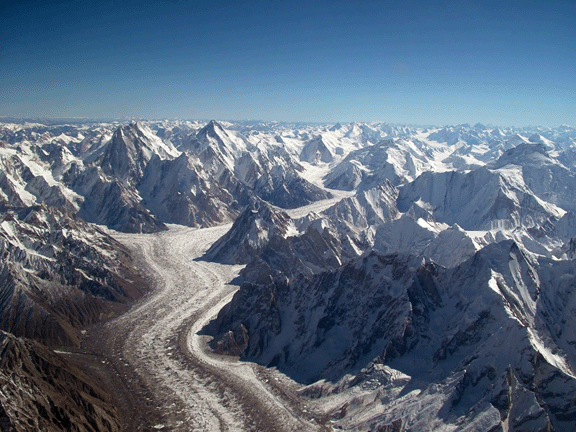
A third of Himalayan ice cap doomed, finds report, Guardian, Guardian, Damian Carrington, Environment editor@dpcarrington 4 Feb 2019
Even radical climate change action won’t save glaciers, endangering 2 billion people At least a third of the huge ice fields in Asia’s towering mountain chain are doomed to melt due to climate change, according to a landmark report, with serious consequences for almost 2 billion people.
Even if carbon emissions are dramatically and rapidly cut and succeed in limiting global warming to 1.5C, 36% of the glaciers along in the Hindu Kush and Himalaya range will have gone by 2100. If emissions are not cut, the loss soars to two-thirds, the report found.
The glaciers are a critical water store for the 250 million people who live in the Hindu Kush-Himalaya (HKH) region, and 1.65 billion people rely on the great rivers that flow from the peaks into India, Pakistan, China and other nations.
“This is the climate crisis you haven’t heard of,” said Philippus Wester of the International Centre for Integrated Mountain Development (Icimod), who led the report. “In the best of possible worlds, if we get really ambitious [in tackling climate change], even then we will lose one-third of the glaciers and be in trouble. That for us was the shocking finding.”
Wester said that, despite being far more populous, the HKH region had received less attention than other places, such as low-lying island states and the Arctic, that are also highly vulnerable to global warming.
Prof Jemma Wadham, at the University of Bristol, said: “This is a landmark piece of work focused on a region that is a hotspot for climate change impacts.”
The new report, requested by the eight nations the mountains span, is intended to change that. More than 200 scientists worked on the report over five years, with another 125 experts peer reviewing their work. Until recently the impact of climate change on the ice in the HKH region was uncertain, said Wester. “But we really do know enough now to take action, and action is urgently needed,” he added.
The HKH region runs from Afghanistan to Myanmar and is the planet’s “third pole”, harbouring more ice than anywhere outside Arctic and Antarctica. Limiting the global temperature rise to 1.5C above pre-industrial levels requires cutting emissions to zero by 2050. This is felt to be extremely optimistic by many but still sees a third of the ice lost, according to the report. If the global rise is 2C, half of the glaciers are projected to melt away by 2100.
Since the 1970s, about 15% of the ice in the HKH region has disappeared as temperatures have risen. But the HKH range is 3,500km long and the impact of warming is variable. Some glaciers in Afghanistan and Pakistan are stable and a few are even gaining ice, most probably due to increased cloud cover that shields the sun and changed winds that bring more snow. But even these will start melting with future warming, Wester said…….https://www.theguardian.com/environment/2019/feb/04/a-third-of-himalayan-ice-cap-doomed-finds-shocking-report
Nuclear Company SNC-Lavalin should be barred from federal contracts

Is this company an advisor to ANSTO and Australia’s nuclear lobby?
SNC-Lavalin should be barred from federal contracts: Angus, Call comes after two former executives pleaded guilty to breaking laws · CBC News Feb 03, 2019 The Canadian government should suspend engineering giant SNC-Lavalin from competing for future federal government contracts after two former top executives pleaded guilty to charges in recent weeks, says NDP MP Charlie Angus.
Americal Republican politicians get big money from coal companies, – wonder how many Australian Liberals do?

150 Congressional Republicans Represent Fossil Fuel Companies Instead of Their Communities https://www.desmogblog.com/2019/01/30/150-congressional-republicans-climate-deniers-fossil-fuel-companies?utm_source=dsb%20newsletter , January 30, 2019 by ClimateDenierRoundup.
Last week, we mocked the fossil fuel industry’s use of an outlet it owns to brag about perverting democracy — but we didn’t actually call out the politicians in the industry’s pocket.
Lucky for us, the Center for American Progress Action Fund did just that this week. A new analysis from CAP tallies up the climate deniers in the 116th Congress. As it turns out, there are a lot: 150.
But that’s actually an improvement from last year, when there were 180. Of those 180, 47 are no longer serving: 22 were defeated in 2018, 16 retired, five resigned, and four went to other positions.
United States 150 out of 335 United States Members of Congress are climate deniers, collecting $68,359,582 in dirty money.
Top recipients
Mitch McConnell (R) – $3,018,793
Jim Inhofe (R) – $2,111,110
John Cornyn (R) – $3,444,515
Ted Cruz (R) – $3,372,000
Kevin Brady (R) – $1,753,762
The number of climate deniers receiving fossil fuel funding elected to the 116th Congress. Credit: Center for American Progress Action Fund Continue reading
Japan using Fukushima ‘recovery’ in a propaganda campaign for Olympic Games, despite radiation levels
The returning residents of Fukushima’s nuclear disaster
Near site of Fukushima nuclear disaster, a shattered town and scattered lives, WP, By Simon Denyer, February 3 NAMIE, Japan — Noboru Honda lost 12 members of his extended family when a tsunami struck the Fukushima prefecture in northern Japan nearly eight years ago. Last year, he was diagnosed with cancer and initially given a few months to live.
Today, he is facing a third sorrow: Watching what may be the last gasps of his hometown.
For six years, Namie was deemed unsafe after a multiple-reactor meltdown at the Fukushima Daiichi Nuclear Power Plant following a 2011 earthquake and tsunami.
In March 2017, the government lifted its evacuation order for the center of Namie. But so far, hardly anyone has ventured back.
Its people are scattered and divided. Families are split. The sense of community is coming apart.
“It has been eight years; we were hoping things would be settled now,” the 66-year-old Honda said. “This is the worst time, the most painful period.”
For the people of Namie and other towns near the Fukushima plant, the pain is sharpened by the way the Japanese government is trying to move beyond the tragedy, to use the 2020 Tokyo Olympics as a symbol of hope and recovery, a sign that life can return to normal after a disaster of this magnitude.
Its charm offensive is also tied up with efforts to restart the country’s nuclear-power industry, one of the world’s most extensive networks of atomic power generation.
Six Olympic softball games and a baseball game will be staged in Fukushima, the prefecture’s bustling and radiation-free capital city, and the Olympic torch relay will start from here.
But in Namie, much closer to the ill-fated nuclear plant, that celebration rings hollow, residents say.
This was a close-knit community of farmers, fishermen and potters — of orchards, rice paddies and cattle sandwiched between the mountains and the sea. It was a place where people celebrated and mourned as a community, and families lived together across generations.
That’s all gone. On the main street, a small new shopping arcade has opened. But a short walk away, a barber shop stands abandoned, its empty chairs gathering years of dust. A sign telling customers to make themselves at home is still displayed in a bar, but inside debris litters the floor. A karaoke parlor is boarded up. Wild boars, monkeys and palm civets still roam the streets, residents say.
Just 873 people, or under 5 percent, of an original population of 17,613 have returned. Many are scared — with some obvious justification — that their homes and surroundings are still unsafe. Most of the returnees are elderly. Only six children are enrolled at the gleaming new elementary school. This is not a place for young families.
Four-fifths of Namie’s geographical area is mountain and forest, impossible to decontaminate, still deemed unsafe to return. When it rains, the radioactive cesium in the mountains flows into rivers and underground water sources close to the town.
Greenpeace has been taking thousands of radiation readings for years in the towns around the Fukushima nuclear plant. It says radiation levels in parts of Namie where evacuation orders have been lifted will remain well above international maximum safety recommendations for many decades, raising the risks of leukemia and other cancers to “unjustifiable levels,” especially for children.
In the rural areas around the town, radiation levels are much higher and could remain unsafe for people to live beyond the end of this century, Greenpeace concluded in a 2018 report.
“The scale of the problem is clearly not something the government wants to communicate to the Japanese people, and that’s driving the whole issue of the return of evacuees,” said Shaun Burnie, senior nuclear specialist with Greenpeace. “The idea that an industrial accident closes off an area of Japan, with its limited habitable land, for generations and longer — that would just remind the public why they are right to be opposed to nuclear power.”
Today, Namie’s former residents are scattered across all but one of Japan’s 47 prefectures. Many live in the nearby town of Nihonmatsu, in comfortable but isolating apartment blocks where communal space and interaction are limited. With young people moving away, the elderly, who already feel the loss of Namie most acutely, find themselves even more alone.
………. many residents say the central government is being heavy handed in its attempts to convince people to return, failing to support residents’ efforts to build new communities in places like Nihonmatsu, and then ending compensation payments within a year of evacuation orders being lifted. ……. https://www.washingtonpost.com/world/asia_pacific/near-site-of-fukushima-nuclear-disaster-a-shattered-town-and-scattere
Climate change affecting the Atlantic Ocean circulation
 A surprising new picture of ocean circulation could have major consequences for climate science, Some experts say the Atlantic Ocean circulation is already slowing down — but we’re just beginning to learn how it really works, WP By Chris Mooney, January 31 2019
It may be the biggest wild card in the climate system. Scientists have long feared that the so-called “overturning” circulation in the Atlantic Ocean could slow down or even halt due to climate change — a change that would have enormous planetary consequences.
But at the same time, researchers have a limited understanding of how the circulation actually works, since taking measurements of its vast and remote currents is exceedingly difficult. And now, a major new research endeavor aimed at doing just that has suggested a dramatic revision of our understanding of the circulation itself.
A new 21-month series of observations in the frigid waters off Greenland has led to the discovery that most of the overturning — in which water not only sinks but returns southward again in the ocean depths — occurs to the east, rather than to the west, of the enormous ice island. If that’s correct, then climate models that suggest the circulation will slow as the climate warms may have to be revised to take this into account.
……….. The new results come from the $ 32 million OSNAP, or “Overturning in the Subpolar North Atlantic,” program, the first attempt to comprehensively measure the circulation in the exceedingly remote regions in question. These icy seas, it is believed, are where cold, salty waters — which are extremely dense — sink below the sea surface into the depths, and then travel back southward again all the way to the Southern Hemisphere.
This “overturning” process is crucial because the sinking in the North Atlantic effectively pulls more warm, salty water northward via a system of currents that includes the Gulf Stream. This heat delivery, in turn, shapes climate throughout much of the region, and especially in Europe.
Better understanding of how the circulation works is key, since some scientists have already proposed that it is slowing down, with major consequences, including ocean warming and sea level rise off the U.S. east coast.
Global temperature maps in recent years have shown a strange area of anomalously cold temperatures in the ocean to the southeast of Greenland, along with very warm temperatures off the coast of New England.
The cold region — which has been dubbed the “cold blob” and also “warming hole” — is strikingly anomalous at a time when the Earth and its oceans are otherwise warming. And the suggestion has been that this represents a decline in the volume of heat being transported northward by the circulation.
The warm waters off New England, in this interpretation, would represent a key corollary — additional ocean heat hanging around in more southern waters, rather than making the trip northward………. https://www.washingtonpost.com/climate-environment/2019/01/31/surprising-new-picture-ocean-circulation-could-have-major-consequences-climate-scien
USA to leave Intermediate-range Nuclear Forces (INF) treaty- Donald Trump confirms
 Donald Trump confirms US withdrawal from INF nuclear treaty, Guardian, Julian Borger, World affairs editor, Sat 2 Feb 2019
 Announcement gives Russia 180 days to destroy violating missiles and launchers to avoid new arms race Donald Trump has confirmed that the US is leaving the Intermediate-range Nuclear Forces (INF) treaty, saying “we will move forward with developing our own military response options” to Russia’s suspect missile.In a written statement, Trump said that the US would be suspending its compliance with the 1987 treaty on Saturday, and would serve formal notice that it would withdraw altogether in six months.
He left the door open to the treaty being salvaged in that 180-day window, but only if Russia destroys all of its violating missiles, launchers and associated equipment. Since 2013, the US has alleged that Russia has developed a new ground-launched cruise missile which violated the INF prohibition of missiles with ranges between 500km and 5,500km.
Russia for several years denied the missile existed but has more recently acknowledged its existence, saying its range does not violate INF limits.
“This is in reality, under international law, Russia’s final chance,” a senior administration official said. “If there is to be an arms race, it is Russia that has undermined the global security architecture.”
In his statement, Trump warned that unless Russia destroyed its missile by August: “We will move forward with developing our own military response options and will work with Nato and our other allies and partners to deny Russia any military advantage from its unlawful conduct.”
Washington’s European allies have been anxious that the death of the INF treaty would lead to a return to the tense days of the 1980s, and an arms race involving short- and medium-range missiles on European soil………
, neither the Trump nor Pompeo gave any indication whether the administration would agree to extend the 2010 New Start treaty, the last remaining arms control agreement constraining the arsenals of the two major nuclear weapons powers.
Both the US and Russia have abided by the New Start limit of 1,550 deployed, strategic nuclear warheads, but the treaty expires in 2021, leaving little time to negotiate a five-year extension.
Alexandra Bell, a former state department arms control official and senior policy director at the Centre for Arms Control and Non-Proliferation, said: “New Start is working, it’s good for American national security and this administration is putting global security at risk by foot-dragging on extension.” https://www.theguardian.com/world/2019/feb/01/inf-donald-trump-confirms-us-withdrawal-nuclear-treaty
USA’s Environmental Protection Agency protecting the nuclear industry?
 Skeptic on radiation limits will head EPA radiation panel, https://www.kwch.com/content/news/Skeptic-on-radiation-limits-will-head-EPA-radiation-panel-505198021.html By ELLEN KNICKMEYER, Associated Press 1 Feb 19, WASHINGTON (AP) — The Environmental Protection Agency has appointed a scientist who argues for easing regulations on lower-level radiation exposures to lead the agency’s radiation advisory committee.
Acting EPA head Andrew Wheeler on Thursday announced the appointment of Brant Ulsh, a health physicist, as one of the EPA’s science advisers and the panel chairman. Ulsh has been a leading critic of the EPA’s decades-old position that exposure to any amount of ionizing radiation is a cancer risk.
In a paper he co-wrote last year, Ulsh and a colleague argued that the position was based on outdated scientific information and forced the “unnecessary burdens of costly clean-ups” on facilities working with radiation.
The EPA under President Donald Trump has targeted a range of environmental protections, in line with Trump’s arguments that overly strict environmental rules have hurt U.S. businesses. Environmental and public health advocates say the rollbacks threaten the health and safety of Americans.
Some environmental groups and scientists have criticized what they say is the administration’s openness to an outlier position on radiation risks.
“Once again the Trump administration is moving to the fringe for its scientific advice, choosing someone who could undercut foundational protections from radiation,” Bemnet Alemayehu, a staff scientist at the Natural Resources Defense Council environmental advocacy group, said in a statement Friday. “We need sound science to dictate health protections, not dangerous theories.”
EPA spokesman John Konkus declined comment Friday, referring a reporter to a news release announcing the appointment.
Ulsh did not immediately respond to an email Friday asking for comment, including whether he intended to use the advisory position to encourage reconsideration of the EPA’s no-tolerance policy on lower doses of radiation exposure.
Last year, Ulsh told The Associated Press that “we spend an enormous effort trying to minimize low doses” at nuclear power plants, for example.
“Instead, let’s spend the resources on minimizing the effect of a really big event,” he said.
U.S. agencies have long maintained there is no threshold of radiation exposure that is risk-free.
The National Council on Radiation Protection and Measurements reaffirmed that last year after reviewing 29 public health studies on cancer rates among people exposed to low-dose radiation.
The EPA last year proposed a rule that would have instructed regulators to consider “models across the exposure range” when it comes to dangerous substances.
Environmental groups and some scientists expressed concern then that the directive could open the way for an agency retreat from its long-standing no-tolerance rule for ionizing radiation exposure. But the proposed rule did not mention radiation, and EPA officials denied it would have applied to radiation. It said the agency still follows its no-tolerance guidelines.
But the EPA’s proposal last year did specify consideration of a particular scientific model, called the U curve, put forward by Edward Calabrese, a toxicologist and leading proponent of the theory that exposure to radiation and other hazardous substances can actually be healthy at low doses
The EPA’s initial news release on the rule last April quoted Calabrese as praising the proposal, calling it a “major scientific step forward” in assessing the risks of “chemicals and radiation.”
EPA calendars obtained through the Freedom of Information Act show an appointment between Calabrese and EPA chief of staff Ryan Jackson on June 28, 2017, early in the tenure of Scott Pruitt, Wheeler’s predecessor.
Investment analyst warns on grim future for uranium market
 Investing News 29th Jan 2019, Speaking with the Investing News Network at this year’s Vancouver Resource Investment Conference, financial analyst Jayant Bhandari made a case for avoiding uranium projects, saying that low demand and the rise of renewable energy mean the commodity’s future is grim. “Most uranium-mining projects do not make sense unless uranium prices go up by
100 or 200 percent,” said Bhandari. https://investingnews.com/daily/resource-investing/energy-investing/uranium-investing/jayant-bhandari-uranium-green-credentials-camouflage/?mqsc=E4025852
Amidst soaring costs, a succession of shutdowns, wastes problems .. the nuclear industry keeps spinning its propaganda

| Nuclear power down for the count, Jim Green, Online Opinion, 31 January 2019, http://onlineopinion.com.au/view.asp?article=20138&page=0
Last year was a “positive year for nuclear power” according to the World Nuclear Association (WNA). And indeed it was, compared to 2017, which was one of the industry’s worst-ever years. The WNA cited nuclear power’s net gain in 2018 (nine reactor grid connections compared to six permanent shutdowns). A superficial look at the numbers suggests some more good news for the industry. The number of reactor grid connections (start-ups) over the past five years (38) almost doubled the number in the five years before that (21). If the number doubled again, the much-hyped nuclear renaissance would be upon us. A casual observer might also be impressed by the fact that the number of reactor grid connections (59) and construction starts (71) over the past decade exceeded the number of permanent reactor shutdowns (50). And some more good news for the industry: according to the WNA, 41 reactors will enter commercial operation in the four years from 2019-22. But after that, the pre-Fukushima mini-renaissance (38 reactor construction starts from 2008-2010) slows dramatically with an estimated total of just nine reactor start-ups in the following four years. Ominously for the industry, the 22 construction starts from 2014-18 was less than half the number (49) from 2009-13. The (independent) World Nuclear Industry Status Report (WNISR) noted in early January that 49 reactors are under construction worldwide ‒ the first time the number has fallen below 50 in a decade, down 19 since 2013, and the number has decreased for five years in a row. If all these contradictory good-news, bad-news figures seem a little … contradictory, that’s because nuclear power currently reflects two opposing dynamics: the mini-renaissance is evident but will subside by the mid-2020s, and the Era of Nuclear Decommissioning (discussed later) has begun and will be in sharp focus by the mid-2020s. By contrast, renewable power generation continues to expand rapidly and costs continue to fall dramatically. Renewables accounted for 26.5 percent of global electricity generation in 2017 compared to nuclear power’s 10.3 percent. Ageing reactor fleet The industry faces severe problems, not least the ageing of the global reactor fleet. The average age of the fleet continues to rise and reached 30 years in mid-2018. A reasonable estimate is that the average lifespan of the current reactor fleet will be about 40 years. There will likely be an average of 8-11 permanent reactor shutdowns annually over the next few decades: · The International Energy Agency expects a “wave of retirements of ageing nuclear reactors” and an “unprecedented rate of decommissioning” ‒ almost 200 reactor shutdowns between 2014 and 2040. · The International Atomic Energy Agency (IAEA) anticipates 320 gigawatts (GW) of retirements from 2017 to 2050 (that’s about 80 percent of the current worldwide reactor fleet). · Another IAEA report estimates up to 139 GW of permanent shutdowns from 2018-2030 and up to 186 GW of further shutdowns from 2030-2050. · The reference scenario in the 2017 edition of the WNA’s Nuclear Fuel Report has 140 reactors closing by 2035. · A 2017 Nuclear Energy Insider article estimates up to 200 permanent shutdowns over the next two decades. So an average of 8-11 construction starts and grid connections will be required to maintain current nuclear generation. Yet construction starts have averaged just 4.5 over the past five years. Grim prospects For the first time in many years, perhaps ever, the IAEA was up-front about the grim prospects for nuclear power in a September 2018 report. The IAEA said: “Nuclear power’s electricity generating capacity risks shrinking in the coming decades as ageing reactors are retired and the industry struggles with reduced competitiveness … Over the short term, the low price of natural gas, the impact of renewable energy sources on electricity prices, and national nuclear policies in several countries following the accident at Japan’s Fukushima Daiichi Nuclear Power Plant in 2011 are expected to continue weighing on nuclear power’s growth prospects … In addition, the nuclear power industry faces increased construction times and costs due to heightened safety requirements, challenges in deploying advanced technologies and other factors.” The IAEA’s low and high projections for global nuclear power capacity in 2030 are both 36 percent lower than the same projections in 2010, the year before the Fukushima disaster. Former World Nuclear Association executive Steve Kidd noted in an August 2018 article: “The current upward spike in reactor commissioning certainly looks impressive (at least compared with the recent past) but there are few signs that here will be a further uplift in the 2020s. What we see today is largely the result of rapid growth in the Chinese industry, which has now seemingly ended. … In Asia, the sharp downturn in Chinese interest in nuclear is unlikely to be replaced by India or by a combination of the other populous counties there. It is clear that without a strong lead from the established nuclear countries, a worldwide uplift in reactor construction is not going to happen.” And therein lies a fundamental problem for the nuclear industry: it is in a frightful mess in the three countries that accounted for 56 percent of global nuclear power capacity just before the Fukushima disaster: the US, France and Japan. A 2017 EnergyPostWeekly article said “the EU, the US and Japan are busy committing nuclear suicide.” Spin Bright New World, an Australian pro-nuclear lobby group (that accepts secret corporate donations) listed these wins in 2018: 1. Taiwanese voters voiced support for overturning legislation to eliminate nuclear power. 2. Poland announced plans for a 6-9 GW nuclear sector. 3. China connected the world’s first AP1000 and EPR reactors to the electrical grid. 4. Some progress with Generation IV R&D projects (Terrestrial Energy, NuScale, Moltex), and the passing of the US Nuclear Energy Innovation Capabilities Act which aims to speed up the development of advanced reactors. Those are modest and pyrrhic wins. To take each in turn: 1. Taiwan’s government remains committed to phasing out nuclear power although the 2025 deadline has been abandoned following a referendum in November 2018. 2. Poland might join the club of countries producing nuclear power ‒ or it might not. Currently it is a member of a group of countries that failed to complete partially-built power reactors and have never generated nuclear power, along with Austria, Cuba, the Philippines, and North Korea. 3. China’s nuclear power program has stalled ‒ the country has not opened a new construction site for a commercial reactor since December 2016. The most likely outcome over the next decade is that a small number of new reactor projects will be approved each year, well short of previous projections and not enough to match the decline in the rest of the world. 4. Generation IV fantasies are as fantastical as ever. David Elliot ‒ author of the 2017 book Nuclear Power: Past, Present and Future ‒ notes that many Generation IV concepts “are in fact old ideas that were looked at in the early days and mostly abandoned. There were certainly problems with some of these early experimental reactors, some of them quite dramatic.” One example of the gap between Generation IV rhetoric and reality was Transatomic Power’s decision to give up on its molten salt reactor R&D project in the US in September 2018 ‒ just weeks before the public release of the New Fire propaganda film that heavily promotes the young entrepreneurs who founded Transatomic. The company tried but failed to raise a modest US$15 million for the next phase of its R&D project. An article by four current and former researchers from Carnegie Mellon University’s Department of Engineering and Public Policy, published in the Proceedings of the National Academy of Science in July 2018, argues that no US advanced reactor design will be commercialised before mid-century. Further, the Carnegie authors systematically investigated how a domestic market could develop to support a small modular reactor industry in the US over the next few decades ‒ including using them to back up wind and solar, desalinate water, produce heat for industrial processes, or serve military bases ‒ and were unable to make a convincing case. Long-time energy journalist Kennedy Maize recently argued in POWER magazine that Generation IV R&D projects are “longshots” and that the “highest profile of the LWR apostates is TerraPower … backed by Microsoft founder and multi-billionaire Bill Gates. Founded in 2006, TerraPower is working on a liquid-sodium-cooled breeder-burner machine that can run on uranium waste, while it generates power and plutonium, with the plutonium used to generate more power, all in a continuous process.” TerraPower recently abandoned its plan for a prototype reactor in China due to new restrictions placed on nuclear trade with China by the Trump administration. Cost blowouts The Bright New World lobby group might have cited some other pyrrhic wins in 2018. The French government abandoned previous plans to reduce nuclear power to 50 percent of total electricity generation by 2035 (compared to 71.6 percent currently) but still plans to shut 14 reactors by 2035. Cost estimates for two French-built reactors ‒ one in France and the other in Finland ‒ have increased by a factor of 2.5‒3and the reactors are the best part of a decade behind schedule. The Vogtle reactor project in the US state of Georgia came close to being abandoned last year but it was rescued despite multi-year delays and monumental cost overruns (the estimate for two AP1000 reactors has doubled from US$14 billion to US$28 billion). The current cost estimate for Vogtle reactors #3 and #4 is an order of magnitude greater than Westinghouse’s 2006 estimate of US$1.4-$1.9 billion to build one AP1000 reactor. To find another blowout of that magnitude you’d need to go back to … Vogtle #1 and #2! Built in the 1970s and 1980s, the cost of the first Vogtle twin-reactor project skyrocketed 13-fold, from US$660 million to US$8.7 billion (around US$18 billion in today’s money). The only other reactor construction project in the US ‒ a twin-reactor AP1000 project in South Carolina ‒ was abandoned in 2017 after the expenditure of US$9‒10.4 billion. That disaster bankrupted Westinghouse and almost bankrupted its parent company Toshiba. So much for the nuclear renaissance. The Era of Nuclear Decommissioning In many countries with nuclear power, the prospects for new reactors are bleak and rear-guard battles are being fought to extend the lifespans of ageing reactors that are approaching or past their design date. A new era is approaching ‒ the Era of Nuclear Decommissioning ‒ following on from nuclear power’s growth spurt from the 1970s to the 1990s then 20 years of stagnation. The Era of Nuclear Decommissioning will entail: · A decline in the number of operating reactors. · An increasingly unreliable and accident-prone reactor fleet as ageing sets in. · Countless battles over lifespan extensions for ageing reactors. · An internationalisation of anti-nuclear opposition as neighbouring countries object to the continued operation of ageing reactors (international opposition to Belgium’s ageing reactors is a case in point and there are numerous other examples). · Battles over and problems with decommissioning projects (e.g. the UK government’s £100+ million settlement over a botched decommissioning tendering process). · Battles over taxpayer bailout proposals for companies and utilities that haven’t set aside adequate funds for decommissioning and nuclear waste management and disposal. (According to Nuclear Energy Insider, European nuclear utilities face “significant and urgent challenges” with over a third of the continent’s nuclear plants to be shut down by 2025, and utilities facing a €118 billion shortfall in decommissioning and waste management funds.) · Battles over proposals to impose nuclear waste repositories and stores on unwilling or divided communities. |
The One Earth Climate Model – Leonardo DiCaprio’s foundation has a bold new plan
 Leonardo DiCaprio’s foundation just announced a bold new plan to curb climate change https://www.fastcompany.com/90296468/leonardo-dicaprios-foundation-just-announced-a-bold-new-plan-to-curb-climate-change
The One Earth Climate Model says we can curb temperature rises without resorting to nuclear power or using unproved technologies. It will be expensive–but far less than the subsidies we currently give fossil fuel companies. BY ADELE PETERS , 30 Jan 19
A landmark climate report in late 2018 explained exactly what’s at stakeif the world doesn’t limit global warming to 1.5 degrees Celsius, from the total loss of coral reefs to millions of people at risk from sea level rise. Now, a new report lays out a blueprint to keep warming in check– without, as many plans do, relying on controversial nuclear power or new technologies to capture CO2 (including machines that suck carbon dioxide from the air) that haven’t yet been proven at scale. The report says it can happen for far less money than we’re currently spending to subsidize fossil fuels.
The researchers took a detailed, bottom-up look at the energy sector, modeling each hour of energy use through 2050 on 72 regional energy grids, studying local solar and wind data, and projecting energy demand and the need for storage. They considered three scenarios. In one, based on projections from the International Energy Agency, they looked at how the world could continue to rely heavily on fossil fuels and warm an apocalyptic 5 degrees. In another, they modeled how the world could limit warming to 2 degrees. The last scenario looked at a 1.5-degree limit.
To stay under 1.5 degrees of warming, the report says, the world needs to move quickly to renewable energy, reaching 100% renewables by 2050. By 2020, we’ll need to be phasing out an average of two coal power plants every week. Heating, cooling, and transportation will have to shift to electricity on a massive scale. Energy use will have to become much more efficient, with total demand dropping by more than a third.
The changes in the energy system–all based on currently available technology–can get the world most of the way to the 1.5-degree target. “Negative emissions,” or sucking carbon out of the air, is necessary for the rest. While other climate models include new carbon-capture technology, the researchers found that planting and protecting forests could take up enough carbon to avoid unproven solutions. Through changes in land use, particularly large-scale reforestation in tropical forests and reducing logging, it’s possible to sequester around 150 gigatons of carbon dioxide. “Forests do a much better job as natural carbon sinks–and they are an asset for our planet that should be conserved for a wealth of reasons, which is why we propose the restoration of forests and a moratorium on deforestation within this generation,” Teske says. (The report acknowledges that this solution has risks, including the possibility that increasing wildfires burn down trees, or prolonged droughts mean that soil isn’t taking up as much carbon.)
A fast transition to renewable energy would also create more jobs than the business-as-usual path, the report says. By 2050, on a 1.5-degree pathway, the world would have 46.3 million energy sector jobs, versus 29.9 million in a 5-degree scenario. The transition would be expensive, with a cost of around $1.7 trillion a year. But governments currently spend an estimated $5 trillion a year to support fossil fuels, or $10 million a minute every day. Shifting to clean power could happen at a third of the cost.
The report makes it clear that it’s technically and economically possible to make the changes we need. The gap is political and social. “Staying below 1.5 Celsius is still possible, but it’s going to take radical action by governments to implement the right policy frameworks and public mobilization on an unprecedented scale if we’re to build the zero-carbon future that the world so desperately needs,” says Teske.
1 This month

of the week – Australians for War Powers Reform (AWPR)
To see nuclear-related stories in greater depth and intensity
 Antinuclear