Water wars: Are India and Pakistan heading for climate change-induced conflict?DW , 30 Jan 19,
Across the world, climate change is sparking conflict as people struggle over dwindling resources. The fight over water could quickly escalate between India and Pakistan — and both have nuclear arms.
Yemen, Somalia and Syria are just some of the places where climate change is increasingly regarded as a root cause of violent conflict. But while much of the focus on climate change-attributed conflict has predominantly been on Africa and the Middle East, a potentially even deadlier clash over resources may be looming on the horizon in Asia.
That’s because India and Pakistan — bitter rivals over water — both have nuclear weapons in their arsenal.
The two countries have a long but strained agreement over sharing water from the Indus River and its tributaries. Waters from the Indus, which flow from India and the disputed Kashmir region into Pakistan, were carved up between India and Pakistan under the 1960 Indus Water Treaty (IWT).
The IWT divides the six major rivers of the Indus basin between Pakistan and India. Pakistan was granted rights to most of the water in the region’s western rivers — the Indus, Jhelum and Chenab — which flow through Indian-administered Kashmir.
The dispute over the Kashmir region — a flashpoint between India and Pakistan for more than six decades — is hugely intertwined with water security. Both countries claim the whole region, but each only controls a part of it.
While the IWT has managed to survive the wars and other hostilities, it is increasingly being strained to its limit. Pakistan has accused India of throttling its water supply and violating the IWT by constructing dams over the rivers flowing into Pakistan from Kashmir.
“Any country with nuclear weapons, if they’re backed into a corner because they have no water — that’s really dangerous,” said Jeff Nesbit, author and executive director of non-profit climate communication organization Climate Nexus.
‘A matter of survival’
For Sherry Rehman, Parliamentary Leader of the left-wing opposition Pakistan People’s Party (PPP) in the Senate, water security, especially in South Asia, “has become a regional security threat.”
“We are now facing challenges brought about by climate change which were not a primary focus during the negotiations for the Indus Water Treaty,” she told DW.
“It has become a matter of survival,” she continued. “Aside from the lack of formal dialogue, the rhetoric floating around suggesting a possible water war is particularly alarming.”
A treaty under threat
For Pakistan, the Indus waters are a lifeline: most of the country depends on it as the primary source of freshwater and it supports 90 percent of the country’s agricultural industry.
And while Pakistan was considered relatively plentiful with water, a mixture of mismanaged irrigation, water-intensive agriculture and climate change has reduced the Indus to a trickle in parts.
When the rapidly-melting glaciers in the Himalayas, which feed the Indus waters, eventually disappear as predicted, the dwindling rivers will be slashed even further…………
Elsewhere in Asia, other conflicts have also been linked to climate change. For instance the unprecedented flooding in Thailand in 2011 which sparked major protests over unfair emergency supplies distribution and ultimately led to a military coup that overthrew the democratically-elected government in 2014. The military junta is still in power to this day.
On a global level, Janani Vivekananda, climate security expert at consultancy Adelphi, is somewhat more hopeful about how the struggle over water will play out.
America’s Chernobyl’: Inside The Most Toxic Place In The Nation | TODAY
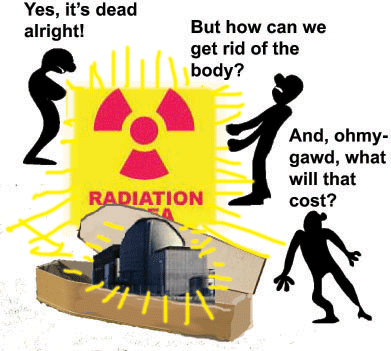
Cost to taxpayers to clean up nuclear waste jumps $100 billion in a year https://www.nbcnews.com/news/all/cost-taxpayers-clean-nuclear-waste-jumps-100-billion-year-n963586 An Energy Department report shows the projected cost for long-term nuclear waste cleanup overseen by DOE jumped $100 billion in just one year. Jan. 29, 2019, By Laura Strickler, WASHINGTON— The estimated cost of cleaning up America’s nuclear waste has jumped more than $100 billion in just one year, according to a DOE report — and a watchdog warns the cost may climb still higher.
The Energy Department’s projected cost for cleanup jumped from $383.78 billion in 2017 to $493.96 billion in a financial report issued in December 2018.
A government watchdog and DOE expert said the new total may still underestimate the full cost of cleanup, which is expected to last another 50 years. “We believe the number is growing and we believe the number is understated,” said David Trimble, director of the Government Accountability Office’s Natural Resources and Environment team.
The cost was calculated by the accounting firm KPMG under contract to DOE.
The 586-square-mile site, home to nine former production reactors and processing facilities, produced plutonium for America’s nuclear arsenal during the Cold War.
Cleaning up Hanford has already cost taxpayers $170 billion over 30 years, but government auditors say the most challenging parts of the clean-up work are yet to be done.
Still not cleaned up are 56 million gallons of what the DOE’s inspector general has described as “hazardous and highly radioactive waste.” The rise in projected cost is due to updated estimates for building and running a waste treatment plant, including “operating costs, tank farm retrieval and closure costs” at the site, according to the report. The report also refers to changes in “technical approach or scope” and “updated estimates of projected waste volumes.”
Trimble of the GAO believes the Energy Department “does not have a coherent strategic plan on how to address its cleanup mission.”
A spokesperson for the Energy Department said in an emailed statement that the office that oversees the cleanup is “committed to making progress on the ground at Hanford, and mitigating the years of escalating liabilities at the site.”
The spokesperson said DOE expects more cost increases “and is working with regulators and stakeholders on best options to treat and dispose of radioactive waste.”
Energy Secretary Rick Perry has proposed a reclassification of the radioactive waste at Hanford to make its disposal less expensive, a suggestion opposed by environmental groups in the Pacific Northwest.
In mid-December, DOE issued a financial report with a signed letter from U.S. Energy Department Secretary Rick Perry on the fourth page. Perry’s letter lists the agency’s accomplishments and describes the agency’s environmental cleanup activities. He cited the completion of an underground project at Hanford, but does not mention the projected increase in costs to taxpayers.
“PLAGUED WITH MISMANAGEMENT”
For decades, government auditors have raised serious concerns about the lack of clear goals for the site and long term problems with the cleanup.
A 2018 report from the DOE’s inspector general rolled up 38 investigations the IG had conducted on the environmental management efforts at Hanford.
The IG concluded Hanford has been “plagued with mismanagement, poor internal controls, and fraudulent activities, resulting in monetary impacts totalling hundreds of millions of dollars by the various contractors at the site.”
Bechtel, one of the large government contractors that manages site cleanup, was part of a group of contractors that paid a $125 million settlement in 2016, the largest settlement ever obtained by the agency’s inspector general.
The U.S. had alleged Bechtel improperly used federal taxpayer dollars to fund a multi-year lobbying effort in Congress to continue the funding of its contract.
In response to the recent Energy Department report Bechtel spokesperson Fred deSousa notes that the waste treatment plant they are building in Hanford is “the most complex project of its kind in the world.” DeSousa also told NBC in his statement that the project has gone through multiple independent reviews resulting in changes to its contract. “Today the project is bigger, more robust, and has more stringent operating and safety margins,” he said.
The new Democratic chair of the House Energy and Commerce Committee says the committee will increase its oversight of Hanford.
“It is essential that DOE better manage and oversee its contractors to ensure that taxpayers, workers and the environment are being protected” said Rep. Frank Pallone, Jr., D-N.J. “The Committee will continue to have questions for DOE as to whether cleanup efforts at Hanford and other sites are being properly managed.”
Ecologist 29th Jan 2019 Decommissioning** The nuclear energy industry faces severe problems in 2019 – and beyond. Chief among them is the ageing of the global reactor fleet. The average age of the fleet reached 30 years in mid-2018 and continues to rise. The average lifespan of the current reactor fleet will be about 40 years, according to reasonable estimates. There will likely be an average of 8‒11 permanent reactor shutdowns annually over the next few decades.
This will add up to about 200 reactor shutdowns between 2014 and 2040. Indeed, the International Energy Agency expects a “wave of retirements of ageing nuclear reactors” and an “unprecedented rate of decommissioning”. The International Atomic Energy Agency (IAEA) anticipates 320 gigawatts (GW) of retirements from 2017 to 2050 (that’s about 80 percent of the current worldwide reactor fleet). Another IAEA report estimates up to 139 GW of permanent shutdowns from 2018‒2030 and up to 186 GW of further shutdowns
from 2030-2050. The reference scenario in the 2017 edition of the WNA’sNuclear Fuel Report has 140 reactors closing by 2035. A 2017 Nuclear Energy Insider article estimates up to 200 permanent shutdowns over the next two decades. https://theecologist.org/2019/jan/29/nuclear-decommissioning-era-approaches
Steve Dale No Nuclear Waste Dump Anywhere in South Australia, January 29 Does anyone know about this “upcoming review” of the environmental protection laws? It might explain a recent uptick in nuclear propaganda activity recently..
This fragment from a recent Daily Telegraph article (hidden by paywall) “Mining sector pushes for nuclear option to lowering Australia’s energy” –
“… The Minerals Council of Australia has seized on the upcoming review of environmental protection laws under which nuclear power is banned.”
And from the Minerals Council web site article “Heatwaves proof positive Australia needs nuclear” –
“… The good news is the nuclear ban can be reversed with a single amendment to the Environment Protection and Biodiversity Conservation Act 1999 – which happens to be due for review this year. ”
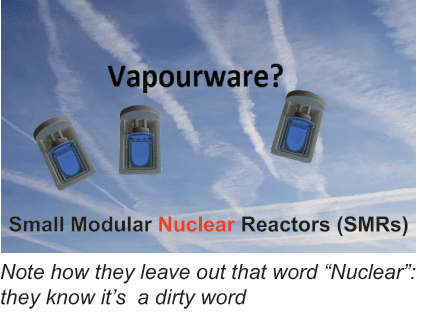
The Minerals Council article above contains the usual lies told to politicians, from the article – “Nuclear energy has changed significantly. There is now a family of new technologies – small modular reactors – leading the way in cost. These are readily deployable and produce zero emissions.” Nuclear energy risks hasn’t changed, small modular reactors don’t exist.
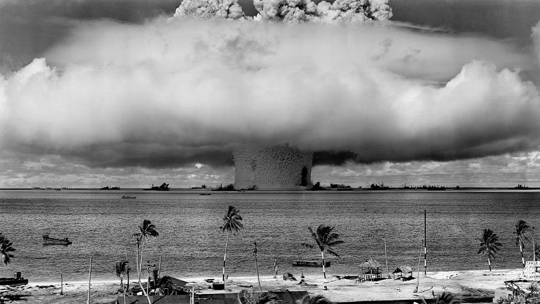
From the Archives: The end of French nuclear testing in South Pacific From 1960, amid great controversy, France carried out 193 nuclear tests in French Polynesia in the South Pacific. On this day in 1996 President Jacques Chirac announced testing had come to end. SMH, By Matthew Gledhill & David Lague 29 January 2019, First published in the Sydney Morning Herald on January 21, 1996Mr Jacques Chirac has announced a definitive end to French nuclear testing in the South Pacific, at the same time promising to play an “active and determined role for disarmament in the world”.
The French President told his nation in a TV broadcast on Monday that he would begin diplomatic moves to sign the Comprehensive Test Ban Treaty (CTBT) banning nuclear trials world-wide, later this year.
The tests, concluding with the sixth and largest blast at Fangataufa on Saturday, finished four months short of the original scheduled date.
Mr Chirac had predicted eight nuclear trials when the resumption of testing was announced on June 13 last year, but is believed to have curtailed the program under international pressure.
The Australian Prime Minister, Mr Keating, welcomed an end to the testing, but said President Chirac should not have overturned the previous French Government’s moratorium on testing.
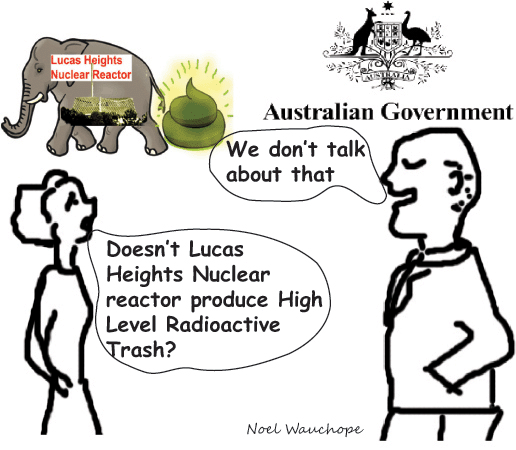
Paul Waldon– Fight To Stop Nuclear Waste In The Flinders Ranges, 26 Jan 19 Australia day 2019 marks the 61st anniversary of the birth of the first nuclear reactor at Lucas Heights with a flick of a switch in 1958, and yet this runaway industry that has placed the cart before the horse has also failed to deal with the radioactive wastes and now is expecting an unwilling community on aboriginal land to embrace such burden.
Australia’s responsibility should be to maintain one, and only one high grade nuclear waste dump, that’s “Lucas Heights.”
‘Deadly, toxic business’: New Mexico will reject nation’s nuclear waste, activists vow, Orange County Register, 27 Jan 19
Plan to keep waste at reactor sites is working fine, they say
In Southern California, the greatest hope for removing highly radioactive nuclear waste from the quake-prone coast might be those private, temporary storage sites that need licenses from the federal government to open.
But in New Mexico — where Holtec International wants to build such a site that could store waste from San Onofre, Diablo Canyon and scores of other commercial reactors — locals vow to do everything in their power to keep the state from becoming America’s biggest nuclear waste dump.
“The rush is on by the Nuclear Regulatory Commission to grant Holtec a license before the people realize we’re being sacrificed for another government nuclear experiment,” said Noel Marquez, an artist and member of the Alliance for Environmental Strategies.
“We’re having to research, for ourselves, the long-term consequences of this deadly, toxic business. We’re being targeted for environmental injustice.”
The passionate show-of-force came Tuesday, the day before the NRC’s three-judge Atomic Safety and Licensing Board heard oral arguments from project opponents in Albuquerque. The aim is to figure out which groups have standing with the NRC to oppose the Holtec project, but legal challenges to the plan are under way in other courts as well.
Below the radar, the NRC’s plan for temporarily storing nuclear waste is actually working pretty well, said Terry Lodge, an attorney for opponents: “They are storing waste at nuclear reactor sites, relatively uneventfully and not particularly expensively,” he said.
That, to many Californians near the shuttered San Onofre and Diablo Canyon plants, is exactly the problem.
‘Entire project is illegal’
Those familiar with America’s nuclear waste wars may be experiencing Yucca Mountain deja vu.
New Mexico, like Nevada, has no commercial nuclear reactors. Many New Mexicans, like many Nevadans, don’t want to become the nation’s nuclear dump. But New Mexicans, unlike Nevadans, have a different legal argument to make.
Congress’ Nuclear Waste Policy Act of 1982 forbids permanent waste storage on the Earth’s surface, and — given the federal government’s decades-long paralysis in finding a permanent, deep geologic repository — Holtec’s temporary facility could well wind up being a permanent one, they say.
“The entire project is illegal,” said Diane Curran, an attorney representing the group Beyond Nuclear. If New Mexicans “step up and say, ‘We’ll take it in our above-ground facility,’ I’m really afraid you’ll have it forever — a shallow graveyard for the nation’s nuclear waste.”
At a press briefing Tuesday, opponents raised the specter of cracked and damaged fuel canisters and/or rods; of dangers related to transporting canisters from all corners of the country to New Mexico by road or rail; and of the “geologic unsuitability” of the Southeastern New Mexico site, where there are underground caves, sinkholes from mining and brine that could corrode the storage containers. They also painted Holtec as an opportunistic player trying to maximize its profits and eliminate all risk.
During his stay, Francis reportedly plans to visit Hiroshima and Nagasaki to pray for the victims of the 1945 atomic bombings of the two cities, which killed some 220,000 people.
“I believe he will have sympathy for the movement to abolish nuclear arms,” Keiko Ichikawa said after attending her first mass since the pope announced his trip to Japan, home to some 450,000 Roman Catholics.
“I hope the pope’s visit will be an opportunity to encourage the movement,” the 77-year-old said.
Francis has repeatedly voiced a desire to visit Japan and wanted to work as a missionary there in his youth but abandoned the plan after a lung operation.
In January of last year, Francis issued a harrowing photograph taken in 1945 showing a young Japanese boy carrying his dead brother. The child on the boy’s back was killed when the United States A-bombed Nagasaki.
Francis, who has often spoken of the dangers of nuclear weapons, had written just four words on the back of the image: “The fruit of war.”
According to local media, the pope is also considering visiting the Fukushima region, which was hit by massive tsunami triggered by a 9.0-magnitude earthquake in March 2011 that led to the world’s worst nuclear disaster since Chernobyl.
The high waves killed around 18,000 people along Japan’s northeastern coastline and swamped the Fukushima No. 1 nuclear power plant, sending three of its reactors into meltdown.
“We also have a great suffering in Fukushima due to the nuclear reactor accident,” said Yuko Honma, a 82-year-old Catholic nun.
“I hope he will have a chance to visit there too” and encourage the victims, she added.
Authorities have been working to rebuild the region, although areas near the crippled plant remain uninhabitable because of high radiation.
During his trip to Japan in 1981, Pope John Paul II visited Hiroshima and Nagasaki. He also held a mass at a Tokyo baseball stadium, inviting some 35,000 believers.
Swedish school strike activist demands economists tackle runaway global warming. Read her Davos speech here,
Our house is on fire. I am here to say, our house is on fire.
According to the IPCC (Intergovernmental Panel on Climate Change), we are less than 12 years away from not being able to undo our mistakes. In that time, unprecedented changes in all aspects of society need to have taken place, including a reduction of our CO2 emissions by at least 50%.
And please note that those numbers do not include the aspect of equity, which is absolutely necessary to make the Paris agreement work on a global scale. Nor does it include tipping points or feedback loops like the extremely powerful methane gas released from the thawing Arctic permafrost.
At places like Davos, people like to tell success stories. But their financial success has come with an unthinkable price tag. And on climate change, we have to acknowledge we have failed. All political movements in their present form have done so, and the media has failed to create broad public awareness.
But Homo sapiens have not yet failed.
Yes, we are failing, but there is still time to turn everything around. We can still fix this. We still have everything in our own hands. But unless we recognise the overall failures of our current systems, we most probably don’t stand a chance.
We are facing a disaster of unspoken sufferings for enormous amounts of people. And now is not the time for speaking politely or focusing on what we can or cannot say. Now is the time to speak clearly.
Solving the climate crisis is the greatest and most complex challenge that Homo sapiens have ever faced. The main solution, however, is so simple that even a small child can understand it. We have to stop our emissions of greenhouse gases.
Either we do that or we don’t.
You say nothing in life is black or white. But that is a lie. A very dangerous lie. Either we prevent 1.5C of warming or we don’t. Either we avoid setting off that irreversible chain reaction beyond human control or we don’t.
Either we choose to go on as a civilisation or we don’t. That is as black or white as it gets. There are no grey areas when it comes to survival.
We all have a choice. We can create transformational action that will safeguard the living conditions for future generations. Or we can continue with our business as usual and fail.
That is up to you and me.
Some say we should not engage in activism. Instead we should leave everything to our politicians and just vote for a change instead. But what do we do when there is no political will? What do we do when the politics needed are nowhere in sight?
Here in Davos – just like everywhere else – everyone is talking about money. It seems money and growth are our only main concerns.
And since the climate crisis has never once been treated as a crisis, people are simply not aware of the full consequences on our everyday life. People are not aware that there is such a thing as a carbon budget, and just how incredibly small that remaining carbon budget is. That needs to change today.
No other current challenge can match the importance of establishing a wide, public awareness and understanding of our rapidly disappearing carbon budget, that should and must become our new global currency and the very heart of our future and present economics.
We are at a time in history where everyone with any insight of the climate crisis that threatens our civilisation – and the entire biosphere – must speak out in clear language, no matter how uncomfortable and unprofitable that may be.
We must change almost everything in our current societies. The bigger your carbon footprint, the bigger your moral duty. The bigger your platform, the bigger your responsibility.
Adults keep saying: “We owe it to the young people to give them hope.” But I don’t want your hope. I don’t want you to be hopeful. I want you to panic. I want you to feel the fear I feel every day. And then I want you to act.
I want you to act as you would in a crisis. I want you to act as if our house is on fire. Because it is.
This is an edited version of a speech given by Greta Thunberg at Davos this week.
Welcome to “The New Abnormal” Bulletin of the Atomic Scientists By Bulletin Staff, January 24, 2019 A new abnormal: It is still 2 minutes to midnight Humanity now faces two simultaneous existential threats, either of which would be cause for extreme concern and immediate attention. These major threats—nuclear weapons and climate change—were exacerbated this past year by the increased use of information warfare to undermine democracy around the world, amplifying risk from these and other threats and putting the future of civilization in extraordinary danger.
There is nothing normal about the complex and frightening reality just described.
WASHINGTON, D.C. – January 24, 2019 – Citing lack of progress on nuclear risks and climate change dangers as “the new abnormal,” the Doomsday Clock remains at 2 minutes to midnight, as close to the symbolic point of annihilation that the iconic Clock has been since 1953 at the height of the Cold War. The decision announced today to keep the Doomsday Clock at two minutes before midnight was made by the Bulletin of the Atomic Scientists’ Science and Security Board in consultation with the Board of Sponsors, which includes 14 Nobel Laureates.
We are in a strong position where electricity supplies are secure and costs are falling, says Greg Clark, in a letter to the Financial Times this week. He should know since he is the UK’s business secretary. Never mind that the contractors behind two nuclear power stations have pulled out because they dare not take the risk, while a third promises to be an epic financial disaster, and that the remaining two on the drawing board seem increasingly likely to stay there.
Mr Clark is relentlessly upbeat: “Britain’s electricity requirement for the 2030s is not a problem of shortages but the much better challenge of abundance.” This challenge has already translated into a rise of 8 per cent last year in the cost of domestic electricity, and a looming 11 per cent rise in the absurd “price cap”, as the cost of subsidies for “green” energy slides sneakily into household bills. However, he is right about abundance. The fracking revolution has utterly changed the balance for both oil and gas supplies, and made a nonsense of the UK government’s decade-old assumptions about ever-increasing prices.
As Dieter Helm, Mr Clark’s go-to expert on energy costs, argues in a paper this week, the trouble dates back to when the Liberal Democrats were tossed the energy brief in the coalition government. Chris Huhne and Ed Davey were achingly green, but because they assumed oil was running out, the pair reluctantly supported new nukes, laying the foundations for today’s meltdown.
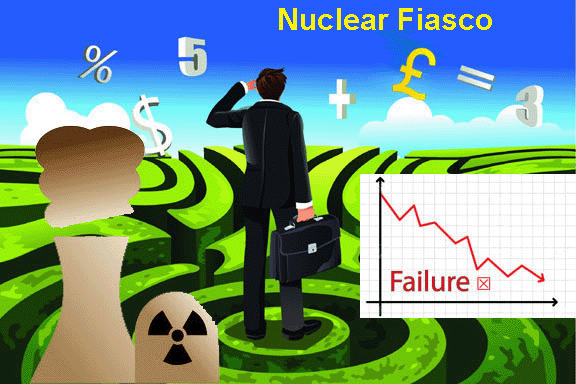
The grim truth is that these huge projects are a financial dead end, driven there by changing technology along with escalating safety requirements and the costs of decommissioning. As Mr Helm argues, there is a powerful case for abandoning nuclear altogether. Mr Pollyanna Clark, meanwhile, promises yet another energy white paper this summer. Oh dear.
Bill Gates comes to Washington — selling the promise of nuclear energy, WP, By Steven Mufson, January 25
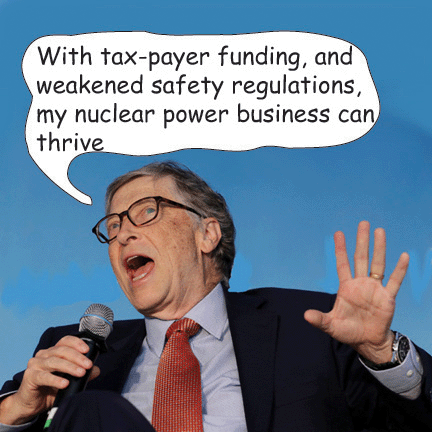
Bill Gates thinks he has a key part of the answer for combating climate change: a return to nuclear power. The Microsoft co-founder is making the rounds on Capitol Hill to persuade Congress to spend billions of dollars over the next decade for pilot projects to test new designs for nuclear power reactors.
Gates, who founded TerraPower in 2006, is telling lawmakers that he personally would invest $1 billion and raise $1 billion more in private capital to go along with federal funds for a pilot of his company’s never-before-used technology, according to congressional staffers…….
Gates said in his year-end public letter. “The problems with today’s reactors, such as the risk of accidents, can be solved through innovation.” …..
But many nuclear experts say that Gates’s company is pursuing a flawed technology and that any new nuclear design is likely to come at a prohibitive economic cost and take decades to perfect, market and construct in any significant numbers.
Lawmakers are listening to him. Through the Energy Department, Congress approved $221 million to help companies develop advanced reactors and smaller modular reactors in fiscal 2019, above the budget request. But Gates and TerraPower, which received a $40 million Energy Department research grant in 2016, are looking for more. …….
Edwin Lyman, a nuclear expert at the Union of Concerned Scientists, said TerraPower is one of many companies that is raising the public’s hopes for advanced nuclear reactor designs even though they’re still on the drawing boards and will remain unable to combat climate change for many years.
“We think the vendors of advanced nuclear power designs are saying they can commercially deploy them in a few years and all over the world,” Lyman said. “We think that is counterproductive because it is misleading the public on how fast and effective these could be.” ……
Many nuclear power experts say that the technology Gates is promoting — called a “traveling wave reactor” — does not work as advertised, at least not yet. “These designs . . . require advances in fuel and materials technology to meet performance objectives,” a Massachusetts Institute of Technology report said last year.
TerraPower has changed key elements of its design and has still not resolved critical problems, experts say……
critics say TerraPower has been stumbling over a handful of obstacles.
First, TerraPower has discovered that the traveling wave didn’t travel so well and that it would not evenly burn the depleted uranium in the “candle.” Second, and partly as a result, it needed to change the design to reshuffle the fuel rods — and do that robotically while keeping the reactor running. Third, it has struggled to find a metal strong enough to protect the fuel rods from a bombardment of neutrons more intense than those commonly used in reactors — and for a much longer period of time…….
In many ways, TerraPower’s design resembles fast breeder reactors. Fast breeders have faster moving neutrons, the subatomic particles that trigger fission.
Allison Macfarlane, former chairman of the Nuclear Regulatory Commission, said earlier versions of fast breeder reactors have turned in a “dismal performance.” The United States built two small reactors at a government laboratory in Idaho, Japan built a commercial unit called Monju, and France built two called Phenix and Superphenix — and all of them have been shut down.
………TerraPower has also been working with the Energy Department on another reactor. If it moved ahead, it could obtain federal funds for 60 percent of the cost of a test reactor, Burkey said. That design would rely on molten salt as both coolant and fuel. TerraPower believes an advanced molten salt reactor could be more efficient and produce less waste than current models.
Evening Standard 22nd Jan 2019 The British nuclear industry is a mess. Successive governments spent 13 years devising a nuclear policy, and after years of debate, six nuclear power stations were eventually selected. The idea was that private contractors, not government, should take the risk and build the plants. But the contractors were wary, and with the collapse of renewable energy prices they have become warier still.
Of the six sites, three have been abandoned, two — Sizewell and Bradwell in Suffolk and Essex — are still to be finalised. Only one, Hinkley Point C in Somerset is proceeding and it is controversial to say the least. Chances are that Hinkley will be abandoned
and we won’t build any more giant plants, but Government is still wedded to its policy so it may take a few years, or a general election.
The cost of renewable energy is, however, coming down fast and environmentalists say new electricity storage systems still to be developed will eventually bridge the gap for when the wind does not blow enough. We are not there yet though. But there is another option, though not one which environmentalists favour, and that is small modular reactors. Rolls-Royce has been making and
maintaining the power plants which drive the nuclear-powered submarines
carrying Britain’s nuclear deterrent since at least the Sixties.
SMRs required Government to make available resources so the licensing and safety-assessment programme could
run smoothly and remove the risk of the whole thing being endlessly delayed. It required further long-term thinking in the form of a promise to buy at least seven of the plants so that Rolls-Royce could capture the economies of scale in manufacturing which are essential to bringing the costs down. It required Government to be willing to provide matched funding in the development phase of the project. And finally it required Government support to assist the company in fully developing its export markets.
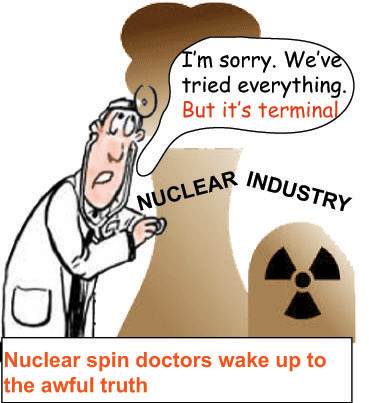
Climate News Network 21st Jan 2019, Once hailed as a key part of the energy future of the United Kingdom and several other countries, the high-tech atomic industry is now heading in the opposite direction, towards nuclear sunset. It took another body blow last week when plans to build four new reactors on two sites in the UK were abandoned as too costly by the Japanese company Hitachi. This was even though it had already sunk £2.14 billion (300 bn yen) in the scheme.
Following the decision in November by another Japanese giant, Toshiba, to abandon an equally ambitious scheme to build three reactors at Moorside in the north-west of England, the future of the industry in the UK looks bleak. The latest withdrawal means the end of the Japanese dream of keeping its nuclear industry alive by exporting its technology overseas. With thedomestic market killed by the Fukushima disaster in 2011, overseas sales were to have been its salvation. https://climatenewsnetwork.net/nuclear-sunset-overtakes-fading-dreams/
There was a time – not so long ago – that government ministers talked enthusiastically about a new nuclear age. A fleet of brand new reactors producing reliable, low carbon electricity for decades to come. Not only that, but the government wouldn’t be taking any of the risks associated with financing and building them.
Hinkley, Moorside, Wylfa, Oldbury, Bradwell and Sizewell were identified as the sites for the most significant national wave of new nuclear power construction anywhere in the world.
Of those six, only one is under construction, three have been abandoned, and two face an uphill battle to get the green light.
Under those circumstances, you might think the government would be embarrassed that its energy policy was in disarray. But it’s not.
The collapse of the Wylfa and Oldbury projects today (following the abandonment of Moorside) is evidence of some new economic realities that have seen government enthusiasm for new nuclear fade.
High price
The first and most obvious is the cost of building the darn things.
At £20bn Hinkley Point is the most expensive UK construction project to date – HS2 will beat it.
The good news is that the UK government isn’t paying a penny of it.
The bad news is that the electricity it will one day produce will be expensive.
EDF, the French contractor that’s paying for its construction, could only raise the money to do it by extracting a guarantee from the UK government that it would receive more than double the current going rate – for 35 years.
That’s one way to finance it. Let EDF raise the money and take the risk but ultimately foist the cost onto future generations of energy customers.
Who pays?
One of the reasons Hinkley is so expensive is that EDF needed to go out and borrow huge sums for a risky project at interest rates of over 9%. In fact, of the total £20bn bill for Hinkley, well over half of it was the cost of raising the money over the lifetime of the project.
The government can borrow money much more cheaply than anyone else. Right now it could get a £20bn 10-year loan at 1.3% and use that money to build the thing itself. There are financial and political problems with that.
First, it adds to the public debt – which successive recent governments have been keen to reduce.
Second, if there are massive cost overruns (and that is almost a rule with nuclear projects), the government foots the spiralling bill, taking commensurate political flak.
Third, if the government is suddenly in the business of building nuclear power stations, why not other things – in fact why not nationalise the infrastructure we have already got? That is not comfortable territory for a Conservative government.
Doing the sums
There is a another way. Pay-as-you-go. Rather than lumber future generations with more expensive energy, get current consumers to pay a little extra on their bills (amount decided by the regulator) during the construction. This removes the need for massive borrowing and means you don’t have to offer a juicy price guarantee to the contractor at the end as a reward for taking the operational and financial risk.
This is the model the government now prefers and is testing on the Thames Tideway project. If Sizewell and Bradwell are ever built – this is how they will be financed.
I say “if” because the truth is, the sums for new nuclear have been made very tough by the sharp falls in the cost of renewables. In 2015, the cost of offshore wind was over £140 per megawatt hour. That makes Hinkley Point look cheap at £92.50. The price of offshore wind is now £57.50……. https://www.bbc.com/news/business-46906245








 Antinuclear