Sir David Attenborough calls for ‘urgent’ climate change action
David Attenborough tells Davos: ‘The Garden of Eden is no more’Human activity has created a new era yet climate change can be stopped, says naturalist, Guardian, Graeme Wearden in Davos, Tue 22 Jan 2019 Last modified on Tue 22 Jan 2019 Sir David Attenborough has warned that “the Garden of Eden is no more”, as he urged political and business leaders from around the world to make a renewed push to tackle climate change before the damage is irreparable.Speaking at the start of the World Economic Forum (WEF) in Davos, Switzerland, the 92-year-old naturalist and broadcaster warned that human activity has taken the world into a new era, threatening to undermine civilisation.
“I am quite literally from another age,” Attenborough told an audience of business leaders, politicians and other delegates. “I was born during the Holocene – the 12,000 [year] period of climatic stability that allowed humans to settle, farm, and create civilisations.” …..
“The Holocene has ended. The Garden of Eden is no more. We have changed the world so much that scientists say we are in a new geological age: the Anthropocene, the age of humans,” he declared.
In a stark warning to the world leaders and business chiefs flocking to the WEF this week, Attenborough warned that the only conditions that humans have known are changing fast.
“We need to move beyond guilt or blame, and get on with the practical tasks at hand.”…..
Get it right, he argued, and humans can create a world with clean air and water, unlimited energy and sustainable fish stocks, but only if decisive action is taken now.
“Over the next two years there will be United Nations decisions on climate change, sustainable development and a new deal for nature. Together these will form our species’ plan for a route through the Anthropocene.
“What we do now, and in the next few years, will profoundly affect the next few thousand years,” he added.
My Turn: Martin Luther King’s quest to stop the nuclear arms race https://www.concordmonitor.com/KIngs-quest-to-stop-the-nuclear-arms-race-22786447By WILLIAM LAMBERS For the Monitor January 21, 2019, Civil rights champion Martin Luther King Jr. was also an activist for nuclear disarmament. Dr. King used his voice for peace during the Cold War nuclear arms race.
He can inspire us today to finish the journey of eliminating all nuclear weapons.
The year was 1958. The Soviet Union and the United States were developing and testing nukes at an alarming rate. In March, Dr. King received a letter from Norman Cousins and Clarence Pickett of the National Committee for a Sane Nuclear Policy. King was asked to support a statement urging an end to nuclear testing.
He joined the SANE movement right away. In April, Dr. King also signed an appeal by Protestant clergyman on halting nuke tests.
The public outcry against nuclear tests helped encourage President Dwight Eisenhower to start negotiations with the Soviets on a test ban treaty in 1958. In October, King joined a statement to the U.S. and Soviet negotiators in Geneva.
It read “an important beginning has to be made on one vital part of the problem of world peace, the permanent internationally inspected ending of nuclear weapons tests.”
Eisenhower proposed a suspension of nuclear tests during the talks. There were no nuclear tests by the U.S. or the Soviets from late 1958 into 1961. His successor President John F. Kennedy was able to produce a limited treaty with the Soviets in 1963 banning nuclear tests in the atmosphere, underwater and outer space. Underground tests did continue.
The 1996 Comprehensive Nuclear Test Ban Treaty, banning all tests including underground, has yet to be ratified by the U.S. Senate. President Donald Trump could ask the Senate to ratify this treaty and fulfill one of Dr. King’s goals of ending nuke tests forever.
Ending nuclear testing was seen as a critical step toward stopping the arms race. Dr. King understood the threat of nukes.
In 1957, in Ebony Magazine, King wrote “I definitely feel that the development and use of nuclear weapons of war should be banned. It cannot be disputed that a full-scale nuclear war would be utterly catastrophic. Hundreds and millions of people would be killed outright by the blast and heat, and by the ionizing radiation produced at the instant of the explosion.”
Dr. King recognized that spending on nuclear armaments robbed from society. King said, “A nation that continues year after year to spend more money on military defense than on programs of social uplift is approaching spiritual doom.”
The goal of eliminating nuclear weapons has been shared by successive leaders including presidents Ronald Reagan and Barack Obama. President Trump has yet to take action on eliminating nuclear weapons. Instead Trump has sought to scrap the Iran nuclear deal and the INF Treaty with Russia.
We have lost any momentum in reducing the nuclear danger. There are still close to 15,000 nukes worldwide, according to the Arms Control Association. Dr. King’s words can inspire us to jumpstart nuclear disarmament.
In his sermon “Loving Your Enemies” Dr. King said, “It is an eternal reminder to a generation depending on nuclear and atomic energy, a generation depending on physical violence, that love is the only creative, redemptive, transforming power in the universe.”
King wanted all people, all nations, to come together to work out their differences. Through what Dr. King called “a great fellowship of love” the world can achieve peace and nuclear disarmament.
Instead of nation’s wasting dollars on nukes we could feed the hungry, end disease and save the environment. As we celebrate Martin Luther King Day listen to his words and be inspired to take action for world peace.
(William Lambers is the author of “The Road to Peace” and “Ending World Hunger.”)
Is there a message in here, for Tasmania, Kangaroo Island, French Island ……?
Observer 20th Jan 2019 A tech revolution – and an abundance of wind and waves – mean that the people of Orkney now produce more electricity than they can use. It seems the stuff of fantasy. Giant ships sail the seas burning fuel that has been extracted from water using energy provided by the winds, waves and tides. A dramatic but implausible notion, surely.
Yet this grand green vision could soon be realised thanks to a remarkable technological transformation that is now under way in Orkney. Perched 10 miles beyond the northern edge of
the British mainland, this archipelago of around 20 populated islands – as well as a smattering of uninhabited reefs and islets – has become the centre of a revolution in the way electricity is generated.
Orkney was once utterly dependent on power that was produced by burning coal and gas on the Scottish mainland and then transmitted through an undersea cable. Today the islands are so festooned with wind turbines, they cannot find enough uses for the emission-free power they create on their own. Community-owned wind turbines generate power for local villages; islanders drive non-polluting cars that run on electricity; devices that can turn the energy of the waves and the tides into electricity are being tested in the islands’ waters and seabed; and – in the near future – car and passenger ferries here will be fuelled not by diesel but by hydrogen, created from water that has been electrolysed using power from Orkney’s wind, wave and
tide generators. https://www.theguardian.com/environment/2019/jan/20/orkney-northern-powerhouse-electricity-wind-waves-surplus-power-hydrogen-fuel-cell
Gavin Williamson has been accused of betrayal just six months after promising campaigners he’d help,By Susie Boniface,19 JAN 2019, The Tories have refused to order a study into genetic damage suffered by children of servicemen in the British nuclear tests.
Defence Secretary Gavin Williamson’s decision came days after his department finally admitted it never warned the men used in Cold War radiation experiments that their families might have been harmed.
Children of the 1950s veterans report 10 times the normal rate of birth defects. But six months after he met campaigners and promised to help, Williamson has been accused of betrayal.
Shirley Denson, 84, who told the minister her husband Eric was ordered to fly through the mushroom cloud of a massive H-bomb, said: “I’m disgusted the man who seemed to listen so carefully has let us down so badly.
“A fifth of the children and grandchildren Eric and I had have deformities, including missing and extra teeth. Our family is just one of thousands and Williamson knows this.”
Eric killed himself after years of crippling headaches, and Shirley later uncovered proof he had been exposed to 165 years’ worth of background radiation to his brain in just 6 minutes.
Campaigners and cross-party MPs had asked for research into all the children’s health problems, but instead Williamson has spent a six-figure sum on repeating an old study into the veterans’ cancer rates.
It is expected to take a year to report back, and in the meantime veterans, who are mostly in their 80s, are dying at the rate of one a week.
Labour deputy leader Tom Watson, who is backing the vets’ campaign for justice, said: “The earlier study failed to note the miscarriages, ill health, infant mortality and childhood illness which so many veteran families experienced. As a result it showed few problems, when the veterans’ experience was very different.
“By raising their hopes then dashing them with science designed to fail, the Defence Secretary has shown scant regard for the survivors, widows and children he promised to help.”
The announcement followed an admission in Parliament the MoD had never warned the men that exposure to radiation might damage their DNA.
Junior minister Tobias Ellwood confessed after a search of the archives that he was “unable to locate” any proof servicemen were made aware of the dangers.
Another states Downing Street considered how “to limit the genetic hazards”.
And a No10 letter discovered in the archives proves that in 1955, when warned about the genetic dangers, PM Anthony Eden responded: “A pity, but we cannot help it.”
When he met campaigners Mr Williamson also promised them a speedy review into a medal for the veterans’ exceptional service.
But 6 months later, a medal review committee has yet to be formed and neither the MoD nor Cabinet Office, which is in charge of honours, can give a timescale for when it will meet to hear the veterans’ evidence.
Just before Christmas, thousands of bomb test documents were removed from the National Archives without explanation.
North American glaciers melting much faster than 10 years ago – study
Satellite images show glaciers in US and Canada, excluding Alaska, are shrinking four times faster than in previous decade , Guardian, Emily Holden in Washington, Sat 19 Jan 2019
Glaciers in western North America, excluding Alaska, are melting four times faster than in the previous decade, with changes in the jet stream exacerbating the longer-term effects of climate change, according to a new study.
The retreat hasn’t been equal in the US and Canada. The famous alpine ice masses in the Cascade Mountains in the north-west US have largely been spared from the trend.
“The losses we would expect were reduced because we got a lot of additional snow,” said David Shean, a co-author at the University of Washington. “Moving forward we may not be so lucky.” The jet stream – the currents of fast-flowing air in the atmosphere that affect weather – has shifted, causing more snow in the north-western US and less in south-western Canada, according to the study released in Geophysical Research Letters, a publication of the American Geophysical Union. Changes in the northern hemisphere jet stream are increasingly firmly linked to global warming.
That warming from humans burning fossil fuels is also expected to continue to melt alpine glaciers, even under scenarios for more moderate greenhouse gas levels.
While some of the fourfold increase in the melting rate in western North America is related to manmade climate change, the researchers can’t say with certainty how much.
“We’re starting to understand these shorter cycles that have real impacts on how the glaciers are behaving and how much water is stored in the glaciers,” Shean explained.
Alaskan glaciers get much of the attention in North America because Alaska is warming faster than the continental US. Mount Hunter in Denali national park, is seeing 60 times more snow melt than it did 150 years ago.
Melting glaciers spell trouble for millions in Asia, SMH, By Henry Fountain,19 January 2019On a summer day in the mountains high above Almaty, Kazakhstan’s largest city, the Tuyuksu glacier is melting like mad. Rivulets of water stream down the glacier’s thin leading edge.
In Central Asia, a warming climate is shrinking many glaciers. The Tuyuksu is losing ice every year. Around the world, vanishing glaciers will mean less water for people and crops in the future. Here, the people need to prepare sooner.
As she has for nearly two decades, Maria Shahgedanova, a glaciologist at the University of Reading in England, has come here to check on the Tuyuksu. As one of the longest-studied glaciers anywhere, the Tuyuksu helps gauge the effect of climate change on the world’s ice.
Glaciers represent the snows of centuries, compressed over time into slowly flowing rivers of ice, up to about 300 metres thick here in the Tien Shan range of Central Asia and even thicker elsewhere. They are never static, accumulating snow in winter and losing ice to melting in summer.
But in a warming climate melting outstrips accumulation, resulting in a net loss of ice. That is what is happening in Kazakhstan and all over the globe.
The world’s roughly 150,000 glaciers, not including the large ice sheets of Greenland and Antarctica, cover about 500,000 square kilometres of the Earth’s surface. During the last four decades they have lost the equivalent of a layer of ice 20 metres thick.
Most are getting shorter, too. Small ones in places like the Rockies and Andes have disappeared. And researchers say that even if greenhouse gas emissions were sharply curtailed immediately, there has already been enough warming to continue shrinking glaciers around the world.
This great global melting contributes to sea level rise. It affects production of hydroelectricity. It leads to disasters like rapid, catastrophic floods and debris flows. It alters rivers and ecosystems, affecting the organisms that inhabit them.
But here in the Tien Shan, the biggest effect may be on the supply of water for people and agriculture. ……..The researchers analyse samples from streams to determine the mix of water sources, which is important for forecasting how the rivers will fare over time. A melting glacier can at first increase stream flow, but eventually the glacier reaches a tipping point, called peak flow, and meltwater begins to taper.
“At some point they cannot produce the water they are providing right now,” said Matthias Huss, a researcher at the Swiss Federal Institute of Technology in Zurich. “It’s really important for water managers to know when this tipping point is reached.”
Glaciers elsewhere in Central Asia – in China to the east, and Kyrgyzstan and Tajikistan to the south – will eventually decline as well. But the biggest effect will be further south, where countless glaciers feed the great river basins of Asia.
Nuclear’s Bleak Odds in a Green New Deal
Ocasio-Cortez won’t rule out inclusion of nuclear, but some see sector as incompatible with ‘100% renewable’ focus Morning Consult , January 14, 2019 Lawmakers embracing a transition to 100 percent renewable energy under a Green New Deal have largely left out mention of whether nuclear energy should be included in such a policy package. While Rep. Alexandria Ocasio-Cortez, one of the Green New Deal’s biggest proponents, said she hasn’t ruled out nuclear energy from the platform, other advocates on the left hold long-running concerns that appear to lessen nuclear’s chances of inclusion in the deal.
Rep. Chellie Pingree (D-Maine) is one of over 40 lawmakers who have issued their support for Green New Deal concepts championed by the freshman Democratic representative from New York, who has floated a draft resolution that calls on lawmakers to work toward supplying 100 percent of U.S. power demand from renewables, building a national smart grid and putting money toward a drawdown of greenhouse gases.
“I think on nuclear energy, we all have a general resistance to it,” Pingree said, because of the unsolved quandary of how to deal with nuclear waste, along with remaining environmental and safety issues. “We all think of Japan.”……..
The Sunrise Movement, an environmental group formed in 2017 that has taken up the Green New Deal cause and staged climate protests last year outside the office of now-House Speaker Nancy Pelosi (D-Calif.) is still “working on a policy outline for what a Green New Deal includes and are consulting with experts and other organizations to develop that,” said Stephen O’Hanlon, who handles communications for the group, in an email. That plan will be ready soon, he said.
If the rest of the environmental community is any indication, nuclear’s outlook in a Green New Deal is even grimmer. The Green Party of the United States’ Green New Deal calls for a full phaseout of U.S. nuclear power. And on Thursday, hundreds of environmental groups wrote an open letter in support of a Green New Deal that supports transitioning completely away from nuclear, along with biomass resources and large-scale hydropower.
Mike McKenna, a Republican strategist who worked on President Donald Trump’s Energy Department transition team, said there is “zero chance” of nuclear getting into a Green New Deal…….
US to begin nuclear treaty pullout next month after Russia missile talks fail, Guardian, Julian Borger in Washington, 17 Jan 2019
Officials reject Russian offer to inspect new missile
US says it will suspend observance of INF treaty on 2 February
The US has rejected Moscow’s offer to inspect a new Russian missile suspected of violating a key cold war-era nuclear weapons treaty, and warned that it would suspend observance of the agreement on 2 February, giving six-months’ notice of a complete withdrawal. The under secretary of state for arms control and international security, Andrea Thompson, confirmed the US intention to withdraw from the treaty after a meeting with a Russian delegation in Geneva, which both sides described as a failure.
Donald Trump took US allies by surprise when he announced his intention to leave the 1987 Intermediate-range Nuclear Forces (INF) treaty in October. The agreement led to the destruction of thousands of US and Soviet weapons, and has kept nuclear missiles out of Europe for three decades.
The Russian foreign minister, Sergei Lavrov, accused the US of intransigence, saying Moscow had offered to allow US experts to inspect the suspect missile, which it insists does not infringe the limits laid down in the treaty.
“However, US representatives arrived with a prepared position that was based on an ultimatum and centred on a demand for us to destroy this rocket, its launchers and all related equipment under US supervision,” Lavrov said.
Thompson noted that the US had been demanding Russian transparency over the missile for more than five years. She confirmed that the offer of inspections was not enough and that the US was demanding the destruction of the missile system, known as the 9M729……..
She said that there were currently no plans for follow-up talks on the INF before the 2 February deadline laid down by the Trump administration, though US and Russian diplomats would be meeting, including at a summit of the Nato-Russian council next week.
Thompson said that if Russia did not show willingness to comply with the treaty by the deadline, the US would suspend its own obligations, meaning that the US defense department could start research and development on missiles with ranges currently banned by the INF, from 500 to 5,500km.
At the same time, she told reporters, the US would formally give notice of its withdrawal from the treaty, which could come into effect on 2 August.
After that, there would be no restrictions on deployment of medium-range missiles in Europe or the Pacific………..
The Trump administration was criticised by former officials and arms control advocates for not pursuing the Russian offer of inspections.
“We’ve spent years trying to get something – anything – out of the Russians on INF. The Russian offer of an exhibition of the 9M729 is not enough, but it is something,” Alexandra Bell, a former senior state department official who is now senior policy director at the Centre for Arms Control and Non-Proliferation.
“Perhaps it is a foundation on which to build. Not trying to take advantage of this opportunity is to leave diplomatic options on the table and that’s just foolish.”
Daryl Kimball, the head of the Arms Control Association said: “If the INF is terminated on 2 August, there will be nothing to prevent Russia from deploying nuclear missiles that threaten Europe and the Trump administration will have no hesitation in pursuing the deployment of INF-prohibited weapons in Europe.” https://www.theguardian.com/world/2019/jan/16/us-russia-inf-treaty-nuclear-missile
Ground Zero Nagasaki: Living the nuclear past – and future, Asia Times, By SUSAN SOUTHARDJANUARY 18, 2019 “………. Much of Nagasaki and the world have, of course, moved on from that terrible morning when a 5-ton plutonium bomb plunged at a thousand kilometers an hour toward the city of 240,000 people. Forty-three seconds later, it detonated half a kilometer above Nagasaki’s Urakami Valley. A super-brilliant blue-white flash lit the sky, followed by a thunderous explosion equal to the power of 21,000 tons of TNT. The entire city convulsed
Based on my book Nagasaki: Life after Nuclear War, I often give talks in the US about that unforgettable (or now often-too-forgettable) day when, for only the second time in history, human beings deemed it right to assault their own species with apocalyptic power. At these book talks, I’ve learned to be prepared for someone in the audience to say that the Japanese deserved what they got. It’s still hard to hear.
At its “burst point,” the Nagasaki blast reached temperatures higher than at the center of the sun, and the velocity of its shock wave exceeded the speed of sound. Within three seconds, the ground below had reached an estimated 3,000 to 4,000 degrees Celsius. Directly beneath the bomb, infrared heat rays instantly carbonized human and animal flesh and vaporized internal organs. Did the men, women, and children of Nagasaki really deserve that?
As the mushroom cloud rapidlyascended 3km over the city and eclipsed the sun, the bomb’s vertical blast pressure crushed much of the Urakami Valley. Horizontal blast winds tore through the region at two and a half times the speed of a Category 5 hurricane, pulverizing buildings, trees, animals, and thousands of people.
The blazing heat twisted iron, disintegrated vegetation, ignited clothing, and melted human skin. Fires broke out across the city, burning thousands of civilians alive.
And though no one knew it yet, larger doses of radiation than any human had ever received penetrated deeply into the bodies of people and animals.
…………. the United States bombed and incinerated all or parts of 66 Japanese cities, killing, maiming or irradiating more than 668,000 civilians. In Nagasaki alone, by the end of 1945 when a first count was possible, 74,000 men, women and children were dead. Of those, only 150 were military personnel. Seventy-five thousand more civilians were injured or irradiated.
Today, this kind of indiscriminate killing and harm to civilians would be called “terrorism.”
Despite the history most Americans have learned – that the atomic bombings of Hiroshima and Nagasaki were military necessities that ended World War II and saved a million American lives by obviating the need for an invasion of Japan’s home islands – there is no historical evidence that the Nagasaki bombing had any impact on Japan’s decision to surrender.
What we aren’t taught are the political and military complexities of the last few months of the war or how, in the postwar years, the US government crafted this end-of-war narrative to silence public opposition to the atomic bombings and build support for America’s fast-expanding nuclear-weapons program.
What many don’t realize is that this misleading version of history allows us to turn away from what happened in Hiroshima and Nagasaki and continue to support the development and proliferation of nuclear weapons without ever having to think about what those weapons do.
Still, so many decades later, in a world in which the Trump administration is preparing to withdraw from a key Cold War nuclear agreement with Russia and the US nuclear arsenal is being modernized to the tune of up to $1.6 trillion, it’s worth recalling the other side of the story, the kind of suffering the Hiroshima and Nagasaki bombings caused in August 1945 and long after.
Within weeks, people in both cities began experiencing mysterious symptoms: vomiting, fever, dizziness, bleeding gums, and hair loss from what doctors would later understand as radiation-related sickness. Purple spots appeared all over their bodies. Many died in excruciating pain within a week of the first appearance of such symptoms. Fear gripped Nagasaki. From one day to the next, no one knew when his or her time might come.
In those first nine months, pregnant women suffered spontaneous abortions, stillbirths, or the deaths of their newborn infants. Many of the babies who survived would later develop physical and mental disabilities.
Five years after the bombings, thousands more began dying from leukemia and other illnesses caused by high-dose radiation exposure, initiating cycles of higher than normal cancer rates that would last for decades. The bombs had, from the survivors’ perspective, burned their bodies from the inside out. Parents exposed to radiation feared possible genetic defects in their children and hovered over them year after year, terrified that what looked like a simple cold or stomach ache would lead to severe illness or death.
Scannell: The radiation risk posed when you undergo CT scans. The Mercury News, 18 Jan 19
Researchers estimate that nearly 2 percent of future cancers could be related to computerized tomography, It’s often said, “What you don’t know won’t hurt you.” But I’ve never understood the rationale behind that. In fact, as a doctor, I’d argue otherwise — that what you don’t know can harm you a great deal.
I’m thinking of this in light of recent studies concerning radiation exposure from medical imaging tests like computerized tomography (CT) scans. Many of us don’t know that we’re exposed to ionizing radiation when we undergo a CT scan, that ionizing radiation is a carcinogen or that data links an increased risk of cancer to low-level doses that are commonly used in CT imaging.
And while that increased risk may be small, it’s also cumulative over time — a concern for patients who receive multiple scans.
The benefits of CT scans in diagnosing disease and saving lives are indisputable. But, like any medical test or treatment, CT scans entail potential risks that should be balanced against expected benefits. Unfortunately, we’ve paid little attention to the radiation risks.
Putting the risk in perspective is difficult, considering the various yardsticks by which meaningful radiation exposure and cancer risks are measured. But, in broad terms, we can consider the constant background radiation from natural sources that we’re exposed to every day. While a chest X-ray exposes us to a 10-day dose of background radiation, a chest CT scan delivers about 2 years’ worth. And the average 3-year dose we get from a CT of the abdomen and pelvis more than doubles when the scan is repeated with and without contrast.
It’s important to remember that the increased cancer risk from a single CT scan remains low for most individuals. Still, the risk accumulates with additional scanning, and it constitutes an unnecessary risk if the scan isn’t medically necessary.
That latter point deserves underscoring because about 30 percent of CT scans performed in the U.S. are unnecessary, according to estimates. And, given that we perform over 80 million CT scans annually, it’s gob-smacking to consider the extraordinary unnecessary risk we’re assuming as a population. In fact, taking this population perspective, researchers have estimated that nearly 2 percent of future cancers could be related to CT scans.
Given the risks, our causal attitude toward CT scans is surprising. But they’ve become the Big Mac staple of modern medical fare. As a matter of perceived need or convenience, too many doctors order them and too many patients demand them when they aren’t medically needed.
Ground Zero Nagasaki: Living the nuclear past – and future, Asia Times, By SUSAN SOUTHARDJANUARY 18, 2019 “…………….Hibakusha stories
It’s essential for us to remember such grim details, not just for the sake of history, but for our future, because nuclear weapons far more powerful and devastating than the Nagasaki bomb are now commonplace.
In a small area of Nagasaki that includes Hypocenter Park, the Nagasaki Atomic Bomb Museum, and Peace Park, dedicated teams of Japanese men and women still work tirelessly to counter the world’s inclination to forget what happened. For the past 35 years, one organization, the Nagasaki Foundation for the Promotion of Peace, has assembled cadres of hibakusha speakers – typically about 40 at any time – willing to tell their stories. They are now aging women and men with unique memories of the day of that bombing and the weeks, months and years that followed.
Sixteen-year-old Taniguchi Sumiteru was delivering mail on his bicycle about a kilometer and a half from the hypocenter when, a split-second after the bomb detonated, its tremendous force and searing heat blew him off his bicycle and slammed him face-down on to the road. His entire back was burned off. By all rights, he should never have survived. Three months later, he finally received medical treatment. Still in constant pain 10 years after the bombing, he became one of Nagasaki’s earliest anti-nuclear activists.
Wada Koichi, an 18-year-old streetcar driver at the time of the bombing, decided to speak out when he held his first grandchild and flashed back to the charred corpse of a baby he’d stepped over as he searched for his missing colleagues.
Do-oh Mineko, then 15, suffered critical injuries to her head and lingered near death for months. Though those injuries eventually healed, radiation exposure had caused all her hair to fall out. For nearly a decade, she hid in her house until her hair finally grew back. As an adult, she kept her identity as a hibakusha secret until, in her late 60s, she found new meaning for her life by telling her story to schoolchildren.
Yoshida Katsuji, only 13, was looking up in the direction of the bomb at the moment it exploded. His entire face was scorched. Years later, as friends and colleagues told their stories publicly, he remained silent, afraid of looks of disgust from audiences due to his disfigurement. He finally began speaking out in his late 60s after deciding that being shy was not a good reason to keep silent when it came to the terrorizing impact of nuclear weapons.
These four and many others dared to cross boundaries in Japanese culture to tell their personal stories of suffering and help others grasp what nuclear war would mean for the world. Unfortunately, most hibakusha – at least those who were old enough to have vivid memories of the bombing and its aftermath – have died or are reaching the end of their lives. They are the only people capable of telling us first-hand about the experience of nuclear war, and each year their numbers diminish. ………….. http://www.atimes.com/ground-zero-nagasaki-living-the-nuclear-past-and-future/
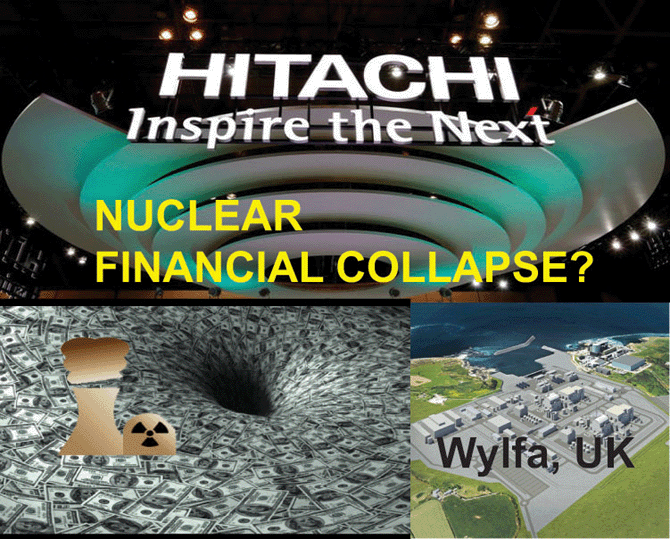
Hitachi to Cease Work on Nuclear Power Plant in North Wales, NYT, Stanley Reed, Jan. 17, 2019, Hitachi said on Thursday that it was suspending work on a 15 billion pound, or $19.3 billion, nuclear power project in North Wales after failing to agree on financial terms with the British and Japanese governments.
“The decision was made from the viewpoint of Hitachi’s economic rationality as a private enterprise,” the company, based in Japan, said.
Ben Russell, a spokesman for Hitachi’s British venture, Horizon Nuclear Power, said that discussions with the governments would continue but that its staff, currently around 300 people, would be cut to “a minimal handful.”
Hitachi will also stop planning work on a second project, in Oldbury, England. The company said it planned to take a write-off of 300 billion yen, or $2.75 billion, on the projects.
The decision by Hitachi is a blow to the British government, which is betting heavily on nuclear installations to help meet the country’s electric power needs in the coming decades.
The big question is whether Hitachi’s move will be a death knell for Britain’s campaign to build nuclear plants, which so far has resulted in only one project under construction.
While there are signs that the government is rethinking its energy policy, it was willing to go a long way toward trying to keep Hitachi on board.
In a statement to Parliament on Thursday, Greg Clark, the secretary of state for business and energy, said the government had been willing to consider providing one-third of the equity financing for the project and to take on all of the construction debt. When Hitachi continued to balk, Mr. Clark said, “I was not prepared to ask the taxpayer to take on a larger share.”
…….For Hitachi, though, the announcement could mark the end of a long and expensive saga. The company acquired the Horizon sites from two German utilities in 2012 for £697 million, or about $900 million, and wound up spending around £2 billion in total on design approvals, staff and other matters. It has been hiring apprentices, who have been training at a technical college on the island and going to Spain and Japan for work experience. At times in recent months more than 100 archaeologists were on the site, excavating and recording ancient structures that the construction would have destroyed.
Hitachi hoped Britain would prove to be an international showcase for its reactor designs. Ultimately, the company lost patience with the high level of spending required to land such a project there.
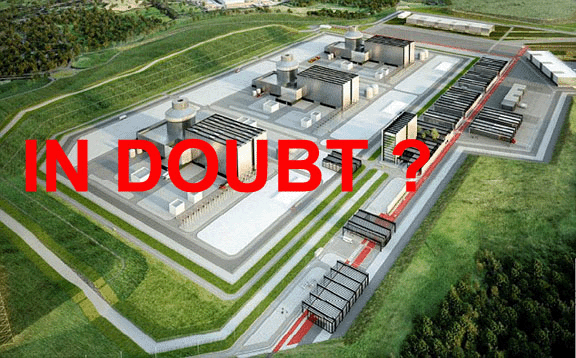
Hitachi set to suspend work on £16bn reactor, leaving Hinkley Point as the only new UK plant still being built. Japanese firm Hitachi is set to cancel a £16 billion nuclear power station in Wales, leaving the long-term future of Britain’s energy sector in jeopardy.
While no formal decision has yet been made, the Nikkei newspaper has reported that an impasse in months-long talks between the company, London and Toyko on financing is expected to result in the flagship Wylfa project being axed at a Hitachi board this week.
The company has already ploughed nearly £2 billion into the project, yet has struggled to attract investors, “even though (the) UK government may have promised as much as two thirds of the build cost” says Unearthed, a “generous largesse on behalf of UK taxpayers, not offered to any other energy projects”.
“Withdrawal by Hitachi would be a major blow to the UK’s plans to replace dirty coal and ageing reactors with new nuclear power plants, and heap pressure on ministers to consider other large-scale alternatives such as offshore windfarms,” says The Guardian, adding it would “leave Britain’s ambitions for a nuclear renaissance in tatters”
……. the assumptions which underpinned the old policy now look laughably wrong”, says the Financial Times.
“The costs of all forms of energy (apart from nuclear) have fallen dramatically and there is no shortage of supply. Electricity demand is down thanks to efficiency gains and new technology. The contract for the first new nuclear station being built at Hinkley Point in Somerset, which enjoys a guaranteed index-linked price for 35 years from the moment the plant is commissioned, looks exorbitant” says the paper. …….https://www.theweek.co.uk/98952/britain-s-nuclear-energy-future-in-jeopardy
Nuclear power is too dangerous for use as an energy source. Take it from the guy who chaired a nuclear commission under Obama. Slate By MIKE PESCA 15 Jan 19Listen to The Gist via Apple Podcasts, Overcast, Spotify, Stitcher, or Google Play.
On The Gist, ’twas an eventful news day (William Barr, opioid fatality statistics, Brexit … ), but Mike’s got a big Spiel to fry.
After the Shutdown: Oyster Creek Nuclear Generating Station Oyster Creek is done producing nuclear energy. Now comes the hard part: cleaning up five decades of radioactive waste. New Jersey Monthly,ByIan T. Shearn | | January 14, 2019
“………A CHANGE IN PLANS
Shortly after the shutdown, plant employees began the process of cooling down the reactor and removing all nuclear fuel for storage in the plant’s used-fuel pool, a bath of highly purified, chemically balanced, fresh water. The 40-foot-deep pool—with reinforced concrete walls 2-feet thick—contains 2,430 fuel assemblies, more than half of the spent fuel that has accumulated over five decades.
Exelon estimated decommissioning would take 60 years. Its method, a process known as SAFSTOR, includes waiting for the radiation—both in the fuel pool and the reactor—to diminish naturally over decades, reducing the contamination risk for workers dismantling the facility. That plan changed dramatically last summer when Exelon reached an agreement to sell the plant to Holtec International, which has a technology campus in Camden, and proposes to complete the task in less than eight years by expediting the transfer of the spent fuel from the pool to dry storage casks before its radiation has appreciably decayed. Holtec and Exelon have asked the U.S. Nuclear Regulatory Commission for an expedited approval of the sale by May 1,prompting concern among environmentalists.
“What’s the big hurry?” asks Janet Tauro, board chair of Clean Water Action NJ. “Holtec may be the best thing in the world, but we’re talking about 1.7 million pounds of nuclear waste.” Lacey Township, the Sierra Club and Concerned Citizens of Lacey have asked the NRC to hold a public hearing. Tauro and Clean Water Action New Jersey have asked the state attorney general for a review of the Exelon/Holtec deal.
“The NRC will try to complete a review of the application by May 1,” says NRC spokesman Neil Sheehan.“But we have made it clear to Exelon and Holtec that achieving that will be contingent upon us receiving the information we need.” That could include information about technical aspects of the decommissioning and adequacy of funding for the project.
Exelon and Holtec officials are nonetheless optimistic the deal will be approved on their timetable. Soon, the nuclear license and the 700-acre property would be transferred to Holtec—along with control of a nearly $1 billion decommissioning trust fund generated by utility ratepayers over decades. Holtec would assume all liability for the spent nuclear fuel—and any potential accidents.
Jeff Tittel, director of the New Jersey Sierra Club, says he’s fine with the expedited decommissioning schedule. “It’s very doable and it’s been done many times throughout the country,” he notes. But he would like to see the storage site for the nuclear waste elevated and upgraded to withstand potential flooding or a terrorist attack. According to an AP report, the Sierra Club and several community groups also say the $1 billion fund is insufficient for cleanup and storage.
Tittel is “most concerned,” however, about the transfer of Oyster Creek’s ownership from Exelon, an industry behemoth with deep pockets, to Holtec, a relatively small limited-liability company, which will subcontract the work to an even smaller subsidiary. “If there is some kind of accident, there will be no one to hold accountable,” he says. …….
What’s in it for Holtec? The company would, in effect, hire itself and its subsidiary to clean up the site by drawing fees from the decommissioning fund. Holtec also would purchase its own storage casks for the cleanup…..
Holtec’s decommissioning plan “is like burying a body without an autopsy,” says Paul Gunter, policy analyst and nuclear-reactor watchdog.
Gunter is also alarmed by Holtec’s partnership for the decommissioning work. SNC-Lavalin, Gunter says, currently faces federal corruption charges in Canada. Equally disturbing, he says, the company is “barred from doing any contractual work with the World Bank until 2023—again because of global corruption.”
SNC-Lavalin has had a legal cloud over its head since 2015 (the same year it began collaborating with Holtec) when allegations surfaced that former employees paid $150 million in bribes to officials in Libya to influence government policy and win contracts. …..And in May, Canadian authorities filed charges against SNC-Lavalin after a multiyear probe related to illegal political contributions.
“Is this the company we want to be handling a $1 billion trust fund?” asks Gunter……..
The decommissioning project is not the only joint venture between Holtec and SNC-Lavalin. The two companies are also collaborating on the design and production of a small, nuclear and modular reactor, called SMR-160, at Holtec’s Technology Campus in Camden. The reactor is planned for operation by 2026.
Last February, Holtec signed an agreement in Camden that calls for the state-run nuclear operator in Ukraine to adopt the SMR-160 technology to meet its energy needs. Shortly after, Holtec announced that Ukraine may also become a manufacturing hub for SMR-160 components.










 Antinuclear